1193
MIRRORED VEDIC VERTICALLY AND CROSSWISE
MULTIPLICATION TECHNIQUE (MVVCMT): LONG
INTEGER MULTIPLICATION ALGORITHM
EVON M. O. ABU-TAIEH, PHD
Faculty of Information System, Jordan University-Aqaba-Jordan E-mail: [email protected]
ABSTRACT
The paper presents Mirrored Vedic Vertically and Crosswise Multiplication Technique (MVVCMT) which is an algorithm based on Vedic Vertically and Crosswise Multiplication Technique. Vedic Vertically and Crosswise Multiplication Technique is an ancient Indian technique used to shorten the process of mental multiplication especially for big numbers. In India, the multiplication technique is still taught to kids to enhance their skills in mental multiplication. The proposed algorithm in this research was inspired by this
ancient yet practical, easy to understand and apply multiplication technique. Vedic Vertically and
Crosswise Multiplication Technique was rediscovered in 1965 by Swami Bharati Krishna Tirthaji in his
book Vedic Mathematics. The proposed algorithmruns with only 100 multiplications rather than n2 based
number of multiplications. In this paper, the first section explains the Vedic Vertically and Crosswise
Multiplication Technique with and example and algorithm. Then the paper presents a hands-on example to show the simplicity of the original technique. Next, the paper presents the proposed algorithm name
"Mirrored Vedic Vertically and Crosswise Multiplication Technique" which is dubbed (MVVCMT).
Keywords: Vedic mathematics; Multiplication Technique; complex numbers; Complex multiplication.
1 INTRODUCTION
Multiplying two n-digits numbers is an open question in computer science. Long integer multiplication is an essential ingredient in public key cryptography methods RSA and Diffie & Helman, and ElGamel algorithms [1], [2], [3], and [4] respectively. Public key cryptosystems allows message encryption and appending unforgeable digital signature. "The RSA public-key cryptosystem is based on the dramatic difference between the ease of finding large prime numbers and the difficulty of factoring the product of two large prime numbers"[5]. Furthermore, "In order to achieve security with the RSA cryptosystem, however, it is advisable to work with integers that are several hundred bits long, to resist possible advances in the art of factoring" as stated by the same source. Long Numbers that have more than 15 digits are hard to multiply in fact computers round the numbers to the closest digit. For example, 999,999,999,999,999,999 is rounded to 999,999,999,999,999,000 hence, when multiplied the product of multiplication is not accurate.
Accuracy is needed especially when dealing with numbers that pertains to ciphering applications. Another problem with multiplying long numbers is time; such multiplication takes a long time. A third problem is storage space, just imaging carrying out such a task manually. Furthermore, many used different algorithms to overcome these problems: Schoolbook long multiplication with complexity O(n2) [6], Karatsuba algorithm with
complexity O(n1.585) according to [7], 3-way
Toom–Cook multiplication with complexity
O(n1.465), k-way Toom–Cook multiplication with
complexity O(nlog (2k− 1)/logk), Mixed-level Toom–
Cook with complexity O(n 2√2logn log n) according
to [8], Schönhage–Strassen algorithm with complexity O(n*log(n)*log(log(n))) according to [9] and [10], Fürer's algorithm with complexity
O(nlogn2O(log* n)) according to [11]. In summary
1194 In this paper section 2 will discussed the complexities of long integer multiplication algorithms: Karatsuba, 3-way Toom–Cook, k-way Toom–Cook, Mixed-level Toom–Cook, Schönhage–Strassen algorithm, and Fürer's algorithm. The paper then shows the Vedic Vertically and Crosswise Multiplication Technique, and will explain the technique using a hands-on example and suggested an algorithm, in section 3 and section 4 respectively. Then the paper will present the suggested and inspired algorithm named MVVCMT, with an algorithm and example in section 5 and section 6. The results of the research are discussed in section 7.
2 LONG INTEGERE MULTIPLICATION
ALGORITHMS
Multiplication algorithms tried to solve the multiplication operation efficiency: Karatsuba, 3-way Toom–Cook, k-way Toom–Cook, Mixed-level Toom–Cook, Schönhage–Strassen algorithm, and Fürer's algorithm. In the next paragraphs these algorithms will be discussed.
The traditional schoolboy multiplication algorithm (classical multiplication algorithm), shown in figure 1, has the running time of O (n2) and needs a storage (memory) of at least nXn matrix where n is the number of digits in the two integers. The algorithm is carried out by multiplying each digit of the multiplicand by each digit of the multiplier and then adding up all the properly shifted results.
Karatsuba algorithm with complexity
O(n1.585) was discovered in 1962 by Anatolii
Alexeevitch Karatsuba [12] and [13] the idea is to reduce multiplication operation in a 2-digits numbers base-m from 4 operations to 3 operations, is basically the following:
Suppose the P & Q as follows: P1*M+P2 and Q1*M+Q2 to calculate their multiplication:
1. Compute Result1 = P1*Q1 2. Compute Results2= P1*Q2
3. Compute Result3 =(P1+P2) *(Q1+Q2) 4. Compute Result4=Result3-Result1-Result2
5. Computer Result1 * m2+Result4 * m + Result2
The algorithm used 1 multiplication in the first step, and another multiplication in the second step. In the third step the algorithm consumed one multiplication and 2 additions operations. In the fourth step the algorithm consumed two subtraction operations. And in the final step two multiplications operations and two addition operations but they are just to place in the right index. Hence, the reduction of three multiplications rather than four multiplications, the improvement factor is 4:3. Karatsuba Multiplication
Algorithm later named divide and conquer
algorithm, shown in Figure (2). Another improvement is Toom-Cook algorithm which based on the work of Karatsuba algorithm claimed to a generalization of Karatsuba algorithm. Toom-Cook was developed by Andrei Toom and Stephen Cook. The improvement factor stated is 9:5. Toom-Cook is composed of five steps: Splitting, Evaluation, Pointwise multiplication, Interpolation and Recompositing as described by [14]. Bothe Karatsuba and Toom-Cook use Divide and conquer technique. Hence, preprocessing overheads, as explained in the following quote "Algorithms such as FFT and Toom-Cook have lower algorithm complexity. However, because of the preprocessing overheads such as the divide and conquer, evaluation, and interpolation, the operating cost of these algorithms is actually much higher, making them useful only when the integers are extremely large. Consequently, only classical and Karatsuba multiplication algorithms and their combination are being used in current cryptosystem. This is especially true after considering circumstances such as memory constraints and the practical finite field size. "[15]
multiply(a[1..p], b[1..q], base) // Operands containing rightmost digits at index 1 product = [1..p+q] //Allocate space for result
for b_i = 1 to q // for all digits in b carry = 0
for a_i = 1 to p //for all digits in a product[a_i + b_i - 1] += carry + a[a_i] * b[b_i] carry = product[a_i + b_i - 1] / base
product[a_i + b_i - 1] = product[a_i + b_i - 1] mod base
product[b_i + p] += carry // last digit comes from final carry return product
1195 "Cook showed how the actions of this machine could be simulated by an extremely complicated and long, but still polynomial, Boolean formula. This Boolean formula would be true if and only if the program which was being run by the Turing machine produced a “yes” answer for its input" [16] and [17].
As for the Schönhage–Strassen algorithm with complexity O(n*log(n)*log(log(n))) according to [9]. The two numbers multiplied are treated as two separate matrices of one column and 2*n rows. The two matrices are multiplied with FFT matrix of base 2*n using w8 and the modulo integer Integer, the result is two matrices that are multiplied by each other: element by element. The result is one matrix that must go through Invers FFT. Again, the result is recombined using the carry operation.
Fürer's algorithm with complexity O
(nlogn2O(log* n)) according to [11] is faster the
Schönhage–Strassen algorithm. Furer (2007) states that his algorithm run very much like Schönhage–Strassen algorithm with two exceptions: the ring of integers modulo used, and FFT is divided "more evenly". Another fact stated by Furer [11] is "All known methods for integer multiplication (except the trivial school method) are based on some version of the Chinese Remainder Theorem". The Chinese Remainder Theorem states "There are certain things whose number is unknown. If we count them by threes, we have two left over; by fives, we have three left over; and by sevens, two are left over. How many things are there?" as [18] by a chines mathematician (Sun Zi) in the third century. The Chinese remainder theorem was finally stated and proved in its full generality by L. Euler in 1734[5]. The Chinese Remainder Theorem was stated formally as follows: let p, q be co-prime then the
system of equations has a unique solution for x
modulo pq. The same thing goes if we have more
than two equations.
x ≡ a (mod p) x ≡ b (mod q)
Looking back at Multiplication algorithms who tried to solve the long integer multiplication operation efficiency: Karatsuba algorithm, 3-way Toom–Cook, k-way Toom– Cook, Mixed-level Toom–Cook, Schönhage– Strassen algorithm, and Fürer's algorithm; and comparing their complexity with the traditional schoolboy, figure (1) multiplication algorithm O(n2) one can conclude the following: Fürer's algorithm is the least complex, followed by Schönhage–Strassen algorithm, then Toom-Cook versions, then Karatsuba algorithm. The constant quests in all the algorithms are: accuracy, speed and storage. All quested elements are reflected in the word algorithms complexity.
3 VERTICALLY AND CROSSWISE
MULTIPLICATION TECHNIQUE (VCMT)
Vertically and Crosswise Multiplication Technique is an ancient Indian technique popularized by Swami Bharati Krishna Tirthaji’s
Vedic Mathematics, published posthumously in
1965. The book can be found on the website [19]. Multiplying two n-digit integer numbers using VCMT entails the work shown in (1)
∑ ∑ ……….(1)
procedure karatsuba(num1, num2) if (num1 < 10) or (num2 < 10) return num1*num2
/* calculates the size of the numbers */
m = max(size_base10(num1), size_base10(num2)) m2 = m/2
/* split the digit sequences about the middle */ high1, low1 = split_at(num1, m2)
high2, low2 = split_at(num2, m2)
/* 3 calls made to numbers approximately half the size */ z0 = karatsuba(low1,low2)
z1 = karatsuba((low1+high1),(low2+high2)) z2 = karatsuba(high1,high2)
[image:3.612.85.526.57.264.2]1196 When multiplying two 4-digit numbers the multiplier named P and made up of digits P1P2P3P4 and the multiplicand Q is made up of four digits Q1Q2Q3Q4, where the first digit in each P and Q are the highest order digit.
Table (1): A trace table of the operations and expected results of 4-digits P and Q.
i+j Ai+j Multiplication
operations
Addition operations
1 C2 0
2 P1 Q1+C3 1 1
3 P1Q2+P2Q1+C4 2 2
4 P1Q3+Q1P3+P2Q2+C5 3 3
5 P1Q4+Q1P4+P2Q3+Q2P3+C6 4 4
6 P2Q4+Q2P4+P3Q3+C7 3 3
7 P3Q4+Q3P4+C8 2 2
8 P4Q4 1 0
Total Number of Operations 16 15
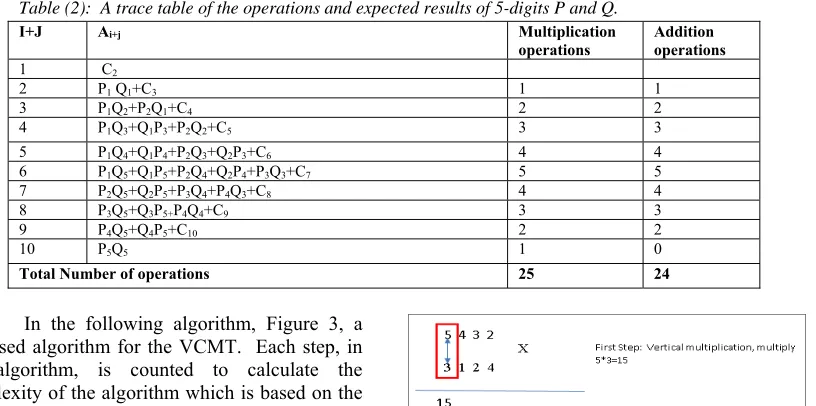
Pi is the ith digit in the multiplier, i=1...n. and Qj is the jth digit in the multiplicand, j=1..n. The letter C is the carry from the carry operation. The 8th digit of the result is product of multiplying P4Q4 which produces 8th digit and the carry number C8. The 7th digit is the result of P3Q4+Q3P4+C8and produces the 7th carry. The 6th digit is the result of P2Q4+Q2P4+P3Q3+C7 and produces the 6th carry. The 5th digit is the result of P1Q4+Q1P4+P2Q3+Q2P3+C6 and produces the 5th carry. The 4th digit is the result of P1Q3+Q1P3+P2Q2+C5 and produces the 4th carry. The 3ed digit is the result of P1Q2+P2Q1+C4and produces the 3ed carry. The 2ed digit is the result of P1 Q1+C3 and produces the 2ed carry. The first digit is the 2ed carry. The whole operation which is reflected in table 1 including 16 multiplication operations and 15 addition operations. The addition operations are: 10 addition operations and 5 addition operations for the carry. Therefore, when multiplying the two 4-digit numbers the following results table 1 is expected:
Same thing happens when multiply two 5-digits integer numbers P and Q as shown in digits' form P is P1P2P3P4P5 and Q is Q1Q2Q3Q4Q5. , where the first digit in each P and Q are the highest order digit. Pi is the ith digit in the multiplier, i=1...n. And Qj is the jth digit in the multiplicand, j=1..n. The letter C is the carry from the carry operation. The 10th digit of the result is product of multiplying P5Q5 which produces 10th digit and the carry number C10. The 9th digit of the result is product of multiplying P4Q5+Q4P5+C10 which produces 9th digit and the carry number C9.
1197
Table (2): A trace table of the operations and expected results of 5-digits P and Q.
I+J Ai+j Multiplication
operations
Addition operations
1 C2
2 P1 Q1+C3 1 1
3 P1Q2+P2Q1+C4 2 2
4 P1Q3+Q1P3+P2Q2+C5 3 3
5 P1Q4+Q1P4+P2Q3+Q2P3+C6 4 4
6 P1Q5+Q1P5+P2Q4+Q2P4+P3Q3+C7 5 5
7 P2Q5+Q2P5+P3Q4+P4Q3+C8 4 4
8 P3Q5+Q3P5+P4Q4+C9 3 3
9 P4Q5+Q4P5+C10 2 2
10 P5Q5 1 0
Total Number of operations 25 24
In the following algorithm, Figure 3, a proposed algorithm for the VCMT. Each step, in the algorithm, is counted to calculate the complexity of the algorithm which is based on the VCMT. The running time of the algorithm is
n*n+2n hence the running time is almost n2.
Algorithm Running
time For i=n down to 1
For j=n down to 1 Product [j + i ]=(Pi*Qj)+ Product [j + i]
Next j Next i
For i=2n down to 1 Result[i]=rightmost digit(product[i])
Carry[i]=left (digits of product[i]) Product[i-1] = product[i-1] + carry[i]
Next i
n n2
[image:5.612.114.522.95.298.2]2n
Figure 3: A suggested algorithm for VCMT with number of operations.
4 VEDIC MULTIPLICATION EXAMPLE
To visually enhance the understanding of Vertically and Crosswise Multiplication Technique (VCMT) the following example is given shown in the figures below. Multiplying a 4-digit number (5432) by 4-digit multiplicand (3124). The 4-digit multiplier named P is composed of 4 digits P1P2P3P4, the multiplicand Q is respectively made of 4-digits Q1Q2Q3Q4. P1 is the highest digit in P
The first step is set the window to 1 which entails taking the highest first digit from multiplier and multiplicand in this case (5, 3) and multiply them to produce 15. The 15 is stored in the answer line as shown in the Figure 4 below.
Figure 4: Step #1 of VCMT vertical multiplication.
[image:5.612.88.298.329.491.2]Next, set the window to 2, choose the highest two digits and crisscross multiplication, see Figure 5. Multiply 4 by 3 and 5 by 1 and add the result: 5*1+4*3=17. The result is divided to two parts: a lowest digit is put in the answer line while the upper digit(s) are added to the answer line. In this example 7 is put on the answer line and the 1 is added to 15 to become 16.
Figure 5: Step #2 of VCMT crisscross operation.
[image:5.612.316.520.415.507.2]The third step: the window is increased by 1 to become 3. A crisscross operation is carried out by multiplying P1*Q3 (5*2) and multiplying P3*Q1 (3*3) and a vertical operation is carried out by multiplying P2*Q2 (4*1). And add all the results (10+9+4) which results 23. The 23 is again split where the lowest digit is put in the answer line and the carry=2 is added to previously mentioned (7) in the answer line to become 9, see Figure 6.
[image:5.612.317.519.638.711.2]1198 The fourth step, the window is increased by 1 to become 4. A crisscross operation is carried out by: multiply P1*Q4 (5*4), P2*Q3 (4*4), P3*Q2(3*1), and P4*Q1 (2*3) which results to (20+8+3+6) which equals 37. The 37 is again split to answer and carry. The lowest digit (7) is put on the answer line and the 3 is added to previously produced 3 to become 6, Figure 7.
Figure 7: Step #4 of VCMT crisscross operation with window size 4.
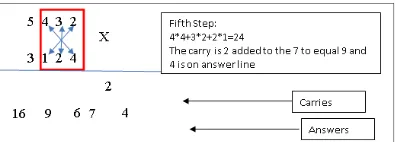
[image:6.612.90.295.197.288.2]In the fifth step and since the window reached the limit 4, the window is decreased by 1 to 3. A crisscross operation is carried out between P2*Q4 (4*4) and P4*Q2 (2*1). A vertical operation is carried out between P3*Q3 (3*2). The result (16+6+2) is 24. The lowest digit 4 is put on the answer line and the highest digit 2 is added to the previously produced 7 to become 9, Figure 8.
Figure 8: Step #5 of VCMT crisscross operation with window size 3.
[image:6.612.93.291.390.461.2]The sixth step, the window is reduced by 1 to become two and a crisscross operation is carried out: P3*Q4 (3*4) and P4*Q3 (2*2). The rest is (12+4) which is 16, again the result is spilt to answer and carry. The lowest digit 6 is put on the answer line and the carry (1) is added to the previously produced 4 to become 5, see Figure 9.
Figure 9: Step #6 of VCMT crisscross operation with window size 2.
The seventh step, the window is reduced by 1 to become 1. And vertical operation is carried out P4*Q4 which is (2*4) the result is 8 and is put on the answer line, figure 10. By reading
what is on the answer line 16969568 is the answer of the multiplication operation.
Figure 10: Step #7 of VCMT crisscross operation with window size 1.
The example above intended to visually enhance the understanding of Vertically and Crosswise Multiplication Technique (VCMT). The example explained each step and the variation of the window size and the uses of the window. Figures 3 to figure 10 reflected visually the steps to explain the process of the Vertically and Crosswise Multiplication Technique (VCMT).
Looking back at the example above and counting the number of multiplications and additions we fine the following: In the first step there was one multiplication operation. In the second step there were two multiplication operations and one addition operation. In the third step there were three multiplication operations and two addition operations. In the fourth step, there were four multiplication operations and three addition operations. In the fifth step there were three multiplication operations and two addition operations. In the sixth step there were two multiplication operations and one addition operation. In the seventh step there was only one multiplication operation. One can conclude that the number of multiplication operations is 16 and the addition operations is 9 while there is an addition operation for the carry which is 7 addition operations which makes the total of the addition operation also 16. The summery of all operations in a 4-digit number multiplied by 4-digit number is in table1.
[image:6.612.91.291.581.651.2]1199
5 SUGGESTED ALGORITHM:
MIRRORED VEDIC VERTICALLY
AND CROSSWISE MULTIPLICATION TECHNIQUE (MVVCMT)
Mirrored Vedic Vertically and Crosswise Multiplication Technique (MVVCMT) is an algorithm that reduces the number of multiplications operation in long integer multiplication to 100 simple multiplication operations. The algorithm works as follows:
Scan both P & Q (multiplier and multiplicand) and produce the frequency of each digit and the index of each digit. The result is shown like in figure 12 and figure 13.
Produce the result, carries and answer. The following section will explain the algorithm with the two major steps in sections 6.1 and section 6.2.
6 MVVCMT
MVVCMT assumes that both multiplier and multiplicand are equal in number of digits and
treats both multiplier and multiplicand as an array of digits rather than decimal number. The most significant digit is stored in an array with index 1 and the least significant digit is stored in the array with index n. Hence, the multiplier is a one-
dimensional array of digits with size n. The
multiplicand is one-dimensional array of digits with size n. The product of both multiplier and
multiplicand are stored as individual digits in one-dimensional array with the size of 2n.
MVVCMT has two parts: the first part named
Scan part, the second part is the multiplication lookup part. The Scan part has an input of both
multiplier (P) and multiplicand (Q). The Scan part
will produce two matrices: a matrix for P and a Matrix for Q. The matrices include each digit in the P or Q with the frequency of each digit and indices of each digit. The second part of MVVCMT is the multiplication lookup part which will carry out the multiplication process. Both parts are explained in the next two sections.
Frequencey_index(P,Q) Time
Q_Frequencey=0 P_Frequencey=0
For i 1 to length[P] ' (or Q)
P_Frequencey (P[i])= P_Frequencey (P[i])+1 Q_Frequencey (P[i])= Q_Frequencey (Q[i])+1 P_Index(P_Frequencey (P[i]))=i
Q_Index(Q_Frequencey (Q[i]))=i Next i
[image:7.612.116.482.373.472.2]1 1 n n-1 n-1 n-1 n-1
Figure 11: The first part of MVVCMT is called Frequencey_index(P,Q).
6.1.Scan Part: Frequencey_index(P,Q)
The scan part of the algorithm, named Frequencey_index(P,Q), produces two matrices:
the first matrix is a one dimensional array that holds the frequency of each digit in P and Q. The suggested scan algorithm Frequencey_index(P,Q)
is shown in Figure 11.
The Frequencey_index(P,Q) produces the
matrix shown in Figure 12. The first part of the matrix reflects the frequency of each digit in P. The second part shows the index /location/order of the digit in P. To further explain assume that P is
the following 70-digit number:
62642001874012850961516549482644422193020 37178623509019111660653946049. As can be seen in the matrix (Figure 12) there are 10 zeros and 10 ones and 8 twos in P. The second matrix is the one that keeps the location/position/index of the digit. The positions 38,42,49,64 in P are held
1200 P digits
P
Frequency P digits Indices of each digit in P
0 10 0 6 7 12 17 39 41 51 53 61 68
1 10 1 8 13 20 22 36 44 54 56 57 58
2 8 2 2 5 14 29 34 35 40 48
3 4 3 38 42 49 64
4 9 4 4 11 25 27 31 32 33 66 69
5 5 5 16 21 24 50 63
6 10 6 1 3 19 23 30 47 59 60 62 67
7 3 7 10 43 45
8 4 8 9 15 28 46
[image:8.612.90.531.56.281.2]9 7 9 18 26 37 52 55 65 70
Figure 12: A matrix that shows each digit in P with the frequency of each digit and the indices of digit.
Assume Q is the following 70 digits'
number:3398717423028438554530123627613875835633986495969597423490929302771479. The second matrix is for Q, the digit, 0, has frequency of 4 and the digit 0 is located in index 11,22,58,63.
Again the digit 1 has frequency of 4 and is located in 6, 23, 30 and 67. The scan part of the suggested algorithm has running time of n, where n is the length of P or Q.
Q
digits Q Frequency
Q
digits Indices of each digit in Q
0 4 0 11 22 58 63
1 4 1 6 23 30 67
2 7 2 9 12 24 27 54 60 64
3 12 3 1 2 10 15 21 25 31 36 39 40 55 62
4 7 4 8 14 19 44 53 56 68
5 7 5 17 18 20 34 37 46 50
6 5 6 26 29 38 43 48
7 8 7 5 7 28 33 52 65 66 69
8 6 8 4 13 16 32 35 42
[image:8.612.90.519.339.491.2]9 10 9 3 41 45 47 49 51 57 59 61 70
Figure 13: A matrix that shows each digit in P with the frequency of each digit and the indices of digit.
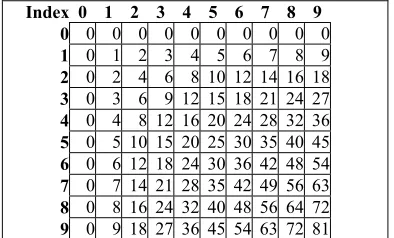
Create multiplication table like (figure 14), the purpose of the multiplication table is to be used as a lookup table. The use of the lookup table will reduce the multiplication operations from n2 in
schoolboy multiplication to a constant number 100 multiplication in the worst-case scenario. The use of such table is shown in the figure 15 of the suggested algorithm.
Index 0 1 2 3 4 5 6 7 8 9
0 0 0 0 0 0 0 0 0 0 0
1 0 1 2 3 4 5 6 7 8 9
2 0 2 4 6 8 10 12 14 16 18
[image:8.612.95.292.580.699.2]3 0 3 6 9 12 15 18 21 24 27 4 0 4 8 12 16 20 24 28 32 36 5 0 5 10 15 20 25 30 35 40 45 6 0 6 12 18 24 30 36 42 48 54 7 0 7 14 21 28 35 42 49 56 63 8 0 8 16 24 32 40 48 56 64 72 9 0 9 18 27 36 45 54 63 72 81
Figure 14: A standard multiplication table.
6.2.The Multiplication Process Part
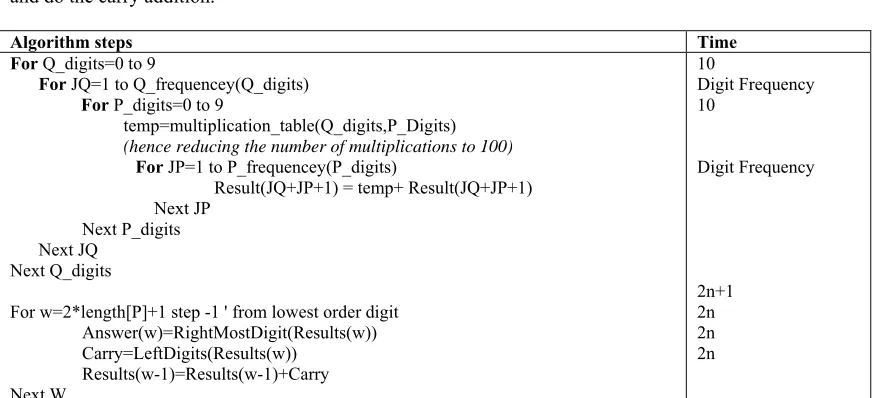
1201 multiplication. In the same token, reducing the number of multiplication to only 100 multiplications. Hence, reducing the look to n
rather than n2. The second part of the algorithm merely present the answer by calculating the carry and do the carry addition.
Algorithm steps Time
For Q_digits=0 to 9
For JQ=1 to Q_frequencey(Q_digits) For P_digits=0 to 9
temp=multiplication_table(Q_digits,P_Digits) (hence reducing the number of multiplications to 100)
For JP=1 to P_frequencey(P_digits)
Result(JQ+JP+1) = temp+ Result(JQ+JP+1) Next JP
Next P_digits Next JQ
Next Q_digits
For w=2*length[P]+1 step -1 ' from lowest order digit Answer(w)=RightMostDigit(Results(w)) Carry=LeftDigits(Results(w))
Results(w-1)=Results(w-1)+Carry Next W
10
Digit Frequency 10
Digit Frequency
[image:9.612.85.522.159.358.2]2n+1 2n 2n 2n
Figure 15: The second part of MVVCMT.
As can be seen in the previous the number of multiplication operations is reduced to 100 multiplications. The lookup operations of the multiplication operations are 100*P_ Digit Frequency* Q_Digit Frequency. The frequency of any particular digit is worth discussing here: P and Q are made of digits from 0 to 9. The frequency of any digit in P or Q must always be equal or less than n. If the frequency of certain digit is n this
implies that the other 9 digits have frequency equal to 0. Hence, using the frequency & the index of each digit to look the multiplication result reduces the number of multiplication operation to only 100. The number of additions is reduced to 2n
where n is length of P or Q. The carry operation is also 2n where n is number of digits in P or Q.
Furthermore, one can state the following regarding the three basic operations:
Number of multiplication operation =100 Number of carry operations =2*n+1
Number of additions =2*n +10*digit frequency multiplier*10*digit frequency multiplicand.
Again, digit frequency is n in worst case
which means the other 9 digits will have 0 frequencies. Regarding the storage problem (memory) the suggested algorithm needs for storage is matrix 10X10 to hold the multiplication table. Frequency matrix with 10 rows and n
columns (worst case). Two arrays with each one row and length 2n+1 to store the answer and carry
results. Hence, the storage needs are minimal, and any basic computer handles such requirements.
Regarding accuracy, the algorithm never round results as was shown previously in the introduction section. Where computers round numbers more than 15 digits long, this algorithm can handle numbers up to 200 digits using Microsoft Excel. Furthermore, numbers being added or multiplied are kept to basic digits 0-9 and additions with carry are used on small numbers.
7 RESULTS AND DISCUSSION
The suggested algorithm MVVCMT is
1202 unlike Karatsuba's algorithm, Schönhage–Strassen
algorithm, Toom-Cook, and schoolboy algorithm. The MVVCMT algorithm needs NOT to preprocess the numbers like Karatsuba's algorithm
there are no: Splitting, Evaluation, Pointwise multiplication, Interpolation and Recompositing as in Toom-Cook. Further, MVVCMT needs no two separate matrices like in Schönhage–Strassen algorithm. Nor does MVCCMT needs a nXn Matrix like the traditional schoolboy multiplication algorithm.
8 CONCLUSION
Long integer multiplication has many applications and uses. Long integer multiplication is an essential ingredient in public key cryptosystems. Many public key crypto systems require such long integer multiplication algorithms that are fast, precise and require less memory. "Multiplying polynomials with real or complex coefficients is a major area where long integer multiplication is very useful. Long integer multiplication is used extensively for finding large prime numbers. Another application is the computation of billions of digits of π to study patterns. A very practical application is the testing computational hardware" stated by[11].
This paper suggested an algorithm Mirrored Vedic Vertically and Crosswise Multiplication Technique (MVVCMT) which inspired by Vedic Vertically and Crosswise Multiplication Technique. The algorithm is to deal with multiplying long integers with digits count 2 to 200 digits. The 200 digit integer multiplication is recommended by [1] as they stated in their paper " We recommend that n be about 200 digits long. Longer or shorter lengths can be used depending on the relative importance of encryption speed and security in the application at hand. An 80-digit n provides moderate security against an attack using current technology; using 200 digits provides a margin of safety against future developments" which was reflected in in the work [20]. The basic requirements for such algorithm are speed, accuracy and storage space (memory). The paper discussed the complexities of Karatsuba, 3-way Toom–Cook, k-way Toom– Cook, Mixed-level Toom–Cook, Schönhage– Strassen algorithm, and Fürer's algorithm. The paper showed the Vedic Vertically and Crosswise Multiplication Technique, and explained the technique using a hands-on example and suggested an algorithm. Then the paper presented (MVVCMT), with an algorithm and example. MVVCMT has advantage over other algorithms since it reduces the number of digit multiplication to only 100 operations regardless of the number of
the digits of P & Q. MVVCMT also has the running time of n2 yet the number of multiplications and additions are reduced: the number of carry operations is reduced to 2n and the number of additions is 2*n +10*digit frequency multiplier*10*digit frequency multiplicand. Furthermore, the storage needed (memory) is 10X10 matrix, 2*n to store the multiplier and multiplicand and a 2*n array to hold the result. Each element in the previously mentioned matrices is of size one digit (0-9) hence storage space is minimal. MVVCMT is inspired by a Technique taught to children to improve their mental multiplication, where children can enjoy multiplying long integer. Hence, the algorithm is simple, easy to use, needs minimum storage and utilizes only 100 multiplication operations. MVVCMT algorithm is unlike: Karatsuba's
algorithm, Schönhage–Strassen algorithm, Toom-Cook algorithm and schoolboy algorithm. While such algorithms needed: preprocessing, Splitting, evaluation, pointwise multiplication, Interpolation, recompositing, nXn matrices. The MVVCMT algorithm reduced the number of multiplication operations and reduced the need for memory.
REFERENCES
[1] Rivest, Ronald L., Shami,r Adi, and Adleman, Leonard M. 1978. A method for obtaining digital signatures and public-key cryptosystems. Communications of the ACM, 21(2):120–126, 1978. See also U.S. Patent 4,405,829. Retrieved 20 Jun 2017 from: https://people.csail.mit.edu/rivest/Rsapaper.pdf [2] Diffie, W. and Hellman, M. E., 1976. New
directions in cryptography, Institute of Electrical and Electronics Engineers, vol. 22, no. 6, pp. 644–654, 1976. Retrieved 20 Jun
2017 From:
https://www-ee.stanford.edu/~hellman/publications/24.pdf [3] ElGamal, T. 1985. A public key cryptosystem
and a signature scheme based on discrete logarithm, in Advances in Cryptology, vol. 196 of Lecture Notes in Computer Science, pp. 10–18, 1985. Retrieved 20 Jun 2017 From: http://people.csail.mit.edu/alinush/6.857-spring-2015/papers/elgamal.pdf
[4] Pollard, J.M. Theorems on factorization and primality testing. Proc. Camb. Phil. Soc. 76 (1974), 521-528. Retrieved 20 Jun 2017 from:
http://maths-people.anu.edu.au/~brent/pd/rpb120.pdf [5] Cormen, Thomas H.; Leiserson, Charles E.;
1203 Press and McGraw-Hill. pp. 55–56. ISBN 0-262-03293-7. Retrieved 20 Jun 2017 From: http://is.ptithcm.edu.vn/~tdhuy/Programming/I ntroduction.to.Algorithms.pdf
[6] Aboud S. J. ,Abu-Taieh E. M, A. 2006. New Deterministic RSA-Factoring Algorithm, Jordan Journal of Applied Science, Volume 8, No. 1, pp. 54-66, Amman-Jordan, 2006. [7] Karatsuba A. 1995. The Complexity of
Computations. Proceedings of the Steklov Institute of Mathematics. 211: 169–183. Translation from Trudy Mat. Inst. Steklova, 211, 186–202. Accessed 21/1/2017 from http://www.ccas.ru/personal/karatsuba/divcen.p df
[8] Knuth, D. 1997. The Art of Computer Programming, Volume 2. Third Edition, Addison-Wesley. Section 4.3.3.A: Digital methods, pg.294. Retrieved 20 Jun 2017 from: http://broiler.astrometry.net/~kilian/The_Art_o
f_Computer_Programming%20-%20Vol%201.pdf
[9] Schönhage A., Strassen V., 1971. Schnelle Multiplikation großer Zahlen", Computing 7 (1971), pp. 281–292.
[10] Aho, Alfred V., Hopcroft, John E., and Ullman, Jeffrey D. 1974. The design and analysis of computer algorithms, Addison-Wesley, Reading, Massachusetts, 1974. Retrieved 20 Jun 2017, from: https://doc.lagout.org/science/0_Computer%20 Science/2_Algorithms/The%20Design%20and %20Analysis%20of%20Computer%20Algorith ms%20%5BAho%2C%20Hopcroft%20%26% 20Ullman%201974-01-11%5D.pdf
[11] Fürer, M. 2007. Faster Integer Multiplication. Proceedings of the 39th Annual ACM Symposium on Theory of Computing, San Diego, California, USA, June 11–13, 2007, pp. 55–67. Retrieved 20 Jun 2017 from: https://web.archive.org/web/20130425232048/ http://www.cse.psu.edu/~furer/Papers/mult.pdf [12] Karatsuba A. and Ofman Y. 1962.
Multiplication of Many-Digital Numbers by Automatic Computers. Proceedings of the USSR Academy of Sciences. 145: 293–294. Translation in the academic journal Physics-Doklady, 7 (1963), pp. 595–596
[13] Warren Jr., Henry S. (2013). Hacker's Delight (2 ed.). Addison Wesley - Pearson Education, Inc. ISBN 978-0-321-84268-8. Retrieved 20 Jun 2017 From: https://doc.lagout.org/security/Hackers%20Del ight.pdf
[14] Bodrato M. 2007. Towards Optimal Toom– Cook Multiplication for Univariate and Multivariate Polynomials in Characteristic 2 and 0. In WAIFI'07 proceedings, volume 4547 of LNCS, pages 116–133. June 21–22, 2007. Retrieved 20 Jun 2017 From: http://citeseerx.ist.psu.edu/viewdoc/download? doi=10.1.1.76.790&rep=rep1&type=pdf [15] Jahani, S., Samsudin, A., Subramanian,K.G.
2014. Efficient Big Integer Multiplication and Squaring Algorithms for Cryptographic Applications, Journal of Applied Mathematics, vol. 2014, Article ID 107109, 9 pages, 2014. doi:10.1155/2014/107109
[16] Weiss, M. 2014. Data Structures and algorithms analysis in C++, fourth edition, Pearson, USA. Retrieved 20 Jun 2017 from: http://iips.icci.edu.iq/images/exam/DataStructu resAndAlgorithmAnalysisInCpp_2014.pdf [17] Cook, S. 1971. The Complexity of
Theorem Proving Procedures, Proceedings of the Third Annual ACM Symposium on Theory of Computing (1971), 151–158. Retrieved 20
Jun 2017 From:
https://www.cs.toronto.edu/~sacook/homepage /1971.pdf
[18] Dence, Joseph B., Dence ,Thomas P. 1999. Elements of the Theory of Numbers . Retrieved 20 Jun 2017 From: https://books.google.jo/books?id=YiYHw7evhj kC&pg=PA156&redir_esc=y#v=onepage&q&f =false
[19] Swami Bharati Krishna Tirthaji. 1965. Vedic Mathematics. Retrieved 20 Jun 2017 from: http://www.indiadivine.org/content/files/file/40 -vedic-mathematics-by-shankaracharya-bharati-krishna-tirtha-pdf/
![Figure 2: Karatsuba Multiplication Algorithm [5].](https://thumb-us.123doks.com/thumbv2/123dok_us/8904399.956193/3.612.85.526.57.264/figure-karatsuba-multiplication-algorithm.webp)