1398
IOT MULTITASKING: DEVELOPMENT OF HYBRID
EXECUTION SERVICE ORIENTED ARCHITECTURE
(HESOA) TO REDUCE RESPONSE TIME FOR IOT
APPLICATION
1POONAM GUPTA, 2K V V SATYANARAYAN, 3D D SHAH
1 Research Scholar, Koneru Lakshmaiah Education Foundation, Vaddeswaram, Guntur, Andhra Pradesh,
India
2Professor, Koneru Lakshmaiah Education Foundation, Vaddeswaram, Guntur, Andhra Pradesh, India 3Professor, Imperial College of Engineering and Research, Pune, Maharashtra, India
E-mail: 1[email protected]
ABSTRACT
IoT solutions are formulated and accomplished to cope with distinct challenges influenced by domain-specific necessities, thus not considering issues of visibility, scalability, interoperability along with use-case independence. Consequently, they can be less principled, the vendor focused and barely replicable as any generalized design available. The conventional SOA model address the architecture design issue, as core issue with conventional SOA is, it does not look into whether existing application platforms can provide the solutions to help with the implementation of IoT as a generalized approach for numerous tasks. To upgrade the framework of existing IoT options, present research developed new hybrid execution service oriented architecturemodel as a “middleware” which identifies new principles for developing IoT architectures and supporting the interoperation of IoT solutions. In this particular work, we seek to fill this gap and additionally we suggest an architectural strategy in line with SOA that targets the reasoning behind to come up with the development of new Internet of Things ibroker, and every sensing gadget is believed being a service using a single interface as an option to traditional single-use case designs. By this new framework, we accomplished modularization, powerful resource reuse, a boost in efficiency, loosely recourse coupling. In summary, this paper focuses on multi-tasking of systematic execution of request and response with development of architecture called “Hybrid Execution Service Oriented Architecture” (HESOA).
Keywords: IoT, SOA, Request processing, hybrid model, IoT computation
1. INTRODUCTION
High demand of computation and communication in modern many decades has elevated the significance of distributed computing. A result of the heterogeneity of resources, useful resource organization is among the most key challenges in constructing distributed computer systems. The most crucial purpose of IoT is to ascertain innovative connectivity of solutions, devices along with services that transcend machine to machine communications, accommodating different protocols, areas, and applications.
The interconnection of all these "things" definitely will lead in operation automation and will eventually support innovative applications just like SCADA and Surveillance Products.
Nevertheless, for the internet of Things idea to systematically present itself, the processing requirements have to go higher than conventional scenarios that use smart devices along with evolving into devices day-to-day prevailing objects and embedding data into kinds of living conditions. Further section provides detailed need of present study.
1399 Garcia-de-Prado et. al (2017) proposed context-aware data processing and architectures still pose a challenge, in spite of being key requirements in order to get stronger IoT architectures. To face this challenge, we propose a COLLaborative ConText Aware Service Oriented Architecture (COLLECT), which facilitates both the integration of IoT heterogeneous domain context data through the use of a light message broker and easy data delivery among several agents and collaborative participants in the system making use of an enterprise service bus. But this study needs more generalized utilization as it targeting only context-aware data processing.
Further Shen et. al (2017) developed generic architecture for IoT which can connect any devices irrespective of type of sensor. This architecture supports two DIY areas: network DIY for data aggregation and application DIY for service cooperation. To connect these two DIYs, a centralized controller has been designed to provide standardized interfaces for data acquisition, organization, and storage, and to support elastic and supportive computing. But, during this research only similar protocols are considered. Hence again there is need of multiple protocol processing.
Zhu et. al (2017) provided a distributed service-oriented architecture. In this architecture, each manufacturer provides service for their own products, and data nodes keep the information collected by them. Semantic technologies are adopted to handle problems of heterogeneity and serve as the foundation to support different applications. But, only semantic topologies considered during research and this becomes specific service utilization hence, new architecture development is necessary to provide facility of independent IoT system execution.
2. RELATED WORK
Development of new hybrid architecture is a research gap identified with analysis of existing SOA framework and adoptions to it.
Leuet. al (2014) developed an IoT system skeleton and a shortest processing time (SPT) algorithm for scheduling web-based IoT messages. The accomplished reserving pattern held by a priority queue unit can properly secure the response messages through the occupied IoT receptors for each client request. But, this work is limited to web-based application only.
Zhang et al (2014) discussed how to build an Event-driven SOA infrastructure, where we can employ powerful resource facts to bring about IoT services, employ separate together with shared activities running the IoT solutions, and make use of occurrence session to put together the IoT solutions. Several uses and findings are mentioned to point out idea evidence for these kinds of event-driven SOA. But, this approach processes single request protocol only and cannot support multi protocol system.
Chen et al (2014), developed a novel adaptive filtering technique to determine the best way to combine direct trust and indirect trust feedbacks dynamically to minimize both convergence time and trust bias. The author demonstrated the potency of the suggested confidence management by having a system structure program in SOA dependent IoT techniques. But, this focuses more on data management and there is a need of request processing ability of the system where multiple protocols can be handled same time.
As per Tiburski et al (2015) middleware for IoT is actually accepted as the system which will give these essential facilities of assistance and has now turned out to be extremely essential IoT nowadays. The design associated with IoT middleware is invariably determined by a service-oriented architecture and possesses reliability prerequisite as one of its key problems. A large number of info which passes in such type of method necessitates a reliability design which provides the safeguard within the over-all system. Nevertheless, nothing within the already present SOA dependent IoT middleware solutions have identified a reliability standard you can use as a blueprint design. From this impression, this examines the significance of characterizing standard reliability design for SOA-based IoT middleware, evaluates principles and already presents work; along with it helps make factors around a set of reliability assistance to use to establish reliability design to reduce the protection risks in SOA-based IoT middleware solutions.
1400 middleware architecture represents the better adaptation to multisensor and multistream application scenarios in the IoT, which improves heterogeneous data utilization value. The data processing middleware based on SOA for the IoT establishes a solid foundation of integration and interaction for diverse networks data among heterogeneous systems in the future, which simplifies the complexity of integration process and improves reusability of components in the system.
Issarny et al (2016) explored how the service-oriented design paradigm could possibly be revisited to treat challenges presented by the IoT for the enhancement of distributed uses. The author discusses the advancement of the accommodating middleware solutions occupying the benefits of probabilistic protocols to address level, cross-paradigm interactions to handle heterogeneity, and streaming-based connections to help with the natural sensing performance introduced by the IoT.
Tiburski et al (2016) implemented only one of these services (CCP - Communication Channel Protection) which is composed of two security approaches: TLS and DTLS. Both approaches are known security protocols able to provide confidentiality, integrity, and authenticity. The implemented service was focused on protecting data transmission in an IoT middleware system (COMPaaS - Cooperative Middleware Platform as a Service) and was validated through a specific e-health scenario. The primary purpose was to examine if reliability implementations compromise, in the case of response time frame, the communication capabilities of the middleware strategy, which can be the crucial feature the e-health case. This again falls under single domain application protocol. Hence, development of middleware is necessary to handle multiple protocol requests.
Derhamy et al (2017) In their work, integrating distributed events into SOA is the basic principle. The information searching ability to real entities are segregated from their actuation ability that behaves as a base for ultra-scale along with adaptable IoT applications. The author then determines a allocated event-based IoT system base to aid IoT service formation and enable for any covering of system access complexity, where the IoT solutions are event-driven, and impedance coordinating around service working out and occurrence conversation is the pattern purpose. The coordination reason of an IoT assistance program is removed being an event structure that helps the
distributed delivery of the process with scalability. This work focuses only on event based request protocols and there is need of middleware development with semantic, application level protocol interaction facility.
Avila et al (2017) presented an introduction to the concept of SOA and its main features, making a small emphasis on safety aspects. Being a fundamental concept, the information of several options which are located in medical sector is formulated, certainly those whose mission is the health care at home; the most crucial element of these options are overall body sensor systems.
Badarinath et al (2017) presented a review of service-oriented architecture (SOA) based four-layer model for realizing IoT applications in manufacturing is proposed. Finally, a review of the state of art of IoT applications in manufacturing including shop floor automation, predictive maintenance, energy-aware manufacturing, and smart workers is presented with relevant industry use cases.
A paper by Richard et al (2017) reviews basic IoT architectures, the corresponding evolution at different stages, and presents generalized IoT interoperations under the trend of cross-silo and cross-ecosystem communications. In line with these trends and requirements, ID Oriented Networking, with the detailed background and implementation framework, is elaborated, which contributes to achieving unified IoT communications in future networks. Also, the merits, challenges and future work of ION are briefly discussed as well.
According to study by Song et al (2017) Internet of Things (IoT) system is identified to possess opportunities to boost the practicable effectiveness of several commercial functions. There is a increasing desire of significant accessibility to powerful devices charged short-range radio interfaces, just like IEEE 802. 15. 4 along with IEEE 802. 11ah to help produce link with various units in IoT systems with the intention to hold the functional effectiveness.
1401 internet learning based factorization. Article author built the target characteristic of internet factorization and implemented stochastic gradient lineage algorithm to unravel the performance. In depth studies are executed on real life open datasets, which examine the performance and effectiveness of the recommended solution. Author suggested an internet custom QoS conjecture solution influenced by internet learning for cloud precessing uses. In this solution, factorization solutions is employed to estimate the suitable anonymous QoS valuations. Dissimilar to the standard MF type implemented in recommender solutions, author extend the typical MF type towards an internet QoS conjecture solution, particularly internet learning dependent factorization.
In such strategy, server initially gathers the user-contributed QoS values in addition to preserve these to storage system. Next the internet learning factorization model executes upgrade if completely new data files arrives, and lastly helps make custom QoS conjecture and returns conjecture leads to the prospective end user.
As per Chrysoulas et al (2017), it is similarly essential Providers to identify the sole QoS Component that intend the most beneficial QoS tier in a specified value. Form of service, response period, access and expense, are comprised a fundamental group of elements that need to be evaluated as soon as developing a definite Grid system. In the recommended QoS design Prosumers demand solutions in line with the mentioned group of elements. The Prosumer needs the assistance with the QoS Component. It can be next the QoS Component of which attempts the Provider which most effective matches the requirements of the customer. Additionally, SOA solution enables settlement for the individuals QoS attributes. Like this any unnecessary disturbance between various services could be eliminated. In the case of a implementation, organizing dynamically adaptive service platforms ensures that the many aspects the service implementations can surely and proficiently be maintained at runtime. To fulfill this particular require, several authors suggest permutations of service oriented architectures with software element dependent setup solutions.
McKee et al (2017) focussed over Forecasting and insuring service effectiveness is almost certainly an interest of research out of areas of real-time organizing by way of Cloud Software as a Service (SaaS). While using introduction of
Internet of Things (IoT), presenting Quality of Service (QoS) ensures is evermore imperative to providing perfect process capabilities. This brings out a specific concern by means of insuring the services commercialized QoS is in fact accomplished when implemented in the real-world at which one can find interfering workloads.
3. METHODOLOGY
3.1 IoT Architecture Reference
[image:4.612.319.518.420.708.2]Building a standard grounding for a domain is absolutely not always easy. Building the common grounding includes the meaning of IoT entities along with conveying their particular fundamental interactions together with associations amongst each other. The IoT architecture gives specifically such a typical ground with the IoT arena. One other advantage is the utilization of the IoT architecture for the generations of architectures for certain platforms. Consequently, present research alludes this model as a foundation for integration with SOA. The Domain Model comprises various sub-models which establish the probability for the IoT design space and therefore handle the formerly mentioned new perspective and facets.
1402 As presently suggested above, the main thereby the key model is the IoT Domain Model, that explains most of the aspects that will be appropriate with the Internet of Things. All the other designs along with the IoT Domain Architecture derive from the principles unveiled in the IoT Domain Model. Despite the fact that several models, like the IoT Communication Model along with the IoT Trust, Protection, and Privacy Model may be less imperative in some application eventualities, the IoT Domain Model is essential for many usages of the IoT foundation architecture.
3.2. SOA Architecture
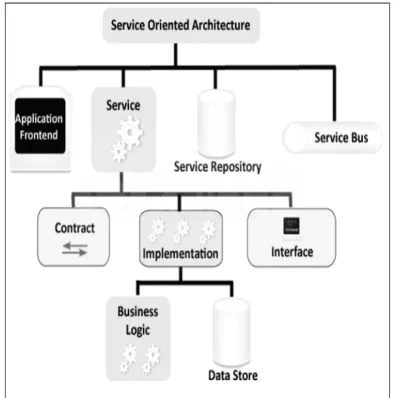
A service-oriented architecture (SOA) is a type of software design whereby services are offered for the other elements by application aspects, through the transmission protocol using a network. The essential key points of service-oriented architecture are independent of clients, products, and services along with technologies.
[image:5.612.98.295.510.709.2]Service-oriented architecture (SOA) is definitely advancement of distributed computing in line with the request/response pattern for synchronous/ asynchronous functions. An application's organization logic or private functions are generally modularized and offered as services designed for consumer/client functions. What is actually key to such services is their particular freely coupled character; i. e., the service program is independent of the setup. IoT application designers or program integrators can construct IoT applications by generating several services without the need of recognizing the services' root implementations.
Figure 2: Traditional Service-Oriented Architecture (SOA)
With regards to Issarny et al (2016), The authors in attempt this method by implementing SOAP-based Web services entirely on the nodes without needing gateways. Nonetheless, implementing the middleware element entirely on the device could cause a lot of difficulties, like message delays, restrained protected connections, restricted computational ability, excessive electricity usage, etc.
Looking at such difficulties, the authors in make use of the compact CoAP protocol on sensor gadgets and measure the tradeoff around response intervals and delivery accomplishment rates. Although CoAP sustains incredibly low-resource connections, it is more desirable for synchronous connections. A number of other protocols are formulated to cope with the above mentioned problems, and standardization initiatives designed to ensure interoperability.
As in brief discussed earlier, returning to SOA along with the accommodating SOM for any IoT has been through different techniques, as an immediate effect with the scientific evolution of the IoT. Definitely, the reality that a thriving quite a few program areas considers the use of profiting the IoT has additionally motivated the enhancement of the allowing hardware along with software solutions. This is certainly such as highlighted by the significant materials on middleware options for any IoT.
1403
3.3 Middleware Architecture Developments For IoT
The middleware is definitely interface which helps the connection involving scientific and also the practical application levels, this approach furnishing technical interoperability. IoT is seen as a heterogeneous and potent facilities consisting of an extremely plethora of things, so, gathering data from such several objects can be an significant process because it enables software platforms to comprehend the surroundings far better. Furthermore, we simply cannot anticipate all of these objects to get linked with the computing devices as a result of complex and economical factors. In such a circumstance middleware carries a key purpose in simplifying the enhancement of completely new services and also the integration of older technological know-how straight into new ones, thereby, IoT middleware is located amongst the IoT hardware together with data and also the applications which developers establish to manipulate the IoT.
As allocated IoT functions turn out to be more substantial and much more complicated, the real producing of sensor data channels turns into incorrect processing. Alternatively, data channels have to be fused towards perceptible data and such bits of information and facts ought to be merged with foundation information to infer innovative bits of information. And additionally because so many IoT apps need basically real-time action to stimulation within the conditions, like facts inference operation is required to be carried out in a very continuing, on-line fashion. Nevertheless, at this point in ongoing IoT solutions, sensing together with protocol handling are mainly accomplished with the clean data, in contrast several IoT applications desire higher-level circumstances understanding along with thought around the systems’ areas and also the real conditions the place that they run. For this purpose being conceivable, it is vital of having detailed semantic designs for data mode exploration. Semantic designs are basically classified principles and operations that thought engines are able to manage to discover innovative components of facts and know-how about a process and also its particular conditions. The most crucial difficulty is usually that present-day semantic designs are certainly not suited to powerful. Ongoing data study for IoT platforms is possibly accomplished off-line or is deficient in any kind of semantic-based testing.
To ensure an adaptive data files delivery, the middleware reveals a couple of APIs
accommodating each of those request-response along with publish-subscribe connection designs. Along with the request-response pattern, data files can be recovered synchronously when the details end user would probably get that information, it has to dispatch a request on the data files supplier, that can right away provide the communicating solution.
The publish-subscribe connection unit, alternatively, intrusions an asynchronous data files sending approach. In such a case, the details end user issues reoccuring request confirmed information of interest. In that case, each time a new information is produced, the information supplier looks after providing that data files to all or any activated data clients.
Even as we are heading with the ”Internet of Things” as represented by, innumerable gadgets will be interconnected, presenting and using information and facts on the network are utilized. Since these devices must interoperate, the service-oriented strategy is apparently a promising choice, i. e. each and every device will need to make available its service as standard services, while in parallel it's possible to uncover and invoke new service with some other services on-demand.
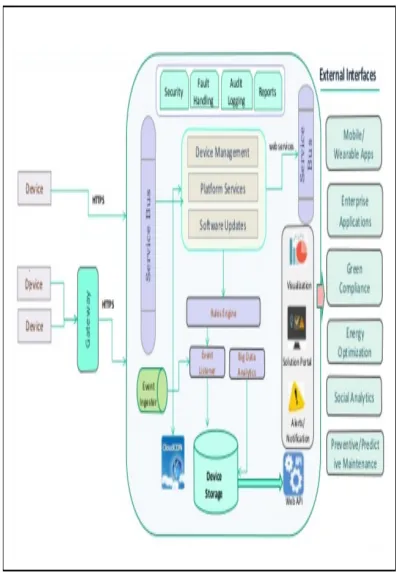
IoT Middleware with SOA indicates a case diagram of major facets of the use-case scene meant for SOA bundled IoT middle layer. To comprehend a powerful integration of the effectiveness provided by the internet of Things, relate Figure-3 above which reveals real-world devices assistance with inlayed software to conventional IT platforms by producing them available in a service-oriented approach.
1404 The design indicates the important service aspects for electronic, software, data layouts along with communication protocols that are definitely included in today’s embedded systems.
All services provided by networked gadgets are abstracted by services. Whether devices provide services specifically or their particular purpose is covered towards a service rendering. Within this layer of the integration architecture and on most layers above, the idea of gadgets is abstracted from and also the just accessible means are services.
A data files end user are able to access to information shown by usable IoT options by using a single connection program (middleware). Software interoperability is principally obtained by bringing out a specific identity space which routes many of the information accessible in IoT fields. Whenever a completely new data files is supplied in an IoT program, the portal unit convey this happening to those other entire base, by giving an announcement note.
3.4 Key Elements For Present Analysis
As related work discussed in Section-2 of this paper, from literature study the key elements for analysis are identified as following:
IoT system protocol support for single protocol and multiple protocols.
Response time for IoT request protocol.
Role of Broker in protocol handling.
Message packet loss ratio for specific request.
Individual data rate
Aggregated data volume
Latency, Efficiency and tolerance
Data level security and transport level security.
Such elements need to evaluate and test for acceptance testing. Present HESOA is tested using Hive system and depicted in section-5 of this paper.
4. ARCHITECTURE DEVELOPMENT- HESOA
In line with the IoT Domain Model, the IoT Information Processing Model has been formulated with consideration of SOA. Hybrid Execution Service Oriented Architecture (HESOA) defines the sequence of IoT sensor requests in an IoT pre-processing along with core pre-processing blocks for the conceptual level. The information associated with these principles of the IoT Domain Model is
patterned, which is explicitly collected, stored and refined in an IoT Umbrella Processing block, e. g. information about Devices, IoT Services and Digital Entities collected at this point for additional request sorting and processing. The IoT Hybrid Functional Model identifies groups of functionalities in a hybrid mode i. e. Event-based function, service-based, database oriented, and semantic driven, application dependent, that most are compiled with detection of priority as high, middle and low priority requests.
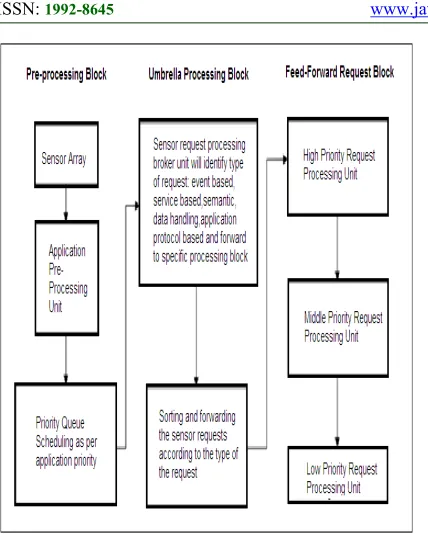
Hybrid Functionality Groups (HFG) establishes with each other, adopting the associations identified within the Umbrella Processing Block. The Hybrid Functionality Groups supply the functionalities for reaching the cases of such request protocols or dealing with the data associated with the request protocols, e. g. details about Event based requests or specifics of distinct IoT Service requests. The uses of the HFGs which regulate information and facts make use of Hybrid Execution Service Oriented Architecture (HESOA) Model as the rationale for structuring their particular information. An important purpose in any distributed computer system is a conversation amongst the various elements. One of the several attributes of existing IoT systems is normally the heterogeneity of communication solutions applied, which frequently is an immediate manifestation of the complicated requirements such systems must fulfill. The present HESOA IoT brings out new SOA architecture for controlling the complexity of request protocols for multitasking of several types of application sensors in even more homogeneous approach. Following figure-4 shows Functional Architecture of HESOA.
1405
Figure 4: Functional Architecture of HESOA
Pre-Processing Block: This block receives input from sensors or specific hardware. The request from sensors is further stored in the sensor array in a logical manner. These sensor array requests forwarded to Application pre-processing unit to separate requests according to the event, data and/or service requests. Now it becomes important to identify priority before feeding request protocol to Umbrella Processing Block. Hence scheduling identified as per functional priorities of request protocols.
Umbrella Processing Block: This block is a heart of architecture as this block works as a broker and holds all prioritized and sorted request protocols according to type and priority key-value.
Feed-Forward Request Block: This block works as an input for application layer buffer for IoT. The final priority-wise execution done here and each request protocol gets own execution id for further sensory/hardware execution.
As HESOA works as a middleware for IoT system, the benefit is an execution of any request protocol as per type of functional block and priority of execution. Existing systems have been developed as per specific requirements or functionalities but HESOA proves the high efficiency and handles any type of functionalities like the homogeneous model.
4. FUNCTIONAL COMPARISON WITH EXISTING SYSTEM
As per research gaps discussed in section-2 of this paper, present work compared for functional analysis with existing research. The key elements for comparison are:
Type of protocols supported
Response time for middleware request processing
Data Volume response time
IoT and SOA efficiency in terms of priority scheduling
We executed test for sensor request using JMeter where 400 requests are generated and processed at a time. These requests are processed using HESOA middleware architecture with Hive Interface. As existing systems are developed for single protocol support, present research is best performed for multiple protocols like MQTT, XMPP and CoAP. Hence, this work is highly efficient for hybrid protocol processing. Further, due to priority request modeling at middleware block, request processing is fast than existing systems. The quality of services is compared in next section-5 for performance identification.
5. QUALITY OF SERVICES FOR HESOA ARCHITECHTURE
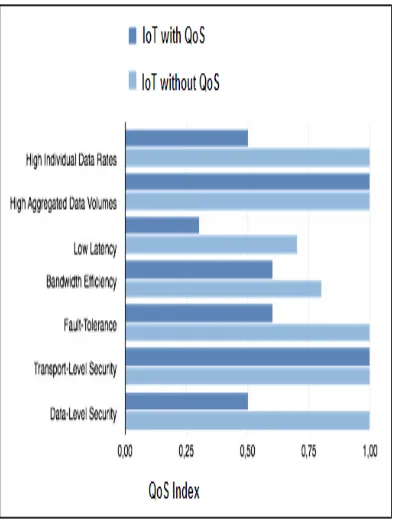
As each IoT framework must be well designed according to QoS parameters, present research analyzed QoS parameters for multi-tasking HESOA. Such applications possess an array of QoS prerequisites that could be commonly sorted as most effective effort, differentiated solutions and additionally secured solutions. As the unit is typically useful resource restricted there is a excessive likelihood that QoS offered might fail or break down in the course of service delivery. The unit is designed for furnishing an array of solutions; consequently there will be a multitude of functionally matching solutions offered to clients. The QoS indexing is carried out for middleware of present research and identified parameters are shown in figure-5 below.
1406 communications which are generally published in the event the execution has got accomplished.
Moreover, choice of IoT units should never alone be led by system variables, however, also need to be the cause of metrics like user’s Quality of Service (QoS) and reliability choices. QoS metrics could be tested concerning system variables such as response time, packet deprivation etc.
[image:9.612.91.289.309.570.2]QoS dimension is usually calculated by providing clients to show their Quality of Knowledge (QoK) that is definitely a lot more subjective dissimilar to QoS dimension concerning variables just like offered a data response duration, how can a end user experience a service; what exactly is the bottom objective of the end user applying this system services.
Figure 5: QoS Index for HESOA Architecture
By having client’s specific these kind of QoK metrics, one can possibly estimate the required QoS metrics of the service. These kinds of quotes can be carried out by possibly converting the qualitative end user QoK reviews to quantitative scales by utilizing methods like likert range.
Consequently, presented a particular process for the end user, the HESOA Middleware will figure out of which sensors/devices could engage in the multi-level system protocols for any specific process taking in account restrictions like
reliability, level of privacy breach, etc. In accomplishing this, clients will stipulate the QoK/QoS factors and adaptable array of reliability necessities of solutions with an overlay multilevel system to fulfill an end user issue. With this aspect, remember that systems often have several control entities thereby; nodes owned by various systems often have various service provisioning which can make service level architecture extremely challenging. Present research considered all possible parameters to make hybrid protocol communication more secure and reliable.
6. CONCLUSION
We have offered the new design of architecture HESOA that can highly couple the envisioned Internet of Things infrastructure by means of enterprise services. This work is executed for only three pairs of sensors where each pair supports MQTT,XMPP and CoAP protocols. As a multiple protocol testing, we limited present research for MQTT,XMPP and CoAP protocols only. The strategy is a homogeneous setup of Event-based function, service-based, database oriented, semantic oriented and/or application based. Ultimately each block organized within single control location. However, we propose to conduct algorithmic execution and its QoS performance assessment in the future. The HESOA is a very new approach to SOA to attenuate complexity of delivery of multiple different types of sensory routines. Hence, this architecture can be implemented for complex systems like SCADA or Remote Sensing Applications. As a future research focus, we suggest the embedded middleware system with application processing interface development like plug and play.
ACKNOWLEDGEMENT:
We would like to thank K L University, Vijayawada and G. H. Raisoni college of Engineering and Management, Pune for providing constant encouragement and support to complete this research work.
REFRENCES:
1407 [2] Zhang, Yang, Li Duan, and Jun Liang Chen.
"Event-driven soa for iot services." Services Computing (SCC), 2014 IEEE International Conference on.IEEE, 2014.
[3] Chen, Ray, JiaGuo, and FenyeBao. "Trust management for service composition in SOA-based IoT systems.” 2014 IEEE Wireless Communications and Networking Conference (WCNC), .IEEE, 2014.
[4] Tiburski, Ramão Tiago, et al. "The importance of a standard security architecture for SOA-based iot middleware." IEEE Communications Magazine 53.12 (2015): 20-26.
[5] Wang, Feng, et al. "A data processing middleware based on SOA for the internet of things." Journal of Sensors 2015.
[6] Issarny, Valérie, et al. "Revisiting service-oriented architecture for the IoT: a middleware perspective." International Conference on Service- Oriented Computing. Springer International Publishing, 2016.
[7] Tiburski, Ramão Tiago. Security services provision for SOA-based IoT middleware systems. PontifíciaUniversidadeCatólica do Rio Grande do Sul, 2016.
[8] Derhamy, Hasan, Jens Eliasson, and Jerker Delsing. "IoT interoperability-on-demand and low latency transparent multi-protocol translator."IEEE Internet of Things Journal (2017).
[9] Avila, Karen, et al. "Applications Based on Service-Oriented Architecture (SOA) in the Field of Home Healthcare." Sensors 17.8 (2017): 1703.
[10] Badarinath, Rakshith, and Vittaldas V. Prabhu. "Advances in Internet of Things (IoT) in Manufacturing."IFIP International Conference on Advances in Production Management Systems.Springer, Cham, 2017.
[11]Richard Li, and XiaofeiXu. "ID Oriented Networking (ION) for IoT interoperation." Global Internet of Things Summit (GIoTS), 2017.IEEE, 2017.
[12]Song, Liumeng, et al. "QoS-Aware Energy-Efficient Cooperative Scheme for Cluster-Based IoT Systems." IEEE Systems Journal 11.3 (2017): 1447-1455.
[13]Xu, Jianlong, et al. "Online personalized QoS prediction approach for cloud services." Cloud Computing and Intelligence Systems (CCIS), 2016 4th International Conference on. IEEE, 2016.
[14] Chrysoulas, Christos, and Maria Fasli. "Towards an adaptive SOA-based QoS & Demand-Response Provisioning Architecture for the Smart Grid." (2017): 77-86.
[15] McKee, D. W., et al. "n-Dimensional QoS Framework for Real-Time Service-Oriented Architectures." 2nd IEEE International Symposium on Real-time Data Processing for Cloud Computing. IEEE Computer Society Press, 2017.
[16] Issarny, Valérie, et al. "Revisiting service-oriented architecture for the IoT: a middleware perspective." International Conference on Service-Oriented Computing. Springer International Publishing, 2016.
[17] Priego, Rafael, et al. "Agent-based middleware architecture for reconfigurable manufacturing systems." The International Journal of Advanced Manufacturing Technology (2017): 1-12.
[18] Garcia-de-Prado, Alfonso, Guadalupe Ortiz, and Juan Boubeta-Puig. "COLLECT: COLLaborativE ConText-aware service oriented architecture for intelligent decision-making in the Internet of Things." Expert Systems with Applications 85 (2017): 231-248.
[19] Shen, Yulong, et al. "MicroThings: A Generic IoT Architecture for Flexible Data Aggregation and Scalable Service
Cooperation." IEEE Communications Magazine 55.9 (2017): 86-93.