www.hydrol-earth-syst-sci.net/13/1399/2009/ © Author(s) 2009. This work is distributed under the Creative Commons Attribution 3.0 License.
Earth System
Sciences
A general real-time formulation for multi-rate mass transfer
problems
O. Silva1, J. Carrera1, M. Dentz1, S. Kumar2, A. Alcolea3, and M. Willmann4
1Institute of Environmental Assessment and Water Research (IDÆA-CSIC), Barcelona, Spain 2Department of Geology and Geophysics, Texas A&M University, USA
3Hydrogeology Centre (CHYN), University of Neuchˆatel, Neuchˆatel, Switzerland 4Institute of Environmental Engineering, ETH Zurich, Switzerland
Received: 20 February 2009 – Published in Hydrol. Earth Syst. Sci. Discuss.: 17 March 2009 Revised: 24 July 2009 – Accepted: – Published: 5 August 2009
Abstract. Many flow and transport phenomena, ranging from delayed storage in pumping tests to tailing in river or aquifer tracer breakthrough curves or slow kinetics in reac-tive transport, display non-equilibrium (NE) behavior. These phenomena are usually modeled by non-local in time formu-lations, such as multi-porosity, multiple processes non equi-librium, continuous time random walk, memory functions, integro-differential equations, fractional derivatives or multi-rate mass transfer (MRMT), among others. We present a MRMT formulation that can be used to represent all these models of non equilibrium. The formulation can be extended to non-linear phenomena. Here, we develop an algorithm for linear mass transfer, which is accurate, computationally in-expensive and easy to implement in existing groundwater or river flow and transport codes. We illustrate this approach by application to published data involving NE groundwater flow and solute transport in rivers and aquifers.
1 Introduction
Solving flow and solute transport phenomena in natural me-dia requires using variables, such as heads and concentra-tions, that characterize the state of the system at every point. As such, they are termed state variables. State variables are assumed representative of a small portion of water around
Correspondence to: O. Silva ([email protected])
such point. Using them to model flow and transport implic-itly requires assuming local equilibrium.
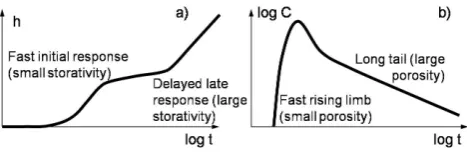
Even though local equilibrium is assumed by default, non-equilibrium (NE) behavior is frequently observed in flow and transport through water bodies. Symptoms of NE depend on the actual phenomenon under study. In flow problems, NE is typically manifested by a delayed drainage (Gerke and van Genuchten, 1993a, b) or a delayed storage mobi-lization (Fig. 1a). Head in a water body often rises fast at early times in response to an inflow, which suggests a small storage capacity. However, the rate of head rise may de-cay at later times, suggesting an increase in storage capac-ity (Boulton, 1955). In tracer transport problems, break-through curves typically display fast and sharply rising limbs (Fig. 1b), which might denote a small volume of displaced water, but then display a long tail at late times, which sug-gests the opposite (Valocchi, 1985; Carrera, 1993; Cortis and Berkowitz, 2004). In reactive transport problems, NE is man-ifested, for example, by reaction rates, orders of magnitude slower than what would be expected from laboratory experi-ments (White and Peterson, 1990).
Fig. 1. Typical response to (a) a constant injection test in a double porosity formation and (b) a tracer test breakthrough curve. In both cases, the system reacts with small storage capacity at early times, but much larger at late times, suggesting that some time is needed before the full storage capacity is mobilized.
surface (Boulton, 1955; Neuman and Witherspoon, 1971; Neuman and Tartakovsky, 2009), or at low permeability blocks (Barenblatt et al., 1960; Warren and Root, 1963). It has also been attributed to heterogeneity (Cortis and Knudby, 2006). NE has also been observed in multiphase flow and ex-tensively studied in the petroleum field (e.g., Kazemi et al., 1976; Kazemi and Gilman, 1993). Here, departures from equilibrium are attributed to the permeability contrast be-tween porous blocks, which store most of the fluid on the reservoir, and fractures, which have a low storage capacity but a high permeability. Fluid flow occurs mainly through the fractures, whereas the matrix blocks act as fluid sink/sources (Da Prat, 1982).
Water flow and solute transport in unsaturated fractured rock and soils also display non-equilibrium behavior (Gerke and van Genuchten, 1993a, b; Zhou et al., 2006). Usually, the imbibition rate or fluid flow between the fractures and the matrix domains is driven nonlinearly by the local pressure difference in liquid-phase pressure between the fracture and the matrix blocks (Zimmerman et al., 1995).
In solute transport, non-equilibrium has been attributed to diffusion-limited storage into immobile regions, kinetic sorp-tion or heterogeneity (Brusseau et al., 1989; Sudicky, 1989, 1990; Valocchi, 1990; Sardin et al., 1991; Cvetkovic et al., 1992; Toride et al., 1993; Tsang, 1995; Haggerty and Gore-lick, 1995; Ray et al., 1997; Carrera et al., 1998; Dentz and Berkowitz, 2003; El-Zein et al., 2005; Salamon et al., 2006; Vogel et al., 2006; Zhang et al., 2006, 2007; Alcolea et al., 2008; Willmann et al, 2008; Kumar, 2008; Gouze et al., 2008). Non-equilibrium is intrinsically associated to mul-ticomponent reactive transport at the field scale (Willmann et al., 2009). In these systems, several reactions can take place in different parts of the domain. These reactions are influ-enced by the dynamic of flow between these regions.
Non-equilibrium also has been observed in solute trans-port through rivers that are influenced by the exchange of water between the river and the underlying hyporheic zone (Fernald et al., 2001; Boano et al., 2007; Marion et al., 2008) or by aggregated dead-zones (Beer and Young, 1983; Lees et al., 1998, 2000; Davis et al., 2000). Dead zones can be asso-ciated to a number of effects, such as reverse flows induced
by bends and pools, side pockets, zones between dikes, tur-bulent eddies, and wakes behind bed irregularities and rough-ness elements (Deng et al., 2004). Non-equilibrium has also been observed in natural systems like saturated hillslopes constituted by well-connected fractures and a main soil ma-trix (Zhang et al., 2009).
Mathematical formulations to simulate NE behavior are as diverse as the phenomena they represent. However, most of them can be viewed as non-local in time. This means that storage mobilization does not depend solely on heads (or concentration) at the current time, but also on their his-tory. In practice, this can imply that a sink-source term (e.g. Carrera et al., 1998) or that an additional storage term (e.g. Haggerty and Gorelick, 1995) are added to the mass balance equations. It is the form of such terms what sets different non-local formulations apart. Their number is too long to list, but the most widely used have been:
– Dual porosity formulations (e.g., Warren and Root, 1963) view the medium as consisting of two overlap-ping continua (mobile and immobile). The mobile con-tinuum allows lateral exchanges of water and solute mass. The immobile continuum only exchanges mass with the mobile region. Actual solution of the problem can be achieved either by spatial discretization, Laplace transform of semi-analytical solutions. Even though dual porosity formulations can be viewed as rather sim-ple, they represent a basic building block for other for-mulations.
– Integro-differential formulations (Herrera and Rodarte, 1973; Herrera and Yates, 1977; Carrera et al., 1998) consist of representing mass transfer to the immobile region as the convolution of the state variable (head or concentration) past history and a memory func-tion. They can be solved by semi-analytical methods or Laplace transform (Carrera et al., 1998).
– Multi-rate mass transfer (MRMT) (Roth and Jury, 1993; Haggerty and Gorelick, 1995; Carrera et al., 1998; Hag-gerty et al., 2000; Wang et al., 2005; Gouze et al., 2008; Benson and Meerschaert, 2009) is a generalization of dual-porosity models, in which mass transfer between a mobile and multiple immobile regions is modeled by diffusive or first-order mass transfer terms. Here, the medium heterogeneity is mapped onto a distribution of retention times in the immobile regions.
high permeability regions. Here the medium hetero-geneity is mapped onto the distribution of time incre-ments. In general the space and time increments are coupled.
– Time fractional derivatives (Benson et al., 2000a, b; Berkowitz et al., 2002; Zhang et al., 2009) and/or frac-tional mobile/immobile transport (Metzler and Klafter, 2000; Schumer et al., 2003) describe NE by means of fractional (i.e., non-integer) time derivatives.
These formulations look different. However, when restricted to locality in time (some of them can also represent non-locality in space), they are not. Dual porosity formulations are a special case of MRMT. Dentz and Berkowitz (2003) showed that the MRMT approach and the uncoupled ver-sion of the CTRW approach are formally equivalent and gave an explicit map between them. Haggerty et al. (2000) dis-cuss the equivalence between MRMT and integrodifferential formulations. The equivalence of space and time fractional dynamics and these approaches has been discussed by, e.g., Metzler and Klafter (2000), Berkowitz et al. (2006), Schumer et al. (2003), Benson and Meerschaert (2009) and Zhang et al. (2009). In essence, a fractional order time derivative is equivalent to a power-law memory function or a power-law distribution of retention times (MRMT) or time increments (CTRW).
In hindsight, the equivalence of such a diverse set of for-mulations sounds evident. In essence, they can all be viewed as expressing linear mass transfer between mobile and im-mobile regions. That this exchange is characterized by a dis-tribution of residence times or time increments, by a memory function or by a fractional order derivative does not look crit-ical. However, a broad set of characterizations hinders com-parison and synthesis, thus slowing scientific development. A unified approach is needed.
An additional problem comes from the mathematical dif-ficulty of some of these formulations. Integrodifferential equations or Laplace transform are extremely efficient, but not easy to grasp by many. Worse, their applicability is re-stricted to linear problems. Therefore, they are not imme-diate to translate to non-linear phenomena, such as multi-component reactive transport (Donado et al., 2009; Willmann et al., 2009).
The objective of this work is to propose a unified formu-lation that is computationally efficient and can be extended to non-linear phenomena. We adopt the MRMT approach for two reasons. First, it is intuitive and does not require mathematical tools beyond basic calculus. Second, it allows localization. As discussed above, the domain is assumed to consist of a mobile continuum and several overlapping im-mobile continua. These exchange mass linearly with the mo-bile region. In this way, the state of immomo-bile zones can be characterized by heads (or concentrations). That is, the tradi-tional single state variable is substituted by several state vari-ables (as many as immobile regions). Effectively, these work
as local state variables, that can be used to model non-linear processes.
2 Governing equations
Non-local in time formulations can be used to enrich the behavior of either the flow or transport equations, or both. In either case, they can be viewed in two complementary fashions: (i) as a continuum of delayed storage terms, in which case these equations represent the total mass balance in both mobile and immobile regions, or (ii) as a contin-uum of sink/source terms, which act as linear mass exchange terms between mobile and immobile zones. In practice, the continuum is substituted by a discrete number of terms. Us-ing the first view, the flow equation becomes
Sm
∂hm
∂t +
N X
j=1
Sim,j
∂him,j
∂t = −∇ ·q+q (1)
wheret [T] is time,hm[L] is head in the mobile zone, Sm
[L−1] is the specific storage coefficient, q[L T−1] is water flux,q [T−1] represents a sink/source (recharge/extraction), andhim,j [L] andSim,j [L−1] are head and specific storage
coefficients of the jth immobile zone, respectively. Water storage in each immobile region is fed by a linear exchange with the mobile domain
Sim,j
∂him,j
∂t =σim,j
Kim,j
Lim,j
hm−him,j (2)
whereσim,j [L2L−3] is the specific surface of thejth
im-mobile region,Lim,j [L] its distance from the mobile zone
andKim,j[L T−1] its hydraulic conductivity.
Analogously, the solute transport equation expresses the solute mass balance per unit volume of aquifer
φmRm
∂cm
∂t +
N X
j=1
φim,jRim,j
∂cim,j
∂t = ∇ ·(Dm· ∇cm)−q· ∇cm (3)
wherecm[M L−3] is the mobile concentration, Dm[L2T−1]
is the hydrodynamic dispersion tensor, φm [L3L−3] is the
mobile porosity (volume of pores per unit aquifer volume), andRm[−] is the mobile zone retardation factor. Similarly,
cim,j [M L−3],φim,j [L3L−3] andRim,j [−] are the
con-centration, porosity and retardation factor of thejth immo-bile zone. As in flow phenomena, mass balance in thejth immobile region is given by
Rim,jφim,j
∂cim,j
∂t =σim,j
φim,j0 Dim,j
Lim,j
cm−cim,j (4)
whereφim,j0 [L3 L−3] is its porosity (volume of pores per unit volume of immobile region),Dim,j[L2T−1] is a
function ofφim,j (see e.g., Carrera et al., 1998). In
prac-tice, the physical meaning of the parameters in Eqs. (2) and (4) is somewhat approximative. What is important is that (1)
N immobile regions are considered, (2) their state is char-acterized by a state variable (uim), and (3) they exchange
mass with the mobile region proportionally to the difference in state variables. Bearing this in mind, Eqs. (1–4) can be written in general as
β∂um
∂t +
N X
j=1
βj
∂uim,j
∂t =Lu(um) (5)
∂uim,j
∂t =αj um−uim,j
j =1...N (6)
whereu=h, for flow oru=c, for solute transport. Theβj
[−] coefficients are called capacity coefficients (Rim,jφim,j
for transport orSim,j for flow) to account for the distribution
of mass in the immobile phases; β [−] is the capacity co-efficient of the mobile phase (Rmφmfor transport orSmfor
flow); andαj [T−1] is a first-order mass transfer rate
coeffi-cient. The right-hand side of Eqs. (1) and (3) is designated generically by the operatorLu.
DenotingFj thejth term of the sum in Eq. (5), the
gov-erning equations for the immobile zones are given as
Fj =βj
∂uim,j
∂t =βjαj um−uim,j
j =1...N (7a)
F =
N X
j=1
Fj (7b)
whereF is the total exchange between mobile and immobile regions.
3 Numerical formulation for MRMT
Spatial and time discretization of either the flow or transport equations under local equilibrium assumptions (i.e., without MRMT) leads to a linear system of equations
D1um
1t +Au
k+θ m =bk
+θ (8)
where1um=ukm+1−ukm,1t=tk+1−tk is the time step,θ is
a weighting factor and the superscripts stand for the time in which the variable is evaluated.
Accounting for MRMT can be achieved in two ways: (a) using an appropriate mesh with nodes representing the im-mobile zones (e.g., Neuman et al., 1982), or (b) by elim-inating the unknown in the immobile region as an explicit state variable, i.e. expressinguim,jas a function ofum(e.g.,
Carrera et al., 1998). Here, we have adopted the later ap-proach because: first, it maintains the number of unknowns unchanged and, second, it is actually simpler to implement into existing generic flow and transport simulation codes.
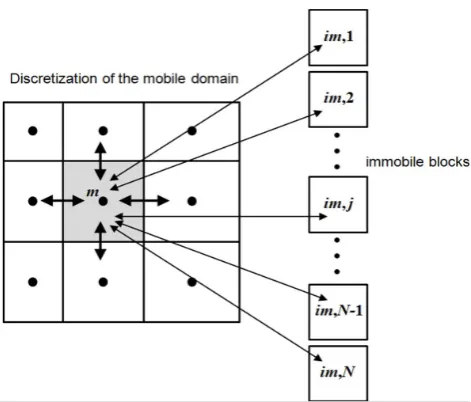
Figure 2 displays a schematic representation of a hypo-thetical numerical mesh that includes both the mobile and immobile domains. We assume that each nodemof the mo-bile zone is connected to all adjacent nodes of the mesh and to all the immobile blocks. Node im,j of the immobile re-gion is only connected to nodem. Geometrically, node im,j overlaps with node m. We show below that the variableu
at node im,j (i.e.,uim,j)can be solved explicitly as a
func-tion ofum. Therefore, node im,j needs not be an “uncertain”
node, but can be considered as a zero-D node that contributes to the mobile region, and is only updated after mobile state variables have been computed.
We first solve the N first-order ordinary differen-tial Eq. (6) in terms of 1um, while assuming that um
varies linearly during each time increment. That is,
um=ukm+ 1um1t t−tk. This leads to N first-order
linear differential equations, whose solution is
uim,j(t )=ukim,je
−αj t−tk
+ukm1−e−αj t−tk
(9) +1um
1t
t−tk
− 1
αj
1−e−αj t−tk
Combining Eqs. (6), (7a) and (9), the fluxFj evaluated at
timetk+θ will be
Fjk+θ =βjαj
ukm+θ−ukim,j+θ
=βjαj
ukm−ukim,je−αjθ 1t+1um
1t βj 1−e
−αjθ 1t (10)
Notice that this flux is only a function ofuat the previous time step and 1um. Therefore, the total mass flux, Fk+θ,
given by Eq. (7b), can be substituted into Eq. (8). This leads to a system that is identical to Eq. (8), except that the storage matrix and sink/source term are modified according to
D∗
ii=(D)ii+vi N X
j=1
βj 1−e−αjθ 1t (11a)
b∗k+θ
i =(b) k+θ i −vi
N
X
j=1 βjαj
h
ukm,i−
ukim,j
i
i
e−αjθ 1t (11b)
whereukm,i is the value ofuat nodei of the mobile region and timetk,ukim,j
i is the corresponding value in thejth
immobile block, andvi is the volume of celliin volume
in-tegrated formulations (e.g., finite element) and is equal to 1.0 in discretized formulations (e.g., finite differences). Finally, it is necessary to updateuim,j at the end of each time step
using Eq. (9). This approach is quite simple to program and should lead to accurate solutions at a very low computational cost. As with the integro-differential approach, the number of nodes/elements is not altered by the addition of the MRMT terms.
by Slooten (2009). The module defines MRMT ob-jects by means of a specific type of variables, that con-tain the capacity terms βj and mass transfer coefficients
αj, and provides services to solve the equation described
here. The module supports some characteristics of object-oriented programming. In fact, the module was designed such that its types and operations are available from out-side but the details of the implementation are hidden from the user (“black box” principle). These function-alities facilitate linking other Fortran modules or objects to mod process MRMT.f90. For instance, reactive trans-port may be included in both the mobile and immobile re-gions, by properly linking the object-oriented tool CHEP-ROO (Bea et al., 2009) to both any conservative transport code and the module mod process MRMT.f90. The module can be downloaded from http://www.h2ogeo.upc.es/English/ English/software.htm#Mod process MRMT.
4 Equivalence with other similar approaches
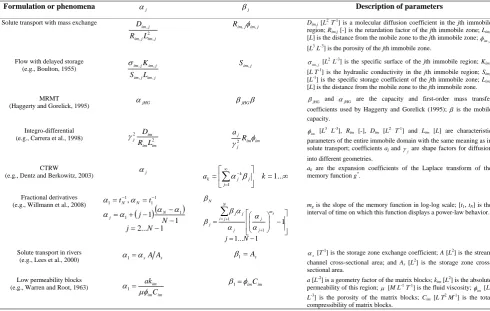
As mentioned in the introduction, a large number of non-local in time schemes have been presented by different au-thors. This section is devoted to discussing their equivalence so as to facilitate using them in the proposed formulation. This equivalence is summarized in Table 1 in terms of coeffi-cientsαj andβj of the generalized MRMT model proposed
in this work (Eqs. 5 and 6).
4.1 Equivalence with the classical MRMT approach
Haggerty et al. (2000) provided a comparison table with dif-ferent MRMT formulations considering governing equations similar to Eqs. (5) and (6). The present approach is essen-tially identical to that of Haggerty and Gorelick (1995). The main difference is that they formulated their equations per unit volume of water. Therefore, their capacity coefficients are equal to the coefficientsβj of Eqs. (5) and (6), but
di-vided by the mobile capacity,β. DenotingβjHG andαjHG the capacity and first-order mass transfer coefficients consid-ered by Haggerty and Gorelick (1995), we have the following equivalence relationship
βjHG =βjβ (12a)
αjHG =αj (12b)
We have preferred to use capacity coefficients as defined in Eq. (5) to keep the physical meaning and consistence of the governing equations as mass balances per unit volume of aquifer.
4.2 Equivalence with the integro-differential approach
[image:5.595.310.546.59.260.2]Many schemes approximate the effect of the immobile region by a continuous memory function. The governing equations are then solved in the Laplace domain. These solutions can
Fig. 2. Hypothetical numerical discretization of the mobile and im-mobile domains.
also be approximated by expanding the memory function as a sum of exponentials (Carrera et al., 1998). Each summand can then be solved as explained in Sect. 3. For the purposes of comparison with our approach, the important issue is to acknowledge that such approaches are typically defined in terms of overall parameters for the whole immobile region (as opposed to independentαj andβj). For the works of
Carrera et al. (1998) and Salamon et al. (2006), the equiva-lence is given by:
αj =γj2
Dim
RimL2im
(13a)
βj =
aj
γj2Rimφim (13b)
whereφim[L3L−3],Rim [−],Dim [L2T−1] andLim[L]
are characteristic parameters of the entire immobile domain. Coefficientsaj andγj can be found in the literature (e.g.,
Haggerty and Gorelick, 1995; Carrera et al., 1998; Haggerty et al., 2000; Salamon et al., 2006) for diffusion into different geometries (layered, cylindrical, spherical and veins) and the standard first-order model. These formulations result from the analytical solution of the diffusion equation. A large number of first-order mass transfer rate coefficients and their distributions estimated from field and laboratory test results can be obtained from the works of Cosler (2004) and Hag-gerty et al. (2004).
Table 1. Equivalence between the present formulation and other approaches, on the basis of coefficientsαj andβj that appear in Eqs. (5) and (6).
Formulation or phenomena αj βj Description of parameters
2 -1
D Solute transport with mass exchange
2 , , , j im j im j im L R D
Rim,jφim,j
im,j [L T ] is a molecular diffusion coefficient in the jth immobile
region; Rim,j [-] is the retardation factor of the jth immobile zone; Lim,j
[L] is the distance from the mobile zone to the jth immobile zone; φim,j
[L3L-3] is the porosity of the jth immobile zone.
Flow with delayed storage (e.g., Boulton, 1955)
j im j im j im j im L S K , , , , σ
Sim,j σim,j
[L2L-3] is the specific surface of the jth immobile region; K
im,j
[L T-1] is the hydraulic conductivity in the jth immobile region; S
im,j
[L-1] is the specific storage coefficient of the jth immobile zone; L
im,j
[L] is the distance from the mobile zone to the jth immobile zone.
MRMT and
(Haggerty and Gorelick, 1995) αjHG βjHGβ jHG
α
HG j
β are the capacity and first-order mass transfer coefficients used by Haggerty and Gorelick (1995);
β
is the mobile capacity.
Integro-differential
(e.g., Carrera et al., 1998) 2 2 im im im j L R D γ
j im im
j R a φ γ2 im
φ [L3 L-3], R
im [-], Dim [L2 T-1] and Lim [L] are characteristic
parameters of the entire immobile domain with the same meaning as in solute transport; coefficients aj and γj are shape factors for diffusion into different geometries.
a CTRW
(e.g., Dentz and Berkowitz, 2003) αj ⎥ = ∞
⎦ ⎤ ⎢ ⎣ ⎡ =
∑
∞ = − ... 1 1 k a j j k j k α βk are the expansion coefficients of the Laplace transform of the
memory function g*. Fractional derivatives ( )( ) 1 ... 2 1 1 , 1 1 1 1 1 1 − = − − − + = = = − − N j N j t t N j N N α α α α α α 1 ... 1 1 1 1 − = ⎥ ⎥ ⎦ ⎤ ⎢ ⎢ ⎣ ⎡ − ⎟ ⎟ ⎠ ⎞ ⎜ ⎜ ⎝ ⎛ = + + =
∑
N j g m j j j N j i j j j N α α α α β β β m (e.g., Willmann et al., 2008)
g is the slope of the memory function in log-log scale; [t1, tN] is the
interval of time on which this function displays a power-law behavior.
Solute transport in rivers
(e.g., Lees et al., 2000) α1=αsAAs β1=As αs [T
-1] is the storage zone exchange coefficient; A [L2] is the stream
channel cross-sectional area; and As [L2] is the storage zone
cross-sectional area. Low permeability blocks
(e.g., Warren and Root, 1963)
im im im C ak μφ
α1=
im imC
φ
β1= a [L
-2] is a geometry factor of the matrix blocks; k [L2
im ] is the absolute
permeability of this region; μ [ML-1T-1] is the fluid viscosity; [L3
im
φ
L-3] is the porosity of the matrix blocks; C
im [L T2M-1] is the total
compressibility of matrix blocks.
F (x, t )=
t Z
0
g (t−τ )∂um(x, τ )
∂τ dτ (14)
=g∗∂um
∂t +g (t ) um(x,0)
wheregis the memory function and * denotes the convolu-tion product. Carrera et al. (1998) approximate this product using the integro-differential approach of Herrera and Ro-darte (1973) and Herrera and Yates (1977). An equivalent alternative is to approximategby
g (t )=
Z ∞
0
αb (α) e−αtdα (15)
whereb(α)[T] is a density function of first-order rate coef-ficients. Haggerty et al. (2000) provide explicit expressions for the density and memory functions for various models or geometries. To use the approach of Sect. 3, we need to ex-press the memory function as
g (t )=
∞
X
j=1
αjβje−αjt (16)
Note that Haggerty et al. (2000) included the factorαjβjon
the memory function, unlike Carrera et al. (1998) who placed it on fluxF. However, both approaches are equivalent. We calculate the convolution product in Eq. (14), truncating the memory function at Nth term and following the same al-gebraic analysis described in the Appendix 1 of Carrera et al. (1998). Thus, we can expressFk+θas
Fk+θ= N
X
j=1
βjαje−αjθ 1tIjk+ 1um
1t N
X
j=1
βj 1−e−αjθ 1t
(17a)
Ijk+1=
Z tk+1
0
e−αj tk+1−τ ∂um
∂τ dτ =e
−αj1tIk
j (17b)
+ 1−e
−αj1t
αj
1um
1t
The equivalence between our approach and integro-differential approach becomes evident by comparing Eqs. (17a) and (10). Also note that, from Eq. (9) we obtain the recursive relationship
ukm+1−uk
+1
im,j=e
−αj1tuk
m−ukim,j
+ 1
−e−αj1t
αj
which is similar to Eq. (17b). Therefore, we arrive at Eqs. (7b) and (10) by imposing the condition
Ijk=ukm−ukim,j (19)
The coefficients in Eq. (13) result from an infinite series ex-pansion that needs to be truncated. Truncation criteria and expression for the final terms of truncated multi-rate series can be found in Haggerty and Gorelick (1995) and Salamon et al. (2006). In the case of diffusion into different geome-tries, they proposed the same criteria to evaluateβN.
How-ever, while Haggerty and Gorelick (1995) suggested writing
αN as the rest of theαj coefficients (i.e., Eq. 13a), Salamon
et al. (2006) proposed the following expressions
βN = 1−
N−1
X
j=1
aj
γj2
!
Rimφim (20a)
αN =λ
1−
N−1
P
j=1 aj
γj2 !
1−λ
N−1
P
j=1 aj
γ4
j
!
Dim
RimL2im
(20b)
whereλfor layers, spheres, cylinders are given by Salamon et al. (2006).
4.3 Equivalence with CTRW
Dentz and Berkowitz (2003) found a mathematical equiva-lence between MRMT and the CTRW model (Berkowitz and Scher, 1998; Dentz et al., 2004; Berkowitz et al., 2006; Mar-golin et al., 2003; Salamon et al., 2006;). They formulated a CTRW approach which is formally equivalent to the integro-differential formulation of MRMT presented in this paper. They present a map between the memory function defined in the context of integro-differential formulations,g, and the transition time distributionψ (t )
g∗(s)= 1+ψ
∗(s) (1+sτ
0)
sτ0ψ∗(s)
, (21)
whereτ0defines which portion of the medium is mobile or immobile and as such is related to the mobile and immobile volume fractions of the medium (see Dentz and Berkowitz, 2003). The Laplace transform of the memory function,g∗, can be expanded into a series insaccording to
g∗(s)=
∞
X
k=1
(−1)kaksk, (22)
where explicit expressions for theak are given in Dentz and
Berkowitz (2003). Forg∗(s)given by the Laplace transform of Eq. (16), we obtain
g∗(s)=
∞
X
j=1
αjβj
αj+s
=
∞
X
j=1
βj
∞
X
k=1
(−1)kα−jksk (23)
=
∞
X
k=1
(−1)ksk
" ∞ X
j=1
αj−kβj #
By comparison of Eqs. (22) and (23), we obtain relations between theβjand theakfor a given series of ratesαj
ak =
"∞ X
j=1
αj−kβj #
(24)
The latter expression can be inverted (numerically) in order to obtain explicit expressions for the weightsβj and thus for
the memory functiong(t )that simulates the transport behav-ior in a CTRW.
4.4 Equivalence with the fractional derivatives approach
Another method to describe non-localities in time is the fractional-order advection-dispersion equations (fADE) (Benson et al., 2000a, b; Zhang et al., 2009). This ap-proach is quite general and can be characterized by a power law memory function when only the time derivative term in the advection-dispersion equation (ADE) is fractional (Will-mann et al., 2008).
On the other hand, Dentz and Berkowitz (2003) proposed the use of the truncated power law memory function, which has become widely used because breakthrough curves often display a power law behavior at late times (see, e.g., Zhang et al., 2007; Willmann et al., 2008). The late time behav-ior of the breakthrough curve can be related to the memory function (Haggerty et al., 2000). This memory function only requires specifying the slope of the memory function in log-log scale,mg, and the interval of time [t1,tN] on which this
function displays a power-law behavior. A practical method to calculate the distribution coefficientsβj consists of, first,
calculate theαj values assuming they are evenly distributed
on a logarithmic scale while fixingα1 = tN−1andαN=t1−1.
Secondly, we obtain a recursive relationship forβj values
by approximating the memory function with expressions of successive increasing orders, i.e.
log N
X
i=j βiαi
!
−log N
X
i=j+1 βiαi
!
=mg logtj −logtj+1
(25)
wheretj=αj−1. This leads to
βj =
N P
i=j+1
βiαi
αj
α
j
αj+1
mg −1
j =1...N−1 (26)
To get the values ofβj, we first assign an arbitrary value to
βN (e.g.,βN=1). Then we apply Eq. (26) and finally scale
these values imposing the condition
N P
j=1
βj=1.
4.5 Equivalence with other models and phenomena
Many of those models rely on single rate first-order mass transfer (e.g., Roth and Jury, 1993). Haggerty and Gore-lick (1995) have classified these mass transfer models as “chemical” or “physical” with subdivisions into one-site or two-sites models. They have shown how these models are equivalent and interchangeable.
As an examples, we want to mention the model of flow through low permeability blocks (Warren and Root, 1963), the transient storage model of longitudinal solute transport in rivers and streams (Bencala and Walters, 1983), and trans-port under linear kinetic adsorption (e.g., Nkedi-Kizza et al., 1983). In essence, all of these models are particular cases of the single first-order mass transfer model, in which there is only one immobile zone exchanging mass with the mobile domain.
Warren and Root (1963) formulated a model for the single-phase flow of a slightly compressible liquid through forma-tions containing an intergranular porosity and a fissure poros-ity. In their approach, the continuity equation includes a term accounting for the flow between the two porous regions. Here, the state variables are the pressure in the fractured zone,um [M L−1T−2], and the pressure in the matrix
re-gion,uim,1[M L−1T−2]. Also, we can identifyβ andβ1 withφmCmandφimCim, whereCmandCim[L T2M−1] are
the total compressibilities of the fracture and matrix blocks, respectively. The flow between fracture and matrix regions is controlled by the mass transfer rate coefficientα1given by
α1=
akim
µφimCim
(27) wherea [L−2] is a shape factor reflecting the geometry of the matrix blocks,kim [L2] is the absolute permeability of
this region andµ[M L−1T−1] is the fluid viscosity. For solute transport in rivers the governing Eqs. (5) and (6) are based on the conservation of mass principle for the stream and storage zone segments (Bencala and Walters, 1983; Lees et al, 2000; Zhang and Aral, 2004). In this context,um[M
L−3] is the in-stream solute concentration, uim,1 [M L−3] is the storage zone solute concentration, β represents the stream channel cross-sectional area A [L2], and β1 is the storage zone cross-sectional areaAs [L2]. The first-order
mass transfer rate coefficient is given by
α1=
A
As
αs (28)
whereαs[T−1] is the storage zone exchange coefficient.
Similar identification of parameters can be done with other phenomena and models. Some of them are summarized in Table 1.
5 Applications
In order to illustrate the proposed formulation, we apply it to four problems. We first test its applicability to flow problems
by simulating delayed yield from storage, which we verify by comparison to Boulton’s (1955) analytical solution. We also simulate an actual pumping well test carried out at a nearly field scale (Martinez-Landa et al., 2004). Next, we compare our approach with the integro-differential approach, simulat-ing the hypothetical radially convergent tracer test described by Alcolea et al. (2001). We then apply the present approach to solve two problems of radial flow to a pumping well (Hag-gerty and Gorelick, 1995). Finally, we show how our formu-lation can be used to simulate a river tracer experiment (Lees et al., 2000). Simulations were carried out with TRACONF (Carrera et al., 1993), a Fortran program for the simulation of water flow and solute transport through porous media. 5.1 Example of NE in flow phenomena
Boulton (1955) developed an analytical solution for unsteady radial flow allowing delayed yield from storage. This prob-lem can be described by Eq. (1) withN=1, assumingq=0. We model a hypothetical pumping test, considering a trans-missivity of T=0.01 m2s−1, Sm=0.001 andSim=0.1, and a
pumping rate of 0.04πm3s−1. Initial head equals zero. We compare our non-local in time approach with the Boulton’s solution for three values of the rate coefficientα=2.5×10⁻⁶, 10−5and 5×10⁻⁵s−1. Boulton (1955) referred toα as an empirical constant. We considered a mesh of 208 nodes with a spacing size1r increasing geometrically with a factor of 1.08. The integration scheme in time was semi-implicit with variable1t.
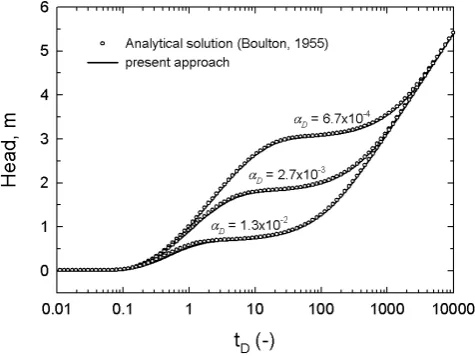
Figure 3 displays the evolution of heads, at a distance of R=51.6 m from the well, versus dimensionless time (tD=Tt/SmR2). We can see that the numerical solution (solid
line) obtained with the present approach matches the analyti-cal solution (circles) obtained by Boulton (1955). The figure illustrates the influence of the rate coefficientαon the sys-tem behavior. Whenαis small (long response time), the sys-tem behaves for a long time as if there was no delayed yield. Whenαincreases the system soon behaves as it is constituted only by one domain with the full storage. This is expected because for very large values ofα, the water mass transfer between mobile and immobile zones is so fast that they tend to be at equilibrium.
The present approach was also applied to the simulation of a field experiment. To do so, we consider a pumping test carried out during the second stage of FEBEX project (Martinez-Landa et al., 2004). We simulated a 2-D flow through a medium constituted by a granite matrix with a hor-izontal fracture. As in the Boulton’s problem, this pumping test can be modeled by Eq. (1) withN=1, assumingq=0. A pumping rate of 1.01×10⁻⁵m3s−1was applied during 9 s. As initial head we assumed steady-state conditions. Previ-ous data analysis suggests an estimated fracture transmis-sivity ofT=8.91×10⁻⁶m2s−1, and specific storage coeffi-cientsSm=1.2×10⁻³andSim=3.9×10⁻². Using an
Fig. 3. Comparison between the present approach and an analytic solution (Boulton, 1955) for delayed yield. Dimensionless rate co-efficient is defined asαD=SmR2α/T.
rate coefficient asα=7.8×10⁻⁵s−1. We considered a mesh of 125 nodes with a spacing size1rincreasing geometrically with a factor of 1.1. The integration scheme in time was fully implicit with variable1t.
Figure 4 shows the evolution of measured drawdown at a distance of r=0.043 m from the well. We can see that the present approach (solid line) reproduces the experimen-tal data (circles). The figure also shows that an increase in the mass transfer rate coefficient or in the matrix storage co-efficient, causes an increase in the fluxes of water from the fracture to the matrix. As expected, this leads to a delay in the drawdown, as shown in Fig. 4 (dotted and dashed lines). 5.2 Example of NE in solute transport
We model the convergent tracer test described by Alcolea et al. (2001). A tracer mass of 7.88 g is injected 8 m away from a well pumping 150 m3d−1. The radius of the pumping well and the aquifer thickness are 0.2 m and 5 m, respectively. Porosity of the mobile domain isφm=0.1. The immobile
zone consists of layers of length Lim=0.05 m and porosity
φim=0.045. The diffusion coefficient in the immobile zone
was set to Dim=0.001 m2d−1. Alcolea et al. (2001) used
TRANSIN code, which considers the integro-differential ap-proach to solve matrix diffusion problems. Thus, we have calculated coefficients α’s and β’s according to Eq. (13) withN=50. A uniform mesh with a grid size1r=0.005 m (93 nodes) and a fully implicit integration scheme in time was used in the simulations.
[image:9.595.48.286.64.242.2]Figure 5 shows the breakthrough curves at the pump-ing well simulated with the present approach and with TRANSIN, which compare quite well. The maximum rel-ative error was 1%.
Fig. 4. Simulation of a pumping well test (Martinez-Landa et al., 2004) with the present approach.
Fig. 5. Breakthrough curve of tracer in a radial convergent test, illustrating the equivalence between the present approach and the integro-differential formulation (Alcolea et al., 2001).
5.3 Example of NE in solute transport at field scale
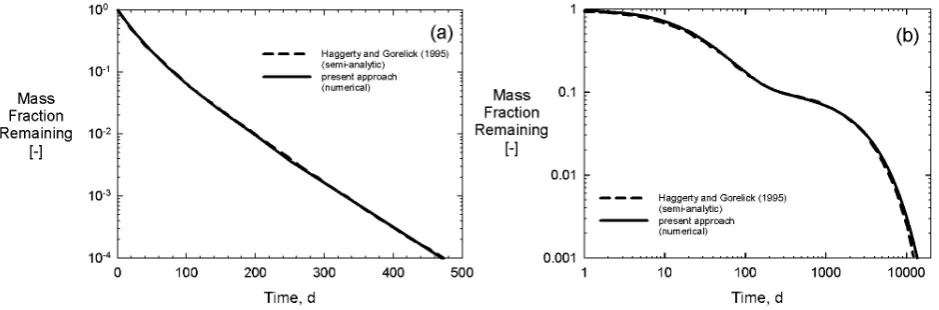
[image:9.595.309.546.291.467.2]Fig. 6. Comparison between the present approach and a semi-analytic solution (Haggerty and Gorelick, 1995). (a) Homogeneous aquifer. (b) Mixture of mass transfer processes (heterogeneous aquifer).
that all cells have the same volume and1r1=1.39 m. The integration scheme in time was semi- implicit with variable
1t.
The first case study simulates the cleanup history of a ho-mogeneous aquifer where seven immobile zones are associ-ated to a distribution of grain sizes. The grains are assumed to be spherical; theαj andβj coefficients are given in
Ta-ble 2 of Haggerty and Gorelick (1995). As in their work, we have considered 50 exponential terms to adequately de-scribe each immobile domain. Figure 6a displays the evo-lution of the PCE mass fraction remaining through an sce-nario of 500 d. We can see that the numerical solution (solid line) obtained with the present approach match very well the semi-analytical solution (dashed line) obtained by Haggerty and Gorelick (1995).
In the second numerical experiment, we simulate the re-moval of PCE from an heterogeneous aquifer. Here, hetero-geneity arises from four immobile zones of different geom-etry (porous grains, grain aggregates, clay layers and clay pods) and two immobile zones characterized by a surface reaction (slow and fast reactions). The mass-transfer pa-rameters are those appearing in Table 3 of Haggerty and Gorelick (1995). Note that these parameters are assumed locally heterogeneous, but they have the same distribution at all points in space. Once again, 50 terms were used to describe each geometry and only a single term for each re-action. Figure 6b shows predictions of the mass fraction of PCE remaining in the aquifer during a remediation scenario of 20 000 d. Again, the evolution of the mass fraction remain-ing obtained through the present approach (solid line) fit well the results predicted by the semi-analytical solution (dashed line). Therefore, the present model can reproduce the behav-ior of heterogeneous media characterized by different types and rates of mass transfer.
5.4 Example of NE due to transient storage in a river tracer experiment
Here we make use of the equivalence between the present ap-proach and the transient storage model described in Sect. 4.5 to model a river tracer experiment (Lees et al., 2000).
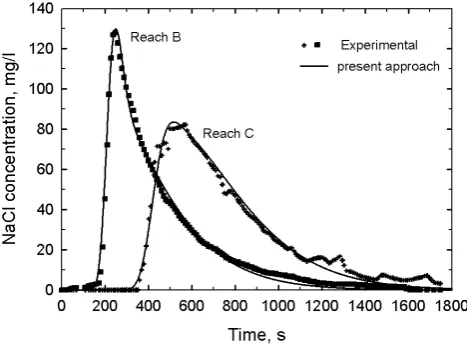
In one of their experiments, Lees et al. (2000) injected an amount of 10 kg of sodium chloride into a river upstream, and measured the tracer concentration over time at three sampling stations downstreams. They measured a constant discharge of 251 L s−1. Figure 7 shows the breakthrough curves (BTC) at two reaches (reach B located at 140 m and reach C at 190 m downstream from the injection point) and the BTC’s simulated with the present approach. To fit ex-perimental BTC’s we fixed the longitudinal dispersion coef-ficient atDm=0.64 m2s−1. The estimated model parameters
(Eq. 28) were (As/A=0.62;αs=0.0056 s−1)for reach B, and
(As/A=0.68;αs=0.0058 s−1)for reach C.
This example shows that the proposed formulation can re-produce the behavior of mass transfer between active flow and dead-zones in a river system. However, a certain knowl-edge of the distributions of the storage zone cross-sectional area, storage zone exchange coefficient, and dispersion co-efficient could be used to improve the description of ex-perimental data by the MRMT model. In such a case, the proposed approach could better describe the complex mass transfer processes attributed to the wide spectrum of dead zones in natural rivers and streams (Zhang et al., 2009).
6 Conclusions
Fig. 7. Simulation of a tracer river experiment (Lees et al., 2000).
flow and transport in heterogeneous media, chemical trans-port under kinetic adsorption in soils and groundwater and transport in streams and rivers. All of these approaches are equivalent to and can be formulated in terms of the proposed MRMT formulation. We have developed an easy-to-use nu-merical implementation of multi-rate mass transfer, which embeds existing formulations for non-locality in time. This numerical method is simple and physically consistent with and mathematically equivalent to other non-local in time flow and transport approaches such as integro-differential, CTRW and fractional derivatives formulations. The present approach avoids the spatial discretization of the immobile domain, because it solves state variables of that zone as ex-plicit functions of the state variables in the mobile domain. The approach also avoids the need to keep track of the past history of state variables at the mobile domain. That is, the proposed formulation yields an algorithm that is local in time to model non-local phenomena. The latter facilitates (i) physical interpretation of parameters and (ii) incorporation of non-linear phenomena, such as chemical reactions, that re-quire local variables. The algorithm was implemented into a Fortran 90 module that is very efficient and accurate, as it in-volves an analytical solution for the mass balance equations in the immobile zones. Through a series of examples we have illustrated that the proposed formulation can describe a wide spectrum of phenomena displaying non-equilibrium be-havior. Thus, the developed MRMT module may find wide application for the realistic modeling of environmental flow and transport problems.
The decomposition of a complex non-local single contin-uum domain into a simple multicontincontin-uum domain opens a wealth of possibilities for modeling non-linear phenomena. We expect that the actual procedure for extending the pro-posed formulation to non-linear processes will be problem dependent. Willmann et al. (2009) or Donado et al. (2009) have done it for multicomponent reactive transport because
this problem can be decomposed as (1) linear transport of conservative components and (2) non-linear local chemical computations. In this kind of problems, the localization implicit in MRMT is essential. Moreover, in this kind of problems, the immobile regions decomposition obtained for conservative (linear) transport remains unaltered when sim-ulating reactive (non-linear) transport. However, this may not remain true in general. The MRMT formulation can be easily extended for modeling non-linear phenomena such as multiphase flow or rainfall-runoff, but whether the immobile regions decomposition can be left unaltered remains to be proven.
The module has been tested by comparison with published solutions and is publicly available at http://www.h2ogeo.upc. es/English/English/software.htm#Mod process MRMT.
Acknowledgements. We gratefully acknowledge the financial support received from CICYT and ENRESA of Spain, and EC projects FUNMIG (contract number 516514) and MUSTANG (contract number 227286). We also acknowledge the support received from the MICINN and the European Social Fund. The authors gratefully acknowledge A. Valocchi and a anonymous reviewer for their valuable comments.
Edited by: N. Romano
References
Alcolea, A. and Carrera, J.: Difusi´on en la matriz. Formulaci´on integro-diferencial, in: VII Simposio de Hidrogeolog´ıa, Hidro-geolog´ıa y Recursos Hidr´aulicos 24, Asociaci´on espa˜nola de hidroge´ologos, Murcia, Spain, 703–714, 2001.
Alcolea, A., Carrera, J., and Medina, A.: Regularized pilot points method for reproducing the effect of small scale variability: Ap-plication to simulations of contaminant transport, J. Hydrol., 355(1–4), 76–90, 2008.
Barenblatt, G. I., Zheltov, I. P., and Kochina, I. N.: Basic concept in the theory of seepage of homogeneous liquids in fissured rocks, J. Appl. Math. 24(5), 1286–1303, 1960.
Bea, S. A., Carrera, J., Ayora, C., Batlle, F., and Saaltink, M. W.: CHEPROO: A Fortran 90 object-oriented module to solve chem-ical processes in Earth Science models, Comput. Geosci., 35(6), 1098–1112, 2009.
Beer, T. and Young, P. C.: Longitudinal dispersion in natural streams, J. Environ. Eng.-ASCE, 109(5), 1049–1067, 1983. Benson, D. A., Wheatcraft, S. W., and Meerschaert, M. M.:
Appli-cation of a fractional advection-dispersion equation, Water Re-sour. Res. 36(6), 1403–1412, 2000a.
Benson, D. A., Wheatcraft, S. W., and Meerschaert, M. M.: The fractional-order governing equation of L´evy motion, Water Re-sour. Res., 36(6), 1413–1423, 2000b.
Benson, D. and Meerschaert, M. M.: A simple and efficient ran-dom walk solution of multi-rate mobile/immobile mass transport equations, Adv. Water Res., 32(4), 532–539, 2009.
Berkowitz, B., Klafter, J., Metzler, R., and Scher, H.: Physical pic-tures of transport in heterogeneous media: advection-dispersion, random-walk, and fractional derivative formulations, Water Re-sour. Res. 38(10), 1191, doi:10.1029/2001WR001030, 2002. Berkowitz, B., Cortis, A., Dentz, M., and Scher, H.:
Model-ing non-Fickian transport in geological formations as a con-tinuous time random walk, Rev. Geophys., 44, RG2003, doi:10.1029/2005RG000178, 2006.
Boano, F., Packman, A. I., Cortis, A., Revelli, R., and Rodolfi, L.: A continuous time random walk approach to the stream transport of solutes, Water Resour. Res., 43, W10425, doi:10.1029/2007WR006062, 2007.
Boulton, N. S.: Unsteady radial flow to a pumped well allow-ing for delayed yield from storage, in: Publication N◦37 de l’Association Internationale d’Hydrologie, Assembl´ee g´en´erale de Rome, Tome II, 472–477, 1955.
Brusseau, M. L., Jessup, R. E., and Rao, P. S. C.: Modeling the transport of solutes influenced by multiprocess nonequilibrium, Water Resour. Res., 25(9), 1971–1988, 1989.
Carrera, J., Galarza, G., and Medina, A.: TRACONF, Programa de elementos finitos para la soluci´on de las ecuaciones de flujo y transporte en acu´ıferos confinados, E.T.S.I. Caminos, Canales y Puertos, Universitat Polit`ecnica de Catalunya, Barcelona, 53 pp., 1993.
Carrera J.: An overview of uncertainties in modeling groundwater solute transport, J. Contam. Hydrol., 13(1–4), 23–48, 1993. Carrera, J., S´anchez-Vila, X., Benet, I., Medina, A., Galarza, G.,
and Guimer`a, J.: On matrix diffusion: formulations, solution methods and qualitative effects, Hydrogeol. J., 6, 178–190, 1998. Cortis, A. and Berkowitz, B.: Anomalous transport in “classical” soil and sand columns, Soil Sci. Soc. Am. J., 68(5), 1539–1548, 2004.
Cortis, A. and Knudby, C.: A continuous time random walk ap-proach to transient flow in heterogeneous media, Water Resour. Res., 42, W10201, doi:10.1029/2006WR005227, 2006. Cosler, D. J.: Effects of rate-limited mass transfer on water
sam-pling with partially penetrating wells, Ground Water, 42(2), 203– 222, 2004.
Cvetkovic, V., Shapiro, A., and Dagan, G.: A solute flux approach to transport in heterogeneous formations 2. Uncertainty analysis, Water Resour. Res., 28(5), 1377–1388, 1992.
Da Prat, G.: Well test analysis for naturally fractured reservoirs, in: Proceedings eighth workshop geothermal reservoir engineer-ing, Standford, California, December, LCN-85-081235, 119– 126, 1982.
Davis, P. M., Atkinson, T. C., and Wigley, T. M. L.: Longitudinal dispersion in natural channels: 2. The roles of shear flow dis-persion and dead zones in the River Severn, U.K., Hydrol. Earth Syst. Sci., 4, 355–371, 2000,
http://www.hydrol-earth-syst-sci.net/4/355/2000/.
Deng, Z. Q., Singh, V. P., and Bengtsson, L.: Numerical solution of fractional advection-dispersion equation, J. Hydraul. Eng., 130(5), 422–431, 2004.
Dentz, M. and Berkowitz, B.: Transport behavior of a passive solute in continuous time random walks and multirate mass transfer, Water Resour. Res., 39(5), 1111, doi:10.1029/2001WR001163, 2003.
Dentz, M., Cortis, A., Scher, H., and Berkowitz, B.: Time behav-ior of solute transport in heterogeneous media: transition from
anomalous to normal transport, Adv. Water Res., 27(2), 155–173, 2004.
Donado, L. D., S´anchez-Vila, X., Dentz, M., Carrera, J., and Bol-ster, D.: Multi-component reactive transport in multi-continuum media, Water Resour. Res., in press, 2009.
El-Zein, A. H., Carter, J. P., and Airey, D. W.: Multiple-porosity contaminant transport by finite-element method, Int. J. Ge-omech., 5(1), 24–34, 2005.
Fernald, A. G., Wigington Jr., P. J., and Landers, D.: Transient storage and hyporheic flow along the Willamette River, Oregon: Field measurements and model estimates, Water Resour. Res., 37(6), 1681–1694, 2001.
Gerke, H. H. and van Genuchten, M. T.: A dual-porosity model for simulating the preferential movement of water and solutes in structured media, Water Resour. Res. 29(2), 305–319, 1993a. Gerke, H. H. and van Genuchten, M. T.: Evaluation of a
first-order water transfer term for variably saturated dual-porosity flow models, Water Resour. Res., 29(4), 1225–1238, 1993b. Gouze, P., Melean., Y., Le Borgne, T., Dentz, M., and Carrera,
J.: Non-Fickian dispersion in porous media explained by het-erogeneous microscale matrix diffusion, Water Resour. Res., 44, W11416, doi:10.1029/2007WR006690, 2008.
Haggerty, R. and Gorelick, S. M.: Multiple-rate mass transfer for modeling diffusion and surface reactions in media with pore-scale heterogeneity, Water Resour. Res., 31(10), 2383–2400, 1995.
Haggerty, R., McKenna, S. A., and Meigs, L. C.: On the late-time behavior of tracer test breakthrough curves, Water Resour. Res., 36(12), 3467–3479, 2000.
Haggerty, R., Harvey, Ch. F., von Schwerin, C. F., and Meigs, L.: What controls the apparent timescale of solute mass transfer in aquifers and soils? A comparison of experimental results, Water Resour. Res., 40, W01510, doi:10.1029/2002WR001716, 2004. Herrera, I. and Rodarte, L.: Integrodifferential equations for system
of leaky aquifers and applications. 1. The nature of approximate theories, Water Resour. Res., 9(4), 995–1005, 1973.
Herrera, I. and Yates, R.: Integrodifferential equations for system of leaky aquifers and applications. 3. A numerical method of un-limited applicability, Water Resour. Res., 13(4), 725–732, 1977. Kazemi, H., Merril, L. S., Porterfield, K. L., and Zeman, P. R.: Nu-merical simulation of water-oil flow in naturally fractured reser-voirs, Soc. Pet. Eng. J., 16(6), 317–326, 1976.
Kazemi, H. and Gilman, J. R.: Chapter 6. Multiphase flow in frac-tured petroleum reservoirs, in: Flow and Contaminant Transport in Fractured Rock, edited by: Bear, J., Tsang, C.-F., and de Marsily, G., Academic Press, San Diego, California, 267–323, 1993.
Kumar, S.: Effect of sorption intensities on dispersivity and macro-dispersion coefficient in a single fracture with matrix diffusion, Hydrogeol. J., 16, 235–249, 2008.
Le Borgne, T., Dentz, M., and Carrera, J.: Lagrangian statistical model for transport in highly heteroge-neous velocity fields, Phys. Rev. Lett., 101(9), 090601, doi:10.1103/PhysRevLett.101.090601, 2008.
Lees, M. J., Camacho, L., and Whitehead, P.: Extension of the QUASAR river water quality model to incorporate dead-zone mixing, Hydrol. Earth Syst. Sci., 2, 353–365, 1998,
http://www.hydrol-earth-syst-sci.net/2/353/1998/.
of transient storage and aggregated dead zone models of longi-tudinal solute transport in streams, Water Resour. Res., 36(1), 213–224, 2000.
Margolin, G., Dentz, M., and Berkowitz, B.: Continuous time random walk and multirate mass transfer modeling of sorption, Chem. Phys., 295(1), 71–80, 2003.
Marion, A., Zaramella, M., and Bottacin-Busolin, A.: Solute trans-port in rivers with multiple storage zones: the STIR model, Water Resour. Res., 44, W10406, doi:10.1029/2008WR007037, 2008. Martinez-Landa, L., Alcahud, A., and Jordan, J.: Operational
phase: hydraulic testing campaign. Pulse and short duration tests, FEBEX project, 70-hyd-1-5-004, Department of Geotechnical Engineering and Geo-Sciences, Technical University of Catalo-nia, Spain, 2004.
Metzler, R. and Klafter, J.: The random walk’s guide to anomalous diffusion: a fractional dynamics approach, Phys. Rep., 339(1), 1–77, 2000.
Neuman, S. P. and Witherspoon, P. A.: Analysis of non-steady flow with a free surface using the finite element method, Water Re-sour. Res., 7(3), 611–623, 1971.
Neuman, S. P., Preller, C., and Narasimhan, T. N.: Adaptive explicit-implicit quasi-three-dimensional finite element model of flow and subsidence in multiaquifer systems, Water Resour. Res., 18(5), 1551–1562, 1982.
Neuman, S. P and Tartakovsky, D. M.: Perspective on theories of non-Fickian transport in heterogeneous media, Adv. Water Re-sour., 32(5), 670–680, 2009.
Nkedi-Kizza, P., Biggar, J. W., van Genuchten, M. Th., Wierenga, P. J., Selim, H. M., Davidson, J. M., and Nielsen, D. R.: Modeling tritium and chloride 36 transport through an aggregated oxisol, Water Resour. Res., 19(3), 691–700, 1983.
Ray, Ch., Ellsworth, T. R., Valocchi, A. J., and Boast, Ch. W.: An improved dual porosity model for chemical transport in macrop-orous soils, J. Hydrol., 193(1–4), 270–292, 1997.
Roth, K. and Jury, W. A.: Linear transport models for adsorbing solutes, Water Resour. Res., 29(4), 1195–1203, 1993.
Salamon, P., Fern`andez-Garcia, D., and G´omez-Hern´andez, J. J.: Modeling mass transfer processes using random walk particle tracking, Water Resour. Res., 42, W11417, doi:10.1029/2006WR004927, 2006.
Sardin, M., Schweich, D., Leij, F. J., and van Genuchten, M. T.: Modeling the nonequilibrium transport of linearly interacting solutes in porous media, A review, Water Resour. Res., 27(9), 2287–2307, 1991.
Schumer, R., Benson, D. A., Meerschaert, M. M., and Baeumer, B.: Fractal mobile/immobile solute transport, Water Resour. Res., 39(10), 1296, doi:10.1029/2003WR002141, 2003.
Slooten, L. J.: An Object Oriented approach to groundwater opti-mization and simulation problems, Ph.D. thesis, Department of Geotechnical Engineering and Geo-Sciences, Technical Univer-sity of Catalonia, Spain, 2009.
Sudicky, E. A.: The Laplace transform Galerkin technique: a time-continuous finite element theory and application to mass trans-port in groundwater, Water Resour. Res., 25(8), 1833–1846, 1989.
Sudicky, E. A.: The Laplace transform Galerkin technique for ef-ficient time-continuous solution of solute transport in double-porosity media, Geoderma, 46, 209–232, 1990.
Toride, N., Leij, F., and van Genuchten, M. T.: A comprehensive set of analytical solutions for nonequilibrium solute transport with first-order decay and zero-order production, Water Resour. Res., 29(7), 2167–2182, 1993.
Tsang, Y. W.: Study of alternative tracer tests in characterizing transport in fractured rocks, Geophys. Res. Lett., 22(11), 1421– 1424, 1995.
Valocchi, A. J.: Validity of the local equilibrium assumption for modeling sorbing solute transport through homogeneous media, Water Resour. Res., 21(6), 808–820, 1985.
Valocchi, A. J.: Use of temporal moment analysis to study reactive solute transport in aggregated porous media, Geoderma, 46(1–3), 233–247, 1990.
Vogel, H.-J., Cousin, I., Ippisch, O., and Bastian, P.: The domi-nant role of structure for solute transport in soil: experimental evidence and modelling of structure and transport in a field ex-periment, Hydrol. Earth Syst. Sci., 10, 495–506, 2006,
http://www.hydrol-earth-syst-sci.net/10/495/2006/.
Wang, P. P., Zheng, Ch., and Gorelick, S. M.: A general approach to advective-dispersive transport with multirate mass transfer, Adv. Water Res., 28(1), 33–42, 2005.
Warren, J. E and Root, P. J.: The behavior of naturally fractured reservoirs, T. Soc. Petrol. En. AIME, 228, 245–255, 1963. White, A. F. and Peterson, M. L.: Role of reactive-surface area
char-acterization in geochemical kinetic models, in: Chemical Model-ing of Aqueous Systems II, edited by: Melchior, D. C. and Bas-sett, R. L., American Chemical Society, Washington, DC, 460– 475, 1990.
Willmann, M., Carrera, J., and S´anchez-Vila, X.: Transport up-scaling in heterogeneous aquifers: what physical parameters control memory functions?, Water Resour. Res., 44, W12437, doi:10.1029/2007WR006531, 2008.
Willmann, M., Carrera, J., S´anchez-Vila, X., Silva, O., and Dentz, M.: Coupling of mass transfer and reactive transport for non-linear reactions in heterogeneous media, Water Resour. Res., in review, 2009.
Zhang, Y. and Aral, M. M.: Solute transport in open-channel net-works in unsteady flow regime, Environ. Fluid Mech., 4(3), 225– 247, 2004.
Zhang, Y., Liu, H.-h., Zhou, Q., and Finsterle, S.: Effects of dif-fusive property heterogeneity on effective matrix diffusion co-efficient for fractured rock, Water Resour. Res., 42, W04405, doi:10.1029/2005WR004513, 2006.
Zhang, Y., Benson, D. A., and Baeumer, B.: Predicting the tails of breakthrough curves in regional-scale alluvial systems, Ground Water, 45(4), 473–484, 2007.
Zhang, Y., Benson, D. A., and Reeves, D. M.: Time and space nonlocalities underlying fractional-derivatives models: distinc-tion and literature review of field applicadistinc-tions, Adv. Water Res., 32(4), 561–581, 2009.
Zhou, Q., Liu, H.-H., Gudmundur, S., Bodvarsson, S., and Molz, F.: Evidence of multi-process matrix diffusion in a single fracture from a field tracer test, Transport Porous Med., 63, 473–487, 2006.