
doi:10.5194/hess-15-2437-2011
© Author(s) 2011. CC Attribution 3.0 License.
Earth System
Sciences
Simultaneous estimation of land surface scheme states and
parameters using the ensemble Kalman filter: identical twin
experiments
S. Nie1, J. Zhu2, and Y. Luo1
1National Climate Center, China Meteorological Administration, Beijing, China 2Institute of Atmospheric Physics, Chinese Academy of Sciences, Beijing China
Received: 20 December 2010 – Published in Hydrol. Earth Syst. Sci. Discuss.: 28 January 2011 Revised: 21 July 2011 – Accepted: 28 July 2011 – Published: 3 August 2011
Abstract. The performance of the ensemble Kalman filter (EnKF) in soil moisture assimilation applications is inves-tigated in the context of simultaneous state-parameter esti-mation in the presence of uncertainties from model parame-ters, soil moisture initial condition and atmospheric forcing. A physically based land surface model is used for this pur-pose. Using a series of identical twin experiments in two kinds of initial parameter distribution (IPD) scenarios, the narrow IPD (NIPD) scenario and the wide IPD (WIPD) sce-nario, model-generated near surface soil moisture observa-tions are assimilated to estimate soil moisture state and three hydraulic parameters (the saturated hydraulic conductivity, the saturated soil moisture suction and a soil texture empiri-cal parameter) in the model. The estimation of single imper-fect parameter is successful with the ensemble mean value of all three estimated parameters converging to their true val-ues respectively in both NIPD and WIPD scenarios. Increas-ing the number of imperfect parameters leads to a decline in the estimation performance. A wide initial distribution of estimated parameters can produce improved simultaneous multi-parameter estimation performances compared to that of the NIPD scenario. However, when the number of esti-mated parameters increased to three, not all parameters were estimated successfully for both NIPD and WIPD scenarios. By introducing constraints between estimated hydraulic pa-rameters, the performance of the constrained three-parameter estimation was successful, even if temporally sparse obser-vations were available for assimilation. The constrained es-timation method can reduce RMSE much more in soil mois-ture forecasting compared to the non-constrained estimation method and traditional non-parameter-estimation
assimila-Correspondence to: S. Nie ([email protected])
tion method. The benefit of this method in estimating all im-perfect parameters simultaneously can be fully demonstrated when the corresponding non-constrained estimation method displays a relatively poor parameter estimation performance. Because all these constraints between parameters were ob-tained in a statistical sense, this constrained state-parameter estimation scheme is likely suitable for other land surface models even with more imperfect parameters estimated in soil moisture assimilation applications.
1 Introduction
Soil moisture is a key state variable controlling the partition-ing of water and energy fluxes at the land surface. It influ-ences the surface water cycle, and, consequently, the latent heat flux and surface energy balance. As a numerical simula-tion to the realistic land surface state, the land surface model (LSM) is a popular tool providing proper soil moisture ini-tial conditions for numerical weather prediction models and climate models. However, given its simplified physical and mathematical processes, LSM only approximates actual pro-cesses in nature. Uncertainties in hydrodynamic propro-cesses, model variables and model parameters lead to large errors in the simulation of soil moisture condition. The proper initial-ization of soil moisture conditions in LSMs remains an open issue in meteorological and hydrological research.
Kalman filter (EnKF) method, first introduced by Evensen (1994), has received an increasing attention and been widely used in recent years. By propagating an ensemble of state vectors in parallel, such that each state vector represents a particular realization of generated model replicates, it pro-vides a flow-dependent background error covariance ob-tained at each update and adjusts the background optimally to newly available observations. In recent years, the EnKF has been successfully applied to different soil moisture as-similation problems (Walker and Houser, 2001; Reichle et al., 2002a, b, 2008; Reichle and Koster, 2005; Crow and Van Loon, 2006; Crow and van den Berg, 2010; Ni-Meister et al., 2006; Zhang et al., 2010). In most of these studies, how-ever, the EnKF was only used for estimating time-varying state variables under the presumption that model parameters were specified in advance by calibrations. In common cal-ibration methods, model parameters are adjusted by a his-torical batch of measurements so that the behavior of model approximates, as closely and consistently as possible, the ob-served behavior of the real land system over some period of time (Niyogi et al., 2002; Xia et al., 2002; Coudert et al., 2006). There exist two main weaknesses in these calibration approaches: (i) they cannot include information from new observations, and (ii) as commonly practiced, they ignore er-rors from initial condition and atmospheric forcing data. Be-cause the EnKF accounts for a wide range of possible model errors easily (Evensen, 2003), it has the potential to over-come these two drawbacks by explicitly accounting for all sources of uncertainty and developing a simultaneous treat-ment of state and parameter estimation to refine its assimila-tion performance.
By means of the state augmentation technique (Anderson, 2001), model parameter estimation can easily be included in the framework of the EnKF. The principle of state aug-mentation is that model parameters can be considered as “pseudo” model states along with conventional state vari-ables, and then the error covariance sampled by ensemble members can be used directly to update those model pa-rameters in exactly the same manner as for the conventional state variables. Recently, the state-parameter estimation ap-proach was successfully applied in atmospheric (Aksoy et al., 2006), oceanic (Annan et al., 2005), and ecological (Chen et al., 2008) assimilation fields. In the hydrological field, the idea of state-parameter estimation was first introduced by Moradkhani et al. (2005a, b), using the EnKF and particle filter. The results were promising, and nearly all of the pa-rameters were well estimated. Subsequently, this approach was widely used in many hydrological studies (Franssen and Kinzelbach, 2008; DeChant and Moradkhani, 2010; Leisen-ring and Moradkhani, 2010; Wang et al., 2009; Montzka et al., 2011). However, similar simultaneous estimations of soil moisture and hydraulic parameters are few at present, except for certain studies available using the particle filter method (Qin et al., 2009; Montzka et al., 2011). Hence, the applica-bility of simultaneous state-parameter estimation approach
in soil moisture assimilation under the EnKF framework re-quires careful study. As soil hydraulic parameters in many LSMs are generally difficult to measure at regional scales, they are usually estimated according to soil texture class by pedotransfer functions (Dickinson et al., 1993; Wosten et al., 2001). Because such functions are obtained from experimen-tal data under specific conditions, uncertainty arises from the extrapolation of these functions to other regional or global LSM scales (Cornelis et al., 2001). According to the study of Montaldo et al. (2007), when key LSM soil hydraulic pa-rameter are estimated poorly, large errors in these papa-rameters can result in a persistent bias in soil moisture prediction and cause soil moisture assimilation approaches to fail. There-fore, this paper first investigates the capability of the EnKF in reducing errors in posterior values of hydraulic parameters by simultaneous state-parameter estimation approach in soil moisture assimilation.
2 Land surface model and parameter estimation framework
2.1 Land surface model
The land surface model used is the Atmosphere-Vegetation Interaction Model (AVIM) (Ji, 1995), which contains a phys-ical process mode and a vegetation biologphys-ical process mode. Detailed descriptions of this model are given by Ji and Hu (1989) and Ji (1995). The version used in this study only considers the physical process mode, a typical soil-vegetation-atmosphere (SVAT) type model developed by Ji and Hu (1989). This model includes three soil layers with thicknesses of 0.1, 0.9, and 3.6 m from ground. The layer-averaged soil moisture is modeled for each of the three soil layers. The free drainage assumption is used for the bot-tom layer. The change of soil moisture in the near surface layer and root zone layer over a time step is controlled by the change in water flux over these two layers. Richards’ equa-tion for unsaturated flow is used for the simulaequa-tion of this flux, expressed as:
F (z)= −k(z)dψ (z) dz
z
+k(z)z6=0 (1)
wherezis the depth and F (z) is the soil water flux. The unsaturated hydraulic conductivityk(z)and unsaturated soil water suction ψ (z) are defined in Clapp and Hornberger (1978):
k(z)=ksat( δ δsat)
2b+3 (2)
ψ (z)=ψsat( δ δsat)
−b (3)
whereδand δsatare the unsaturated and saturated soil
mois-ture; ksat andψsat are the saturated hydraulic conductivity
and soil moisture suction respectively; andbis a soil texture empirical parameter. In this paper, parametersksat,ψsatand bwere chosen for estimation.
2.2 Parameter estimation framework using the EnKF Parameter estimation frameworks used in this paper are based on the EnKF. The comprehensive presentation of the standard EnKF is given by Evensen (2003), and this subsec-tion represents primarily the modificasubsec-tions to the standard EnKF after considering simultaneous state-parameter esti-mation in its framework.
2.2.1 State-parameter estimation without constraint To extend the applicability of the EnKF to state-parameter estimation, building an evolution of parameter similar to that of the model state variable is needed. By adding mean-zero
Gaussian random noiseτit−1with covariance Qθt−1to param-eter θi, the evolution of parameter can be expressed in the form of:
θit−=θti+−1+τit−1,τit−1∼N (0,Qθt−1) (4) The superscripts “–” and “+” refer to states in the forecast step and update step, respectively; the superscript “i” indi-cates the ensemble members. When multiple parameters are estimated simultaneously, perturbations on different param-eters are considered as mutually independent without cross-parameter constraint. The covariance of θti− is a diagonal matrix.
With artificially perturbed parameters, the time evolution for each ensemble member of state vectorxi in the EnKF is: xit−=ft(xit+−1,u
i t−1,θ
i+
t−1),i=1,2,...,n. (5)
wherexit− is the i-th forecast ensemble member at time t
andxit+−1is thei−th updated ensemble member at timet−1. The nonlinear operatorf(.) denotes the land surface model processes containing state vectors xi, forcing data vectors ui, and model parameter vectorsθi. The forcing data pertur-bations are made by adding mean-zero Gaussian noiseµit−1 with covariance Qut−1to the forcing data at each time step: uit−1=ut−1+µit−1,µit−1∼N (0,Qut−1) (6)
When observations are available, each ensemble member of state vector and parameter vector is updated as follows:
xit+ θit+
=
xit− θit−
+Kθ,xt (yit−Htxit−) (7) where Ht is the measurement operator andyit is the i−th member of observation ensemble generated by adding mean-zero random measurement error ηit with covariance Qyt to actual observation (Burgers et al., 1998):
yit=yt+ηti,ηit∼N (0,Q y
t) (8)
Kθ,xt is the Kalman gain matrix that considers state-parameter estimation. It is obtained by:
Kθ,xt =Pθ,x,t −HTt (HtPθ,x,t −HTt +Rt)−1 (9) where Pθ,x,t −and Rt are forecast error covariance matrix and observation error covariance matrix respectively. Pθ,x,t − is computed as the sample covariance from forecast ensemble of model state variables and parameters. It is an ensemble covariance matrix around the ensemble mean:
Pθ,x,t −= 1
n−1XtX T
t (10)
where, Xt = [x1t−− ¯x − t ,...,xn
− t − ¯x
− t ;θ1
− t −θ
− t ,...,θ
n− t − θ−t ]andx¯−t =1
n
Pn i=1xi
− t ,θ
− t =1n
Pn i=1θi
−
2.2.2 State-parameter estimation with constraint In fact, some statistical relationships exist between differ-ent model parameters (e.g., Cosby et al., 1984; Rawls et al., 1982; Schaap and Leij, 2000; van Genuchten, 1980; Zhuang et al., 2001). As additional information, these statistical con-straints between parameters require assessment in the frame-work of the EnKF to perform better state-parameter estima-tion.
In the general case, the constraints are nonlinear, ex-pressed as:
g∗t =Gt(θ∗t) (11)
where g∗t denotes nonlinear constraints between different model parametersθ∗t at time t. Without losing generality, the parameters, which are not contained ing∗t, are defined asθ00. The constrained update to each ensemble member of state vectorsxiis computed as follows:
xit+ θit+
=
xit− θit−
+Kθ 00
,g∗
t (yit−Htxit−) (12)
where Kθ 00
,g∗
t is the Kalman gain matrix including con-straints. It is obtained as follows:
Kθ 00
,g∗ t =P
θ00,g∗,−
t HTt (HtPθ 00
,g∗,−
t HTt +Rt)−1 (13) where Pθ
00 ,g∗,−
t is the constrained error covariance matrix of state ensembles and parameter ensembles. Each ensemble member will satisfy the constraints. When constraints exist among parameters, the definition of Q in Eq. (4) should have cross-parameter correlations and the generation of perturba-tionsτshould be taken the constraints into consideration. In Sect. 3 we provide a detailed description of how to generate perturbations according to the specified constraints consid-ered in this paper.
3 Experiments background and approach
This study is based on a series of identical twin experiments taking soil moisture in the top two layers and parametersksat,
ψsatandbas state variables in the EnKF. The design of the identical twin experiment is similar to that of Crow and Van Loon (2006), with the assumptions that the “true” states are model-generated and the source and magnitude of model er-rors and observation erer-rors are perfectly known statistically. This approach avoids a number of key complexities facing to assimilate actual soil moisture observations and makes the parameter estimation behavior of the EnKF more transparent. Note that little information about the statistical properties of errors in realistic soil moisture assimilation may degrade the performance of the EnKF in parameter estimation.
Because this study investigates the feasibility of EnKF-based parameter estimation in soil moisture assimilation,
all experiments were conducted at point scale for compu-tational simplification. Jiangji station (the outlet of the Shiguanhe sub-basin in the Huaihe River Basin) of the HUaihe river Basin EXperiment (HUBEX, China’s contri-bution to GEWEX Asian Monsoon Experiment, Fujiyoshi et al., 2006) was chosen as the experiment site due to its comprehensive meteorological forcing data sets. In this sta-tion, the soil texture is sandy loam, and the vegetation type is broadleaf shrubs with bare soil. The experiment period cov-ered all of 1998. During the Intensive Observation Period in 1998 (from 21 May to 31 August), hourly gauge-based pre-cipitation, once daily air temperature, humidity, surface pres-sure and wind speed data sets were available in Jiangji. Dur-ing other period in the year, daily observations of these me-teorological forcing from the Gushi meme-teorological site (ap-proximately 15 km from Jiangji) was used. Without incom-ing radiation observation, the radiation forcincom-ing data from the NCEP (National Centers for Environmental Prediction) re-analysis dataset version 1 was used as a substitute. All these forcing data sets were used to force the AVIM in Jiangji in all identical twin experiments with a time step of half hours for the model and one-day frequency for assimilating soil mois-ture “observations”.
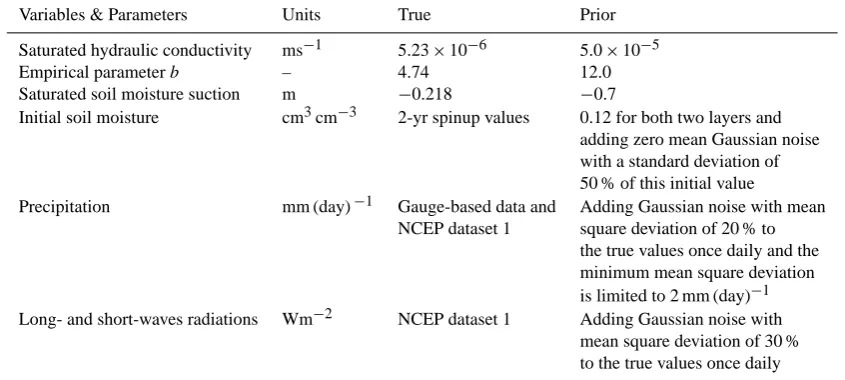
Table 1. Specific differences of soil hydraulic parameters, initial soil moisture condition, and meteorological forcing data between “true”
and “prior” model integrations in the identical twin experiments.
Variables & Parameters Units True Prior
Saturated hydraulic conductivity ms−1 5.23×10⁻⁶ 5.0×10⁻⁵
Empirical parameterb – 4.74 12.0
Saturated soil moisture suction m −0.218 −0.7
Initial soil moisture cm3cm−3 2-yr spinup values 0.12 for both two layers and adding zero mean Gaussian noise with a standard deviation of 50 % of this initial value
Precipitation mm (day)−1 Gauge-based data and Adding Gaussian noise with mean
NCEP dataset 1 square deviation of 20 % to the true values once daily and the minimum mean square deviation is limited to 2 mm (day)−1 Long- and short-waves radiations Wm−2 NCEP dataset 1 Adding Gaussian noise with
mean square deviation of 30 % to the true values once daily
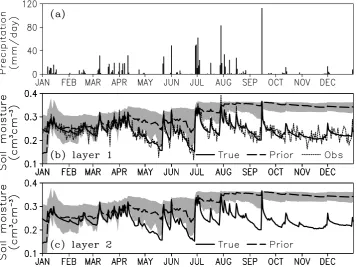
top two layers and the “actual observation” of near surface soil moisture used in identical twin experiment. For errors in hydraulic parameters, initial condition and atmospheric forc-ing data, there were significant deviations from prior states to true states of soil moisture in both layers. Perturbations on forcing data, soil moisture initial conditions and forcing data created large enough ensemble spreads on prior soil moisture for both two layers to maintain the uncertainty in the model-ing prediction. In both soil layers, the ensemble spreads nar-rowed slowly with time and finally maintained an approxi-mate a value of 0.02 cm3cm−3, comparable to the “observed error” in the soil moisture observations.
Given the statistical properties of model errors and ob-servation errors, the EnKF attempts to modify prior state back to the true state by assimilating “actual observations” (Crow and Van Loon, 2006). In the filter, the number of ensemble size was set to 100 in all experiments, achieving a balance between the computational effort of processing a large number of runs and the need for having a sufficiently large set of ensembles to characterize the ensemble distribu-tion. The ensemble of soil moisture initial values was gen-erated by adding zero mean Gaussian noise with a standard deviation of 50 % to the prior values at the first time step. The ensemble of forcing data was generated by perturbing prior forcing data with the same statistical properties as the actual forcing data errors once a day. The random pertur-bation method was also applied to obtain the ensemble of model parameters. A noticeable issue here was the magni-tude of standard deviation of perturbation on model parame-ters because no straightforward guidance exists for the proper range of estimated parameter deviation. Given the difficulty of accurately estimating prior parameter uncertainty in real soil moisture assimilation settings, two kinds of initial
pa-rameter distribution scenarios (hereafter denoted as IPD sce-nario), the narrow IPD (NIPD) scenario and the wide IPD (WIPD) scenario, were considered in this study to fully ex-plore the capability of the EnKF in estimating all these cho-sen hydraulic parameters. In NIPD scenario, initial ensemble spreads of all estimated parameters were small and unable to cover their true values, representing our insufficient knowl-edge about first guess error of these hydraulic parameters. In WIPD scenario, initial ensemble distributions of all pa-rameters were large enough for covering their true values, indicating our satisfactory knowledge about first guess error of all parameters. The prior ensemble mean, standard devi-ation and uncertainty range of all these three parameters in both two IPD scenarios are listed in Table 2. Furthermore, because parameters were not dynamical variables, the vari-ances of them were reduced at the update step but remained constant at the forecast step. This caused the variances of parameters to decrease progressively and may lead to filter divergence in parameters. To avoid filter divergence, there-fore, a small perturbation was implemented on parameters continually in a similar way as that on forcing data according to Eq. (4) with a time interval of 10 days. The standard devia-tions of the small perturbadevia-tions onksat,ψsat, andbwere
cho-sen as 0.8×10⁻⁶ms−1, 0.01 m, and 0.08 respectively, which are much smaller than the orders of parameters themselves. Small standard deviation and sparse perturbation interval on these parameters in the filter processes avoids the behavior of the model being shocked for sharp changes of parameters in model integration.
Fig. 1. The precipitation forcing (a) and soil moisture evolution of the near surface layer (b) and the root zone layer (c) in the identical twin
experiment during 1998 at Jiangji station. The solid line represents the “true” state, the long dash line represents the “prior” state, the short dash line represents the “actual observation” of near surface soil moisture, and the shaded area represents the ensemble spread of the “prior” soil moisture.
Table 2. Specific values of uncertainty range, initial ensemble mean and standard deviation for parametersksat,ψsatandbin both narrow initial parameter distribution (NIPD) scenarios and wide initial parameter distribution (WIPD) scenarios.
Parameter Units Min Max NIPD scenario WIPD scenario
Mean Std. dev. Mean Std. dev.
ksat ms−1 1.1×10⁻⁶ 8.2×10⁻⁵ 5.0×10⁻⁵ 8.0×10⁻⁶ 5.0×10⁻⁵ 3.3×10⁻⁵
ψsat m −0.95 −0.02 −0.7 0.05 −0.7 0.7
b – 1.4 15.5 12.0 0.8 12.0 8.0
were taken into account in the assimilation processes. All constrained relationships considered in this study were soft equality constraints that exist physically for which the model can run through despite these constraints violations. Al-though these constraints differed from hard constraints re-quiring satisfaction in model integration (e.g., inequality straints in Wang et al., 2009), it might retain benefits for con-sideration in the multi-parameter estimation processes un-der ensemble assimilation framework of the EnKF. Given that some studies (e.g., Rawls et al., 1982; Zhuang et al., 2001) did not have all relationships between these three hy-draulic parameters and others (e.g., Schaap and Leij, 2000; van Genuchten, 1980) did not have enough soil classifica-tions as that in the AVIM model, the literature of Cosby et al. (1984) was selected in this study for its unified soil
samples to obtain statistical relationships between parame-tersksat,ψsatandb. Table 5 in Cosby et al. (1984) can be
formulated to explicitly display equality constraints between these three parameters:
1ksat=(β11b−1)ksat (14)
1ψsat=(β21b−1)ψsat (15)
where1ksat,1ψsatand1bare the perturbations of
parame-tersksat,ψsatandbrespectively, andβ1,β2are constrained
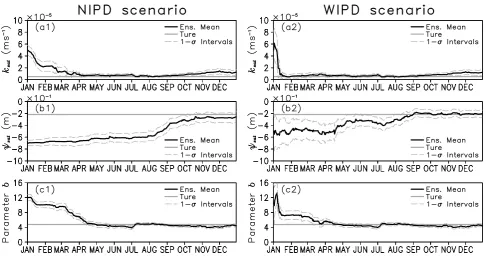
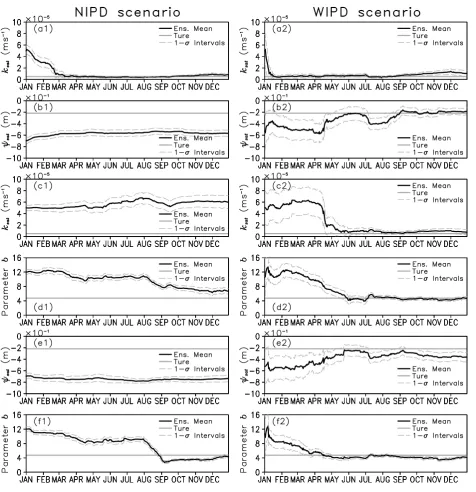
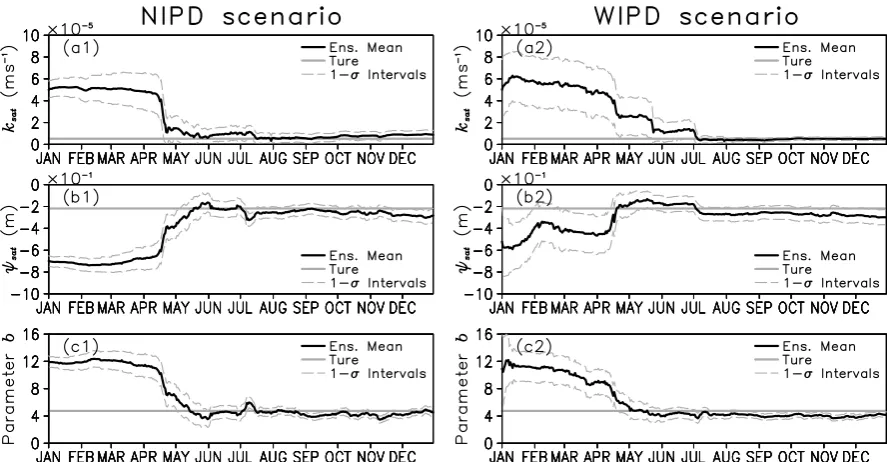
[image:6.595.93.505.438.510.2]Fig. 2. Time evolution of the ensemble mean parameter values (solid black line) vs. the true parameter values (solid gray line) from
single-parameter estimation experiments in NIPD and WIPD scenarios. Estimated single-parameters are (a1), (a2) the saturated hydraulic conductivity;
(b1), (b2) the saturated soil moisture suction; and (c1), (c2) a soil texture empirical parameterb. The area between two dashed gray lines represents the 1-standard deviation (1-σ) intervals of the parameter spread.
4 Results
4.1 Single-parameter estimation results
Results from the individual estimation of these three hy-draulic parameters in both NIPD and WIPD scenarios are presented in Figs. 2 and 3. In each experiment, only one such parameter was perturbed around its imperfect mean value, and other parameters were kept unperturbed at their true val-ues.
Figure 2 illustrates that the one year evolution (once-daily analyses) of the ensemble mean parameter values along with the true parameter values remain constant in time. The area between two dash gray lines around the estimated mean pa-rameter value represents the 1-σ (one standard deviation) limits of the parameter ensemble spread. These standard deviation limits were computed by averaging the standard deviations of each 100-member ensembles at each forecast step. Successful parameter estimation should indicate that the error of the estimated parameter is smaller than or very close to the 1-σ limit. The estimated mean parameter val-ues of all three parameters for both NIPD and WIPD sce-narios converge to their true values within several months, and the true values remain stable within the 1-σ limit sub-sequently. When these model parameters were included in the augmented state vectors of the EnKF, the perturbation of parameter led to the update of soil moisture state to a certain
extent. We assumed the general form of the relationship be-tween the perturbations of these parameters and the update of soil moisture as follows:
1sm∼f1(1ksat)+f2(1ψsat)+f3(1b) (16)
where1ksat,1ψsatand1bare the perturbations of
param-etersksat,ψsat andb, and 1sm is the update of soil
mois-ture. Nonlinear operatorsf1(·),f2(·)andf3(·)denote the
sampled relationships between 1sm and 1ksat, 1ψsat and 1b, respectively. In each single-parameter estimation exper-iment, one of these operators in Eq. (16) is considered in the EnKF update process. In assimilation processes, therefore, the available near surface soil moisture observation informa-tion can be transferred by the operator to correct the error in corresponding imperfect parameter and estimate it success-fully. Further analysis found that the convergence rate of ap-proach to the true values varied among different parameters and different IPD scenarios. We defined “convergence time” as the time taken for a true parameter value to fall first within the 1-σlimit around the estimated mean parameter. The con-vergence times of parametersksatandbwere much less than
that of parameterψsat in both NIPD and WIPD scenarios.
Because the convergence time can scale the efficiency of the EnKF to estimate each parameter to a certain extent, this re-sult implies that near surface soil moisture observations con-tain more useful for parameterksat andb than for
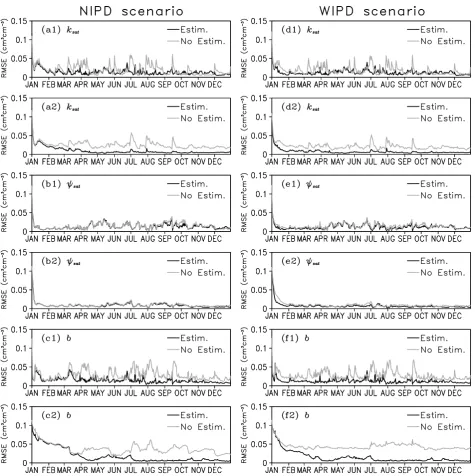
Fig. 3. The time evolution of the root mean squared error (RMSE) of near surface layer soil moisture (a1–f1), and root zone layer soil
moisture (a2–f2) for soil moisture forecasting from single-parameter estimation experiments (solid black lines) compared with that of non-parameter-estimation benchmark experiments (solid gray lines) in both NIPD and WIPD scenarios. Parameters shown are (a1), (a2), (d1),
(d2) the saturated hydraulic conductivity; (b1), (b2), (e1), (e2) the saturated soil moisture suction; (c1), (c2), (f1), (f2) a soil texture empirical
parameterb.
easier to correct than those in parameterψsatby assimilating the same soil moisture observation in individual parameter estimation experiments. Moreover, for the same estimated parameter, the convergence time in WIPD scenario was less that in NIPD scenario, indicating that a wider prior distribu-tion of imperfect parameters can make estimated parameter converge to its true value easier under the same conditions.
In addition to the mean parameter values, the root mean squared error (RMSE) of soil moisture in each forecast step compared to soil moisture “true state” was calculated to de-scribe errors in soil moisture forecasting:
RMSEt=
v u u t
1
n−1 n
X
i=1
Fig. 4. The time evolution of ensemble soil moisture forecasting of near surface layer (a1–f1), and root zone layer (a2–f2) in WIPD scenario. (a1), (a2), (c1), (c2), (e1), (e2) are for non-parameter-estimation benchmark experiments and (b1), (b2), (d1), (d2), (f1), (f2) are for
single-parameter estimation experiments. The estimated single-parameters shown are (a1), (a2), (b1), (b2) the saturated hydraulic conductivity; (c1),
(c2), (d1), (d2) the saturated soil moisture suction; (e1), (e2), (f1), (f2) a soil texture empirical parameterb. The solid line represents the “true” values, the long dash line represents the ensemble mean values, and the shaded area represents the ensemble spread of soil moisture forecasting.
where the subscript “t” represents time step (every day in the experiment period), n is the ensemble member, smit−is the soil moisture forecast states of thettime step, based on pos-terior soil moisture states and parameters of the last assimi-lation time step with perturbed precipitation and radiations. smtruet is the “true state” of soil moisture for thettime step. The evolution of RMSE for soil moisture forecasting in top
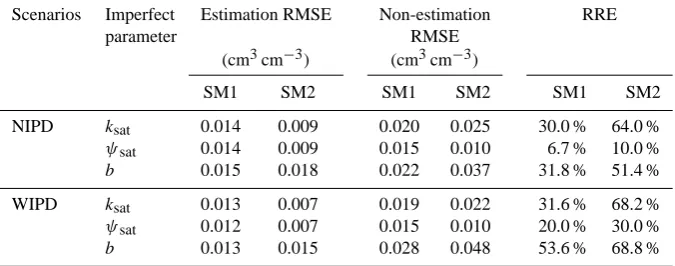
Table 3. Summary of time average root mean squared error (RMSE) and relative root mean squared error (RRE) of soil moisture in
near surface layer (SM1) and root zone layer (SM2) in three single-parameter estimation experiments and corresponding non-parameter-estimation experiments in both NIPD and WIPD scenarios with individual imperfect parameters of the saturated hydraulic conductivityksat, the saturated soil moisture suctionψsat, and a soil texture empirical parameterb, respectively.
Scenarios Imperfect Estimation RMSE Non-estimation RRE
parameter RMSE
(cm3cm−3) (cm3cm−3)
SM1 SM2 SM1 SM2 SM1 SM2
NIPD ksat 0.014 0.009 0.020 0.025 30.0 % 64.0 %
ψsat 0.014 0.009 0.015 0.010 6.7 % 10.0 %
b 0.015 0.018 0.022 0.037 31.8 % 51.4 %
WIPD ksat 0.013 0.007 0.019 0.022 31.6 % 68.2 %
ψsat 0.012 0.007 0.015 0.010 20.0 % 30.0 %
b 0.013 0.015 0.028 0.048 53.6 % 68.8 %
scenarios, the RMSE of both two soil layers in parameter es-timation experiments were lower than that in non-parameter-estimation benchmark experiments for all three parameters. In these identical twin experiments, parameter error was con-sidered one of the main error sources of soil moisture simula-tion. With parameter errors reduced by estimation processes in the EnKF, fewer error contributions from imperfect param-eters can refine the performance of soil moisture forecasting in each estimation experiment.
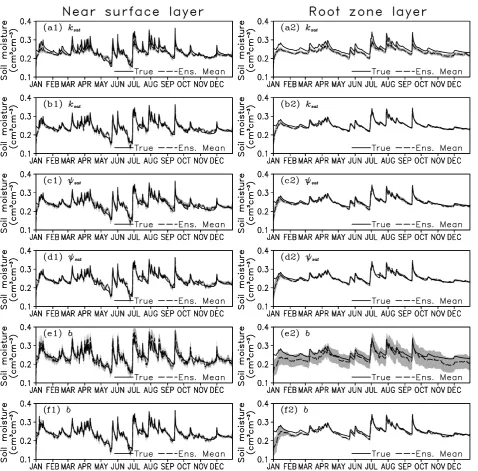
Figure 3 also depicts that the behavior of RMSE evalua-tion of soil moisture forecasting in parameterψsatestimation case is less identifiable than that of parameterksatandb in both scenarios. Taking WIPD scenario as an example, Fig. 4 compares the time evolution of soil moisture forecasting and its ensemble uncertainty in these three single parameter esti-mation experiments. Because the root zone layer is less af-fected by atmosphere forcing and soil moisture observation, the uncertainty of soil moisture forecasting in this layer can reflect the impact of parameter errors to a large extent. The uncertainty of soil moisture forecasting in near surface layer primarily reflects the impact of errors of atmosphere forcing. Errors associated with imperfect parameterksatandbare re-flected in soil moisture forecasting more significantly than those associated with parameterψsat (Fig. 4a2, e2), which leads to large biases in soil moisture ensemble forecasting values compared to their true values. This result implies that errors in these two parameters are comparable to those in soil moisture initial condition and forcing data. For param-eterψsat, because the uncertainty of soil moisture
forecast-ing caused by parameter error (Fig. 4c2) was much smaller than that by errors in initial condition (the first two months in Fig. 4c2) and forcing data (Fig. 4c1), the RMSE evaluation of soil moisture forecasting was less correlated with the error in parameterψsat. Therefore, even when parameterψsatdid
not converge to its true value (before April in Fig. 2b2), the RMSE evolution of soil moisture forecasting was reduced
reasonably (Fig. 4e1, e2) by assimilating near surface soil moisture observation using the EnKF.
Further analysis revealed that the decrease of RMSE from non-parameter-estimation experiments to estimation experi-ments varied among parameters. To quantify relative estima-tion performance, we defined the “relative root mean squared error”, as follows:
RRE=hRMSENo-Estimationi − hRMSEEstimationi hRMSENo-Estimationi
×100% (18) where the operation h·i denotes time average over the en-tire experiment period. The RRE was a relative measure of how much error has been reduced by parameter estima-tion compared to non-parameter-estimaestima-tion benchmark ex-periments. The results of time average RMSE and RRE for single-parameter estimation experiments in both NIPD and WIPD scenarios are summarized in Table 3. The estima-tion experiments in the WIPD scenario had smaller RMSE and larger RRE than those in the NIPD scenario. One possi-ble reason might be that estimation experiments in the WIPD scenario all have less convergence time than that in the NIPD scenario, causing more parameter error reduced by the EnKF estimation processes. The smallest RRE was exhibited by pa-rameterψsatin both NIPD scenario (6.7 %, 10 %) and WIPD scenario (20 %, 30 %). The RRE of parameter ksat and b
were much larger than that of parameterψsat, which were both over 30 % for the near surface layer and even more than 60 % for the root zone layer. This result implies that the soil moisture forecasting is more sensitive to the error in param-eter ksatandb than that in parameterψsat, consistent with
Fig. 5. Same as in Fig. 2 but for three sets of dual-parameter estimation experiments, which are (a1), (a2), (b1), (b2) forksatandψsat set; (c1), (c2), (d1), (d2) forksatandbset; and (e1), (e2), (f1), (f2) forψsatandbset, in both NIPD and WIPD scenarios with mutually independent parameter perturbations.
soil layer had less effect on soil moisture forecasting in the root zone layer. Therefore, with the error in the imperfect pa-rameter reduced by the EnKF, soil moisture forecasting in no observation soil layer can be improved more significantly in any corresponding parameter estimation processes. Combin-ing the previous analyses of ensemble mean parameter val-ues and RMSE, the EnKF-based single-parameter estimation performed successfully in soil moisture assimilation.
4.2 Multi-parameter estimation results
To obtain a comprehensive picture of the EnKF’s capabil-ity and limits in parameter estimation when multiple imper-fect parameters are involved, the results from three sets of dual-parameter estimation experiments and subsequently the three-parameter estimation experiments are presented here.
The dual-parameter experiments were performed with
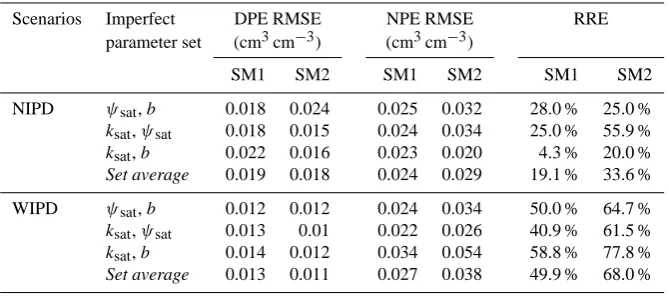
Table 4. Summary of the time average root mean squared error (RMSE) and relative root mean squared error (RRE) of soil moisture in
near surface layer (SM1) and root zone layer (SM2) in three sets of dual-parameter estimation (DPE) experiments (withψsatandb,ksatand
ψsat, andksatandbas imperfect parameters respectively) and corresponding non-parameter-estimation (NPE) experiments in both NIPD and WIPD scenarios.
Scenarios Imperfect DPE RMSE NPE RMSE RRE
parameter set (cm3cm−3) (cm3cm−3)
SM1 SM2 SM1 SM2 SM1 SM2
NIPD ψsat,b 0.018 0.024 0.025 0.032 28.0 % 25.0 %
ksat,ψsat 0.018 0.015 0.024 0.034 25.0 % 55.9 %
ksat,b 0.022 0.016 0.023 0.020 4.3 % 20.0 %
Set average 0.019 0.018 0.024 0.029 19.1 % 33.6 %
WIPD ψsat,b 0.012 0.012 0.024 0.034 50.0 % 64.7 %
ksat,ψsat 0.013 0.01 0.022 0.026 40.9 % 61.5 %
ksat,b 0.014 0.012 0.034 0.054 58.8 % 77.8 %
Set average 0.013 0.011 0.027 0.038 49.9 % 68.0 %
imperfect parameters, respectively. Figure 5 shows the evo-lution of ensemble mean parameter values from these dual-parameter experiments for both NIPD and WIPD scenarios. The performances of simultaneous dual parameter estimation have some deterioration compared to that of individual esti-mations. In the NIPD scenario, only one parameter was es-timated to the true value in setsψsat,b(Fig. 5a1) andksat, ψsat(Fig. 5f1). For theksatandbset, both imperfect param-eters failed estimation, although some convergence of the es-timated value of parameterbto its true value was still notice-able. The estimation performance in the WIPD scenario was better than that in the NIPD scenario. Except for parameter
ψsatin theψsat,bset (Fig. 5e2), all other imperfect param-eters in these three dual-parameter sets were estimated suc-cessfully. Unlike single-parameter estimation case, sampled relationships of two parameters in Eq. (16) need to be consid-ered simultaneously in the EnKF for an increase of imperfect parameters here. Therefore, the degree of freedom in assim-ilation processes increased and made the dual-parameter es-timation unstable and intractable. The comparative results between NIPD and WIPD scenarios imply that wide enough initial perturbation on estimated parameters has positive in-fluences on the performance of estimation. In other words, more ensemble sampling information content in the wide prior distribution of estimated parameters is used to identify the parameters properly.
Table 4 illustrates the time average RMSE and RRE of these three dual-parameter estimation sets. Similar to the sin-gle parameter estimation experiments, the RMSE of all three dual-parameter estimation experiment sets in both NIPD and WIPD scenarios were lower than of non-parameter-estimation benchmark experiments, despite not all incorrect parameters converging to their true values in some cases (Fig. 5). For more error associated with incorrect parameters being reduced by estimation processes, the RRE in WIPD
scenario (49.9 % and 68 % for two layers on set average) was also much larger than that in NIPD scenario (19.1 % and 33.6 % on set average). In general, although some esti-mated parameters had worse estimations compared to single-parameter estimation cases, the estimation with two imper-fect parameters using the EnKF was still beneficial to reduce the parameter-related model error in soil moisture forecast-ing, especially when the prior distribution of estimated pa-rameters was wide enough to cover true values.
When the uncertainty extended to the entire set of three parameters, some significant deterioration of estimation per-formance is occurred (Fig. 6). The estimated ensemble mean values of all three parameters did not converge to their true values throughout the entire experiment period in the NIPD scenario. When the prior distribution of parameter was nar-row, small parameter uncertainty reflected by ensemble sam-pling was not enough for the EnKF to build reasonable en-semble statistical relationships between the enen-sembles of soil moisture observation and all estimated parameters simulta-neously. In the WIPD scenario, as a wider prior distribution of estimated parameters led to more appropriate sampling in-formation included in parameter ensembles, better estimation performances withksat andb converging to their respective true values successfully were obtained compared to that in the NIPD scenario. However, independent random perturba-tions added to different estimated parameters during the up-date process of assimilation may still break the complicated relationships between hydraulic parameters and soil moisture observations easily and may cause the failure in simultaneous estimation of all incorrect parameters. For dealing with all imperfect parameters properly, constraints in Eqs. (14) and (15) (obtained from Cosby et al., 1984) were taken into ac-count for further improving estimation performance.
Fig. 6. Same as in Fig. 2 but for the three-parameter estimation experiments in both NIPD and WIPD scenarios with mutually independent
parameter perturbations.
Fig. 7. Same as in Fig. 2 but for the three-parameter estimation experiments in both NIPD and WIPD scenarios with constrained parameter
perturbations.
perturbation. The evolutions of the ensemble mean parame-ter values are shown in Fig. 7. The estimated ensemble mean values for all three parameters converge to their true values successfully in both NIPD and WIPD scenarios with almost the same convergence time of five months. From the view-point of adding information, imposing constraints between model parameters also adds new information to the EnKF
[image:13.595.75.519.348.579.2]correlation between parameters effectively offset the decline in the estimation power of the EnKF and make all parameters converge to their true values effectively.
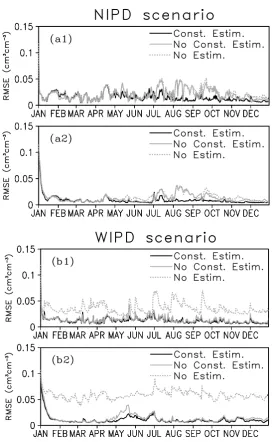
The RMSE evolution of constrained estimation, non-constrained estimation and non-parameter-estimation exper-iments are displayed in Fig. 8. The smallest RMSE for two soil layers are exhibited by constrained estimation experi-ments in both NIPD and WIPD scenarios. In the NIPD sce-nario, the RMSE of soil moisture forecasting were almost the same for those three experiments before May. The reason for coincident RMSE was attributed to the key role of soil mois-ture observation in updating of soil moismois-ture states in this scenario. The evaluation of posterior soil moisture ensembles (Fig. 9) displayed that observation information was enough for the EnKF reducing most of error in soil moisture fore-casting in this assimilation period, even if all estimated pa-rameters had imperfect values (Fig. 9a1, a2). Whereas after the convergence time of all parameters in the constrained es-timation experiment (Fig. 7a1, b1, c1), because all three pa-rameters failed to be estimated in non-constrained estimation experiment in this period (after June in Fig. 6a1, b1, c1), the cumulative effects of parameter error caused positive biases in the ensemble mean of soil moisture forecasting in the dry-ing down periods (Fig. 9a1, a2). The constrained estimation case had more benefits in RMSE evolution compared to its non-constrained counterpart (Fig. 8a1, a2). In the WIPD sce-nario, because more parameter prior uncertainties were in-troduced and kept in the whole EnKF assimilation processes, much large uncertainties were contained in the posterior en-sembles of soil moisture forecasting in the parameter-estimation experiment (Fig. 9d1, d2). The RMSE in non-estimation experiments (Fig. 8b1, b2) were much larger than that of the NIPD scenario (Fig. 8a1, a2). With larger prior parameter error in this scenario, the soil moisture forecasting errors (combined errors of initial condition, parameter and atmosphere forcing) were much larger than the error in the near surface soil moisture observations at the early stage of the EnKF assimilation processes (Fig. 9e1, e2, f1, f2). In this case, although all three parameters did not converge to their true values in both constrained and non-constrained es-timation experiments before April (Figs. 6 and 7), the RMSE of soil moisture forecasting in these two experiments can also converge to an equivalent low level as observation er-ror within several assimilation cycles (Fig. 8b1, b2). After June, as all three parameters in constrained estimation exper-iment (Fig. 7a2, b2, c2) and two key parameter ksat andb
in non-constrained estimation experiment (Fig. 6a2, c2) was successfully estimated by the EnKF, the performance of con-strained estimation experiment actually benefited little from these additional constraints between parameters in the last half year in the WIPD scenario. Figures 8b1, b2 indicate that the RMSE of constrained estimation experiment was slightly smaller compared to corresponding non-constrained estima-tion experiment, although it was still significantly smaller than that of non-parameter-estimation experiment.
4.3 Sparse observation assimilation results
Actual conventional in situ soil moisture observations in China and other areas in the world were sparse in time with a measurement interval of about 10 days (Robock et al., 2000; Nie et al., 2008). For the future application of the constrained multi-parameter estimation method in assimilating actual in situ soil moisture, its performance with temporally sparse observation conditions were tested and are discussed in this subsection.
Results from experiments with 10-day assimilation inter-val are shown in Figs. 10 and 11. Figure 10 illustrates that the performances of ensemble mean values for all parameters were similar to that of one-day assimilation interval experi-ments, especially in the NIPD scenario, even if much less soil moisture observation information was assimilated in this case. In constrained estimation experiments, all three param-eters successfully converged to true values in both NIPD and WIPD scenarios. However, the situation was not satisfied for the non-constrained experiments, in which the estimations for most of estimated parameters failed. Less available soil moisture observation information assimilated in the EnKF weakened the role of the EnKF on reducing uncertainties in wide prior parameter distributions. Therefore, the 1-σ in-tervals in the WIPD scenario here (e.g., Fig. 10a2, d2) were larger than those of corresponding one-day assimilation in-terval experiments. The RMSE evolution in Fig. 11 depicts that the smallest RMSE were exhibited by constrained es-timation experiments in both NIPD and WIPD scenarios as that in one-day assimilation interval case. With much less soil moisture observation information used to reduce model errors and improve the performance of the EnKF, the RMSE of soil moisture forecasting was always larger than that in one-day assimilation interval case.
Fig. 8. Same as in Fig. 3 but for the time evolution of RMSE of near surface layer soil moisture (a1), (b1) and root zone layer soil moisture (a2), (b2) from the constrained (solid black lines) and non-constrained (solid gray lines) three-parameter estimation experiments in both
NIPD and WIPD scenarios corresponding to Figs. 5 and 6, respectively. Short dashed gray lines represent RMSE from non-parameter-estimation benchmark experiment.
all imperfect parameters simultaneously, causing significant increases of RRE from the non-constrained estimation exper-iment (less than 10 %) to the constrained estimation experi-ment (more than 30 %). In the WIPD scenario, as the non-constrained estimation experiments already have good esti-mation performance (e.g., Fig. 10e2, f2), the advantage of the constrained estimation method compared to unconstrained method in the RMSE of soil moisture forecasting was not as significant as that in the NIPD scenario. In this scenario, the RRE of constrained estimation experiments were slightly larger than that of non-constrained estimation experiments for all assimilation intervals.
Fig. 9. The time evolution of ensemble soil moisture forecasting of near surface layer (a1–f1), and root zone layer (a2–f2) in both NIPD (a–c) and WIPD (d–f) scenarios. (a1), (a2), (d1), (d2) are for non-parameter-estimation benchmark experiments, (b1), (b2), (e1), (e2) are for
non-constrained three parameter estimation experiments and (c1), (c2), (f1), (f2) are for constrained three parameter estimation experiments. The solid line represents the “true” values, the long dash line represents the ensemble mean values, and the shaded area represents the ensemble spread of soil moisture forecasting.
certain period (e.g., one month), making it difficult to over-come the accumulation of errors in soil moisture state in the process of model integration. Therefore, when the parameter uncertainties reflected by ensemble were insufficient, proper assimilation frequency (about once 10 or 20 days here) dis-played the greatest advantages of this constrained estima-tion method in soil moisture assimilaestima-tion using the EnKF. Whereas in WIPD scenario, the 1-day assimilation interval
Fig. 10. Same as in Fig. 2 but for the constrained three-parameter estimation experiments (a1), (a2), (b1), (b2), (c1), (c2) and non-constrained
three-parameter estimation experiments (d1), (d2), (e1), (e2), (f1), (f2) in both NIPD and WIPD scenarios with 10-day assimilation interval.
5 Conclusions
This study explores the applicability of the EnKF-based state-parameter estimation in soil moisture data assimilation using a physical process land surface model by a series of identical twin experiments. Uncertainties in model parame-ters, soil moisture initial condition and atmospheric forcing data were considered primary sources of model errors. By the means of state augmentation, model-based pseudo near surface soil moisture observations estimated model
param-eter and soil moisture state simultaneously. Three key hy-draulic parameters: the saturated hyhy-draulic conductivityksat,
the saturated soil moisture suctionψsatand a soil texture
Fig. 11. Same as in Fig. 3 but for the time evolution of RMSE of near surface layer soil moisture (a1), (b1) and root zone layer soil moisture (a2), (b2) from the constrained (solid black lines) and non-constrained (solid gray lines) three-parameter estimation experiments in both
NIPD and WIPD scenarios with 10-day assimilation interval corresponding to Fig. 8. Short dashed gray lines represent RMSE from the non-parameter-estimation benchmark experiment.
knowledge about the first guess error of these hydraulic pa-rameters and the wide IPD (WIPD) scenario indicating we know enough about the first guess error of all parameters.
The estimation of single imperfect parameter was suc-cessful for all three estimated parameters in both NIPD and WIPD scenarios. The ensemble mean value of each esti-mated parameters converge to its true value successfully. In-creasing the number of imperfect parameters led to a de-cline in the performance of parameter estimation, especially
Table 5. Summary of the time average root mean squared error (RMSE) and relative root mean squared error (RRE) of soil moisture in
near surface layer (SM1) and root zone layer (SM2) in three-parameter constrained estimation (CE) experiments, non-constrained estimation (NCE) experiments, and non-parameter-estimation (NPE) experiments in both NIPD and WIPD scenarios with assimilation intervals of 1 day, 10 days, 20 days, 30 days and 40 days, respectively.
Scenarios Assimilation CE RMSE NCE RMSE NPE RMSE CE RRE NCE RRE
intervals (cm3cm−3) (cm3cm−3) (cm3cm−3) (%) (%)
SM1 SM2 SM1 SM2 SM1 SM2 SM1 SM2 SM1 SM2
NIPD 1 day 0.015 0.009 0.021 0.013 0.022 0.014 31.8 35.7 4.5 7.1
10 days 0.028 0.020 0.042 0.031 0.046 0.034 39.1 41.2 8.7 8.8
20 days 0.034 0.025 0.053 0.041 0.054 0.043 37.0 41.9 1.9 4.7
30 days 0.039 0.031 0.056 0.045 0.059 0.047 33.9 34.0 5.1 4.3
40 days 0.043 0.035 0.060 0.049 0.063 0.052 31.7 32.7 4.8 5.8
WIPD 1 day 0.012 0.011 0.014 0.014 0.036 0.059 66.7 81.3 61.1 76.3
10 days 0.026 0.021 0.029 0.026 0.045 0.053 42.2 60.4 35.6 50.9
20 days 0.032 0.027 0.035 0.029 0.055 0.059 41.8 54.2 36.4 50.8
30 days 0.035 0.029 0.036 0.031 0.057 0.058 38.6 50.0 36.9 46.6
40 days 0.036 0.031 0.037 0.031 0.059 0.059 39.0 47.5 38.3 47.5
RMSE was still superior to the non-parameter-estimation benchmark experiments with parameter error reduced in the estimation processes. The failure of estimation was ascribed to independent perturbations on different estimated parame-ters, causing the increase of degree of freedom of assimila-tion system and the breakage of the statistical relaassimila-tionships between these parameters in assimilation processes.
A strategy of considering constraints between estimated hydraulic parameters in the filter was introduced to improve the performance of estimating all three imperfect parameters simultaneously. The constraints used were obtained from Cosby et al. (1984), and are the approximation to actual statistical relationships between these parameters. The per-formance of the constrained three-parameter estimation was successful, even if observations were available with tempo-rally sparse intervals such as 10 days or much longer. From the viewpoint of adding information, imposing the equality constraints between estimated parameters also adds new in-formation to the EnKF assimilation system and the available observations, namely, the statistical balance correlation be-tween these parameters. For this reason, the constrained esti-mation method effectively overcame the negative impacts of the non-closure problem in the multi-parameter estimation, especially for the NIPD scenario which features an insuffi-cient guess for the prior error of estimated parameters.
Compared to non-parameter-estimation and non-constrained estimation cases, the constrained three-parameter estimation case can reduce RMSE in soil moisture forecasting much more. The benefits of this constrained estimation method in estimating all imperfect parameters simultaneously are fully demonstrated when the corre-sponding non-constrained estimation case has a relatively poor performance for parameter estimation as in the NIPD
[image:19.595.66.533.120.289.2]Acknowledgements. The authors wish to thank the National
Meteorological Information Center of China Meteorological Ad-ministration for the meteorological forcing data used in this study. We would like to thank H. Moradkhani and two other anonymous reviewers for their constructive comments. This research was supported by the National Natural Science Foundation of China (Contract No. 40905046, 40437017 and 40221503), the Chinese Academy of Science (Contract No. KZCX2-YW-202), the National High Technology Research and Development Program of China (Grant No. 2009AA1220005, 2009BAC51B03), and the National Basic Research Program of China (973 Program: 2010CB951902).
Edited by: Y. Liu
References
Aksoy, A., Zhang, F., and Nielsen-Gammon, J. W.: Ensemble-based simultaneous state and parameter estimation in a two-dimensional sea-breeze model, Mon. Weather Rev., 134, 2951– 2970, 2006.
Anderson, J. L.: An ensemble adjustment Kalman filter for data assimilation, Mon. Weather Rev., 129, 2884–2903, 2001. Annan, J. D., Hargreaves, J. C., Edwards, N. R., and Marsh, R.:
Parameter estimation in an intermediate complexity earth system model using an ensemble Kalman filter, Ocean Modell., 8, 135– 154, 2005.
Burgers, G., van Leeuwen, P. J., and Evensen, G.: Analysis scheme in the ensemble Kalman filter, Mon. Weather Rev., 126, 1719– 1724, 1998.
Chen, M., Liu, S., Tieszen, L. L., and Hollinger, D. Y.: An im-proved state-parameter analysis of ecosystem models using data assimilation, Ecol. Model., 219, 317–326, 2008.
Clapp, R. B. and Hornberger, G.. M.: Empirical equations for some soil hydraulic properties, Water Resour. Res., 14, 601–604, 1978. Cosby, B. J., Hornberger, G. M., Clapp, R. B., and Ginn, T. R.: A statistical exploration of the relationships of soil moisture char-acteristics to the physical properties of soils, Water Resour. Res., 20(6), 682–690, 1984.
Cornelis, W., Ronsyn, M. J., van Meirvenne, M., and Hartmann, R.: Evaluation of pedotransfer functions for predicting the soil mois-ture retention curve, Soil Sci. Soc. Am. J., 65, 638–648, 2001. Coudert, B., Ottl´e, C., Boudevillain, B., Demarty, J., and
Guille-vic, P.: Contribution of thermal infrared remote sensing data in multiobjective calibration of a dual-source SVAT model, J. Hy-drometeorol., 7, 404–420, 2006.
Crow, W. T. and van den Berg, M. J.: An improved approach for estimating observation and model error parameters in soil moisture data assimilation, Water Resour. Res., 46, W12519, doi:10.1029/2010WR009402, 2010.
Crow, W. T. and Van Loon, E.: Impact of incorrect model error assumptions on the sequential assimilation of remotely sensed surface soil moisture, J. Hydrometeorol., 7, 421–432, 2006. Dechant C. and Moradkhani H.: Radiance data assimilation for
op-erational snow and streamflow forecasting, Adv. Water Resour., 34, 351–364, 2010.
Dickinson, R., Henderson-Sellers A., and Kennedy P.: Biosphere-Atmosphere Transfer Scheme (BATS) version 1e as coupled to the NCAR Community Climate Model, NCAR Tech. Note TN-387+STR, Natl. Cent. for Atmos. Res., Boulder, Colo, 1993.
Evensen, G.: Sequential data assimilation with a nonlinear quasi-geostrophic model using Monte Carlo methods to forecast error statistics, J. Geophys. Res., 99(C5), 10143–10162, 1994. Evensen, G.: The ensemble Kalman filter: Theoretical formulation
and practical implementation, Ocean Dyn., 53, 343–367, 2003. Franssen H. J. H. and Kinzelbach W.: Real-time groundwater flow
modeling with the Ensemble Kalman Filter: Joint estimation of states and parameters and the filter inbreeding problem, Water Resour. Res., 44, W09408, doi:10.1029/2007WR006505, 2008. Fujiyoshi, Y., Ding, Y. H., and Zhang, Y.: Outline of
GAME/HUBEX, in: Final Report of GAME/HUBEX, Edited by: Fujiyoshi, Y., and Ding, Y. H., GAME/HUBEX Project Of-fice, Beijing, 1–6, 610 pp., 2006.
Houser, P. R., Shuttleworth, W. J., Famiglietti, J. S., Gupta, H. V., Syed, K. H., and Goodrich, D. C.: Integration of soil moisture remote sensing and hydrologic modeling using data assimilation, Water Resour. Res., 34, 3405–3420, 1998.
Ji, J. J.: A climate-vegetation interaction model: Simulating physi-cal and biologiphysi-cal processes at the surface, J. Biogeogr., 22, 445– 451, 1995.
Ji, J. J. and Hu, Y.: A simple land surface process model for use in climate studies, Acta. Meteorologic. Siniea, 3, 342–351, 1989. Jung, Y., Xue, M., and Zhang, G.: Simultaneous estimation of
mi-crophysical parameters and the atmospheric state using simu-lated polarimetric radar data and an ensemble Kalman filter in the presence of an observation operator error, Mon. Weather Rev., 138, 539–562, doi:10.1175/2009MWR2748.1, 2010.
Kalman, R. and Bucy, R.: New results in linear prediction and fil-tering theory, Trans. AMSE J. Basic Eng., 83D, 95–108, 1961. Leisenring M. and Moradkhani, H.: Snow water equivalent
estima-tion using Bayesian data assimilaestima-tion methods, Stoch. Environ. Res. Risk Assess., 25, 253–270, doi:10.1007/s00477-010-0445-5, 2010.
Margulis, S. A., McLaughlin, D., Entekhabi, D., and Dunne, S.: Land data assimilation and estimation of soil mois-ture using measurements from the Southern Great Plains 1997 Field Experiment, Water Resour. Res., 38, 1299, doi:10.1029/2001WR001114, 2002.
Montaldo, N., Albertson, J. D., and Mancini, M.: Dynamic cali-bration with an ensemble Kalman filter based data assimilation approach for root-zone moisture predictions, J. Hydrometeorol., 8, 910–921, 2007.
Montzka, C., Moradkhani, H., Weihermuller, L., Canty, M., Hen-dricks Franssen, H. J., and Vereecken, H.: Hydraulic parame-ter estimation by remotely-sensed top soil moisture observations with the particle filter, J. Hydrol., 399, 410–421, 2011.
Moradkhani H., Hsu, K., Gupta, H. V., and Sorooshian, S.: Un-certainty assessment of hydrologic model states and parameters: Sequential data assimilation using the particle filter, Water Re-sour. Res., 41, W05012, doi:10.1029/2004WR003604, 2005a. Moradkhani, H., Sorooshian S., Gupta, H. V., and Houser, P.: Dual
State-Parameter Estimation of Hydrological Models using En-semble Kalman Filter, Adv. Water Resour., 28, 135–147, 2005b. Nie, S., Luo, Y., and Zhu, J.: Trends and scales of observed soil moisture variations in China, Adv. Atmos. Sci., 25(1), 43–58, 2008.
into a land surface model, J. Geophys. Res., 111, D20102, doi:10.1029/2006JD007190, 2006.
Niyogi, D. S., Xue, Y., and Raman, S.: Hydrological land surface response in a tropical regime and a midlatitudinal regime, J. Hy-drometeorol., 3, 39–56, 2002.
Qin, J., Liang, S., Yang, K., Kaihotsu, I., Liu, R., and Koike, T.: Simultaneous estimation of both soil moisture and model parameters using particle filtering method through the assim-ilation of microwave signal, J. Geophys. Res., 114, D15103, doi:10.1029/2008JD011358, 2009.
Rawls, W. J., Brakensiek, D. L., and Saxton, K. E.: Estimation of soil water properties, Trans. Amer. Soc. Agric. Eng., 25, 1316– 1320, 1982.
Reichle R. H. and Koster, R. D.: Global assimilation of satel-lite surface soil moisture retrievals into the NASA Catch-ment land surface model, Geophys. Res. Lett., 32, L02404, doi:10.1029/2004GL021700, 2005.
Reichle, R. H., Crow, W. T., and Keppenne, C. L.: An adaptive ensemble Kalman filter for soil moisture data assimilation, Water Resour. Res., 44, W03423, doi:10.1029/2007WR006357, 2008. Reichle, R. H., Entekhabi, D., and McLaughlin, D. B.:
Downscal-ing of radio brightness measurements for soil moisture estima-tion: A four-dimensional variational data assimilation approach, Wate Resour. Res., 37, 2353–2364, 2001a.
Reichle, R. H., McLaughlin, D. B., and Entekhabi, D.: Variational data assimilation of microwave radiobrightness observations for land surface hydrologic applications, IEEE Trans. Geosci. Re-mote Sens., 39, 1708–1718, 2001b.
Reichle, R. H., McLaughlin, D. B., and Entekhabi, D.: Hydrologic data assimilation with the ensemble Kalman filter, Mon. Weather Rev., 130, 103–114, 2002a.
Reichle, R. H., Walker, J. P., Koster, R. D., and Houser, P. R.: Ex-tended versus ensemble Kalman filtering for land data assimila-tion, J. Hydrometeor., 3, 728–740, 2002b.
Robock, A., Vinnikov, K. Y., Srinivasan, G., Entin, J. K., Hollinger, S. E., Speranskaya, N. A., Liu, S., and Namkhai, A.: The global soil moisture data bank, B. Am. Meteorol. Soc., 81, 1281–1299, 2000.
Schaap, M. G. and Leij, F. J.: Improved prediction of unsaturated hydraulic conductivity with the Mualem-van Genuchten model, Soil Sci. Soc. Am. J., 64, 843–851, 2000.
van Genuchten, M. T.: A closed-form equation for predicting the hydraulic conductivity of unsaturated soils, Soil Sci. Soc. Am. J., 44, 892–898, 1980.
Wang, D., Chen, Y., and Cai, X.: State and parameter estimation of hydrologic models using the constrained ensemble Kalman filter, Water Resour. Res., 45, W11416, doi:10.1029/2008WR007401, 2009.
Walker, J. P. and Houser, P. R.: A methodology for initializing soil moisture in a global climate model: Assimilation of near surface soil moisture observations, J. Geophys. Res., 106, 11761–11774, 2001.
Wen, L., Gallichand, J., Viau, A. A., Delage, Y., and Benoit, R.: Calibration of the CLASS model and its improvement under agri-cultural conditions, T. ASAE, 41, 1345–1351, 1998.
Wosten, J., Pachepsky Y., and Rawls W.: Pedotransfer functions: bridging the gap between available basic soil data and missing soil hydraulic characteristics, J. Hydrol., 251, 123–150, 2001. Xia, Y., Pitman, A. J., Gupta, H. V., Leplastrier, M.,
Henderson-Sellers, A., and Bastidas, L. A.: Calibrating a land surface model of varying complexity using multicriteria methods and the Cabauw dataset, J. Hydrometeorol., 3, 181–194, 2002.
![catena Poly[[bis(4 chloromethylpyridine κN)cobalt(II)] di μ dicyanamido κ2N1:κ2N5]](data:image/gif;base64,R0lGODlhAQABAIAAAP///wAAACH5BAEAAAAALAAAAAABAAEAAAICRAEAOw==)