Public Health Theses School of Public Health
Spring 5-15-2015
Examining Parental Generalization of the SafeCare®
Child Health Module Using Smartphone
Enhancements
Rachel Atkinson
Follow this and additional works at:https://scholarworks.gsu.edu/iph_theses
This Thesis is brought to you for free and open access by the School of Public Health at ScholarWorks @ Georgia State University. It has been accepted for inclusion in Public Health Theses by an authorized administrator of ScholarWorks @ Georgia State University. For more information, please contact
Recommended Citation
Atkinson, Rachel, "Examining Parental Generalization of the SafeCare® Child Health Module Using Smartphone Enhancements." Thesis, Georgia State University, 2015.
Examining Parental Generalization of the SafeCare® Child Health Module Using
Smartphone Enhancements
By
Rachel Atkinson
Master of Public Health GEORGIA STATE UNIVERSITY
A Thesis Submitted to the Graduate Faculty of Georgia State University in Partial Fulfillment of the Requirements for the Degree
MASTER OF PUBLIC HEALTH
ATLANTA, GEORGIA 30303
TABLE OF CONTENTS
ACKNOWLEDGMENTS ...iii
LIST OF TABLES……….iv
INTRODUCTION...8
REVIEW OF THE LITERATURE...8
2.1 Child Maltreatment……….………….8
2.2 Medical Neglect………..9
2.3 Sequela…………...10
2.4 Health Education...12
2.5 SafeCare……….………..………13
2.6 Technology……….14
2.7 Health Studies………..16
2.8 Generalization of Intervention………..17
2.9 Current Study………..17
METHODS AND PROCEDURES………... 18
3.1 Participants………18
3.2 Materials………..20
3.3 HV Training…………...22
3.4 Reliability Training...22
3.5 Assessment………23
3.6 Consumer Satisfaction………25
3.7 Experimental Design………25
3.8 Experimental Procedures……….………26
3.9 Follow Up………28
RESULTS...28
DISCUSSION AND CONCLUSION... 36
5.2 Limitations………...40
5.3 Conclusions and Future Study...43
REFERENCES...44
APPENDICES………...48
Acknowledgements
Thank you to my advisors and my family and friends for the encouragement and
guidance throughout the research and writing experience.
List of Tables
Table 1 Mothers’ Demographics
Table 2 Scenario Prompts
Table 4 Cell Phone Protocol
APPROVAL PAGE
EXAMINING PARENTAL GENERALIZATION OF THE SAFECARE CHILD HEALTH MODULE USING SMARTPHONE ENHANCEMENTS
By
Rachel Atkinson
Notice to Borrowers Page
All theses deposited in the Georgia State University Library must be used in accordance with the stipulations prescribed by the author in the preceding statement.
The author of this thesis is: Rachel Atkinson
P.O. Box 3995
Atlanta, Georgia 30302-‐3995
The Chair of the committee for this thesis is: John R. Lutzker
Department: Institute of Public Health College: Health and Human Sciences Georgia State University
P.O. Box 3995
Atlanta, Georgia 30302-‐3995
Users of this thesis who not regularly enrolled as students at Georgia State University are required to attest acceptance of the preceding stipulation by signing below.
Libraries borrowing this thesis for the use of their patrons are required to see that each user records here the information requested.
NAME OF USER ADDRESS DATE TYPE OF USE (EXAMINATION ONLY OR
COPY)
Abstract
Child maltreatment is a serious public health problem that leads to psychological,
physical, behavioral, and economic burdens for children and broader community.
Current data suggest that child maltreatment has declined over the past 20 years
with the smallest declines in child neglect. In 2013, medical neglect represented
approximately 31% of all substantiated cases of child maltreatment. SafeCare® is an
evidence-‐based home visiting program that targets risk factors for child
maltreatment by providing three modules: home safety, health, and parent-‐child
interaction, or parent-‐infant interaction for children who are not walking. The
SafeCare health module aims to teach parents how to identify and treat their
children when they become ill, reducing the potential for medical neglect. Previous
SafeCare research demonstrated that incorporating cell phones into training
improves home safety and parent-‐child interaction outcomes. The current research
evaluated the SafeCare health module and the effect cell phone enhancements had
on parents’ child health knowledge. Data reaffirm the value of the SafeCare health
module to increase parental child health skills and that incorporating cell phone
technology may promote generalization and may engage participants and increase
effectiveness.
Examining Parental Generalization of the SafeCare® Child Health Module Using
Smartphone Enhancements
Literature Review
Child Maltreatment
Child maltreatment is a serious public health problem that leads to
psychological, physical, behavioral, and economic burdens for not only children
experiencing the trauma, but for the broader community as a whole. Child
maltreatment is defined as “any act or series of acts of commission or omission by a
parent or other caregiver (e.g., clergy, coach, teacher) that results in harm, potential
for harm, or threat of harm to a child” (Centers for Disease Control and Prevention
[CDC], 2014). Forms of child maltreatment include: physical abuse, sexual abuse,
psychological abuse, physical neglect, emotional neglect, medical/dental neglect,
educational neglect, inadequate supervision or exposure to violent environments.
The United States Department of Health and Human Services (2015) reported that
in 2013, there were 3.4 million referrals made nationwide to Child Protective
Services (CPS), which included 6.3 million children. There were 678,810 unique
victim accounts of child abuse and neglect nationally. In Georgia, there were
110,323 CPS reports and 18,752 child victims and 71 child fatalities. Child
maltreatment comes with a cost that rivals high profile public health problems such
as stroke and Type 2 diabetes. Fang and colleagues (2012) reported that the total
lifetime economic burden from new cases of child maltreatment in the United States
in 2008 was approximately $124 billion. Rovi, Chen, and Johnson (2004) reported
likely to die during hospitalization, have longer stays, receive twice the number of
diagnoses, and incur double the charges than non-‐maltreated hospitalized children.
The same study also showed the primary form of payment was Medicaid (66.5%)
for maltreatment-‐related hospitalizations versus 37.0% of non-‐maltreatment
related hospital stays. Child maltreatment is a serious public health concern that has
many consequences including excessive risky behaviors, criminal activity,
proneness to victimization, perpetuating further violence, and emotional and
physical disturbances (Felitti, et al., 1998).
Current data suggest that child maltreatment has declined over the past 20
years in the areas of emotional child abuse and sexual abuse (Finkelhor, Shattuck,
Turner, & Hamby, 2013), but not dramatically in child neglect (Finkelhor, Jones, &
Shattuck, 2013), which remains the most prevalent type of child maltreatment in the
United States. Child neglect is defined by the World Health Organization (1999) as
the failure to provide for the development of the child in all categories: health,
education, development, nutrition, shelter, and safe living conditions. Failure to
provide must be examined from a context that considers the resources realistically
available to the caretakers of a child or has a high likelihood of causing damage to
the child’s health or physical, mental, spiritual, moral, or social development.
Medical Neglect
The National Child Abuse and Neglect Data System (NCANDS) divides neglect
into four categories: physical, educational, emotional/psychological, and medical.
Medical neglect is defined by the failure to provide necessary healthcare for a child
acute illness and ignoring recommended treatment options when a child has a
chronic illness resulting in numerous hospital visits or a deteriorating health status.
According to the Child Welfare Information Gateway (2012), in 2011, medical
neglect represented approximately 31% of all substantiated cases of child
maltreatment, representing over 15,000 children. Approximately 34% of the
children experiencing medical neglect were younger than 3-‐years-‐old and
approximately 75% were under 12-‐years-‐old.
Sequela
The Adverse Childhood Experiences (ACE) studies, executed and funded by
the CDC and the Kaiser Permanente Department of Preventative Medicine were
originally conducted to examine the lasting effects on adults who experienced child
abuse, neglect, or other childhood traumatic experiences. The ACE study examined
retrospective survey data from over 17,000 participants who reported their
physical health and their adverse childhood experiences of abuse (emotional,
physical, and sexual), neglect (emotional and physical), and household dysfunction
(i.e., mental illness, substance abuse, domestic violence, etc.). The amount of
exposure to adverse childhood experiences was related and highly predictive of
multiple risk factors for many poor health outcomes, including death (Felitti et al.,
1998). Hanson et al., (2014) examined the effects of early life stress (ELS) on the
development of the hippocampus and amygdala. The ELS of interest was physical
abuse, neglect, and/or low socioeconomic status. The hippocampus is involved in
learning, memory, and stress response, while the amygdala is responsible for
make it difficult to recognize important social stimuli. Hanson et al (2014) found
that children who had been exposed to physical abuse or came from a low
socioeconomic background were found to have smaller hippocampal regions and
children exposed to greater cumulative stress and expressed behavioral problems
were found to have smaller hippocampal and amygdala regions. Thus, there is
evidence that experiencing adverse circumstances at an early age is associated with
structural differences in the brain.
Jinseok (2009) used the National Longitudinal Study of Adolescent Health
(Add Health) to examine intergenerational transmission of child abuse (ITCA) and
to compare the patterns of transmission of physical abuse and neglect. The original
Add Health study longitudinally examined a nationally representative population of
adolescents’ health related behaviors. The study by Jinseok and colleagues (2009),
examined responses from adolescents in grades 7 through 12 and compared their
responses when interviewed again when they were between 18-‐ and 28-‐years old.
The adults who became parents and reported experiencing neglect and physical
abuse in childhood, (grades 7 through 12) were more likely to display neglect and
physical abusive parenting behaviors, respectively. More specifically, parents who
reported being neglected during childhood were 2.6 times more likely to show
neglectful parenting behavior and twice as likely to report physically abusing their
children. Also, parents who recalled being physically abused were 5 times more
likely to report being physically abusive to their children and 1.4 times more likely
In sum, major findings indicate that as exposure to ACEs or early life stress
increase, so does the risk for health problems later in life including, but not limited
to: alcoholism, depression, drug use, liver disease, suicide attempts, smoking, risk
for intimate partner violence, and sexually transmitted diseases, (CDC, 2014). The
ACE studies provide an example of why prevention and intervention of child
maltreatment is so critical.
Health Education
Health literacy is a factor that considerably impacts child health education
and how it is effectively communicated to parents. While there is no single definition
for the concept of health literacy, the Institute of Medicine’s proposed definition is
the ability of individuals to attain, process, and recognize basic health information
and services needed to make correct health decisions (Nielsen-‐Bohlman, 2004). The
health decisions relied upon by parents to make include prevention of diseases (e.g.,
immunizations), management of chronic diseases, and recognizing when it is
appropriate to take their child for medical appointments (Moore, Robert, Perry, &
Derek, 2013). Nielsen-‐Bohlman (2004), reports that almost half of all American
adults have difficulty understanding health information, thus affecting their ability
to use subsequent information appropriately.
Low health literacy leads to decreased use of preventative care services
(Dewalt, Berkman, Sheridan, Lohr, & Pignone, 2004) and results in increased health
care costs, estimated up to $73 billion dollars (Friedland & O’Neill, 1998). A parental
low health literacy negatively impacts adults’ health outcomes as well as child
measured the health literacy of 503 caregivers in a pediatric emergency
department, and found that 55% demonstrated low health literacy. Low health
literacy was found to be a predictor of non-‐urgent emergency room use. DeWalt and
Hink (2009) found that parents with low health literacy had less knowledge about
health and made choices that were less advantageous for their children’s health
compared to those with higher literacy. Materials and the messages portrayed at the
appropriate literacy level have the potential to improve child health outcomes,
especially in families with the most social adversity (Davis, 2013).
SafeCare
SafeCare is an evidence-‐based home visiting program that targets risk-‐
factors for child maltreatment by providing three modules: home safety, health, and
parent-‐child interaction (or parent-‐infant interaction) for children under 5-‐years
old. The purpose of the home safety module, the focus of the present research, is to
reduce and eliminate hazards in the home as well as to prevent unintentional injury
to children. The health module teaches parents how to identify and treat their
children when they are ill. The parent-‐child interaction (PCI) module provides
parents with skills to improve child behavior, and the parent-‐infant interaction (PII)
module teaches parents how to interact verbally and physically with their infants.
The SafeCare model has demonstrated noteworthy improvements in targeted
parent behaviors. For example, Gershater-‐Molko and colleagues (2003) found an
84% increase in positive parenting skills (i.e., home safety, child health and parent-‐
child interactions) taught through SafeCare. Similarly, Guastaferro and colleagues
at improving parenting skills. Chaffin and colleagues (2012) found that when
recidivism outcomes of SafeCare were compared to enhanced services as usual,
SafeCare was more effective at reducing recidivism.
Technology
Cell phones are easily accessible and widely used by persons of all income
levels (Brenner, 2013). The Pew Research Center reported that as of January 2014,
98% of people ages 18-‐26, 97% of people ages 30-‐49 had a cell phone and 84% of
those with an annual household income under $30,000 had a cell phone.
Smartphone ownership has increased from 35% in 2011 to 58% in 2014, and the
trend of increasing ownership is seen in other devices as well, such as, desktop or
laptop, eBook reader, tablet computer, mp3 player, and game console (Pew
Research Center, 2014). Taking into consideration that the largest percent of child
maltreatment perpetrators (40.5%) are between the ages of 25-‐34 (USHHS, 2015),
there is reason to suggest that technology may be a useful tool in child maltreatment
interventions. As cell phone technology continues to grow and advance it is
important that public health programs incorporate this technology to increase
effectiveness. In a review of mobile phone applications in preventative health it was
found that there are four main areas that are positively impacted: delivering health
information and instruction, successful treatment compliance, chronic disease
monitoring, and providing reminders via text messages (Vodopivec-‐Jamsek, de
Jongh, Gurol-‐Urganci, Atun & Car (2008).
Technology has been found to be useful in identifying child maltreatment
execution of interventions (Self-‐Brown & Whitaker, 2008). Jabaley, Lutzker,
Whitaker, and Self-‐Brown (2011) showed that iPhones were effective in reducing
home safety hazards and that incorporating them into the SafeCare model also
reduced face-‐face time of the home visitor and the families. Bigelow and colleagues
(2008) reported that parents were less likely to drop out of the intervention
program when cell phone technology was incorporated and that parents’ use of
learned parenting skills increased 22% from baseline to postintervention with cell
phones incorporated into the intervention. This demonstrates that cell phones are
helping parents apply parenting techniques and they are integrating them into their
every day lives with ease. In addition, Carta and colleagues (2013) compared
outcomes of mothers receiving Planned Activity Training (PAT), part of the SafeCare
Parent-‐Child Interaction module, with cell phone technology incorporated (CPAT) to
those who received PAT without cellphone technology. PAT is a five-‐session module
that teaches parents how to positively and effectively engage with their children by
establishing rules and limits and providing feedback regarding the child’s behavior
to prevent challenging behavior. Mothers who received CPAT were more likely to
incorporate the newly learned parenting strategies, thus, reducing depression and
stress for the mothers. They also found that the children demonstrated higher rates
of positive engagement and adaptive behaviors. This study found that by enhancing
PAT with cellphone technology, the program had improved effectiveness by
increased use of the learned strategies, higher retention rates, and improved child
engagement.
Health Studies
A meta-‐analysis (Geeraert, Noortgate, Grietens, and Onghena, 2004) found
that early prevention programs aimed for children 3-‐years-‐old and under yielded
significant positive effects for preventing child maltreatment. Participating in early
prevention programs teaches parents how to manage stress and create a positive
learning environment for their children before harmful recurring behaviors are
established (Hawley, 2000; Whitaker, Lutzker & Shelley, 2005). Programs that
incorporate home visitation are effective at preventing maltreatment before it
occurs and preventing recidivism by parents with a substantiated child
maltreatment history (Flaherty, Stirling & The Committee on Child Abuse and
Neglect, 2010; Zielinkski, 2005).
Incorporating written materials into child maltreatment interventions
improves outcomes in a cost-‐effective manner. Herman, Young, Espitia, Fu, and
Farshidi (2009) found a 30% reduction in unnecessary emergency room visits in
low-‐income, minority parents who participated in an intervention using a health aid
book and non-‐emergency medical scenarios. Herman and Jackson (2010) trained
parents how to respond to common childhood illness with a low-‐literacy health
book and found that emergency room and doctor visits decreased as well as missed
days at work or school.
Delgado and Lutzker (1988) found that parents retain health education
knowledge when skills are taught through modeling and role-‐playing followed by
positive practice versus solely using written materials for education purposes.
sufficient English reading ability, will take the time out of their day to read the
information, and that reading alone will be efficient to retain and carry-‐out the
suggested course of action pertaining to child health. However, Delgado and Lutzker
(1988) determined that once parents acquired the skills through practice and role-‐
playing, they were more likely to effectively use the written materials to supplement
their subsequent actions regarding their child’s health.
Generalization of Intervention
Generalization, in relation to this study, is defined as the occurrence of
similar behaviors during non-‐training conditions that were taught during training
(Stokes & Baer, 1977). According to Stokes and Baer (1977), generalization can
occur across subjects, settings, people, behaviors and/or time. McNeil, Eyberg,
Eisenstadt, Newcomb and Funderbuck, (1991) found that children were able to
generalize desired behaviors in the classroom following parent-‐child interaction
therapy in the home. To date, there is little research available demonstrating
generalization of behaviors in child maltreatment interventions.
Current Study
The focus of this study was to assess at-‐risk parents’ acquisition of basic
parenting skills taught in the SafeCare intervention and how parents use these skills
when the home visitor is not in the home. SafeCare was delivered to three at-‐risk
families in their homes as usual and integrated generalization assessment through
technological enhancements between sessions. This study measured generalization
through different modes of communication via iPhone technology and collected
Parents were trained in the SafeCare child health module which was
technologically enhanced through texting, calling, or a videoconferencing
mechanism (e.g., FaceTime®). Parents were prompted by the home visitor through
these forms of technology to demonstrate generalization of trained skills, the
purpose of which was to see how the parent utilized the newly trained skills when
the home visitor was not in the home. It was predicted that families would increase
child health care skills following intervention and that integrating the technological
enhancements would promote a high rate of skill acquisition.
Method
Participants
Three mothers were recruited from a nonprofit organization dedicated to
helping homeless families with children and by word of mouth. The first mother was
recruited using the services of the nonprofit organization. The second participant
was recruited by word of mouth from the first mother and the third participant was
recruited by word of mouth from the second mother. All three mothers were
coworkers.
Dyad One, an 18 year-‐old mother and her 7-‐month-‐old daughter, lived in two
different extended stay hotels and an apartment during the training. The mother
was employed at the beginning of intervention at a call center and was in the
interview process for another position at the end of intervention. She was married;
the father of the daughter was incarcerated. The mother’s highest level of education
was “some high school.” She was earning an income of $10 per hour and working 45
Dyad Two, comprised of a 23-‐year-‐old mother and her two children, a 3-‐year
old daughter and 1-‐year old son. During training they lived in an apartment during
the training, which she shared with her brother. The mother was not married but
the children had regular visits with the father. She indicated her highest level of
education was “some college” and was employed at the beginning of training at a
call center but had taken employment elsewhere before the training was completed.
She was earning an annual income between $15,000 and $29,999. Sessions took
place in the home, the home of a friend, and in the home (a house) of the
grandmother. The multiple settings were occurred upon request of the mother
based on her availability.
Dyad Three, a 27 year-‐old mother and her 9-‐ and 4-‐year-‐old daughters, lived
in an apartment at the beginning of intervention, but moved to a new apartment
during training. She indicated her highest level of education was “some college” and
was employed at a call center at the beginning of training, then unemployed for a
short time before re-‐graining employment by the end of training. She indicated her
annual income was between $4,000 and $5,999. All sessions took place in the home
with the exception of one, which took place in a secluded location in the food court
in a mall due to carpets being cleaned in her apartment. For purposes of this study,
the mother used her 4-‐year-‐old daughter as a point of reference for the child health
scenarios.
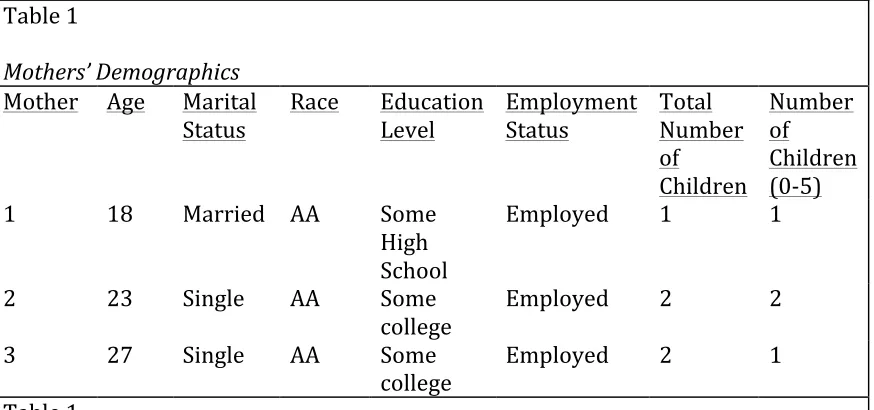
Table 1
Mothers’ Demographics
Mother Age Marital Status
Race Education Level
Employment Status
Total Number of
Children
Number of
Children (0-‐5)
1 18 Married AA Some
High School
Employed 1 1
2 23 Single AA Some
college Employed 2 2
3 27 Single AA Some
college Employed 2 1
Table 1
Materials
Mothers participating in the Health module each received a health manual
(See Appendix A), the Sick and Injured Child Checklist – Parent Version (SICC-‐P) (See
Appendix B), a health kit, and an iPhone™. The health manual served as a resource
guide for the parent to reference for questions regarding child health. The manual,
previously validated by medical professionals for accuracy and relevance (Bigelow
& Lutzker, 2000) included a form on which the parent may record important phone
numbers, a health supplies checklist, a health-‐recording chart, and steps for caring
for a child in a variety of health situations. Also included in the health manual was
information regarding hygiene, nutrition, physical activity, immunizations, and
preventing shaken baby syndrome and sudden infant death syndrome (SIDS). The
health manual also included a symptom and illness guide that details how to
approach health events such as injuries, breathing problems, allergies, bites and
[image:21.612.89.526.79.284.2] [image:21.612.87.527.79.283.2]The SICC-‐P provided detailed information on the steps to take when
evaluating health concerns. It is a one-‐page summary of the steps presented in the
larger health manual. When trained to use the SICC-‐P, parents are taught specified
steps to determine if health concerns warrant which of the following: care at home,
doctor appointment, or go to the emergency room or call 911.
Upon completion of the training sessions the mothers were compensated
with a health kit. The kit included basic health essentials, for example, digital
thermometer, Band-‐Aids™, sunscreen, antibiotic ointment, and other similarly
related products. The mothers received the health kit after the final follow-‐up
session to provide them with tools to use the skills learned in training going forward
upon completion of the module, but after delivery of the training sessions so as to
reduce the risk of biasing the results.
An iPhone 5S or 4S was provided for each mother upon completion of all five
baseline sessions. The phone was used for generalization measures as well as a tool
for keeping in contact with the mothers to schedule sessions. Phone communication
included video-‐conferencing, text messages, and video chat. The available phones
for use were provided by the Center for Healthy Development at Georgia State
University. The mothers were also compensated $20 after each session.
Before the start of the baseline and training sessions, the parents received an
informed consent form that detailed the purpose of the study, procedures, any
possible risks or benefits of participation, confidentiality, and listed points of
approved by the Georgia State University Institutional Review Board before the
start of the study.
Home Visitor Training
The Home Visitor (HV) and Reliability Observer (RO) were trained to deliver
the SafeCare health module. Training consisted of watching online role-‐plays and
didactic presentations on skills with quizzes throughout that incorporated the
SafeCare materials consistent with real life health scenarios. The HV and the RO
practiced by role-‐playing the sessions until mastery was achieved. Mastery, defined
as an understanding of the health scenarios, was achieved by scoring 90% inter-‐
observer reliability.
Reliability Training
Interobserver reliability was established through practice sessions in which
the two HVs met with a staff member from the National SafeCare Training and
Research Center (NSTRC) to role-‐play the sessions in the module. The HV and the
RO took turns presenting the NSTRC staff member with health scenarios as if they
were the parent and the staff member was the mother. The HV and the RO practiced
scoring the answers using the specified protocol designated for each scenario. This
training took place as necessary until a minimum of 90% reliability between the HV
and RO was achieved. Reliability was calculated using the following formula:
number of agreements divided by the sum of all agreements and disagreements
multiplied by 100.
Assessment
The health module was designed to consist of five baseline sessions, five
training sessions and one follow-‐up session. The module taught the parents how to
identify and care for health related illnesses. The number of baseline sessions was
pre-‐determined by the experimental design. During baseline sessions the HV
examined the mothers’ responses to emergency room scenarios (ER), doctor’s
appointment scenarios (DA), and care at home scenarios (CH) scenarios. This
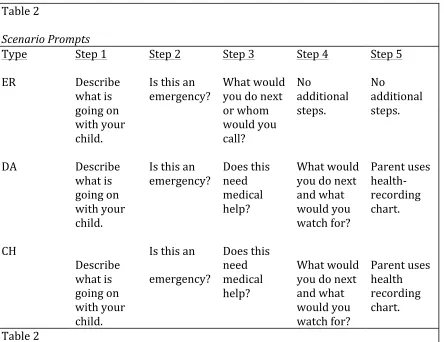
measured the mother’s knowledge of typical child health scenarios. The prompts
used by the HV when presenting each scenario type can be seen in the table below.
Table 2
Scenario Prompts
Type ER DA CH
Step 1
Describe what is going on with your child.
Describe what is going on with your child.
Describe what is going on with your child.
Step 2
Is this an emergency?
Is this an emergency?
Is this an
emergency?
Step 3
What would you do next or whom would you call?
Does this need medical help?
Does this need medical help?
Step 4 No
additional steps.
What would you do next and what would you watch for?
What would you do next and what would you watch for?
Step 5 No
additional steps.
Parent uses health-‐ recording chart.
Parent uses health recording chart.
[image:24.612.89.533.329.671.2]During baseline sessions the HV offered no feedback to incorrect or correct
responses. This was explained to the mothers by the HV as a way for the HV to learn
what the mothers knew and understood about their children’s health. Each training
session began with assessment of each scenario type (ER, DA, and CH) and
designated one day of training ER scenarios, one day of training DA scenarios, and
one day of training CH scenarios. The HV offered feedback to responses by the
mother during training sessions only. The remaining two days of training also began
with assessment of each scenario type and focused the training on prevention tips,
information on nutrition and physical activity, and summaries of what was trained
on the previous days. The HV also communicated with the mothers via text,
FaceTime, and video between training sessions for generalization and scheduling
purposes.
The HV collected data using the Sick and Injured Child Checklist – Home
Visitor Version (SICC-‐HV) for each of the three scenarios: CH, DA, or ER. The health
scenarios manual consisted of 40 unique scenarios presenting the symptoms of a
child illness or ailment. The mother indicated the course of action to address the
problem (CH, DA, or ER). At each visit, the mother was asked one of each type of
scenario. For every question the parent answered correctly, a (+) was recorded and
for every incorrect answer a (-‐) was recorded. After each session, the HV totaled the
correct answers for each scenario and a total correct percentage was calculated.
Mastery of each scenario type was required before moving on to the next. The
mother had to demonstrate 100% mastery for the ER scenarios and 80% mastery
Consumer Satisfaction
Once the mothers completed the final training session, they were asked to
complete a Parent Satisfaction Survey. The survey was an 11-‐item questionnaire
with statements designed to assess the mothers’ perceptions of the SafeCare health
module. The statements were rated by the mothers using a Likert-‐scale ranging
from 1 (Strongly Agree) to 5 (Strongly Disagree). There was also additional space
for the mothers to leave comments. Once the mothers completed the Parent
Satisfaction Survey, they placed it in an envelope and gave it to the HV.
Experimental Design
The current research was conducted in part to meet the criteria for single-‐
case design outlined by the What Works Clearinghouse (WWC; Kratochwill,
Hitchcock, Horner, Levin, Odom, Rindskopf, & Shadish, 2010). This multiple-‐baseline
design across behaviors, replicated with three mothers was used to examine the
effects of the intervention on health behavior and parental knowledge. This design
attempted to meet What Works Clearinghouse (WWC) standards with reservations,
set forth by the U.S. Department of Education. These standards specify that single-‐
case research designs must have a minimum of six phases with at least 3 data points
per phase with reliability checks in 20% of sessions.
Data were collected face-‐to-‐face using the SICC-‐HV. The order of training was
ER, DA, and CH. This order was intentionally set forth to start with the most serious
circumstances and end with the least serious.
Experimental Procedures
Baseline. During each baseline session, the HV presented the mother a card
with a health scenario that her child could experience and read aloud while the
parent read along. The HV followed the steps outlined on the SICC-‐HV, which
provided prompts for the HV and sequenced actions for the health scenario and
then recorded the mothers’ responses. The HV offered no feedback to the mother’s
responses and was explained to mothers by the HV as a way for the HV to better
understand the mothers’ skills regarding child health. After the baseline data were
collected, the session was summarized with the mother and the next session was
scheduled either in person by text message with the HV.
Training. Following the five baseline sessions, the health manual and SICC-‐P
were distributed to the mothers at the first training session. The mother was also
provided with the iPhone™ during the first training session. Training was separated
into three skill sets: ER, DA, and CH as set forth by the experimental design.
Training began with scenarios that require a visit to the ER or to call 911.
When this skill was mastered, the mother was trained on the DA skill set and
practiced the ER steps. Once mastery was achieved, the mother was trained in the
final skill set, CH, while continuing to practice the already mastered skill sets.
The training occurred through a standardized presentation format in which
first, the skills were explained and modeled by the HV, then the parent practiced the
skill and the HV provided positive and corrective feedback until mastery was
achieved. Mastery was achieved by scoring 100% on the ER scenarios and 80%
to the health manual as a reference guide to look-‐up symptoms related to illness.
The HV then modeled the steps using the SICC-‐P to demonstrate the decision-‐
making behavior (skill) desired from the parent. The parent was then prompted
using the SICC-‐P using the same scenarios the HV had modeled. Positive and
corrective feedback were provided to the parent after each scenario. This loop
continued until mastery was achieved for the specified skill.
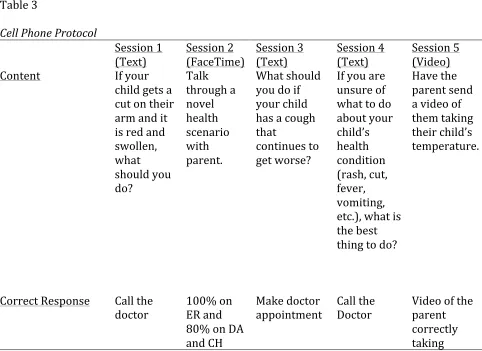
Generalization Sessions. Between training sessions, contact was made with
the mother by iPhone with the parent. Questions were asked that utilized each
feature of the phone (e.g., video-‐conferencing, FaceTime™, text, and video-‐
messaging) and can be seen in the table below.
Table 3
Cell Phone Protocol
Session 1 Session 2 Session 3 Session 4 Session 5
(Text) (FaceTime) (Text) (Text) (Video)
Content If your
child gets a cut on their arm and it is red and swollen, what should you do?
Talk through a novel health scenario with parent.
What should you do if your child has a cough that
continues to get worse?
If you are unsure of what to do about your child’s health condition (rash, cut, fever, vomiting, etc.), what is the best thing to do?
Have the parent send a video of them taking their child’s temperature.
Correct Response Call the
doctor 100% on ER and 80% on DA and CH
Make doctor appointment
Call the Doctor
[image:28.612.96.578.363.714.2]
child’s temperature
Table 3
Follow-‐Up. After completing the training sessions and acquiring mastery for
ER, DA, and CH, the mother was contacted by the HV to schedule a face-‐to-‐face
session one month postintervention. The HV re-‐assessed the mother’s maintenance
of the three scenario types. Maintenance was measured by asking the mother the
three specified scenarios types (ER, DA, and CH) and recording the percentage of
correct responses. Mothers then received their health kit and returned the phone.
Results
Baseline and Training
Mother One. Upon completion of five baseline sessions, in which the
performance ranged from 33% to 100% correct, with a mean of 79.8%, training for
the ER scenarios began. Skills assessed on all three scenarios at the beginning of the
first training session indicated the mother needed training for ER skills, thus
training began. Each assessment occurred at the beginning of a training session. At
the beginning of the second training session, skills for each scenario were assessed
and the ER score was 100%. This remained stable throughout each training session.
Based on the improved demonstration of ER skills, DA was trained in the second
session. When all three scenarios were assessed at the beginning of session three,
the DA scores did not indicate adequate skills and understanding and was therefore
retrained during session three. At session four, after assessing each scenario, DA
throughout the remaining training sessions. CH was trained in session four and data
remained unstable until follow up sessions were completed.
Mother One scored 0% on the first generalization question and her data
showed an upward trend going forward, scoring a 100% on the second, third,
fourth, and fifth questions. However, the third question was comprised of three
parts (ER, DA, and CH) and she only maintained 100% was for the ER scenario; an
80% was scored for DA and a 20% was scored for CH.
Mother Two. Upon completion of five baseline sessions in which the
performance ranged from 0% to 100% correct, with a mean of 66.4% training for
the ER scenarios began. Skills assessed on all three scenarios at the beginning of the
first training session indicated the mother was still deficient in ER skills with a score
of 66% and thus was trained. At the beginning of the second training session, skills
for each scenario were assessed and the ER score was 33% indicating a need for
another ER training session, as a score of 100% is considered successful for ER.
After training ER during the second session, the assessment in the third session
showed ER skills at 100% and remained stable throughout each training session
throughout training. Based on the improved demonstration of ER skills, DA was
trained in the third session. When all three scenarios were assessed at the beginning
of session four, the DA scores indicated adequate skills and understanding; this
demonstration of DA skills was maintained throughout the remaining training
sessions. CH was trained in session four and data remained stable throughout
During the generalization questions, mother two scored 100% on each
question asked throughout the training. However, she did not respond to the final
generalization question and therefore no data could be reported.
Mother Three. Upon completion of five baseline sessions in which the
performance ranged from 0% to 66% correct, with a mean of 52.8% training for the
ER scenarios began. Knowledge assessed on all three scenarios at the beginning of
the first training session indicated the mother had still not mastered ER desired
skills with a score of 66% and thus was trained. At the beginning of the second
training session, knowledge for each scenario was assessed and the ER score was
adequate at 100% and remained stable throughout the remaining training sessions
with the exception of session three. In session three, ER was not retrained, but the
scenario was practiced in further detail until the mother demonstrated sufficient
knowledge by scoring 100% throughout the remaining training. DA was trained in
the second session, and at the beginning of session three the DA scores indicated
adequate knowledge and understanding; this demonstration of DA skills was
maintained throughout the remaining training sessions. CH was trained in session
three and data remained stable at 80%, throughout sessions four and five.
Mother three scored 0% on the first generalization question and her data
also showed an upward trend going forward, scoring a 100% on the second, third,
fourth questions. However, the third question was comprised of three parts (ER, DA,
and CH) and the 100% was only seen for the ER scenario; an 80% was scored for DA
and a 0% was scored for CH. The final generalization question was not answered
Follow-‐up
Mother One. This mother received a follow-‐up session and due to unstable
data indicating a weak knowledge of CH scenarios, she received a booster session,
during which CH was trained until the mother’s CH score was back to criterion of
80%. Data for ER and DA remained stable for the follow-‐up and booster sessions
and was deemed adequate by the HV.
Mother Two and Mother Three. Mothers two and three did not maintain
contact with the researcher to participate in a follow-‐up session and therefore no
data can be reported.
Mother 1
0 20 40 60 80 100
BL1 BL2 BL3 BL4 BL5 S1 S2 S3 S4 S5 S6 FU1 FU2
Per
cent Co
rr
ect
ER Scenarios
ER Scenarios
Generalization
0 20 40 60 80 100
BL1 BL2 BL3 BL4 BL5 S1 S2 S3 S4 S5 S6 FU1 FU2
Per
cent Co
rr
ect
DA Scenarios
Mother Two
0 20 40 60 80 100
BL1 BL2 BL3 BL4 BL5 S1 S2 S3 S4 S5 S6 FU1 FU2
Per
cent Co
rr
ect
CH Scenarios
CH Scenarios
Generalization
0 20 40 60 80 100 120
Per
cent Co
rr
ect
Generalizations
Generalzations ER
Generalzations DA
Generalzations CH
0 20 40 60 80 100
BL1 BL2 BL3 BL4 BL5 S1 S2 S3 S4 S5 S6 FU1
Per
cent Co
rr
ect
ER Scenarios
ER Scenarios
0 20 40 60 80 100
BL1 BL2 BL3 BL4 BL5 S1 S2 S3 S4 S5 S6 FU1
Per
cent Co
rr
ect
DA Scenarios
DA Scenarios
Generalizations
0 10 20 30 40 50 60 70 80 90 100
BL1 BL2 BL3 BL4 BL5 S1 S2 S3 S4 S5 S6 FU1
Per
cent Co
rr
ect
CH Scenarios
CH Scenarios
Generalizations
0 20 40 60 80 100 120
Per
cent Co
rr
ect
Generalizations
Mother Three
0 20 40 60 80 100
BL1 BL2 BL3 BL4 BL5 S1 S2 S3 S4 S5 FU1
Per
cent Co
rr
ect
ER Scenarios
ER Scenarios Generalization
0 20 40 60 80 100
BL1 BL2 BL3 BL4 BL5 S1 S2 S3 S4 S5 FU1
Per
cent Co
rr
ect
DA Scenarios
DA Scenarios Generalization
0 20 40 60 80 100
BL1 BL2 BL3 BL4 BL5 S1 S2 S3 S4 S5 FU1
Per
cent Co
rr
ect
CH Scenarios
CH Scenarios
Consumer Evaluation
Mothers One and Three completed the Parent Satisfaction Survey. Both
mothers indicated that the training helped them better understand their children’s
health and that the training would be beneficial for other parents. The mothers also
both indicated that knowing when their child needs emergency treatment and when
to take their child to the doctor became easier. They indicated practice during
sessions and the written materials were useful. They believed the HV to be warm
and friendly, on time to appointments, and good at explaining the material.
Strongly
Agree Agree Neutral Disagree Strongly Disagree 1. Caring for my child’s
health when he/she is sick or injured has become easier
2/2
2. Deciding when to take my child to the doctor has become easier.
2/2
3. Deciding when my
child needs emergency 2/2
0 20 40 60 80 100 120
S1-‐Text S2-‐Text S3-‐FaceTime S4-‐Text FU1-‐Video
Per
cent Co
rr
ect
Generalizations
ER DA
treatment has become easier.
4. I believe that this health training would be useful to other parents.
2/2
5. I do not feel the health training gave me new or useful information or skills.
2/2
6. Practicing during the sessions was useful.
2/2
7. The written
materials were useful. 2/2
8. The Home Visitor was on time to appointments.
2/2
9. The Home Visitor was warm and friendly.
2/2
10. The Home Visitor was negative and critical.
2/2
11. The Home Visitor was good at explaining the material.
2/2
Discussion
The current research evaluated the SafeCare health module and the effect cell
phone enhancements had on parents’ general child health knowledge. Previous
SafeCare research that examined cell phone enhancements was conducted on the
home safety module. No previous research had incorporated the use of cell phones
into the child health module. Thus, this research integrated generalization
assessments through technological enhancements between sessions through the use