Public Health Theses School of Public Health
Summer 8-11-2015
Patient Satisfaction & Knowledge of Services: An
Evaluation of a Street Medicine Program
Aleta Christensen
Follow this and additional works at:https://scholarworks.gsu.edu/iph_theses
This Thesis is brought to you for free and open access by the School of Public Health at ScholarWorks @ Georgia State University. It has been accepted for inclusion in Public Health Theses by an authorized administrator of ScholarWorks @ Georgia State University. For more information, please contact
Recommended Citation
Christensen, Aleta, "Patient Satisfaction & Knowledge of Services: An Evaluation of a Street Medicine Program." Thesis, Georgia State University, 2015.
STREET MEDICINE PROGRAM
By
ALETA MARIE CHRISTENSEN
AUGUST 11, 2015
ABSTRACT
INTRODUCTION: Healthcare needs among homeless populations are difficult to meet within the scope of a standard healthcare model. A street medicine model addresses the specific needs of those experiencing homelessness; healthcare professionals seek to build trust and rapport with people who are living unsheltered by taking their clinical practice to the streets. The street medicine program evaluated in this study provides primary and behavioral care in a metropolitan area in the Southeastern United States.
AIM: This program evaluation aimed to answer the following questions: how has the street medicine program affected the perceptions of ill-health and access to healthcare among its current patients? Further, how would the current patients of the street medicine program rate their satisfaction with the program and are they aware of all available services?
METHODS: Using a mixed methods approach, 40 semi-structured interviews and participant observations were conducted with patients of the street medicine program. Participants were asked to rate their satisfaction with the program and their overall health status on a 5 point Likert scale. Informed by Consensual Qualitative Research (CQR) analysis methods, the qualitative data were transcribed and coded. All quantitative analyses were done using SPSS.
RESULTS: Overall, 70% of participants rated their satisfaction with the street medicine program as excellent (n=28). For self-rated health status, there was a normal distribution across the Likert scale with 43% reporting their overall health status as moderate (n=17). Using CQR, four key domains emerged from the qualitative data: community trust, rapport building, needs addressed, and needs not addressed. These domains encompassed specific participant responses. Examples include: heard about the street medicine program through word of mouth (community trust), team showed kindness (rapport building), received diagnosis and treatment (needs
addressed), and needing help getting into housing (needs not addressed).
CONCLUSION:Overall, this study validated the effectiveness of the street medicine program in
PATIENT SATISFACTION & KNOWLEDGE OF SERVICES: AN EVALUATION OF A
STREET MEDICINE PROGRAM
by
ALETA MARIE CHRISTENSEN
B.S., GEORGIA STATE UNIVERSITY
A Thesis Submitted to the Graduate Faculty
of Georgia State University in Partial Fulfillment
of the
Requirements for the Degree
MASTER OF PUBLIC HEALTH
ATLANTA, GEORGIA
APPROVAL PAGE
PATIENT SATISFACTION & KNOWLEDGE OF SERVICES: AN EVALUATION OF A
STREET MEDICINE PROGRAM
by
ALETA MARIE CHRISTENSEN
Approved JULY 17TH, 2015 by:
EMILY GRAYBILL, PhD
Committee Chair
MONIQUE CARRY, PhD
Acknowledgments
This project was incredibly fulfilling and would not have been as meaningful to me without the
support and guidance of my thesis committee. Additionally, the time I spent with the individuals
that make up the street medicine team was inspiring! The experiences I had with them and the
knowledge I gained will stay with me always and will absolutely impact the work I do in the
future. I am also very grateful to the many family members and friends who gave their love and
Author’s Statement Page
In presenting this thesis as a partial fulfillment of the requirements for an advanced degree
from Georgia State University, I agree that the Library of the University shall make it available
for inspection and circulation in accordance with its regulations governing materials of this type.
I agree that permission to quote from, to copy from, or to publish this thesis may be granted by the
author or, in his/her absence, by the professor under whose direction it was written, or in his/her
absence, by the Associate Dean, School of Public Health. Such quoting, copying, or publishing
must be solely for scholarly purposes and will not involve potential financial gain. It is understood
that any copying from or publication of this dissertation which involves potential financial gain
will not be allowed without written permission of the author.
TABLE OF CONTENTS
Chapter One: Introduction...7
Chapter Two: Review of the Literature...10
Homelessness and health………...…...10
Evaluations of programs that deliver care to homeless populations……….…………....13
Patient Satisfaction………15
Chapter Three Program Description...…...……... 17
Chapter Four: Methods...18
Theoretical rationale………..………...18
Consenting process………...18
Confidentiality...18
Ethical Considerations...18
Validity and reliability….………..………...18
Evaluation stakeholders….………...19
Evaluation questions...19
Sample………...19
Procedure…………...20
Process for data analysis...20
Chapter Five: Results... 22
Sample...22
Participant satisfaction...23
Participant health status...24
Rapport building...25
Community trust………...…………..…………..26
Needs addressed.…………..……….27
Needs not addressed...28
Chapter Six: Summary... 30
Discussion of evaluation questions...30
Support for additional funding...31
Recommendation for program implementation...32
Implications for future research………...33
Conclusions………...…………..…………..34
References...35
Appendices………..………...40
Street medicine program logic model………...40
Structured interview protocol………...41
Chapter 1 - Introduction
Homelessness, poverty and health care are intimately interwoven. Poor health can be
both a cause and a result of homelessness. People who are homeless are at greater risk of
infectious disease, chronic illness, poor mental health, and substance abuse, as well as being
victims of violence, compared to the general population. Further, the number of people affected
by homelessness is striking.
Estimates of how many people experience homelessness annually range drastically from
2.3 million to 3.5 million (Maness & Khan, 2014) which equates to about 1% of the U.S.
population and it is estimated that this number will continue to grow (McCabe, Macnee, &
Anderson, 2001). In one metropolitan area alone, nearly 7 thousand people were living
unsheltered, on the streets. Women and children were significantly represented in these statistics
and 21% were veterans (DeNavas-Walt, Proctor, & Smith, 2011). Throughout the United States,
between 130,000 and 200,000 veterans experience homelessness every night and most suffer
from PTSD. There is also a growing population of family units that experience homelessness;
estimates suggest that 41% of the homeless population is intact family units. The rising shortage
of affordable housing coupled with an increase in poverty rates is largely responsible for the
startling numbers (“Health Care and Homelessness,” 2009). It is important to note that homeless
population demographic data is a very rough estimate, especially for those living unsheltered.
Because this population lives in unreachable and ignored/avoided locations, and due to the
mobile and transient nature of homelessness, it is very difficult to get accurate data.
People experiencing homelessness are roughly 5 times more likely to become ill than
housed people and have an average life expectancy of between 42 and 52 (Maness & Khan,
of communicable disease. This was the case in Atlanta in August of 2014 when there was a
Tuberculosis outbreak leading to the death of 3 people and the infection of forty-seven (Algar,
2014). According to local officials, this outbreak has still not yet been contained and the
tuberculosis cases are consistently identified in individuals who have been staying at various
shelters. Homelessness hinders good nutrition, personal hygiene, and basic first aid. This, paired
with dangerous, violent conditions and extreme weather exposure, creates a situation in which
the needs of homeless populations are increasingly complex. Even a simple cut or common cold
can quickly escalate into a life-threatening infection or pneumonia. Unsurprisingly, mental
illness and addiction can develop or be made worse in such challenging situations. Further,
conditions which require regular, uninterrupted treatment, such as tuberculosis and HIV/AIDS,
are extremely difficult to treat or manage among those without established care within a
healthcare system or a consistent place of residence (Algar, 2014).
Due to the overwhelming burden of health disparities the homeless population carries, it
is important to assess the model in which patient care is given. In a standard model of healthcare,
patients have to travel to a clinical setting where there are often regimented protocols for the
flow of a visit with a healthcare provider (Hwang & Burns, 2014). Homeless populations need a
more tailored approach to healthcare. In addition, individuals experiencing homelessness need to
be empowered to take an active role in their health care (Bogart, Bird, Walt, Delahanty, & Figler,
2004). One way to address the needs of homeless populations is a patient-centered medical home
model which can incorporate healthcare and housing as well as provide resources for
employment and legal aid (Maness & Khan, 2014). However, availability of these programs is
limited and requires individuals experiencing homelessness to have access to resources that
poor mental health or have an infectious disease are less likely to seek care (Currie, Patterson,
Moniruzzaman, McCandless, & Somers, 2014) and those that do seek care report poor
coordination of care and follow-up after services are received (Greysen, Allen, Lucas, Wang, &
Rosenthal, 2012).
Another approach to healthcare for homeless populations is a street medicine model.
Within the street medicine model, patients that are living unsheltered receive healthcare
wherever they are living; that is, healthcare providers leave the clinical setting and see patients
on the streets (Howe, Buck, & Withers, 2009). The street medicine model also seeks to provide a
patient-centered approach to healthcare, but further strives to build relationships with individuals
that have been excluded from standard healthcare models in addition to delivering care based on
the needs stated by the patient (Withers, 2011). Meeting individuals experiencing homelessness
on their terms is an important tool for building trust among a population that has historically
been distrustful of systems within society and is known to underutilize available services
(Withers, 2011). The current study evaluates patient satisfaction and knowledge of services of
Chapter 2 - Review of the Literature
Homelessness and health
History of the disparity. Those who experience homelessness have been historically
single white males. However, this is no longer the case and the disparity now affects an
ethnically diverse group of men, women, and children. Alcohol and drug abuse and dependence
has been a long standing factor to homelessness (McQuistion, Gorroochurn, Hsu, & Caton,
2014). Historically, those that experience homelessness have been at higher risks for morbidity
and mortality in general. HIV/AIDS has been a leading cause of death among this population and
other sexual transmitted infections have been prevalent (Caton et al., 2013).
Affected population. Veterans experience higher rates of homelessness than those who
have not served in the military (Metraux, Clegg, Daigh, Culhane, & Kane, 2013). There are
striking differences in homelessness rates between the branches of service. 64.3% of the veterans
surveyed by Metraux, et al served in the Army, 16.1% in the Navy, 11.7% in the Marines, and
7% in the Air Force. Also of note, veterans that had experienced homelessness had finished their
tours of service and were honorably discharged (90.1%) (Metraux et al., 2013). Individuals with
alcohol and drug dependencies are at a higher risk for experiencing homelessness as well as
those with a criminal record (McQuistion et al., 2014). Although women are in the minority
among homeless populations, they are still significantly represented. Women who are
experiencing homelessness are at a higher risk of contracting HIV/AIDS and other sexual
transmitted infections (Caton et al., 2013). This could be the result of the high prevalence of sex
work and illicit drug use among women experiencing homelessness (V. Bungay, 2013).
Determinants or causal factors. In a 2014 study that explored recurrent homelessness and
experience homelessness again. It was also reported that dependence on drugs and alcohol was
higher among those who experience recurrent homelessness. Finally, it was found that those who
experienced recurrent homelessness were more likely to have a diagnosis of antisocial
personality disorder and/or a criminal record (McQuistion et al., 2014). In another study,
researchers found that 56.8% of participants had experienced homelessness at least twice in the
three years previous indicating that previous homelessness is a risk factor for future periods of
homelessness (Okuyemi et al., 2013). In a study of women experiencing homelessness, 48% of
participants had experienced some kind of childhood sexual abuse and 32% had a history of
PTSD (Caton et al., 2013).
Intersectionality of gender, SES, age and race/ethnicity. Among veterans, one study did
not find any differences between male and female genders, but homelessness was strongly
associated with lower educational attainment before entering the military, and black or Hispanic
veterans were more likely to experience homelessness (Blackstock, Haskell, Brandt, & Desai,
2012). In another study, 85% of the veterans that had experienced homelessness were male and
rates of homelessness increased as military rank decreased (Metraux et al., 2013). Okuyemi, et
al, reported that among their population of people experiencing homelessness that smoked,
56.3% were black and 35.6% were white, 74.7% were male, and the mean age was 44.4 years
(2013).
Discussion around impact within varying levels of the social-ecological model. Metraux
et al, concluded that their study will provide an important foundation for the media to discuss
homelessness among veterans. They implied that using popular media sources to spread
awareness would have an effect on the disparity at a societal level (2013). In her article, Bungay
healthcare and treatment programs for alcohol and drug dependencies at the community level.
Bungay also stated that the needed accessibility would be greatly increased with additional
support from the societal level through funding and policy change (2013). Okuyemi, et al,
reported that among the homeless population they surveyed, 37% of smokers wanted to quit
within the next six months and over 70% had already tried to quit. This suggests that there is
readiness to change at the individual level and that interventions targeted at the individual could
be successful (2013). McQuistion, et al, specified the need for comprehensive and collaborative
societal level interventions due to the complexities and comorbidity of disparities associated with
homelessness (2014).
Effect of homelessness on other health disparities. Women who are experiencing
homelessness are more likely to engage in illicit activities such as sex-work and drug use.
Women who are experiencing homelessness also have a higher burden if they become pregnant
in that they lack the resources to ensure a healthy pregnancy, provide adequate care for a child,
or terminate the pregnancy (Vicky Bungay, Johnson, Varcoe, & Boyd, 2010). Tobacco use has
been responsible for a very large burden of disease but due to policy change smoking rates in the
U.S. are declining. However, among homeless populations, smoking rates are 70% higher than
among those who are not homeless. In addition, 82.8% of the participants from one study had
used illicit drugs and 42.7% considered themselves an alcoholic or dependent on drugs
(Okuyemi et al., 2013). McQuistion et al, identified the high prevalence of drug and alcohol
dependency and mental health disorders among those experiencing homelessness. In addition to
showing these as causal factors for recurrent and chronic homelessness, the authors determined
that rates of emergency room visits among this population were very high (42.4%). This could
Evaluations of programs that deliver care to homeless populations
Providing healthcare services to homeless populations presents considerable challenges
within standard healthcare models. The literature discusses numerous barriers to care including
limited access to providers, transportation issues, and lack of health insurance or ability to pay
(Rowan, Mason, Robitaille, Labrecque, & Tocchi, 2013). These barriers are often exacerbated by
a mistrust of healthcare providers, negative experiences within the healthcare system (Weinstein
et al., 2013), poor mental health (Schütz et al., 2013), and drug and alcohol addiction (Rowan et
al., 2013).
Many programs and services exist to address the needs of homeless populations. A street
medicine model addresses the specific needs of those experiencing homelessness; healthcare
professionals seek to build trust and rapport with people who are living unsheltered by taking
their clinical practice to the streets and other locations that are outside of a clinical setting
(Withers, 2011). While no literature could be found for this review that evaluated a program
using a street medicine model, evaluations of programs targeting homeless populations were
reviewed and included the following themes: concurrent disorders, housing assistance, utilization
of health student volunteers, and rapport and trust.
Concurrent disorders. People experiencing homelessness are more likely to suffer from
both poor mental health and substance abuse/addiction. Having concurrent disorders can create a
never-ending cycle negatively impacting housing status and overall health; individuals that suffer
from concurrent disorders are not only more likely to experience homelessness, but are also more
likely to utilize healthcare services from emergency departments (Schütz et al., 2013). Many
programs attempt to address mental illness as a way to also address homelessness. One such
BCMHA is located in an inner-city area in British Columbia and aims to provide access to care
for individuals with concurrent disorders. Patients received multi-dimensional treatment from a
multidisciplinary team of healthcare providers. Evaluators conducted a baseline assessment and
then an assessment after six months using questionnaires that measured mental health, substance
use, and housing situation. The program evaluation conducted for BCMHA concluded that
addressing patients’ concurrent disorders resulted in significant improvements to their mental
health and substance use was reduced; the study only reported on housing status at baseline
(Schütz et al., 2013).
Housing assistance. Housing assistance in conjunction with other social services and
healthcare could be more effective than simply providing “treatment as usual;” that is, social
services without collaboration and high utilization of emergency departments (Tinland et al.,
2013). A program evaluation was conducted for Pathways to Housing – Pennsylvania (PTH-PA),
which provides access to permanent housing, healthcare, and community support for individuals
experiencing homelessness. Evaluators in this study determined that when permanent housing
was combined with onsite healthcare, overall health of homeless populations were improved and
utilization of emergency services were reduced (Weinstein et al., 2013).
Utilization of health student volunteers. The utilization of health student volunteers in the
delivery of services to homeless populations, can contribute to their development as
compassionate, skilled providers for vulnerable populations. The Houston Outreach Medicine
Education and Social Services program is a student-run clinic that provides primary care services
to those experiencing homelessness. Program evaluators reviewed whether the program was of
educational value to these students by counting the number of patient encounters, along with
program. Evaluators found that the program indeed had a measurable impact on students’
educational experience in their healthcare professional training; students gained “empathy,
compassion, and heightened social awareness” (Clark, Melillo, Wallace, Pierrel, & Buck, 2003).
Rapport and trust. Many programs try to provide more services that are easily accessible
by emphasizing rapport and trust building to ensure that homeless populations feel comfortable
obtaining services. One program, the Interdisciplinary Teaching Medical and Dental Clinic for
Inner City Street Youth in Ottawa, Canada, provides dental and health services for the homeless
youth population. Evaluators measured reach and satisfaction of the program. Results showed
that patients needed additional clinic hours, but were otherwise satisfied with the atmosphere,
convenience, and services provided (Rowan et al., 2013).
Patient satisfaction
Among all patients, not just those experiencing homelessness, patient satisfaction is a
proven predictor of healthcare service utilization (Macnee & McCabe, 2004); specific to
homeless populations, patient satisfaction is an important tool in measuring the success of
patient-centered medical homes (Chrystal et al., 2015). However, most tools for measuring
patient satisfaction have only been shown to be reliable among white, middle class populations
(McCabe et al., 2001).
Among homeless populations, patient satisfaction tools are needed that accurately capture
their satisfaction specific to their healthcare and health-related behaviors. This is best done by
collecting both qualitative and quantitative data from patients (Kertesz et al., 2014) and should
capture information regarding respect and non-judgement (McCabe et al., 2001). Additionally,
provider is associated with increased satisfaction (Rolfe, Cash-Gibson, Car, Sheikh, &
McKinstry, 2014).
Any evaluation of healthcare models that address the needs of the homeless population,
needs to include patient reported measures of satisfaction with care. Evaluation protocols that
ignore self-reported patient satisfaction can be used to support the justification of additional
funding for standard models of healthcare that provide services to homeless populations, even if
the care is not patient-centered (Kertesz et al., 2014). The literature identifies the need for
research that investigates the meaning of satisfaction from the perspective of individuals
Chapter 3 - Program Description
In order to address the healthcare needs among the homeless population in a metropolitan
area in the southeastern United States, a community-based organization implemented a street
medicine program that focuses on primary and behavioral care. The street medicine program
engages people who are experiencing homelessness to address primary and behavioral healthcare
needs. The program aims to build trust of providers and standard healthcare models among a
population generally distrustful and ostracized by medicine and society. The ultimate goals of the
street medicine team, per the program’s logic model, are to provide stability of care, improve
physical and behavioral conditions, connect patients to housing and educate patients on risk
reduction behaviors to promote health awareness while they are living in such challenging
conditions (Appendix page 38).
The street medicine program partners with a non-profit organization that aims to
empower healthcare students by expanding on their traditional medical educations through
volunteer opportunities with the street medicine team. Student volunteers are exposed to the
realities of living on the street and are trained to better engage with patients experiencing
homelessness and inter-related health disparities. Another goal of the street medicine program is
to encourage students to choose career paths that provide health care to underserved populations.
In order to meet the goals of the street medicine program, once a week a team is
assembled for street outreach and patient care. The team consists of multidisciplinary healthcare
professionals that are able to address primary and behavioral healthcare needs. The team also
includes a peer outreach specialist and health student volunteers.
Chapter 4 - Methods
Theoretical Rationale. Very little research exists on site-specific patient care and little is
known about the impact, including patient satisfaction, of programs that follow a street medicine
model. Because so little is known, an inductive approach was appropriate; rather than entering
this evaluation research with expectations and theories, theories and recommendations emerged
through data analysis (Heath & Cowley, 2004).
Consenting Process. This study was approved by the university’s Institutional Review
Board for human subject protection. The informed consent form was the first document
presented to clients for review. The consent form was read aloud to each participant and signed
by the participant and the researcher. To ensure that consent was not obtained while participants
were obviously impaired from alcohol, consent from participants was only obtained from
participants in a sober state. All participants consented to be in the study.
Ethical Consideration. Careful consideration was given in the development of study
protocols to ensure risks to participants were minimal. Receiving medical care was not
contingent on research participation, nor were any benefits directly given to participants. In the
consent form participants were made aware that their input could potentially help the street
medicine program grow and improve.
Validity and Reliability Measures. This study utilizes methodological and data
triangulation as the primary validity strategies. Through using multiple methods, both a
structured interview in addition to participant observation, criteria for methodological
triangulation are met. With the resources available, the main reliability strategies consisted of
through the transcription process. Finally, research validity and reliability was established
through peer debriefing and team meetings.
The proposed evaluation has been requested by the partnering non-profit organization in
addition to community-based organization that runs the street medicine program. These
stakeholders were available throughout the process for checking in and troubleshooting.
Additionally, as this is a thesis project, regular meetings with the thesis chair and co-chair
occurred.
Evaluation Stakeholders. There are three primary stakeholders for the purposes of this
evaluation: 1) The community-based organization that runs the street medicine program, 2) the
homeless population reached by the street medicine program, and 3) the partnering non-profit
organization that provides student volunteers.
Evaluation Questions. The goal of this evaluation is to learn the opinions of the patients
of a street medicine program through semi-structured mixed method interviews and participant
observation. This evaluation intended to answer the following questions: 1) how has the street
medicine program affected the perceptions of overall health status and access to healthcare? 2)
are patients satisfied with services? and 3) is the homeless population reached by the street
medicine team aware of all services provided?
Sample. After engaging with the Street Medicine team, clients were told of research
being conducted to evaluate patient expectations and satisfaction. If interested, the clients were
directed to the onsite researcher for more information about the research and participation. This
convenience sampling easily captured participants meeting the inclusion criteria: any individual
Street Medicine team. Participants were drawn from the various locations that the street medicine
team visited.
Procedure. Data collection occurred concurrently with the normal Street Medicine
program. The researcher accompanied the Street Medicine team on Wednesday nights to all
locations. The time spent at each location varied due to volume of people present, treatment
needs, and overall interest among individuals in being engaged by the team. Participants engaged
in face-to-face semi-structured audio-recorded interviews (appendix page 41). The interviews
were all conducted by the student PI and were guided by the interview protocol developed for
this evaluation and took between five and fifteen minutes. The participants were asked to answer
questions related to their expectations around interacting with the Street Medicine team, whether
or not their expectations were met, and current health status. Given the literature around patient
satisfaction among homeless populations, the semi-structured interview contained both
qualitative and quantitative elements. After conducting the semi-structured interview, the student
PI completed a participant observation (appendix page 42) in order to gather information about
what could be observed and to record notes on the setting in which the client was engaged. The
student PI recorded the client's current appearance and level of attentiveness during the
interview.
Process for Data Analysis. For this study, a Consensual Qualitative Research (CQR)
approach was utilized during data analysis (Hill et al., 2005). The interviews were transcribed
focusing primarily on the information that was directly relevant to the questions asked. The
research team then met to discuss the meaning of the data and came to consensus on domains
and core ideas. The agreed on domains refer to broader topics that cluster the data into major
succinctly reflected what the participants said. Finally, where applicable, specific needs were
identified as topics within a core idea. Due to the size of the sample and the nature of the data,
Chapter 5 - Results
Sample. In total, forty interviews were conducted over the course of thirteen weeks. Over
the course of the thirteen weeks, the street medicine team visited six locations and participants
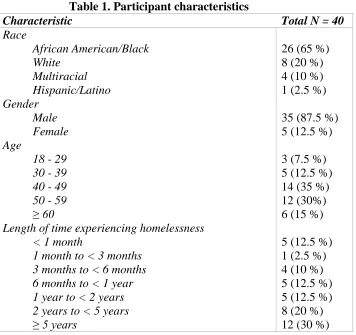
were successfully recruited from four of the locations visited. The final sample, Table 1, was
primarily male and African American/Black. The majority of participants reported being
homeless for longer than one year. The average age of participants was 46.7 years and had a
[image:23.612.75.431.266.601.2]normal distribution ranging from 18 years to 72 years.
Table 1. Participant characteristics
Characteristic Total N = 40
Race
African American/Black 26 (65 %)
White 8 (20 %)
Multiracial 4 (10 %)
Hispanic/Latino 1 (2.5 %)
Gender
Male 35 (87.5 %)
Female 5 (12.5 %)
Age
18 - 29 3 (7.5 %)
30 - 39 5 (12.5 %)
40 - 49 14 (35 %)
50 - 59 12 (30%)
≥ 60 6 (15 %)
Length of time experiencing homelessness
< 1 month 5 (12.5 %)
1 month to < 3 months 1 (2.5 %)
3 months to < 6 months 4 (10 %)
6 months to < 1 year 5 (12.5 %)
1 year to < 2 years 5 (12.5 %)
2 years to < 5 years 8 (20 %)
≥ 5 years 12 (30 %)
Two of the locations were located under overpasses. One of the overpasses provided very
little open area for sleeping and people had established sleeping areas on the concrete walkway
location were fifty years of age or older and were alone before and after the interview. The other
overpass ran over a very busy interstate and an exit ramp. While this location was a high-traffic
area, the people found at this location had established sleeping areas underneath the overpass
between the highway and exit ramp; eight interviews were conducted at this location. Of the
eight participants, all of them reported being homeless for over a year and half of them stated
that they had been homeless for over five years. Seven interviews were conducted at a bridge
that was cut off and the route that it originally created was diverted. At this location, people have
established camps both on top of and underneath the bridge. Over half of the participants had
never encountered the team before and this was the only location where the majority of
participants were in the company of others. Finally, twenty-three of the interviews were
conducted outside of a church at the heart of the downtown area. At this location, people have
established sleeping areas along the sidewalks and under the awnings of all sides of the church.
The majority of the participants at this location had encountered the team before and over half
reported having been homeless for over one year.
Among those interviewed, it was determined that contact was initiated equally by the
street medicine team (n=20) and participants (n=19). To examine the relationship between
whether or not the participant had encountered the street medicine team before and who made
the initial contact on the day the interview was conducted, a Chi-square test for independence
was done using a Continuity Correction to determine significance at p < .05. Results indicated
that the majority of participants that approached the team had previously interacted with the team
before (65%). However, this association was not significant, χ2 (1, N = 39) = .211, p = .65.
Patient satisfaction. A complete report of patient satisfaction can be found in Table 2.
excellent. Of the participants that reported highest satisfaction, 23 reported that 2 or 3 needs were
addressed, 4 reported that 1 need was addressed. 15 participants that reported highest satisfaction
mentioned 1 or two needs that were not addressed. 1 participant reported that no needs were
addressed but elements of rapport building were mentioned. Of the participants that rated their
satisfaction with the street medicine program as good, the majority reported that 2 or 3 of their
needs were addressed; 2 participants also reported that 1 need was not addressed. Of the
participants that rated their satisfaction with the street medicine program as moderate, 2 people
reported that 1 of their needs was addressed and the other person reported that 3 needs were
addressed; all 3 reported that at least 1 need was not addressed. The participant that rated their
satisfaction with the street medicine program as poor reported having 1 need that was not
addressed during the initial encounter. The majority of participants that rated their satisfaction as
excellent had encountered the team before.
Patient health status. Among those participants that reported that at least one of their
needs was addressed by the street medicine program, a higher overall health status was reported.
Participants reported their overall health status (Table 2) using a Likert scale; there was a normal
distribution across the scale with 43% reporting their overall health status as moderate (n=17).
Other factors that may have contributed to a participant’s health status may include isolation and
not knowing of anywhere to receive care. The majority of participants were alone before and
after the interview (n=26). 50% of participants reported that the emergency room was either the
only other place that they receive care or as a place that they could receive care if they needed
besides the street medicine program. 35% of participants reported that they did not know of
anywhere to receive healthcare. In order to determine whether or not participants’ needs being
to compare participants’ overall health status with whether or not they had at least one need
addressed. Among the participants that had at least one need addressed, 80% reported that their
overall health status was better than fair. This correlation was approaching significance: χ2 (4, N
[image:26.612.75.437.183.379.2]= 39) = 8.98, p = .06.
Table 2. Patient satisfaction and overall health status
Patient Satisfaction* Total N = 40
Excellent (5) 28 (70 %)
Good (4) 8 (20 %)
Moderate (3) 3 (7.5 %)
Fair (2) 0 (0 %)
Poor (1) 1 (2.5 %)
Self-rated overall health status* Total N = 39
Excellent (5) 6 (15 %)
Good (4) 9 (22.5 %)
Moderate (3) 17 (42.5 %)
Fair (2) 4 (10 %)
Poor (1) 3 (7.5 %)
* Both patient satisfaction and health status were reported using a 5 point Likert scale.
Qualitative component. Using CQR methods for data analysis, the transcribed interviews
were coded into general ideas (domains) and key summaries of participant responses were
recorded (core ideas). All domains and core ideas were then quantified and are reported as
percentages of the total 40 participants. In total, four domains were agreed on for coding the
qualitative components to the data. Domains included rapport building, community trust, needs
addressed, and needs not addressed. A complete report for all qualitative components can be
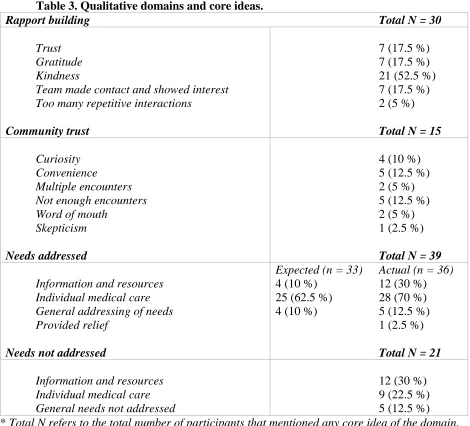
found in table 3.
Rapport building. Rapport building was used as a way to describe positive or negative
feelings of comfort and/or appreciation between individual participants and the street medicine
team. Within this domain five core ideas emerged: trust, gratitude, kindness, team made contact
rapport building was mentioned in the vast majority of the interviews. Predominantly,
participants commented about the street medicine team’s kindness. Participants mentioned
equally the following core ideas: the team made contact and showed interest, gratitude, and trust.
Finally, two participants mentioned a repetitive action that was conflicting with rapport building;
in both situations participants expressed feeling overburdened with all of the paperwork that was
[image:27.612.72.542.239.665.2]required.
Table 3. Qualitative domains and core ideas.
Rapport building Total N = 30
Trust 7 (17.5 %)
Gratitude 7 (17.5 %)
Kindness 21 (52.5 %)
Team made contact and showed interest 7 (17.5 %)
Too many repetitive interactions 2 (5 %)
Community trust Total N = 15
Curiosity 4 (10 %)
Convenience 5 (12.5 %)
Multiple encounters 2 (5 %)
Not enough encounters 5 (12.5 %)
Word of mouth 2 (5 %)
Skepticism 1 (2.5 %)
Needs addressed Total N = 39
Expected (n = 33) Actual (n = 36)
Information and resources 4 (10 %) 12 (30 %)
Individual medical care 25 (62.5 %) 28 (70 %)
General addressing of needs 4 (10 %) 5 (12.5 %)
Provided relief 1 (2.5 %)
Needs not addressed Total N = 21
Information and resources 12 (30 %)
Individual medical care 9 (22.5 %)
General needs not addressed 5 (12.5 %)
Community trust. Community trust was established as a domain to describe a broader
feeling of comfort and trust between the larger homeless population and the street medicine
team. Six core ideas were found within this domain: curiosity, convenience, multiple encounters,
not enough encounters, word of mouth, and skepticism. Elements of community trust were
mentioned at least one time in a significant portion of interviews. Curiosity refers to the
participant not really having expectations of what was going to happen when they met with the
team, but that they were simply curious. Participants mentioned that they appreciated that the
team came to them and identified that feature as being convenient. Having multiple encounters
with the team and hearing about the team through word of mouth were mentioned in 5% of the
interviews. Several participants mentioned that there were not enough encounters happening with
the street medicine team; those participants all indicated that they wanted to see the team more
often. Finally, one interview included the core idea of skepticism; the participant mentioned
feeling leery of being approached by the team whom the participant had not encountered before.
Needs addressed. This domain broadly captures participants referring to receiving
specific goods, services, or information and resources. Within the needs addressed domain four
core ideas were identified: information and resources, individual medical care, general
addressing of needs and provided relief. Overall, needs addressed was mentioned by all but one
participant. This domain was coded into two different variables in order to distinguish between
the needs addressed being mentioned as an expectation or as something that actually happened.
In total, 82.5% of participants mentioned needs addressed as an expectation and 90% of
participants mentioned needs addressed as something that actually happened at least once. Over
half of the participants expected individual medical care and 70% reported actually receiving
were mentioned: treatment, medication, vitals/health screening, lab results, foot care, psychiatric
care, given medical care, saw provider through telemedicine. 10% of participants reported that
they expected general addressing of needs and 12.5% reported that general addressing of needs
actually happened; this core idea included the topic of receiving condoms. 10% of participants
mentioned that they expected to receive information and resources and 30% of participants
reported that they actually received information and resources from the team which included the
topics of substance abuse counseling, housing, medical referral, and homeless verification form.
Finally, 1 participant reported that the team addressed their needs by providing relief.
Needs not addressed. In total, 52.5% of participants mentioned having between 1 and 2
needs not addressed. It is important to note that among the participants that had needs that were
not addressed, 85.7% of them reporting having a different need addressed. The reasons for this
included not mentioning additional needs to the team and being unaware that additional needs
could be addressed by the team. Within the domain of needs not addressed, three core ideas were
identified: information and resources, general needs not addressed, and individual medical care.
17.5% of participants reported not receiving the information or resources that they needed.
Specifically, participants mentioned needing help with getting replacement identification and
resources for getting housing. 12.5% of participants reported that a general need was not
addressed; the topics of general needs not addressed included: food and water, blanket, rain gear,
birth control, and feminine hygiene products. 30% of participants identified an individual
medical care need that was not addressed; the topics mentioned regarding individual medical
care needs not addressed included: earlier intervention/continuity of care, dental care, eye
hepatitis, pregnancy, etc.), eczema cream, privacy during care, diagnostic test, and over the
Chapter 6 - Summary
Discussion of evaluation questions
The data proved to be useful in evaluating patient satisfaction and knowledge of services.
Per the program’s logic model (Appendix page 40), this evaluation showed that the street
medicine program has been successful with the stated short-term goals of identifying patients’
health risks and building rapport between providers and homeless populations. Responses to
each evaluation question are below. In addition to providing insight on the proposed evaluation
questions, this study also effectively highlighted areas for strengthening and expanding the street
medicine program.
1) How has the street medicine program affected the perceptions of overall health status and
access to healthcare?
Participants who reported that the street medicine program addressed at least one of their
needs also reported a higher overall health status. This could be an indication of the street
medicine program having a positive impact on the perceptions of overall health status among
homeless populations. Further, the street medicine program successfully provides a model for
healthcare that allows for easy access and patient-centered care.
2) Are patients satisfied with services?
The overwhelming answer to this question is yes, patients of the street medicine program
are satisfied. Drivers of satisfaction include receiving medical and behavioral healthcare,
individual rapport building, and strengthening community trust. Of the 3 participants that did not
have their needs addressed, two of them mentioned elements of rapport building and community
addressed by the team upon a second encounter. One received a shot instead of pills and the
other received eczema cream.
3) Is the homeless population reached by the street medicine team aware of all services
provided?
Although the majority of the study participants reported that they had needs that were
addressed, over half of participants also identified needs that were not addressed by the team.
The needs mentioned by participants that were not addressed included topics that the street
medicine addresses through services and referrals. Participants reported that they had not
mentioned addressing certain needs to the street medicine team because they were not aware that
the team offered certain services or could provide certain information or resources.
Although participants were not aware of all services provided by the street medicine
program, it is important to comment on one of the primary ethos of the street medicine program.
In order to build trust within a program that is largely distrustful of the healthcare system and
other structural components of society, the street medicine team attempts to avoid intrusiveness
by allowing the patient to lead the encounter and inform the team of what their needs are and
how to focus the encounter. Because of this patient-centered approach, it may be that every need
cannot be addressed or even discussed.
Support for additional funding
The street medicine program is a valuable resource for its community. This evaluation
showed that the street medicine program is able to reach a significant number of people
experiencing homelessness who would otherwise be utilizing the emergency room or not
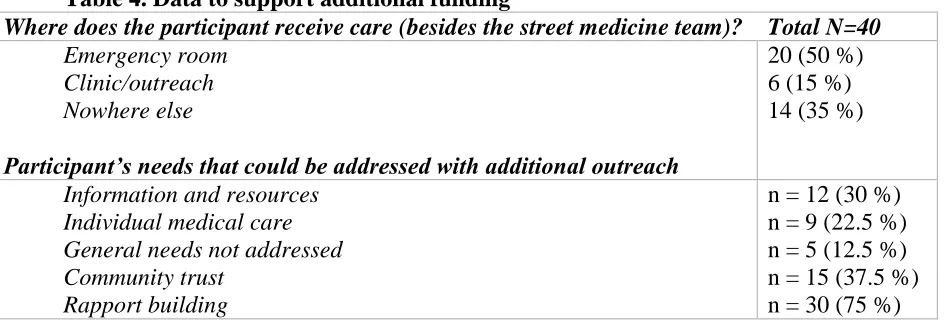
receiving care at all (Table 4). This is particularly important given the exorbitant cost and
unsheltered do not have insurance or are underinsured, reimbursement and payment is low when
these individuals are treated in the emergency setting.
The street medicine program is an effective way to address the healthcare needs of the
homeless population. Participants of this evaluation identified the importance of multiple
encounters as well as the need for more encounters for building rapport and trust (Table 4). In
addition, the street medicine model effectively reduces the burden of treating homeless
populations within the standard healthcare model. Additional days for outreach and encounters
with this population would allow for the street medicine team to engage with more people,
increase the number of locations visited, and further increase the opportunities for individuals
[image:33.612.76.551.372.532.2]experiencing homelessness to have their healthcare needs addressed in an appropriate way.
Table 4. Data to support additional funding
Where does the participant receive care (besides the street medicine team)? Total N=40
Emergency room 20 (50 %)
Clinic/outreach 6 (15 %)
Nowhere else 14 (35 %)
Participant’s needs that could be addressed with additional outreach
Information and resources n = 12 (30 %)
Individual medical care n = 9 (22.5 %)
General needs not addressed n = 5 (12.5 %)
Community trust n = 15 (37.5 %)
Rapport building n = 30 (75 %)
Recommendations for program implementation
Over the course of the data collection period, it was observed that many of the individuals
the street medicine program encounters lived without basic necessities for self-care. In response,
the street medicine team distributed hygiene kits to the individuals they engaged with. However,
medicine program expand the partnership with the non-profit organization to include asking
them to be responsible for acquiring more supplies to stock hygiene kits, in addition to recruiting
health student volunteers. Further, it is recommended that the kits include condoms and feminine
hygiene products. Finally, it is recommended that the hygiene kits be distributed more freely
even to those individuals who do not seek engagement from the street medicine program or who
approach the team seeking things the team does not primarily provide, like food.
During the time spent interviewing the opportunity arose on many occasions for
participants to identify needs that were not addressed by the team. In some cases, the interviewer
was able to redirect the participant back to the street medicine team and additional services,
resources, information, and/or goods were provided on the spot. Therefore, it is recommended
that someone other than the street medicine team members that are involved in the patient
encounter/treatment spend 2-3 minutes after the encounter checking in with the patient about
how the encounter went and what other needs the patient may have that were not addressed. This
would provide the street medicine team with an opportunity to inform patients of other needs the
team can address. This could be done effectively by the peer outreach specialist and would
further address the need for additional encounters.
Implications for future research
This study will contribute information regarding patient experiences among a highly
vulnerable population. Being able to highlight the program’s successes and areas for
improvement based on patient satisfaction is a necessary measure to report because the homeless
population often goes unseen/untreated and therefore programs like street medicine have no basis
Further research is needed to better understand the meaning of satisfaction within
homeless populations; there is need for a measure that accurately measures patient satisfaction
among underserved and minority populations. Additionally, the data from the current study may
show that, among underserved populations, satisfaction bias may be present in that patients are
satisfied and grateful for any services, regardless of quality or appropriateness, because they
have low expectations.
Conclusion
Overall, this study validated the effectiveness of the street medicine program in building
trust and rapport. This study contributes information regarding patient experiences within an
References
Algar, J. (2014, August 10). TB outbreak in Atlanta: 3 homeless people killed, 47 infected. Tech
Time. Retrieved from
http://www.techtimes.com/articles/12634/20140810/tb-outbreak-in-atlanta-3-homeless-people-killed-47-infected.htm
Blackstock, O. J., Haskell, S. G., Brandt, C. A., & Desai, R. A. (2012). Gender and the Use of
Veterans Health Administration Homeless Services Programs Among Iraq/Afghanistan
Veterans: Medical Care, 50(4), 347–352.
http://doi.org/10.1097/MLR.0b013e318245a738
Bogart, L. M., Bird, S. T., Walt, L. C., Delahanty, D. L., & Figler, J. L. (2004). Association of
stereotypes about physicians to health care satisfaction, help-seeking behavior, and
adherence to treatment. Social Science & Medicine (1982), 58(6), 1049–1058.
Bungay, V. (2013). Health Care Among Street-Involved Women: The Perpetuation of Health
Inequity. Qualitative Health Research, 23(8), 1016–1026.
http://doi.org/10.1177/1049732313493352
Bungay, V., Johnson, J. L., Varcoe, C., & Boyd, S. (2010). Women’s health and use of crack
cocaine in context: Structural and “everyday” violence. International Journal of Drug
Policy, 21(4), 321–329. http://doi.org/10.1016/j.drugpo.2009.12.008
Caton, C. L. M., El-Bassel, N., Gelman, A., Barrow, S., Herman, D., Hsu, E., … Felix, A.
(2013). Rates and Correlates of HIV and STI Infection Among Homeless Women. AIDS
and Behavior, 17(3), 856–864. http://doi.org/10.1007/s10461-012-0198-x
Chrystal, J. G., Glover, D. L., Young, A. S., Whelan, F., Austin, E. L., Johnson, N. K., …
Mental Health Conditions. PLoS ONE, 10(2).
http://doi.org/10.1371/journal.pone.0117395
Clark, D. L., Melillo, A., Wallace, D., Pierrel, S., & Buck, D. S. (2003). A multidisciplinary,
learner-centered, student-run clinic for the homeless. Family Medicine, 35(6), 394–397.
Currie, L. B., Patterson, M. L., Moniruzzaman, A., McCandless, L. C., & Somers, J. M. (2014).
Examining the relationship between health-related need and the receipt of care by
participants experiencing homelessness and mental illness. BMC Health Services
Research, 14. http://doi.org/10.1186/1472-6963-14-404
DeNavas-Walt, C., Proctor, B., & Smith, J. (2011, September). Income, Poverty, and Health
Insurance Coverage in the United States: 2010. United States Census Bureau.
Greysen, S. R., Allen, R., Lucas, G. I., Wang, E. A., & Rosenthal, M. S. (2012). Understanding
transitions in care from hospital to homeless shelter: a mixed-methods, community-based
participatory approach. Journal of General Internal Medicine, 27(11), 1484–1491.
http://doi.org/10.1007/s11606-012-2117-2
Health Care and Homelessness. (2009, July). National Coalition for the Homeless. Retrieved
from http://www.nationalhomeless.org/factsheets/health.html
Heath, H., & Cowley, S. (2004). Developing a grounded theory approach: a comparison of
Glaser and Strauss. International Journal of Nursing Studies, 41(2), 141–150.
Hill, C. E., Knox, S., Thompson, B. J., Williams, E. N., Hess, S. A., & Ladany, N. (2005).
Consensual qualitative research: An update. Journal of Counseling Psychology, 52(2),
Howe, E. C., Buck, D. S., & Withers, J. (2009). Delivering health care on the streets: challenges
and opportunities for quality management. Quality Management in Health Care, 18(4),
239–246. http://doi.org/10.1097/QMH.0b013e3181bee2d9
Hwang, S. W., & Burns, T. (2014). Health interventions for people who are homeless. The
Lancet, 384(9953), 1541–7.
http://doi.org/http://dx.doi.org.ezproxy.gsu.edu/10.1016/S0140-6736(14)61133-8
Kertesz, S. G., Pollio, D. E., Jones, R. N., Steward, J., Stringfellow, E. J., Gordon, A. J., … Holt,
C. L. (2014). Development of the Primary Care Quality-Homeless (PCQ-H) instrument: a
practical survey of homeless patients’ experiences in primary care. Medical Care, 52(8),
734–742. http://doi.org/10.1097/MLR.0000000000000160
Macnee, C. L., & McCabe, S. (2004). Satisfaction with care among homeless patients:
development and testing of a measure. Journal of Community Health Nursing, 21(3),
167–178. http://doi.org/10.1207/s15327655jchn2103_4
Maness, D. L., & Khan, M. (2014). Care of the homeless: an overview. American Family
Physician, 89(8), 634–640.
McCabe, S., Macnee, C. L., & Anderson, M. K. (2001). Homeless patients’ experience of
satisfaction with care. Archives of Psychiatric Nursing, 15(2), 78–85.
http://doi.org/10.1053/apnu.2001.22407
McQuistion, H. L., Gorroochurn, P., Hsu, E., & Caton, C. L. M. (2014). Risk Factors Associated
with Recurrent Homelessness After a First Homeless Episode. Community Mental Health
Journal, 50(5), 505–513. http://doi.org/10.1007/s10597-013-9608-4
Metraux, S., Clegg, L. X., Daigh, J. D., Culhane, D. P., & Kane, V. (2013). Risk Factors for
Afghanistan Conflicts. American Journal of Public Health, 103(S2), S255–S261.
http://doi.org/10.2105/AJPH.2013.301432
Okuyemi, K. S., Goldade, K., Whembolua, G.-L., Thomas, J. L., Eischen, S., Guo, H., … Jarlais,
D. D. (2013). Smoking Characteristics and Comorbidities in the Power To Quit
Randomized Clinical Trial for Homeless Smokers. Nicotine & Tobacco Research, 15(1),
22–28. http://doi.org/10.1093/ntr/nts030
Rolfe, A., Cash-Gibson, L., Car, J., Sheikh, A., & McKinstry, B. (2014). Interventions for
improving patients’ trust in doctors and groups of doctors. The Cochrane Database of
Systematic Reviews, 3, CD004134. http://doi.org/10.1002/14651858.CD004134.pub3
Rowan, M. S., Mason, M., Robitaille, A., Labrecque, L., & Tocchi, C. L. (2013). An innovative
medical and dental hygiene clinic for street youth: results of a process evaluation.
Evaluation and Program Planning, 40, 10–16.
http://doi.org/10.1016/j.evalprogplan.2013.04.005
Schütz, C., Linden, I. A., Torchalla, I., Li, K., Al-Desouki, M., & Krausz, M. (2013). The
Burnaby treatment center for mental health and addiction, a novel integrated treatment
program for patients with addiction and concurrent disorders: results from a program
evaluation. BMC Health Services Research, 13, 288.
http://doi.org/10.1186/1472-6963-13-288
Tinland, A., Fortanier, C., Girard, V., Laval, C., Videau, B., Rhenter, P., … Auquier, P. (2013).
Evaluation of the Housing First program in patients with severe mental disorders in
France: study protocol for a randomized controlled trial. Trials, 14, 309.
Weinstein, L. C., Lanoue, M. D., Plumb, J. D., King, H., Stein, B., & Tsemberis, S. (2013). A
primary care-public health partnership addressing homelessness, serious mental illness,
and health disparities. Journal of the American Board of Family Medicine: JABFM,
26(3), 279–287. http://doi.org/10.3122/jabfm.2013.03.120239
Withers, J. (2011). Street medicine: an example of reality-based health care. Journal of Health