Political Science Theses Department of Political Science
Fall 8-26-2010
Social Transformation in Divided Societies:
Willingness to Integrate Post-Power Sharing
Agreement: The Northern Ireland Case
Elizabeth A. O'Callaghan
Georgia State University
Follow this and additional works at:https://scholarworks.gsu.edu/political_science_theses Part of thePolitical Science Commons
This Thesis is brought to you for free and open access by the Department of Political Science at ScholarWorks @ Georgia State University. It has been accepted for inclusion in Political Science Theses by an authorized administrator of ScholarWorks @ Georgia State University. For more information, please [email protected].
Recommended Citation
O'Callaghan, Elizabeth A., "Social Transformation in Divided Societies: Willingness to Integrate Post-Power Sharing Agreement: The Northern Ireland Case." Thesis, Georgia State University, 2010.
SOCIAL TRANSFORMATIONS IN DIVIDED SOCIETIES:
WILLINGNESS TO INTEGRATE POST-POWER SHARING AGREEMENT
THE NORTHERN IRELAND CASE
by
ELIZABETH A. O‟CALLAGHAN
Under the Direction of Dr. William M. Downs
ABSTRACT
This thesis examines the factors which impact societal willingness to integrate in a post
conflict, post power sharing agreement environment. Utilizing the Northern Ireland case, this
study analyzes variance in willingness to integrate between Protestant and Catholic groups.
Analysis of the Northern Ireland Life and Times survey data illustrates the shifting relationship
between political trust and ingroup/outgroup frustrations on levels of willingness to integrate
since the Good Friday Agreement. Statistical analyses indicate confirmation of ingroup
attachment and elite political trust hypotheses, and reduced impact of outgroup benefit
perceptions on willingness to integrate since the Good Friday Agreement.
SOCIAL TRANSFORMATIONS IN DIVIDED SOCIETIES:
WILLINGNESS TO INTEGRATE POST-POWER SHARING AGREEMENT
THE NORTHERN IRELAND CASE
by
ELIZABETH A. O‟CALLAGHAN
A Thesis Submitted in Partial Fulfillment of the Requirements for the Degree of
Master of Arts
in the College of Arts and Sciences
Georgia State University
Copyright by Elizabeth A. O‟Callaghan
SOCIAL TRANSFORMATIONS IN DIVIDED SOCIETIES:
WILLINGNESS TO INTEGRATE POST-POWER SHARING AGREEMENT
THE NORTHERN IRELAND CASE
by
ELIZABETH A. O‟CALLAGHAN
Committee Chair: Dr. William M. Downs
Committee: Dr. Sarah Allen Gershon
Dr. Carrie L. Manning
Electronic Version Approved:
Office of Graduate Studies
College of Arts and Sciences
Georgia State University
DEDICATION
ACKNOWLEDGEMENTS
Greatest thanks to my entire Thesis Committee for their repeated feedback and support. Thanks
to Dr. William M. Downs for his continued guidance during the various versions of this paper
and the full length of the thesis writing process. Thanks to Dr. Sarah Allen Gershon for her
unending encouragement and methodological guidance during this thesis and the whole of my
graduate studies. Dr. Carrie Manning, thank you for helping me to understand how to read like a
graduate student and apply that knowledge to my continued research. I would also like to thank
the whole of the Department of Political Science faculty for encouraging the pursuit of thorough
objective political knowledge. And to Toni Creighton for keeping us all organized and on
schedule.
I would also like to thank the Georgia State University Librarians for their patience and
assistance for my many requests throughout the many versions and stages of data collection and
research process.
Thanks to Holly Teresi, Alex Wishart, and Bonnie Raley for their friendship, support,
and for acting as sounding boards on more than a few occasions. To Amanda Whalen and
Michael Rast, thank you both for enhancing the cultural emersion process during our time in
Ireland. Also thank you to Andrea Aldrich, Dr. Shauna Reilly, Ryan Yonk, and all of the other
graduate students that have made the journey through graduate school more fun than it probably
TABLE OF CONTENTS
ACKNOWLEDGEMENTS ... v
LIST OF TABLES ...viii
LIST OF FIGURES ... ix
INTRODUCTION ... 1
LITERATURE REVIEW ... 2
Social Cohesion ...3
Elite Peace Initiation ...4
Delivery of the Masses? ...6
Social Dominance Theory and Intergroup Relationships ...7
Socioeconomic Factors ...8
THEORY AND EXPECTATIONS ... 9
Intergroup Behavior and Perceptions ... 10
Individual Trust in Domestic Political Elites... 11
Additional Factors ... 13
Temporal Nature of Social Transformation ... 14
DATA AND MEASUREMENTS ... 20
Dependent Variables ... 20
Political Trust ... 21
InGroup Attachment ... 22
Outgroup Benefit ... 23
Previous Interaction ... 24
Socio Economic Variables ... 25
METHODS AND FINDINGS ... 26
CONCLUSIONS... 36
REFERENCES ... 39
APPENDIX –VARIABLES,MEASURES AND CODING ... 45
Dependent Variables ... 45
LIST OF TABLES
Table 1: Percent Preference for Mixing in Neighborhoods ... 19
Table 2: Percent Preference for Mixing in the Workplace ... 19
Table 3: Measuring Contact – Percent Respondents who Attended Mixed Schools ... 24
Table 4: Ordered Logit Regressions - Pooled 1998 & 2008 Data... 27
Table 5: Ordered Logit Regressions – Willingness to Integrate for Individual years.. 28
Table 6: Percent Change For Protestants given Outgroup Benefit... 28
Table 7: Percent Change given Attachment ... 30
Table 8: Percent Unionist and Nationalist by Religion... 31
LIST OF FIGURES
INTRODUCTION
How do trust in political elites and perceptions of ingroup and outgroup benefits impact
willingness to integrate in the post-conflict context? In post-conflict societies, social
transformation and integration are important for creating sustainable peace. While there are a
variety of ways in which peace and power sharing agreements are initiated, if agreements are to
produce the desired effect of sustainable peace, integration and tolerance must proliferate
throughout politics and society. This thesis aims to measure and explain the existence of such
change in the latter area, society.
Social cleavages can be rooted in language, ethnicity, regionalism, culture or race, and in
all cases they tend to constitute obstacles to inter-group reconciliation.1 Societal differences
become politicized for a variety of reasons including mobilization for attainment of power or
resources, political or otherwise. They deepen and become ingrained over time through
socialization, group separation, and the maintenance of an “us versus them” mentality which
constitute barriers to post-conflict consolidation of peace agreements and peace sustainability.2
At issue in this research project is the role of political trust and perceived group benefit as
facilitators of individual willingness to interact and integrate with persons of another, previously
antagonistic, group. Scholars have discussed group insecurities and low levels of trust in elite
power sharing agreements as causes of group unwillingness to integrate (Hughes & Donnelly
2001; Hughes 1998; O‟Neill 2000; Reik et al. 2008). It is the goal of this thesis to test hypotheses
about alternative variables that may impact willingness to integrate in post-conflict societies.
Identifying social transformations has significant implications for successful peace processes,
these implications are discussed in greater detail below. Additionally it should be noted here that
1
See Donald Horowitz‟s discussion of ascriptive group identity (1985 also Varshney 2001).
2
while there are many factors that can spoil peace agreements this thesis concentrates on
measuring social change and the factors that contribute to reduced social space between
historically divided social groups. The societal aspects of peace sustainability are important for
long term sustainability of peace, therefore, identification of specific causal factors for increasing
societal cohesion (factors include elite trust, perceptions of outgroup benefit, and ingroup
attachment) over time in post conflict societies is relevant and imperative for understanding the
full post-conflict picture.
LITERATURE REVIEW
Peace processes in societies that have endured protracted internal conflict are particularly
complex and fragile. Goodhand and Hulme discuss five key premises that underlie the concept of
peace-building:
(1) There is an assumption that peace requires social transformation and must be built over time.
(2) Peace encompasses economic, social, cultural, political and humanitarian issues; it is something more than the absence of violence, and includes ideas about sustainable development and social justice.
(3) Peace building is not an event with a precise beginning and end, rather it refers to processes which occur before, during and after violent conflict.
(4) Peace building is not a specific activity but a consequence of an activity (defined by its outcome or process).
(5) It is based on the premise thatsocieties affected by violent conflict still contain individuals, groups, attitudes and processes that promote peace. Conflicts also generate a 'moral' economy, not just a 'predatory' one. There are instances of civil groups or 'constituencies for peace', as for example in Somaliland, who have helped support and develop a peace process." As the term implies, peace is built upon by supporting and nurturing such constituencies within civil society”
These five premises and are largely built on the assumption of reconciliation within societies as a
primary goal and emphasize the temporal nature of peace building. Social transformation is a
requirement of peace and “must be built over time” throughout a peace process (Goodhand &
Hulme 1999, 16; emphasis added).
Rothchild and Roeder identify and discuss two institutional phases of the transition to
peace: the “initiation phase” and the “consolidation phase”. The initiation phase is essentially
the institutional foundation for elections, while the consolidation phase is the institutionalization
of free and fair elections (2005, 12). Rothchild and Roeder go on to state that there is a gap
between the initiation phase and the consolidation phase, or the inability of the institutional
ground work to hold during implementation. Reliance on purely institutional aspects of a peace
process can ignore the importance of social transformation, which is a parallel and subsequent
phase of a successful transformation processes. The social transformation aspect or phase is an
absolute necessity of any peace process according to Goodhand and Hulme, and can potentially
fill the “gap” between the initiation phase and the consolidation phase.
Social Cohesion
Social capital literature discusses the importance of social interactions and distinguishes
between intra-group interaction (bonding) and inter-group interaction (bridging) (Putnam 1993;
Colletta & Cullen 2000). Social cohesion defined by Berckman and Kawachi (2000) as two
societal features: "the absence of latent conflict" and "the presence of strong social
bonds-measured by levels of trust and norms of reciprocity".3Strong social cohesion is discussed as an
important aspect for maintaining peace while weak social cohesion has the alternative affect.
3
Weak social cohesion increases the risk of social disorganization, fragmentation, and exclusion and the potential for violent conflict. Building community or social capacity is a key development task for strengthening overall social cohesion and the ability to manage and prevent conflict (see Sen 1999).
(Colletta & Cullen 2000, 13)
Social cohesion is therefore important for preventing violent conflict in the first place, but also in
reducing the likelihood of societies reverting to violent conflict after peace initiatives have
established a ceasefire or institutionalized peace.
Elite Peace Initiation
The type of power sharing agreement and government formed after violent conflict is
debated as greatly impacting the level of social integration over time with in post conflict
societies, and therefore the ability of peace to sustain long-term. Consociational agreements and
majoritarian agreements are championed by various scholars and strands of literature as
producing the optimal outcome in post violent conflict societies.
Consociationalism is an elite initiated power sharing mechanism, one that should produce
institutions that will effectively manage elite interaction based on institutional constraints.
Consociationalism has been championed as the legitimate way to achieve “conflict regulation”
(McGarry & O‟Leary 1995 via Dixon 1997, 4; Lijphart 1977; McGarry & O‟Leary 2004).
Consociationalism which is discussed at length by Lijphart (1969; 1977), Dixon (1997), and
O‟Leary and McGarry (2004) is a structured power-sharing system put in place by political
groups which are identified and divided by some characteristic (i.e. ethnic or religious identity)
to ensure equal representation of each group. While there are many forms of power-sharing,
consociationalism is identifiable by four power-sharing characteristics: an inclusive executive,
proportional representation, a level of group autonomy, and minority vetoes in legislature
(McGarry & O‟Leary 2004, 154).4 Power-sharing structures in consociationalism are elite driven
processes usually accomplished through cooperation and constitutional inclusions. These power
sharing institutions are put in place to create a political structure that increases political
participation and provides more equal representation than majoritarian structures.
Majoritarian institutions limit representation and inclusion due to the winner-take-all
setup. Producing difficulty for minorities to voice at the electoral and legislative level and often
leading to “tyranny of the majority”. Many political systems have been engineered to account for
this low level of representation including federalism, partition, and power sharing.5
Consociationalism, a top-down method of power sharing, has however been criticized for
unintended long term consequences. Consociationalism has the potential to promote continued
divisions due to the necessity of identifying political parties along ethnic, linguistic or religious
stratifications. Identification along these lines is necessary to ensure adequate levels of power
sharing and representation between groups where at least one of which has previously been
excluded from the political process. Horowitz (1985), a proponent of majoritarian structures,
argues that identification along these stratified lines only further ingrains the division rather than
building cross-societal interactions which, he believes, would lead to more sustainable elite and
social interaction. Roeder and Rothchild also state that power sharing institutions which “provide
an attractive basis to end a conflict in an ethnically divided country are likely to hinder the
consolidation of peace and democracy over the long run” (2005, 6).
4
See McGarry and O‟Leary (2004) or Lijphart (1969; 1977) for full discussion of these four characteristics.
5
In sum, Horowitz and Dixon among others deny the probability that elite constructed
institutions, which maintain identification of the “other” rather than promoting solidarity, can
lead to a sustained peace, a cooperative political system, or a coherent and interactive civil
society.6 Elite action therefore might be necessary and sufficient for initial peace agreements and
short term conflict management, but it is unclear and unlikely that elite cooperation is sufficient
for the prolonged sustainment of peace.
Delivery of the Masses?
Lijphart discusses the importance of elites being able to deliver followers for
consociational institutions to be successful (Lijphart 1969; McGarry & O‟Leary 2004, 154). This
indicates again the tie between full social cohesion (discussed above) and elite initiatives in the
form of power sharing institutions or otherwise. This vertical link between elites and society is
imperative to understand and must be accounted for within a post conflict society. Reik et al.
state that:7
If citizens are aware that their leaders are interacting with leaders of an opposing nation in a friendly way, similar benefits can be expected. This is an important point as it represents one means of altering the attitudes of the general population who in democratic societies have the ultimate power in determining the fate of reconciliation efforts. Such extended contact effects may ever begin to transform the public's representation of "us" and "them" into a more inclusive "we."
(2008, 268)
While establishment of these vertical links is important, “contact theory", is also referred to
frequently within bottom-up literature as a positive force within divided societies (e.g. Hewstone
et al. 2005; Allport 1954; Hayes et al. 2007; Brewer 1996; Riek et al. 2008). Contact theory
6
Timothy D. Sisk and Christoph Stefes (2005) also discuss the obstacles for long term social integration under consociationalism.
7
discusses the impact of interaction between groups, within a society that have traditionally been
in opposition to one another, for building the positive and cross societal interaction Horowitz
states is important to reconciliation. It is important to note that some top-down theories, that
propagate elite initiated peace through formal power sharing institutions, have indicated that
contact between groups can have a reinforcing effect. Contact can further ingrain preconceived
negative notions about the “other”, and further stratify or increase tensions between groups
(O‟Leary & McGarry 1995).
Social Dominance Theory and Intergroup Relationships
"Legacies of war" discussed by Jarstad (2008) are the societal norms of behavior and
interaction that exists long after the end of violent conflict. These social legacies can produce
hurdles for maintaining a stable and sustainable peace. Intergroup relations and perceptions of
group benefit become embedded during long, enduring identity conflicts. The violent
manifestations of this conflict are not the beginning or the end of such interactions and weak
trust between opposing groups.
Levin and Sidanius (1999) discuss the implications of hierarchical societies and how
ingroup and outgroup behavior is dependent upon the strength of the hierarchical system and if
one‟s own group (the ingroup) is the lower or higher status. Levin and Sidanius find, using cases
of the US and Israel, that groups with a lower status have greater behavioral variation between
cases. This variation is dependent on the relationship the lower status ingroup has with the
dominant outgroup.8 Higher status groups alternatively exhibit more consistent behavior across
cases. Dominant groups within a society will participate in “elevation of the ingroup…when
8
social identity needs are salient, and devaluation of the outgroup…when social dominance needs
are salient among high-status group members” (120). The above behaviors are efforts to
safeguard the dominant group‟s status and maintain the hierarchical system. Crighton and
MacIver (1991) discuss group dominance in protracted internal conflict. They discuss Lebanon
and Northern Ireland and find that groups in hierarchically ranked societies will have “fears of
extinction” and are more likely to “produce protracted conflicts” (139). Crighton and MacIver
also find that the “fear of extinction” is greatest among “dominant groups who are regional
minorities”, and the existence of dominant group insecurity increases the likelihood of
institutional exclusion, minority mobilization, and protracted conflict (139-140).9
In addition to group threat ingroup attachment contributes to intergroup relations
literature. Hinkle and Brown (1990) found that two factors were important in relation to
outgroup perceptions. The first contributing factor, also discussed above, is how the ingroup
perceives they are doing relative to how the outgroup is doing. The second factor is
connectedness to the ingroup, captured in social identity theory, which argues that mere
identification with a group will increase prejudices to the outgroup (Levin & Sidanius 1999;
Abrams 1984; Kelly 1988; Hinkle & Brown 1990).
Socioeconomic Factors
In addition to the above factors that impact levels of social cohesion, previous studies
have shown at the aggregate level that per capita income and school enrolment as well as other
socioeconomic factors are important for post conflict reconciliation and sustainable peace (see
9
Quinn, Mason, & Gurses 2007; also e.g. Fearon & Latin 2003; Collier & Hoeffler 1998; 2004;
Sambanis 2004). Leighly and Vedlitz (1999) find that increases in socioeconomic levels,
operationalized as income and education level, produced positive political participation across
four groups.10
THEORY AND EXPECTATIONS
The primary literature on social cohesion looks at the issue at the aggregate level where
each post conflict society or a group within that society is examined as the unit of analysis.
Social transformation, at the aggregate level, can be operationalized as a shift in willingness to
integrate with an outgroup over time. The implications of the individual level causal mechanisms
for willingness to integrate are, however, often left unaddressed in post conflict literature.
Identification of willingness to integrate at the individual level in societies that have experienced
aggregate level shifts or social transformation can be utilized to determine important
individual-level causal mechanisms for inciting such change. This study aims to contribute a greater
understanding of what impacts willingness to integrate within a divided society at the individual
level. The dependent variable examined is therefore the individual‟s willingness to integrate with
the outgroup. Primary independent variables include: perceived outgroup benefit of an instituted
power sharing agreement, individual trust in political elites, social contact with the outgroup, and
a variety of control variables.
10
Linghley and Vedlitz (1999) examine political participation across four ethnic groups: Anglos,
Intergroup Behavior and Perceptions
Intergroup relationships within a single society and perceptions of ingroup and outgroup
status, discussed in social dominance theories and social identity theory, sheds light on how
intergroup perceptions and interactions can impact social transformations post conflict. Changes
in intergroup behavior overtime are important factors for determining social transformations and
willingness to integrate at the individual level.
Group Threat
The combination of assertions in social domination literature, and the expectation that
these embedded values and norms will have lingering effects are coupled here under the
condition that elites have engaged in some form of power sharing agreement. After a peace
agreement “fears” of minority and majority groups that exist before and during protracted
conflicts are likely to remain salient for some individuals long after full blown violent conflict
has subsided (Horowitz 1985). Perception that the outgroup is benefiting more from a particular
agreement indicates higher levels of “fear of extinction.” According to theory discussed above
“fears” of a shifting social hierarchy should be primarily experienced by the dominant group.
The following expectations regarding the relationship between perceived outgroup benefit of a
peace agreement and variation in levels of willingness to integrate with that outgroup can be
asserted:
Hypothesis 1(a): Individuals who perceive that an outgroup has benefited more from a power sharing agreement are less likely to be willing to integrate with that outgroup.
Ingroup Attachment
In addition to outgroup benefit playing an important role in determining level of
willingness to integrate, strength of ingroup attachment as discussed by Hinkle and Brown
(1990) is also expected to be significant. Group attachment within a post conflict society is
expected to have a similar outcome; with increased attachment to one‟s ingroup the individual
will be less likely to desire interaction with the outgroup.
Hypothesis 2: Strength of identification with one‟s ingroup will negatively and significantly impact willingness to integrate with the outgroup.
Individual Trust in Domestic Political Elites
Theories of intergroup contact as a factor in perceptions of the outgroup help inform
expectations of willingness to integrate between groups. Vertical links (cues taken from
domestic elite members) and horizontal (society level cross community) links are important
social interactions that contribute to trust and social cohesion. Each of these intergroup relational
links can manifest positively (positive interactions that build positive/new perceptions of an
outgroup) or negatively (negative interactions that reconfirm/strengthen prior stereotypes of an
outgroup). However, they both have potential to impact interactions and willingness to interact
or integrate with the outgroup.
Vertical Links and Political Trust
To achieve “delivery of the masses”, as discussed above, one would expect a need for
high levels of individual trust in the political elites who are initially creating power sharing
persistent ingroup attachments and outgroup perceptions that linger after the end of a violent
conflict, rallying the public to trust the power sharing agreements that have been instituted can
prove difficult. Much of the political behavior literature regarding political and social trust has
found that while national level indicators of social and political trust are strongly related, little
individual level analysis provides fully convincing evidence of a significant and robust
relationship between political trust and social indicators (Newton 2007, 352). However, group
identification within divided societies provides a different context for analyzing political trust
that can be more predictive of individual‟s behavior, and for this study, the individual‟s
willingness to integrate.
While past literature is relatively inconclusive, this study looks at individual level trust in
political elites within the specific reference to group identity of elites in relation to that of the
individual within the context of a stratified society. The expectation is that there will be a
significant and positive relationship between individual level trust in domestic political elites
who have engaged in power sharing agreements and an individual‟s willingness to integrate. It is
the connection of political trust with an ingroup or outgroup that will increase the viability of
measuring political trust at the individual level. Cross-community elite trust (i.e. trust in
outgroup political elites) should lead to greater levels of willingness to integrate with that
outgroup. While intra-community elite trust (i.e. higher levels of trust in the ingroup elites) will
produce reduced levels of willingness to integrate with the outgroup. Following assumptions
derived from social identity theory and social dominance theory in combination with previous
Hypothesis 3: Individual trust in domestic political elites11 (groups or parties) will impact the level of willingness to integrate. Trust in outgroup political elite will be positively and significantly related to willingness to integrate, while higher levels of trust in ingroup elite will be negatively and significantly related to willingness to integrate.
Horizontal Links and Social Contact
Interactions with members of the outgroup are also expected to impact perceptions and
willingness to integrate with that outgroup. Scholars debate if outgroup contact has a positive or
negative impact on perceptions of the outgroup. There is, however, agreement that contact does
have an influence of some kind on perceptions and interactions between groups. Therefore while
a prediction of the direction of the relationship cannot be made, it is expected that contact will be
a significant predictor of willingness to integrate with the outgroup.
Additional Factors
Socioeconomic indicators, frequently used in political behavior literature as well as post
conflict literature12 as important predictors, should positively influence willingness to integrate.
It is expected that higher economic status and education will lead to higher levels of willingness
to integrate. Due to variation in socioeconomic indicators across a social population the above
hypotheses will be investigated while controlling for a variety of socioeconomic indicators such
as, perception of household income over time, personal income, level of education, age and
sex.13
11
Domestic political elites refers to those political elites who identify as one of the conflicting sides within an internal conflict and have participated in creation of power sharing agreements or one or more institutions created by the power sharing agreement.
12
e.g. Bigombe, Collier and Sambanis (2000), Collier and Hoeffler (2004). Socioeconomic indicators, including GDP per capita and education levels predict peace sustainability and democratization.
13
Temporal Nature of Social Transformation
The societal change necessary to embed or reinvigorate14 a norm of social tolerance and
functional integrated society will take time. The necessity of time indicates that even after the
predominant violence has ended and power sharing agreements are initiated social integration
and continued cooperation on the elite and societal levels are paramount to ensuring sustainable
peace. While peace agreements and formal power sharing institutions are important aspects of
peace building, they are in many cases the early stages of a full and successful peace process.
Bigombe, Collier and Sambanis note that “after ten years of peace the risks of conflict are about
half of those after five years of peace at the mean of the characteristics of post-conflict countries”
(2000, 333). Given Goodhand and Hulme‟s premises and the additional literature above it can be
assumed that if social transformation, or the reduction of embedded social hierarchies, takes
place, it will not necessarily be immediately following the institution of a power sharing
agreement. Social transformation of societies into fully cohesive entities will potentially take
decades, not years. While it is not a novel idea that change, in the form of social transformation,
takes time, empirical studies that examine cases of post conflict reconciliation often focus on
short term analysis of only a few years after peace is initiated (e.g. the two year threshold used
by Doyle & Sambanis 2000). Limiting years of analysis is understandable for practical reasons,
but limits full understanding of changes that might be taking place in societies that exhibit
successful peace maintenance. Virginia P. Fortuna (2004) comments that “many studies of the
stability of peace use an arbitrary time period (five years, say) to determine whether peace is
stable. But peace often falters more than five years out” (271). Fortuna finds 14 years to be the
14
mean duration of peace (2004, 277).15 Due to the temporal nature of peace processes,
examination of individual level factors that lead to increases in social and political tolerance
necessitates longitudinal analysis of specific cases. Evidence from several years after a power
sharing agreement is, therefore, necessary to allow for assessment of variation over time.
THE CASE
Selection of a case is somewhat limited by the relatively small number of cases that have
successfully reached the consolidation phase of the peace process, many fewer indicate some
form of social transformation.16 This study, as discussed above, will primarily examine the
relationship between elite political trust and group benefit and the impact these factors have on
social transformation.
To test the hypotheses above, examination of an appropriate case must be determined.
Necessary characteristics of a test case include: a fragmented society, history of protracted
conflict, and institutionalization of an elite initiated power sharing agreement. While there are a
few societies that fit this description the society must also show indication of societal
transformation over time, since initiation of power sharing agreements. According to Mukherjee,
out of 61 political power sharing agreements for conflicts meeting the requirements of the
Correlates of War index only 17 lasted more than 7.6 years (2006, 483).
15
Fortuna goes on to discuss the preferred method is a continuous measure of peace duration.
16
Northern Ireland provides an excellent case for initial investigation of the hypotheses
stated above.17 There are two primary groups in Northern Ireland that comprise the historical
cleavages, Protestant/Unionist/Loyalist and Catholic/Nationalist/Republican.18 In the hierarchical
structure of Northern Irish society Protestants make up the higher group and Catholics the lower.
This is apparent in population size, as well as political and social status throughout Northern
Irish history in which Catholics have been the numerical, political, and social minority.
According to the 1991 Northern Ireland Census, Catholics comprised 38 percent of the 18 and
older population, while over 50 percent were Protestants. By the 2001 Census the Protestant
population was reduced to approximately 48 percent while Catholics remained static at 38
percent. Additionally Protestants were over-represented while Catholics underrepresented.
17
The friction between groups in Northern Ireland has deep historical roots going back centuries well beyond the 17th century. In modern history conflict peaked beginning in the late 1960s due to continued political and social repression of the Nationalist minority. In 1969 the Battle of Boggside marked the beginning of heightened violence between Nationalists and Unionists and expansion of British military presence. This event was followed by the 1972 Bloody Sunday cemented the beginning „the Troubles‟, the three decades conflict that plagued Northern Ireland. Many efforts throughout „the Troubles‟ were made to quell violence and create cooperation between Nationalist and Unionist groups. Some of these efforts resulted in agreements such as the Sunningdale Agreement of 1973 and the Anglo-Irish Agreement of 1985. These agreements were not able to hold within Northern Ireland for a plethora of reasons such as elite blockages and inability to decommission civil military groups. In 1998, with efforts by Nationalists and Unionist elites, the UK, the Republic of Ireland and the US, the Good Friday Agreement (GFA) was signed and ratified with an overwhelming support from the public in Northern Ireland and the Republic, instituting consociationalism within Northern Ireland and its National Assembly, and ensuring inclusion of the Nationalist minority (71 percent (82 percent of Catholics and 62 percent of Protestants) of those who voted in Northern Ireland voted for the Good Friday Agreement (McGarry and O‟Leary 2004; 338, & Evans and O‟Leary 2000 table: 14).
18
The first year Sinn Féin ran in a Westminster election, 1983, 15 seats went to two unionist
parties, while two seats went to the two primary Nationalist parties for their 28.3 percent of the
popular vote. In the 1998 Northern Ireland Assembly elections, the first after the power sharing
agreement took effect, representation of Nationalist voters increased with 42 Nationalist seats
(24 SDLP and 18 SF) out of the 108 total Assembly seats.19
In the wake of the Good Friday Agreement (1998), the power sharing agreement between
Catholic and Protestant communities in Northern Ireland, aggregate level survey data indicate
that there is an overall increase in levels of willingness to integrate (see Figure 1). Additionally,
Hughes and Donnelly (2001) discuss that variance in willingness to integrate is potentially a
consequence of levels of trust, or confidence in the process of mixing.20 They comment that
Catholics have increasing trust that their “rights and cultural traditions will be protected” while
Protestants are less enthusiastic and sentiments are “tempered by a growing sense of mistrust and
unease” which emerged after 1996 (3). This assertion follows with other cases discussed by
Crighton and Mac Iver, and Levin and Sidanius. More recent data indicate that there has in fact
been a reduction the variance between Protestant and Catholic groups with regard to each
groups‟ willingness to integrate.
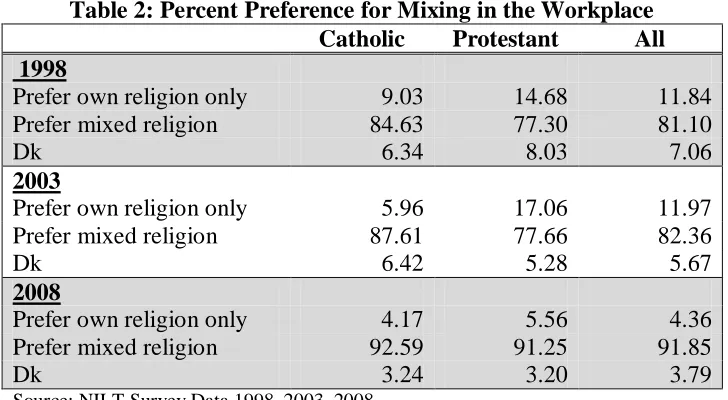
This reduced variation between groups is apparent in Table 1 and 2. Variation in
preference for mixing in neighborhoods has decreased almost 5 percent from 1998 to 2008
(although increasing in 2003). A parallel reduction in variation between groups in combination
with an overall increase in willingness to integrate is present in preference for mixing in the
workplace. In addition to this substantial ingroup-outgroup variation over time within these two
areas, there is also variation across all four willingness to integrate questions over a twenty year
19
CAIN Web service - “Key Issues –Elections in Northern Ireland” http://cain.ulst.ac.uk/issues/politics/election /
20
Source: NISA Survey Data 1989-1996 & NILT Survey Data 1998-2008
Figure 1: Aggregate Percent Willingness to Integrate in Northern Ireland
period from 1989 to 2008. This time frame puts the power sharing agreement right in the middle
of this time period and illustrates well perceptual shifts over time with a steady increase in
willingness to integrate from 2000 on.
The Northern Ireland case is therefore an optimal case for several reasons: the Good
Friday Agreement (engagement in a political power sharing/consociational agreement), a
sufficient amount of time has passed (13 years have passed since the signing of the GFA, thus
significantly reducing the likelihood of reversion to violence), and the case indicates aggregate
level increases in willingness to integrate as well as variation between groups, over time, and at
Table 1: Percent Preference for Mixing in Neighborhoods Catholic Protestant All 1998
Prefer own religion only 18.07 25.03 21.12 Prefer mixed religion 72.42 66.42 70.40
Dk 9.51 8.55 8.48
2003
Prefer own religion only 15.90 26.80 21.80 Prefer mixed religion 76.61 66.40 71.29
other/dk/don‟t care 7.49 6.80 6.91
2008
Prefer own religion only 15.05 22.27 14.65 Prefer mixed religion 79.86 78.62 80.58
other/dk/don‟t care 5.09 3.87 4.77
[image:30.612.125.489.309.509.2]Source: NILT Survey Data 1998, 2003, 200821
Table 2: Percent Preference for Mixing in the Workplace Catholic Protestant All 1998
Prefer own religion only 9.03 14.68 11.84
Prefer mixed religion 84.63 77.30 81.10
Dk 6.34 8.03 7.06
2003
Prefer own religion only 5.96 17.06 11.97
Prefer mixed religion 87.61 77.66 82.36
Dk 6.42 5.28 5.67
2008
Prefer own religion only 4.17 5.56 4.36
Prefer mixed religion 92.59 91.25 91.85
Dk 3.24 3.20 3.79
Source: NILT Survey Data 1998, 2003, 2008
The aggregate level data indicates that there is a societal level shift or a social
transformation taking place in Northern Ireland. Given this, the remainder of this thesis will
investigate, through use of the individual level Northern Ireland Life and Times Survey data, the
causes of potential attitudinal shifts through testing of the hypotheses discussed above.
21
DATA AND MEASUREMENTS
The data for this research are drawn from two waves of the Northern Ireland Life and
Times (NILT) Survey. Cross-sectional, individual level data from the 1998 and 2008 waves are
utilized to account for any changes that might have occurred over time, addressing in part the
temporal nature of the peace process as discussed by Goodhand and Hulme and above. Survey
questions from all variables and waves are laid out below (for specific coding rules see
Appendix).
Dependent Variables
Respondent‟s willingness to integrate in four areas serves as the dependent variable in
this study. There are four questions that measure each area of personal willingness to integrate.
The questions are the same in both waves used and they are as follows:22
1) Neighborhood integration: “If you had a choice, would you prefer to live in a neighbourhood with people of only your own religion, or in a mixed-religion neighbourhood?” Possible responses included “Own religion only” “Mixed religion neighbourhood” and “Don‟t know”. (1998, 30)
2) Workplace integration: “And if you were working and had to change your job, would you prefer a work place with people of only your own religion, or a mixed religion workplace?” Possible responses include, “own religion”, “mixed religion workplace”, and “Don‟t know”.
3) School integration: “And if you were deciding where to send your children to school, would you prefer a school with children of only your own religion, or a mixed-religion school?” Possible Reponses include, “own mixed-religion only,” “mixed mixed-religion school,” and “Don‟t know.” (30)
22
4) Integration in Marriage: “And you personally, would you mind or not mind?” … “if one of their close relatives were to marry someone of a different religion?”23
Possible responses: “Would mind a lot,” “would mind a little,” “would not mind,” and “Don‟t know.” (29)
The responses of these four questions are aggregated creating an ordinal variable, 0 = responded
with preference for no mixing/only “own religion” to all areas of integration and 4 = responded
with preference for mixing/“mixed religion” in all four areas (both “mind a lot” and “mind a
little” responses coded as preference for no mixing).24
Political Trust
The political trust variable utilizes one question from each wave analyzed in this study.
The four primary political groups are measured as follows: the 1998 survey asks respondents
about specific political leaders, while the 2008 survey ask about political parties. Both years‟
questions adequately measure trust levels in the more extreme and more moderate nationalist and
unionist groups.25
23
The question wording for these is identical in most years and has identical wording in the 1998 and 2008 which are statistically analyzed and used for descriptive statistics, and 2003 that is used for descriptive statistics in this thesis. The only difference is that in the 2008 wave there is an additional note to the interviewer for these questions: “If necessary, remind respondent that these questions refer to relations between Protestants and Catholics.” (repeated in each question). The question on personal preference follows a question to impression of general Northern Ireland preference: “And do you think most people in Northern Ireland would mind or not mind if one of their close relatives were to marry someone of a different religion?” (emphasis added to the section that is included above to
illustrate meaning of the marital integration question but only read with the first question regarding general community preference.)
24
Because there is no overt “prefer mixed marriage” or “prefer marriage to your own group” answer for the marriage category the three options given must be assigned values that best represent these preferences. So while there are degrees of preference in the two responses “mind a lot” and “mind a little” both responses do indicate a preference against mixed marriage. Due to this, both are coded as 0 for preferring no integration in marriage rather than a 1 which is assigned to respondents who stated they “would not mind”. A response of “would not mind”, or the absence of objection, is considered here equivalent to preference for integration.
25
1) 1998 survey: Elite Specific question asks; “Here is a list of some of the main politicians in Northern Ireland. Which of them, if any, would you generally trust to act in the best interests of all the people in Northern Ireland?” Respondents could answer yes or no to the following politicians: Gerry Adams, John Alderdice, David Ervine, John Hume, Robert McCartney, Gary McMichael, Monica McWilliams, Seamus Mallon, Ian Paisley, and David Trimble.26
2) 2008 Survey: Party specific question asks; “Thinking about the ministers in the Northern Ireland Executive, how much would you trust a minister from each of these parties to act in the best interests of all the people in Northern Ireland? First, a minister from the Democratic Unionist Party or DUP?” the survey then asks about “A minister from Sinn Féin”, “A minister from the Social Democratic and Labour Party (SDLP)” and “A minister from the Ulster Unionist Party (UUP)”. Responses for all are as follows: “Probably trust,” “Neither trust nor distrust,” “Probably distrust,” “definitely distrust” or “Don‟t know”27
.
Two ordinal variables (0 to 2) are constructed to adequately analyze the relationship
between individuals and elites or parties of the ingroup or outgroup; trust in nationalist elites and
trust in unionist elites. The 2008 data represents the four primary nationalist and unionist parties,
therefore the four elites which align with these parties are utilized from the 1998 data.
InGroup Attachment
Religious identification and level of religious participation, measured by frequency of
attendance to church, as well as political group attachment quantifies ingroup attachment.28 First,
two models were run for each of the specified time periods (one for the Catholic population, and
one for the Protestant population) to clearly identify any variation between significant causal
factors for the two groups. Second, measurement of the respondent‟s frequency of attendance to
church services will gauge strength of attachment (an ordinal variable) to the religious group and
p<.05 level. This variation in significance for Catholics is likely the consequence of heightened tensions during this period which is prior to the signing of the St. Andrews Agreement which buttressed the power sharing initiated with the GFA.
26
1998 NILT Survey (17)
27
Section 5 Q10 NILT Survey Questionnaire (31).
28
identification as Protestant or Catholic.29 Third, the attachment variable measures identification
of the individual as Unionist or Nationalist, this identifies political group attachment which
indicates a strong attachment to either group decreasing the likelihood of willingness to
integrate.30
Outgroup Benefit
Perceived ingroup and outgroup benefit in terms of satisfaction with the power sharing
agreement are derived from two questions. The first question determines if the respondent
identifies as Catholic or Protestant. This variable is combined with questions that gauge if
Unionists/Protestants or Nationalists/Catholics benefited more, less, or equally from the Good
Friday Agreement. While the 2008 question asks specifically about Protestants and Catholics,
and the earlier waves ask in terms of Unionist and Nationalist identification, the manner in which
identity in Northern Ireland is constructed allows for these two terms of identity to be collapsed
into comparable categories.
1) The 1998 and 2003 surveys ask: “Thinking back to the Good Friday Agreement now, would you say that it has benefited unionists more than nationalists, nationalists more than unionists, or that unionists and nationalists have benefited equally?” Responses include: “Unionists benefited a lot more than nationalists,” “Unionists benefited a little more than nationalists,” “Nationalists benefited a lot more than unionists,” “Nationalists benefited a little more than unionists,” “Unionists and nationalists benefited equally,” and “Don't know”31
.
29
There are obviously additional religions represented in the Northern Irish population, however, these are not pertinent to this particular study and are dropped out of the model.
30
Note that „political group‟ is used instead of political party. I am using identification with either Nationalist or Unionist political identities, the two identities which are accounted for in the GFA broadly, rather than specific political parties which may or may not identify with one of these broader political identifications. The three waves in this study have different response categories which have been standardized for comparison across years.
31
2) The 2008 survey asks: “And thinking about all the political changes that have taken place in Northern Ireland since 1998, would you say that they have benefited Catholics more than Protestants, Protestants more than Catholics or have Protestants and Catholics benefited equally?” Responses included; “Protestants benefited a lot more than Catholics,” Protestants benefited a little more than Catholics,” “Catholics benefited a lot more than Protestants,” “Catholics benefited a little more than Protestants,” “Protestants and Catholics benefited equally,” “Other,” “Neither Side benefited,” or “Don‟t know” 32
Previous Interaction
Contact theories are measured by identifying if the respondent attended a mixed school or
not. Approximately 5% of schools in Northern Ireland are mixed between Protestants and
Catholics as of 2003.33 While there are other ways that interaction may occur, the following
question is consistent across all waves. “Did you ever attend a mixed or integrated school in
Northern Ireland, that is, a school with fairly large numbers of both Catholic and Protestant
children?” Responses include, “Yes,” “No,” or “don‟t know”34
. Approximately 88 percent of
both Catholics and Protestants respondents in 2008 and Catholic respondents in 1998 attended
non-integrated school. Protestant respondents in 1998 however reported higher levels of mixed
[image:35.612.106.507.518.647.2]education at 14 percent (see Table 3).
Table 3: Measuring Contact – Percent Respondents who Attended Mixed Schools
1998 2008
Catholic Protestant Catholic Protestant
Mixed 11.62 14.10 11.34 11.30
Not Mixed 88.38 85.90 88.66 88.70
N = 628 943 432 593
Source: NILT Survey Data 1998, 2008
32
Section 5 Q11 NILT Survey Questionnaire (31). Variable BENCHNG.
33
CAIN: http://cain.ulst.ac.uk/ni/educ.htm
34
Socio Economic Variables
In addition to the variables discussed above variation that may be explained by
socio-economic factors is controlled for. Previous literature, both generally and in the sub-areas of
conflict and post-conflict reconciliation, has indicated that education level, income, and social
status impact behavior (e.g. Sullivan et al. 1981; Stoufer 1955; Nunn et al. 1978; Blanton,
Crocker, & Miller 2000; Blanton 2001). 35 Economic Status in this study is measured through a
self-identified household income level. “Looking back over the last year or so, would you say
that your household's income has... fallen behind prices, kept up with prices, or, gone up by more
than prices?” or “(Don‟t know)”36
. This question primarily measures perceived economic status
which allows for understanding of how secure, financially and otherwise the individual feels.
Educationlevel is measured as an ordinal level variable ranging from no formal education (0) to
degree level or higher (5). The respondent was asked for their highest level of education and
shown a list of responses.37Income is measured with a categorical ordinal variable ranging from
under £3000 (1) to over £40,000 (10). It is important to clarify here the difference between the
income variable and the economic status variable. While income is the actual reported household
income, economic status is gauging the respondent‟s perception of economic wellbeing and
security.
35
Previous literature indicates a positive relationship between education, income and social status, and tolerance. Studies that use the state as the unit of analysis usually use GDP or GDP per capita to gauge state economic productivity (e.g. Quinn, Mason and Gurses (2007) who find that higher GDP reduces the likelihood of conflict recurrence).
36
Q6 from 1998 NILT Survey Questionnaire (3).
37
Furthermore correlation statistics show that each of these variables is gauging a different concept
(.26 in 1998 and .16 in 2008).38 The age variable is the self reported age of the respondent. Sex is
represented with a dichotomous variable where 0 = female and 1= male.39
METHODS AND FINDINGS
The data utilized for this study is cross sectional and therefore a variety of ordered logit
regression analyses are examined to test expectations of the hypotheses discussed above.
Ordered logit regression provides the appropriate model parameters to account for the ordinal
nature of the dependent variable, integration.40 Six models are examined below. Two models for
each individual year, and a pooled sample combining the 1998 and 2008 waves of data are
analyzed. Pooling the data allows for increasing the N, if variables exhibit the same behavior
over multiple years, and the implications of increasing time after the initiation of a power sharing
agreement and institutions.41
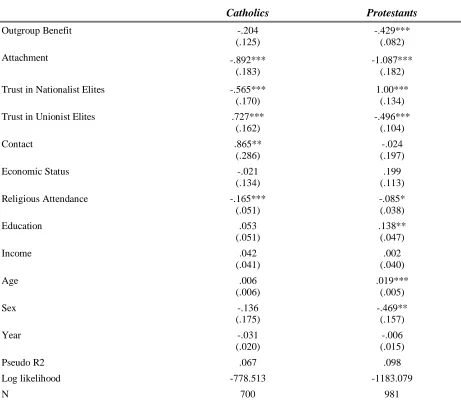
The pooled data model (Table 4) indicates confirmation of the hypotheses discussed
above. The second proposition of the first hypotheses which posits a greater impact of outgroup
benefit on the dominant group is confirmed. Outgroup benefit is found to have a negative and
significant impact on the dominant, Protestant, group. Protestants who responded that they
thought Catholics had benefited the most from the GFA were 39.2 percent less likely to be
38
Additionally, it is possible that there could be an interaction effect between these two variables. Models were run with an interaction term combining the affects of the economic status variable and the income variable. The interaction term had little effect on the model as a whole and was an insignificant predictor of integration itself.
39
The literature indicates that sex is unlikely to have a significant impact on ingroup/outgroup behavior due to the primary ingroup identification (e.g. Jorst 2001). While there is no expectation that the sex of a respondent will have any explanatory over behavior the alternative of this is that it does impact behavior, or willingness to integrate here, and is therefore included as a control.
40
See Long and Freese (183-184, 2006) for full discussion of ordinal outcome modeling.
41
willing to integrate in all four areas than those who felt that Protestants benefited the most (see
Table 6). This finding is confirmatory of assumptions of group threat affects within social
dominance theory. The outgroup benefit variable is not significant for those individuals
[image:38.612.75.536.253.655.2]identifying as Catholic.
Table 4: Ordered Logit Regressions - Pooled 1998 & 2008 Data
Willingness to Integrate
Catholics Protestants
Outgroup Benefit -.204
(.125)
-.429*** (.082)
Attachment -.892***
(.183)
-1.087*** (.182)
Trust in Nationalist Elites -.565***
(.170)
1.00*** (.134)
Trust in Unionist Elites .727***
(.162)
-.496*** (.104)
Contact .865**
(.286)
-.024 (.197)
Economic Status -.021
(.134)
.199 (.113)
Religious Attendance -.165***
(.051)
-.085* (.038)
Education .053
(.051)
.138** (.047)
Income .042
(.041)
.002 (.040)
Age .006
(.006)
.019*** (.005)
Sex -.136
(.175)
-.469** (.157)
Year -.031
(.020)
-.006 (.015)
Pseudo R2 .067 .098
Log likelihood -778.513 -1183.079
N 700 981
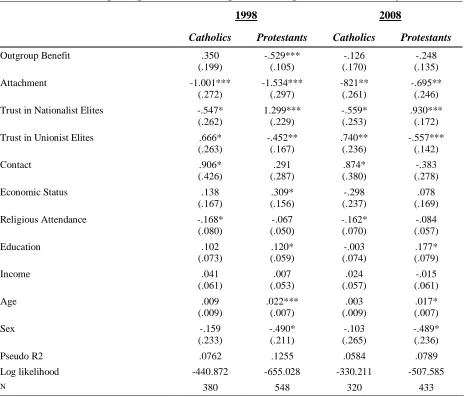
Table 5: Ordered Logit Regressions – Willingness to Integrate for Individual years
1998 2008
Catholics Protestants Catholics Protestants
Outgroup Benefit .350
(.199) -.529*** (.105) -.126 (.170) -.248 (.135)
Attachment -1.001***
(.272) -1.534*** (.297) -821** (.261) -.695** (.246)
Trust in Nationalist Elites -.547*
(.262) 1.299*** (.229) -.559* (.253) .930*** (.172)
Trust in Unionist Elites .666*
(.263) -.452** (.167) .740** (.236) -.557*** (.142)
Contact .906*
(.426) .291 (.287) .874* (.380) -.383 (.278)
Economic Status .138
(.167) .309* (.156) -.298 (.237) .078 (.169)
Religious Attendance -.168*
(.080) -.067 (.050) -.162* (.070) -.084 (.057)
Education .102
(.073) .120* (.059) -.003 (.074) .177* (.079)
Income .041
(.061) .007 (.053) .024 (.057) -.015 (.061)
Age .009
(.009) .022*** (.007) .003 (.009) .017* (.007)
Sex -.159
(.233) -.490* (.211) -.103 (.265) -.489* (.236)
Pseudo R2 .0762 .1255 .0584 .0789
Log likelihood -440.872 -655.028 -330.211 -507.585
N 380 548 320 433
*p<.05; **p<.01; ***p<.001; robust standard errors in parentheses.
Table 6: Percent Change For Protestants given Outgroup Benefit
1 2 2 3 3 4 4 5 (minmax)
1998 -8.75 -11.28 -12.91 -12.94 -45.88
2008 -3.63 -3.32 -3 -2.67 -12.62
[image:39.612.120.491.575.663.2]Models for 1998 re-confirm this finding, however outgroup benefit in 2008 is not significant at
the .05 level for either group. Outgroup benefit with a p-value of .066 is however still note
worthy, especially considering the reduction of effect given the percent change. This finding is
confirmatory of assumptions of group threat affects within social dominance theory. The
outgroup benefit variable is not significant for those individuals across years and reduces
substantially from 1998 to 2008. Percent change in 1998 indicates that Protestants who
responded with the highest perception of outgroup benefit were 45.8 percent less likely to be
willing to integrate in all four areas than those who responded with the highest levels of ingroup
benefit. In 2008 the percent change is just under 13 percent. Additionally, 26 percent of this 45.8
percent change in 1998 is occurring between respondents who felt that both groups benefited
equally and those who felt the greatest levels of outgroup benefit. This finding indicates the high
level of impact that perceptions of outgroup benefit have on high levels of willingness to
integrate. Again, these findings confirm social dominance theories. Additionally, Crighton and
McIver‟s (1991) findings that the dominant group is more susceptible to “fear of extinction” are
re-confirmed within the pooled model and the 1998 model. However, the fact that the 2008
model produces insignificant relationship between outgroup benefit is important to the
evolutionary story of post conflict in Northern Ireland. Catholics and Protestants in 2008 are not
making decisions about wanting to integrate with the outgroup based on outgroup or ingroup
benefits.
The second hypothesis which discusses the implications of attachment to an ingroup is
strongly supported by the pooled sample as well as the 1998 and 2008 models. Individuals
(Nationalists or Unionists) are significantly less likely to want to engage with the outgroup.
These results confirm that attachment to an ingroup, in this case the political group increases
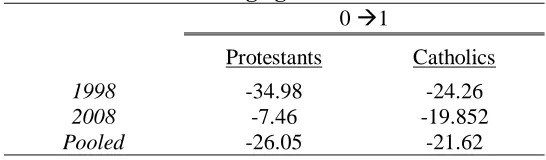
negative perceptions, or at least impedes positive feelings about the outgroup. Catholic
respondents in 1998 who are attached to one of the primary political groups are 24 percent less
likely to be willing to integrate in all four areas than those who are not attached. In 2008 the
percent difference is just less than 20 percent, and the pooled model finds that Catholic attached
respondents are 21 percent less likely than Catholics that are not attached. The impact of
Protestant attachment to a political group is largely the same as it is for Catholic respondents.
Protestants in 1998 who respond as identifying as Unionist or Nationalist are 34.9 percent less
likely to be willing to integrate in all four areas than those who do not identify with one of these
political identities. In 2008 the impact drops greatly respondents are only 7.5 percent less likely
to be willing to integrate in all areas (see Table 7). This drop in percent change between these
two years indicates that attachment to a political group for Protestants matters less for informing
a person‟s willingness to integrate ten years after the GFA. More specifically, we can infer from
these results that this impact that attachment has on integration is primarily coming from
attachment to the political ingroup.42
[image:41.612.169.442.540.620.2]
Table 7: Percent Change given Attachment
0 1
Protestants Catholics
1998 -34.98 -24.26
2008 -7.46 -19.852
Pooled -26.05 -21.62
42
Table 8: Percent Unionist and Nationalist by Religion
1998 2008
Catholic Protestant Catholic Protestant Not Unionist 98.9 27 99.06 30
Unionist 1.1 73 0.9 70
Not Nationalist 37.1 99.5 48.6 99.6
Nationalist 62.9 0.5 51.4 0.34
Source: NILT Survey Data 1998, 2008
It is known that Catholics primarily identify as Nationalist and Protestants identify
primarily as Unionists, as this is apparent in Table 8. In 1998 and 2008 approximately only 1
percent of Catholics identify as Unionists while the majority that attached with one of these
groups identifies as Nationalist. Likewise, less than .5 percent of Protestants identify as
Nationalists while around 70 percent in both 1998 and 2008 identify as Unionist. The second
hypothesis, that “strength of identification with one‟s ingroup will negatively and significantly
impact willingness to integrate with the outgroup,” is strongly confirmed with these findings.
Additionally, findings are consistent between groups unlike outgroup benefit.
Trust in political elites, which address the third hypothesis, has the expected result as well
and is significantly impactful on individual willingness to integrate. In the pooled model
individuals who trust in outgroup elites (Protestants trusting in Nationalist elites or Catholics
trusting in Unionist elites) are significantly more likely to say they would integrate with the
outgroup. Protestants who trust both Nationalist groups/individuals are almost 43 percent more
likely to be willing to integrate in all four areas than Protestants who trust neither. Catholics who
trust both Unionist groups/individuals are 32.5 percent more likely to want to integrate in all four