ROUTING OPTIMIZATION FOR LAST MILE MOBILE OF HYBRID
OPTICAL/WIRELESS ACCESS NETWORK
M. A. Wong1, M. Elshaikh2, Nadiatulhuda Zulkifli3, S. M. Idrus3, S. J. Elias4 and Arnidza Ramli5
1Department of Engineering Technology, Universiti Teknikal Malaysia Melaka, Durian Tunggal, Melaka, Malaysia 2School of Computer and Communication, Universiti Malaysia Perlis, Arau, Perlis, Malaysia
3Faculty of Electrical, Univeristi Teknologi Malaysia, Johor Bahru, Johor, Malaysia 4School of Computer Sciences, Universiti Teknologi MARA Kedah, Kedah, Malaysia
E-Mail: [email protected]
ABSTRACT
Last mile mobile hybrid wireless–optical access network is obtained increasing attention among internet users and industry plus is gauging momentum as bandwidth-effective, flexible, and cost-effective solutions for providing connectivity to anywhere internet users in anywhere areas. In this work, we address the issue of resource utilization efficiency designing the cooperate multiple layers framework of deploy over passive optical network. Namely, we consider the case where the coverage of a mobile wireless segment which features multi-hop wireless link, multiplexing scheme and operated either according to the IEEE 802.11 standard is extended by an additional Ethernet-based Passive Optical Network (EPON). We propose a design of experiment simulation model which optimizes the overall last mile mobile hybrid wireless–optical access networks transmission in terms of system network performance, while accounting for the specific traffic requirements of the anywhere internet users, and the specific features of the technological components. The data packet delivery ratio (PDR), average end-to-end delay, total energy consumption and network throughput are evaluated as the performance metrics by OMNeT++ simulation. Conditions for best fit performance are determined through optimization, generalizing existing work by opting taguchi scheme for choosing the best fit parameters for determines the optimal and efficient last mile mobile hybrid wireless–optical access networks. Simulation studies indicate the optimized framework of last mile mobile of hybrid optical wireless access network that proposed here is performing better such as 2-6% energy reduction as compared to the non-optimized of the first work in joint cooperation layers of last mile mobile HOWAN framework.
Keywords: mobile ad hoc network, design of experiment, packet delivery ratio, ad-hoc on-demand distance vector, taguchi, signal noise ratio.
INTRODUCTION
The recent progresses in the field of access technologies have boosted the fundamental adoption of optical technology such as to-point (P2P) and point-to-multipoint (P2MP) which are normally in the market described as Passive Optical Network (PON) and are gauging momentum as an effective way to reach the final mobile users due to their favorable features in terms of bandwidth efficient, robustness and maintainability (Rodney S. Tucker1, 2011). In the last few years also, the quality of experience requested by mobile users has incredibly increased (think of the triple play services), thus challenging the architectures of the deployed current access networks. HOWAN took up the challenge that is also known as WOBAN which is a novel access network that combines the optical and wireless technologies. It was introduced to provide mobility and extended reach of high capacity broadband access networks. HOWAN is a novel access architecture that provides wireless at the front end, either a WiFi or WiMAX, while supported by an optical backhaul such as PON. As a consequence, it is straightforward to envision the use of Last Mile Mobile Hybrid Wireless–Optical Broadband Access Networks (LMMHOWANs) that having desirable features in terms of provided bandwidth and deployment.
To fully unleash the potentials of HOWAN architectures, several technical challenges have to be
addressed and resolved such as most of the existing work of access network proposed solutions within a specific functional OSI layer such as physical layer or network layer. Others challenges including the quality of services across the wireless/optical, the routing in the hybrid architecture, demands for better and faster services often result in growing power consumption which in turn leads to increase in carbon footprint and unwanted heat. Here, we believe that it is important to investigate a more holistic solution that consider multiple layers to include more than just one functional layer (GreenTouchTM, 2012). For that, an architectural platform that consider cooperation multiple functional layers e.g. physical and network layers demonstrating a seamless transmission of mobile/wireless signals over standardized PON topologies has been investigated to provide centralized heterogeneous network with ubiquitous access and mobility (Rodney S. Tucker2, 2011) such as broadcast access with splitting scheme and WLAN while it is relies on the optical IP architecture which hopefully can address the challengers mention here.
(MANET), while supported by an optical backhaul such as PON (Pulak Chowdhury et al. 2009) with the focus in this article by means of accessing each remote Optical Network Unit/Base Station (ONU/BS) from the optical line terminal (OLT) by frequency division multiplexing (TDM) and splitter. In details, we trying to improve the access network with design of experiment through simulation model which can optimize the objective studies that include achieving robust and efficient system network, while accounting for the specific traffic requirements of the mobile users, and the specific features of the technological components.
Specifically, this has brought about the cooperation of multiple layer in HOWAN framework that also provides the following key features that illustrate its departure from the existing work and mark the contributions of this paper; contributions on the general architecture of hybrid optical/wireless networks and contributions on protocol-oriented aspects of routing assignment.
It simplifies the process of monitoring and analysis study by providing a unified interface for accessing application, protocol and system information. This also mark the inclusion of a multiplex scheme of network paradigm in the wireless domain through IEEE standard 802.11.
The generic design of the unified framework was proposed to solved to the optimality by selects the best network parameter of transmission to be installed and integrate these disparate specific functional of OSI layer into a multitude layer form which should be familiar and further enabled simplifies the process of specifying cross-layer interaction in service-oriented architecture by providing a declarative way to specify how a set of layering improvement of joint-functionality should be composed and adapted in interoperability strategy
This cooperation multiple-level approach offers (i) an improved of very high degree of flexible scalability, to better evaluate with different routing compositions of MANET over passive access network of efficiency, and (ii) towards centralized heterogeneous information system with extensible access control, to include cooperating protocols to find the right set of design level optimizations for a certain use-case which in this article focus on transmission handling. Hence, none of the existing work in HOWAN has considered this scenario.
Organization of the paper is as follows: Section 2 overviews the related work in the field, Section 3 overviews the main building blocks of the reference WOBAN architecture. In Section 4, the framework of the proposed solution of typical last mile mobile of HOWAN backhaul. We introduce the optimization simulation model for last mile mobile of HOWAN backhaul planning and comment on the corresponding simulation design of experiment. Section 5 reports on the performance evaluation carried out to assess the quality and the utility
of the proposed optimization model. Finally, concluding remarks are made.
LITERATURE REVIEW
Advanced optical networks infrastructures and efficient node component elements in optical access networks such as splitter, AWG, fiber, ONU and etc are main enabling factors triggering the development of high speed Internet services (MNM Warip et al. 2011) and the Next Generation Optical Wireless Access Networks (NGOWAN) paradigm towards simultaneous of optical access network through centralization. The concept is to design a single control integrated development platform simulation model of optical wireless access network based researcher work (David Piehler, 2011) targeting the couple with customized interactive nature of traffic transmission such as TCP flow control, streaming video (H.264/AVC with UDP) and file downloading (FTP) (K. Kim1, (2011).
In order to drive the breakthrough of scalability and robustness of HOWAN based on the hint of integrating more than one existing of different domains or OSI layering, we have proposed our own such platform that combines the capabilities of wireless access protocol and optical backhaul system instead of single building blocks of WOBANs such as IEEE 802.16 multi-hop networks [Y. Yu et al. 2008). This also is an attempt to provide an efficient last mile mobile hybrid optical wireless access communication network platform that featuring cross-configuration in system network paradigm.
In this project, we use the UDP traffic as the background traffic to study the effects of the optimized transmission in MANETprotocol that is AODV routing of MANET over HOWAN that based PON technology in terms of performance metrics such as packet delivery ratio (PDR), capacity, end-to-end data delay and energy consumption. Our objective is to provide an additional source of performance evaluation method with a unique combination of mobile wireless solution and last mile passive optical access technology that refer to, extension of existing radio coverage and capacity carrying UDP traffic plus passive optical backhaul.
Based on the OMNet++ software of INET framework package which focus on frame networking of upper OSI layer and the physical layer modeling (K. Kim2, 2011), hybrid passive optical network model are acknowledged as a fundamental breakthroughs. Given the idea of realism with refer to past several studies and review, this article will be discussing about the viability of creating OMNeT++-based simulation of last mile mobile hybrid wireless optical access framework with AODV routing in MANET deployment over Passive optical Backhaul; driven by point to multipoint optical access system able to support flexible optical splitting mechanism with the joint ability factor to induce better integration and broadcasting transmission-convergence layer (R. Massin et al. 2010).
possess the support to act as both routers and hosts which might be beneficial to work on analysis of passive optical network that interconnects multiple sub-networks on Tree topology. The performance of delivery the “triple-play” service over P2P or P2MP networks is analyzed in numerous studies from the capacity and delay point of view. As a matter of fact, performance simulation on capacity and delay of wireless access based passive optical network access network is undertaken in various environments such as using the commercial software of OPNET platform [R Malhotra et al. 2012). By using the identify open source of OMNeT++ simulator platform, we then analyze a similar situation but consider and checking more criteria where the front-end mobile user nodes applying the AODV routing protocol only of MANET sending traffic to a common destination that is the centralized office (server) at the passive optical backhaul. We do not intend to dispute or concur with the deduction drawn by others author as we are performing the simulations in different environment with convergence between single hierarchical optical system backhaul and AODV routing in MANET (M. A. Wong et al. 2015).
Figure-1. Taxonomy of access protocol.
In this section also and based Figure-1, we reiterate a few class of algorithm effort from publications which call for resource efficiency consumption of access networks and optimized the framework performance quality of end-to-end nodes in Figure below here. Our framework considering different way of doing it that aim at developing a vigorous design by employing design of experiment to quantitatively identifying just the right ingredients that go together to make a high-quality product or service that leveraging the traditional results on resource optimization in terms of energy consumption. It is also accounting for end-to-end links’ quality, delay and capacity issues in a single-access network of integration and cooperation multiple level of optical and wireless technology.
BASIC DESIGN SPECIFICATIONS
Taguchi based design of experiment towards last miles mobile HOWAN
For the first time in access domain, introducing design of experiment (DOE) via Taguchi method (Awada, A et al. 2011) in Last Mile Mobile of HOWAN. For our case here, with this method aims at producing an improved proficient framework where a robust experimental design are involved to reduce the variation in process. In Figure-2, Taguchi separates variables in two types towards achieving optimized output characteristic. Control factors are variables that can be controlled while noise factors are variables which are difficult to control in practice. The purpose of the Taguchi design of experiment is to have the confirming factors set at the optimal levels that should be conducted through experiment of design to compare the existing performance. At the end of this respective method, it can be round up as a specific confirming experiment with factors set at the optimal levels should be conducted to validate the earlier results.
Figure-2. Taguchi approaches design from a robust/efficient design perspective.
METHODOLOGY OVER LMMHOWAN
allocation each are considered independently with 100Mbit/s and 10Gbit/s each.
Table-1. Simulation parameter.
Multi-layer cooperation platform of LMMHOWAN framework
The paper sets forth a proposed framework of the cooperation multi-layer solution for Last Mile Mobile HOWAN which adopted from the model of physical layer impairment-aware control and management protocols for optical transport network (Marinez, 2006). The chosen last mile mobile solution of HOWAN conceptual architecture can be summarized as the fundamental foundation that not only focus on specific physical PON component-oriented of the design but also contain the upper layer model-based on the work in (Redhwan Q et al. 2011).
Figure-3. Framework of multiple layer cooperation solution for HOWAN.
In the study for the last mile mobile solution of HOWAN project with emphasis on the fiber optics ecosystem, GPON with Ethernet feature was taken and declared as the best solution in the combination of low
complexity and best sensitivity which based on pyramid-type layer model. This can be illustrated in Figure-3 that shows the require components of optical and wireless network that are involved in the above HOWAN transmission line; ONU, splitter, OLT reside at the optical backhaul while mobile node, wireless router and wireless gateway in the wireless front end. The important difference from the referred model is the transmission media since this new updated HOWAN also known as NGOWAN uses both wireless and optical media. This respective hybrid framework aims to combine the properties of the optical, mobile, and wireless entities such that wireless mobility is used to simulate the behavior of wireless nodes together with optical wired nodes according to AODV communication protocol. Our framework assumes a centralized management and control approach where resource and routing allocation process (TDM/WDM scheme) is conducted by a single, centralized unit known as the center office (CO) at the backhaul part.
Routing algorithm optimization based Taguchi method
rate limit = do not send out more than 10 RERR or RREQ (boolean)
wait_on_reboot = wait after reboot and gather routes before sending out routing info
llfeedback = allow layer2 link-detection instead of sending hello messages
receive_ n_ hellos = receive N HELLOs before treating as neighbor (non RFC parameter)
optimized_hellos = do not send hello messages if there are no active routes (non RFC parameter)
*refer discussion section for more details.
The main steps of AODV routing design of optimization in the framework LMMHOWAN are shown in Figure-4 above here. Generally, the key point here is the process of optimizing an objective parameters that include control and noise factors with respect to the presence variables for quantitatively identifying just the right ingredients that go together to make a high-quality product or service. After the brainstorming step, the objective parameters are selected on the AODV’s parameters that to be taken into account in the optimization process (refer in the flow chart below). On the strategic level’s decisions, this particular flow chart employs a generic signal-to-noise (SN) ratio as a quantitative measure for determining the optimum system network framework of efficient resource in last mile mobile NGOWAN. There are primarily three categories of SN ratios, namely, “smaller-is-better,” “larger-is-better,” and “nominal-is-best”. At the parameter screening, the selection of SN ratio depends on the goal of study either the energy criteria or other utility criteria such as capacity or delay which are to be minimized or to be maximized. The repeat will take place if the parameter screening is not satisfied. While for devising the optimal framework design, we adopt the constrained optimization method that is using hard constraints which set conditions for the variables that are required to be satisfied. Else, the repeat will happen to find new parameters if the optimization is not satisfied.
Simulation experiments design via Taguchi method In general usage, design of experiments (DOE) or experimental design is the design of any information-gathering exercises where variation is present, whether under the full control of the experimenter or not. However, in statistics, these terms are usually used for controlled experiments. Figure-5 here show the brief technical process undertake in Taguchi method for LMMHOWAN which take place in OMNet++. The additional tool that required in this step are MINITAB and EXCEL. Under the session window output for a Taguchi design, minitab calculates response tables, linear model results, and generates main effects and interaction plots for: signal-to-noise ratios (S/N ratios, which provide a measure of robustness) vs. the control factors.
Figure-5. Taguchi methodology phases.
This OA are a simplified method of putting together an experiment that tag along in this scheme. The procedure to determine the appropriate OA are as follow: 1. Define the number of factors and their levels. 2. Determine the degrees of freedom. 3. Select an orthogonal array. 4. Consider any interactions. For our case, we use the Taguchi’s Two Level Designs. While, signal-to-noise ratio (SN) is analyzed in the Taguchi method to identify the optimal set of process parameters values and after that obtaining the preferred factor either control factor or noise factor for the maximum appropriate SN ratio. Moreover, to determine the effect each variable has on the output, the signal-to-noise ratio, based on three formulas “nominal the best”, “smaller the better - for the case of minimizing the performance characteristic and “larger the better - for the case of maximizing the performance characteristic” of equations (1), (2), and (3) need to be calculated for each experiment conducted based-on the targeted optimization criterion.
(1)
(2)
(3)
Implementation approach in last mile mobile HOWAN framework
Figure-6. Wireless base station module implementing the MANET routing supporting wireless Adhoc networks of
PON access domain.
Development study is also perform towards the compatibility of transmission line between passive optical backhaul and simultaneous multiple service end user and it is achieved by implementing a plurality of fiber access hybrid TDM/WDM enabling common sharing and splitting technique in the upstream/downstream at the central office (CO). Following that, there is the multi-channel access scheme based on a transmission multi destination distribution multiplexing (TM) method couple with intelligent to route where front end routing message is multicast. So, P-MP modes have been viewed as broadcast transmission choice of many researchers while the route reply to the source (initiator) node treated as unicast packet transmission.
Figure-7. OLT and ONU modules are implements the hybrid TDM/WDM-PON OLT and ONU depends on the component modules of the neighbor layer which the frame
is queued and transmitted according to the CSMA/CD protocol.
RESULTS AND DISCUSSIONS
In this section sub section provide 4 sets of parameter that are optimized of the output graph to be analyses which against the preset fixed interval of network speed as follow:-.
a) Energy consumption
After applied this algorithm, our network energy consumption (OPTI) is less about 2-6% energy reduction as compared to prior one (ORI) and the framework remained active for longer period. It is because of the optimized framework of AODV over HOWAN finds the best route which based on the optimum and best fit design parameters selected from the Taguchi scheme thus improved data delivery in the respective framework. This can be explained in the parameter selection, rate limit is chosen due to it placed limitation on the broadcast control messages such as RERR or HELLO message flooding in the network. Under the parameter of wait_on_reboot, waiting phase is applied on the mobile nodes that caused the mobile nodes temporarily become inactive. The rebooted nodes comes out of the waiting phase and becomes an active nodes again. Consequently, all this are lead to improvement of network lifetime in the framework of LMMHOWAN and maintain the framework functionalities. Besides that, the HELLO messages with refer to parameter optimized_ hellos will only be broadcast if there is active route in the framework found which also contribute towards reduction in energy consumption. In addition, the graphs in Figure-8 represents of the S/N smaller is better in the Taguchi analysis which is to obtain optimum energy saving as possible with the best fit parameter setting through the parameter screening step.
b) Throughput/Capacity
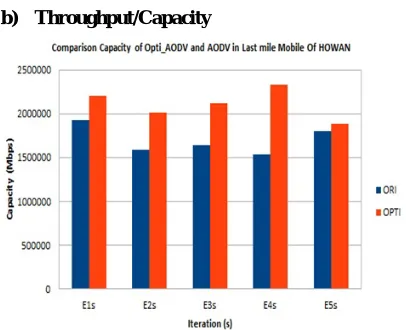
Figure-9. Performance capacity of LMMHOWAN framework for before and after optimization of AODV
routing over HOWAN.
When energy is our main requirement then in high static and dynamic environment, after optimization the respective framework is showing better performance in terms of bandwidth efficiency in this respective framework based on the graph here. It is showing better data transmitted successfully to their final destination as compared to before optimization step taken. This happen based on the parameter selection step that the identified parameter of link layer feedback (llfeedback) which is another way that AODV routing over HOWAN finds neighbors of a node to always maintain the link connectivity and failure preparing for next step of HELLO messages activated in neighbor discovery to reach to the destination. The throughput improved also due to shorter hops as well as performing basic route recovery failure phase of AODV in wireless networks by nature. Furthermore, the Figure-9 represents of the mean S/N larger is better from the Taguchi analysis which is to obtain optimum and higher capacity as possible with the best fit parameter setting through the parameter screening step.
[image:7.612.326.530.526.676.2]c) Packet delivery ratio (PDR)
Figure-10. Performance PDR of LMMHOWAN framework for before and after optimization of AODV
routing over HOWAN.
The Figure-10 here reflects the completeness and accuracy of the framework about the AODV protocol of MANET over HOWAN after optimization. It seems that, there is improvement after optimization around 21.5% based on the average of packet delivery ratio (PDR) thus packet loss is also reduced. From E3s onwards, the PDR is at spike that is higher for a particular time since the modified AODV protocol uses the existing multiple hop solution that extend coverage of trans receive which provide more occurrence of active routes to the final destination. In principle, the characteristics of AODV protocol routing over Passive Optical Network showing feasibility extension of mobile ad hoc routing in optical backhaul. Likewise, due to interval speed increase to E5s the PDR diminishes when there is considerable topology change and links to next hops are consistently broken Also based in the Taguchi design, the graphs represents of the mean S/N larger is better which is to obtain optimum and higher PDR as possible with the best fit parameter setting through the parameter screening step.
d) End-to-End delay
Based in the Figure-11 below, the average improvement propagation delay for LMMHOWAN is 9.5% after optimization. At the iteration point of E1s and E5s, as the network speed increase, there is the possibility the connection generally suffers from temporally latency (lasting small delay times). Besides that, AODV multihop relaying and the requirement of in-order delivery in point-to-multipoint data transmission of optical backhaul can also cause additional delay as a packet may need to wait for prior missing packets during transmission. However, this did not decrease effective bandwidth (refer Figure Capacity). Moreover, the graphs also represents the S/N smaller is better which based Taguchi method which is to obtain optimum and smaller delay as possible with the best fit parameter setting through the parameter screening step.
Figure-11. Performance delay of LMMHOWAN framework for before and after optimization of AODV
[image:7.612.76.291.556.698.2]CONCLUSIONS
It is concluded that seamless performance can be achieved with last mile mobile ad hoc wireless access network – driven from passive optical domains to divert the focus group of mobile user traffic aiming maximize the overall effectiveness of packet route transmission and improved network quality services in terms of packet delivery ratio and overall capacity packet. In this article, under this typical framework that already setup we then examine the performance differences of AODV routing deployment only under two different scenario that is before and after optimization of AODV routing in MANET over Passive Optical Network. The adhered design parameters listed in the methodology here is meant for energy consumption from both of this two scenario as the main criteria here in this paper. Besides that, we also checking out the measure the packet delivery ratio, end-to-end delay (s) and capacity as the performance metrics. Our simulation results shows the AODV routing deployment over Passive Optical Backhaul have the pros and cons in terms of energy consumption, packet delivery ratio, end to end delay and throughput transmission received. But looking on the bright side, the capacity of the particular framework is improved drastically after optimization for the last mile mobile based passive optical access network which then meet the satisfaction for the capacity hungry demand of user or application level. It shows that throughout this comparison integrations framework compares the overall system network performance efficiency, after performing the optimization framework of AODV routing over with passive optical backhaul deployment can perform very well in the way of route discovery and route maintenance due to its nature behaviour over the wireless with passive optical backhaul.
ACKNOWLEDGEMENTS
The author acknowledge the Universiti Teknikal Malaysia Melaka for the financial support through SLAB.
REFERENCES
[1] Awada A. and Wegmann B. 2011. Optimizing the Radio Network Parameters of the Long Term Evolution System Using Taguchi’s Method. IEEE Transactions on, Vol. 60, No. 8, pp. 3825–3839. doi:10.1109/TVT.2011.2163326.
[2] Bontozoglou Andreas, Yang. Kun, Guild. Ken. (2011). Simulation Tools Enabling Research in Convergence of Fixed and Mobile Networks. International Joint Conference of IEEE TrustCom-11/IEEE ICESS-11/FCST-11
[3] Chahidi B., EZZATI A. 2012. Hybrid Routing Protocol for wireless sensor networks. IJCSI International Journal of Computer Science Issues, 9(2), No 1.
[4] David Piehler. (2011). Next Generation Component for Optical Access Network. Conference on Optical Fiber Communication Conference and Exposition (OFC/NFOEC) and the National Fiber Optic Engineers, OSA/IEEE.
[5] GreenTouchTM: Putting Energy into Making Networks More Efficient, (Accessed 31st Mei 2012),http://www.greentouch.org/index.php?page=ict industry combats climate-change.
[6] Garfias. P., De Andrade M., Tornatore M., Buttaboni A., Sallent S., Gutiérrez L. 2014. Energy-Saving Mechanism in WDM/TDM-PON Based on Upstream Network Traffic, Journal of Photonics, pp. 235-250; doi:10.3390/photonics1030235.
[7] Kim K. 2011a. Integration of OMNeT++ hybrid TDM/WDM-PON models into INET framework. In OMNeT++ Workshop.
[8] Kim K. 2011b. A research framework for the clean-slate design of next-generation optical access. Congress on Ultra Modem Telecommunications and Control Systems and Workshops (ICUMT), 3rd International, IEEE.
[9] Lin Liu and Yuanyuan Yang. 2010. Energy-aware routing in hybrid optical network-on-chip for future Multi-Processor System-on-Chip. ACM/IEEE Symposium and Conference on Architectures for Networking and Communications Systems (ANCS).
[10]Malhotra R. and Amit K. Garg. 2012. Analysis Of Capacity And Delay In Passive Optical Networks (Pons). Journal of IJCCR.
[11]Marinez. 2006 Challenges and Requirements for Introducing Impairment-Awareness into the Management and Control Planes of ASON/GMPLS WDM Networks,” IEEE Communications Magazine, Vol. 44, pp. 76-85.
[12]Massin R., Lamy-Bergot C., Martret C. J. Le. and Fracchia R. 2010. OMNeT++-Based cross-layer simulator for content transmission over wireless ad hoc networks. Journal on Wireless Communications and Networking networks, Volume.
[13]Molnár M., Zhou F. and Cousin B. 2009. Multicast Routing in Optical Access Networks. in Optical Access Networks and Advanced Photonics: Technologies and Deployment Strategies, Ioannis P. Chochliouros; George A. Heliotis (Ed.), pp.162-183.
Magazine, Vol. 40, No. 1, pp. 132–139. doi:10.1109/35.978060
[15]Pulak Chowdhury, Biswanath Mukherjee, Suman Sarkar, Glen Kramer and Sudhir Dixit. 2009. Hybrid Wireless-Optical Broadband Access Network (WOBAN): Prototype Development and Research Challenges. IEEE Network, pp. 41-48.
[16]Redhwan Q. Shaddad, Abu Bakar Mohammad, Abdul Aziz M. Al–Hetar and Sevia M. Idrus. 2011. Performance Analysis of Hybrid Optical–Wireless Access Network Physical Layer. Journal of Technology, UTM.
[17]Rodney S. Tucker. 2011a. Green Optical Communications-Part II: Energy Limitations In Networks, IEEE Journal Of Selected Topics In Quantum Electronics, Vol. 17, No. 2, pp. 261-274.
[18]Rodney S. Tucker. 2011b. Green Optical Communications-Part I: Energy Limitations In Transport. IEEE Journal of Selected Topics In Quantum Electronics, Vol. 7, No. 2, pp. 245-260.
[19]Tsouri G. R, Prieto A., Argade N. 2012. A modified Dijkstra's routing algorithm for increasing network lifetime in wireless body area network. Proceedings of the 7th International Conference on Body Area.
[20]Warip M. N. M., Glesk I., Andonovic I. 2011. Power minimizing techniques for full mesh topology optical IP networks. 16th European Conference on Networks and Optical Communications (NOC).
[21]Wong M. A., Zulkifli N., Idrus S. M., Elshaikh M. 2015. Evaluation Method of MANET over Next Generation Optical Wireless Access Network. Information Science and Applications, Springer-Verlag Berlin Heidelberg.