Georgia State University Georgia State University
ScholarWorks @ Georgia State University
ScholarWorks @ Georgia State University
Marketing Dissertations Department of Marketing
5-9-2014
The Strategic Alignment of Organizational Interventions for
The Strategic Alignment of Organizational Interventions for
Salesperson Development with Salesperson Lifecycle
Salesperson Development with Salesperson Lifecycle
Management Model
Management Model
Joon-Hee Oh
Georgia State University
Follow this and additional works at: https://scholarworks.gsu.edu/marketing_diss
Recommended Citation Recommended Citation
Oh, Joon-Hee, "The Strategic Alignment of Organizational Interventions for Salesperson Development with Salesperson Lifecycle Management Model." Dissertation, Georgia State University, 2014.
https://scholarworks.gsu.edu/marketing_diss/27
This Dissertation is brought to you for free and open access by the Department of Marketing at ScholarWorks @ Georgia State University. It has been accepted for inclusion in Marketing Dissertations by an authorized
administrator of ScholarWorks @ Georgia State University. For more information, please contact
PERMISSION TO BORROW
In presenting this dissertation as a partial fulfillment of the requirements for an advanced degree from Georgia State University, I agree that the Library of the University shall make it available for inspection and circulation in accordance with its regulations governing materials of this type. I agree that permission to quote from, to copy from, or publish this dissertation may be granted by the author or, in his/her absence, the professor under whose direction it was written or, in his absence, by the Dean of the Robinson College of Business. Such quoting, copying, or publishing must be solely for the scholarly purposes and does not involve potential financial gain. It is
understood that any copying from or publication of this dissertation which involves potential gain will not be allowed without written permission of the author.
NOTICE TO BORROWERS
All dissertations deposited in the Georgia State University Library must be used only in accordance with the stipulations prescribed by the author in the preceding statement.
The author of this dissertation is:
Joon-Hee Oh 35 Broad St. NW
J. Mack Robinson College of Business Georgia State University
Atlanta, GA 30302
The director of this dissertation is:
Wesley J. Johnston Marketing
35 Broad St. NW
J. Mack Robinson College of Business Georgia State University
The Strategic Alignment of Organizational Interventions for Salesperson Development with Salesperson Lifecycle Management Model
BY
Joon-Hee Oh
A Dissertation Submitted in Partial Fulfillment of the Requirements for the Degree
Of
Doctor of Philosophy
In the Robinson College of Business
Of
Georgia State University
GEORGIA STATE UNIVERSITY ROBINSON COLLEGE OF BUSINESS
Copyright by JOON-HEE OH
ACCEPTANCE
This dissertation was prepared under the direction of the STUDENT’S NAME Dissertation Committee. It has been
approved and accepted by all members of that committee, and it has been accepted in partial fulfillment of the requirements for the degree of Doctoral of Philosophy in Business Administration in the J. Mack Robinson College of Business of Georgia State University.
H. Fenwick Huss, Dean
DISSERTATION COMMITTEE
ABSTRACT
The Strategic Alignment of Organizational Interventions for Salesperson Development with Salesperson Lifecycle Management Model
BY
Joon-Hee Oh
April 21, 2014
Committee Chair: Wesley J. Johnston
Major Academic Unit: Marketing
While earlier studies have discussed such individual factors as motivation, retention, and productivity as they relate to effective and productive sales force management, organizational factors, such as organizational development interventions, are also critical in developing salespeople and identifying their value, and have not been sufficiently studied. In response to the research gap, this study presents a salesperson lifecycle management model for
TABLE OF CONTENTS
Chapter I: Overview
Chapter II: Research Background
A. Managing the Evolving Salesperson and Organizational Development Interventions
B. Measuring Salesperson Value and Evaluating Development Interventions
Chapter III: Three Studies
A. Study 1: Conceptual Framework – Salesperson Value Management Strategy for Effective Sales Force Development and Management
1. Introduction
2. Conceptual Background
2.1 Lifecycle Model and Salesperson Value
2.2 Experiential Learning Transfer and Changes in Salesperson Value 2.3 Salesperson Value Perception ad Organizational Development
Intervention
3. Salesperson Lifecycle Management Model
3.1 Salesperson Lifecycle Management Model – Stage I: Enhancement of Salesperson Value through Experiential Learning
3.2 Salesperson Lifecycle Management Model – Stage II: Competency Management
3.3 Salesperson Lifecycle Management Model – Stage III: Retention Management
4. Salesperson Value Management Strategy for Effective Organizational Development Interventions
4.1 Salesperson Value Management Strategy 4.2 Strategic Extension
5. Implications, Limitations, and Future Study 5.1 Managerial Implications
5.2 Academic Implications 5.3 Limitations and Future Study 6. Conclusion
B. Study 2: Valuing the Salesperson in an Optimal Organizational Development Investment
1. Introduction
2. Measuring Salesperson Value
2.1 Definition of Salesperson Value 2.2 Measuring Salesperson Value
2.3 Measuring Salesperson Lifetime Value 3. Simulation Study
3.2 Three Types of Salesperson and Four Organizational Development Investment Strategies
3.3 Optimization 3.4 Assumptions
3.5 Organizational Development Investment Contribution to New Sales Closing
3.6 Determination of Organizational Development Investment Expenses 4. Results and Findings
4.1 Salesperson Value, Salesperson Lifetime Value, and Break-even Point 4.2 Organizational Development Investment and Firm Salesperson Value 5. Discussions
6. Contributions and Limitations
6.1 Expected Contribution to Practitioners
6.2 Expected Contribution to Literature and Future Studies 6.3 Limitations
7. Conclusion
C. Study 3: Empirical Validation of the Quantitative Basis 1. Introduction
2. Salesperson Lifecycle Management Model and Quantitative Basis
2.1 Managing the Evolving Salesperson and Organizational Development Interventions
2.2 Measuring Salesperson Value and Evaluating Development Interventions 3. Data
3.1 Sales Closing Performance
3.1.1 Sales Performance Data for 2009 Batch 3.1.2 Sales Performance Data for 2010 Batch 3.2 Trainings and Development Investment Expenses
3.2.1. Types of Training
3.2.2. Development Investment Expenses and Marketing Expenses 4. Data Analysis
5. Results and Findings
5.1 Result for 2009 Batch 5.2 Result for 2010 Batch 5.3 Findings and Discussions
6. Implications, Limitations, and Future Study 6.1 Managerial Implications
6.2 Research Implications
Chapter I. Overview
There are 14 million salespeople in North America, and the average annual turnover is 30 to 40
per cent, with the average tenure of a sales rep lasting only nine months (Covert 2010).
Managing such a short timeframe has created challenges and raised important questions about
how people systems fit into overall corporate strategy. Moreover, salespeople evolve through
career stages (Cron 1984). As salespeople evolve, it is essential for firms to continually adapt
their management strategies because salespersons’ psychological and sociological needs vary,
and their job performance and attitudes change (Cron 1984; Cron, Dubinsky, and Michaels
1988). Organizations must therefore strive to remain committed to sound tactics to align their
sales force development and management strategies with their organizational imperatives.
To help businesses ensure workforce effectiveness and alignment with corporate goals in
employee relation management practices, HR consultants have introduced employee lifecycle
management (ELM), which offers benefits that align the workforce with the organization’s
business needs, leading to heightened employee engagement and increased staff retention
(Southcombe 2011). Direct application of ELM for sales force management, however, seems to
be unfeasible because different business strategies require different arrangements of
organizational practices for optimal performance (Slater and Olson 2000).
In marketing literature, Jolson’s (1974) career cycle model suggests that a salesperson’s
career moves through the stages of preparation, development, maturity, and decline. Based on
earlier research in sociology, clinical psychology, and vocational psychology, Cron (1984)
presented a four career-stage model for salesperson management that includes the stages of
career scenarios that salespeople face in their occupational lives. However, neither model
provides the practical contributions for sales organizations, which should perform interventions
to develop and maintain highly committed and productive salespeople within their organizations.
Therefore, while the earlier models deserve academic attention, their appreciation of salesperson
career stages does not meet current sales organizations’ needs in terms of making critical and
practical development intervention decisions. More importantly, these models thus fail to address
sales organizations’ concerns regarding a successful alignment of their sales force development
efforts with corporate goals.
This absence of strategic alignment in sales force management becomes more evident
when considering the claim that firms lack an understanding of how best to measure and evaluate
their training efforts (Attia, Honeycutt, and Leach 2005; Erffmeyer, Russ, and Hair 1991;
Honeycutt, Howe, and Ingram 1993; Lupton, Weiss, and Peterson 1999) in developing a sales
force. Moreover, researchers also claim that the most critical issue facing sales force
development efforts is how to effectively assess sales training programs (Leach, Liu, and
Johnston 2005). These training objectives should be aligned with organizational goals (Attia,
Honeycutt, and Leach 2005), while recognizing that previous salesperson development efforts
are not always formulated by sales organizations (Dubinsky and Hansen 1981; Honeycutt, Howe,
and Ingram 1993).
Therefore, to help sales organizations make decisions that successfully align with their
corporate goals, the first study presents the salesperson value management strategy for sales
organizations that answers two important strategic questions: how to effectively provide
organizational development interventions for successful salespeople development and how to
The strategy addresses the first question by presenting salesperson lifecycle management
(SLM) model, which is based on lifecycle model (Van de Ven and Poole 1995: Van de Ven
2007) and theories on experience-learning-knowledge transfer (Grant 1996; Kolb 1984;
Morrison and Brantner 1992; Seibert 1996; Tracy, Tannenbaum, and Kavanugh 1995;
Timperley, Wilson, Barrar, and Fung 2007). The model identifies three lifecycle stages based on
salesperson value along salesperson lifecycle and sales organizations’ perception on salesperson
value. This study claims that, first, identifying salesperson value is critical for successful sales
force development. Second, sales organizations must categorize their current sales force for
salesperson lifecycle stages based on salesperson value. Lastly, the categorization leads to
necessary and relevant development interventions for each stage to achieve a maximum possible
return from the investment.
The stage-specific interventions, however, should be proven valid to ensure better
alignment of organizational strategies for effective and successful sales force development. In
the US, companies spend $20 billion annually on salesperson training programs (Canaday 2013)
and, in technical markets (e.g., computers, imaging systems, and chemicals), the costs associated
with the development of a single salesperson can exceed $100,000 (Johnston and Marshall
2006). Needless to say, these investments account for a significant portion of any single firm’s
investment. However, according to McKinsey, 75 percent of the senior managers McKinsey
surveyed believe that their training programs fail to contribute to the success of the business
(DeSmet, McGurk, and Schwartz 2010).
Therefore, to help sales organizations ensure effective management of their sales force
and answer the second strategic question, the second study introduces a quantitative basis for
intervention decisions. For validating the quantitative basis, the study conducts a simulation that
eventually determines the most effective organizational development investment decisions,
thereby ensuring successful alignment with organizational strategies. The simulation study finds
that stage-specific organizational development investment can ensure effective and productive
sales force development and provides a support for the salesperson value management strategy.
Though the quantitative basis provides important implications for strategic
decision-making on organizational development interventions, it is limited in terms of its application to
firm practices. Empirical support should therefore be followed, as it enhances the quantitative
basis for a better application. Therefore, the third study empirically validates the salesperson
value management strategy and the quantitative basis. Using actual sales performance data from
one of the leading global consumer financing companies, the study tests the applicability of the
quantitative basis in a real working environment.
The empirical analysis utilizes the three-year sales performance data of 882 salespeople
of the firm and its development and training programs for the salespeople. The values of those
salespersons are measured such that the quantitative basis, which is based on a salesperson value
management strategy proposed, can ensure whether sales organizations may utilize them for
effective and productive organizational development intervention strategies. And, this study
finds that the empirical validation supports the findings from the simulation study and further
supports the claim that sales organizations may utilize the quantitative basis and the salesperson
value management strategy for effective and productive organizational development intervention
Chapter II. Research Background
1. Managing the Evolving Salesperson and Organizational Development Interventions
Salespeople evolve through stages (Cron 1984; Cron, Dubinsky, and Michaels 1988; Cron and
Slocum 1986; Jolson 1974; Slocum and Cron 1985). Evolution implies some level of
development. What is being developed in salespersons’ evolution is their value. Both
organizations and salespersons invest in the salespeople’s development and recognize their
value. As salespeople evolve, therefore, it is essential for firms to continually adapt their
management strategies to recognize the value properly.
However, sales organizations often find that the task of identifying salesperson value
challenging because salespeople evolve through their different lifecycle stages. As salespeople
evolve, their psychological and sociological needs vary, and their job performance and attitudes
change (Cron 1984; Dubinsky and Skinner 2002). This study claims that such salesperson
evolution impedes sales organizations’ attempts to align their strategic development
interventions (e.g., trainings and development programs) with each salesperson’s stage-specific
expectations and demands. This can result in organizations failing to recognize salesperson value
correctly.
To help organizations to manage employee relation effectively, human resources (HR)
consultants introduced employee lifecycle management (ELM) to help businesses ensure
workforce effectiveness and alignment with corporate goals. Smither (2003) proposes two
important aspects of ELM. First, employees at every phase of the lifecycle believe that the work
care about the firms and their careers will deliver better results and will be more committed to
their careers within the company. Therefore, for sales organizations, ELM may offer benefits that
align the workforce with the organization’s business needs, leading to heightened employee
engagement and increased staff retention (Southcombe 2011).
Direct acceptance of ELM in sales force management, however, should be discouraged
because different business strategies require different arrangements of organizational practices
for optimal performance (Slater and Olson 2000). Moreover, salespeople serve a
boundary-spanning role (Belasco 1966; Dubinsky, Howell, Ingram, and Bellenger 1986) and are different
from other "internal" employees (Singh 1998). As a boundary spanner, salespeople are
influenced by two parties: the customers and the employer. The role of salespeople is thus
determined by social interaction with customers, and this role changes according to inconsistent
influences from such interactions. This boundary-spanning role of the salesperson within a sales
organization creates another challenge concerning the direct application of ELM for managing
the sales force.
In marketing literature, Jolson (1974) was the first scholar to discuss an age/job tenure
and performance relationship based on career development (Cron 1984). His study proposes the
salesperson career cycle model, in which a salesperson's performance goes through four stages
(i.e., preparation, development, maturity, and decline), thereby producing a performance function
resembling the familiar product life cycle curve. However, despite some empirical support for
the relationship (Kirchener, McElwain, and Dunnette 1960), the salesperson career cycle
framework lacks the detail necessary to make it useful for most situations (Jolson 1974) and fails
framework’s longer, if not infinite, time horizon does not reflect the high turnover rate and the
short tenure of salespersons in current sales organizations in a practical manner.
Based on earlier research in sociology, clinical psychology, and vocational psychology,
Cron (1984) presented a four career-stage model for salesperson management that includes the
stages of exploration, establishment, maintenance, and disengagement. His study identifies a
series of career stage characteristics and discusses career objectives, developmental tasks,
personal challenges, and psychosocial needs for each career stage. As noted in the study,
however, the practicability of the suggested, broadened salesperson perspective is questionable
(see Cron 1984, page 50). Another study, basing on Cron’s (1984) propositions and extending to
recent empirical results, examined the influence of career stage on components of salespeople’s
motivation–valence for rewards, expectancy, and instrumentality–and presented a career stage
framework (Cron, Dubinsky, and Michaels 1988). However, the study found that none of the
hypotheses received full empirical support and thus argued for additional studies regarding
various subjects, including the investigation of the moderating influence of career stage on
salesperson performance (see Cron et al. 1988, page 88).
While these studies present important career factors that salespeople face in their
occupational lives and suggest that salespeople’s work perceptions change over time along with
their career stage, less research has considered how managers can contend with the changing job
attitudes of salespeople throughout their lifecycle stages and how the managers can better utilize
the evolving skills and abilities of salespeople at different stages (Flaherty and Pappas 2002). In
response to this research dearth, a recent study presents a conceptual organizational development
intervention model designed to allow sales organizations to determine: (1) the training needs for
Honeycutt, and Leach 2005, page 253). While this model can provide some level of practicality
for sales organizations, it nonetheless faces challenges in terms of research design and
measurement concerns. One of these challenges is the autonomy of salespeople, as salespeople
have significant latitude and regular information for how to contend with the stressful sales
situations they may encounter (Singh 1998). This makes evaluating their behaviors in the field
difficult, as the extraneous influences (e.g., changing economics conditions, marketing programs,
and competitive actions) on the final outcomes must be evaluated for calculating the bottom-line
tangible measures and actual dollar contributions (Attia, Honeycutt, and Leach 2005).
Therefore, while the earlier models deserve academic attention, their appreciation of
salesperson career stages does not meet sales organizations’ critical needs to make effective and
practical development intervention decisions. More importantly, these models fail to address
sales organizations’ concerns regarding a successful alignment of their sales force development
efforts with corporate goals. This imposes the following critical question to marketing
researchers: how to effectively provide organizational development interventions for developing
and managing salespeople. Addressing the question, this study ensures to help sales
organizations make decisions that successfully align with their corporate goals.
2. Measuring Salesperson Value and Evaluating Development Interventions
As salespeople evolve, organizations are required to continuously enhance their methods for
managing such personnel. At the same time, salespersons’ needs and demands differ by stages
(Cron and Slocum 1986), making the alignment of people strategies and organizational
involve managing sales force through compensation. Sales organizations believe that
compensation systems can motivate the sales staff or entice them to switch to new employers
(Slater and Olson 2000). Often, however, compensation schemes do not consider the evolving
nature of salespersons’ growth and fail to be aligned with organizational objectives, as they only
focus on technical aspects of rewards and motivation (Zoltners, Sinha, and Lorimer 2006).
Therefore, this study claims that for effective sales force management, organizational
interventions for salesperson development must reflect salespersons’ evolving needs and
demands.
Interventions (e.g., trainings or other development/learning programs) should be proven
valid for promoting the proper alignment of people strategies with organizational goals. As
discussed in an earlier study, however, evaluations of such development interventions that are in
line with firm-level objectives are difficult to attain (Attia, Honeycutt, and Leach 2005;
Honeycutt and Stevenson 1989; Kirkpatrick 1994; Lupton, Weiss, and Peterson 1999), mainly
because of measurement difficulties (Warr, Allan, and Birdi 1999). Moreover, the ROI approach,
a prevalent and well-accepted method in human resource and development literature, has been
vigorously questioned regarding its efficacy in human development investment for decades (e.g.,
Flamholtz, Bullen, and Hua 2002: Schultz 1961).
Despite all these challenges, there have been advances in research on the evaluation of
employee development interventions. Most recently, returns on development interventions
(RODI) analysis (Avolio, Avey, and Quisenberry 2010) for organizational leadership
development interventions were presented in management literature, leveraging the earlier
discussion to evaluate the value of such training interventions (Geber 1995; Honeycutt, Karande,
for an evaluation of leadership development intervention effectiveness over multiple time points
rather than at a fixed beginning and end. Marketing literature also has gone through similar
discussions from economic (Dubinsky 1981), utility (Honeycutt et al. 2001), and data
development analysis (Boles, Donthu, and Lothia 1995) perspectives.
Central to these discussions is the methodology for evaluating organizational employee
development interventions. The main purpose of such an evaluation is to find the value of
training and development interventions. More importantly, these discussions have stimulated
further interest and research in the area. However, as noted in an earlier study, the stimulation
has faced challenges due to such issues as data access and the longitudinal nature of the sales
training under evaluation (Attia, Honeycutt, and Leach 2005).
Therefore, while the earlier frameworks deserve academic attention, they also found their
limitation in applying such frameworks to sales force development and management practices
due to the reasons recognized above. More importantly, these frameworks also fail to address
sales organizations’ concerns regarding a successful alignment of their sales force development
efforts with corporate goals. This again imposes the following critical question to marketing
researchers: how to measure and evaluate organizational development intervention efforts for
their salespeople. Addressing the question, this study mitigates the challenges identified in the
earlier studies and ensures to help sales organizations make decisions that successfully align with
their corporate goals. Thus, this study contributes to the literature by providing a development
intervention strategy and a strategic tool for sales organizations to effectively develop their sales
REFERENCES
Attia, Ashraf M., Earl D. Honeycutt Jr., and Mark P. Leach (2005), “A Three-Stage Model for Assessing and Improving Sales Force Training and Development,” Journal of Personal Selling and Sales Management, 25 (3), 253-268.
Avolio, Bruce J., James B. Avey, and David Quisenberry (2010), “Estimating Return on Leadership Development Investment,” The Leadership Quarterly, 21 (4), 633–644.
Belasco, James A. (1966), “The Salesman’s Role Revisited,” Journal of Marketing, 30(2), 6-8.
Boles, James S., N. Donthu, and R. Lothia (1995), “Salesperson Evaluation Using Relative Performance Efficiency: The Application of Data Envelopment Analysis,” Journal of Personal Selling & Sales Management, 15 (3), 31–49.
Canaday, Henry (2013), “The Transformation of Enterprise Sales Training – How New eLearning Tools Cut Costs and Improve Results,”
http://wwwimages.adobe.com/www.adobe.com/content/dam/Adobe/en/products/adobeconne ct/pdfs/elearning/transformation-of-enterprise-sales-training.pdf.
Cascio, Wayne (1989), “Using Utility Analysis to Assess Training Outcomes,” in Training and Development in Organizations, Goldstein and Associates, eds., San Francisco: Jossey-Bass, 63–88.
Covert, Kim (2010), “Stop the Revolving Door of Salespeople,” [available at http://www.canada.com/Stop+revolving+door+salespeople/3812673/story.html]
Cron, William L. (1984), “Industrial Salesperson Development: A Career Stages Perspective,” Journal of Marketing, 48 (4), 41-52.
––––––––– and John W. Slocum Jr. (1986), “The Influence of Career Stages on Salespeople’s Job Attitudes, Work Perceptions, and Performance,” Journal of Marketing Research, 23 (2), 119–129.
–––––––––, Alan J. Dubinsky, and Ronald E. Michaels (1988), “The Influence of Career Stages on Components of Salesperson Motivation,” Journal of Marketing, 52 (1), 78–92.
DeSmet, Aaron, Monica McGurk, and Elizabeth Schwartz (2010), Getting More From Your Training Programs. McKinsey Quarterly, extracted from
http://www.mckinsey.com/insights/organization/getting_more_from_your_training_program s.
–––––––––, Roy D. Howell, Thomas N. Ingram, and Danny N. Bellenger (1986), “Salesforce Socialization,” Journal of Marketing, 50(4), 192-207.
––––––––– and Steven J. Skinner (2002), “Going the Extra Mile Antecedents of Salespeople’s Discretionary Effort,” Industrial Marketing Management, 31, 589-598.
Erffmeyer, Robert C., K. Randall Russ, and Joseph F. Hair Jr. (1991), “Needs Assessment and Evaluation in Sales Training Programs,” Journal of Personal Selling and Sales Management, 11 (1), 17-30.
Flaherty, Karen E. and James M. Pappas (2002), “The Influence of Career Stage on Job Attitudes: Toward a Contingency Perspective,” Journal of Personal Selling and Sales Management, 22 (3), 135-143.
Flamholtz, Eric G., Maria L. Bullen, and Wei Hua (2002), “Human Resource Accounting: A Historical Perspective and Future Implications,” Management Decision, 40(10), 947−954.
Geber, Beverly (1995), “Does Training Make Difference” Prove it,” Training, 32 (3), 27-34.
Grant, Robert M. (1996), “Toward A Knowledge-Based Theory of the Firm,” Strategic Management Journal, 17, 109–122.
Honeycutt, Earl D. and Thomas H. Stevenson (1989), “Evaluating Sales Training Programs,” Industrial Marketing Management, 18(3), 215-222.
–––––––––, Vince Howe, and Thomas N. Ingram (1993), “Shortcomings of Sales Training Programs,” Industrial Marketing Management, 22(2), 117-123.
–––––––––, Kiran Karande, Ashraf Attia, and Steven D. Maurer (2001), “A Utility-Based Framework for Evaluating the Financial Impact of Sales Force Training Programs,” Journal of Personal Selling & Sales Management, 21(3), 229–238.
Jolson, Marvin A. (1974), “The Salesman’s Career Cycle,” Journal of Marketing, 38 (3), 39-46.
Johnston, Mark W. and Greg W. Marshall (2006), Churchill/Ford/Walker’s Sales Force Management, 8th ed., Boston: McGraw-Hill.
Kirchner, W. K., C. S. McElwain, and M. D. Dunnette (1960), “A Note on the Relationship Between Age and Sales Effectiveness,” Journal of Applied Psychology, 44(2), 92-93.
Kirkpatrick, Donald L. (1994), Evaluation Training Programs: The Four Levels, San Francisco: Berrett-Koehler.
Lupton, Robert A., John E. Weiss, and Robin T. Peterson (1999), “Sales Training Evaluation Model (STEM): A Conceptual Framework,” Industrial Marketing Management, 28(1), 73-86.
Leach, Mark P., Annie H. Liu, and Wesley J. Johnston (2005), “The Role of Self-Regulation Training in Developing the Motivation Management Capabilities of Salespeople,” Journal of Personal Selling and Sales Management, 25(3), 269-281.
Morrison, Robert F. and Thomas M. Brantner (1992), “What Enhances or Inhibits Learning a New Job? A Basic Career Issue,” Journal of Applied Psychology, 77 (6), 926–940.
Philips, Jack J. (1998), “Level Four and Beyond: An ROI Model,” in Evaluating Corporate Training: Models and Issues, Stephen M. Brown and Constance J. Seidner, eds., Boston: Kluwer Academic, 113–140.
Schultz, Theodore W. (1961), “Investment in Human Captial,” The American Economic Review, 51(1), 1-17.
Seibert, K. (1996), “Experience Is The Best Teacher, If You Learn From It,” in The Career Is Dead–Long Live The Career, D. T. Hall, ed. San Francisco: Jossey–Bass, 246 –264.
Singh, Jagdip (1998), “Striking a Balance in Boundary-Spanning Positions: An Investigation of Some Unconventional Influences of Role Stressors and Job Characteristics on Job Outcomes of Salespeople,” Journal of Marketing, 62 (3), 69-86.
Slater, Stanley F. and Eric M. Olson (2000), “Strategy Type and Performance: The Influence of Sales Force Management,” Strategic Management Journal, 21, 813-829.
Slocum, John W. Jr. and William L Cron (1985), “Job Attitudes and Performance during Three Career Stages,” Journal of Vocational Behavior, 26 (2), 126–145.
Smither, James W., Manuel London, and Richard R. Reilly (2005), “Does Performance Improve Following Multisource Feedback? A Theoretical Model, Meta-Analysis, and Review of Empirical Findings,” Personnel Psychology, 58 (1), 33–66.
Southcombe, Nick (2011), “HR Technology: Impacting Workforce Effectiveness with Employee Lifecycle Management,” HC Online. [available at http://dev.hcamag.com/resources/HR- Technology/hr-technology-impacting-workforce-effectiveness-with-employee-lifecycle-management/83454/]
Schultz, Theodore W. (1961), “Investment in Human Capital,” American Economic Review, 51(1), 1−17.
Tracey, J. Bruce, Scott I. Tannenbaum, and Michael J. Kavanagh (1995), “Applying Trained Skills on the Job: The Importance of the Work Environment,” Journal of Applied Psychology, 80 (2), 239–252.
Van de Ven, Andrew H. and Marshall S. Poole (1995), “Explaining Development and Change in Organizations,” Academy of Management Review, 20 (3), 510-540.
––––––––– (2007), Engaged Scholarship: A Guide for Organizational and Social Research. Oxford: Oxford University Press.
Warr, Peter B., Catriona Allan, and Kamal Birdi (1999), “Predicting Three Levels of Training Outcome,” Journal of Occupational and Organizational Psychology, 72 (September), 351– 375.
Zoltners, A. A., Prabhakant, Sinha, and Sally E. Lorimer (2006). The Complete Guide to Sales Force Incentive Compensation: How to Design and Implement Plans that Work. New York: American Management Association.
Chapter III. Three Studies
A. Study 1: Conceptual Framework – Salesperson Value Management Strategy for Effective Sales Force Development and Management
Abstract
While earlier studies have discussed such individual factors as motivation, retention, and
productivity as they relate to effective and productive sales force management, organizational
factors, such as organizational development interventions, are also critical in developing
salespeople and identifying their value, and have not been sufficiently studied. In response to the
research gap, this study presents a salesperson lifecycle management model for identifying and
optimizing salespersons’ value using effective and productive organizational development
interventions. The salesperson lifecycle management model represents an opportunity to
leverage human capital more effectively and to reduce the costs associated with sales force
development and turnover. In addition, using a return on development investment approach, this
study introduces a return analysis on organizational development interventions within a
salesperson value management framework. The framework is designed to find interactions
between the return analysis and break-even point of interventions, providing sales organizations
with strategic implications regarding how to manage organizational investment and salesperson
1. Introduction
A recent survey by Watson Wyatt (2009) of 129 sales and HR executives at large North
American companies found that sales force productivity/efficiency and coaching/development
are two of the top issues facing sales force. This implies that given relatively flat staffing levels,
companies need to get more out of their current salespeople in order to meet increased sales
goals that are set for the following year/s. The survey further found that for such objectives,
companies would need to pay attention to issues of motivation, retention, and productivity
regarding their sales force. Furthermore, their ability to identify top sales performers, to train,
coach and mentor them, and to drive high levels of productivity is the key to success. In
summary, these findings confirm that salesperson value management is critical in productive
sales force management, and that efficient organizational development interventions play an
important role in ensuring the successful development of salesperson value within an
organization.
Prior studies have discussed such individual factors as “motivation” (Cron, Dubinsky,
and Ronald 1988; Ingram, Lee, and Skinner 1989; Miao and Evans 2007; Tyagi 1982, 1985,
1990; Johnston and Keysuk 1994), retention (Brashear, Manolis, and Brooks 2005; Johnston,
Parasuraman, Futrell, and Sager 1988; MacKenzie, Podsakoff, and Ahearne 1998), and
productivity (Jones, Brown, and Zoltners 2005; MacKenzie, Podsakoff, and Fetter 1993; Sujan,
Weitz, and Sujan 1988) in terms of effective and productive sales force management. However,
organizational factors, such as organizational development interventions, which are also critical
in developing salespeople and identifying their value, have not yet gained significant research
This study fills this research gap by presenting a salesperson value management strategy
and addresses how sales organizations effectively perform development interventions for their
sales force. Employing lifecycle model and experience, learning, and knowledge transfer
theories, the strategy addresses the question with salesperson lifecycle management model.
Within the salesperson lifecycle management model, this study identifies three stages and
describes the characteristics of each stage to distinguish one from another. This study claims that
these distinctions lead to the provision of different organizational development interventions for
salespeople at specific stages, and that such stage-specific interventions will ensure a better
alignment of organizational strategies for effective and productive sales force development, and
for salesperson value identification.
This study also discusses a return analysis on organizational development interventions
for sales force development. Despite the fact that organizations are supposed to consider the
financial returns on their investments when making capital investment decisions, such return
analysis on salesperson development interventions has not gained serious attention in sales
literature thus far (Attia, Honeycutt, and Leach 2005). In management literature, Avolio, Avey,
and Quisenberry (2010) discuss returns on development investments (RODI) from an employee
development perspective. The RODI approach contributes to the literature by providing a
structured decision-making process for organizations to determine the necessary interventions.
Especially in an economic recession, organizational development interventions that are proven
valid with a return analysis only encourage decision-makers to make better investment decisions
and to be more aligned with their organizational goals (Avolio, Avey, and Quisenberry 2010).
Using this approach, this study introduces a return analysis on organizational development
find interactions between the return analysis and break-even point of interventions, providing
sales organizations with strategic implications regarding how to manage organizational
investment and salesperson contributions.
The remainder of this study is organized as follows: in the next section, it presents the
salesperson lifecycle management model with stage-specific characteristics. It then discusses the
salesperson value management framework for interaction analysis between organizational
investment for development (i.e., RODI) and break-even point to provide strategic implications
for salesperson lifecycle management model applications of sales force management. Finally, the
implications and present limitations of the study are described.
2. Conceptual Background
Researches have attempted to apply lifecycle model to sales force management practices (e.g.,
Cron 1984; Jolson 1974). While these studies present important career factors that salespeople
face in their career stages, less research has conducted how managers can contend with the
changing job attitudes of salespeople throughout their lifecycle stages and how the managers can
better utilize the evolving skills and abilities of salespeople at different stages. Therefore, to help
the organizations make decisions that successfully align with their corporate goals, this study
presents a salesperson lifecycle management model, which enables firms to improve their sales
force management by dividing the current sales force into lifecycle stages based on salesperson
value. This categorization and consequent stage-specific view helps sales organizations properly
approach the evolving salespersons’ unique expectations and demands (Cron 1984; Dubinsky
identifying salesperson value at each stage, at which the different development interventions
should be made.
2.1. Lifecycle Model and Salesperson Value
A lifecycle is, by definition, the useful life of a product or system, or, by extension, the
developmental history of an individual, or group within a given society. Lifecycle models reflect
the process of an entity’s change as it progresses through a necessary sequence of stages or
phases (Van de Ven and Poole 1995). The typical progression of a lifecycle process is a unitary,
cumulative, and conjunctive sequence of stages, because the content and historical sequence of
these changes is prescribed and regulated by an institutional, natural, or logical program
prefigured at the beginning of the cycle (Van de Ven 2007). In its application to salespersons, the
lifecycle model implies that salespersons evolve through stages with changes in their value,
which is identified through their net contribution to organizations, and can be arranged and
structured by the organization.
Researches have attempted to apply lifecycle model to sales force management practices
(e.g., Cron 1984; Jolson 1974). Jolson (1974) identified salespersons career stages in his career
stage model, which merely reflects changes in salesperson productivity. Cron (1984) presented a
career-stage model that includes the stages of exploration, establishment, maintenance, and
disengagement and identified a series of career stage characteristics and discusses career
objectives, developmental tasks, personal challenges, and psychosocial needs for each career
stage. While the studies present important career factors that salespeople face in their
occupational lives and suggest that salespeople’s work perceptions change over time along with
the strategic organizational interventions for the defined career stages and to the effectiveness of
such interventions in sales force development. This limits an organization’s strategic alignment
between intervention decisions and corporate goals, and requires research advancements in the
field of salesperson development and management. Some studies (e.g., Attia, Honeycutt, and
Leach 2005) attempted to address the limitation, but faced challenges in terms of research design
and measurement concerns (e.g., autonomy of salespeople, see Attia, Honeycutt, and Leach
2005). Moreover, researchers have identified a lack of research on dealing with the evolving
salespersons and their changing job attitudes through their career stages (Flaherty and Pappas
2002; Zoltners et al. 2006).
In response to the research gap, this study develops a salesperson lifecycle management
model for effective organizational development interventions. As an initial step, building up the
earlier discussions on salespersons’ evolution through the career stages, this study claims that
salespersons’ evolution is a process of developing and managing salespersons value. Evolution,
by definition, implies some level of development. What is being developed in salespersons’
evolution is their value. Sales organizations invest in the salespeople’s development and
recognize their value.
Salespersons evolve throughout their career stages (Allen and Meyer 1993; Cron 1984;
Jolson 1974). Evolution implies some level of development. What is being developed in
salespersons’ evolution is their value. Both organizations and salespersons invest in the
salespeople’s development and recognize their value.
Sales organizations, however, often find the task of identifying salesperson value
challenging and face difficulties in practicing development interventions for their salespeople
different career stages. As salespeople evolve, their psychological and sociological needs vary,
and their job performance and attitudes change (Cron 1984; Dubinsky and Skinner 2002). As
such, salesperson evolution impedes sales organizations’ attempts to align their strategic
development interventions (e.g., trainings and development programs) with each salesperson’s
stage-specific expectations and demands. This can result in organizations failing to recognize SV
correctly. Therefore, identifying salesperson value is critical for sales organizations’ successful
sales force development.
This study defines salesperson value as what an individual contributes to an organization
but also what the organization incurs in terms of expenses for that contribution. A typical, solid
example of salesperson value is salespersons’ sales closing. Sales closing, in this study, means
achievement of the desired outcome, which may be an exchange of money or acquiring a
signature. It is, thus, the end of sales process that generates revenue for firm. The sales closing of
salesperson is more than just outcome of organizational interventions (e.g., induction trainings,
sales trainings, sales supports, etc.). Factors such as market conditions, seasonality, or marketing
efforts deserve consideration as well. However, in spite of the difficulty in isolating the training
and development effects from the other contributing factors (see Attia, Honeycutt, and Leach
2005), it is reasonable to assume that organizational development interventions may play a
significant role in generating sales closings. Therefore, this study claims that any expenses
incurred in creating sales closings are strong and stable determinants of salesperson value, upon
which a salesperson’s lifecycle framework for making effective organizational development
Salesperson Value (SV) = Salesperson Contribution (SC) – Organizational Development
Investment (ODI) (1)
In the conceptual formula above, organizational development investment (ODI) includes
expenses incurred in salesperson training and development, such as induction training (e.g.,
orientation and membership trainings), sales training (e.g., training on products, services, and
sales skills), sales supports (e.g., allocated marketing and sales or product promotional expenses
on the products or services sold), and other salesperson training and development programs (e.g.,
ad-hoc training on new product, regulation changes, and compensation scheme changes).
Salesperson contribution (SC) is revenue generated from the new sales of products or services.
To reflect the isolation issue (see Attia et al. 2005), this study proposes that SC be considered in
line with the ODI that are assigned for the creation of the sales and allocated to the specific
individual salesperson. Therefore, SC becomes a function of the ODI contribution, taking into
account the sales volume and the product/service margin.
2.2. Experiential Learning Transfer and Changes in Salesperson Value
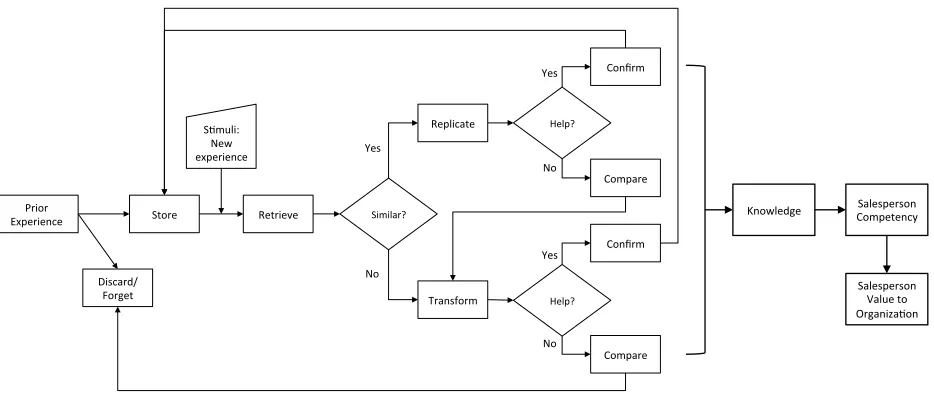
A progression in a lifecycle process can be defined as a salesperson’s experience–
learning–knowledge transfer process. In other words, as salespersons progress throughout their
lifecycle, they experience organizational interventions, learn from the experience, and transfer
that learning into knowledge construction. In the transfer of the experiential learning to
knowledge, experience can be stored in salespersons’ memory, discarded if they are not
interested or fail to find immediate relevance to their interest, or forgot when times passes or the
such as development training (Timperley, Wilson, Barrar, and Fung 2007) if the stimuli are
relevant to their objective (i.e., sales). Then, the retrieved experience can be either replicated or
transformed for learning. And the learning is accumulated for salespersons’ knowledge
construction.
For instance, additional sales trainings on new product/service (i.e., new experience) help
salespeople retrieve their prior experience (e.g., initial sales training or on-the-job training).
When they find the new experience is similar to the prior, salespersons reproduce the prior
experience to see if they can still leverage it for the new experience in selling the new
product/service. If they find that the replication of the prior experience for new product/service
sales does help them, then they confirm that the new experience adds value to the prior
experience and store the new experience next to the prior experience in their memory. If they
find the replication is not helping them in selling the new product/service, then salespersons
compare the new experience with the prior experience and find a need to transform the prior
experience in respective of the new experience to help improve the sales. In this transformation
process, the prior experience can be either completely changed or modified in character to assist
them to sell the new product/service. In case they find a difference between the prior experience
and the new experience but still relevant to their objective, salespersons transform the prior
experience to see if it can be leveraged for the new experience in selling the new product/service.
When the transformation is successful (i.e., helps the sales), salespersons confirm that the
transformed experience can add value and store it along with the new experience in their
memory. If it turns out to be not successful, however, salespersons discard the (transformed)
This study claims that these confirmation/comparison and replication/transformation
processes contribute to salespersons’ learning from experience and eventually assist
salespersons’ knowledge construction and salesperson value. In other words, sales organizations’
development interventions provide the stimuli that allow more such processes and, therefore,
they help salespersons enhance their value. If they are provided with such stimuli throughout
their career stage, salesperson value increases as they go through the career stages. Figure 1.1
[image:33.612.75.542.290.489.2]shows the knowledge construction process.
Figure 1.1. Knowledge Construction Process and Salesperson Value
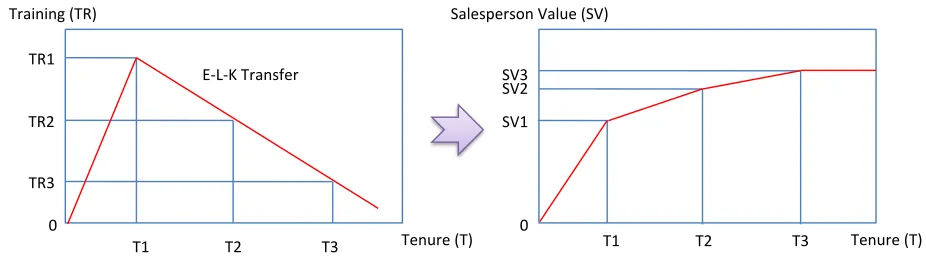
Salespersons, however, experience a marginal decrease in value as they move along their
career stages further. The marginal decrease in salesperson value occurs when a transfer of
experiential learning to job competency (e.g., knowledge, skills, and ability) enhancement and
subsequent salesperson value enhancement is less obvious. In the transfer of the experiential
learning to knowledge, experience is stored in salespersons’ memory and later retrieved by
certain stimuli such as development training (see Timperley et al. 2007). As they evolve through Prior% Experience% Store% Discard/ Forget% Retrieve% Similar?% S:muli:% New% experience% Replicate% Transform% Yes% No% Help?% Yes% Confirm% Compare% No% Help?% Yes% Confirm% Compare% No%
Knowledge) Competency)Salesperson)
their career stages, salespersons experience fewer stimuli and thus have fewer chances to retrieve
earlier experiential learning stored in their memory; they subsequently have a smaller chance of
learning transfer into knowledge. Therefore, salespersons value is expected to decrease
marginally as they evolve through their career stages. Figure 1.2 shows the
experience-learning-knowledge transfer process that salespersons go through during their career and subsequent
changes in salesperson value. This study claims that the change in salesperson value determines
salesperson lifecycle.
[image:34.612.73.536.282.418.2]ELK: Experience-Learning-Knowledge
Figure 1.2. Experience-Learning-Knowledge Transfer and Changes in Salesperson Value
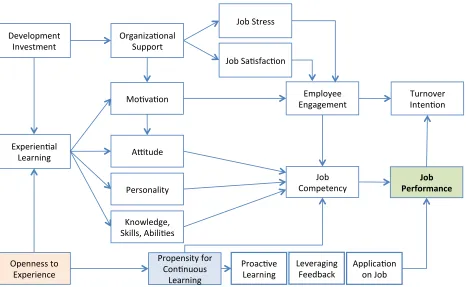
This study also claims that, as salespersons evolve further through the career stages, their
value is expected to decline. In the later stage of salespersons’ career, organizational
development investment is usually minimal, if any. Salespersons perceive a lack of
organizational support, which leads to job stress and job dissatisfaction (Rhoades and
Eisenberger 2002). Croteau and Wolk (2010) claim that talented staff members become
demotivated if they feel trapped by a lack of career growth opportunities or salary ceilings. These
in turn negatively affect employees’ attitudes about learning and developing (Mathieu and
Martineau 1997; Maurer, Weiss, and Barbeite 2003). Sales closing is stagnant, if not decreasing,
Tenure&(T)& Training&(TR)&
T1& T2& T3& TR1&
TR2&
TR3&
0&
E2L2K&Transfer&
Tenure&(T)& Salesperson&Value&(SV)&
T1& T2& T3& 0&
in the later stage. According to Porter and Lawler (1968), job performance is a function of three
variables: motivation level, ability, and role clarity. And as Steers (1977) claimed, highly
committed person is thought to exert high levels of effort, indicating employee engagement is
positively related to job performance. A perceived lack of organizational support and employee
demotivation also leads to employees’ emotional disengagement from organizations, as Harter,
Schmidt, and Hayes (2002) noted. Their study found that emotional disengagement negatively
affects employee turnover. Therefore, SV decreases in its absolute terms. These dynamics are
[image:35.612.79.532.318.633.2]illustrated in Figure 1.3.
Figure 1.3. Organizational Development Investment, Motivation, Salesperson Disengagement, and Turnover
2.3. Salesperson Value Perception and Organizational Development Intervention Development*
Investment*
Perceived* Organiza6onal*
Support*
Self:efficacy*
A>tude* Mo6va6on*
Locus*of*Control* Learning*Goal*Orienta6on*
Turnover* Inten6on* Perceived*
Behavioral* Control*
Job*Stress*
Job*Sa6sfac6on*
Employee* Engagement*
From the beginning, salespersons are being evaluated according to their or their
managers’ subjective expectations and according to their organizations’ objective performance
indicators (Johnston and Shields 1983). The evaluative perception of salespersons comprises the
salesperson value perception, which is defined in this study as the salespersons’ or sales
organizations’ recognition or appreciation of an individual salesperson’s value within an
organization. Thus, salesperson value perception necessarily results in under- or over-expectation
if not met precisely with the changes in the expected salesperson value.
The expected salesperson value is the organization’s expectation of salespersons’ value
enhancement (Johnston and Shields 1983). According to Avolio and his colleague’s (2010)
study, such expectation leads to organizational investment for value enhancement. Therefore, it
is expected that salesperson value increase as organizational investment persists during
salespersons’ tenure. From Figure 1.4, the gaps between the straight line (i.e., expected
salesperson value) and salesperson lifecycle indicate the mismatches in expectations and actual
realization of salesperson values. These mismatches trigger necessary actions for firms to
accommodate the identified gaps (Kuhl and Beckmann 1985; Lazarus 1991; Roseman 1984).
Tenure& Salesperson&&
Value&(SV)&
Expected&SV&
SV&under&expecta5on&(1)&
SV&over&expecta5on&
SV&under&expecta5on&(2)&
Lifecycle(
Actual'SV'
Figure 1.4. Mismatches between Expected Salesperson Value and Actual Salesperson Value
Among the mismatches, salesperson value under-expectations (SV under-expectations on
Figure 4) indicate that the actual appreciation of salesperson value is below the expected level.
The salesperson value relating to under-expectation (SV under-expectation (1)) can be
recognized usually before salespersons develop sufficient knowledge, skills, and ability (KSA)
for contributions (i.e., sales revenue contributions). During this stage, organizational
interventions are necessary for the enhancement of salesperson value. Another salesperson value
under-expectation (SV under-expectation (2)) can be recognized in the later stage, when a net
negative contribution occurs even with the developed KSA. In this stage, firms may observe
salesperson turnover (see Jackofsky 1984). Therefore, the necessary organizational development
interventions should be different from the ones for the earlier stage of salesperson value
under-expectation and more focused on salesperson retention.
For salesperson value over-expectation (SV over-expectation on Figure 4), organizational
interventions need to be arranged to maintain the higher level of salesperson value because
salespersons’ KSA is developed enough to deliver contributions (i.e., net gains). The
effectiveness of, rather than the amount of the intervention serves the purpose in this stage
because the objective of such interventions is to maximize the returns on the interventions.
Therefore, a firm’s investment in this stage is typically lower than its investment in salesperson
value under-expectation stages for maintaining a net gain.
In sum, salesperson value perception identifies the mismatches between the expected
salesperson value and the realized salesperson value. The mismatches indicate different
salesperson values at different career stages and these require different intervention strategies for
conjunction with related expenses. Hence, this study identifies three salesperson lifecycle stages
for an organizational development intervention strategy (see Figure 1.5):
• Stage 1: Enhancement – development and enhancement of salesperson value
• Stage 2: Maintenance – net increase of salesperson value
• Stage 3: Retention – management of potential salesperson disengagement
[image:38.612.84.497.233.471.2]
Figure 1.5. Salesperson Lifecycle Stages and Organizational Interventions.
3. Salesperson Lifecycle Management Model
In addition to the identification of the stages with salesperson value perception for effective
organizational development intervention strategy, this study notes that salespersons develop
unique expectations and demands as they evolve through career stages (Cron 1984; Dubinsky
and Skinner 2002). Organizational development interventions, therefore, must be unique and
Tenure& Salesperson&&
Value&(SV)&
Expected&SV&
SV&under&expecta5on&(1)&
SV&over&expecta5on&
SV&under&expecta5on&(2)& Actual'SV'
0"
Organiza(onal+Interven(ons+
stage-specific if they are to properly address such different characteristics. The salesperson
lifecycle management model allows firms to improve sales force management by categorizing
salespeople into lifecycle stages. Each lifecycle stage is characterized by different features that
reflect the evolving salesperson’s unique expectations and demands, and organizations can
strategically allocate their limited resources for better and more effective sales force
development based on these characteristics. Moreover, such an alignment between organizational
interventions and salesperson expectations helps organizations evaluate the effectiveness of the
organizational interventions by identifying the salesperson value at each stage for which the
different development interventions should be enacted.
Therefore, the objective of the salesperson lifecycle management model is to ensure a
better alignment of the stage-specific development interventions with the organizational
strategies for effective and productive sales force development and salesperson value
identification. The following summarizes the characteristics of each stage and suggests a method
for how sales organizations should manage each stage to attain salesperson development and
value realization.
3.1. Salesperson Lifecycle Management Model – Stage I: Enhancement of Salesperson Value through Experiential Learning
The first stage includes newly hired salespersons. Basic and formal training and
developmental programs are offered for the salespersons. In addition to the acquisition of
necessary selling skills derived from the sales training, salespeople at this stage learn
organizational disciplines and visions, acquire product and service knowledge, and experience
typically motivated to learn (Parker et al. 2003; Tyagi 1982). Despite the efforts, salesperson
value is typically negative (i.e., organizational development investment > salesperson
contribution).
The experiential learning theory emphasizes the central role that experience plays in the
learning process and defines learning as the process whereby knowledge is created through the
transformation of experience (Kolb 1984). Experience is critical in learning and developing the
KSA necessary for effective performance (Morrison and Brantner 1992). In addition to
knowledge, skills, and motivation, there is also evidence that work experiences can shape
attitudes, values, and even personality characteristics (Brousseau 1984; Kohn and Schooler 1978,
1982; Mortimer and Lorence 1979). The knowledge-based view, which emerged from
resource-based theory, argues that the knowledge embedded within individuals is ultimately their only
source of a competitive advantage (Grant 1996).
Therefore, organizational development interventions at this stage should be targeted to
promote salespersons’ experiential learning as they acquire competent salesperson knowledge.
However, learning does not automatically follow from experience. As Seibert (1996) notes,
learning requires both a desire to learn and an environment that provides opportunities for
reflection and learning. In the training literature, for example, there is evidence that an
appropriate climate and a continuous learning culture influence the extent to which the training
experiences translate into the acquisition of new knowledge and positive behavioral outcomes on
the job (Tracy, Tannenbaum, and Kavanugh 1995). Likewise, a supportive (sales) team and
supervisor may also help individuals gain more from training and other work-related experiences
by making them feel more comfortable in using their new knowledge and skills (Tesluk and
In summary, organizations should focus on developing competent salesperson knowledge
by implementing development interventions that promote salespersons’ experiential learning
during the first stage of salesperson lifecycle management model. Figure 1.6 shows the dynamics
[image:41.612.87.522.206.488.2]involved in stage 1.
Figure 1.6. Salesperson Lifecycle Management Model – Stage 1: Salesperson Value
Enhancement with Experiential Learning
3.2. Salesperson Lifecycle Management Model – Stage II: Competency Maintenance
In the second stage, salesperson contribution exceeds investment. Salesperson value
increases but not as much as it did in the earlier stage. This shift indicates that organizations’
extended efforts to promote salespersons’ experiential learning should continue in this stage in
enhancement. Job competency relates to the demonstration of various skills, aptitudes, and
performance levels as they are related to a specific position or job within a company (McLagan
1996). Some scholars regard competence as a combination of the knowledge, skills, and
behaviors that are used to improve performance (e.g., Mansfield 1996). Therefore, the successful
establishment of job competency should affect job performance positively.
The amount of training that a salesperson receives is less than that in the first stage
because basic selling skills and induction training, which make up a major portion of the
training, are not usually repeated for salespeople in this stage. Instead, advanced sales skills, new
product and service training, role-plays, and teamwork experiences are offered along with
feedback, mentoring, and coaching from supervisors as well as senior salespeople.
Mentoring (Kram and Hall 1996) provides the support for salespeople to collaborate for
synergistic knowledge development. While a learning environment and a continuous learning
culture influence the extent to which training experience translates into knowledge (Tracy et al.
1995), performance improvement is likely to occur when salespeople experience another
important type of organizational intervention: feedback and coaching (Peterson and Hicks 1995).
Earlier studies have found that the feedback intervention that is provided for a familiar task,
containing cues that support learning, is likely to yield notable gains in performance (Kluger and
DeNisi 1996). The performance improvement is most likely to occur when feedback indicates
that change is necessary. According to the study by Smither, London, and Reilly (2005),
recipients have a positive feedback orientation, perceive a need to change their behavior, react
positively to the feedback, believe that change is feasible, set appropriate goals to regulate their
While such qualitative development interventions are proven to be valid for salesperson
development, these interventions also imply that sales organizations may notice a productivity
distinction between the salespeople in this stage. This phenomenon is due to individual
differences in the ability to transform learning into competency as well as individual differences
in variables such as openness to experience and propensity for continuous learning (see Vicere
and Fulmer 1998). Research also shows that a salesperson’s openness to new experiences is
positively related to his or her performance improvement (Dominick, Reilly, and Byrne 2004).
Related to the individual difference variable is the propensity for continuous learning.
Continuous learning motivates individuals to anticipate changes in job requirements, request and
use feedback, set development goals, participate in learning activities, practice new behaviors,
apply learning on the job, and improve their performance (Vicere and Fulmer 1998).
Organizations need to contend with such individual discrepancies simply because overall
performance improvements only contribute to higher returns on development interventions.
In summary, this stage is critical for sales organizations because they can make changes
in developmental interventions to realize salesperson value. At this stage in particular, sales
organizations strive to achieve an appropriate return on development investment (RODI) due to
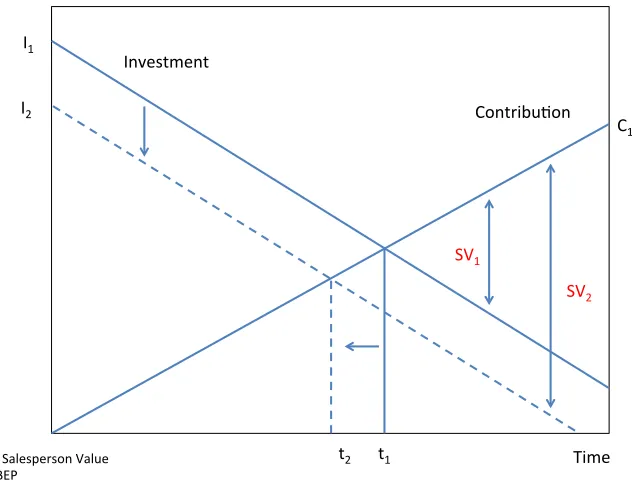
diminishing developmental investment and increasing salesperson productivity. In general, a
break-even point (BEP) indicates the point at which gains equal losses, and at which
organizations start to realize a positive return on their investments. In this study, BEP indicates a
positive RODI. Thus, organizational efforts to improve salesperson productivity are positively
linked to RODI and lead to a faster realization of BEP. Subsequently, achieving BEP early in a
development. A more detailed discussion of BEP identification and management is provided in
[image:44.612.75.541.153.440.2]later sections. Meantime, Figure 1.7 describes the dynamics involved in stage 2.
Figure 1.7. Salesperson Lifecycle Management Model – Stage 2: Competency Maintenance
3.3. Salesperson Lifecycle Management Model – Stage III: Retention Management
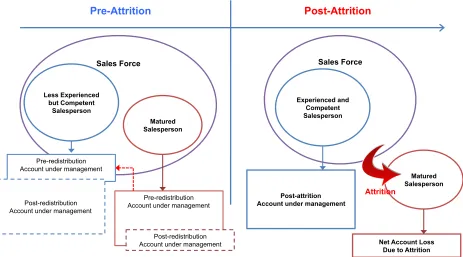
Salespeople at this stage are the most experienced, mature, and profitable for sales
organizations. There are many factors that can influence whether a highly talented staff member
will build a career within an institution or use it as a stepping-stone (Croteau and Wolk 2010).
Croteau and Wolk further claim that whatever their career objectives might be, talented staff
members become demotivated if they feel trapped by a lack of career growth opportunities or
salary ceilings, and leave their area of special excellence to pursue positions in other
organizations. Development*
Investment* Organiza3onal*Support*
Experien3al*
Learning* A:tude*
Mo3va3on*
Knowledge,* Skills,*Abili3es*
Personality*
Job* Competency* Job*Stress*
Job*Sa3sfac3on*
Employee* Engagement*
Openness*to* Experience*
Propensity*for* Con3nuous*
Learning*
Proac3ve*
Learning* Leveraging*Feedback* Applica3on*on*Job*
Job$ Performance$