ScholarWorks @ Georgia State University
ScholarWorks @ Georgia State University
Art and Design Theses Ernest G. Welch School of Art and Design
5-10-2014
An Auto-ethnographic Study of Teaching Methods that Support
An Auto-ethnographic Study of Teaching Methods that Support
Meaning Making in Middle School Art
Meaning Making in Middle School Art
Brenda MajorGeorgia State University
Follow this and additional works at: https://scholarworks.gsu.edu/art_design_theses
Recommended Citation Recommended Citation
Major, Brenda, "An Auto-ethnographic Study of Teaching Methods that Support Meaning Making in Middle School Art." Thesis, Georgia State University, 2014.
https://scholarworks.gsu.edu/art_design_theses/161
TEACHING METHODS THAT SUPPORT MEANING MAKING
IN MIDDLE SCHOOL ART
by
BRENDA S. MAJOR
Under the Direction of Dr. Kevin Hsieh
ABSTRACT
This thesis is an auto-ethnographic study of teaching methods proposed to be effective in
helping develop thinking skills that advance meaning making in my middle school art classes.
The study explored the use of Visible Thinking Routines (Ritchhart et al, 2011) and Art
Investigations (Herz, 2010) in middle school art classes. Reflections and other field texts reveal
the extent to which I found these methods effective in guiding students to develop higher order
thinking skills that support more meaningful outcomes in art and could be beneficial in other
areas of their lives.
TEACHING METHODS THAT SUPPORT MEANING MAKING
IN MIDDLE SCHOOL ART
by
BRENDA S. MAJOR
A Thesis Submitted in Partial Fulfillment of the Requirements for the Degree of
Master of Art Education
in the College of Arts and Sciences
Georgia State University
Copyright by Brenda S. Major
TEACHING METHODS THAT SUPPORT MEANING MAKING
IN MIDDLE SCHOOL ART
by
BRENDA S. MAJOR
Committee Chair: Kevin Hsieh
Committee: Melody Milbrandt
Melanie Davenport
Electronic Version Approved:
Office of Graduate Studies
College of Arts and Sciences
Georgia State University
DEDICATION
This thesis is dedicated to my father, Carlton Leon Spiva [1927-2010] who taught me to
ACKNOWLEDGEMENTS
I would like to acknowledge my family; my husband, Gene, my daughters Courtney,
Lindsey and Madison and my son, Clayton, for their patience and encouragement throughout the
process of completing my program of study and this body of work. I would also like to
acknowledge my division director at High Meadows School, Kate McElvaney and my
co-teacher, Lynn Williams who provided tremendous moral support in my journey of self-discovery
and personal growth. And finally, I would like to acknowledge Dr. Milbrandt, Dr. Davenport,
and Dr. Hsieh, who deftly guided me through the perils and pitfalls of juggling career, family and
TABLE OF CONTENTS
ACKNOWLEDGMENTS………... v
LIST OF TABLES………... viii
LIST OF FIGURES………. ix
1. INTRODUCTION………..……… 1
1.1. Background for the Study……… 1
1.1.1. Teaching and Learning at High Meadows School……… 3
1.2. Purpose of the Study……… 8
1.2.1. Research Questions……… 11
2. REVIEW OF THE LITERATURE……… 12
2.1. Making Meaning……… 14
2.1.1. Thinking Skills for LifelongLearning……… 15
2.1.2. The Opportunity for Meaning Making in Middle School Art………... 17
2.1.3. Meaning Making and Developmental Stages……… 18
2.2. The Importance of Classroom Culture to Authentic Meaning Making…….. 20
2.3. Knowledge Mining……… 22
2.3.1. Making Thinking Visible……… 25
2.3.2. Art Investigations……… 29
3. METHODOLOGY……… 30
3.1. Limitations of the Study……… 35
4. RESEARCH RESULTS……… 36
4.1. Cartooning – Session One………. 36
4.1.2. Planning for Engagement: Needs and Stance……… 40
4.2. Printmaking ………51
4.3. Cartooning – Session Two……… 54
4.4. Cartooning – Session Two: Making Meaning……… 61
5. CONCLUSIONS AND RECOMMENDATIONS……… 65
5.1. I Used to Think, Now I Think……….. 66
5.1.1. Tips for Teachers……… 70
5.2. Recommendations for Future Research in the Field of Art Education……… 71
5.3. Arts Advocacy……… 72
REFERENCES……… 73
LIST OF TABLES
TABLE 1.1 Thinking Routines Matrix 27
TABLE 4.1 Excitement 39
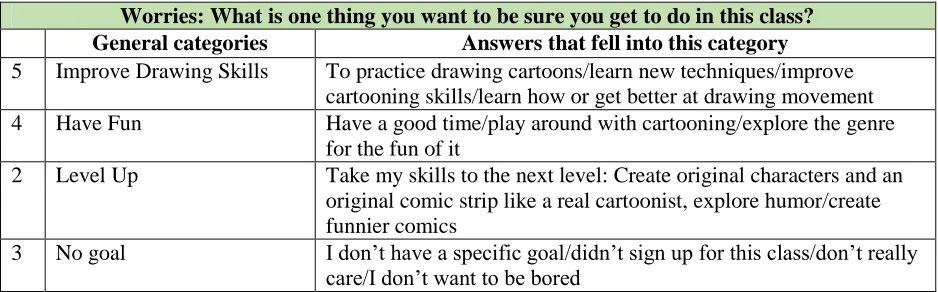
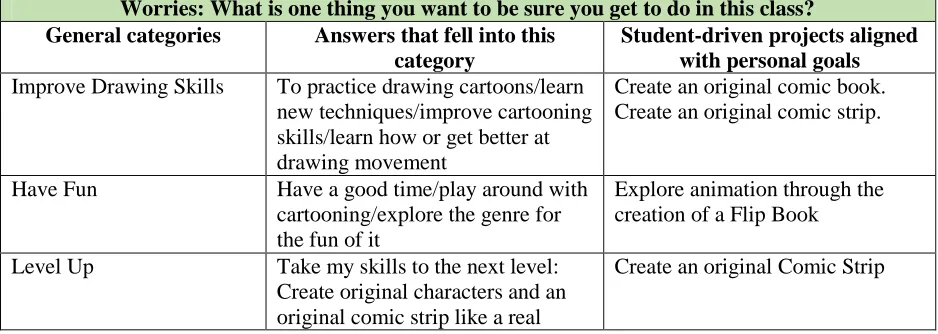
TABLE 4.2 Worries 40
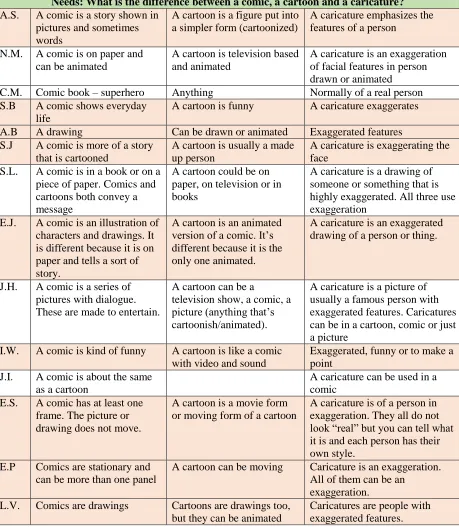
TABLE 4.3 Needs 41
TABLE 4.4 Stance 42
TABLE 4.5 Student Led Projects 48
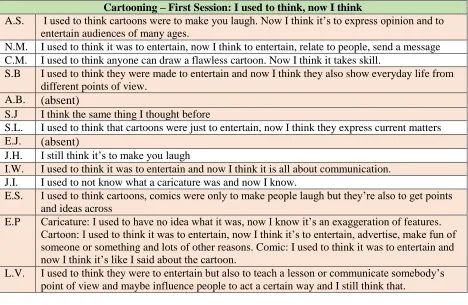
TABLE 4.6 I Used to Think, Now I Think 50
LIST OF FIGURES
Figure 1: Framework for Thinking and Creating 33
1. INTRODUCTION
This thesis is an auto-ethnographic study of teaching methods proposed to be effective in
helping develop thinking skills that advance meaning making in my middle school art classes.
The study is part of an ongoing initiative to make learning in visual arts a more meaningful and
beneficial educational experience for my students by continuously learning about methods and
strategies that elevate the goals and outcomes of visual arts instruction. The study explored the
use of Visible Thinking Routines (Ritchhart et al, 2011) and Art Investigations (Herz, 2010) in
middle school art classes. Reflections and other field texts reveal the extent to which I found
these methods effective in guiding students to develop higher order thinking skills that support
more meaningful outcomes in art and could be beneficial in other areas of their lives. The
literature review explains the two methods and covers research that supports the methods as
aligned with the philosophy and culture of my school and appropriate for a constructivist
learning environment. Such research deeply influences my own core beliefs about effective
instruction and framed the criteria by which my personal judgment was made.
1.1. Background for the Study
In fifth grade, my daughter begged to be home schooled. She was struggling
academically and had just taken a battery of tests to help determine the nature of her difficulty.
At 10 years old, Courtney was an avid reader and had a natural intellectual curiosity about the
world. The academic struggles that surfaced in second grade and continued to plague her efforts
were perplexing. I perceived my daughter as intelligent and insightful, in part, because she was a
precocious artist. From about two years old, making art was a routine part of Courtney’s day.
time choice was always art. At the risk of sounding biased, I was impressed by her skilled and
thoughtful artworks. Her work demonstrated a kind of knowing that is difficult to put into words.
Art was akin to a first language for Courtney. That battery of tests mentioned earlier
revealed Courtney was dyslexic. Chronic fluid behind her eardrums as a toddler created a gap in
verbal language acquisition and impacted phonological awareness. The doctor explained that
Courtney had been hearing the world as if under water. I believe her early exploration of the
world was all the more visual and tactile due to her muffled hearing. Art was accessible and
engaging. When introduced to an art medium, Courtney explored it with focused intensity, first
for its own sake; breaking it down to figure out its essential qualities, and then for purposes of
creating or expressing something. This practice of figuring out how something works in order to
employ its properties for your own ends came back to me years later as I observed my students
and reflected on my teaching methods. Anderson and Milbrandt (2005) describe art as a language
reliant on an understanding about symbolic form, relationships between forms and their
expressive qualities. This was intelligent work that, in my mind, demonstrated advanced
thinking. On this particular fall evening, Courtney clasped her hands and pleaded….”Don’t
make me go back to school. It’s awful. I’m not smart enough and I can’t do anything right.”
There was no way to convince Courtney that her abilities in art were evidence of knowledge and
cognitive achievement. I tried to give specific examples to help her realize her strengths. I
praised her ability to see and show light, her understanding of proportion and three dimensional
space, her visual-spatial memory. Her reply resonated with me. “I’m good at art, but I’m not
good at the stuff that matters. Nobody cares if you are good at art.”
Courtney was speaking the truth as she knew it. In the world outside her home, art was
plenty of rest. It seemed unconnected to her struggle with math computation and writing. In the
world outside her home, art was regarded as distinctly separate from academic achievement.
First hand experiences shape our view of the world and this experience impacted my
parenting, my education as a teacher, and ultimately, my teaching philosophy. It was 2001 and I
had just accepted a teaching position at High Meadows School. In sixth grade, I moved Courtney
to High Meadows as well, initially drawn by the fact that it was project-based. I knew Courtney
needed a different learning environment and I hoped a school that gave students multiple ways to
demonstrate what they know and understand would be a good fit. She told me years later that
High Meadows changed her life. She explained, “Sixth grade is the first time I felt understood.”
Entering the tumultuous years of growth and change in 6th – 8th grade could have been a perilous
time of dwindling academic interest and downward spiraling esteem for Courtney. Instead, an
integrated curriculum connected her capabilities to other disciplines and ignited her love of
learning anew. She understood math, science and social studies as she never had before. She
found she was, after all, good at what matters. Because what matters is making sense of the
world. And children need multiple ways to make that happen. This experience was the first of
many reasons I discovered for supporting visual arts as a means of significant learning across
disciplines.
1.1.1. Teaching and Learning at High Meadows School
My teaching environment for the last 13 years is intentionally counter-cultural. High
Meadows School neither looks nor functions like most other schools. The campus is spread
across 40 wooded acres, once a working farm in Roswell, Georgia. A full sized, hand painted tipi
graces the upper meadow. Drama classes take place in a large converted barn. The soccer field
for chickens and roosters, two sheep, a goat and four rabbits. A climbing wall, meditation
labyrinth, and archery field lie beyond the animal pens. A tire swing, the signature symbol of
High Meadows, hangs from a large oak at the edge of the lower meadow.
High Meadows School was established in 1973 and developed over the subsequent 40
years into a project-based instructional environment that trusts students to learn. It is grounded in
the constructivist belief that children possess an intrinsic need to know that makes them naturally
curious and eager to understand (Brooks & Brooks, 1999). At the heart of this philosophy is the
belief that a meaningful education involves teaching students how to think rather than telling
them what to think; a premise antithetical to traditional practices in education.
These progressive principles have never been the predominant philosophy in American
education. From their inception in the 1830s, state systems of common or public
schooling have primarily attempted to achieve cultural uniformity, not diversity, and to
educate dutiful, not critical citizens.
(University of Vermont, 2002, the John Dewey Project, p.1)
In 2002, on the heels of my inaugural year, the school adopted the International Baccalaureate
Primary Years Program (IB/PYP) for grades K-5. The mission, vision and philosophy of High
Meadows fit naturally with the IB focus on “the development of the whole child encompassing
social, physical, emotional, and cultural needs as well as academic welfare” (International
Baccalaureate Organization [IBO] About Us: Accreditations and Memberships section, para. 1)
and provided an established framework committed to structured, purposeful inquiry as the
leading vehicle for learning. Within that structure, the arts as well as social, emotional and
Significant to my teaching practice and this study, High Meadows chose not to adopt the
International Baccalaureate Middle Years Program (IB/MYP) for grades 6-8. As students move
from elementary to middle school, core values and beliefs are preserved, while the framing and
delivery of art instruction changes.
In Kindergarten through 5th grade, art instruction is designed to connect to classroom
units of study along a matching timeline. Units of study last approximately six weeks and
students come to art class once a week for 45 minutes. The arts are systematically woven into the
fabric of integrated lessons through collaborative planning and frequent communication with
classroom teachers.
In grades 6-8, art classes become elective. Rather than year-long weekly classes, middle
years students have two fifty minute periods in the middle of each day for mini-courses
(electives) that meet daily for six weeks. Courses are offered in a range of disciplines. Within
each discipline, different classes may be offered. Students are expected to take a variety of
mini-courses during their three years in middle school. Students select from a menu of twelve or more
choices per six week period with two requirements; PE and Study Skills are mandatory for each
grade level in the fall.
The mini-course system is designed to offer a wide selection in order to keep classes
small, more student directed and structured for in-depth exploration. Students who choose to take
an art class can match their experience to personal interests and explore media beyond what is
customary or possible in Kindergarten through 5th grade art classes. Art mini-courses, in striving
to offer students the opportunity to deeply explore a specific art form, provides a format
especially conducive to guiding students in personal meaning making through methods and
subdivided into six different classes offered throughout the year that allow students to delve more
deeply into specific media as in Watercolor or Dry Media classes, specific techniques as in the
Contemporary Methods in Drawing and Painting class, or subject matter as in the Drawing and
Painting People. In addition to these classes, a variety of other art classes are offered including
Printmaking, Sculpture, Ceramics, Fiber Arts, Books Arts and Copper Enameling.
Yet in the midst of rich opportunities, the structure of middle school mini-courses vs. the
integrated model in K-5 positions art as incidental rather than essential to education. Beginning
with middle school, parents, administrators and teachers increasingly discount the necessity of
the arts to a good education. Parents exhibit a growing anxiety about the rigor of what they
consider core academic classes such as math and science. They become more focused on their
child’s readiness for high school and less likely to believe that participation in the arts is essential
to that goal. Student attitudes are prejudiced by the prevailing attitudes of the influential adults in
their lives. As art is not required, fewer students routinely participate in art classes. When art
becomes an elective, it is positioned as being less serious or less valuable to education. Both
middle school parents and middle school teachers regard mini-courses as a break in the academic
day. Students who choose an art mini-course often expect the course to be easy and fun. The
change in perception increases the potential for underachievement. The cognitive and personal
benefit of making art is overpowered by other pressures.
A sixth grade student I’ve known since Kindergarten walked into the art room on the
opening day of a new course delighted to have received his first choice of electives. The next
day, he had transferred out. His mother insisted he drop art and enroll in debate because she
thought the skills he learned in debate would help him more in High School than an art class.
serves, rather than detracts from, the goal of preparing for High School. I believe arts develop
critical thinking skills and foster creative intelligence, increasingly understood as valuable across
domains (Nussbaum (2013). I also believe that the arts can be a powerful way to process and
respond to real world issues as well as explore our thoughts and feelings as human beings.
”Through the arts we learn to see what we had not noticed, feel what we had not felt, and to
employ forms of thinking that are indigenous to the arts” (Eisner, 2002, p. 12). These core
beliefs lead me to continuously evaluate my current teaching methods and seek more effective
methods for achieving these outcomes.
Part of my teaching philosophy is the conviction that I have a responsibility to help
students know themselves as learners and people capable of success beyond this particularly
intimate and supportive environment. This sense of responsibility drives my research for specific
artful teaching methods that are designed to enhance the ability to think, express, create and
problem solve both within and beyond the art room. Making the benefits more apparent to
students may even encourage greater participation in the arts and further service this goal.
Meaning making is a powerful way to process and respond to the complexities of
growing up in a modern world. With the appropriate methods, I felt I could lead my students to
connect and combine modes of treatment to create visual expression that evokes a synesthetic
experience, what Eisner refers to as a “substantial cognitive accomplishment” (p 18). And I’m
confident that this engagement in meaning making provides a platform for the development of
thinking skills that transcend art making. “When teachers provide opportunities for students to
engage in tasks that practice such skills and attitudes, they are providing opportunities for the
development of mind.” (Eisner, 2002, p.13). The development of mind is one of education’s
Beyond 8th grade, students have fewer opportunities to participate in arts classes. Many of
the alumni who come back to High Meadows School for campus visits report taking one or two
art classes during their high school career. Middle school turns out to be the last time they are
provided the opportunity to explore meaningful art making. If there is a time when the personal
and educational benefits of meaning making are to be realized through my teaching, it is during
this critical stage when students have a foundation in the skills and knowledge of visual arts and
are developmentally ready to respond and create works with personal significance.
1.2. Purpose of the Study
When I attended IB/PYP teacher training, the focus was teaching through inquiry. My
colleagues and I learned a variety of cooperative teaching methods and strategies for
collaborative learning. Yet, after teaching for twelve years I had amassed a huge library of
Power Point presentations and slide shows. I used Power Point as a definitive content paper.
Everything about the lesson was in there. Every relevant fact. Every relevant image. There was a
measure of security in knowing I had everything in one place and could call it up at the click of a
mouse. My lessons included provocations, questions and conversation that were, in my mind,
consistent with methods of inquiry. Last year, following a formal observation, my division
director asked if I always began my lessons with a Power Point presentation. I had to admit that I
rarely introduced a lesson differently. Then she asked why? Which led me to reflect more deeply
on some of the teaching practices that had become habit and to form my own essential questions.
How do my methods support my goals for students? How do they fall short? Am I making
progress toward becoming the kind of teacher I want to be? How am I equipping students for
success through my teaching? Getting back to an understanding of teaching through inquiry was
to which you already know the answer and that students do not always have to have background
information to begin the process of discovery. There is nothing more engaging than finding your
own burning questions and setting about to answer them.
Educators today are hyper-aware of how the world from which we draw the knowledge
and experience to teach is not the world in which our students will use their knowledge and skills
to live and work. In a rapidly changing world, there remains a consistent need to make sense of
things. But this is not so new a dilemma.
My Dad was born in 1926. He was two and a half years old when the stock market
crashed in 1929 and fifteen when Pearl Harbor was bombed in 1941. Growing up during The
Great Depression and World War II defined his early years. And the world kept changing. He
had babies in the 1950s and teenagers in the 1960s and witnessed first-hand the discovery of
many things we now take for granted on a daily basis. The realities of unprecedented historical,
economic and social events shaped his life.
My father was adaptive, resourceful and creative. Problem solving and thinking through
the limitations and opportunities of the situation were a way of life for him. My siblings and I
marveled aloud at his ability to repair anything, to which he replied, “If I can figure out how it
works, I can figure out how to fix it.” He learned to repair instead of replace. He learned to make
informed substitutions and question how things could be done differently. His formal education
ended at 7th grade, but he was one of the smartest men I’ve ever known. What set him apart was
his ability to think critically. My Dad’s philosophy became one of the core principles that guides
my teaching. It is the basis for the structure of moving from teacher-led skill-based lessons to
mantra: Figuring out how things work is the key to problem solving and lays the foundation for
creativity, imagination and original self-expression
The world my father lived in as an adult was miles apart from the world he knew as a
child. As new things came along, he built on his prior knowledge, transferred and layered what
he already knew with the latest innovation whether dealing with tools, automobile engines or
electronics. He remained curious about how things worked, never stopped learning, and used
what he learned to problem solve. As a lifelong learner, I strive to follow my father’s example.
Making Thinking Visible by Ron Ritchart, Mark Church and Karin Morrison (2011) was
offered as one of the choices for professional learning groups in May of 2012. Each summer,
about five books are offered from which teachers and staff may choose. Upon our return to
school in the fall, teachers meet in small groups for book discussions, then create a presentation
to share the most salient points of their reading and discussion experience. I chose another book,
but decided to read this one as well after discussing its merits with my division director. Upon
reading, I associated thinking routines with a book from one of my graduate classes, Looking at
Art in the Classrooms, Art Investigations from the Guggenheim Museum. (Herz, R. S. (2010).
The methodologies proposed by each were similar in that they encouraged students to think
deeply and respond authentically to art experiences.
I was curious about the extent to which Visible Thinking Routines and Art Investigations
might help me frame engagement and advance the thinking skills conducive to meaning making.
In the context of the visual arts, the making of meaning (meaning-making) is both an end in itself
in the form of an artwork and a conduit in the acquisition of skills and knowledge beneficial
across domains. A secondary aim was to mine the worth of these methods in growing the
child; a process that begins with helping students realize this for themselves through their own
experience and achievement.
This study provided the opportunity to evaluate these methods and determine for myself
whether they helped frame student engagement in the visual arts as an intellectual activity that
matters and enhanced students’ ability to create meaningful art in their own voice.
1.2.1. Research Questions
My research questions are:
1. To what extent do the teaching methods in Visible Thinking Routines and Art
Investigations, in my opinion, engage students in higher order thinking and advance
personal meaning making as they transition from teacher-led, skill-based art making to
self-directed, concept-based artwork with personal meaning?
2. To what extent do these teaching methods, when combined with current methods (such as
goal setting and self-evaluation) help me frame art-making as an intellectual endeavor
and encourage a growth mindset?
In order to answer these questions, I reviewed related literature and articles and conducted
auto-ethnographical reflections before and during a period of integrating the methodologies
2. REVIEW OF THE LITERATURE
As the subject of my study is myself and my teaching methods, it’s important to
acknowledge the internalized principles that guide my teaching. Education is a lifelong journey
and I am not the same teacher today that I was ten years ago. Taking time to review the
pedagogical thought that has most profoundly impacted my practice of teaching helps me know
myself. It may also serve to refresh my practice during the study, helping me to focus anew on
my beliefs as an educator and thus more purposefully align my study with my ideals.
Planning is a key part of teaching. An art lesson plan appears as a linear, sequential
process on the written page with procedures stepped out neatly, first one thing, then the next. My
real world experience when implementing the lesson, however, is naturally multi-dimensional
and multi-disciplinary. I want every student to be as successful as possible. I strive to capture all
I need to know and do in a well-considered plan. But the written plan doesn’t address everything
that will impact the success or failure of the lesson. All of my learning plays a part in being the
kind of teacher of want to be.
I have chosen an auto-ethnographic approach for the unique fit of this Social Science
research method with my purpose. Fetterman (1988) describes ethnography as the art and science
of describing a group or culture. Autoethnography is simultaneously ethnographical (cultural)
and autobiographical (personal) fulfilling the important mission of connecting the two (Chang,
2013). Autoethnographic inquiry uses autobiographical materials of the researcher as the primary
data (Chang, 2013). Through up-close, personal experience and participation, ethnographic
methods allow for the discovery of new personal analytic insights. And the findings from such an
analysis of my teaching, can inform and guide instructional innovations and practices (Genzuk,
to which I belong. In the largest sense, I am an educator. Within that group, I am specifically a
visual arts teacher, and even more specifically, a visual arts teacher at High Meadows School.
Therefore, my research involves a synthesis of my findings through each of these lenses as I have
a triadic purpose in teaching; to educate the whole child through visual arts instruction within the
culture of High Meadows School.
The literature reviewed for this study, which clarifies the autobiographical context of the
experience includes research at the heart of my teaching philosophy and current practices, in
addition to the books from which Visible Thinking Routines and Art Investigations originate.
Early in my teaching career In Search of Understanding: The Case for Constructivist Classrooms
by Brooks and Brooks (year?) and Understanding by Design by McTighe and Wiggins (year?)
were part of my orientation to constructivist practices and teaching through inquiry. These books
form the basis of my beliefs about how instruction should be planned and delivered as well as the
relationship between teaching and learning in the classroom. Art for Life (2005) by Thomas
Anderson and Melody Milbrandt, The Arts and the Creation of Mind by Elliott Eisner and
Aesthetics by Boyd White are key references about what the arts teach as well as the value and
power of meaning making to education. Resources from professional development at High
Meadows School such Yardsticks by C. Wood and Brain-Based Learning by E. Jensen support
my understanding of child development and the science of learning. Other research-based
resources like A Whole New Mind by Daniel Pink and Creative Intelligence by Bruce Nussbaum
referenced here have served to broaden and deepen my understanding of what students need to
be successful today and the ways that attitudes about the value of the arts to education are often
out of step with educating students for 21st century living. Additional resources support the
For teachers, as for any student, a valid measure of learning is whether we can use what
we know (Wiggins & McTighe, 2005). That is, when what I have learned is evident in what I can
do in my classroom to advance the value of art education for my students. This autoethnographic
study will help me find out.
2.1. Making Meaning
“Why do people make art? Basically, we make art to make sense of things, to give
meaning to our existence” (Anderson and Milbrandt, 2005, p. 139). Art is a part of the common
human experience and essential to understanding the world. White (2009) describes art as the
visual expression of sensory experience, perceived through feeling. As White explains, “Each
perception provides an occasion for an act of meaning making: and meanings emerge because
perceptions are built on the basis of comparisons to previous experience” (p. 3). As both artist
and teacher, I have come to appreciate art as a powerful assistant in processing layer upon layer
of experience in a lifelong journey of becoming. I believe the greatest benefits of art education
go beyond the skills and knowledge of art making to helping us more deeply understand
ourselves and the world in which we live. As an art teacher, I have the opportunity to facilitate
the kind of deeper learning that is significant and personally relevant for my students.
I believe that good teachers connect with students in meaningful ways, guide them to a
greater understanding of the world and themselves and teach them more than the content of their
lessons (Eisner, 2002). I am inspired by the example of meaningful teachers in my own life
experience; teachers who live within me and continue to work through me. I know the kind of
teacher I want to be. I want to provide opportunities for my students to engage in art for its own
sake within a structure that advances creativity and positions art making as an intellectual
deal with these issue creatively (Anderson and Milbrandt, 2005). I am on an endless quest for
teaching methods that facilitate authentic meaning making in order to better achieve these
teaching goals. According to Anderson and Milbrandt (2005), “Direct training in this process is
impossible, but a conscientious teacher can devise motivations and activities as well as provide
guidance to help students develop the skills, attitudes and patterns of work that allow them to
express themselves meaningfully in art and life” (p. 152). The methods presented in Visible
Thinking Routines and Artful Investigations in combination with other experience-tested methods
currently practiced showed promised as a means to that end.
2.1.1. Thinking Skills for Life Long Learning
Eisner (2002) believes that the unique quality of learning through the arts is integral to
achieving the greater goals of education. “The outcomes of education can thus be said to
diversify and deepen the kinds of meanings people know how to construct and provide them with
the appetite and ability to shift frames” (p.45). Education is about all the essential elements that
make an informed, enriched, productive, satisfying life possible (Starko, 1995).
Another timely societal purpose achieved through art education includes the development
of creative thinking and problem solving skills. Research regarding creativity has influenced
educational practices from classroom to administration to overall school environments
(Torrance, 1983 as cited by Feith, 2000, April). Educators continue to emphasize the importance
of favorable conditions for developing students’ creative potential. Daniel Pink, author of A
Whole New Mind (2005), asserts that creativity is one of the single most important skills students
asserting that education has an affirmative obligation be aligned with the real world. 21st Century
students need to learn to put ideas together in fresh, new ways to meet challenges we have yet to
(Eisner, 2002). Teaching the making of meaning is one way to provide students with the
opportunity to develop creative intelligence. And the methods proposed for this study have the
potential to advance creative output.
Everybody has creative capacity…everybody. The challenge is to know how to cultivate
them. Children have immense natural capacities of innovation, of creative thinking, of
alternative ways of seeing. They are deeply personal capacities, and great teaching has
always been there to model and to bring them out.
Sir Ken Robinson on the “Power of the Imaginative Mind (Part One)”
Release Date: 5/28/08 (Edutopia, http://www.edutopia.org/sir-ken-robinson-
creativity-part-one-video, transcript, para. 9)
High Meadows is a progressive school with a constructivist orientation. Constructivism is the
model that encourages students to independently seek interests and problems; to generate
multiple hypotheses; to focus on broad ideas rather than specific facts; and to think about
thinking: conditions essential to developing creative potential (Starko, 1995). Constructivism is
meaning making by definition. According to Anderson and Milbrandt (2005), there are specific
characteristics of teaching that support construction of meaning through connections to the real
world, including:
(1) Involving students in higher levels of cognition or thinking
(2) Leading students in substantial conversation about a topic
(3) Promoting social support for peers’ achievement and
(4) Developing themes for teaching that support integrated learning beyond the
Exploring the making of meaning in visual arts is a constructivist process as it provides the
child-centered means to make sense of the world through responding and creating in art. Teaching
methods with a constructivist orientation, such as Visible Thinking Routines and Art
Investigations, can help students connect to the real world, take responsibility for their own
learning, become independent thinkers, inquirers and problem-solvers and develop a holistic
understanding of larger concepts.
2.1.2. The Opportunity for Meaning Making in Middle School Art
Responding and creating are two components with developmentally appropriate
benchmarks within the IB framework for art instruction for Kindergarten through 5th grade.
The process of responding provides students with opportunities to respond to their own
and other artists’ works and processes, and in so doing develop the skills of critical
analysis, interpretation, evaluation, reflection and communication. The process of
creating provides students with opportunities to communicate distinctive forms of
meaning, develop their technical skills, take creative risks, solve problems and visualize
consequences.
(Making the PYP Happen, p.136)
The manifestation of responding and creating in the K-5 classroom is introduction to a variety of
art forms and artists with the opportunity to visually and physically explore the big world of art.
From the earliest grades, children are learning through discovery. They are building a knowledge
base in art related to a larger web of ideas that connect what they are able to do with what they
understand across disciplines. “…children’s visual thinking begins with the exploration of
media” (Anderson and Milbrandt, 2005, p. 47). As a practical matter, instruction is heavily
integrated across disciplines and naturally includes connections to studies in math, science,
language arts and social studies. Yet, students still need to be introduced to the media, processes,
vocabulary, and working concepts basic to art education. We can say then, that instruction is
necessarily skill-based as the investigation and manipulation of tools and materials themselves
are at the heart of art making for beginning artists.
Teaching authentic meaning making involves a process of building on this acquisition of
skills and foundation of knowledge. That is, to help students combine what they have learned
from art experiences with mimesis, the creation of expressive form and familiarity with
conventional signs to engage in higher order thinking and purposeful, meaningful art making
(Eisner, 2002). The framework and instruction in K-5th grade art builds artistic skill and
knowledge and supports the transition to personal meaning making in 6th-8th grade art. The
methods explored in this study were expected to build well on the model of responding and
creating to which students had been exposed in the IB/PYP art curriculum.
2.1.3. Meaning Making and Developmental Stages
The developmental characteristics of young learners serve skill-based art making well in
the early grades. They learn best through active exploration of materials and think intuitively
rather than logically. Even as instruction is centered on the properties of media and artistic
techniques, purity of expression is preserved, as young artists naturally explore on a deeply
personal level. In one of my lessons about expressive marks, first and second grade students were
introduced to several examples of visual music by Wassily Kandinsky, then given recycled
materials of various shapes and sized for printmaking to music. I was amused, yet not surprised,
to note that the paintings were more evocative of the personality of the individual child than the
artist are one. Every piece produced is a self-portrait, imbued with the personality, spirit,
emotions, experiences, hopes and fears of the artist. Early stages of development are favorable
for exploring the possibilities and limitation of different media as well as the creation of
expressive form, one of the three modes of treatment used for meaningful representation (Eisner,
2002).
By fourth and fifth grade, a group identity emerges that enables the artist to see
himself/herself in relation to others (Wood, 2007). Nine and ten year old artists become very
interested and aware of how things work and why things happen, making this a good time for
conventions of scientific exploration to cross over into the art room. Curiosity leads students to
actively experiment and problem solve in art. The exploration of media and techniques grows in
sophistication with this maturing ability to transfer knowledge across domains. Cognitively, ten
year olds become more concerned with factual correctness and getting things right. They are
ready to learn about space, depth and perspective in art (Wood, 2007). And with this, their
artistic skill set along with knowledge of artistic structures continues to grow.
As art becomes an important area to demonstrate technical ability, attitudes about art
begin to change. Students actively seek out models or standards by which to measure their
capabilities. As ten to eleven year olds build their group identity, they may sort themselves into
subgroups of those who are good at art and those who are not (Wood, 2007). “Artistic progress in
their eyes is defined by the mimetic quality of their rendering” (Eisner, p 16). Independent art
making leans heavily toward detailed, accurate line drawings and cartooning. In the early grades,
learning to represent the world through simple shapes and symbols, or conventional signs is an
important part of visual literacy and fine motor practice (Eisner, 2002). Later, these conventions
their world with greater accuracy. To address these developmental changes, instruction by fifth
grade is intentionally more focused on close observation and careful attention to proportion and
relationship of parts to the whole. Students are guided to more skillfully represent the real world
by taking time to perceive what is actually seen rather than relying on learned icons. It is
critically important to establish and reinforce a growth mindset at this stage. I want to steer
students away from defining themselves as artistic or not artistic based on their current abilities,
associating effort with improvement instead.
Between 11 and 13 years of age, students have an increased ability to think abstractly,
reason and see the world from different perspectives (Wood, 2007). They enjoy conversations
with peers and adults and are more interested in discussing substantive issues. They are more
connected to civics, history, current events, politics, social justice and environmental concerns
(Wood, 2007). Middle school students are growing in their ability to reflect and respond in
various ways to historical and contemporary conflicts. They are beginning to grapple with the
larger, more complex questions central to life and living, and seeking ways to confront and make
sense of essential questions. They are poised to explore and express in meaningful ways through
the arts, even as they instinctively avoid making themselves vulnerable to peers or teachers
(Dweck, 2008). The methods explored for this study were well suited to the cognitive abilities of
adolescents described by Wood (2007).
2.2. The Importance of Classroom Culture to Authentic Meaning Making
Encouraging adolescents to think and act outside their comfort zone involves crafting a
classroom environment conducive to creative risk-taking (Dweck, 2008). Anderson and
Milbrandt (2005) assert that student self-expression can be blocked by numerous emotional risks
Milbrandt, 2005) includes:
Fear of making mistakes
Fear of being seen as a fool
Fear of being criticized
Fear of being misused
Fear of being alone (a person with an idea is a minority of one)
Fear of disturbing traditions by making changes
Fear of breaking taboos
Fear of losing the love of the group.
Fear of truly being an individual. (p. 74)
Using what we know about how the brain functions in learning situations is a key
component of implementing effective teaching methods. Jensen (2008) suggests that negative
impact of stress and threat can be minimized by increasing a sense of safety at school,
encouraging positive relationships among learners, providing numerous opportunities for
students to express themselves and reducing stress by activating prior learning (p.490). Teaching
methods and routines that help teachers meet students where they are and provide an outlet for
personal expression support personal meaning-making. “When you create a safe and relaxed
learning environment with an absence of threats and high stress, many learners will surprise you.
They’ll quickly exhibit improved thinking and problem-solving skills and fewer disruptions and
behavioral problems” (Jensen, 2008, p. 50).
Establishing the goal of personal growth is central to the process of meaning making. It is
generally accepted that verbal and mathematical ability can be developed through attention and
with (Dweck, 2008). Positive messages that foster intrinsic motivation and cultivate a growth
mindset include praising effort and problem solving ability and measuring success with authentic
assessment tools that help students track their individual growth.
Adolescence, as we’ve seen, is a time when hordes of kids turn off to school. This is a
time when students are facing some of the biggest challenges of their young lives, and a
time when they are heavily evaluating themselves, often with a fixed mindset
(Dweck, 2008, p.218).
As previously mentioned, adolescence is also a time when hordes of kids turn off to art as they
fail to see the relevance or importance of art to their own lives. They don’t know how art has
been credited as important in the lives of people who did NOT become artists. In Creative
Intelligence, Nussbaum (2013), describes Steve Jobs’ experience with a single calligraphy class
as profoundly influencing the design of the user interface for Apple computers. He asserts that
knowledge gained as a result of deep study and practice in the arts can become a resource for
creative thinking in other disciplines (Nussbaum, 2013).
Cultivating a growth mindset enhances a positive learning environment and encourages
students to persevere in developing the thinking skills and abilities of authentic meaning-making.
Making Thinking Visible methodology can help circumvent the unwillingness of adolescents to
make themselves vulnerable to judgment as they are focused on demystifying thinking skills for
students in a way that helps them hone these skills and recognize how their thinking has changed
over time.
2.3 Knowledge Mining
Teaching through inquiry, incorporating cooperative learning strategies, allowing for
ways for students to measure their own progress are all child-centered methods embedded in
constructivism that support a classroom environment geared toward student success (Brooks and
Brooks, 1993).
Constructivist methods that make students the authors of their experience allow the
teacher to guide and support students in meeting their own goals. When teachers allow students
some control and choice, support their natural sense of curiosity, teach them to leverage strengths
against weaknesses, acknowledge effort and reinforce belief in capabilities while modeling a joy
of learning, intrinsic motivation is increased (Dweck, 2008). Visible Thinking Routines provide a
vehicle for making these things happen in the classroom.
The key for my 6th -8th grade students was tailoring my methods to transition students
from an emphasis on skillful mimesis, to using their skills to produce original, meaningful
artwork. Exemplars at this new stage of art making were about looking beyond techniques to
consider the deeper purpose and contextual meaning of the artwork. We were now interested in
models of meaning making that helped students better understand and create personal expression.
Nussbaum (2013) refers to this updated take on finding inspiration from the past as
knowledge mining. Initially, he recommends acknowledging the “knowledge we all possess by
virtue of who we are and which “tribes” we belong to, the kind of knowledge gained not from
practice, but from life experience” (p. 49). Authentic student work embodies the values of a
generation, a culture, relationships and attitudes that are first hand. It’s important that the
student’s own voice and experience are not subjugated to the source of inspiration, but that the
inspiration provides the foundation for creative expression (Nussbaum, 2013). Knowledge mining
through exemplars helped orient students to what is being observed; the expressive qualities that
Art education in the early years is largely about acquiring the skills and knowledge basic
to making art. Young art students explore, experiment, and acquire a foundation in making art
through observation and imitation. As the artist grows in skill and understanding, he is guided to
create original meaningful art in his own voice.
“There’s an enormous difference between memorizing a few key facts and having an
authentic grasp of a subject” (Jensen, 2008, p. 177). Likewise, there is a big difference in being
able to mimic the style or technique of an artist and truly creating art from within oneself.
Authentic, meaningful learning requires students to process information in their own way,
along their own timeline and in relation to their own perceptual maps. Sorting, analyzing
and drawing conclusions in the context of one’s own life are what makes information
stick.
(Jensen, 2008, p.78)
This is one reason that personal meaning making is valuable to education (Jensen, 2008, p. 83).
Teaching through exemplars, then, is first a way to develop artistic skill and later, a way to
explore how artists create authentic visual communication. According to Jensen, “our brains
fully know something only when we represent the information in our own meaningful way”
(p.178).
Employing teaching methods that help us realize what students already know and what
they are motivated to learn, helped me determine how best to frame new information. And
through assessing current understanding, I could more effectively plan for the remedial or
enrichment needs of the immediate student population. Authentic assessment within the
constructivist (meaning making) model can be imagined as a spiral within which students
2009). As larger concepts were revisited, student ideas could grow in complexity and power. As
Eisner (2002) asserted, “Meaning is not limited to what words can express” (p.230). According
to Brooks (1999), students develop stronger abilities to integrate new information at their
individual cognitive and developmental place with each new cycle. The teacher provides a
framework for learning that places the student at the center of their own learning, encourages
discovery and provides the opportunity for reflective self-assessment (Brooks, 1999). Pente
(2004), explains that artistic activity provides a greater capacity for reflective practices, allowing
individuals to delve into aspects of self that cannot be adequately expressed with words.
2.3.1. Making Thinking Visible
“Too often the thinking that is required to turn activity into learning is left to chance”
(Ritchart et al., 2011, p.9). In 2005, researchers at Harvard Project Zero completed a five year
study that explored how to nurture thinking habits in schools. The initial set of Visible Thinking
Routines, made available via the World Wide Web, was immediately recognized by educators as
a valuable resource in their daily work. Harvard colleagues, Shari Tishman and Patricia Palmer,
involved in the Artful Thinking initiative, noted the usefulness of the thinking routines in
supporting arts integration (Ritchart, 2008, p. xvii). The enthusiasm of educators and the broad
applicability of the thinking routines led to the publication of a subsequent book, Making
Thinking Visible (2005),that expanded and extended the routines, applications, teacher stories
and goals of the initial effort to “fostering engagement, uncovering understanding and promoting
independence within a classroom culture of thinking” (Ritchhart, p. xx). In the book, the authors
outline the types of thinking involved in understanding and provide a series of thinking routines
that guide inquiry. The importance of inquiry in propelling learning is evident in our own
naturally more engaged in the process of discovery. Through discovery, understanding is
developed and curiosity extended to a whole new level of questions. The new questions are
testimony to an increased depth of understanding (p.13). A continuous cycle of finding and
answering questions generated from individual curiosity and authentic desire to know is at the
heart of life-long learning. According to the authors, making the kinds of thinking students need
to do more transparent helps teacher more effectively promote those kinds of thinking in their
interactions with student, which increased my interest in testing the methods with my students.
Furthermore, Ritchart et al asserted that as thinking was demystified, students would become
more adept at self-directed learning. “To be properly metacognitive, then, students have to be
realistically aware of their own cognitive resources in relation to the task demands, and then to
plan, monitor and control those resources“(Biggs, 1978, as cited by Ritchart et al., p. 15). The
benefits of these methods promised to support the kind of metacognition that enriches the
capacity for personal meaning making in visual arts.
The organization and structure of Visible Thinking Routines (Ritchart, et. al, 2011)
supported my study. The routines are organized by the types of thinking each is designed to
promote, which was valuable for helping students recognize the intellectual value of artistic
experiences. The routines are designed to provide a structure for illuminating what students
already know in order that further instruction could be planned to build on prior knowledge. The
routines are intended to be useful tools for guiding students to identify areas of interest, set goals
and attend to their own achievement. They are meant to endow students with a greater ability to
deepen understanding and teachers with a means to evaluate progress and document growth. As
assessment tools that more clearly track learning along a continuum. The routines could also
become a means of re-framing the value and purpose of art and encouraging creative risk-taking.
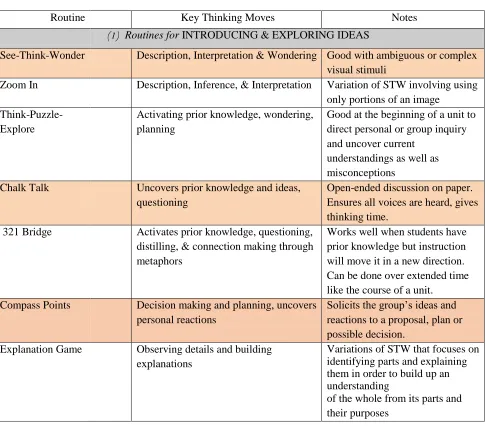
Ritchhart, Church and Morrison (2011) provide a matrix of thinking routines
and the types of thinking promoted for quick reference (p 51).
TABLE 1.1
Thinking Routines Matrix
Routine Key Thinking Moves Notes
(1) Routines for INTRODUCING & EXPLORING IDEAS
See-Think-Wonder Description, Interpretation & Wondering Good with ambiguous or complex visual stimuli
Zoom In Description, Inference, & Interpretation Variation of STW involving using
only portions of an image
Think-Puzzle-Explore
Activating prior knowledge, wondering, planning
Good at the beginning of a unit to direct personal or group inquiry and uncover current
understandings as well as misconceptions
Chalk Talk Uncovers prior knowledge and ideas,
questioning
Open-ended discussion on paper. Ensures all voices are heard, gives thinking time.
321 Bridge Activates prior knowledge, questioning,
distilling, & connection making through metaphors
Works well when students have prior knowledge but instruction will move it in a new direction. Can be done over extended time like the course of a unit.
Compass Points Decision making and planning, uncovers
personal reactions
Solicits the group’s ideas and reactions to a proposal, plan or possible decision.
Explanation Game Observing details and building
explanations
Variations of STW that focuses on identifying parts and explaining them in order to build up an understanding
[image:38.612.78.563.243.669.2](2) Routines for SYNTHESIZING & ORGANIZING IDEAS
Headlines Summarizing, Capturing the heart Quick summaries of the big ideas
or what stands out
CSI: Color, Symbol, Image Capturing the heart through metaphors Non-verbal routine that forces visual connections
Generate-Sort-Connect-Elaborate: Concept Maps
Uncovering and organizing prior knowledge to identify connections
Highlights the thinking steps of making an effective concept map that both organizes and reveals one’s thinking
Connect-Extend-Challenge Connection making, identify new ideas, raising questions
Key synthesis moves for dealing with new information in whatever form it might be presented: books, lecture, movie, etc.
The 4 C’s Connection making, identifying key
concept, raising questions, and considering implications
A text-based routine that helps identifies key points of complex text for discussion. Demands a rich text or book.
Micro Lab A protocol for focused discussion Can be combined with other
routines and used to prompt reflection and discussion
I used to think Reflection and metacognition Used to help learners reflect on
how their thinking has shifted and changed over time.
(3) Routines for DIGGING DEEPER INTO IDEAS
What makes you say that? Reasoning with evidence A question that teachers can
weave into discussion to push students to give evidence for their assertions.
Circle Viewpoints Perspective taking Identification of perspectives
around an issue or problem.
Step Inside Perspective taking Stepping into a position and
talking or writing from that perspective to gain a deeper understanding of it.
Red Light, Yellow Light Monitoring, identification of bias, raising questions
Used to identify possible errors in reasoning, over reaching by authors, or areas that need to be questioned.
Claim Support Question Identifying generalizations and theories, reasoning with evidence, counter arguments
Tug of War Perspective taking, reasoning, identifying complexities
Identifying and building both sides of an argument or tension/dilemma
Word-Phrase-Sentence Summarizing and distilling Text-based protocol aimed at
eliciting what a reader found important or worthwhile. Used with discussion to look at themes and implications.
From Making Thinking Visibleby Ritchhart, Morrison & Church (Spring 2011) p. 51
The Visible Thinking Matrix divides thinking routines into three categories that are
helpful in targeting the type of thinking you want students to do. Section 1 includes routines for
Introducing and Exploring Ideas. Section two includes routines synthesizing and organizing
ideas. And section three includes routines for digging deeper into ideas. The shaded cells in the
matrix highlight routines purposefully chosen for use in this study.
2.3.2. Art Investigations
Art Investigations (Herz, R. S. 2010) is a methodology supported by research in brain
science. In Human Brain, Human Learning (1992), Hart describes the brain as a pattern seeking
device. He asserts that the human search for meaning is an innate survival mechanism that drives
us to seek understanding, a principle at the heart of intrinsically motivated learning. If students
find no meaning, they refocus their attention to something else. Pattern detection serves not only
the acquisition of artistic skill, but the greater search for meaning as students look for relevant
connections to their own lives, feelings or situations by constantly asking, “How is this new
information like something I already know?” (Carla Mathison). Recognizing patterns and
relating new information to what we already know prepares us to respond to the world around us
and our own emotions (Jensen, 2008, p184). This is the type of critical thinking and meaning
3 METHODOLOGY
Because of the nature of my study, I chose autoethnography as the methodology. As a set
of methods, ethnography is not far removed from the sort of approach that we all use in everyday
life to make sense of our surroundings (Genzuk, 2003). The purpose of social research is to
capture the character of naturally occurring human behavior, which can only be achieved by
first-hand contact in natural settings, not by inferences from what people do in artificial settings.
Therefore, ethnographers carry out their research in natural settings focused on a single place or
group of relatively small scale.
In the case of autoethnography, the behavior of the research participant, which is myself,
is studied in everyday contexts, rather than under experimental conditions created by the
researcher. Data collection is relatively unstructured as compared to quantitative research
involving a specific hypotheses and controlled conditions. The research does not involve
following a rigidly defined plan and the categories used for interpreting data are not fixed.
While the research is purposeful, even systematic, data is initially collected in as raw a form, and
on as wide a front, as possible and generated from a variety of sources (Genzuk, 2003). The
researcher analyzes and interprets the meanings and functions of human actions through verbal
descriptions and explanations wherein quantification and statistical analysis plays little or no role
(Genzuk, 2003). “They collect field data by means of participation, self-observation, interview,
and document review; verify data by triangulating sources and contents; analyze and interpret
data to decipher the cultural meanings of events, behaviors, and thoughts; and write
autoethnography.” (Genzuk, 2003 p.?) Like ethnographers, auto ethnographers are expected to
treat their autobiographical data with critical, analytical, and interpretive eyes to detect cultural
and others within a particular context. Chang (2013) argues that autoethnography should be
ethnographical in its methodological orientation, cultural in its interpretive orientation, and
autobiographical in its content orientation.
My research involves evaluating my experience teaching through research-based routines
believed to support the transition of 6th-8th grade students from teacher-led skill-based art making
to authentic self-directed art making in their own voice. This outcome is the ultimate goal of my
teaching journey with students at High Meadows that begins as early as Kindergarten and ends
with sending them off to High School at the end of 8th grade. The evaluation includes a personal
assessment of how well these routines mesh with a constructivist classroom including the
particular characteristics of the High Meadows School culture.
Reflecting and evaluating to my own satisfaction how research-based teaching methods
such as Art Investigations (Herz, 2010) and Visible Thinking Routines (Ritchhart et al, 2011)
work to advance critical thinking skills while deepening knowledge and understanding in art
lessons will assist me in refining and improving my own teaching practices.
The study compares routines and related experiences in two different sessions of
Cartooning and one session of Printmaking. The analysis and interpretation is extended to
include recent autobiographical data from other class experiences. The methods were woven into
established methods that I believe support my teaching goals. Established methods include
developing a shared understanding of principles and beliefs at the heart of our art experience
together, a planned emphasis on setting and working toward individual goals, and involving
students in establishing the criteria for measuring growth. These established practices help clarify
My research questions are:
1. To what extent do the teaching methods in Visible Thinking Routines and Art
Investigations, in my opinion, engage students in higher order thinking and advance
personal meaning making as they transition from teacher-led, skill-based art making
to self-directed, concept-based artwork with personal meaning?
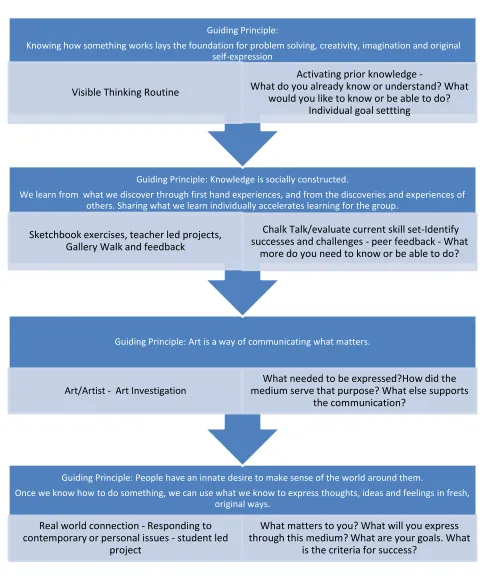
A simple flowchart provides an overview of the structure into which these methods were
woven. Some routines are designed to serve as a pre-assessment and help lead students in setting
personal goals related to the acquisition or advancement of skills and/or knowledge, others
stimulate creative or critical thinking that inspires creative output. These routines were also
useful in determining the teacher-led projects that appropriately challenged students to think and
grow. Other thinking routines and investigations were incorporated as needed to support deeper
understanding, illuminate the cognitive processes that accompany art making endeavors and
support meaning-making. Following several teacher-led projects, students were given the
Figure 1: Framework for Thinking and Creating
Guiding Principle: People have an innate desire to make sense of the world around them.
Once we know how to do something, we can use what we know to express thoughts, ideas and feelings in fresh, original ways.
Real world connection - Responding to contemporary or personal issues - student led
project
What matters to you? What will you express through this medium? What are your goals. What
is the criteria for success? Guiding Principle: Art is a way of communicating what matters.
Art/Artist - Art Investigation
What needed to be expressed?How did the medium serve that purpose? What else supports
the communication? Guiding Principle: Knowledge is socially constructed.
We learn from what we discover through first hand experiences, and from the discoveries and experiences of others. Sharing what we learn individually accelerates learning for the group.
Sketchbook exercises, teacher led projects, Gallery Walk and feedback
Chalk Talk/evaluate current skill set-Identify successes and challenges - peer feedback - What
more do you need to know or be able to do? Guiding Principle:
Knowing how something works lays the foundation for problem solving, creativity, imagination and original self-expression
Visible Thinking Routine
Activating prior knowledge
-What do you already know or understand? -What would you like to know or be able to do?
2. To what extent do these teaching methods, when combined with current methods
(such as goal setting and self-evaluation) help me frame art-making as an intellectual
endeavor and encourage a growth mindset?
Students were guided through substantial conversations and collaboratively constructed flip
charts sparked by Visible Thinking Routines and Art Investigations. The routines were
accompanied by quality examples of meaning making and helped students develop the criteria by
which individual growth was measured. Having determined the criteria for success to their own
satisfaction, students could work and seek guidance or further instruction as individually needed.
Data was collected from several field texts and kept visible in the classroom during the course.
Field texts used for data collection included:
1. Flip charts that record and organize student comments collaboratively
developed during the process of inquiry (visible thinking)
2. Routine voice-recorded observations, reactions and reflections
3. Notes from interactions with students, teachers and other members of the
community that arise naturally during the course of the study.
The overview began as a loose outline of activities that included the guiding principles (cultural
context) that framed connection with students following the process of thinking, responding and
creating (intentional procedural design of High Meadows art curriculum) over the six week
course. Changes in the expected flow, as often occurs in a constructivist environment, were
incorporated in the collection of data and considered a natural part of the documentation and
evaluation process. The analysis of data from my classroom experience was evaluated within the
context of the culture within which I teach and my personal and professional beliefs about