Middle-Secondary Education and Instructional Technology Dissertations
Department of Middle-Secondary Education and Instructional Technology (no new uploads as of Jan. 2015) Summer 8-12-2014
Students' and Teachers' Perceptions of the Engagement of
Students' and Teachers' Perceptions of the Engagement of
Creativity in Secondary Choral Ensemble Classes
Creativity in Secondary Choral Ensemble Classes
David W. Langley Georgia State University
Follow this and additional works at: https://scholarworks.gsu.edu/msit_diss
Recommended Citation Recommended Citation
Langley, David W., "Students' and Teachers' Perceptions of the Engagement of Creativity in Secondary Choral Ensemble Classes." Dissertation, Georgia State University, 2014.
https://scholarworks.gsu.edu/msit_diss/135
This Dissertation is brought to you for free and open access by the Department of Middle-Secondary Education and Instructional Technology (no new uploads as of Jan. 2015) at ScholarWorks @ Georgia State University. It has been accepted for inclusion in Middle-Secondary Education and Instructional Technology Dissertations by an authorized administrator of ScholarWorks @ Georgia State University. For more information, please contact
This dissertation, STUDENTS’ AND TEACHERS’ PERCEPTIONS OF THE ENGAGEMENT OF CREATIVITY IN SECONDARY CHORAL ENSEMBLE CLASSES, by DAVID WAYNE LANGLEY, was prepared under the direction of the candidate’s Dissertation Advisory
Committee. It is accepted by the committee members in partial fulfillment of the requirements for the degree, Doctor of Philosophy, in the College of Education, Georgia State University.
The Dissertation Advisory Committee and the student’s Department Chairperson, as
representatives of the faculty, certify that this dissertation has met all standards of excellence and scholarship as determined by the faculty. The Dean of the College of Education concurs.
_________________________________ ____________________________________ Peggy Albers, Ph.D., Committee Chair Patrick K. Freer, Ed.D., Committee Co-Chair
_________________________________ ____________________________________ Deron Boyles, Ph.D., Committee Member Katie Carlisle, Ph.D., Committee Member
_________________________________ Chris Oshima, Ph.D., Committee Member
_________________________________ Date
________________________________ Dana Fox, Ph.D., Chairperson,
Department of Middle and Secondary Education
________________________________ Paul A. Alberto, Ph.D.
Interim Dean
AUTHOR’S STATEMENT
By presenting this dissertation as a partial fulfillment of the requirements for the advanced degree from Georgia State University, I agree that the library of Georgia State University shall make it available for inspection and circulation in accordance with its regulations governing materials of this type. I agree that permission to quote, to copy from, or to publish this
dissertation may be granted by the professor under whose direction it was written, by the College of Education’s Director of Graduate Studies, or by me. Such quoting, copying, or publishing must be solely for scholarly purposes and will not involve potential financial gain. It is understood that any copying from or publication of this dissertation which involves potential financial gain will not be allowed without my written permission.
NOTICE TO BORROWERS
All dissertations deposited in the Georgia State University library must be used in accordance with the stipulations prescribed by the author in the preceding statement. The author of this dissertation is
David Wayne Langley 787 Vinings Estates Dr.
Mableton, GA 30126
The director of this dissertation is
Dr. Patrick K. Freer School of Music College of Arts and Sciences
CURRICULUM VITAE
David Wayne Langley
ADDRESS: 787 Vinings Estates Drive Mableton, GA 30126
EDUCATION:
Ph.D. 2014 Georgia State University Teaching and Learning M.M.Ed. 2003 University of Georgia
Music Education B.Mus.Ed. 2001 University of Georgia
Music Education
PROFESSIONAL EXPERIENCE:
2003-present Chorus Teacher
Collins Hill High School,
Gwinnett County School System, GA 2006-2009 Adjunct Instructor
Georgia Perimeter College,
University System of Georgia, GA 2001-2003 Music Teacher
Crabapple Crossing Elementary School, Fulton County School System, GA
PROFESSIONAL SOCIETIES AND ORGANIZATIONS
STUDENTS’ AND TEACHERS’ PERCEPTIONS OF THE ENGAGEMENT OF
CREATIVITYIN SECONDARY CHORAL ENSEMBLE CLASSES
by
David Wayne Langley
Under Direction of Patrick K. Freer
ABSTRACT
Findings showed that most students found their chorus class to contain creative activities. They were unable to explain through which activity creativity occurred. Findings from the quantitative survey helped to form a qualitative second phase, including teacher interviews and student focus groups. 2 teachers were interviewed. 2 focus groups were conducted, comprised of 4 students from each of the interviewed teachers (total of 8 students across the 2 focus groups). Qualitative findings suggested that middle school students viewed creativity differently inside chorus than they did in general. This likely came from the influence of their teacher as well as a process-oriented view of creativity. High school students had traditional understandings yet noted that creative activities, like improvisation and composition, were absent from their chorus classes. Teacher participants stated that they felt unconfident in leading such lessons, and were most affected by their undergraduate professors. Implications include additional focus on creativity in undergraduate music teacher preparation programs. This would also address the recent revision of the music education national standards. Further research involving student perceptions of creativity is necessary.
STUDENTS’ AND TEACHERS’ PERCEPTIONS OF THE ENGAGEMENT OF
CREATIVITYIN SECONDARY CHORAL ENSEMBLE CLASSES
by
David Wayne Langley
A Dissertation
Presented in Partial Fulfillment of Requirements for the
Degree of
Doctor of Philosophy
in
Teaching and Learning
in
the Department of Middle and Secondary Education
in
the College of Education Georgia State University
Copyright by David W. Langley
ACKNOWLEDGEMENTS
I simply could not have completed this dissertation without the support, guidance, and encouragement of so many individuals. I would like to express my gratitude to my committee members, friends, and most of all, my family.
Thank you to Patrick Freer. His guidance has helped me to feel confident as a writer, researcher, and music educator. I hope to model my own university teaching after him. Thank you to Peggy Albers for her words of encouragement and for volunteering to chair my
committee. Thanks go to Katie Carlisle for her support during my coursework and on this
committee. Thank you to Chris Oshima who showed me how exciting statistics could be. Finally, thank you to Deron Boyles who, on my very first night of classes at Georgia State, said that he was “here to put the ‘Ph.’ in your Ph. D.” Thank you for your service and insight through my prospectus and dissertation writing.
I would like to thank all of my fellow doctoral students in music education. This was an experience I will never forget, and I am thankful for your friendship. I could not have done it without you all! A special thank you goes to my dear friend and confidante, Paulette Sigler. Thank you for reading over so many papers, drafts and applications along the way.
My family has constantly encouraged me throughout this process. Thank you to my parents, Wayne and Shirley Langley, for keeping me focused on my life goals and supporting them wholeheartedly. Thank you to the Holbrook family for all of your encouragement and love.
TABLE OF CONTENTS
Page
List of Tables……….vi
List of Figures………...vii
Abbreviations………viii
1 INTRODUCTION……….1
Personal Motivations………..3
Historical Justifications………..4
Problem Statement……….5
Theoretical Perspective………..6
Conceptual Perspective………..8
Overview of the Methodology………...9
Significance of the Study………..10
Delimitations………..11
Research Questions………12
Organization of the Study………..12
Definition of Terms………13
2 REVIEW OF LITERATURE………...13
Research in the Cognition and Psychology of Creativity……….15
3 METHODOLOGY………...41
Theoretical Perspective………42
Research Methodology………43
Population and Sample……….44
MCPA Construction……….45
Pilot Study………46
Full Study Quantitative Design………48
Full Study Quantitative Implementation………..50
Full Study Qualitative Design………..51
Full Study Qualitative Implementation………53
4 QUANTITATIVE RESULTS……….55
Student MCPA Results………55
Teacher MCPA Results………...71
Student and Teacher Results Comparison………...78
Conclusions………..82
5 QUALITATIVE RESULTS………82
Introduction………..84
Exposition……….86
Development……….97
6 CONCLUSIONS AND IMPLICATIONS………..110
Summary of the Methods……….110
Conclusions………..111
Implications………..122
Future Research Recommendations……….127
Personal Reflections……….130
References………132
LIST OF TABLES
Table Page
1 Question 2 descriptive statistics……….61
2 Question 3 descriptive statistics……….63
3 Question 4 descriptive statistics……….66
4 Teacher MCPA question 2 descriptive statistics………...73
5 Teacher MCPA question 3 descriptive statistics………...74
6 Teacher MCPA question 4 descriptive statistics………...77
7 Descriptive statistics for question 2; student and teacher comparison…………..79
8 Descriptive statistics for question 3; student and teacher comparison…………..80
LIST OF FIGURES
Figure Page
1 Comparison of original and revised Bloom/Krathwohl taxonomy……...………...8
2 Display of the explanatory sequential design………44
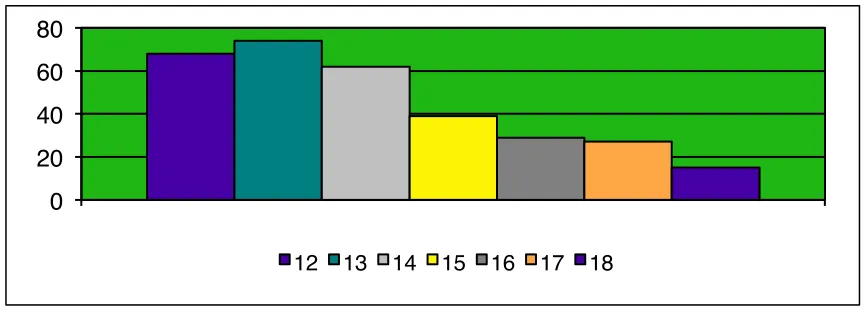
3 Student participants by years of age………..56
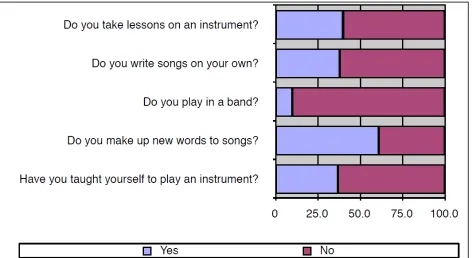
4 Student extracurricular musical activities………..57
ABBREVIATIONS
MCPA Measures of Creativity Perceptions Assessment
NAfME National Association for Music Education
OM Odyssey of the Mind
1 INTRODUCTION
Creative intelligence is looked upon with distrust; the innovations that are the essence of
individuality are feared, and generous impulse is put under bonds not to disturb the peace. Were
art an acknowledged power in human association and not treated as the pleasuring of an idle
moment or as a means of ostentatious display, and were morals understood to be identical with
every aspect of value that is shared in experience, the “problem” of the relation of art and morals
would not exist. (Dewey, 1934, p. 348).
Early music educators championed singing as a healthy activity for the mind, body, and
soul of their students. Initial justifications for including music as a subject of study were based
on the theory of Johann Heinrich Pestalozzi, whose personal motto of education was “learning
by head, hand and heart” (Pestalozzi, Holland, Cooke, Robinson, & Green, 1977).
Performing ensembles have been a central part of music education ideology since the
middle of the twentieth century. Trends such as the band movement and the a cappella choir
movement have caused educators to place an emphasis on precision and uniformity in student
musicians. Yet, through this focus on excellence in public performance, other attributes of an
education in music may have been neglected. Among these forgotten attributes of learning may
be thinking and acting creatively.
Creativity within music is commonly considered to take part in two activities of
music-making: composition and improvisation (Kennedy, 2000). While both activities include creating
new pieces of music or parts within a piece of music, a main difference between the two
concerns the timeframe in which the music is created. Composition is created prior to the
these have been considered the primary forms of creative activities (Kennedy, 2000), creativity
may be possible through many other musical activities, such as performing, conducting, or
interpreting. As outlined in the review of literature later in this text, creativity may be possible
whenever individuals are given an accepting social environment in which to create. That
environment, as created by the choices of the music teacher, is frequently geared towards
mastery performance by the large ensembles of band, chorus, and orchestra.
When the perfection of music for public performance becomes the goal of music
teachers, the resulting instructional methods may become overwhelmingly teacher-centered.
According to Huba and Freed (2000), teacher-centered learning is most characterized by
knowledge transmitted passively from the teacher to the learner. Assessment and learning are
considered separately in this type of environment, as the emphasis is on correct, or convergent,
answers. Applying this style of instruction to a music class, decisions on the interpretation of
music are made almost solely by the teacher. The interpretation of that musical literature
becomes the creation of the teacher and, by inference, the composer--the role of the
student-musician becomes to merely enacting the pre-determined interpretation of the teacher.
Additionally, most of the time in class is spent on convergent activities, such as the type of music
rehearsal described above. Allsup and Benedict (2008) use the term “Fordism” to describe such
styles of teaching, referring to students as workers on a musical assembly line which produces
the latest musical invention of the teacher. The strict definition of teacher-centered learning
seems to contradict the essence of creativity, and this may provide significant information within
the realm of this study.
While still respecting the fine ensemble music that is produced, and the professionals that
teachers regarding the engagement of creativity within music performing ensemble classes. At
the heart of this purpose is the way that students understand the meaning of the term creativity,
and what effects the environment of the classroom and teacher perspectives had on shaping that
understanding. The study may uncover a confusion amongst students of what creative
experiences look like in chorus classes, which will then be further researched to find common
themes and reasoning for this misunderstanding.
Personal Motivations
The motivation for this study came as I began to reflect on creativity within my own early
education. I was involved in numerous educational, religious, and community music ensembles
throughout my childhood, beginning as early as 5 years of age. Reflecting back as an adult, it
occurred to me that of all my experiences, I felt the most creative in an activity called Odyssey of
the Mind (OM), which was not specifically directed towards music. As I reflected on this
experience, I began to consider why I felt that this was such a creative endeavor. The atmosphere
within OM was one of acceptance, empowerment, and equality. By the rules of the event, the
preparation time was to be focused on student ideas with only minimal teacher oversight. This
stipulation allowed for an environment that led to free thinking and collaboration. The teacher
served purely as a facilitator who helped to maintain this environment yet did not control the
activities and thought processes taking place.
This caused me to think: why were these experiences not present in my musical
education? Clearly, my music teachers played an important role in my life, as they have guided
me into the profession. The very reasons that made OM such a creative experience were,
conversely, the reasons that I did not find my music education as creatively stimulating.
seen as an educator. The majority of music ensembles that I have witnessed are teacher-centered.
In many classrooms, all of the musical decisions are dictated by the teacher, and the students are
merely enactors of those decisions.
The goal of this study is to investigate students’ perceptions of creativity and what may
have led to the formation of those perceptions. Methods will be thoroughly discussed later, but
perceptions of students, and their teachers, will be measured in a mixed methods study. This
study will include a quantitative survey instrument and a qualitative phase of teacher interviews
and student focus groups. A more complete understanding of student perceptions may then help
teachers who wish to place more emphasis on creativity within music classes.
Historical Justifications
The history of choral music education in the United States includes rare but important
instances of creativity. For the purposes of this study, creativity within music education will be
defined as “the engagement of the mind in the active, structured process of thinking in sound for
the purpose of producing some product that is new for the creator” (Webster, 2002A, p. 11).
While this definition was chosen for use here, alternatives will be discussed within the review of
literature. In music classes, engagement in creativity most often takes the form of composing
new music, improvising, and arranging existing pieces of music. Early colonial tunebooks were
composed in an improvisatory style until a movement towards European art music dominated
new editions (Kennedy, 2000). Frances Elliott Clark, a prominent music teacher in the early 20th
century and founding member of the Music Supervisors’ National Conference, introduced
composition as a creative outlet for her elementary school choruses (Stoddard, 1968). After the
technical performances through the inspiration of war veterans who became music teachers
(Mark & Gary, 2007).
The 1960s were a time of innovation for music education, and choral performing
ensembles were included in this effort. A major innovation came in the form of the
Comprehensive Musicianship movement. The ideas contained in Comprehensive Musicianship
provided the impetus for the Young Composers Project (Mark & Gary, 2007). Through this
initiative, composers under the age of 35 were placed in local school districts to write music
specifically for the school ensembles. While the project was intended to foster creativity, the
effect was only tangential, as the students only creative stimulation was through performing the
composer-created music (Mark & Gary, 2007).
The Manhattanville Music Curriculum Project, from 1965-1970, was designed to infuse
creative experiences specifically within performing ensembles through the spiral curriculum of
Jerome Brunner (Thomas, 1970). However, the project was not well-received among ensemble
directors. While the structure of the spiral curriculum was widely acknowledged, the creative
portions of the curriculum were not valued. Mark and Gary (2007) stated that the “MMCP was
used in some schools, but the most common usage was the adaptation of its concepts and
strategies for use in traditional music programs,” (p. 444). While many historical instances of
creativity in music ensemble classes exist, the long term effects of such instances has been
negligible (Kennedy, 2000).
Problem Statement
In addition to the historical perspectives discussed, creativity is currently viewed as an
important topic within music education. The issue of including creativity has been addressed
adopted in 1994, in the capacities of composing, arranging, and improvising (NAfME, 2012).A
revised set of National Standards was released in 2014. The realignment created standards as
they fit into four categories of artistic processes; creating, performing, responding, and
connecting. For each artistic process, anchor standards were created which spanned across all
arts curricula. Anchor standards, and the supporting performance standards, are based on student
learning instead of teacher instructional methods (NAfME, 2013). Still, only marginal amounts
of time are focused on these activities within general music classrooms (Orman, 2002, Williams,
2007). Most research has been focused on elementary school music classes (Hickey, 2001,
Kiehn, 2003, Koutsoupidou, 2005, Beegle, 2010), while little is known about the issue within the
middle and high school performing classes of band, chorus, and orchestra. While teachers
overwhelmingly believed that creativity is important (Fairfield, 2010), they still devoted very
little time to using these skills within music classes (Snell, 2012).
The current study explored this topic using a mixed methods research design. Chorus
teachers and their students, at the middle school and high school levels, took part in a
quantitative survey designed to understand the creative activities that happen in chorus classes. A
qualitative phase, using teacher interviews and student focus groups, helped to clarify some
participants’ understanding of the term “creativity.” This study was designed to produce data that
helped to uncover the values of students in regards to creativity. It also related the student data to
the values, intentions, and actions of those students’ teachers. The findings uncovered interesting
relationships between the values of teachers and the actions that their students perceive.
Theoretical Perspective
This study took the form of mixed-methods research, as will be discussed in detail in the
perspective for mixed-methods studies, as it has been the common misconception that
quantitative research must stem from a position on positivism/post-positivism (Crotty, 1998).
However, it is the position of this researcher that mixed-methods research has strongly benefited
from a grounding within one unified perspective for both phases of research.
This study was grounded in the participatory worldview, as outlined by Creswell and
Plano Clark (2011). This perspective was built upon the idea that meaning is neither completely
objective nor completely subjective, but instead a blending of the two. Through this theory, a
sense of pluralism developed within the study, considering those ideas that come from the
consciousness of the participants while also considering their meaning as interpreted by
interaction with the world around them. Tarnas stated that, in this worldview, “meaning is
enacted through the dialectical participation of the human mind with the larger meaning of the
cosmos,” (1993, p. xii).
Applying this perspective to the present study involved comparing student and teacher
perceptions in congruence with their views of the meaning of creativity and the creative process
(Fleith, 2000). This perspective has been especially appropriate as definitions of creativity are
mitigated (Jordanus, 2010). It may be found that teachers had an understanding of what it means
to be creative which differs from that of their students (Fairfield, 2010). This understanding by
teachers may have been influenced by research in the area, and the differing positions found
there (Odena & Welch, 2007). Additionally, theories of the creative process appeared to be
misunderstood (Sawyer, 2000). Theories of the creative process have been defined as actions
taken towards a product that is deemed creative. This misunderstanding by teachers may have
been transferred to the students in music classes, who add their own perspective to the definition
Conceptual Perspective
In 1956, Benjamin Bloom proposed a taxonomy of learning objectives based on
cognition. This hierarchical taxonomy listed the processes of knowledge, comprehension,
application, analysis, and evaluation to denote depth of understanding of a particular field.
This taxonomy was revised in 2002 by Krathwohl, one of Bloom’s former students. The
revised hierarchy replaced the previous categories with remembering, understanding, applying,
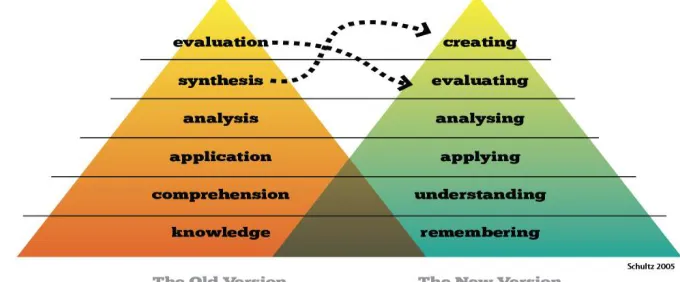
analyzing, evaluating, and creating, as can be seen in Figure 1 below. The extension of Bloom’s
work by Krathwohl has been generally accepted, and has been frequently referenced in articles
featured in leading creativity peer-reviewed journals (Persson, 2010, Kokotsaki, 2011). The
revision firmly placed creativity at the apex of learning. Since creativity has been cited as the
[image:24.612.122.462.398.539.2]highest form of learning, it should have a place at the center of education.
Figure 1. Comparison of original and revised Bloom/Krathwohl taxonomy.
Under this framework, creating of new musical experiences became the highest form of
musicality that students can achieve. It may be that performing music, the focal point of most
choral ensembles, most often ends at the level of applying, defined as “carrying out or using a
then choral students have not received a complete understanding of music, according to
Krathwohl’s taxonomy of cognition. The possibility that choral students may not have consistent
creative opportunities in the classroom, along with the lack of research in this area within choral
classes, is justification for the present study.
Overview of the Methodology
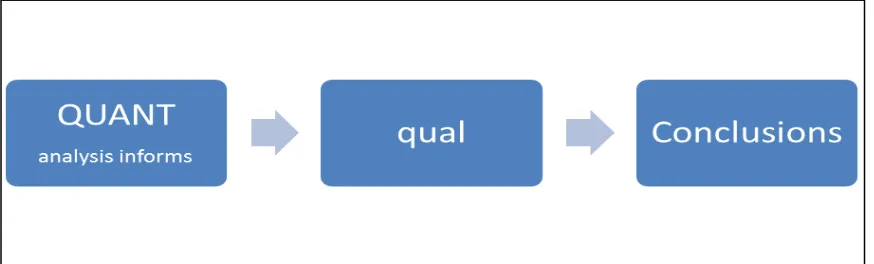
The present research study took the form of a mixed methods design, using the
Explanatory Sequential Design as defined by Creswell and Plano Clark (2011). The population
included both middle- and high-school students who were enrolled in chorus, as well as the
chorus teachers of these students. Data collection took place in two phases; phase one was a
survey instrument resulting in quantitative analysis, and phase two consisted of a follow-up
qualitative step including interviews of the teachers and focus groups of chorus students. The
sample was drawn from eleven participating schools (six middle, five high) from three school
districts.
Data collection began with a survey instrument to measure student and teacher
perceptions of the use of creativity within the choral ensemble classroom. The instrument was
researcher-created and was based upon the work of Phelps, Ferrara, and Goolsby (1993) as well
as Patrick, Turner, Meyer, and Midgley (2003). While the Patrick et al. model was applied to
mathematics students to measure perceptions of avoidance methods, the present survey was
unique in its use of similar questions to measure perceptions of choral music students. The
survey was administered to students (n = 314) as well as teachers (n= 12). Quantitative data
gathered through the Likert scale questions of the survey helped to identify a sample of students
and teachers who were chosen to take part in the qualitative phase. The quantitative phase was
convenience, as it was necessary for the researcher to travel to several schools for the qualitative
phase, which will be conducted in person. Students and teachers from two of the schools which
participated in phase one were selected to continue participation in phase two. Students were
interviewed in focus groups, while teachers were interviewed individually. The design of
questions within both settings were based on the work of Krueger and Casey (2001) and Krueger
(2002), which provided an outline for qualitative research within focus groups.
Each phase of the research was designed to supply a distinct understanding of the topic.
The goal of the quantitative section was to identify perceptions of the teaching environment from
both student and teacher perspectives through the survey instrument. This was achieved as
participants rated their perceptions of the value and activity with creativity in their classroom, as
well as other information about the classroom environment itself. Those viewpoints were
compared and considered when creating questions for the qualitative portion. Questions were
guided by the findings from the quantitative survey instrument. Kreuger (2002) recommended
forming open-ended questions that elicit reflection. Kreuger (2002) also provided a guideline for
opening, introductory, transitional, key, and ending questions, which were adopted in the current
study. The qualitative section allowed the researcher to understand student ideas of what
creativity is, how it has been fostered in their choral classrooms, and how they use it on their
own. Teacher responses to the survey instrument were compared to the student responses. This
study was necessary because of this possible environment and the effect that it may have on
music students.
Significance of the Study
Considering the current bodies of research in creativity, and specifically with music
study. The first is the current gap in research that concerned performing ensembles and
creativity. As stated previously, the bulk of existing research measured the inclusion of creativity
in elementary and/or general music classes. Students in performing ensembles have not been the
focus of most research in this area, and so this study was formed to relieve this concern.
Secondly, the existing research provided a reason for this issue to be considered as a legitimate
issue within performing ensembles. As stated earlier, creativity is included as the highest form of
cognition within a specific domain, here choral music. The consideration that this thinking might
not take place exposed a particular pedagogical deficiency that should be further investigated.
Delimitations
This study is intentionally limited in its scope. The bulk of research in this topic has been
conducted in elementary school or general music class settings. This existing research serves as a
base for the current work. However, it is very likely that the findings of general music studies
might also be found if parallel studies were conducted with older students. While three major
types of ensembles exist (band, chorus, orchestra) in most middle/high schools, this study only
focused on the issue within chorus settings. The study is limited to chorus because that is the area
of expertise of this researcher. Additionally, since the traditions of ensembles have historically
been diverse (Allsup & Benedict, 2008), the compounding variables of those traditions might
have served to invalidate findings. Since the traditions of the choral ensemble are understood by
the researcher, this was chosen as the focus ensemble for this study. Finally, middle school
ensembles were included to incorporate a possible transition between elementary school music to
Research Questions
The purposes of this study were:
1) To explore the individualized meanings of creativity of students within choral
ensembles, and
2) To identify the effects that teachers’ perceptions and classroom environment have on
helping students shape the meaning of creativity.
Organization of the Study
The remainder of this study is organized into five additional chapters, references, and
appendices. Chapter 2 includes a detailed literature review of existing research in the area of
creativity, focusing on discrepancies of meaning, creative process, assessment, and teacher
perceptions that possibly contribute to the issue at hand. Chapter 3 provides an outline of the
research methodology, including reasoning for selecting a mixed methods design. Included in
this chapter will be the sample selection processes, the influences on development of the
assessment instrument, results and recommendations from a pilot study, and procedures for
analysis. Chapter 4 presents the quantitative analysis of results of the survey instrument. Chapter
5 presents findings of the qualitative phase of research, from two teacher interviews and two
focus groups. Chapter 6 contains a conclusive discussion, implications for the field, suggestions
for future research, and the researcher’s personal reflections on this study. A bibliography of
Definition of terms
Creativity: In musical terms, “the engagement of the mind in the active, structured
process of thinking in sound for the purpose of producing some product that is new for the
creator,.” Definition provided by Webster (2002A).
Teacher-Centered Instruction: Paradigm of learning where knowledge is transmitted
from teacher to student, the teacher is primary information provider and evaluator, teaching and
assessing are separate, and emphasis is on the acquisition of knowledge outside of the context in
which it will be used (Huba & Freed, 2000).
MCPA: The Measures of Creativity Perceptions Assessment. The survey instrument
created specifically for this research study. The MCPA measures value of creativity, frequency
of commonly accepted creative activities, and perceptions of classroom environment.
OM: The Odyssey of the Mind program is a creative problem-solving competition for
students in kindergarten through undergraduate programs. It is primarily a team competition,
with a maximum of 8 team members.
2 REVIEW OF LITERATURE
Research in creativity has bloomed in the field of education, and specifically in music
education. Through the beginnings of the field to the present day, varying points of view have
been documented regarding the meaning of the term creativity, perspectives on the creative
process, assessment instruments, and pedagogical qualities of creativity. Stein defined creativity
in 1953 as “a novel work that is accepted as tenable or useful or satisfying by a group at some
point in time,” (p. 311). After this point in history, many studies and much philosophical thought
have been devoted to the role of creativity in the education system, yet researchers are still
instruments are prolific, yet the fundamental question of “how do we accurately measure
creativity?” is still unanswered. There is no consensus among educators on the importance of
creative thinking or its place within the classroom as is evidenced in current debates. The
Partnership for 21st Century Skills, an educational advocacy organization, placed value in
creativity and critical thinking as essential skills, a central structure within the Student Outcomes
and Support Systems (Partnership for 21st Century Skills, 2011). Conversely, as recently as
August of 2012, The Republican Party of Texas stated opposition to “critical thinking skills” in
the official party platform as such skills “have the purpose of challenging the students’ fixed
beliefs…” (Platform Committee, p. 12). The level of uncertainty that surrounds this topic only
further supports the need for additional research, especially research where the outcomes of this
ambiguity affect our students.
While exploring research on creativity, four major themes for exploration emerged. Each
theme contains inconsistencies, and these are explored throughout the chapter. The themes are
organized as follows; a) the meaning of creativity, b) perspectives of the creative process, c)
assessment of musical creativity, and d) educators’ perceptions of creativity. These themes will
be examined through two main sections; Research in the cognition and psychology of creativity,
and research in creativity concerning music education. Common limitations in research between
all themes include empirical research beyond general/elementary music classes and the exclusion
of student perceptions of creativity. Additionally, connections are made involving the balance of
emphasis on process or product, and the inclusion of convergent and divergent thinking.
Because this is not a review of every piece of literature available on the topic, seminal
Investigating these inconsistencies and commonalities in research will begin to reveal support for
a research study into perceptions of teachers and students in secondary choral ensemble classes.
The purpose of this literature review is to critically view the body of work regarding
creativity in education and music education. Current literature supports a view, due to
inconsistencies between studies, that creative activities are underrepresented within music
ensemble courses. This under-representation may affect students, which is cause for additional
research on the matter.
Research in the Cognition and Psychology and Cognition of Creativity
The Meaning of Creativity
Conflicting views of creativity research primarily begin with the meaning of creativity.
Researchers have yet to come to a consensus on exactly what denotes creativity. Historically,
research on the matter shows a revolving meaning, resulting in an even wider range of uses for
the term creativity (Jordanous, 2010). Meanings of creativity diverge based on views of
overarching issues within the field. Through a historical look at varying meanings, this section of
the review serves as a framework to understand the balance of process and product emphasis, as
well as the debate regarding convergent and divergent thinking.
Throughout the literature presented, the debate of emphasis on process or product is very
evident. Both positive and negative aspects are found in definitions regardless of their emphasis.
While process-oriented definitions give the researcher an insight into the cognitive steps needed
for creative thought, product-oriented definitions of creativity are more easily measured.
Conversely, process-orientation is difficult to observe, as product-orientation uses outcomes to
measure the means by which it was reached. However, the distinctions between process and
definitions presented here all fall along that continuum and are not necessarily rooted entirely
within one emphasis.
Within discussions of thought process, researchers have also debated the roles of
divergent and convergent thinking. As research will show, divergent thinking is at the center of
the meaning of creativity (Robinson, 2009). However, some research will support the use of
convergent thinking in a position of validating usefulness.
Representative definitions of creativity are presented here in chronological order. The
reader may note that, simply because meanings are presented chronologically does not
necessarily imply an evolution towards a higher ordered definition in the most recent facsimiles.
Each definition will be critically examined through the framework of process/product emphasis,
role of divergent/convergent thinking, and specific implications for music education.
Early definitions focused on linear stages of the creative process. Wallas (1926) created
an early outline of creativity with a process-oriented emphasis. This outline breaks down the
creative process into four stages; a) preparation, the act of acquiring and combining necessary
skills, b) incubation, thought occurring subconsciously, c) illumination, the moment of
breakthrough, and d) verification, testing the idea for usefulness. While clearly grounded in
process-orientation, Wallas’ final stage of verification provides an introspective view of the
product. Most often, it is the creator him/herself who verifies that the product is both appropriate
and useful. Therefore, the final stage does include an aspect of convergent thinking and product
recognition. However, when considered in music education, Wallas’ stages don’t always apply.
While the musical acts of composition and arranging fit well within this model, improvisation
poses a problem. Since incubation, according to Wallas, occurs during passive thought about the
available for this to occur during musical improvisation. Additionally, verification could only be
used as feedback after the product is complete, as the product is performed at the time of
construction. Although Wallas’ stage theory is flawed when applied to the musical domain, this
work was instrumental in inspiring the work of Guilford (1962).
Following Wallas’ criticisms, there was a reaction against staged models of creative
processes. Guilford (1962, 1967) directly addresses the flaws of the Wallas stage theory in his
model of creativity. Instead of presenting the cognitive process in a linear fashion, Guilford
originally considered 24 divergent processes that in part may contribute to creativity. Eventually,
research narrowed down those processes to four main characteristics of creativity; fluency,
flexibility, novelty, and elaboration. These processes would go on to form the basis for many
assessments of creativity, including Guilford’s own “Tests of Divergent Thinking,” (Guilford,
1967). From the title of this assessment, it is known that Guilford drew distinct separations
between convergent and divergent thinking, claiming that the latter alone was responsible for
creativity. While assessment will be discussed in length later, it should be known that Guilford’s
strict distinctions between convergence and divergence through factor analysis would cause his
assessment, and his definition of creativity, to be discredited. However, the four characteristics
that he presented remain viable, and thus they continue to serve as a foundation for future
research. These characteristics were especially embraced by music educators (Gorder, 1980,
Webster, 1979).
Additional researchers continued to draw criticism for such distinctions between
convergent and divergent thinking. For instance, Crutchfield (1962) defines creativity as “the
opposite of conformity,” (p. 274). Such a stance shows the dominance of the separation of
answers to a specific question, is vital to the creative process, it requires some sort of conformity
to accepted rules of domain. Within the domain of music, some sort of convergence within the
cultural expectations of music is necessary for the listener to define a work as creative (Conrad,
1990). Criticism of Crutchfield is offered by Torrance (1988), viewing “the creative person as
being neither conforming or nonconforming, but as being free to conform or not conform,
depending on what is good, pleasing, and true,” (p.45 ).
The views of Guilford are highly influential in the work of Torrance. Torrance finds that
creativity is in fact linked to 84 personal attributes. However, as a proponent of a
divergent/convergent combination, this definition does not place these attributes within one type
of thinking. While Torrance includes the traits of fluency, flexibility, novelty, and elaboration as
identified by Guilford, he identifies such additional attributes as unusual visualization,
colorfulness of imagery, and element of fantasy. Torrance encourages educators to support and
foster students who display many of these attributes. In order to help identify such students, he
developed the Torrance Tests of Creative Thinking, an assessment tool to be discussed later.
While this measurement tool is still currently in use by researchers, it is often given in tandem
with a domain-specific test of creativity.
The issue of domain-specificity is directly addressed in the work of Csikszentmihalyi
(1996). Through his text, Creativity, Flow, and the Psychology of Discovery and Invention, the
author defines criteria for creativity:
First, it must be domain specific. Second, other members of the field must accept it as
creative and valuable. Lastly, a person must have an act, idea or product that contributes
something new and significant to the existing domain. When all three criteria are met, we
Csikszentmihalyi’s description here provides some insight, but also addresses critical issues.
While the topic of domain-specificity was discussed by Torrance, the issue of social recognition
is a new area for exploration. The idea of value placed by peers or by a group of experts in the
field originally stems from the work of Amabile (1983) and Amabile, Collins, and Phillips
(1996). However, Csikszentmihalyi intertwines this idea with domain specific criteria, providing
an expansion of the definition. In the same text, Csikszentmihalyi advocates for a definition
which includes a combination of convergent and divergent thinking. However, a critical
argument within education is the claim here that one must become fluent in a specific domain in
order to be creative in that domain. Therefore Csikszentmihalyi implies that children are unable
to be creative in the truest sense because they have not yet achieved a level of fluency within the
musical domain.
Various approaches are evident as to the exact meaning of creativity. Additional
understanding may be sought by turning the attention now from the product of creativity to the
actual process through which that product was created.
The Creative Process; A Phenomenological Foundation
Many individuals have sought to understand the creative process through
phenomenology. Merleau-Ponty (1962) describes phenomenology by stating that “in order to see
the world and grasp it as paradoxical, we must break with our familiar acceptance of it,” (p. xiv).
In this perspective, cultural meanings are considered barriers standing in the path of the
unobstructed mind. Phenomenologists seek to view the world not through societal norms and
means, but simply as the objects and experiences placed before the individual, those experiences
Phenomenology suggests that, if we lay aside, as best we can, the prevailing
understandings of those phenomena and revisit our immediate experience of them,
possibilities for new meaning emerge for us or we witness at least an authentication and
enhancement of the former meaning. (p. 78)
Considering this explanation, Merleau-Ponty firmly places the creative process within this
perspective. The process of creativity is perceived as a revolving combination of self, others, and
things (Canatella, 2004). The self assumes two roles, both that of incubator of original thought
and physical creator of the product of that thought. Thus, the self’s thought is formed into an
object. By interacting with the newly created object, the others, or as we sometimes call them in
the arts, patrons, transform the original meaning into a personalized experience. Canatella (2004)
relates this to an artist creating a painting. The artist has a mindfulness of the finished work prior
to any physical creation. The artist then connects the mind and body in the act of creating the
painting. The finished work is then interpreted and transformed by the viewer, who contributes
his/her own meaning to the work. This idea is similar to the thoughts of philosopher Maxine
Greene (1988), who considers such phenomenological views of creativity as democratizing
experiences.
Viewing creativity through the lens of phenomenology involves the consideration of an
individual and his/her created meaning through experience with an object. While this perspective
is valid, the point of view from the philosophical stance of pragmatism takes this perspective one
step further.
John Dewey offers a view of creativity through his pragmatic philosophy, often referred
to as instrumentalism. As opposed to the view of the meaning of experience addressed by
(Sawyer, 2000). Beginning in a standpoint of naturalism, Dewey (1934) claims that experience
begins with an impulsion, or the mind-body’s developing reaction to a stimulus from the
environment. Impulsion only enters the consciousness of the self after meeting with an obstacle,
thus limiting the impulsion. The self must reflect on the obstacle, considering past experiences in
order to find ways to overcome the obstacle. While using these past experiences, the solution to
the obstacle becomes embedded with meaning, and thus the novel solution is considered, in
Dewey’s view, to be creative. It is through this development that the experience of creative
process is initiated.
It is noted that, in the instrumental philosophy of Dewey, expression and creativity must
have a necessary medium in order to carry meaning (Sawyer, 2000). In other words, a domain of
thinking must contain the creation in order for expression to occur (Dewey, 1934). Considering
this artistically, natural sounds or tones do not connote meaning. However, when those sounds
are contained in the recognizable medium of music, then those same tones bring about a level of
meaning for the listener. The Deweyan idea of expression maintains an extended transaction
between the medium and the musical listener, a commonality previously discussed in the
phenomenology of Merleau-Ponty.
While media are necessary for such expression to be perceived, Dewey (1934) cautions
against the over-classification of art forms. The norms and rules associated with such
classifications as cubist art, classical music, or poetic forms only limit the perception of the
consumer and stifle creative thinking within the creator.
Dewey depicts the nature and roots of experience and its journey towards creative
process and not the product in this perspective, which allows for understanding and clarity when
considering the phenomenological views of Merleau-Ponty.
The foundations of experience and its relations to environment have been explained using
phenomenology and instrumentalism. These structures have often been applied as other
individuals have sought to assess the products of the creative process.
Creative Assessment
The literature discussed here suggests that creativity is made up of both divergent and
convergent thought processes that result in the construction of novel and useful products. But the
question that remains is this: to whom is it found to be novel? To whom is it found to be useful?
To be deemed creative, does a product need to meet a universal standard of novelty and
usefulness? According to Kaufman and Beghetto (2009), the answer is a resounding no. In fact,
creativity can be divided into four levels, from “mini-c,” or learning process creativity, to
“Big-C,” or world expert level creativity (Kaufman & Beghetto, p. 2). By structuring different levels
of creativity, Kaufman and Beghetto avoid the issue of overarching standards to which all
persons must strive to adhere. This distinction is both useful and yet confusing when considering
the assessment of creativity. Although it may give a frame of reference, someone functioning on
a “Big-C” creative level might not find the novelty in the work of someone who is only prepared
for a “mini-c” product (Plucker et al., 2009). Further, what may be novel and useful to an
adolescent student might not be met with the same level of interest by a veteran teacher. These
issues drive both historical and current debates in creative assessment.
As definitions of creativity have evolved, so has the issue of measuring creativity.
Assessments are largely speculative and often rely on the conceptions of the assessment creator,
measure domain-specific creative products (Webster,1979) as well as an individual’s general
aptitude for creativity (Torrance, 1974; Guilford, 1962; Amabile et al., 1996). Each measurement
has inherent flaws, such as Guilford’s use of factor analysis to parse convergent and divergent
characteristics (Baron & Harington, 1981). This is especially true when considered in the
structure provided by Kaufman and Beghetto (2009). While measurements of creative products
can be detrimental to a student’s motivation to continue creating, they must also provide much
needed support by offering loose structure and providing constructive feedback (Beghetto,
2005).
Assessments with music education will be scrutinized using these two requirements from
Beghetto (2005) as well as the four levels from Kaufman and Beghetto (2009) when the music
education section is presented. To complete the psychological topics within creativity, attention
will now turn to the topic of perceptions of creativity by teachers.
Teacher Perceptions of Creativity
Teacher perceptions of what creative activities look like in a classroom serve as another
point of tension in the field. This is not a new issue for education in general (Treffinger et al.,
1968). Themes from research appear to point towards a disconnect between teachers’
understanding of creativity and the application of creativity within the classroom. Thus, the
inability to accurately define and assess creativity has caused teacher perceptions of creativity to
become biased. However, Robinson (2009) reminds us that there are two types of creative
teaching; 1) the teaching of skills related to creativity and 2) the teaching of personal creativity
(p. 24).
Teachers in classrooms where creativity seemed to flourish found that certain
performed a qualitative study with three teachers who perceived themselves as encouraging
creativity in their students. Through interviews with these teachers, Pelfrey (2011) found that
using techniques such as encouraging collaboration, student choice, imagination, and creating a
risk-free environment fostered creative activity amongst their students. While these techniques
may be used as a framework, generalizability of the claims of just three teachers is not sound.
However, it should be noted that the techniques identified were primarily student-centered,
which may intimidate some teachers who prefer a traditional environment with the teacher as the
center of learning. In fact, those teachers who are only comfortable with teacher-centered
environments may perceive the identified creative characteristics as defiant and disobedient.
General education teachers were most likely to name creative students as their least
favorites. Two studies from the 1990s began a line of inquiry studying teachers’ perceptions of
characteristics of students. Westby and Dawson (1990) reported that teachers found those
students with creative characteristics such as novelty and uniqueness to be among their least
favorite students. Conversely, those with noncreative characteristics were found to be among
most teachers’ favorite students. Although the same teachers were shown to value creativity in
general, their perceptions towards students embodying that creativity were quite the opposite. It
would appear from these results that something within the mindset of the teacher caused the
outward and inward views of creativity to become disjunctive. A possible cause is found in what
characteristics the teachers favored in students, which includes acts of conformity and obedience.
The value of creative thinking shifts at some point in the early career of an educator.
Scott (1999) surveyed both college students and in-service teachers on characteristics that were
similar to the Westby and Dawson (1995) study. Findings showed that college students valued
concluded from these findings that opinions between pre-service and in-service teachers may
change once their focus changes to maintaining a teacher-centered, orderly classroom. Further
studies in this area might reveal the early-service teacher’s focus on classroom management.
Studies by Westby and Dawson (1995) and Scott (1999) were performed using elementary
classroom teachers as participants, therefore to generalize these findings outside of that group
would be unfounded. However, this line of inquiry shows merit and could be applied to
secondary or subject-specific teachers. For instance, one may wonder if the results would be
similar if replicated in a performing arts classroom.
Recent studies have shown an outgrowth of perceptions of creativity into other areas of
education. In 2005, Beghetto surveyed middle and secondary teachers on the contributions of
students in classroom discussions. While the teachers later stated that they valued creativity in
their classrooms, Beghetto (2005) found that these same teachers discouraged novel and unique
responses during discussions. Yet again, findings point towards a dichotomous relationship
between what teachers think about creativity and what they allow in their classrooms.
The most supportive evidence for bias against creativity comes from Mueller et al.
(2011), showing that this bias goes beyond just the classroom. While we have seen that a creative
product needs both a sense of novelty and practicality, a survey by Mueller et al. (2011) showed
that these characteristics were seen as diametrically opposed. These findings clearly show that
individuals’ outward expressions about creativity are very different than their feelings about the
characteristics that make up creativity. Mueller et al. (2011) goes as far as comparing this
phenomenon to similar views on race, gender, and age bias. Mueller et al. goes on to write:
“Because there is such a strong social norm to endorse creativity, and people
to admit that they do not want creativity; hence, the bias against creativity may be
particularly slippery to diagnose.” (p. 16)
The findings here, and throughout general education, influence research towards applying
these structures towards music education, and in particular to the middle/secondary ensemble
paradigm.
Research Concerning Creativity in Music Education
Meaning of Creativity in Music Education
With the introduction of domain-specificity as described in psychological topics in
creativity, Webster (2002A) introduced a definition of musical creativity as “the engagement of
the mind in the active, structured process of thinking in sound for the purpose of producing some
product that is new for the creator”(p. 11). Webster implicitly connects the three main themes of
this discussion to the domain of music education through this definition. Contained in the
definition is the possibility for both convergent and divergent thinking providing that they are
“active” and “structured.” Webster mentions democratically both the process and product. There
is also recognition and verification of the product and process by the creator him/herself. While
this is the most complete definition thus far, it may be considered too broad and vague for some
critics.
The development of a clear definition of creativity is clearly an ongoing inquiry. This
review is limited in scope, as there are endless views on this subject. However, consider this
development from the point of view of an educator. The educator might try to encourage
creativity in his/her classroom, but how does one see these definitions provided in action? How
does one choose which brand of creativity they believe is occurring, or can occur, within a grade
inability to define creativity beyond characteristics, inclusion and exclusion statements, and
qualifiers has eluded researchers to this point. In fact, Webster (1990) states that the term
creativity has become so misused that we should abandon the use of the term, alternatively using
the term “creative thinking.” This disagreement in use of terms, and especially in the fact that
there can be convergent thinking involved, has caused confusion within the field.
Researchers have continued the debate over the definition of creativity as attention is
turned to how to measure creativity. However, discussions of the creative process have been
addressed from angles outside of psychology. The phenomenological approaches, as previously
discussed, will now be applied to music education.
Phenomenology of Creativity in Music Education
Researchers have used various approaches in parsing the elements of the creative process.
While some have analyzed the experiences of thinking creatively and concluded general themes,
others have investigated the process holistically and in conjunction with the harboring
environment.
The measurements of creativity have long been explored. While domain-specific and
domain-general assessments have been designed, many share a commonality of tools; fluency,
flexibility, originality, and elaboration. These tools have been applied within music, notably by
Webster (1991). In this measurement, fluency is defined as the volume of responses to a certain
musical stimulus. Flexibility is measured as the volume of different responses. Originality is
determined by the uniqueness of each response, and elaboration is defined as the detail or depth
of a response. In Webster’s definitions, it is difficult to separate the tools of flexibility and
originality. However, it may be that Webster (1991) intends flexibility to simply mean a wide
may be seen as an unexpected response. Considering this theory within Dewey’s
instrumentalism, one might consider flexibility as an alternate way to overcoming obstacles,
while originality is perceived as different outcomes than those expected given the culture and
experience of the creator.
While the tools as applied by Webster (1991) are useful in measuring the product of
creative thinking, such thinking only takes place given certain parameters and qualifications.
Amabile et al.(1996) states that these tools are actually general creativity skills. These skills
alone could not produce creative products. It is also necessary for the creative individual to have
domain-specific knowledge and skills, upon which new ideas may be formed. Additionally,
Amabile et al. (1996) stresses the importance of outside influences, such as social environment
and motivation, a characteristic of instrumentalism. Without all of these factors, creativity is
unlikely to occur.
In applying the work of Webster and Amabile, practical implications for music education
may begin to form. It is the role of the teacher to establish a learning environment that values and
respects creative thinking, to provide instructional experiences that provide domain-specific
skills, and to foster motivation for such creative thinking. Only after the role of the teacher is
accomplished are students empowered and motivated to think creatively and apply the tools of
fluency, flexibility, originality and elaboration to produce a creative product. This approach has
been most successfully adapted and applied in the work of Hickey (2003) when considering
composition in music classrooms.
Additional applications of the work of Amabile et al. (1996) and Hickey (2003) are
evident in the work of Wiggins (2002). It is found in this research that social implications are
involving group composition, Wiggins (2002) found that the creative process is highly
influenced as individuals within the group contribute their own perspectives and musical
experiences. The individualized meanings of each group member interact with the overall
dynamic of the compositional product, thus creating a mixture of the musical identities of the
group. In other works, this process is defined as “parallel composing,” (Glover, 2000), and is a
classic example of Merleau-Ponty’s combination of self-object-others influences.
Similar evidence to parallel composing is found in the case study research of Barrett
(1996). Young children were asked to use invented notation to show their musical play, and the
children were asked to verbally explain their thought processes as they occurred. The findings
showed that creative thinking was in fact not a linear process. Students moved through different
phases of creativity in a nonlinear fashion, and often went back to earlier steps to refine or revise
their previous ideas. The findings of Barrett (1996) are in opposition to the hierarchical, linear
model as developed by Swanwick and Tillman (1986). The latter study showed that musical
creativity in children and adolescents showed a direct relation to age, and appear to closely align
with the developmental approach of Piaget’s stage theory. Both Merleau-Ponty and Dewey seem
to provide support for non-linear thinking in the creative process. Music educators teaching
secondary ensemble classes may or may not be supportive of nonlinear creative processes. The
historical traditions of the rigorous, convergent choir class working in unison do not support
nonlinear thinking. Considering this, the discussion now turns towards the use of this process in
music classrooms through improvisation and composition as prime outlets for musical creativity.
Outlets for Musical Creativity
Discussions of creativity within music generally seem to center around two primary
discussed as creative activity. However, improvising and composing are commonly viewed as
two separate and distinct activities, and both are distinguished from rehearsed performance.
Research through the lenses of phenomenology and ethnomusicology provide differing opinions
from this common conception.
Burnard (2000) interviewed several students regarding their musical backgrounds, asking
them to identify moments of creativity. Findings indicated that teacher perceptions and
pre-constructed ideas regarding composition and improvisation were highly influential of the
creative environment. Interviews with students also revealed a deep connection between the
experiences of improvising and composing within each student’s mind. Burnard (2000)
concluded that both were the end result of creative thinking through a continuous yet cyclical
thought process. The difference in that thought process between the two activities was only
apparent in the lack of “time away” in improvisation, as this is not possible in that performance
practice since creation and performance occur instantaneously. The model presented by Burnard
is distinct from the revised model of Webster (2002B), in that the time-dependent element is
considered optional in the Burnard process, thus accommodating improvisatory activities.
Burnard (2000) presented the idea that improvisation, although an ends in itself, could be
considered a step within composition. The author asserts, through this assumption, that these two
activities are deeply connected through intention. Such a combining of domains is evidence of
the influence from instrumentalism. Evidence from an ethnomusicological standpoint will be
now addressed to support this assumption
Ethnomusicological Impact
Ethnomusicologists have often dealt with the connection between creative activities and
composing and improvising, and directly affects their roles within performance (Blacking, 1973).
In many cultures, there are no specific words to define creative musical activities from
performance activities. This is most evident in cultures where written notation and music-reading
are not evident or pertinent to performance. While these roles differ by culture, Campbell (2002)
states that one might look towards the musical play of children to locate a connection.
According to Campbell (2002), children of all cultures often take part in musical play. In
this type of play, the actions of creating, revising, and performing are melded into one. Songs
may appear in various forms, may be stored and repeated at different times, and may be altered
to meet the experiences of the moment. It is through this musical play that children begin to
develop creative thinking in music. However, applying this back to formal music education, this
form of learning is often overlooked or omitted. Additionally, major distinctions between
activities are created by teacher’s perceptions of creativity, thus causing an uninviting
environment. Improvisation, and thus composition, may be affected more by culture as the child
grows older and deals with more sophisticated musical structures.
The studies previously discussed have shown that musical play in children is formed by
the cultural environment, and forms “ritualized” or “improvisational” performances (Nettl,
1974). However, as children grow in age and musical maturity, they begin to interact with the
traditional, mature music of their culture. This interaction affects the student musician’s ability to
improvise. Nettl (1974) describes some music meant for improvisation as more dense than
others. For instance, the Western art music basis for improvisation, the figured bass of Baroque
music, is highly dense and thus produces similar improvisatory outcomes. However, some music