English Theses Department of English
Fall 8-20-2013
Cyborg in the Mirror: Embodiment in Video Games
Cyborg in the Mirror: Embodiment in Video Games
Andrea Judy
Georgia State University
Follow this and additional works at: https://scholarworks.gsu.edu/english_theses
Recommended Citation Recommended Citation
Judy, Andrea, "Cyborg in the Mirror: Embodiment in Video Games." Thesis, Georgia State University, 2013. https://scholarworks.gsu.edu/english_theses/157
This Thesis is brought to you for free and open access by the Department of English at ScholarWorks @ Georgia State University. It has been accepted for inclusion in English Theses by an authorized administrator of
by
ANDREA JUDY
Under the Direction of Mary Hocks
ABSTRACT
The Kinect will be the primary focus of this thesis about the process of
embodi-ment while interacting with video games of a third person perspective. The Kinect
serves as a mirror to reflect back a cyborg identity on the screen that the player
embod-ies.
by
ANDREA JUDY
A Thesis Submitted in Partial Fulfillment of the Requirements for the Degree of
Master’s of Arts
in the College of Arts and Sciences
Georgia State University
Copyright by Andrea Judy
by
ANDREA JUDY
Committee Chair: Mary Hocks
Committee: Ashley Holmes
Michael Harker
Electronic Version Approved:
Office of Graduate Studies
College of Arts and Sciences
Georgia State University
DEDICATION
ACKNOWLEDGEMENTS
I would like to thank several people. I would like to thank my family for their love
and support. I would like to thank Dr. Mary Hocks for all of her help and direction during
the duration of this project. I would also like to thank Dr. Michael Harker, and Dr. Ashley
TABLE OF CONTENTS
ACKNOWLEDGEMENTS ... v
1 INTRODUCTION ... 1
1.1 PURPOSE OF STUDY ... 2
2 LITERATURE REVIEW ... 13
2.1 DUAL IDENTITIES IN VIDEO GAMES ... 15
2.2 MATERIALITY ... 273
2.3 VISUAL RHETORIC ... 30
3 AN EXAMINATION OF KINECT STAR WARS Error! Bookmark not defined.7 3.1ANALYSIS ... 5Error! Bookmark not defined. 4 CONCLUSIONS ... 63
LIST OF FIGURES
Figure 1.1 Kinect Star Wars Cover ... 37
Figure 1.2 Start Screen ... 39
Figure 1.3 Choose Character Screen ... 40
Figure 1.4 Tutorial ... 42
Figure 1.5 Defend Yourself ... 43
Figure 1.6 Jump ... 45
Figure 1.7 Dance-Vadar ... 47
Figure 1.8 Dance Han Solo ... 48
Figure 1.9 Dance Leia ... 49
Figure 1.10 Dance Women 01 ... 49
Figure 1.11 Dance Women 02 ... 50
Figure 1.12 Smash ... 51
Figure 1.13 Racing First Person ... 52
1 INTRODUCTION
The connection between the physical body and identity is often overlooked in
current studies of identity in the digital age. This is especially true in the field of video
game studies where the game controller interfaces have evolved to be more physically
driven by the body of the player, but the research available does not reflect this change.
Games are becoming more physically tied to the player, the umbilical cord
con-necting gamer and virtual space is fading away to wireless connections or connections
created through sophisticated cameras and interactive interfaces. The rise of such
vir-tual connections can be seen in the Kinect system on the Xbox 360 where the player is
connected to game system not by any cords but by a camera that tracks and processes
the player’s movements and translates it into the space of the game in live time. This
particular system, The Kinect, is what this thesis focuses on, looking at the mirror of
dig-ital identity in video games. The more active, material participation of the body positions
the Xbox Kinect video game system as a mirror that reflects back an identity of the
player that is a hybrid of physical, material, and digital: a cyborg.
The unique position of video games as an interactive medium that is engaged
with and through various physical means allows for it to be particularly well studied. The
player interacts with the controller (or becomes the controller) and finds a digital
reflec-tion of his or herself on the screen. This new mirror allows for a false identity, a merging
of digital and physical to come into existence. The cyborg allows the player to be both
identities blur together in a new way born in the digital realm that has risen over the last
decade in particular with the prominence of interactive controllers like the Kinect.
1.1 Purpose of the Study
Since the Kinect has only been out for the Xbox 360 since 2010, it is still a very
new medium that is only now being discussed in scholarship. The system has been
widely successful, holding a place in the Guinness Book of World Records as the
"fast-est selling consumer electronics device" after selling a total of 8 million units within its
first 60 days on the market. It is also the first game element that does not require any
wires or controllers on the player to interact with the system. As the slogan for the
Ki-nect says, “You are the controller.”
The primary focus of this is thesis will be how digital space is innately tied to the
physical in connection to the Kinect video game system. A player is only capable of
be-ing on the computer or game system for as long as his or her body allows, and he or
she can only complete the video games that his or her skills are honed to. While these
digital spaces let the player do things he or she could otherwise not do, like slay a
drag-on or catch an NFL pass, he or she still must interact with them physically to complete
these tasks. The seemingly limitless nature of digital spaces is still innately controlled
by physical limits. Despite entering into this boundless realm, our bodies still dictate our
access, and should not be disregarded as a crucial aspect of identity.
As these new physically driven game systems rise, the need for study also
in-creases. The constant shift and change in the digital field leads to a constant struggle to
con-tinues to grow on a daily basis. There are many aspects of video games that could be
studied and carefully examined, so to keep the scope of this project at a manageable
level, this thesis will be focusing strictly on the Kinect, particularly the Star Wars Kinect
game, played in a single player, non-online capacity.
This idea of putting the control in the hands of the player is something that is a
unique experience to games. There is an element of change to every play of the game.
Games are not film, novels, websites, blogs or any other form of multimedia. They
inter-act very differently with their audience, and must be looked at separately. Video games
are also a relatively young medium, having only grown into popularity within the last
40-50 years, and, have only recently become their own field of studies within the academic
community. Video Game Studies continues to grow in the academic community, taking
theories from several other fields like rhetoric, visual studies, literary theory, and
com-puter science theories. Amongst the field there is still debate on how best to accurately
define what is a game, and why we engage in them.
To define games one must look at several aspects to clarify the purpose and
reach a cohesive explanation of what is a game. Games are generally viewed to play for
the purpose of fun, relaxation, and as a means to engage with culture at large. Johan
Huzinga came up with the idea of the magic circle relating to games. When the player
enters the magic circle it creates a division between the player and the real world and
draws them into a space with alternate rules and requirements. However, this ‘magic
circle’ also can apply to other events like birthdays, weddings, job interviews, etc. where
the rules are different from those of the everyday world. It also is impossible to say that
time, behavior, mood, and the fact that some items gained in a virtual space (say an
online account or a rare item) can be sold for real money.
Another definition comes from Rollings who described a game as, “…a series of
interesting choices.” This definition also applies to multiple venues, not just virtual
games, but brings in the important aspect of choice. Choice is one of the main areas
where a game differs drastically from a book, movie and comic book. There is an
inter-active aspect of choice and control in the hands of the player. However, this definition
focuses more on the textual and play aspects of the game than on the interface tying
the player and the game together, and that does not aid in this discussion.
Games vary widely in their story in the narrative aspects, and the actual narrative
of the games will not be looked at in detail, even though the style of interaction can vary
based on the game’s narrative arc. Some games are very linear with a set task that
must be accomplished in a specific way, with an assigned avatar (a character that
rep-resents the player in the game space) and a very limited path must be taken. Others
al-low for creation of the avatar and leave the world wide-open for a player to choose
vari-ous options and create their own path. However, this thesis will focus on the interaction
between player and interface, not the relationship between the player or the interface
and the narrative text of the game.
Several other writers and philosophers have worked on defining what a game is.
Roger Caillois claimed, in his 1958 book, Man, Play and Games, that 4 essential
quali-ties must exist for something to count as ‘play.’ Those things are as follows: must be
(45). These, however, applied mainly to non-virtual based games and will not serve the
purpose of this thesis.
The definition this thesis will use is from Natkin who states that a game is “…an
interactive audiovisual work whose primary aim is to entertain and which uses for its
im-plementation a machine-based or computer technology. (Natkin 2 Video Games and
Interactive Media). The inclusion of a machine is a crucial element of the video game
and is one of the main components to be considered in this thesis. The computer
(sys-tem used to play the video game) plays a huge role because the machine manages the
universe of the game, applies the rules, and creates the interface that connects the
player and the game. This interface is the focus of the thesis and in order to keep that
focus, this definition best applies.
The audiovisual aspect of the game combined with the interface work together
with the interface to draw the player into the machine-created world. These aspects
must function with and through the player to create the digital identity of the cyborg and
allow the player to become immersed in this virtual space. The interface of the game
must allow the player to enter into the digital world and embrace this virtual space. The
game system itself serves as the portal connecting the two realms: the digital and the
physical identity.
Identity, answering the age-old question of “Who am I?” is not an easy thing to
define or explain, and it serves as a key role in the discussions presented in this thesis.
I follow the definition presented by Foss, Foss and Trapp who explain:
Individuals form selves or identities through various properties or
friends, activities, beliefs, and values. As they ally themselves with various
properties or substances, they share substance with whatever or
whom-ever they associate and simultaneously define themselves against or
sep-arate themselves from others with whom they choose not to identify. (192)
This definition shows exactly how closely the internal and external worlds are
connected in the self and the fluid nature of identity. There is not a single, constant
an-swer to the question of identity, but a constantly evolving and expanding self. The
inter-nal and exterinter-nal world work together and are not mutually exclusive. They very closely
intertwine and work together and through one another. Identity is not concrete and
sta-ble, but shifts and changes over time and place.
Embodiment is often used in several different ways so to clarify what this thesis
means by the term I am going to use Waskul’s definition, “…the term ‘embodiment’
re-fers quite precisely to the process by which the object-body is actively experienced,
produced, sustained and/or transformed as a subject-body” (3). The shift of body from
object to subject is what creates this action. The body goes from being the object, the
thing that is doing the observing, to the subject, the thing that is being observed. Video
games shift what the body is viewed as, and how it is regarded since the video game
changes the body’s representation and allows it to not just be controlled, but to be fully
observed on the screen in the idealized form of an avatar who mirrors the player’s
ac-tions in real time.
In order to tie these varying topics and ideas together, I will use the definition of
rhetoric provided by Condit, who argues, “Human beings are bodies that have
with each other. Therefore, rhetoric might be defined as theories of symbolic
interac-tions among human bodies” (Condit 107). This definition generates a connection
be-tween human bodies and their identity, and looks at the relationship bebe-tween them.
Ty-ing these topics together requires lookTy-ing at several different schools of thought and
concepts from multiple disciplines, but rhetoric ties together these topics by using
sym-bolic interactions through interfaces among bodies, both physical and material.
The game becomes a blending of physical and virtual, of reality and fantasy, or
human and digital. The video games create a cyborg identity as we use the medium to
extend ourselves. Donna Haraway provides the definition of cyborg that this thesis will
be using. She defines a cyborg as “a cybernetic organism, a hybrid of machine and
or-ganism, a creature of social reality as well as a creature of fiction” (117). The cyborg is a
blurred binary of opposites coming together into a new creature that exists in our
mod-ern society. As binaries blur together, more and more cyborgs appear. The character’s
body becomes our body and we physically control those reactions. When the Kinect
captures the movements of our physical body and reflects them on the screen, we see
the cyborg reflection in the screen.
Identity within video game spaces is a new field to the realm of academic study,
particularly in regards to the newer game systems that are available. The player and
system work together, and “The human responds to the machine and the machine
re-sponds to the human in a feedback mechanism, where the organic and the inorganic
are in constant communication with each other” (Nayar 77). Game systems, unlike
mov-ies or other narratives, require physical participation from the observer. Even if that
player and the game that communication constantly takes place through. The player
provides the information needed for the Kinect to birth a new identity on the screen; the
avatar contains the movements of the player, but the shape of the virtual. There is a
deep collaborative process between the two to create a new reflection of the player that
is both organic and inorganic, machine, and human, a cyborg identity. Through the
un-ion of the physical and the digital, a new cyborg identity is born on the screen, without
input from both the material and the virtual; this blurred reflection could not come into
creation.
Particularly in video games, this constant feedback loop continually supplies the
connection between physical and digital. By requiring the player’s interaction with the
screen through physical means, the game interface continuously is reconnecting the
player and game to the point where the identity of the avatar on screen and the physical
body begin to blur into one identity reflected on the screen.
Many players refer to their game avatars as “me”; this is explained by Clark and
Chalmer’s concept of the “extended mind”, which argues that humans have become
skilled at using things within the world around us to extend ourselves (Crawford 84).
This extension leads the player to see the reflection on the screen as a unified version
of his or her identity. The prop of the video game console extends our identity because
of our bodily connection to it.
The interface of the Kinect encourages a blurring of the line between virtual and
physical. The movements of the physical body are translated to the virtual screen in real
time; the player interacts with the intangible world of the game at the same rate that he
of the player on the screen that the player engages with as though it were a physical
presence.
This includes taking the physical action such as jumping, kicking, dancing, or
try-ing to block attacks with one’s own body reacttry-ing in real time to the game. The
instanta-neous connection between player and digital world is one of the aspects that makes this
link so strong. The player watches, reacts, and responds to the digital world in the same
instant that he or she would to the physical world around the player. This makes the
connection to the game that much stronger as compared to the original style video
games where the player responds by pressing a button as opposed to responding with
the whole body.
The Kinect changes the way that the player interacts with the digital world around
him or her. The third person perspective creates the illusion of the mirror image being
reflected back and is what this thesis will focus on. Many games utilize the first person
point of view where the game literally puts the player as the controller by playing the
game through the perspective of the avatar. This one forces the player to become the
avatar and to embrace themselves as the avatar; however, most of these games shift
from first person to third person perspective when dramatic moments happen. These
moments are generally portrayed in a cinematic scene that cannot be interacted with.
These scenes often take players out of the moment of being the character because
there is a dramatic shift between being the avatar and seeing the avatar reflected back
to them. For the purpose of this thesis I will focus on games that utilize a third person
perspective throughout the game play rather than discussing both first person and third
almost exclusively takes place in the third person where the entire body of the avatar is
visible on screen during most moments of the game, rather than a constant shifting from
a third-person to a first-person perspective. This allows for me to focus more exclusively
on the avatar as a cyborg reflection of the physical body on the screen.
The player takes on the role of these virtual characters and uses them as a
digi-tal “surrogate mind and body” (Gee 258). The character that is played within the game
space is both the player and the machine. They become a blended binary guided by the
interface of the game where the player can dictate the actions of the character through
a series of physical movements. The player begins to blur the lines between their digital
identity reflected on the screen of the game and their physical body. Their physical
movements are recreated in a whole body reflection on the screen that allows for a
sense of unification that is not possible without this reflection. Since a human cannot
watch him or herself move, the digital reflection becomes accepted as the whole self
and as an accurate representation of one’s self.
This physical connection and involvement is often overlooked in the field of video
game studies, and there have been several calls for the return of the physical to the
field of gaming. Emma Westecoot in particular argues that the body must be more
closely examined in game studies. She explains:
…video gameplay requires physical input and response, whether
holding and manipulating a game pad, swinging a Wii mote, or a
PlayStation Move controller or the physical movements of a gamer in front
of an Xbox Kinect sensor... It is also the video gamer, through the
physically master though learned and repeated actions. In fact, the Kinect
and similar technologies make the body more obviously central to play. In
turn, video gameplay can have an effect on our bodies, such as causing
sweaty palms, aching muscles or eyestrain from repeated play. (3)
To try to tease apart the body and video games is to try to pull apart the player
and the game. The player’s physical involvement with the game is what ties him or her
into the video game, what blurs the lines between machine and human. This physical
connection is what lends itself to the reflective nature of the game. The screen serves
as a mirror reflecting the player’s movements, whether it be by the pressing of a button
to create a kick or the physical act of kicking to create a kick on screen. The player’s
movement is what creates the identity on screen, without the physical connection there
is no reflection.
Within video game studies there is a lack of focus on the materiality behind the
games, and the importance that the physical body plays in relation to the connection
be-tween player and avatar. With this thesis, I am hoping to begin to rectify this problem
within the scholarship and encourage future studies that focus on the materiality within
the video game fields, and how the controller, body, and physical space around the
player inform the virtual world within the video game community. Due to space
limita-tions of this thesis, I will use some materiality theories, and discuss the role of the body
in Kinect video games, but the primary focus will remain on the interaction of physical
and digital identity, in the future I hope to do more studies that delve further into the
Video games, particularly the Kinect system, force the boundaries to blend
fur-ther than most ofur-ther electronic involvements because it replicates the body and reflects
it back in a totally virtual space. While typing on a keyboard, I can still clearly see my
own hands moving, and watch both them and the words they are creating, however,
with the Kinect, I cannot both watch my entire body move and watch the digital
reflec-tion. I watch the reflection to see what my body has done: the reflection becomes the
cyborg on the screen, and becomes, during the duration of the game, the representation
of the player’s identity. The avatar merges to become both player and character, a
combination of data and muscles that moves and bends and reacts physically to threats
and events in the virtual space. The two become intertwined and indistinguishable from
one another while the player is involved in the world of the game.
This creates a new way for the player to engage with the world around him or
her. Through the lens of the Kinect the player becomes both audience and creator.
Emma Westecott, in her article “The Player Characters as Performing Object” discusses
the dual action of being player and creator by explaining her interactions with the act of
playing a game, “A doubling happens in this action, between the physical movements
on the controller and the representation of agency on screen. As a player I act, then
watch the results of my action on screen, always already audience to my own play
prac-tice” (1). They can both observe and participate in the world around them, create the
actions, and observe them in a way that is not possible in their daily life where one is
either the audience or the actor; they cannot observe the actions of their body from an
outsider’s perspective. However, through the lens of the game, they can suddenly view
play-er is always audience to hplay-er own play act” (Westecott 1). The playplay-er always is able to
watch his or her own reflection on the screen and interact with the digital space of the
game. The reflection becomes the digital self, a cyborg on the screen. Here the player
becomes both the object and the subject of his or her own gaze.
In this digital world, bodies are limitless and powerful far beyond the normal
range. In this world, the player can wield swords, cross roaring rivers, and escape from
a haunted manor all with a few movements. While some games record the movements
of the body exactly, there are others that use the basic body movements to create
something dramatic and that would not be physically possible by most players of the
game. The game translates those movements into some far beyond the physical of the
body. It extends not just the reach of the body, but the power behind it and that is a truly
intoxicating experience for the player. They become something more than just a human
2 LITERATURE REVIEW
While other game systems use wireless controllers, the Kinect uses the body,
without any sort of external controller as the control for the system. It is simply the body
making and shaping the world of the game. There is no electronic attachment placed to
the body, no outside force that must be acted upon. There is a camera, a panoptic
watcher that sees, records, and translates every movement into the space of the digital.
It is through the lens of the Kinect that the body becomes a cyborg reflection. The
inter-face of the Kinect is what so successfully completes this transformation and is what the
focus of this thesis, rather than the narrative texts of a game or the concept of video
games as a whole.
The physical form of the object that we engage with holds a critical purpose in
the way we interact with it. The material shape of the world we engage with serves a
critical purpose, Looy, while looking at Walton's ideas examines the way that the
pur-pose of the material object changes the way we perceive it when he states:
From Walton’s perspective, all three works are designed with a similar
purpose in mind, i.e. to evoke imagining. As such, they anticipate their
own use and provide a role for the person engaging with them. This
im-plicit role manifests itself in the object’s material characteristics – e.g. the
size of the book, the number of frames per second for the film or the
con-trols for the game – and in its content. (62)
The size and shape of the object, like a book, effect how it is viewed and
inter-acted with. The shape and size of a video game controller changes how it is held and
Mote is a long, slender object that is held in one hand and used mostly by swinging the
object like a sword or a tennis racket, or to point towards a specific object on the screen;
the PlayStation Move is built, and used in a similar manner. Before the release of the
Kinect, the Xbox 360 controller is made to be held by two hands, and required multiple
buttons, and joy sticks to be pushed to fully engage the controller. The interface for this
device consisted on pushing varying buttons to complete an action, for example,
press-ing the ‘X’ button would cause the avatar to kick, but the bodily connection between kick
and pressing that specific button only existed through the interface of the game, outside
of the game, the body responded to a kick command with the motion of kicking. This all
changed with the rise of the Kinect , as it does not require any material object to be held
or reacted with. Instead, the body itself becomes the controller, and motions that are
used to interact with the material world are recreated in the virtual space. A kick within
the video game and a kick within the material become one and the same movement,
creating a blur between the digital and physical.
This shifts the way that the object is engaged. It turns the body into a part of a
machine by turning the body into the controller. This instantly ties the physical presence
of the body into the material structure of the game in a more innate way then an
exter-nal controller. Using the body as the interface of the machine creates an instant cyborg
identity because, as Looy explained, the shape of the material object's interface
chang-es how it is engaged with, and since the way to interact with a Kinect game is to use the
body, it presents an interface that is already learned in the material world, and
shatter rocks, buildings, and bones in the virtual world, it allows for the frail physical
body to become limitless, extending into the incorporeal reaches of digital space.
In McLuhan’s discussion of the Narcissus myth, it is not just the reflection of
him-self that Narcissus falls in love with, it is the extension of himhim-self into another object that
he is enamored with. McLuhan dissects the Narcissus myth in a new way:
The Greek myth of Narcissus is directly concerned with a fact of human
experience, as the word Narcissus indicates. It is from the Greek narcosis,
or numbness. The youth Narcissus mistook his own reflection in the water
for another person. This extension of himself by mirror numbed his
per-ceptions until he became the servomechanism of his own extended or
re-peated image. The nymph Echo tried to win his love with fragments of his
own speech, but in vain. He was numb. He had adapted to his extension
of himself and had become a closed system. Now the point of this myth is
the fact that men at once become fascinated by any extension of
them-selves in any material other than themthem-selves. (41)
The man or woman who engages with video games watches as his or her body
expands and merges into the realm of the digital. It no longer takes on simply the
physi-cal space it occupies, but extends into realms that cannot be physiphysi-cally touched. This
extension is fascinating, and the ability to watch one’s own body, something that can
only be done in a mirror or by video, enhances the idea that the digital body reflecting
back is their identity. The body reflected back to the player is often more physically
ap-pealing, sexualized, and stronger than the physical body. In the virtual space the body is
stop the virtual body in the game. The player becomes enamored with the avatar, and
the extension becomes their body on the screen.
Gilster Paul argues that the computer not only extends the body, but extends the
world around us, and changes how we interact with the world around us, "A virtual world
is an interface of unique power; it translates a complicated computer task into the
uni-verse of objects and motion we all inhabit" (Glister 249). The computer within the game
helps to recreate the world in a new environment that expands out into both virtual and
digital spaces. Rather than just extending the body, it is extending the environment
around it by turning the physical space around the player into the game, when the
play-er kicks forward, he or she physically (should) hit nothing, but he or she will react as if
he or she struck something because in the digital world, there was contact. To even
properly connect with the Kinect, the physical space around the player must be altered
so that all other large material objects are pushed out of the way and a clear area is
created around the player to allow for free movement. The rules of the Kinect interface
dictate the shape the material world must take for the interaction to happen. The body
becomes both master and servant in the space of the game. The body can work both
within and outside of the game world, blurring together both the material and the
physi-cal into a cyborg space that the player works to build and control.
2.1 Dual Identities in Games
The controller connects this dual identity, and the medium ties them innately
to-gether, bringing the physical into the virtual. The player connects into the body and mind
of the avatar they are inhabiting, or as Gee says, “Virtual characters have virtual minds
player inhabits the virtual shell presented to them, and the two identities blur together
into something that is neither fully digital, nor fully material. The player straddles the
boundary of cyberspace and physical space, inhabiting the avatar on screen and
react-ing to the digital world around them through their physical body.
Distinguishing between where the physical ends and the digital begins becomes
harder and harder as our world becomes more digital, particularly with the Kinect where
the body becomes the interface that connects body and machine. This slipping line is
something Haraway notes, “The boundary between physical and non-physical is very
imprecise for us” (120). The line that divides body and virtual is blurred even further with
this relationship. The non-physical space of the game is only accessible by the physical
connection through the body so the line is impossible to fully draw. When the body kicks
and the digital reflection reacts in the same way, the line between the two worlds blurs.
The interface cannot be interacted with without the physical body connecting with the
digital one, the interface exists in this blurring space of cyborgs.
Trying to pry apart what is human and what is machine is a much larger
chal-lenge than one would originally guess. Mansfield argues this point by asking us, "If a
computer and the system design that operates it are technology, is the hand equally a
piece of technology, and the thought that makes it move?" (Mansfield 161) Why are the
electrical impulses fired by a human mind to control a hand movement not considered
the same as the electrical impulses that allow a game controller to communicate
elec-tronically with its main unit? How is the human body so different from a computer that
we cannot see similarities between the two? Mansfield argues that the distinction
function without a human body to be the controller for it, the human body is a part of the
machine. It is made out of bones, flesh and blood instead of metal, but it still works as a
part of the machine, trying to separate the two causes difficulties since only by their
in-teraction is the system created and able to function.
This lack of distinction is what allows humans and machines to merge together
into a cyborg identity. There is a similarity that allows a cohesive joining of thoughts and
ideas. To argue that machines and humans are entirely separate entities is to ignore the
distinguishing similarities between the two that tie them so closely together, that
ma-chines exist because humans built them, and that they run because of human
interac-tion. We are the machines that we have created. Without humans, there would be no
machine.
The machines become an extension of the body, and we work with machines
and use them to extend the reach and capabilities of the human body. These changes
with interaction between human and machine lead to changes with wider interactions.
The controller becomes an extension of the player and changes their perception of his
or her self and the world around them. When the body itself becomes the controller and
the object, the physical body becomes an extension into the digital world, more tightly
interweaving the physical and the digital into a new blurred space that is a combination
of factors. The way that the body interacts with the world changes, while the body may
be moving in the physical realm, it is not interacting directly with the material world, but
with the digital world.
The body becomes the subject reflected back to the player to be interacted with.
games will continue to reflect the physical world into a virtual space and create a cyborg
in the mirror that the players will view as a whole extension of themselves. Instead of
getting lost in their reflection in the water, they will find themselves embodied in the
cy-borg reflected in the screen. The Kinect acts as a digital mirror by reflecting the physical
into the digital realm, changing the body from subject to object. Just like a mirror, the
Kinect shows us a reflection of our body as a whole. Since the body cannot be viewed
as a whole without some sort of reflection, the player accepts this cyborg on the screen
as an accurate reflection of their own body. The reflection is the digital representation of
the player’s body reflected back through the screen.
Since the Kinect cannot be engaged without using the body as the controller, it
must be engaged with in a physical sense to come into existence. Without the Kinect
the player cannot participate in this realm; the body melds with the Kinect to become the
controller. When distinguishing between the material and the virtual, the line between
machine and human becomes even more blurred. The body becomes a part of the
ma-chine by serving as the controller that connects the body and the video game through
the interface of the Kinect, and the power of blurring the digital and the physical.
Furthermore, drawing the line between the body and the self is also a very
diffi-cult distinction to draw with the rise of digital spaces. This challenge is something that
has been struggled with for years, and one that Zhao embodies by simply stating,
“One’s body is not one’s self, but one’s self cannot exist in separation from one’s body”
(Zhao 399). This paradoxical relationship mirrors the relationship between the body and
the game. The game cannot exist without the body to engage with it, and the virtual
co-dependent on one another to continue to exist. The interface of the Kinect ties the two
so closely together that they cannot be fully severed and creates this reflection on the
screen that is both physical and digital.
How the game connects to the player is a very different relationship than the way
that other mediums interact with their audiences. Unlike movies or TV shows, the video
game needs participation from the viewer to exist, and creates an avatar for the player
to embody, rather than inviting the player to simply be an audience to the digital world,
the game world demands interaction and immersion, and even provides an avatar to
house the player. Katherine Hayles describes this concept as, “Instead of an embodied
consciousness looking through the window at a scene, consciousness moves through
the screen to become the POV (point of view), leaving behind the body as an
unoccu-pied shell” (38). The identity leaves the body, transmitted through the video game
inter-face and is planted into the cyborg reflection on the screen. The body becomes the
ob-ject of the action as the player views their own actions as a spectator. The player takes
on dual roles of object, and subject, audience, and actor, digital and physical, all in the
space of the interaction with the Kinect.
Video games exist in both the realm of the physical and the virtual and tie
to-gether the computer and the machine in a cyborgian identity that Haraway would
em-brace as a blending of the human and machine. The new game interfaces, like the
Ki-nect, particularly blur the boundaries more than previous interfaces have because they
require no external controller on the body. They take the physical and directly connect it
reflecting the player’s actions back to him or her. The player is translated from the
mate-rial world to the digital.
The translation of the physical to the digital, and the real to the virtual leads to the
images on the screen becoming not true reflections, but cyborg creatures that the
inter-action of the player and the machine through the interface has created. This dual
em-bodiment of avatar and play is best described by Sheila Murphy “When I game, I am
both player and character simultaneously – in the virtual space of the game I am Tony
Hawk and Sheila Murphy…My meat-body has tainted his virtual-body, for together we
constitute the player-character.” (224). She is no longer just herself or just the character
within the game, she has become a meshing of the two, of virtual and real. She
recog-nizes this shift in her own identity that stepping both physically and virtually into the
world of the game leads to this chimera identity of player and character, digital and
ma-terial.
Sheila Murphy studies games extensively, and is one of the most dominant
voic-es calling for the study of the body in relation to video game studivoic-es. She documents
her own playing experiences, and maintains the importance of the gamer and controller
interaction by explaining the roles and importance of the player and controller:
Control within a game and the controllers used to play a game are actually
quite crucial factors in facilitating a player’s identification with an avatar
and establishing a connection between the physical body of the gamer in
front of the television or computer screen and one’s identity within the
Ignoring the physical interaction of the gamer through the controller is to overlook one of
the most critical aspects in the play of identity within video games. The controller is what
connects the two together, tying together the real and the virtual, the machine and the
human and allowing for the identity to be reflected on the screen back to us as a fully
formed illusion of self. Because the Kinect uses the body as the controller, its
connec-tion of the player and the game is based out of the body of the player, and this allows
for a direct connection between machine and human by turning the body into the
inter-face.
The game becomes a blending of physical and virtual, of reality and fantasy, or
human and digital all tied together through the human body. The video games create a
cyborg identity as we use the medium to extend ourselves. The avatar’s body becomes
the player’s body and the body physically controls those reactions in the digital space.
When the Kinect captures the movements of our physical body and reflects them on the
screen, we see the cyborg reflection in the screen.
This obsession with the extension of one’s self in virtual spaces is on the rise as
the world turns to more and more digital forms of interaction. Defining boundaries of
human and machine become increasingly blurred and difficult to tell apart when they are
closely interacting. Pramod K. Nayar looks exactly at the idea of integrating the body
into the machine, and what happens then. How do we separate the two at that point?
He asks several questions, including:
If machines are external, i.e. foreign, to the human body—as devices to
enhance our functions—then what happens when the machine is
or VR, is our ‘body” distinct from the machine? Does the foreign “body”
(the machine) become a part of our natural body? (65)
Now that the body and the machine are becoming so seamlessly integrated, how
can one tell them apart? When the machine represents the movements of the body then
how can you tell exactly where the two separate? The space between them is what
connects them, allows the body to be the controller. The separation of the body and the
machine has become increasingly blurred the more integrated into daily life the machine
becomes. The Kinect has integrated the body into its functions by allowing it to serve as
the controller and source of interaction. This has changed the relation because the
player is no longer a totally external part of the process, connected only by external
con-troller devices, but the actual movement of the body serves to control the game. If the
body moves from the screen, the game pauses until the body returns, it is a critical
piece of the machine.
The separation is often overlooked because of the idea of the body as a weak or
flawed object. As we continue forward into an increasingly digital age, the body is more
and more cast aside in exchange for more mechanical or virtual notions of identity.
There is a dominating view that the body is frail and needs to be replaced by the
ma-chine. In his book, Interactive Realism, Daniel Downes looks at this concept, and the
history behind the view of the body as weak:
The image of the cyborg has also been invoked an idealized virtual body
that offers at least a temporary solution to the Enlightenment view of the
body as irrational, weak, and passive; this view is characteristic of much
re-place the body as well as mind. Indeed the same hierarchy of spirit over
flesh is present—this time the operative narrative is a psychotic descent
into the realm of the body as mechanism. (65)
This connection takes the physical body and transforms it into something more,
something part machine. The body is translated into a digital realm where it cannot be
hurt, and where the limits are much less restrictive. The Kinect allows the players, for a
moment, to become a cyborg and to watch his or her own cyborg reflection on the
screen. The connection of body and machine in the Kinect, then, is an ideal
representa-tion of this. It is the controller that is the main mechanism that connects player to game
character. This link is what makes video games a unique medium and creates the
two-way loop of information.
This devaluing of the body fails to see that interactions with virtual spaces still
have a physical connection. Cyberspace still must be accessed through a material
de-vice that is controlled by physical means, and that ultimately these connections to an
intangible space have tangible portals. Just as the mirror allows us to create a glimpse
of the illusive ‘self’ so too do virtual spaces reflect our physical form. The two, physical
and virtual, are innately connected, or as Haraway says, “The machine is us, our
pro-cesses, an aspect of our embodiment. We can be responsible for machines; they do not
dominate or threaten us. We are responsible for boundaries; we are they” (146). The
cyborg blurs the boundaries that we attempt to set up between machine and human.
The cyborg embraces a union of organic and inorganic and allows a blending of
no longer have to decide whether the ‘self’ in virtual space is or isn’t reflective of us; we
merely have to realize that it is a blurring of machine and human.
The controller body ties us into this new world where our identity has been
rear-ranged and we are gaining a glimpse of the full cyborg through a screen/mirror. We are
both physically and non-physically connected to this game world. Identity and the
boundaries are constantly blurring and therefore incredibly difficult to pin down and
un-derstand. To try to totally separate the two is a difficult task because the identity has
be-come a cyborg.
This blurring fits in with the idea of the cyborg which can exist across binaries
and allow us to do the same. Haraway describes the difference between people and
cy-borgs, “People are nowhere near so fluid, being both material and opaque. Cyborgs are
ether, quintessence” (113). By engaging with the interface of the Kinect we are able to
become the cyborg and watch ourselves in the digital mirror. We are able to adopt the
cyborg identity in order to engage with the digital world around us. The Kinect allows us
to become more fluid and to exist in both the physical, and the digital, something that is
difficult for humans to do.
Game characters in particular give us a cyborg vehicle to inhabit because the
character is a creation outside of ourselves. The game character serves as both
charac-ter and reflection, or “This dual nature of game characcharac-ters— that they are projects the
player has been handed and beings into which the players project their desires,
inten-tions, and goals—is why I refer to them as projective beings, a phrase meant to capture
their double-sided nature” (Gee 260). This very clearly reflects the cyborgian nature of
falsely unified through physical interaction. The player embodies the avatar, and
be-comes the digital reflection reflected back to him or her through the game. The player is
able to interact with the digital world through the digital body of the avatar that he or she
inhabits as the player interacts with the video game world.
Sheila Murphy discusses the dual role of being both in the video game world, and
being a part of the game world. In discussing the PlayStation’s slogan, ‘Live in your
world, play in ours,’ she says:
One both lives in his or her world while also playing in Sony’s PlayStation
world. These spaces overlap one another and are literally linked through
the screen and the console of the gaming system. The in-game structures
that enable the identification of the gamer with the onscreen character –
perspectival modes, narration, cinematics, audio cues, force feedback,
densely orchestrated game levels and worlds – all serve to deepen the
connection between the game world and the real world. (Murphy 235).
The game is designed to draw the player into the virtual space, to have him or
her connect with the world on the screen and not the physical world around them. While
the body ties the player to this virtual world, the world of the game blurs that connection
until the player is focusing more on the virtual world than their own physical connection.
The avatar in the game becomes the player, and the body becomes a part of the
ma-chine.
2.2 Materiality
In the realm of video games, the player becomes fascinated by this extension of
and he or she can control what happens. The use of the controller or, in the case of the
Kinect, the body becomes the connection to the intangible. The body’s own movements
extend into another space and reflects back to them. They become the subject, the
ob-ject, and the audience of their own body and can experience it in new ways that were
not available to them previously. This process makes the tangible into an intangible
re-flection of reality.
Games play a vital role in the material world for a variety of reasons, Marshall
McLuhan describes games and their function in human society, “Any game, like any
medium of information, is an extension of the individual or the group” (243). The body
looks to extend itself into other mediums, particularly mediums that will allow the
physi-cal body to expand outwards. Humans use tools to develop their own abilities, and as
these tools have become more digital; the body has begun to expand into these digital
spaces. In video game spaces this expansion continues to transfer their identity into the
cyborg space of the game where the body has served as the connection between the
physical and material.
Donna Harraway, in her explosive Cyborg Manifesto, questions humans, bodies,
and the boundaries that we are blurring. She looks at the world around her that is
em-bodied in the physical and asks:
Why should our bodies end at the skin, or include at best other beings
en-capsulated by skin? From the 17th century till now, machines could be
an-imated—given ghostly souls to make them speak or move or to account
for their orderly development and mental capacities. Or organisms could
She looks at the future as a time when the boundaries of the body no longer end
with the boundary of skin. The body extends out into cyberspace, blurring together.
Ma-chines can possess souls and power, and we can put ourselves into the maMa-chines,
be-coming cyborgs that are no longer strictly made up of the space of our flesh, but the
vir-tual spaces that we can expand ourselves to. However, the body still plays a crucial role
in this, the body still ties the mind to these extensions, without the body there is not a
connection to the digital realm. There is no experience without the body to provide the
guide wire for the experience.
Another comment that Harraway makes discusses the fear that people often
have of looking at machines in relations to our identity. Humans are still responsible for
the boundaries and hold the control over the machines. They are us, and we are the
machines. We use them as extensions of ourselves to reach into the digital world. The
boundaries between us and the machines are slipping and blurring until we are left with
embodied machines interacting with bodies. The Kinect is an example of this system
where the body and the machine begin to blur and work together to complete their task.
The body works in tandem with the machine, not as two separate entities, but as one.
Harraway views the computer not as something outside of us or as a totally
for-eign creature, but as something that we can control and use to extend our bodies. We
are the machines because we dictate their use and function. The computers need us to
work, and we need the computers to interact with the new digital world we've created. It
is not a relationship where we have lost power, but one where we have the power to
Video games, particularly played through the Kinect interface, are the ideal
com-bination of human and machine because the body becomes the controller and the
con-nection to the machine. This blurs the idea of mechanical and natural by forcing the
body to become a part of the machine. The Kinect then takes the movements of this
body controller and reflects the body back in a digital form. The body and the digital
im-age of the character combine into one creature. The body fills the digital avatar
present-ed on the screen and views it as a reflection of the body’s movements, creating a digital
cyborg.
The movements of the player affect how the character responds and moves. In
order to ride in a certain direction, one must lean and actively move towards the chosen
direction. This sensation makes the game world feel as responsive as the material world
where choices such as picking up something. or throwing something have more
conse-quences, the experience of having a game respond in real time to the movements of the
body intimately ties together the body, the reflection, and the sense of identity. As the
body serves as the controller, the image reflected back on the screen acts just like a
mirror, reflecting back the body in real time as it moves. The image is not an actual
pic-ture of the player, but through the lens of the Kinect, it is the cyborg reflection of the
character and player merged together.
The interface of the Kinect creates this digital reflection on the screen that mimics
the reflection used to view one’s own features. This mimicry allows for the player to
eas-ily identify the avatar on screen as his or her reflection when the avatar responds to the
player’s movements. The rhetoric of the body works through the interface of the Kinect
The process of embodiment complicates the matter of identity. The body goes
from being the subject to becoming an object viewed through a virtual lens. The Kinect
transforms the body from purely a physical construction that cannot be viewed without
an outside source like a mirror into a cyborg merging of physical and virtual that can be
watched by the player. The cyborg is the object that is viewed, and embodies the
audi-ence. The player will view the avatar on the screen as his or her own body, and be able
to observe his or herself as an outside observer would. The game interface pushes this
further because the body is still innately tied to the reflection. This is not just an
imag-ined instant, but a moment where the body and its movements are reflected back in a
real time and believable manner.
As the body moves from subject to object, it merges with the avatar on the
screen. The Kinect loops the two together, and the player becomes the cyborg reflection
on the screen. They become someone that they can watch as an outsider and that they
can control, while remaining embodied. It allows another dualism of being both subject
and object, performer and audience. The dual nature of video games as a truly cyborg
medium continue to grow as they continue to merge together the material and the digital
the more that they are engaged with and participated with.
What truly creates this process of embodiment where the body comes to be
ex-tended into the space of the cyborg, does not come just from the screen or from the
game. It comes from the interface that links these two together. Paul Benedetti and
Nancy DeHart look at interfaces and explain why they are crucial, "…there is a total
metamorphosis of the user by the interface. It is the metamorphosis that I consider the
that allows the body to be expanded into new realms. It is the unique Kinect interface
itself that provides this because of its use of the body itself as a wireless, natural
con-troller. By reflecting the body’s motions in the avatar, the Kinect creates the image of a
mirror and that encourages the player to easily identify with the avatar on the screen. By
Mimicking the rhetoric of the mirror, the Kinect creates an easily understood interface
that allows the player to blur with the avatar on the screen.
Edward T. Hall in his work The Silent Language, looks at the history of humans
interacting with things around them, and how they are involved in the use of objects to
extend themselves. Like McLuhan, he sees the interaction of people with things by
look-ing at the history of humankind. He describes:
Today man has developed extensions for practically everything he used to
do with his body. The evolution of weapons begins with the teeth and the
fist and ends with the atom bomb. Clothes and houses are extensions of
man’s biological temperature-control mechanisms. Furniture takes the
place of squatting and sitting on the ground. Power tools, glasses, TV,
tel-ephones, and books which carry the voice across both time and space are
examples of material extensions. Money is a way of extending and storing
labor. Our transportation networks now do what we used to do with our
feet and backs. In fact, all man-made material things can be treated as
ex-tensions of what man once did with his body or some specialized part of
his body. (123)
The history of humans and their objects can be seen in the development of using
weapons extend and expand teeth and fists, and new objects like games extend the
abilities of the body. The digital space allows the body to magnify its abilities to interact
with the world around them. This digital space allows us to grow our ability to
communi-cate, and our ability to shape our environment. They work to help the body reach out
into other areas, extending the body into a limitless realm where physical space no
longer constrains the activities of the body.
Materiality works together to look at the way that humans interact with things and
sources around them. Woodward describes materiality as concerned with "the mutual
relations between people and objects” (Woodward 14). People work with objects to
ex-tend their presence into new spaces, and in ways they would not otherwise be able to
engage with the world. Games allow the player to interact with a digital world in ways
they cannot otherwise do. The games allow the player to be able to perform tasks that
are otherwise impossible to do. It allows the player to become a hero or villain in their
own story, and to expand his or her body into the digital realm and become something
more than human. The body, seen as something so weak, suddenly becomes
some-thing powerful and infinite in the digital space of the game.
The reason why the tie between object and the person innately bonds them
to-gether, as Woodward describes, is that "…objects are culturally powerful because, in
practice, they connect physical and mental manipulation" (Woodward 15). Objects are
how humans interact with the world around them and contain themselves in the objects
they identify with. By interacting with the Kinect, the player is not just interacting with a
machine but is becoming a part of the interface of the machine. The body has become a
The Kinect using the body as the interface turns the body into an object that is
used by the mental aspect of the body to interact with the game system. The body no
longer is just a part of the identity but is also a part of the machine. This blurs the body
into a part of the object that it is engaging with. It interacts with the body and the
ma-chine, allowing the identity of the player to blur into the space of the game.
While the Kinect responds primarily to physical actions, it also can respond to
verbal commands. This adds another layer of interaction that connects the body to the
machine. Generally spoken words are only used to interact with other living creatures,
but the Kinect is shifting that idea by responding to a variety of commands, though this
feature is not made as much use of as the physical movements in most games played
on the Kinect. It is primarily used to pause the game or access the menus within the
game, more than to actually interact with the avatar of the game.
This avatar becomes the reflection of the player as they interact with the game.
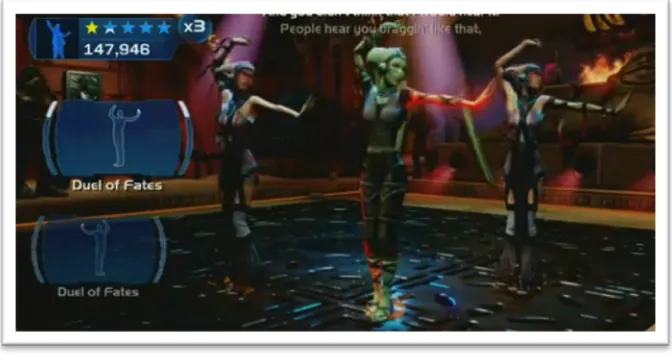
The player performs the dance action while watching the action be acted back to them.
In this feedback loop they can watch their virtual bodies recreate their movements,
usu-ally with much better form and skill than the player. It is an idealized reflection of the
player’s actions. There is also a small screen in the corner that allows the player to
watch a literal live version of their dancing that accurately reflects their size and
move-ments.
This creates both an idealized and an actual reflection of the player. The
non-detailed version of the player creates the scans that the Kinect uses to create the user's
image. So these represent a closer to reality reflection of the player, however, it is
are displayed above the avatar and that is where the player's attention is focused. If the
scanned image of the player is displayed, it is in a small square at the top or bottom left
of the screen, not the center where the eyes instantly are drawn. It also does not
pro-vide detail in these scans, so the shapes are vague, and uninteresting when compared
to the fleshed out and detailed avatar. Through the way the screen displays information,
the game encourages the player to interact with an idealized cyborg reflection as
op-posed to one that closer reflects the body.
2.3 Visual Rhetoric
Because the connection between player and game is created through a visual
space, visual rhetoric must be examined to provide a more rounded view of the process
of embodiment. It is the visual image of the avatar that the player becomes connected
to, and it is the digital image on the screen that the player interacts with, so this plays a
crucial role in the scope of this thesis. However, in order to keep this project to a
man-ageable size, there will be a limited number of visual rhetorical focuses as the main
fo-cus remains on the interface and embodiment of the player into the space of the video
game.
The connection between the visual and technology is a link that is prominent in
much scholarship surrounding the topic. Video games are a visual medium that
com-bine sound, and movement to create an interactive story. But what binds the player into
the reflection of the avatar is the visual components reflected back on the screen. As
such, visual rhetoric plays a crucial role in this thesis.
As most technologies are visually based, there is an extensive amount of
vid-eo games. However, much of this work already done on technology and the visual can
be applied to video games, for instance, Kristie S. Fleckenstein, provides a very efficient
explanation in her book, Embodied Literacies: Imageword and a Poetics of Teaching,
where she describes the process of technology and images working together:
Via spatial arrangements and visual technologies, a person is reduced to
that which is seen but does not see; a person becomes an object of
infor-mation but never the subject of communication. Central to Foucault’s
ar-gument about surveillance though is the degree to which individuals
inter-nalize the habit of surveillance so that it becomes the tool by which we
es-tablish our presence in the world. (Fleckenstein 57)
This is the process of embodiment where the player becomes the object on the
screen, where he or she embodies the digital skin of the avatar, no longer his or her
own body. She draws on Foucault’s discussion of the panopticon where there is the
po-tential for someone to always be watching and observing. The Kinect transforms the
player into this all-seeing observer for this digital world. The player internalizes the
Ki-nect watching the player, and in turn, watches the avatar on the screen at all moments.
The classics scholars of the visual rhetoric field even apply well to the field of
video game studies, in Walter Benjamin’s classic, The Work of Art in Age of the
Me-chanical Reproduction, he discusses film at length, and while the mediums of film and
video games are vastly different, his statements on the actor being viewed remain
rele-vant to the process of the player becoming the avatar on the screen, particularly since
the Kinect does serve as a camera recording the player and reflecting them back onto
The camera that presents the performance of the film actor to the public
need not respect the performance as an integral whole. Guided by the
cameraman, the camera continually changes its position with respect to
the performance… It comprises certain factors of movement which are in
reality those of the camera, not to mention special camera angles,
close-ups, etc. Hence the performance of the actor is subjected to a series of
optical test. (9)
The Kinect acts as a camera recording the actions of the player and reflecting the
ac-tions instantly back in an idealized form. The movements of the avatar are not the exact
movements of the player; they are movements picked up by the camera and made
“bet-ter” in the machine’s reflection on the screen. Like the actor on the screen, the final
pro-duction is not a true reflection of the performance as a whole, especially since the
Ki-nect camera only captures and reflects the movements of the player, and not the virtual
world which is controlled by coding within the individual game being played.
The world that is portrayed on the screen is a much more vibrant, engaging, and
attractive world than the world around most players of the game. In the game there is an
abundance of green spaces or space. There are attractive men and women all around
who will happily engage with the player. The visual appeal of the game serves to lure
the player even further into the digital world. The avatar itself is also an attractive anchor
point to tie the player to the avatar. By allowing the player to choose or create their own
body in the game world, the player is given control over their own body, a control that