Best Practices for Food Waste Reduction at Congregate Nutrition Programs – Diverting Food Waste to Feed More Seniors
Anna Ghelli
The University of North Carolina at Chapel Hill Gillings School of Global Public Health
A paper submitted to the faculty of the University of North Carolina at Chapel Hill in partial fulfillment of the requirements for the degree of Master of Public Health in the Department of Nutrition
11/2019
Approved by: _______________________ Shu Wen Ng, PhD
Paper Advisor
Executive Summary
QuestionWhat steps can Meals on Wheels take to reduce food waste and in turn, feed more seniors?
Problem Overview
Food waste is a global problem. It is estimated that 40% of all edible food is wasted while many suffer from food insecurity. There is a gap that exists between the food that is produced and the hungry people. North Carolina has the 4th highest rate of senior hunger in the country at 13%.
Congregate meal sites serve 23,337 seniors each year in North Carolina. Still, 83% of low income, food-insecure adults are not receiving the meal services that they need. One way to feed more people is to prevent food waste. There is enough food being produced worldwide, it is just a matter of recovery and redistribution to those in need. This report outlines ways to reduce waste and instead, feed more seniors in need.
Recommendations
Several approaches can help meal sites and commercial kitchens to utilize food more efficiently. This can allow them to decrease food waste and instead feed more individuals.
Recommendations for Pre-Consumer Food Waste Reduction (Source Reduction) Recommendation 1 – Client-centered Menu Planning
Allowing participants to provide feedback is important to determine likes and dislikes. It also creates buy-in that may further increase intake.
Recommendation 2 – Forecasting
A significant amount of food is wasted when portions are too large or when forecasting by staff overestimates customer needs.
Recommendation 3 – Quality Assurance
Steps should be taken to ensure that sites receive only the amount of food they require and that the food delivered is prepared, packaged and transported in a way that preserves quality to maximize customer satisfaction.
Recommendations for Post-Consumer Food Waste Diversion Recommendation 4 – Leftovers
Participants should be allowed to take seconds if there is food remaining after a meal. Regular instruction on food safety can mitigate any risk of foodborne illness.
Recommendation 5 – Composting
If any food cannot be salvaged for human consumption, it should be composted. This diverts food from landfills and allows it to serve a further purpose.
Table of Contents EXECUTIVE SUMMARY ... 2 QUESTION ... 2 PROBLEM OVERVIEW ... 2 RECOMMENDATIONS ... 2 BACKGROUND ... 6 METHODOLOGY ... 10 FINDINGS ... 14
FINDING 1–STAKEHOLDER FEEDBACK CAN DRIVE MENU DECISIONS ... 14
FINDING 2–THERE ARE SOME BARRIERS TO MAKING MENU CHANGES ... 15
FINDING 3–MENU CHANGES ARE NOT THE ONLY WAY TO PREVENT WASTE ... 16
FINDING 4–SEVERAL THINGS ARE GOING WELL ... 16
RECOMMENDATIONS ... 17
RECOMMENDATIONS FOR PRE-CONSUMER FOOD WASTE REDUCTION (SOURCE REDUCTION) ... 18
Recommendation 1 - Stakeholder Input and Menu Planning ... 18
Recommendation 2 - Forecasting ... 18
Recommendation 3 - Quality Assurance ... 19
RECOMMENDATIONS FOR POST-CONSUMER FOOD WASTE DIVERSION ... 20
Recommendation 4 - Leftovers ... 20
Recommendation 5 - Composting and Onsite Gardens ... 21
CONCLUSIONS ... 22
REFERENCES ... 23
INDEX OF ACRONYMS
Acronyms Mentioned in Report
DGA Dietary Guidelines for Americans DRI Dietary Reference Intake
EPA U.S. Environmental Protection Agency MOW Meals on Wheels of Wake County
NFESH National Foundation to End Senior Hunger NGO Non-governmental Organization
OAA Older Americans Act RD Registered Dietitian
Background
It is estimated that 40% of all edible food is wasted while many suffer from food insecurity. There is a gap that exists between the food that is produced and the hungry people. We throw too much away, without considering alternatives. Environmental Protection Agency (EPA) estimates that food accounts for 21.6% of all municipal solid waste, which is more than any other single component.
Ultimately, these practices have negative implications for the environment while benefiting no one. The earth is a closed ecosystem, and we must use resources efficiently and mindfully to meet everyone's needs.
Food waste is a behavior problem. If consumers, businesses, and organizations were more knowledgeable about the potential positive impact of decreasing food waste, they may be motivated to make a change. According to a 2016 study, almost 80% of US citizens said they feel guilty when throwing away food (The Economist Intelligence Unit, 2016). The desire is there, but it has to be prioritized. Businesses and organizations may find additional motivation if they consider the cost savings. A significant amount of food is wasted when portions are too large or when forecasting by staff
overestimates customer needs. Approximately every dollar that US consumer-facing businesses invest in food waste reduction, results in an $8 cost savings (ReFed, 2018). Still, reducing food waste is about more than saving money, it is also about feeding more people.
The food insecurity prevalence rate among seniors in North Carolina is 13%. This is the 4th highest rate among all US states (FRAC, 2019). Food insecure seniors are 2.3 times more likely to
experience depression, 32% more likely to experience activity limitations, 65% more likely to experience diabetes, 57% more likely to experience heart failure and 19% more likely to experience high blood
pressure compared to food-secure seniors (Ziliak & Gundersen, 2017). These health conditions contribute to increased hospital visits, medical and prescription drug costs. Malnutrition is associated with longer hospital stays (4-6 additional days) and a 50% higher readmission rate compared to non-malnourished individuals. Rising hunger rates lead to rising healthcare costs. The percentage of food-insecure individuals is positively correlated with additional healthcare costs (Berkowitz et al., 2018). Reducing food insecurity may reduce spending and improve health outcomes. One way to do this is by increasing food access by providing services such as home-delivered meals and congregate nutrition programs.
Older adults experience age-related physiological changes which result in changes to dietary needs compared to other life stages. Older adults may not need as many calories but they still need essential nutrients. However, a variety of factors can make getting all the nutrients they require challenging. This population can experience malabsorption, dental health decline, and taste changes. Various medications can decrease appetite and alter digestion, absorption, metabolism or excretion of essential nutrients (Bernstein & Munoz, 2012). These challenges mean that food distributers such as Meals on Wheels (MOW) must create nutrient-dense menus that take the preferences of older adults into consideration.
Nutrition services including the Congregate Nutrition Program and the Home-Delivered Nutrition Program, are authorized under Title III-C of the Older American Act (OAA). These services provide healthy meals to those over 60 years-of-age, facing social and financial hardships. The OAA guidelines require that all food served through these programs provide a third or more of the
participant’s dietary reference intakes (DRIs) and adhere to the Dietary Guidelines for Americans (DGA). State and local food safety and sanitation requirements must also be followed and should appeal to
older adults (Administration for Community Living, 2019). This report will focus primarily on reducing food waste related to these nutrition services.
Meals on Wheels (MOW), is an agency that provides nutrition services under the OAA. MOW of Wake County receives food from a commercial food caterer, Food Runners Collaborative, that serves several counties and congregate nutrition programs. Food is distributed from this central location; therefore, they have a large reach throughout the community. North Carolina’s congregate nutrition programs served 23,337 seniors in 2018 (Meals on Wheels of America, 2019). Still, 83% of low income, food-insecure seniors are not receiving the meal services that they require (U.S. Government
Accountability Office, 2015). One way to feed more people who are food insecure is to prevent food waste.
One of the first steps in reducing an agency’s food waste is to perform a food waste assessment. The National Foundation to End Senior Hunger (NFESH) has developed an innovative way to perform such an assessment. The program is called What a Waste, and it is a systematic process meant to help "congregate nutrition programs save money by cutting down on avoidable food waste, improve
operations, engage seniors, explore different nutrition options, and explore environmentally sustainable solutions for reducing avoidable and repurposing or positively utilizing unavoidable food waste" (NFESH. n.d.).
In 2016 the NFESH approached MOW of Wake County about completing a 3-month assessment of food waste at a local congregate nutrition program. Five Points Center for Active Adults in Raleigh, NC was chosen as the site for this analysis. The NFESH analyses found that the Five Points Center for Active Adults wasted 8,399lbs of food or 4,625 meals annually (National Foundation to End Senior Hunger, 2016). These projections are likely similar across Wake County, and perhaps across all 331 congregate
meal sites in North Carolina. Diverting food waste could help feed the 237,584 seniors that are food insecure in NC (Meals on Wheels of America, 2019). There is enough food being produced worldwide, it is a matter of recovery and redistribution to those in need. This report outlines ways to reduce waste and instead, feed more seniors in need. This report uses the analyses provided by the NFESH and additional primary research to design the next steps for Meals on Wheels of Wake County and associated congregate meal sites.
Looking Ahead
The goal of this report is to provide MOW with recommendations to feed food-insecure seniors by reducing food waste. There are 4,062 people on the North Carolina waitlist for home-delivered meals and 288 on the waitlist for congregate nutrition programs and these are just the numbers reported to the state. The actual number of people waiting for these services is expected to be much higher. There is insufficient funding to deliver meals to everyone in need especially since many cannot afford the $4.75 each meal costs (Meals on Wheels of America, n.d.). Improvements to efficiency might mitigate this funding shortage. Many more seniors could be fed by reducing waste and redistributing food to those in need. The NFESH report highlighted several important pieces of information. It provided insight into the most wasted food items both post-consumer (plate waste) and overproduction (pan waste). The report also provided insights into the potential impact that reducing food waste could have. In fact, according to the report Five Points Center for Active Adults loses $19,870 annually to food waste – the cost of 5,938 meals. This report utilizes firsthand interviews and formative research to make recommendations about what MOW can do to reduce food waste now.
Methodology
To determine the next steps for MOW in their effort to reduce food waste, I interviewed several key stakeholders. This included the executive director of MOW of Wake County, the staff at the Five Points, and the executive director of the Food Runners Collaborative, the central caterer.
Before conducting any interviews, I reviewed the NFESH report on food waste at the Five Points, then performed a literature review of food waste and food insecurity issues related to seniors. I further looked into how other agencies have used the NFESH project. This allowed me to generate several questions to guide my interviews. All interviews were conducted in-person with additional
correspondence via e-mail. The order of analysis and main take ways from the interviews are:
Meals on Wheels of Wake County
The central kitchen at MOW of Wake County distributes food via home-delivered meals and congregate nutrition programs (see Figure 1). MOW of Wake County does consider the preferences of their clients when making menu decisions. They administer yearly surveys, accept feedback via telephone, and hold quarterly menu meetings. However, nutritional content and cost are prioritized over client preferences. A registered dietitian (RD) must sign off on the menu to ensure that meets the nutritional guidelines set forth by the OAA. Planning a meal is also contingent on meeting the food cost budget of $2.05 per meal. With these factors in mind, it is also difficult to meet the preferences of everyone across culture, age, and economic status. However, consistent feedback is taken into consideration. For example. Wake County has taken steps to switch brands for certain products that were the subject of consumer complaints.
The Food Runners Collaborative relies on forecasting performed by each of the sites they prepare food for. Each day they receive an order and they prepared enough to meet that number of meals, plus 4-5 meals, to make sure the site does not run out. One concern is that volunteers usually serve food at these sites and they may not be trained to provide standardized portions of food items. However, the
commercial kitchen rarely over prepares food because of the way they receive forecasting information from sites. Any surplus of prepared food (pre-consumer pan waste) is donated to Interfaith Food Shuttle (IFFS).
Five Points Center for Active Adults
The 2016 NFESH report was reviewed extensively to determine key areas of waste and potential recommendations. The report also revealed variations in waste based on the day of the week and potentially other external factors. Several food items contributed to the total plate waste observed at
Five Points (see Figure 3). These items were the focus of the discussion with the staff at Five Points. I reviewed the menu with the staff and asked additional questions about these high waste items.
Example questions include;
o Do clients have special dietary needs? (are they diabetes, do they have dental problems or dysphagia?)
o Are certain items too hard to chew?
o Are there foods that people ask for that are not on the menu? o What foods do people seem to dislike?
o Do clients take leftovers including fruit and milk?
The results of the Five Points focus group was brought to MOW of Wake County. The top pan and plate waste items (see Figures 2 and 3) were discussed to determine forecasting errors versus consumer preferences. According to the 2016 NFESH report, Five Points experiences more post-consumer pan waste than plate waste. Further, 23% of ordered food became pan waste at Five Points over the 3-month analysis period (National Foundation to End Senior Hunger, 2016). Pan waste is an issue because it means the resources that went into cultivating, transporting and cooking that food were wasted without the food ever reaching someone's plate. It should be noted that over-preparing food leading to post-consumer pan waste may be mitigated if clients can take food home. However, preventing the excess from occurring should be prioritized.
Figure 2: Post-Consumer Pan Waste at Five Points (National Foundation to End Senior Hunger, 2016)
Findings
Several key pieces of data were gathered from stakeholder interviews and from reviewing the NFESH report and client surveys. These findings were used to shape the recommendations made for food waste reduction.
Finding 1 – Stakeholder Feedback Can Drive Menu Decisions
A general theme emerged when MOW participants were asked about the meals they receive. Many are happy with the service, but at Five Points, many also wish for more variety, softer textures, and
vegetables that are not overcooked. Participants should be continuously surveyed to better understand their food preferences. Preferences may be different across cultures and geographic regions but within counties, MOW can likely find meals that accommodate the majority of participants. It is important to consider nutrient profile so meals must meet OAA standards but it is also important that people are willing and able to eat the offerings.
MOW surveys revealed several foods that participants would like that are not on the menu including; turkey sausage, pulled pork, fish, breakfast foods, fish, seafood, tossed salads, tuna and chicken salad, cabbage, casseroles, peanut butter, and breakfast and more varieties of fruit. Surveys are an important way to reach clients at all sites across the county and allow them to provide input.
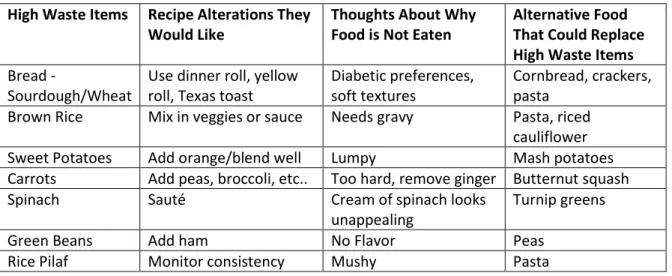
Comments from Five Points staff included: beef and vegetables should be served with rice, beef pot pie should be served with rice, chicken and dumplings are too thick, barbeque chicken is not good, green beans have no flavor, chili should be served with cornbread, not everyone likes mushrooms, sugar snap peas are stringy and a choking hazard, pork lion/chicken leg can be very dry, chicken parmesan should
be served with noodles. Below are some suggestions made by the staff on behalf of clients. Not
everything is feasible given the cost and nutritional constraints, but it is important to give stakeholders a voice to foster buy-in and better understand preferences.
Table 1: Comments from meeting with the Five Points Center for Active Adults. High Waste Items Recipe Alterations They
Would Like
Thoughts About Why Food is Not Eaten
Alternative Food That Could Replace High Waste Items Bread -
Sourdough/Wheat
Use dinner roll, yellow roll, Texas toast
Diabetic preferences, soft textures
Cornbread, crackers, pasta
Brown Rice Mix in veggies or sauce Needs gravy Pasta, riced cauliflower Sweet Potatoes Add orange/blend well Lumpy Mash potatoes Carrots Add peas, broccoli, etc.. Too hard, remove ginger Butternut squash Spinach Sauté Cream of spinach looks
unappealing
Turnip greens
Green Beans Add ham No Flavor Peas
Rice Pilaf Monitor consistency Mushy Pasta
Finding 2 – There Are Some Barriers to Making Menu Changes
There are several factors to consider when adjusting the menu. Food must be able to maintain its integrity and temperature during transport. Items going to congregate nutrition program sites may have more flexibility with this because of the different equipment used. Financial constraints are another barrier. MOW of Wake County has a budget of $2.05 a meal which limits menu options. Some high waste vegetables noted in the study were also the most effective options. This means that the cost-benefit ratio must be closely monitored: it might be worth switching out some items in the long run if less of the new item is thrown out. Nutritional adequacy is another barrier. The OAA set nutritional requirements that programs must adhere to. This is because nutritional status is a key determinant of successful aging (Bernstein & Munoz, 2012). Registered dietitians (RDs) will work closely with programs to make sure that their menus meet the OAA standards. Other barriers may include; kitchen
Finding 3 – Menu Changes Are Not the Only Way to Prevent Waste
Improving recipes or replacing food items that fall into the high waste category is one option. Replace food options needed to be similar in terms of nutrient profile to accommodate regulatory standards without reworking the whole menu. This is appropriate for many of the things that fall into both the plate and pan waste categories. Given the barriers to making menu changes previously discussed, it is worth considering alternative ways to reduce waste. One comment from clients and staff was that food is sometimes overcooked or mushy, making it less likely to be eaten. Maintaining the quality of the food throughout production and transport is one way to overcome this issue. Knowing how many people will be eating the food prepared is also important. Overestimating attendance can lead to overproduction. Lastly, composting is a preferable option to discarding food if recovering food for human consumption is not an option.
Finding 4 – Several Things Are Going Well
Several actions are already being taken to reduce food waste within MOW of Wake County and Five Points Center for Active Adults.
Things that are going well:
o At Five Points, participants often take-home milk or drink it on-site – this is not wasted. o At Five Points, participants are allowed "seconds" that they may take home.
o At Five Points, participants are regularly taught about food safety related to taking home meals. o At the MOW kitchen, pan waste is donated to Interfaith Food Shuttle at the end of production. o MOW has quarterly menu meetings and surveys participants annually.
These practices should be used by other congregate nutrition programs, as part of a system of best practices to reduce food waste.
Recommendations
Food waste prevention requires behavior change. Multiple people, throughout the food system, must make consistent choices that prioritize reducing waste, for the desired outcomes to occur. To facilitate this requires education, standardization and, procedures such as quality assurance. The following are recommendations to MOW and all similar meal programs, to maximize resources, primarily food (see Image 1 in the appendix for education materials). These recommendations are divided into pre-consumer and post-pre-consumer opportunities for food waste reduction. Figure 4 illustrates where these strategies can be applied within the MOW food system.
Recommendations for Pre-Consumer Food Waste Reduction (Source Reduction)
Recommendation 1 - Stakeholder Input and Menu Planning
Stakeholder input should be consider when making menu decisions. Participant surveys and site visits will reveal where changes are needed. Onsite staff will likely have a good idea of what participants are eating. Menu changes should be a collaborative effort between the chef and program dietitian and these changes should be made according to participant feedback. It may be possible to pilot test new recipes to focus groups.
Alterations to the menu are one method to reduce food waste. These alterations should consider client preferences to reduce consumer food waste and increase consumption. Adequate nutrition in older adults is important due to the health risks associated with malnutrition. Involving seniors in making menu decisions increases buy-in which may lead to increased intake. Seniors should be able to request food items and give feedback on meals they like or dislike. The least preferred items should be replaced with nutrient equivalent options or recipes should be altered. Ways to obtain this information are through site visits, surveys, and menu meetings (see appendix for related resources). Adjustments can improve client satisfaction which can increase intake and reduced plate waste (Shipkoski, Ouellette, & Wills, n.d.).
Recommendation 2 - Forecasting
Home-delivered meals are easy to forecast because they are on a set daily schedule. The only waste comes during the occasions when someone is not home to receive their meal and this is infrequent because clients are homebound. Congregate sites may experience more challenges with forecasting. The Food Runners Collaborative (MOW caterers) prepares 4-5 extra meals in addition to the number order by each site. This can create a large surplus if the site overestimates the expected attendance. Careful
consideration should be taken by sites to ensure accurate prediction of the number of meals needed daily. As indicated by the 2016 NFESH report, not every day of the week hosts the same number of people. Attendance may also vary based on the day of the menu cycle or other external factors. If the site is consistently over-predicting, they will experience more pan waste. If this is the case, they should scale back their orders. MOW may need to remind sites to look out for pan waste as a measure of excessive ordering. Congregate nutrition programs should maintain accurate historical data regarding attendance and waste to make accurate predictions about future attendance. Software or excel may help create forecasting models. Research suggests that exponential smoothing is the most efficient type of mathematical forecasting technique for Title IIIc congregate programs (Blecher, 2004). This technique can easily be completed in excel, using historical data, to predict future attendance (see appendix for instructions). If reservations are required, programs should monitor compliance with the reservation system. If people are frequently missing reservations, this should be taken into consideration when ordering meals for the day.
Recommendation 3 - Quality Assurance
MOW administration and the individual congregate nutrition program have a role to play in reducing waste. The goal of these programs is to feed seniors in need. Therefore, the food served to them must be something they are able and willing to eat. For example, this population often requires softer textures due to dental issues. If meals are too hard upon delivery, participants cannot eat them and plate waste will occur. To prevent this, MOW should be design meals with clients in mind and food should be evaluated before packaging for appearance, taste, and texture. Inventory should also be monitored. When food is sent out for delivery, close attention should be paid to the quantity to ensure the no one receives too much or too little. For sites that have not completed a plate or pan waste
assessment, it may be helpful to do so either through weighing waste or through visual inspection. Quality improvement is a continuous process to maximize client satisfaction and efficiency.
Congregate nutrition programs should be advised to look for these things;
o Is the correct amount of food being delivered?
o Is there significant pan waste after meals? If a site is consistently receiving too much; the 4-5 meal buffer may need to be reduced or eliminated.
o Is there excessive plate waste after meals? Volunteers may need standardize training on how much to serve to clients and serving utensils that yield standardized portions.
o What foods seemed to be thrown away frequently? Why?
MOW should encourage congregate nutrition programs to provide feedback, especially before quarterly meetings. Upon requesting this information, MOW should make it clear to programs that their
information is valued and will be reviewed and utilized.
Recommendations for Post-Consumer Food Waste Diversion
Recommendation 4 - Leftovers
If source reduction is not possible or not effective enough, the next most preferable method of food waste diversion is to feed more people. Five Points allows attendees to take second helpings after everyone has been served. Participants may also take home plate leftovers. This reduces post-consumer pan waste. All congregate nutrition programs should be made aware that the NC Division of Aging and Adult Services allows the re-service of food in accordance with the NC Food Code. MOW may need to educate on-site staff on this policy. Sites can; offer takeout containers, make containers available for purchase or encourage participants to bring reusable storage containers. Remaining meals can also be
purchased by individuals that do not qualify for the congregate nutrition program at full price
(Administration for Community Living. (2015). Food that remains after production in the kitchen should be donated to Interfaith Food Shuttle or other food recovery organizations. An easy way to identify potential partners and facilitate food redistribution is to use a food sharing app such as “Olio”. Another option is to freeze remaining pan waste with the blast chiller at MOW of Wake County and redistribute it. These leftover products could be sold. This serves several purposes. The profits from the store can be reinvested into the Meals on Wheels program while feeding people and preventing food waste
(Bethune, 2017). This may be an option for kitchens with more pan waste that cannot be controlled with enhanced forecasting if there is refrigeration available.
Recommendation 5 - Composting and Onsite Gardens
If food remains after seconds are offered, it does not mean that food must be thrown away. Food waste that cannot be reclaimed to feed humans can be used to create compost for gardens. Gardens can grow food to supplement meals. An added benefit is that gardens are associated with many benefits for seniors including increased physical strength, fitness and flexibility, cognitive ability, and socialization (Wang & MacMillan, 2013). On-site gardens may be worth installing if possible. Wake County has several locations where compost can be deposited if sites do not have a place compost. This would require developing a system for composting according to county regulations and a method of transporting compost to drop off locations. More information about this can be found on the local municipal waste website.
Conclusions
According to the 2013 Current Population Survey, about 83% of low- income, food-insecure adults, do not receive meal services such as those provided by MOW (U.S. Government Accountability Office, 2015). The What the Waste project found that the equivalent of 4,625 meals was wasted annually at just one congregate nutrition program site (National Foundation to End Senior Hunger, 2016). If these meals could be recovered at this center and others like it, including the 330 additional congregate nutrition programs in North Carolina, MOW could feed a lot more people. Accommodating more people means that participants can enjoy the additional benefits associated with congregate nutrition programs and home delivery services. MOW participants have fewer emergency room visits and fewer hospital admissions than non-participants (Mabli et al., 2018). The home-delivered meal program is associated with better nutritional status, dietary intake, food security, and well-being (Wright et al., 2015).
Additionally, 80% of participants say that congregate meal programs improved their health and 54% say that these meals account for over 50% of their daily food intake (Mabli et al., 2018). These sites also provide social opportunities for seniors. The National Poll on Healthy Aging reports that 1 in 3 seniors report feeling lonely (Malani et al., 2019). Reduced isolation can improve health and associated health care costs. AARP Public Policy Institute research has found that social isolation costs Medicare an additional $6.7 billion a year (Flowers et al., 2017). The senior population is continuing to grow and their needs will only become more apparent in years to come. More food does not have to be produced globally to feed everyone, it needs to be utilized more efficiently (Holt-Giménez et al. (2012). Diverting food waste is a key component of feeding more humans. As this occurs within congregate nutrition programs, this will allow more seniors to take part in MOW and experience all the benefits the program has to offer.
References
Administration for Community Living. (2015). The Older Americans Act nutrition program did you know…..? Retrieved from https://acl.gov/sites/default/files/programs/2016-11/OAA-Nutrition-Program-FAQ.pdf
Administration for Community Living. (2019). Nutrition Services. Retrieved from https://acl.gov/programs/health-wellness/nutrition-services
Bernstein, M., & Munoz, N. (2012). Position of the Academy of Nutrition and Dietetics: food and nutrition for older adults: promoting health and wellness. Journal of the Academy of Nutrition and Dietetics, 112(8), 1255-1277.
Bethune, M. (2017, March 3). A Montreal Meals-on-Wheels program is closing the food waste loop. Retrieved from https://civileats.com/2017/03/03/a-montreal-meals-on-wheels-program-closing-the-food-waste-loop/
Blecher, L. (2004). Using forecasting techniques to predict meal demand in Title IIIc congregate lunch programs. Journal of the American Dietetic Association, 104(8), 1281-1283.
Flowers, L., Houser, A., Noel-Miller, C., Shaw, J., Bhattacharya, J., Schoemaker, L., & Farid, M. (2017). Medicare spends more on socially isolated older adults. Insight on the Issues, 125.
FRAC. (2019). Rate of food insecurity among households with seniors (age 60+), by state, 2015-2017. Retrieved from https://www.frac.org/maps/seniors/tables/sr_food_insec_2015_2017.html Gustavsson J, Cederberg C, Sonesson U, van Otterdijk R, Meybeck A. (2011). Global food losses and food
waste. Retrieved from http://www.fao.org/ docrep/014/mb060e/mb060e.pdf
Holt-Giménez, E., Shattuck, A., Altieri, M., Herren, H., & Gliessman, S. (2012). We already grow enough food for 10 billion people… and still can't end hunger. Journal of Sustainable Agriculture, 36, 595-598
Mabli, J., Ghosh, A., Schmitz, B., Shenk, M., Panzarella, E., Carlson, B., & Flick, M. (2018). Evaluation of the effect of the older Americans Act Title III-C nutrition services program on participants’ health care utilization. Washington, DC: US Department of Health and Human Services, Administration for Community Living.
Malani, P., Solway, E., Kirch, M., Singer, D., & Kullgren, J. (2019). Loneliness and Health. Retrieved from
https://deepblue.lib.umich.edu/bitstream/handle/2027.42/148147/NPHA_Loneliness-Report_FINAL-022619.pdf?sequence=1&isAllowed=y
Meals on Wheels of America. (2019). Delivering so much more than just a meal in North Carolina. Retrieved from https://www.mealsonwheelsamerica.org/docs/default-source/fact-sheets/2019/2019-state/north-carolina-2019.pdf?sfvrsn=f91ab93b_2
Meals on Wheels of America. (n.d.). FAQ’s. Retrieved from https://www.wakemow.org/faqs National Foundation to End Senior Hunger. (2016, Sep 22). What a waste baseline report and
recommendations to Meals on Wheels of Wake County for the Five Points Center for Active Adults.
NFESH. (n.d.) What a waste. Retrieved from http://nfesh.org/what-a-waste/ ReFED. (2018). Restaurant food waste action guide. Retrieved from
https://www.refed.com/downloads/Restaurant_Guide_Web.pdf
Shipkoski, J., Ouellette, C. & Wills, J. (n.d.). Food Waste: Impact and Options How to prevent waste in community food programs from planning to service.
http://aging.georgia.gov/sites/aging.georgia.gov/files/Food%20Waste%20OH%20Hunger%20Su mmit%20PPT.pdf
The Economist Intelligence Unit. (2016). Fixing food 2016: Toward a more sustainable food system. Retrieved from http://foodsustainability.eiu.com/whitepaper/
United States Environmental Protection Agency. (n.d.). Sustainable management of food. Retrieved from https://www.epa.gov/sustainable-management-food/sustainable-management-food-basics United States Environmental Protection Agency. (2015). Reducing wasted food & packaging: A guide for
food services and restaurants. Retrieved from https://www.epa.gov/sites/production/files/2015-08/documents/reducing_wasted_food_pkg_tool.pdf
United States Environmental Protection Agency. (2016, August). Food loss prevention options for restaurants. Retrieved from
https://www.epa.gov/sites/production/files/2016-08/documents/food_loss_prevention_options_restaurants_august_2016.pdf
U.S. Governement Accountability Office. (2015, June 10). Older Americans Act: Updated information on unmet need for services. Retrieved from https://www.gao.gov/assets/680/670738.pdf
Wang, D., & MacMillan, T. (2013). The benefits of gardening for older adults: a systematic review of the literature. Activities, Adaptation & Aging, 37(2), 153-181.
Wright, L., Vance, L., Sudduth, C., & Epps, J. B. (2015). The impact of a home-delivered meal program on nutritional risk, dietary intake, food security, loneliness, and social well-being. Journal of
Nutrition in Gerontology and Geriatrics, 34(2), 218-227.
Wunderlich, S. M., & Martinez, N. M. (2018). Conserving natural resources through food loss reduction: Production and consumption stages of the food supply chain. International Soil and Water
Appendix
Helpful Links to Resources
Menu Planning
Dietary Guidelines for Americans Recommendations
https://health.gov/dietaryguidelines/2015/resources/DGA_Recommendations-At-A-Glance.pdf Example Participant Surveys
http://www.ascog.org/wp-content/uploads/2015/11/Congregate-Meal-Survey-032015-Final.pdf
Quality Assurance
How to Perform a Food Waste Audit
https://www.epa.gov/sites/production/files/2015-08/documents/r5_fd_wste_guidebk_020615.pdf Sensory Changes in Older Adults
https://www.nia.nih.gov/health/smell-and-taste Serving Sizes for Older Adults
https://www.nia.nih.gov/health/serving-and-portion-sizes-how-much-should-i-eat
Forecasting
Software Which Uses Historical Data to Determine How Much Food to Order Each Day https://accessiblesolutions.com/meal-delivery-software
How to Use Exponential Smoothing Technique in Excel
https://www.exceltip.com/tips/exponential-smoothing-in-excel.html Example of a Site that Utilizes Reservation Based Forecasting
http://www.dcslnc.org/publications/administrative/Durham%20Center%20for%20Senior%20Life%20Co ngregate%20Meal%20Policy.pdf
Leftovers
Policy on Leftover Food
https://www.mealsonwheelsamerica.org/docs/default-source/research/retirement-research-foundation/north-carolina.pdf
Food Safety Education
https://nutritionandaging.org/toolkit-food-safety-in-older-adults-disease-prevention-strategies-and-educational-resources/#wbounce-modal
Where to Donate Unserved Pan Waste – Find Somewhere Near You https://geopub.epa.gov/ExcessFoodMap/
Use a Food Sharing App https://olioex.com
Composting
Find a Place to Drop off Compostable Food
http://www.findacomposter.com
Need Someone to Compost Food For You https://compostnow.org
Learn How to Compost
https://www.epa.gov/recycle/composting-home
https://content.ces.ncsu.edu/extension-gardener-handbook/2-composting Funding a Community Garden