Volume 4, Issue 3, March 2015
620
A RAIN PIXEL RESTORATION ALGORITHM FOR VIDEOS WITH
DYNAMIC SCENES
V.Sridevi, P.Malarvizhi, P.Mathivannan
Abstract
Rain removal from a video is a challenging problem due to random spatial distribution and motion of rain. Rain removal is a difficult task in videos. Rain removal is important and useful task in security surveillance, movie editing applications. In indoor environment, video is captured in ideal environment because artificial illumination is formed. On other hand in outdoor environment, it is important to remove weather effect. Outdoor vision systems are used for various purposes such as tracking, recognition and navigation. Current systems do not we will not taken the account for common weather conditions such as rain, snow, fog and mist. Rain consists of spatial distributed droplets of rain. . Rain changes the intensity in images and videos that can severely impair the performance of outdoor vision systems.. When light passes through the rain drop it get reflects and refracts from a large field of view towards the camera, creating sharp intensity patterns in images and videos. A group of such falling drops results in complex space and time varying signals in videos. If we apply different types of filter to remove the rain its gets motion blurred. So we have to develop for all weather conditions.The rainy videos which are pixels exhibit small but frequent intensity changes in the illumination change moving camera etc. To remove the rainy effect, it is to detect the fluctuations caused by the rain, and replace it with the original values. In the paper we have considered the rainy videos to remove the blur and improve the accuracy of the videos.Key Words:
bilateral filter, dynamic scene, motion occlusion, video analysis1. INTRODUCTION
In indoor environment, video is captured in ideal environment because artificial illumination is formed. On other hand in outdoor environment, it is important to remove weather effect. Rain removal is a difficult task in videos. Outdoor vision systems are used for various purposes such as tracking, recognition and navigation. Current systems do not we will not taken the account for common weather conditions such as rain, snow, fog and mist. So we have to develop for all weather conditions. Based on the physical
properties and S. K. Nayar, [1] there are two kinds of weather conditions: steady and dynamic .Based on the 4 physical properties there are two kinds of weather conditions: steady and dynamic [1]. Figure 1 and 2 show the steady and dynamic weather conditions respectively.
A. Steady and Dynamic Weather Conditions
The steady weather conditions are fog, mist and haze. The size of those particles is about 1-10μm. The dynamic weather conditions are rain, snow and hail. Its size is 1000 times larger than that of steady conditions i.e., about 0.1-10mm. The intensity of a particular pixel will be the aggregate effect of a large number of particles in case of steady weather conditions. In dynamic weather conditions, since the droplets have larger size, the objects will get motion blurred. The work contains two modules: detection of rain and removal of rain. The detection of rain is too compound. Rain produces intensity changes in images and videos that can severely impair the performance of outdoor vision systems.
Fig-1: Visual Appearance of Steady Weather Condition. When light passes through the rain drop it get reflects and refracts from a large field of view towards the camera, creating sharp intensity patterns in images and videos. A group of such falling drops results in complex space and If we apply different types of filter to remove the rain its gets motion blurred. So in our proposed work we uses bilateral filter to remove the rain from videos and it preserves the edges.
621
Fig-2: Visual Appearance of Dynamic Weather Condition1.2 Related Work
A Photometric and Dynamic Model
Kshitiz Garg and Shree K. Nayar [1] in 2007 present the first complete analysis of the visual effects of rain on an imaging system and the various factors that affect it. To handle photometric rendering of rain in computer graphics and rain in computer vision they develop systematic algorithm. They first develop a photometric model that describes the intensities produced by rain streaks and then develop a dynamic model that captures the spatiotemporal. Together, these models describe the complete visual appearance of rain. Using this model they develop a new algorithm for rain detection and removal. By modeling the scattering and chromatic effects, Narasimhan and Nayar successfully recovered “clear day” scenes from images taken in bad weather. But, their assumptions such as the uniform velocities and directions of the rain drops limited its performance.
B Temporal and Chromatic Properties
By using both temporal and chromatic properties of rain Xiaopeng Zhang, Hao Li [2] presents a K-mean clustering algorithm for rain detection and removal. There are 2 properties: temporal and chromatic property. The first property states that an image pixel is never always covered by rain in all the video. The second property states that the changes of R, G, and B values of pixels affected by the rain are same.
This algorithm can detect and remove rain streaks in both stationary and dynamic scenes, by using both temporal and chromatic properties which are taken by immobile cameras but it gives wrong result for moving cameras. It can handle for light rain and heavy rain conditions. This method is only suitable for static background scenes, and it gives out false result for foreground colors.
C Probabilistic Model
K. Tripathi and S. Mukhopadhyay [3] proposed an efficient, simple, and probabilistic model based rain removal algorithm. This algorithm is better for the rain intensity variations. This approach automatically adjusts the threshold. Effectively differentiate the rainy pixels and
non-rain moving object pixels. Differencing is done by the non-rain and Non rain moving objects by using the pixels in consecutive frames. This algorithm does not consider the shape, size and velocity of the raindrops, intensity of rain, which it makes more compounds to different rain conditions. There is a significant difference in time evolution between the rain and non-rain pixels in videos. This method is more durable compared with dynamic scenes. For many situations it gives false results.
D Spatiotemporal Properties
Tripathi and S. Mukhopadhyay [4] used spatio temporal properties for detection and removal of rain from video. The spatiotemporal properties are used to separate rain pixels from non-rain pixels. It is thus possible to involve less number of consecutive frames, reducing the buffer size and delay. They have used spatial temporal property and the chromatic property. According to the spatio-temporal property, rain is detected using improved k-means. It works only on the intensity plane which reduces the complexity and execution time. It reduces the buffer size, which reduces the system cost, delay and power consumption. This method produces the false result for dynamic scenes.
E Motion Segmentation
Jie Chen and Lap-Pui Chau [5] used a novel approach for rain removal. This algorithm is based on motion segmentation of dynamic scene. The motion of rain and object affects the pixel intensity and it get varies The variation caused by rain need to be removed, and the ones caused by object motion need to keep it as it is. Thus motion field segmentation naturally becomes a fundamental procedure of these algorithms.
Proper threshold value is set to detect the intensity variation caused by rain. Rain removal filters are applied on pixels after the photometric and chromatic constraints for rain detection; both spatial and temporal information are then adaptively use during rain pixel recovery. This algorithm gives better performance over others for rain removal in highly dynamic scenes with heavier rainfall.
F Bilateral Filter
We propose a rain removal framework via bilateral filter. Instead of directly applying a conventional image decomposition technique, we proposed a method, first decomposes an image into the low- and high-frequency (HF) parts using a bilateral filter. The HF part is then decomposed into a “rain component” and a “non rain component” by performing dictionary learning by mca method. This method will remove the rain and preserving geometrical details in videos. This is fully automatic and no extra training pulses needed.
First the input is taken as videos. Then the video should be converted into the frames. After converting into the frames, rain streaks are detected and removed by the bilateral filter
Volume 4, Issue 3, March 2015
622
after the videos are converting into frames. In detecting therain, bilateral filter will split the image into low frequency and high frequency component. Low frequency part is considered as non rain component. The high frequency component is considered as rain component. Again the high frequency component is split into two based on the dictionary learning. While removing the rain in the frame is compared with the neighbor pixel and replaces the value in the damaged pixel. And then image is restored. After the restoration frames are converted into the videos.
Fig3: Block diagram
In the detection bilateral filter is used it splits the low frequency and the high frequency components. Where the most of where the most basic information will be retained in the LF part while the rain streaks and the other edge/texture information will be included in the HF part of the image Low frequency components are not having the rain and the high frequency components consists of rain that will be split in to two based on the dictionary learning .In the dictionary learning it learns the image patches and removes the rain by multi component analysis. After removing the rain in the image is integrated with the low frequency and the accuracy is improved and the blur image in the videos is removed.
Algorithm steps:
Step1: Input is given as video that is converted into the frame. After converting the frame the single frame is taken. Step2: Apply the bilateral filter to obtain low frequency component.
Step3: Extract the image patches from high frequency. Apply online dictionary learning.
Step4: Obtain the rain sub dictionary and the non rain dictionary by multi component analysis.
Step5: Reconstruct the each image patch by integrating the low frequency and the non rain sub dictionary.
Step6: Finally the output is taken as videos without rain.
2. SIMULATION RESULTS
A Converting Video into the Frames
First the input is taken as videos. Then the video should be converted into the frames. After converting into the frames rain should be detected and removed by the bilateral filter. In detecting the rain, bilateral filter will split the image into low frequency and high frequency component. Low frequency part is considered as non rain component. The high frequency component is considered as rain component
.again the high frequency component is split into two based on the dictionary learning. While removing the rain in the frame is compared with the neighbor pixel and replaces the value in the damaged pixel. In the fig 4 video should be converted into frame. In the coding we can get particular frame also.
Fig-4: Converting the Videos into the Frames.
B Identification of Rain Components
First the input is given in the fig.5. Identify the red components in the fig.6 using the bilateral filter. Then identify the green components in the fig.7 using the bilateral filter. Again identify the blue components in the fig.8 using the bilateral filter. By doing this method we can identify the rainy affected pixels in the frame.
original image
Fig5:Orginal Image of the Frame
red components
Fig6: Red Components of the Image
INPUT (VIDEOS) FRAMES RAIN
DETECTION RAIN REMOVAL IMAGE RESTORATION OUTPUT (VIDEOS
)
623
green componentsFig7: Green Components of the Image
blue components
Fig8: Blue Components of the Image
C Applying bilateral filter
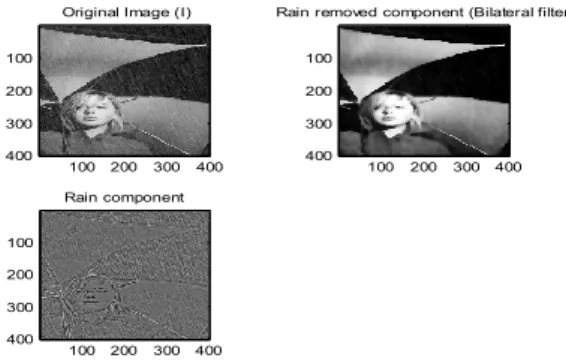
After applying the bilateral filter then take the high frequency component and apply the online dictionary learning In the dictionary learning it learns the image patches and removes the rain by multi component analysis. After removing the rain in the image is integrated with the low frequency and the accuracy is improved and the blur image in the videos is removed. Finally the output is taken as without rain image. In the fig8 the filter for the traffic image and the online dictionary learning is applied to the image rain component is extracted and the rain is removed in the image. Likewise for different images rain is removed in the fig 9 and 10.
Original Image (I)
100 200 300 400 100
200 300 400
Rain removed component (Bilateral filter)
100 200 300 400 100 200 300 400 Rain component 100 200 300 400 100 200 300 400
Fig9: Bilateral Filter Output in Traffic Scenes
Original Image (I)
100 200 300 400 100
200 300 400
Rain removed component (Bilateral filter)
100 200 300 400 100 200 300 400 Rain component 100 200 300 400 100 200 300 400
Fig10: Bilateral Filter Output image of Girl with Umbrella
Original Image (I)
100 200 300 400 100
200 300 400
Rain removed component (Bilateral filter)
100 200 300 400 100 200 300 400 Rain component 100 200 300 400 100 200 300 400
Fig 11: Bilateral Filter Output image in road Side Parking
3. CONCLUSIONS
Existing rain removal algorithms perform poorly in highly dynamic scenes, serious pixel corruptions Based on the proposed work it removes the motion occlusion and improves the accuracy of the video. Both spatial and temporal information are adaptively exploited. Experiment results show that our algorithm plays good results for accuracy. In the future work have been suggested to work in snow or in hail. Rain Pixel restoration algorithm finds its application in the field of:
Security surveillance Vision based navigation Video/movie editing Video indexing/retrieval.
Volume 4, Issue 3, March 2015
624
[1]K. and S. K. Nayar, “Detection and removal of rain fromvideos,” in Proc. IEEE Conf. Comput. Vis. Pattern Recognit., vol. 1, Jul. 2004, pp. 528–535.
[2] K. and S. K. Nayar, “Vision and rain,” Int. J. Comput Vis., vol. 75, no. 1, pp. 3–27, 2007.
[3] X. , H. Li, Y. Qi, W. K. Leow, and T. K. Ng, “Rain removal in video by combining temporal and chromatic properties,” in Proc. IEEE Int. Conf. Multimedia Expo, Jul. 2006, pp. 461–464.
[4] A. K. Tripathi and S. Mukhopadhyay, “A probabilistic approach for detection and removal of rain from videos,” IETE J. Res., vol. 57, no. 1,pp. 82–91, Mar. 2011.
[5] A. Tripathi and S. Mukhopadhyay, “Video post processing: Low-latency spatiotemporal approach for detection and removal of rain,” IET Image Process., vol. 6, no. 2, pp. 181–196, Mar. 2012.
[6] A. Verri and T. Poggio, “Motion field and optical flow: Qualitative properties,” IEEE Trans. Pattern Anal. Mach. Intell., vol. 11, no. 5,pp. 490–498, May 1989.
[7] A. Ogale, C. Fermuller, and Y. Aloimonos, “Motion segmentation using occlusions,” IEEE Trans. Pattern Anal. Mach. Intell., vol. 27, no. 6,pp. 988–992, Jun. 2005.
[8] J. P. Koh, “Automatic segmentation using multiple cues classification,” M.S. dissertation, School Electr. Electron. Eng., Nanyang Technol.University, Singapore, 2003. [9] B. K. Horn and B. G. Schunck, “Determining optical flow,” Artif. Intell., vol. 17, pp. 185–203, Jan. 1981.
[10] M. Shen and P. Xue, “A fast algorithm for rain detection and removal from videos,” in Proc. IEEE Int. Conf. Multimedia Expo, Jul. 2011,pp. 1–6.