Additional file 2. Coaching Tool Detail
A. Answering Men’s Questions
One purpose of our coaching tool was to answer men’s questions about prostate cancer screening or, if appropriate, broader men’s health. We did this using supplemental brochures (see below and on following pages) which reiterated and expanded on the content of our video-based decision aid.
B. Values Clarification Exercise
A second purpose of our coaching tool was to help men clarify their values. We helped men clarify their values for prostate cancer screening through a process of rating and ranking several decision factors.
Our values clarification process is outlined below:
1) Men read a series of two opposing statements about five decision factors (see table 1 below)
2) Men chose which of the two statements best represented their own feelings 2) Men ranked the statements in order of influence to their decision making
3) Based on the color-coding of cards (red=against screening; blue=for screening), men were encouraged to consider whether or not they wanted to be screened.
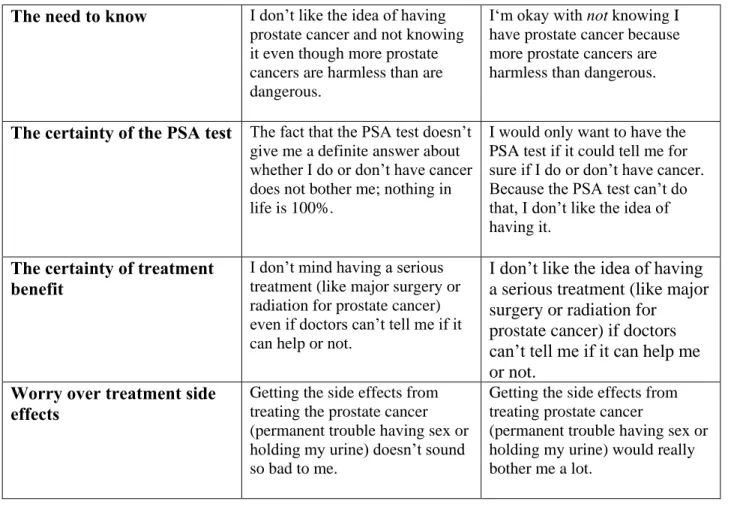
Table 1. Factors and Feelings Influencing the Decision about Prostate Cancer Screening
Decision Factor Statement Favoring
Screening (in red) Statement Against Screening (in blue) The chances of dying from
prostate cancer I have a high chance of dying from prostate cancer, even compared with dying from other causes.
I have very little chance of dying from prostate cancer compared with my chance of dying from other causes.
The need to know I don’t like the idea of having prostate cancer and not knowing it even though more prostate cancers are harmless than are dangerous.
I‘m okay with not knowing I have prostate cancer because more prostate cancers are harmless than dangerous.
The certainty of the PSA test The fact that the PSA test doesn’t give me a definite answer about whether I do or don’t have cancer does not bother me; nothing in life is 100%.
I would only want to have the PSA test if it could tell me for sure if I do or don’t have cancer. Because the PSA test can’t do that, I don’t like the idea of having it.
The certainty of treatment
benefit I don’t mind having a serious treatment (like major surgery or radiation for prostate cancer) even if doctors can’t tell me if it can help or not.
I don’t like the idea of having a serious treatment (like major surgery or radiation for
prostate cancer) if doctors can’t tell me if it can help me or not.
Worry over treatment side
effects Getting the side effects from treating the prostate cancer (permanent trouble having sex or holding my urine) doesn’t sound so bad to me.
Getting the side effects from treating prostate cancer
(permanent trouble having sex or holding my urine) would really bother me a lot.
C. Preparing for discussions with the doctor
A final purpose of our coaching tool was to help men prepare for discussions with their doctor. Our preparation process is outlined below:
1) Men identified barriers they have in discussing things with their doctor from among a list of common barriers (see table 2)
2) Scripted counseling was provided in response to each barrier identified (see table 2) 3) Each men is provided with a “list pad” (see below), which summarizes key messages and encourages them to write down questions to ask their doctor
Table 2. Common Barriers to Participation in Decision Making and Ways to Overcome Them
Barriers to Participation
in Decision Making Scripted Advice to Overcome Barrier
I am not comfortable asking my doctor
questions about my medical care Many people feel that way but it is okay to ask your doctor questions. Most doctors expect their patients to ask questions when they want
to know something. Your doctor likely sees it as an important part of his/her job to inform his/her patients about medical issues. Can you think of a question right now that you’d like to ask your doctor? Planning ahead can make asking your doctor questions easier. You might also use this pad. [example list pad provided below]
I could upset my doctor by giving my
opinions about having a PSA test. Most doctors see it as part of their job to listen to what you think about your medical care. In fact, for a lot of health care today, the doctor needs to know what you think to give you the best care s/he can. Your doctor has to rely on you to let him/her know what you do and don’t want, and when things are or are not working for you. You are the only one who can give him/her that important medical information. Are you thinking right now of an opinion you have about the PSA test that might be hard to say to your doctor? If so, why don’t we talk about it and plan how you’ll say it to your doctor. Planning ahead can make saying your opinions about the PSA test easier.
It would be hard for me to interrupt my
doctor to bring up the PSA test. If you are not comfortable interrupting the doctor or find it hard to break in, one thing that can help is to get your concerns on the agenda for the visit at the beginning. At the end of our meeting, I will give you a copy of a form that sums up what you have told me. Many men find it helpful to give this form to the doctor to help start a conversation about some of their concerns. It helps to do this upfront, at the very beginning of the visit, so your doctor can plan the time that you have together
accordingly
I don’t feel it’s my place to disagree with my
doctor about the PSA test Most doctors see it as part of their job to listen to what you think about your medical care, even if you disagree with him/her. In fact, for a lot of health care today, the doctor needs to know what you think to be able to give you the best care s/he can. Your doctor relies on you to let him/her know what you do and don’t want, and when things are or are not working for you. Sometimes that will mean disagreeing with him/her. That’s expected to happen sometimes. You are the only one who can give
him/her that important medical information.
I worry that I will take up too much of my doctor’s time if I raise my own concerns or questions about the PSA test.
Most doctors see it as part of their job to listen to what you think about your medical care and to answer your questions. The visit is really for you so it is important that the time be used to focus on things that are important to you. Doctors are busy but they know that it is only by addressing your concerns that the time with you will be used most wisely. Some things that can help save time for your doctor when you have questions or concerns are:
1) Letting your doctor know upfront, right away, about your questions and concerns. That way she/he can plan the time you have together to take those needs into account. It can be harder for your doctor to make time for your concerns if he/she thinks that the visit is done and then have a lot of questions come up while they are on their way out the door. To get the most out of your visit, let your doctor know as soon as possible if there are things you want to talk about in a visit.
2) Another thing that can help you raise your questions and concerns is giving your doctor a form that sums up your feelings. It should help start a conversation about some of the things you want to talk over with your doctor.
My doctor uses medical words that I don’t understand when we talk about things like the PSA test.
Most doctors try to speak in plain English but many doctors sometimes forget and slip into medical talk without realizing it because it is so familiar to them. Your doctor will likely appreciate your letting him/her know if s/he is doing this. It’s okay to just ask your doctor to slow down a little and speak in plain English. It won’t be the first time. Can you think of what you might say to your doctor when your doctor uses words you don’t understand? Planning ahead about what you’ll say can help you get the information you’ll need from your doctor.
I don’t like to ask my doctor to explain things better because I’m embarrassed to admit that I did not understand what s/he said.
You should not be embarrassed if you don’t understand what your doctor says all the time. Everyone has their own style of
each other. Most doctors take the time to explain things to you because they want you to understand things about your health. Many medical issues are complicated and take time to understand. Your doctor understands this and expects people to ask questions to help clear up what s/he is saying. When you do this, you are helping your doctor know how to best get the message across to you. Can you think of what you might say to your doctor to let him know he needs to be clearer about what he wants you to do? Planning ahead about what you’ll say can help you get the information you’ll need from your doctor.