
DATA STRUCTURES
Lecture No. 11,12,13
Sorting
SORTING
A process that organizes a collection of
data into either ascending or descending
order.
Can be used as a first step for searching
the data.
SORTING ALGORITHMS
Selection Sort
Insertion Sort
Bubble Sort
Quick Sort
Merge Sort
Heap Sort
SELECTION SORT
It is simple and easy to implement
It is inefficient for large list, usually used to
sort lists of no more than 1000 items
In array of n elements, n-1 iterations are
SELECTION SORT
Select the smallest value from the list.
Bring it to the first location of the list.
Find the next value and repeat the
SELECTION SORT
Suppose the name of the array is A and it
has four elements with the following
values:
4 19 1 3
To sort this array in ascending order, n-1,
SELECTION SORT
Iteration-1
The array is scanned starting from the first to the last element and the element that has the smallest value is selected. The smallest value is 1 at location 3. The address of element that has the smallest value is
noted and the selected value is interchanged with the first element i.e. A[1] and A[3] are swapped
4 19 1 3
SELECTION SORT
Iteration-2
The array is scanned starting from the second to the last element and the element that has the smallest value is selected. The smallest value is 3 at location 4. The address of element that has the smallest value is noted. The selected value is interchanged with the second element i.e.
A[2] and A[4] are swapped
1 19 4 3
SELECTION SORT
Iteration-3
The array is scanned starting from the third to the last element and the element that has the smallest value is selected. The smallest value is 4 at location 3. The address of element that has the smallest value is
noted. The selected value is interchanged with the third element i.e. A[3] and A[3] are swapped
1 3 4 19
ANOTHER EXAMPLE: SELECTION SORT
26 33 43 100 46 88 52 17 53 77
17
|
33 43 100 46 88 52 26 53 77
17 26
|
43 100 46 88 52 33 53 77
17 26 33
|
100 46 88 52 43 53 77
17 26 33 43
|
46 88 52 100 53 77
17 26 33 43 46
|
88 52 100 53 77
17 26 33 43 46 52
|
88 100 53 77
17 26 33 43 46 52 53
|
100 88 77
17 26 33 43 46 52 53 77
|
88 100
17 26 33 43 46 52 53 77 88
|
100
SELECTION SORT
void selectionSort(int numbers[ ], int array_size) {
int i, j;
int min, temp;
for (i = 0; i < array_size-1; i++) {
min = i;
for (j = i+1; j < array_size; j++) { if (numbers[j] < numbers[min]) min = j; } temp = numbers[i]; numbers[i] = numbers[min]; numbers[min] = temp; } }
INSERTION SORT
It is simple as the bubble sort but it is almost
twice as efficient as the bubble sort
It is relatively simple and easy to implement
INSERTION SORT
In insertion sorting, the list or array is scanned from the beginning to the
end
In each iteration, one element is inserted into its correct position relative
to the previously sorted elements of the list
The array elements are not swapped or interchanged
They are shifted towards the right of the list to make room for the new
INSERTION SORT
Given an unsorted list.
Partition the list into two regions: sorted &
unsorted.
At each step, take the first item from
unsorted and place it into its correct
position.
Also requires to shift the remaining items
INSERTION SORT
Suppose the name of the array is A and it
has six elements with the following
values:
16 17 2 8 18 1
To sort this array in ascending order, six
INSERTION SORT
Iteration-1
A[1] is compared with itself and it is not shifted. The array A remains the same
16 17 2 8 18 1
INSERTION SORT
Iteration-2
All data of elements on left of A[2] that are greater than A[2] are shifted one position to the right to make room for A[2] to insert its data into the correct location.
There is only one element with value 16 to the left of A[2]. Thus no
shifting takes place because 16 is less than 17. So A[1] and A[2] are in correct position relative to each other. The array A remains same
16 17 2 8 18 1
INSERTION SORT
Iteration-3
All data of elements on left of A[3] that are greater than A[3] are shifted one position to the right to make room for A[3] to insert its data into the correct location.
There is two elements of left side of A[3] and both are greater than A[3]. Thus shift data A[1] & A[2] one position to right and insert the value of A[3] at A[1]. The array A after shifting and inserting value is:
16 17 2 8 18 1
INSERTION SORT
Iteration-4
All data of elements on left of A[4] that are greater than A[4] are shifted one position to the right to make room for A[4] to insert its data into the correct location.
There is three elements of left side of A[4] and A[2] & A[3] are greater than A[4]. Thus shift data A[2] & A[3] one position to right and insert the value of A[4] at A[2]. The array A after shifting and inserting value is:
2 16 17 8 18 1
INSERTION SORT
Iteration-5
All data of elements on left of A[5] that are greater than A[5] are shifted one position to the right to make room for A[5] to insert its data into the correct location.
There is four elements of left side of A[5] and all are less than A[5]. Thus no shifting & insertion takes place. The array A remains same:
2 8 16 17 18 1
INSERTION SORT
Iteration-6
All data of elements on left of A[6] that are greater than A[6] are shifted one position to the right to make room for A[6] to insert its data into the correct location.
There is five elements of left side of A[6] and all are greater than A[6]. Thus shift data of each element from A[1] to A[5] one position to right and insert the value of A[6] at A[1]. The array A after shifting and inserting value is:
2 8 16 17 18 1
ALGORITHM – INSERTION SORT
InsertionSort()
Algorithm to sort an array A consisting of N elements in ascending order
1. Start
2. Repeat step 3 to 8 For C = 2 to N 3. Set Temp = A[C]
4. Set L = C
5. Repeat Step 6 to 7 While (L>1 and Temp<=A[L-1]) 6. Set A[L] = A[L-1]
7. L = L – 1
8. Set A[L] = Temp 9. Exit
INSERTION SORT CONT…..
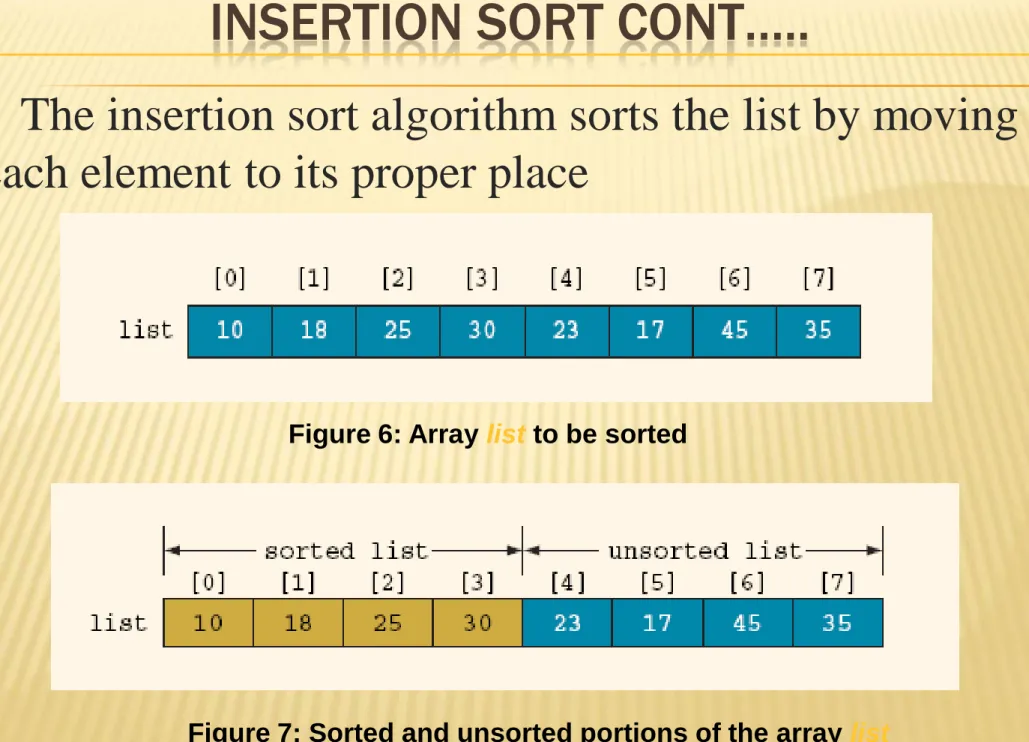
• The insertion sort algorithm sorts the list by moving
each element to its proper place
Figure 6: Array list to be sorted
INSERTION SORT ALGORITHM (CONT’D)
Figure 8: Move list[4] into list[2]
INSERTION SORT ALGORITHM (CONT’D)
Figure 10: Array list before copying list[3] into list[4], then
list[2] into list[3]
Figure 11: Array list after copying list[3] into list[4], and then
INSERTION SORT ALGORITHM (CONT’D)
AN EXAMPLE: INSERTION SORT
InsertionSort(A, n) { for i = 2 to n {
key = A[i] j = i - 1;
while (j > 0) and (A[j] > key) { A[j+1] = A[j] j = j - 1 } A[j+1] = key } } 30 10 40 20 1 2 3 4
i =
j =
key =
A[j] =
A[j+1] =
InsertionSort(A, n) { for i = 2 to n {
key = A[i] j = i - 1;
while (j > 0) and (A[j] > key) { A[j+1] = A[j] j = j - 1 } A[j+1] = key } } 30 10 40 20 1 2 3 4
i = 2
j = 1
key = 10
A[j] = 30
A[j+1] = 10
InsertionSort(A, n) { for i = 2 to n {
key = A[i] j = i - 1;
while (j > 0) and (A[j] > key) { A[j+1] = A[j] j = j - 1 } A[j+1] = key } } 30 30 40 20 1 2 3 4
i = 2
j = 1
key = 10
A[j] = 30
A[j+1] = 30
InsertionSort(A, n) { for i = 2 to n {
key = A[i] j = i - 1;
while (j > 0) and (A[j] > key) { A[j+1] = A[j] j = j - 1 } A[j+1] = key } } 30 30 40 20 1 2 3 4
i = 2
j = 1
key = 10
A[j] = 30
A[j+1] = 30
InsertionSort(A, n) { for i = 2 to n {
key = A[i] j = i - 1;
while (j > 0) and (A[j] > key) { A[j+1] = A[j] j = j - 1 } A[j+1] = key } } 30 30 40 20 1 2 3 4
i = 2
j = 0
key = 10
A[j] =
A[j+1] = 30
InsertionSort(A, n) { for i = 2 to n {
key = A[i] j = i - 1;
while (j > 0) and (A[j] > key) { A[j+1] = A[j] j = j - 1 } A[j+1] = key } } 30 30 40 20 1 2 3 4
i = 2
j = 0
key = 10
A[j] =
A[j+1] = 30
InsertionSort(A, n) { for i = 2 to n {
key = A[i] j = i - 1;
while (j > 0) and (A[j] > key) { A[j+1] = A[j] j = j - 1 } A[j+1] = key } } 10 30 40 20 1 2 3 4
i = 2
j = 0
key = 10
A[j] =
A[j+1] = 10
InsertionSort(A, n) { for i = 2 to n {
key = A[i] j = i - 1;
while (j > 0) and (A[j] > key) { A[j+1] = A[j] j = j - 1 } A[j+1] = key } } 10 30 40 20 1 2 3 4
i = 3
j = 0
key = 10
A[j] =
A[j+1] = 10
InsertionSort(A, n) { for i = 2 to n {
key = A[i] j = i - 1;
while (j > 0) and (A[j] > key) { A[j+1] = A[j] j = j - 1 } A[j+1] = key } } 10 30 40 20 1 2 3 4
i = 3
j = 0
key = 40
A[j] =
A[j+1] = 10
InsertionSort(A, n) { for i = 2 to n {
key = A[i] j = i - 1;
while (j > 0) and (A[j] > key) { A[j+1] = A[j] j = j - 1 } A[j+1] = key } } 10 30 40 20 1 2 3 4
i = 3
j = 0
key = 40
A[j] =
A[j+1] = 10
InsertionSort(A, n) { for i = 2 to n {
key = A[i] j = i - 1;
while (j > 0) and (A[j] > key) { A[j+1] = A[j] j = j - 1 } A[j+1] = key } } 10 30 40 20 1 2 3 4
i = 3
j = 2
key = 40
A[j] = 30
A[j+1] = 40
InsertionSort(A, n) { for i = 2 to n {
key = A[i] j = i - 1;
while (j > 0) and (A[j] > key) { A[j+1] = A[j] j = j - 1 } A[j+1] = key } } 10 30 40 20 1 2 3 4
i = 3
j = 2
key = 40
A[j] = 30
A[j+1] = 40
InsertionSort(A, n) { for i = 2 to n {
key = A[i] j = i - 1;
while (j > 0) and (A[j] > key) { A[j+1] = A[j] j = j - 1 } A[j+1] = key } } 10 30 40 20 1 2 3 4
i = 3
j = 2
key = 40
A[j] = 30
A[j+1] = 40
InsertionSort(A, n) { for i = 2 to n {
key = A[i] j = i - 1;
while (j > 0) and (A[j] > key) { A[j+1] = A[j] j = j - 1 } A[j+1] = key } } 10 30 40 20 1 2 3 4
i = 4
j = 2
key = 40
A[j] = 30
A[j+1] = 40
InsertionSort(A, n) { for i = 2 to n {
key = A[i] j = i - 1;
while (j > 0) and (A[j] > key) { A[j+1] = A[j] j = j - 1 } A[j+1] = key } } 10 30 40 20 1 2 3 4
i = 4
j = 2
key = 20
A[j] = 30
A[j+1] = 40
InsertionSort(A, n) { for i = 2 to n {
key = A[i] j = i - 1;
while (j > 0) and (A[j] > key) { A[j+1] = A[j] j = j - 1 } A[j+1] = key } } 10 30 40 20 1 2 3 4
i = 4
j = 2
key = 20
A[j] = 30
A[j+1] = 40
InsertionSort(A, n) { for i = 2 to n {
key = A[i] j = i - 1;
while (j > 0) and (A[j] > key) { A[j+1] = A[j] j = j - 1 } A[j+1] = key } } 10 30 40 20 1 2 3 4
i = 4
j = 3
key = 20
A[j] = 40
A[j+1] = 20
InsertionSort(A, n) { for i = 2 to n {
key = A[i] j = i - 1;
while (j > 0) and (A[j] > key) { A[j+1] = A[j] j = j - 1 } A[j+1] = key } } 10 30 40 20 1 2 3 4
i = 4
j = 3
key = 20
A[j] = 40
A[j+1] = 20
InsertionSort(A, n) { for i = 2 to n {
key = A[i] j = i - 1;
while (j > 0) and (A[j] > key) { A[j+1] = A[j] j = j - 1 } A[j+1] = key } } 10 30 40 40 1 2 3 4
i = 4
j = 3
key = 20
A[j] = 40
A[j+1] = 40
InsertionSort(A, n) { for i = 2 to n {
key = A[i] j = i - 1;
while (j > 0) and (A[j] > key) { A[j+1] = A[j] j = j - 1 } A[j+1] = key } } 10 30 40 40 1 2 3 4
i = 4
j = 3
key = 20
A[j] = 40
A[j+1] = 40
InsertionSort(A, n) { for i = 2 to n {
key = A[i] j = i - 1;
while (j > 0) and (A[j] > key) { A[j+1] = A[j] j = j - 1 } A[j+1] = key } } 10 30 40 40 1 2 3 4
i = 4
j = 3
key = 20
A[j] = 40
A[j+1] = 40
InsertionSort(A, n) { for i = 2 to n {
key = A[i] j = i - 1;
while (j > 0) and (A[j] > key) { A[j+1] = A[j] j = j - 1 } A[j+1] = key } } 10 30 40 40 1 2 3 4
i = 4
j = 2
key = 20
A[j] = 30
A[j+1] = 40
InsertionSort(A, n) { for i = 2 to n {
key = A[i] j = i - 1;
while (j > 0) and (A[j] > key) { A[j+1] = A[j] j = j - 1 } A[j+1] = key } } 10 30 40 40 1 2 3 4
i = 4
j = 2
key = 20
A[j] = 30
A[j+1] = 40
InsertionSort(A, n) { for i = 2 to n {
key = A[i] j = i - 1;
while (j > 0) and (A[j] > key) { A[j+1] = A[j] j = j - 1 } A[j+1] = key } } 10 30 30 40 1 2 3 4
i = 4
j = 2
key = 20
A[j] = 30
A[j+1] = 30
InsertionSort(A, n) { for i = 2 to n {
key = A[i] j = i - 1;
while (j > 0) and (A[j] > key) { A[j+1] = A[j] j = j - 1 } A[j+1] = key } } 10 30 30 40 1 2 3 4
i = 4
j = 2
key = 20
A[j] = 30
A[j+1] = 30
InsertionSort(A, n) { for i = 2 to n {
key = A[i] j = i - 1;
while (j > 0) and (A[j] > key) { A[j+1] = A[j] j = j - 1 } A[j+1] = key } } 10 30 30 40 1 2 3 4
i = 4
j = 1
key = 20
A[j] = 10
A[j+1] = 30
InsertionSort(A, n) { for i = 2 to n {
key = A[i] j = i - 1;
while (j > 0) and (A[j] > key) { A[j+1] = A[j] j = j - 1 } A[j+1] = key } } 10 30 30 40 1 2 3 4
i = 4
j = 1
key = 20
A[j] = 10
A[j+1] = 30
InsertionSort(A, n) { for i = 2 to n {
key = A[i] j = i - 1;
while (j > 0) and (A[j] > key) { A[j+1] = A[j] j = j - 1 } A[j+1] = key } } 10 20 30 40 1 2 3 4
i = 4
j = 1
key = 20
A[j] = 10
A[j+1] = 20
InsertionSort(A, n) { for i = 2 to n {
key = A[i] j = i - 1;
while (j > 0) and (A[j] > key) { A[j+1] = A[j] j = j - 1 } A[j+1] = key } } 10 20 30 40 1 2 3 4
i = 4
j = 1
key = 20
A[j] = 10
A[j+1] = 20
Done!
EXAMPLE: INSERTION SORT
99
|
55 4 66 28 31 36 52 38 72
55 99
|
4 66 28 31 36 52 38 72
4 55 99
|
66 28 31 36 52 38 72
4 55 66 99
|
28 31 36 52 38 72
4 28 55 66 99
|
31 36 52 38 72
4 28 31 55 66 99
|
36 52 38 72
4 28 31 36 55 66 99
|
52 38 72
4 28 31 36 52 55 66 99
|
38 72
4 28 31 36 38 52 55 66 99
|
72
4 28 31 36 38 52 55 66 72 99
|
INSERTION SORT ALGORITHM
void insertionSort(int array[], int length) {
int i, j, value;
for(i = 1; i < length; i++) {
value = a[i];
for (j = i - 1; j >= 0 && a[ j ] > value; j--) { a[j + 1] = a[ j ]; } a[j + 1] = value; } }
BUBBLE SORT
It is the oldest and simplest method and can be easily
implemented
It is also the slowest and considered to be the most inefficient
sorting algorithm
It works by comparing each item in the list with the item next to it,
and swapping them if required
BUBBLE SORT
To sort data in an array of n elements, n-1 iterations are required Following steps explain sorting of data in an array in acceding order
In first iteration, the largest value moves to the last position in the array In second iteration, the above process is repeated and the second largest
value moves to the second last position in the array and so on
BUBBLE SORT
Suppose the name of the array is A and it
has four elements with the following
values:
4 19 1 3
To sort this array in ascending order, n-1,
BUBBLE SORT
Iteration-1
A[1] is compared with element A[2]. Since 4 is not greater than 19. there will be no
change in the list.
A[2] is compared with element A[3]. Since 19 is greater than 1, the value are
interchanged
A[3] is compared with element A[4]. Since 19 is grater than 3, the value are
interchanged
Thus at the end of the first iteration, the largest value moves to the last
position in the array
4 19 1 3
4 1 19 3
BUBBLE SORT
Iteration-2
A[1] is compared with element A[2]. Since 4 is greater than 1, the value are
interchanged
A[2] is compared with element A[3]. Since 4 is grater than 3, the value are
interchanged
Thus at the end of the second iteration, the second largest value moves
to the second last position in the array
1 4 3 19
BUBBLE SORT
Iteration-3
A[1] is compared with element A[2]. Since 1 is not greater than 3, the value are not
interchanged
So array is sorted in ascending order
BUBBLE SORT
Bubble sort is similar to selection sort
in the sense that it repeatedly finds the
largest/smallest value in the unprocessed
portion of the array and puts it back.
However, finding the largest value is
not done by selection this time.
We "bubble" up the largest value
instead.
BUBBLE SORT
Compares adjacent items and exchanges them
if they are out of order.
Comprises of several passes.
In one pass, the largest value has been
“bubbled” to its proper position.
In second pass, the last value does not need to
BUBBLE SORT
void bubbleSort (int a[ ], int n) {
int i, j, temp, flag; for(i=n-1; i>0; i- -) { flag = 1; for(j=0; i>j; j++) { if(a[j]>a[j+1]) { flag = 0; temp = a[j]; a[j] = a[j+1]; a[j+1] = temp; }
} //out this block when flag is true, i.e. inner loop performed no swaps, so the list is already sorted
if(flag)
break; }
BUBBLE SORT EXAMPLE
9, 6, 2, 12, 11, 9, 3, 7
6, 9, 2, 12, 11, 9, 3, 7
6, 2, 9, 12, 11, 9, 3, 7
6, 2, 9, 12, 11, 9, 3, 7
6, 2, 9, 11, 12, 9, 3, 7
6, 2, 9, 11, 9, 12, 3, 7
6, 2, 9, 11, 9, 3, 12, 7
6, 2, 9, 11, 9, 3, 7, 12
BUBBLE SORT EXAMPLE
6, 2, 9, 11, 9, 3, 7, 12
2, 6, 9, 11, 9, 3, 7, 12
2, 6, 9, 9, 11, 3, 7, 12
2, 6, 9, 9, 3, 11, 7, 12
2, 6, 9, 9, 3, 7, 11, 12
6, 2, 9, 11, 9, 3, 7, 12
Notice that this time we do not have to compare the last two numbers as we know the 12 is in position. This pass therefore only requires 6 comparisons.
First Pass Second Pass
BUBBLE SORT EXAMPLE
2, 6, 9, 9, 3, 7, 11, 12
2, 6, 9, 3, 9, 7, 11, 12
2, 6, 9, 3, 7, 9, 11, 12
6, 2, 9, 11, 9, 3, 7, 12
2, 6, 9, 9, 3, 7, 11, 12
Second Pass First Pass Third PassThis time the 11 and 12 are in position. This pass therefore only requires 5 comparisons.
BUBBLE SORT EXAMPLE
2, 6, 9, 3, 7, 9, 11, 12
2, 6, 3, 9, 7, 9, 11, 12
2, 6, 3, 7, 9, 9, 11, 12
6, 2, 9, 11, 9, 3, 7, 12
2, 6, 9, 9, 3, 7, 11, 12
Second Pass First Pass Third PassEach pass requires fewer comparisons. This time only 4 are needed.
2, 6, 9, 3, 7, 9, 11, 12
BUBBLE SORT EXAMPLE
2, 6, 3, 7, 9, 9, 11, 12
2, 3, 6, 7, 9, 9, 11, 12
6, 2, 9, 11, 9, 3, 7, 12
2, 6, 9, 9, 3, 7, 11, 12
Second Pass First Pass Third PassThe list is now sorted but the algorithm does not know this until it completes a pass with no exchanges.
2, 6, 9, 3, 7, 9, 11, 12
Fourth Pass
2, 6, 3, 7, 9, 9, 11, 12
MERGE SORT
Merge sort is a sorting algorithm for
rearranging lists (or any other data
structure that can only be accessed
sequentially) into a specified order.
It is a particularly good example of the
MERGE SORT
Conceptually, merge sort works as follows:
Divide the unsorted list into two sub-lists
of about half the size.
Sort each of the two sub-lists.
Merge the two sorted sub-lists back into
MERGE SORT
Array mergeSort(Array m)
Array left, right. if length(m) ≤ 1
return m else
middle = length(m) / 2
for each x in m up to middle add x to left
for each x in m after middle add x to right
left = mergesort(left) right = mergesort(right) result = merge(left, right) return result
MERGE SORT
Array merge(left,right)
Array result
while length(left) > 0 and length(right) > 0 if first(left) ≤ first(right)
append first(left) to result left = rest(left)
else
append first(right) to result right = rest(right)
if length(left) > 0
append left to result if length(right) > 0
append right to result return result
MERGE SORT ANOTHER EXAMPLE
Suppose the name of the array is AB and
it has six elements with the following
values:
16 17 2 8 18 1
MERGE SORT
AB
Divide array AB into two sub-arrays A & B
A B
Sort A & B using Bubble or selection or insertion sort
A
B
16 17 2 8 18 1
16 17 2 8 18 1
MERGE SORT
A B
Compare A[1] to B[1], so B[1] is less than A[1], the value of B[1] is
move to AB[1]
AB
1
MERGE SORT
A B
Compare A[1] to B[2], so A[1] is less than B[2], the value of A[2] is
move to AB[2]
AB
1 2
MERGE SORT
A B
Compare A[2] to B[2], so B[2] is less than A[2], the value of B[2] is
move to AB[3]
AB
1 2 8
MERGE SORT
A B
Compare A[2] to B[3], so A[2] is less than B[3], the value of A[2] is
move to AB[4]
AB
1 2 8 16
MERGE SORT
A B
Compare A[3] to B[3], so A[3] is less than B[3], the value of A[3] is
move to AB[5]
AB
At the end, B[3] is move to AB[6], array is sorted
AB
1 2 8 16 17
2 16 17 1 8 18
ALGORITHM
Mergesort(Passed an array) if array size > 1
Divide array in half
Call Mergesort on first half. Call Mergesort on second half. Merge two halves.
Merge(Passed two arrays)
Compare leading element in each array Select lower and place in new array.
(If one input array is empty then place
remainder of other array in output array)
67 45
23 14 6 33
67 45 23 14 6 33 98 42 67 45 23 14 6 33 98 42
67 45 23 14 6 33 98 42 67 45 23 14 6 33 98 42 45 23 14 98
67 45 23 14 6 33 98 42 67 45 23 14 6 33 98 42 45 23 14 98 23 98
67 45 23 14 6 33 98 42 67 45 23 14 6 33 98 42 45 23 14 98 23 98 Merge
67 45 23 14 6 33 98 42 67 45 23 14 6 33 98 42 45 23 14 98 23 98 23 Merge
67 45 23 14 6 33 98 42 67 45 23 14 6 33 98 42 45 23 14 98 23 98 23 98 Merge
67 45 23 14 6 33 98 42 67 45 23 14 6 33 98 42 45 23 14 98 23 98 45 14 23 98
67 45 23 14 6 33 98 42 67 45 23 14 6 33 98 42 45 23 14 98 23 98 45 14 Merge 23 98
67 45 23 14 6 33 98 42 67 45 23 14 6 33 98 42 45 23 14 98 23 98 45 14 14 Merge 23 98
67 45 23 14 6 33 98 42 67 45 23 14 6 33 98 42 45 23 14 98 23 98 45 14 45 Merge 23 98 14
67 45 23 14 6 33 98 42 67 45 23 14 6 33 98 42 45 23 14 98 23 98 45 14 Merge 98 14 45 23
67 45 23 14 6 33 98 42 67 45 23 14 6 33 98 42 45 23 14 98 23 98 45 14 Merge 98 14 14 23 45
67 45 23 14 6 33 98 42 67 45 23 14 6 33 98 42 45 23 14 98 23 98 45 14 Merge 23 14 14 23 98 45
67 45 23 14 6 33 98 42 67 45 23 14 6 33 98 42 45 23 14 98 23 98 45 14 Merge 23 98 14 45 14 23 45
67 45 23 14 6 33 98 42 67 45 23 14 6 33 98 42 45 23 14 98 23 98 45 14 Merge 23 98 14 45 14 23 45 98
67 45 23 14 6 33 98 42 67 45 23 14 6 33 98 42 45 23 14 98 23 98 45 14 67 6 33 42 23 98 14 45 14 23 45 98
67 45 23 14 6 33 98 42 67 45 23 14 6 33 98 42 45 23 14 98 23 98 45 14 67 6 33 42 67 6 23 98 14 45 14 23 45 98
67 45 23 14 6 33 98 42 67 45 23 14 6 33 98 42 45 23 14 98 23 98 45 14 67 6 33 42 67 6 Merge 23 98 14 45 14 23 45 98
67 45 23 14 6 33 98 42 67 45 23 14 6 33 98 42 45 23 14 98 23 98 45 14 67 6 33 42 67 6 6 Merge 23 98 14 45 14 23 45 98
67 45 23 14 6 33 98 42 67 45 23 14 6 33 98 42 45 23 14 98 23 98 45 14 67 6 33 42 67 6 67 Merge 23 98 14 45 6 14 23 45 98
67 45 23 14 6 33 98 42 67 45 23 14 6 33 98 42 45 23 14 98 23 98 45 14 67 6 33 42 67 6 33 42 23 98 14 45 6 67 14 23 45 98
67 45 23 14 6 33 98 42 67 45 23 14 6 33 98 42 45 23 14 98 23 98 45 14 67 6 33 42 67 6 33 42 Merge 23 98 14 45 6 67 14 23 45 98
67 45 23 14 6 33 98 42 67 45 23 14 6 33 98 42 45 23 14 98 23 98 45 14 67 6 33 42 67 6 33 42 Merge 33 23 98 14 45 6 67 14 23 45 98
67 45 23 14 6 33 98 42 67 45 23 14 6 33 98 42 45 23 14 98 23 98 45 14 67 6 33 42 67 6 33 42 Merge 42 23 98 14 45 6 67 33 14 23 45 98
67 45 23 14 6 33 98 42 67 45 23 14 6 33 98 42 45 23 14 98 23 98 45 14 67 6 33 42 67 6 33 42 Merge 23 98 14 45 6 67 33 42 14 23 45 98
67 45 23 14 6 33 98 42 67 45 23 14 6 33 98 42 45 23 14 98 23 98 45 14 67 6 33 42 67 6 33 42 Merge 23 98 14 45 6 33 42 14 23 45 98 6 67
67 45 23 14 6 33 98 42 67 45 23 14 6 33 98 42 45 23 14 98 23 98 45 14 67 6 33 42 67 6 33 42 Merge 23 98 14 45 6 33 14 23 45 98 6 33 67 42
67 45 23 14 6 33 98 42 67 45 23 14 6 33 98 42 45 23 14 98 23 98 45 14 67 6 33 42 67 6 33 42 Merge 23 98 14 45 6 33 42 14 23 45 98 6 33 42 67
67 45 23 14 6 33 98 42 67 45 23 14 6 33 98 42 45 23 14 98 23 98 45 14 67 6 33 42 67 6 33 42 Merge 23 98 14 45 6 67 33 42 14 23 45 98 6 33 42 67
67 45 23 14 6 33 98 42 67 45 23 14 6 33 98 42 45 23 14 98 23 98 45 14 67 6 33 42 67 6 33 42 Merge 23 98 14 45 6 67 33 42 23 45 98 33 42 67 14 6
67 45 23 14 6 33 98 42 67 45 23 14 6 33 98 42 45 23 14 98 23 98 45 14 67 6 33 42 67 6 33 42 Merge 23 98 14 45 6 67 33 42 23 45 98 6 42 67 6 14 33
67 45 23 14 6 33 98 42 67 45 23 14 6 33 98 42 45 23 14 98 23 98 45 14 67 6 33 42 67 6 33 42 Merge 23 98 14 45 6 67 33 42 14 45 98 6 42 67 6 14 23 33
67 45 23 14 6 33 98 42 67 45 23 14 6 33 98 42 45 23 14 98 23 98 45 14 67 6 33 42 67 6 33 42 Merge 23 98 14 45 6 67 33 42 14 23 98 6 42 67 6 14 23 45 33
67 45 23 14 6 33 98 42 67 45 23 14 6 33 98 42 45 23 14 98 23 98 45 14 67 6 33 42 67 6 33 42 Merge 23 98 14 45 6 67 33 42 14 23 98 6 33 67 6 14 23 33 45 42
67 45 23 14 6 33 98 42 67 45 23 14 6 33 98 42 45 23 14 98 23 98 45 14 67 6 33 42 67 6 33 42 Merge 23 98 14 45 6 67 33 42 14 23 98 6 33 42 6 14 23 33 42 45 67
67 45 23 14 6 33 98 42 67 45 23 14 6 33 98 42 45 23 14 98 23 98 45 14 67 6 33 42 67 6 33 42 Merge 23 98 14 45 6 67 33 42 14 23 45 6 33 42 6 14 23 33 42 45 98 67
67 45 23 14 6 33 98 42 67 45 23 14 6 33 98 42 45 23 14 98 23 98 45 14 67 6 33 42 67 6 33 42 Merge 23 98 14 45 6 67 33 42 14 23 45 98 6 33 42 67 6 14 23 33 42 45 67
67 45 23 14 6 33 98 42 67 45 23 14 6 33 98 42 45 23 14 98 23 98 45 14 67 6 33 42 67 6 33 42 Merge 23 98 14 45 6 67 33 42 14 23 45 98 6 33 42 67 6 14 23 33 42 45 67 98
67 45 23 14 6 33 98 42 67 45 23 14 6 33 98 42 45 23 14 98 23 98 45 14 67 6 33 42 67 6 33 42 23 98 14 45 6 67 33 42 14 23 45 98 6 33 42 67 6 14 23 33 42 45 67 98
67 45
23 14 6 33
98 42
QUICK SORT
Quick sort sorts by employing a divide and conquer
strategy to divide a list into two sub-lists.
The steps are:
Pick an element, called a pivot, from the list.
Reorder the list so that all elements which are less
than the pivot come before the pivot and so that all
elements greater than the pivot come after it (equal
values can go either way).
After this partitioning, the pivot is in its final
position. This is called the
partition operation
.
![Figure 8: Move list[4] into list[2]](https://thumb-us.123doks.com/thumbv2/123dok_us/8363981.315747/24.1080.66.1056.26.789/figure-move-list-into-list.webp)
![Figure 10 : Array list before copying list[3] into list[4], then](https://thumb-us.123doks.com/thumbv2/123dok_us/8363981.315747/25.1080.94.1057.50.779/figure-array-list-copying-list-list.webp)
![Figure 12: Array list after copying temp into list[2]](https://thumb-us.123doks.com/thumbv2/123dok_us/8363981.315747/26.1080.7.1077.54.772/figure-array-list-copying-temp-list.webp)