www.impactjournals.com/oncotarget/
Oncotarget, 2017, Vol. 8, (No. 34), pp: 56174-56184
MicroRNA-610 suppresses osteosarcoma oncogenicity via targeting
TWIST1 expression
Chi Jin
1,*, Yongjian Feng
2,*, Yongjian Ni
1and Zhonglin Shan
1 1The Third Department of Orthopaedics, Central Hospital of Cangzhou City, Cangzhou, Hebei, China 2The Fourth Department of Orthopaedics, Central Hospital of Cangzhou City, Cangzhou, Hebei, China *These authors contributed equally to this workCorrespondence to: Chi Jin, email: [email protected]
Keywords: osteosarcoma, microRNAs, miR-610, Twist1, cisplatin
Received: January 16, 2017 Accepted: March 24, 2017 Published: April 11, 2017
Copyright: Jin et al. This is an open-access article distributed under the terms of the Creative Commons Attribution License 3.0 (CC BY 3.0), which permits unrestricted use, distribution, and reproduction in any medium, provided the original author and source are credited.
ABSTRACT
Osteosarcoma is the most frequent primary bone tumor affects adolescents and young adults. Recently, microRNAs (miRNAs) are short, non-coding and endogenous RNAs that played as important roles in the initiation and progression of tumors. In this study, we try to explore the biological function and expression of miR-610 in the osteosarcoma. We showed that miR-610 expression was downregulated in the osteosarcoma tissues and cell lines. Elevated expression of miR-610 suppressed the osteosarcoma cell proliferation, cell cycle, invasion and EMT program. Moreover, overexpression of miR-610 increased sensitivity of MG-63 and U2OS cells to cisplatin. Twist1 was identified as a direct target gene of miR-610 in the osteosarcoma cell. Furthermore, we demonstrated that Twist1 was upregulated in the osteosarcoma tissues and cell lines. The expression of Twist1 was negatively associated with the expression of miR-610 expression in the osteosarcoma tissues. Ectopic expression of Twist1 inhibited the sensitivity of miR-610-overexpressing MG-63 cells to cisplatin. We also showed that overexpression of Twist1 increased the proliferation and invasion of miR-610-overexpressing MG-63 cells. These data indicated that ectopic expression of miR-610 suppressed the osteosarcoma cell proliferation, cell cylce, invasion and increased the sensitivity of osteosarcoma cells to cisplatin through targeting the Twist1 expression.
INTRODUCTION
Osteosarcoma is the most frequent primary bone
tumor affects adolescents and young adults, which is
prone to early metastasis and frequently occurs in the long
bones [1–5]. Despite the recently advancements including
adjuvant chemotherapy, radiotherapy and wide tumor
excision, the prognosis and 5 years survival rate of these
patients remains poor [6–9]. Chemotherapeutic drugs such
as cisplatin and doxorubicin are well used in osteosarcoma
and 5-year survival rate has been increased from 20% to
70% [10, 11]. However, the molecular mechanisms about
acquiring chemoresistance are still unknow [12–14]. It is
urgent need to find these molecular mechanisms to explore
therapeutic strategies.
MicroRNAs (miRNAs) are a type of short,
non-coding and endogenous RNAs that inhibit the protein non-coding
genes expression through partial complementary binding
to the 3’ UTR of mRNAs [15–19]. It has been shown that
miRNAs mediate several biology functions including cell
development, differentiation, apotosis, proliferation, and
metabolism [20–24]. Aberrantly expression of miRNAs
was found in a variety of human tumors such as gastric
cancer, glioblastoma, Ewing’s sarcoma, bladder cancer,
colon Cancer and also osteosarcoma [16, 25–29]. In
addition, mounting evidences demonstrated that miRNAs
also act crucial roles in the development of drug resistance
in different cancers [30–33].
In this study, we try to explore the biological
function and expression of miR-610 in the osteosarcoma.
We showed that miR-610 expression was downregulated
in the osteosarcoma tissues and cell lines. Elevated
expression of miR-610 suppressed the osteosarcoma cell
proliferation, cell cycle, invasion and EMT program.
Moreover, overexpression of miR-610 increased sensitivity
of MG-63 and U2OS cells to cisplatin.
RESULTS
miR-610 increased the sensitivity of
osteosarcoma cells to cisplatin
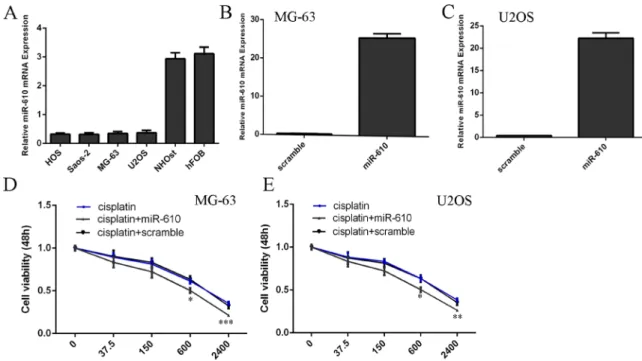
The miR-610 expression level was downregulated
in the osteosarcoma cells (HOS, SAOS-2, MG-63 and
U2OS) compared to in the hFOB cells (Figure 1A).
qRT-PCR analysis suggested that miR-610 mimic could
significantly enhance miR-610 expression both the MG-63
and U2OS cell (Figure 1B and 1C). The response of
MG-63 and U2OS cells to cisplatin enhanced after treated with
the miR-610 mimic compared to the scramble-transfected
cells (Figure 1D and 1E).
The expression of miR-610 was downregulated in
osteosarcoma tissues
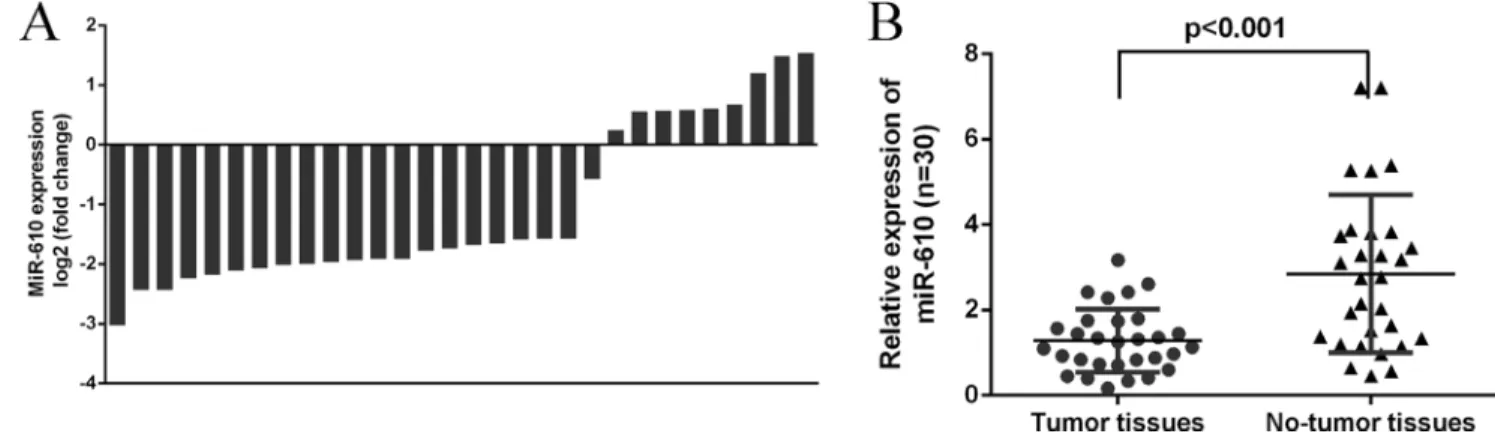
We next determined the miR-610 expression level
in the osteosarcoma tissues. We showed that miR-610 was
downregulated in 21 osteosarcoma cases compare to the
adjacent non-tumor tissues (Figure 2A). The miR-610
expression was lower in the osteosarcoma tissues compare
with the adjacent non-tumor tissues (Figure 2B).
Overexpression of miR-610 suppressed
epithelial-mesenchymal transition (EMT) program
Ectopic expression of miR-610 increased the
epithelial marker E-cadherin protein expression and
decreased the mesenchymal marker N-cadherin,
Vimentin and Snail protein expression (Figure 3A).
MiR-610 overexpression promoted the E-cadherin mRNA
expression and supressed N-cadherin, Vimentin and Snail
mRNA expression (Figure 3B).
Elevated expression of miR-610 suppressed the
osteosarcoma cell proliferation
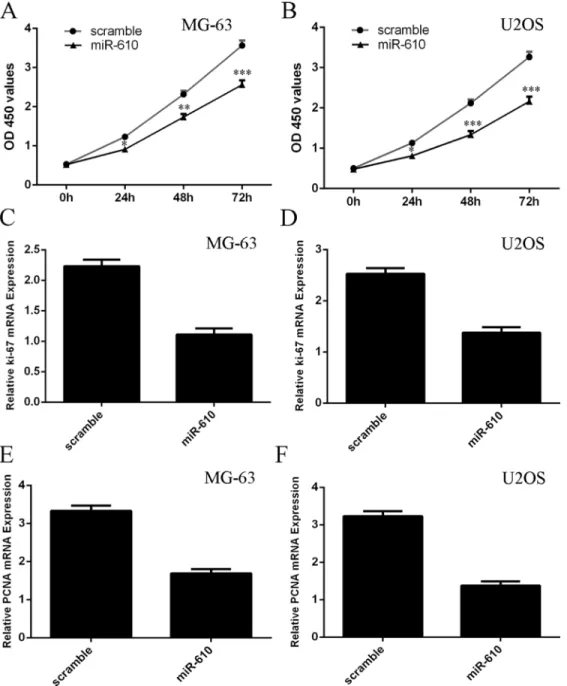
Ectopic expression of miR-610 suppressed the
MG-63 and U2OS cell proliferation (Figure 4A and 4B).
Moreover, overexpression of miR-610 decreased the
ki-67 expression in the MG-63 and U2OS cell (Figure 4
C and 4D). In addition, elevated expression of miR-610
supressed the PCNA expression both in the MG-63 and
U2OS cell (Figure 4E and 4F).
miR-610 overexpression inhibited the
osteosarcoma cell cycle and invasion
Ectopic expression of miR-610 suppressed the
MG-63 and U2OS cell cycle (Figure 5A and 5B). elevated
expression of miR-610 decreased cell invasion both in the
MG-63 and U2OS cell (Figure 5C and 5D).
Twist1 was a direct target gene of miR-610
To search the molecular mechanism involved in
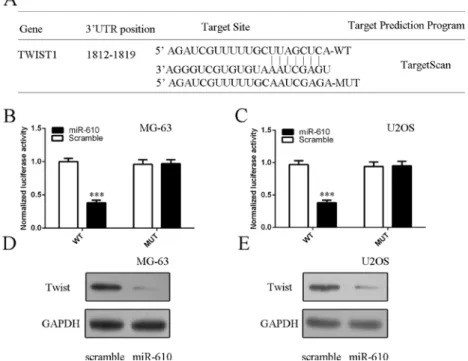
the function of miR-610 in osteosarcoma cell, we used
the TargetScan databases to find potential target gene of
Figure 1: miR-610 increased the sensitivity of osteosarcoma cells to cisplatin.
(A) The expression of miR-610 in the osteosarcoma cells (HOS, SAOS-2, MG-63 and U2OS) and hFOB cells was determined by qRT-PCR. (B) The miR-610 expression in the MG-63 cell after treated with miR-610 mimic. (C) MiR-610 mimic could promote the miR-610 expression in the U2OS cell. (D) The response of MG-63 cells to cisplatin enhanced after treated with the miR-610 mimic compared to the scramble-transfected cells. (E) The response of U2OS cells to cisplatin enhanced after treated with the miR-610 mimic compared to the scramble-transfected cells. *p < 0.05, **p < 0.01 and ***p < 0.001.miR-610. The putative binding site of miR-610 and Twist1
is shown in Figure 6A. Luciferase assay demonstrated that
miR-610 overexpression decreased luciferase activity of
wild-type (WT) 3ʹUTR of the Twist1 vector, but not in the
mutated-type (Mut) 3ʹUTR of the Twist1 construct both in the
MG-63 and U2OS cell (Figure 6B and 6C). Overexpression
of miR-610 suppressed the Twist1 protein expression both in
the MG-63 and U2OS cell (Figure 6D and 6E).
Twist1 was upregulated in osteosarcoma tissues
The Twist1 expression level was upregulated in
the osteosarcoma cells (HOS, SAOS-2, MG-63 and
U2OS) compared to in the hFOB cells (Figure 7A).
We furtherly determined the Twist1 expression level
in the osteosarcoma tissues. We showed that Twist1
was upregulated in 25 osteosarcoma cases compare to
the adjacent non-tumor tissues (Figure 7B). The Twist1
expression was higher in the osteosarcoma tissues
compare with the adjacent non-tumor tissues (Figure 7C).
The expression of Twist1 was negatively associated with
the expression of miR-610 expression in the osteosarcoma
tissues (Figure 7D).
miR-610 increased the sensitivity of
osteosarcoma cells to cisplatin and decreased
the osteosarcoma cell proliferation and invasion
through downregulating Twist1
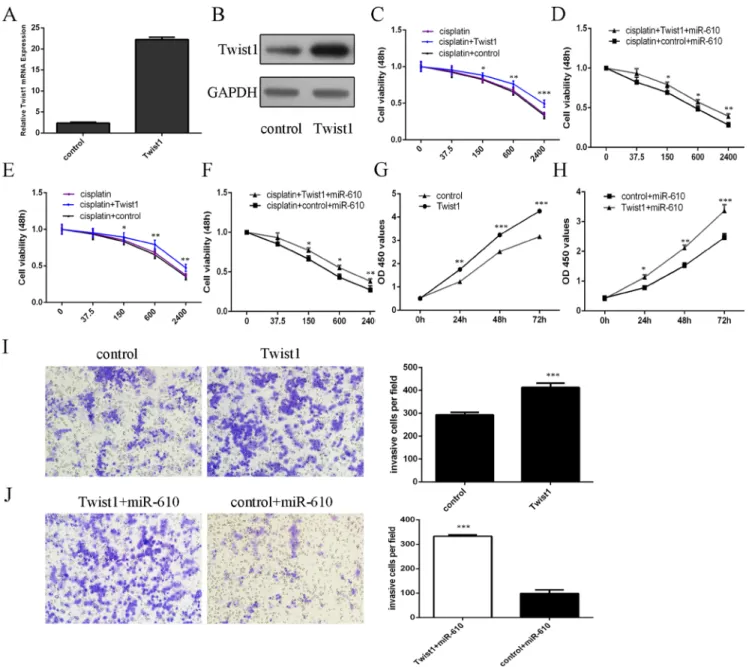
The Twist1 mRNA and protein expression was
upregulated in the MG-63 cell after tranfected with
Twist1 vector (Figure 8A and 8B). The response of
MG-63 and U2OS cells to cisplatin enhanced after treated
with the Twist1 vector compared to the cotrol-transfected
cells (Figure 8C and 8E). Moreover, the responses of
miR-610-overexpressing MG-63 and U2OS cells to
Figure 2: The expression of miR-610 was downregulated in osteosarcoma tissues.
(A) The expression of miR-610 in 30 osteosarcoma cases and adjacent non-tumor tissues was shown. (B) The miR-610 expression was lower in the osteosarcoma tissues compare with the adjacent non-tumor tissues.Figure 3: Overexpression of miR-610 suppressed epithelial-mesenchymal transition (EMT) program.
(A) The protein expression of E-cadherin, N-cadherin, Vimentin and Snail was determined by Western blot. (B) The mRNA expression of E-cadherin, N-cadherin, Vimentin and Snail was determined by qRT-PCR.cisplatin were increased after transfection with the Twist1
vector compared with the control vector (Figure 8D
and 8F). Overexpression of Twist1 enhanced MG-63
cell proliferation (Figure 8G) and invasion (Figure 8I).
Moreover, ectopic expression of Twist1 promoted the
proliferation (Figure 8H) and invasion (Figure 8G) of
miR-610-overexpressing MG-63 cells.
DISCUSSION
Osteosarcoma is the most frequent bone tumor
occurring in adolescence and childhood, with the high
mortality[14, 34, 35]. However, the molecular mechanism
about osteosarcoma progression still remains elusive. It is
supposed that miRNA deregulated expression is involved
in the progression of human tumors[36–39]. In this study,
we explored the biological function and expression of
610 in the osteosarcoma. We showed that
miR-610 expression was downregulated in the osteosarcoma
tissues and cell lines. Elevated expression of miR-610
suppressed the osteosarcoma cell proliferation, cell cycle,
invasion and EMT program. Moreover, overexpression
of miR-610 increased sensitivity of MG-63 and U2OS
cells to cisplatin. Twist1 was identified as a direct target
gene of miR-610 in the osteosarcoma cell. Furthermore,
we demonstrated that Twist1 was upregulated in the
Figure 4: Elevated expression of miR-610 suppressed the osteosarcoma cell proliferation.
(A) Ectopic expression of miR-610 suppressed the MG-63 cell proliferation. (B) Overexpression of miR-610 decreased the U2OS cell proliferation. (C) The expression of Ki-67 was analyzed by qRT-PCR. (D) Ectopic expression of miR-610 suppressed ki-67 expression in the U2OS cell. (E) The expression of PCNA was analyzed by qRT-PCR. (F) Ectopic expression of miR-610 suppressed PCNA expression in the U2OS cell. *p < 0.05, **p < 0.01 and ***p < 0.001.Figure 5: miR-610 overexpression inhibited the osteosarcoma cell cycle and invasion.
(A) Ectopic expression of miR-610 suppressed the MG-63 cell cycle. (B) MiR-610 overexpression decreased the U2OS cell cycle. (C) Elevated expression of miR-610 decreased the MG-63 cell invasion. The relative invasive cells were shown in the right. (D) Ectopic expression of miR-610 suppressed the U2OS cell invasion. The relative invasive cells were shown in the right. **p < 0.01 and ***p < 0.001.Figure 6: Twist1 was a direct target gene of miR-610.
(A) The putative binding site of miR-610 and Twist1 is shown. (B) Luciferase report assay demonstrated that miR-610 overexpression suppressed the luciferase activity of wild-type (WT) 3ʹUTR of the Twist1 vector in the MG-63 cell. (C) MiR-610 overexpression suppressed the luciferase activity of wild-type (WT) 3ʹUTR of the Twist1 vector in the U2OS cell. (D) Ectopic expression of miR-610 decreased the Twist1 protein expression in the MG-63 cell. (E) The protein expression of Twist1 was measured by western blot. ***p < 0.001.osteosarcoma tissues and cell lines. The expression of
Twist1 was negatively associated with the expression of
miR-610 expression in the osteosarcoma tissues. Ectopic
expression of Twist1 inhibited the sensitivity of
miR-610-overexpressing MG-63 cells to cisplatin. We also showed
that overexpression of Twist1 increased the proliferation
and invasion of miR-610-overexpressing MG-63 cells.
These data indicated that miR-610 acted as a tumor
suppressor role in the osteosarcoma progression and
was associated to the sensitivity of osteosarcoma cell to
cisplatin.
Previous data demonstrated that miR-610 was
involved in tumor initiation and progression [40–42].
For example, Wang et al. [40]. suggested that miR-610
suppressed the gastric cancer cell migration and invasion
through inhibiting vasodilator-stimulated phosphoprotein
(VASP) expression. Zeng et al. [43]. confirmed that
miR-610 was decreased in the hepatocellular carcinoma tissues
and cell lines. Ectopic expression of miR-610 reduced
the hepatocellular carcinoma cell proliferation and
tumorigenicity through regulating the protein 1 (TBL1X)
and lipoprotein receptor-related protein 6 (LRP6)
expression. Mo et al. [42]. showed that the expression
level of miR-610 was downregulated in the glioblastoma
cell and tissues and overexpression of miR-610 suppressed
the glioblastoma cell proliferation through regulating the
CCND2 and AKT3 expression. Sun et al. [41]. found
that miR-610 expression level was downregulated in the
colorectal cancer tissues and overexpression of miR-610
decreased the colorectal cancer cell proliferation, invasion
and migration by regulating the hepatoma-derived growth
factor (HDGF) expression. Yan et al. [44]. also showed
that miR-610 expression was decreased in glioma samples
and overexpression of miR-610 suppressed the glioma
cell proliferation, invasion and migration by targeting
the MDM2 expression. In line with these data, we also
demonstrated that miR-610 expression was downregulated
in the osteosarcoma tissues and cell lines. Elevated
expression of miR-610 suppressed the osteosarcoma cell
proliferation, cell cycle, invasion and EMT program.
To study the potential mechanism about miR-610
regulated the proliferation and invasion of osteosarcoma,
we used open-target prediction programs (TargetScan
databases) to predict the target gene of miR-610, and Twist1
was focused. Twist1 is a conserved basic transcription factor
of helix-loop-helix and regulates cell migration, embryonic
morphogenesis and differentiation of myoblast, mesodermal
and osteoblast [45–48]. Recently, several studies showed
Figure 7: Twist1 was upregulated in osteosarcoma tissues.
(A) The Twist1 expression in the osteosarcoma cells (HOS, SAOS-2, MG-63 and U2OS) and hFOB was detected by qRT-PCR. (B) Twist1 was upregulated in 25 osteosarcoma cases compare to the adjacent non-tumor tissues. (C) The Twist1 expression was higher in the osteosarcoma tissues compare with the adjacent non-tumor tissues. (D) The expression of Twist1 was negatively associated with the expression of miR-610 expression in the osteosarcoma tissues.that Twist1 played as an oncogene that increased the
tumor cell proliferation, migration and invasion, induced
the EMT progression, angiogenesis and anti-apoptosis
[49–51]. Twist1 has been found to be upregulated in a lot
of tumors such as gastric cancer, ovarian cancer, breast
cancer, bladder cancer and also osteosarcoma [52–56].
Increasing studies suggested that Twist1 was involved in
drug resistance of cancer [55, 57, 58]. In our study, we
firstly used the TargetScan databases to show that there is
a putative binding site of miR-610 and Twist1. Luciferase
assay demonstrated that miR-610 overexpression decreased
luciferase activity of WT 3ʹUTR of the Twist1 vector,
but not in the Mut 3ʹUTR of the Twist1 construct both in
the MG-63 and U2OS cell. Overexpression of miR-610
suppressed the Twist1 protein expression both in the
MG-63 and U2OS cell. Moreover, we also indicated that Twist1
expression level was upregulated in osteosarcoma tissues
and cell lines. The expression of Twist1 was negatively
Figure 8: miR-610 increased the sensitivity of osteosarcoma cells to cisplatin and decreased the osteosarcoma cell
proliferation and invasion through downregulating Twist1.
(A) The Twist1 mRNA expression was analyzed by qRT-PCR. (B) The Twist1 protein expression was analyzed by western blot. (C) The response of MG-63 cells to cisplatin enhanced after treated with the Twist1 vector compared to the cotrol-transfected cells. (D) The response of miR-610-overexpressing MG-63 cells to cisplatin was increased after transfection with the Twist1 vector compared with the control vector. (E) The response of U2OS cells to cisplatin enhanced after treated with the Twist1 vector compared to the cotrol-transfected cells. (F) The response of miR-610-overexpressing U2OS cells to cisplatin were increased after transfection with the Twist1 vector compared with the control vector. (G) Overexpression of Twist1 enhanced MG-63 cell proliferation. (H) Ectopic expression of Twist1 promoted the proliferation of miR-610-overexpressing MG-63 cells. (I) Overexpression of Twist1 enhanced MG-63 cell invasion. (J) Ectopic expression of Twist1 promoted the invasion of miR-610-overexpressing MG-63 cells. *p < 0.05, **p < 0.01 and ***p < 0.001.associated with the expression of miR-610 expression in
the osteosarcoma tissues. Furthermore, we showed that
Twist1 decreased the sensitivity of osteosarcoma cells
to cisplatin and ectopic expression of Twist1 promoted
the osteosarcoma cell proliferation and invasion. We
demonstrated that miR-610 overexpression increased the
sensitivity of osteosarcoma cells to cisplatin and decreased
the osteosarcoma cell proliferation and invasion through
downregulating Twist1 expression.
In summary, our study suggested that miR-610
expression level was downregulated in the osteosarcoma
samples and cell lines. Ectopic expression of miR-610
suppressed the osteosarcoma cell proliferation, cell cylce,
invasion and increased the sensitivity of osteosarcoma
cells to cisplatin through targeting the Twist1 expression.
MATERIALS AND METHODS
Tissues, cell lines cultured and transfection
Osteosarcoma and the matched adjacent
non-tumor tissues were obtained from surgical resection in
our hospital. Tissues are immediately frozen in the liquid
nitrogen and stored until used. This project was approved
with the Institutional Ethics Committee of Central Hospital
of Cangzhou City and written informed consent was get
from each patient. The Osteosarcoma cell lines (MG63,
HOS, U2OS, and Saos-2) and normal human osteoblastic
cell line hFOB were cultured in the DMEM (Dulbecco’s
modified Eagle’s medium) suppled with FBS, penicillin
and streptomyc. miR-610 mimic and oligonucleotide
scramble were obtained from the GenePharm (Shanghai,
China) and transfected into the MG-63 cells by using
Lipofectamine 2000 (Invitrogen, CA, USA) following
to the manufacturer’s protocol. These characteristics of
patients are described in Supplementary Table 1.
Quantitative RT-PCR
Total RNA was prepared from cells or tissues with
TRIzol (Life Technologies, NY). Quantification for miR-610
and TWIST1 was performed by using qRT-PCR following
to the manufacturer’s information. The expression of U6 was
used as the internal control to the expression of miR-610;
the expression of GAPDH was used as the internal control
to the expression of TWIST. TWIST, forward primer:
5ʹ-ACGAGCTGGACTCCAAGATG-3ʹ and reverse primer:
5ʹ-CACGCCCTGTTTCTTTGAAT-3ʹ; GAPDH, forward
primer: 5ʹ-GACTCATGACCACAGTCCATGC-3ʹ; and
reverse primer: 5ʹ-AGAGGCAGGGATGATGTTCTG-3ʹ.
Cell proliferation and colony formation
Cells were cultured in the 96-well and cell
proliferation was determined by MTT assay (Promega,
Madison, USA) following to the company’s instruction.
Cells proliferation was counted after 24 and 48 hours. The
absorbance was measured by the microtiter plate reader at
450 nm (Molecular Devices, CA, USA).
Cell cycle and invasion
For cell cycle analysis, cells were fixed with 70%
ethanol, re-suspended in the PBS containing Rnase, Triton
X-100 and propidium iodide (Sigma). The cell then was
analyzed by FACSArray Flow Cytometer (Becton Dickerson,
San Jose, CA, USA). For cell invasion, transwell chambers
were used. Cells were cultured on the upper chamber with
the non-coated membrane (Millipore) in the serum-free
media. The lower chamber with the media containing FBS
was used as a chemoattractant. The migration cell on the
lower chamber was determined using microscope.
Luciferase report assay
Cells were cultured in the 48-well plates with
about 60% confluence. Cell was transfected with
miR-610 mimics or scramble and pGL3-TWIST1-3’UTR
and PRL-TK by using Lipofectamine 2000 according to
manufacturer’s instructions. Renilla and firefly luciferase
activitie was determined by using the dual-luciferase
reporter (Promega, USA).
Western blot analysis
Proteins were isolated using a RIPA
(radioimmunoprecipitation) lysis buffer. Total protein was
separated by 12% SDS-PAGE and then transferred to
polyvinylidene fluoride (PVDF) membranes (Millipore,
USA). After blocked with the nonfat milk, the membrane was
incubated with antibodies against TWIST (1:1000, Santa Cruz,
USA), GAPDH (1:5000, Santa Cruz, USA). The membrane
was measured by ECL reagent (Applygen, Beijing).
Statistical analysis
Data are shown as mean ± SD. Comparisons
between more than two groups were performed with
ANOVA and different between two groups was done using
Student’s t-tests. P < 0.05 was considered statistically
significant.
CONFLICTS OF INTEREST
None.
REFERENCES
1. Han K, Chen X, Bian N, Ma B, Yang T, Cai C, Fan Q, Zhou Y, Zhao TB. MicroRNA profiling identifies MiR-195 suppresses osteosarcoma cell metastasis by targeting CCND1. Oncotarget. 2015; 6:8875–89. https://doi. org/10.18632/oncotarget.3560.
2. Salah Z, Arafeh R, Maximov V, Galasso M, Khawaled S, Abou-Sharieha S, Volinia S, Jones KB, Croce CM, Aqeilan RI. miR-27a and miR-27a* contribute to metastatic properties of osteosarcoma cells. Oncotarget. 2015; 6:4920– 35. https://doi.org/10.18632/oncotarget.3025.
3. Tsai HC, Su HL, Huang CY, Fong YC, Hsu CJ, Tang CH. CTGF increases matrix metalloproteinases expression and subsequently promotes tumor metastasis in human osteosarcoma through down-regulating miR-519d. Oncotarget. 2014; 5:3800–12. https://doi.org/10.18632/ oncotarget.1998.
4. Delebinski CI, Georgi S, Kleinsimon S, Twardziok M, Kopp B, Melzig MF, Seifert G. Analysis of proliferation and apoptotic induction by 20 steroid glycosides in 143B osteosarcoma cells in vitro. Cell Prolif. 2015; 48:600–10. 5. Tang J, Shen L, Yang Q, Zhang C. Overexpression of
metadherin mediates metastasis of osteosarcoma by regulating epithelial-mesenchymal transition. Cell Prolif. 2014; 47:427–34.
6. Sarver AL, Thayanithy V, Scott MC, Cleton-Jansen AM, Hogendoorn PC, Modiano JF, Subramanian S. MicroRNAs at the human 14q32 locus have prognostic significance in osteosarcoma. Orphanet J Rare Dis. 2013; 8:7.
7. Geng S, Zhang X, Chen J, Liu X, Zhang H, Xu X, Ma Y, Li B, Zhang Y, Bi Z, Yang C. The tumor suppressor role of miR-124 in osteosarcoma. PLoS One. 2014; 9:e91566. 8. Guo S, Bai R, Liu W, Zhao A, Zhao Z, Wang Y, Wang Y,
Zhao W, Wang W. miR-22 inhibits osteosarcoma cell proliferation and migration by targeting HMGB1 and inhibiting HMGB1-mediated autophagy. Tumour Biol. 2014; 35:7025–34.
9. Huang YZ, Zhang J, Shao HY, Chen JP, Zhao HY. MicroRNA-191 promotes osteosarcoma cells proliferation by targeting checkpoint kinase 2. Tumour Biol. 2015; 36:6095–101.
10. Zhao G, Cai C, Yang T, Qiu X, Liao B, Li W, Ji Z, Zhao J, Zhao H, Guo M, Ma Q, Xiao C, Fan Q, Ma B. MicroRNA-221 induces cell survival and cisplatin resistance through PI3K/Akt pathway in human osteosarcoma. PLoS One. 2013; 8:e53906.
11. Zhang Y, Duan G, Feng S. MicroRNA-301a modulates doxorubicin resistance in osteosarcoma cells by targeting AMP-activated protein kinase alpha 1. Biochem Biophys Res Commun. 2015; 459:367–73.
12. Xu M, Jin H, Xu CX, Bi WZ, Wang Y. MiR-34c inhibits osteosarcoma metastasis and chemoresistance. Med Oncol. 2014; 31:972.
13. Kobayashi E, Hornicek FJ, Duan Z. MicroRNA Involvement in Osteosarcoma. Sarcoma. 2012; 2012:359739. https://doi. org/10.1155/2012/359739.
14. Pan W, Wang H, Jianwei R, Ye Z. MicroRNA-27a promotes proliferation, migration and invasion by targeting MAP2K4 in human osteosarcoma cells. Cell Physiol Biochem. 2014; 33:402–12.
15. Huang K, Dong X, Sui C, Hu D, Xiong T, Liao S, Zhang H. MiR-223 suppresses endometrial carcinoma cells proliferation by targeting IGF-1R. Am J Transl Res. 2014; 6:841–49.
16. Kang M, Ren MP, Zhao L, Li CP, Deng MM. miR-485-5p acts as a negative regulator in gastric cancer progression by targeting flotillin-1. Am J Transl Res. 2015; 7:2212–22. 17. Li J, You T, Jing J. MiR-125b inhibits cell biological
progression of Ewing’s sarcoma by suppressing the PI3K/ Akt signalling pathway. Cell Prolif. 2014; 47:152–60. 18. Wang P, Xu J, Hou Z, Wang F, Song Y, Wang J, Zhu H,
Jin H. miRNA-34a promotes proliferation of human pulmonary artery smooth muscle cells by targeting PDGFRA. Cell Prolif. 2016; 49:484–93.
19. Liu Z, Mai C, Yang H, Zhen Y, Yu X, Hua S, Wu Q, Jiang Q, Zhang Y, Song X, Fang W. Candidate tumour suppressor CCDC19 regulates miR-184 direct targeting of C-Myc thereby suppressing cell growth in non-small cell lung cancers. J Cell Mol Med. 2014; 18:1667–79.
20. Ji F, Zhang H, Wang Y, Li M, Xu W, Kang Y, Wang Z, Wang Z, Cheng P, Tong D, Li C, Tang H. MicroRNA-133a, downregulated in osteosarcoma, suppresses proliferation and promotes apoptosis by targeting Bcl-xL and Mcl-1. Bone. 2013; 56:220–26.
21. Li Z, Yu X, Shen J, Chan MT, Wu WK. MicroRNA in intervertebral disc degeneration. Cell Prolif. 2015; 48:278–83. 22. Yu X, Li Z, Chen G, Wu WK. MicroRNA-10b Induces Vascular Muscle Cell Proliferation Through Akt Pathway by Targeting TIP30. Curr Vasc Pharmacol. 2015; 13:679–86. 23. Li Z, Yu X, Wang Y, Shen J, Wu WK, Liang J, Feng F.
By downregulating TIAM1 expression, microRNA-329 suppresses gastric cancer invasion and growth. Oncotarget. 2015; 6:17559–69. https://doi.org/10.18632/ oncotarget.2755.
24. Yu X, Li Z, Shen J, Wu WK, Liang J, Weng X, Qiu G. MicroRNA-10b promotes nucleus pulposus cell proliferation through RhoC-Akt pathway by targeting HOXD10 in intervetebral disc degeneration. PLoS One. 2013; 8:e83080.
25. Gao X, Jin W. The emerging role of tumor-suppressive microRNA-218 in targeting glioblastoma stemness. Cancer Lett. 2014; 353:25–31.
26. Li Z, Yu X, Shen J, Wu WK, Chan MT. MicroRNA expression and its clinical implications in Ewing’s sarcoma. Cell Prolif. 2015; 48:1–6.
27. Fei X, Qi M, Wu B, Song Y, Wang Y, Li T. MicroRNA-195-5p suppresses glucose uptake and proliferation of human bladder cancer T24 cells by regulating GLUT3 expression. FEBS Lett. 2012; 586:392–97.
28. Jiang Z, Xu Y, Cai S. Down-regulated GAS1 expression correlates with recurrence in stage II and III colorectal cancer. Hum Pathol. 2011; 42:361–68.
29. Lu J, Song G, Tang Q, Yin J, Zou C, Zhao Z, Xie X, Xu H, Huang G, Wang J, Lee DF, Khokha R, Yang H, et al.
MiR-26a inhibits stem cell-like phenotype and tumor growth of osteosarcoma by targeting Jagged1. Oncogene. 2016. 30. Yu X, Li Z. MicroRNA expression and its implications for
diagnosis and therapy of tongue squamous cell carcinoma. J Cell Mol Med. 2016; 20:10–6.
31. Yu X, Li Z. The role of miRNAs in cutaneous squamous cell carcinoma. J Cell Mol Med. 2016; 20:3–9.
32. Geng S, Gu L, Ju F, Zhang H, Wang Y, Tang H, Bi Z, Yang C. MicroRNA-224 promotes the sensitivity of osteosarcoma cells to cisplatin by targeting Rac1. J Cell Mol Med. 2016; 20:1611–19.
33. Jiang L, Lin T, Xu C, Hu S, Pan Y, Jin R. miR-124 interacts with the Notch1 signalling pathway and has therapeutic potential against gastric cancer. J Cell Mol Med. 2016; 20:313–22.
34. Huang G, Nishimoto K, Zhou Z, Hughes D, Kleinerman ES. miR-20a encoded by the miR-17-92 cluster increases the metastatic potential of osteosarcoma cells by regulating Fas expression. Cancer Res. 2012; 72:908–16.
35. Xu H, Liu X, Zhao J. Down-regulation of miR-3928 promoted osteosarcoma growth. Cell Physiol Biochem. 2014; 33:1547–56.
36. Jin Y, Peng D, Shen Y, Xu M, Liang Y, Xiao B, Lu J. MicroRNA-376c inhibits cell proliferation and invasion in osteosarcoma by targeting to transforming growth factor-alpha. DNA Cell Biol. 2013; 32:302–09.
37. Chen L, Wang Q, Wang GD, Wang HS, Huang Y, Liu XM, Cai XH. miR-16 inhibits cell proliferation by targeting IGF1R and the Raf1-MEK1/2-ERK1/2 pathway in osteosarcoma. FEBS Lett. 2013; 587:1366–72.
38. Won KY, Kim YW, Kim HS, Lee SK, Jung WW, Park YK. MicroRNA-199b-5p is involved in the Notch signaling pathway in osteosarcoma. Hum Pathol. 2013; 44:1648–55. 39. Gong M, Ma J, Guillemette R, Zhou M, Yang Y, Yang Y, Hock JM, Yu X. miR-335 inhibits small cell lung cancer bone metastases via IGF-IR and RANKL pathways. Mol Cancer Res. 2014; 12:101–10.
40. Wang J, Zhang J, Wu J, Luo D, Su K, Shi W, Liu J, Tian Y, Wei L. MicroRNA-610 inhibits the migration and invasion of gastric cancer cells by suppressing the expression of vasodilator-stimulated phosphoprotein. Eur J Cancer. 2012; 48:1904–13.
41. Sun B, Gu X, Chen Z, Xiang J. MiR-610 inhibits cell proliferation and invasion in colorectal cancer by repressing hepatoma-derived growth factor. Am J Cancer Res. 2015; 5:3635–44.
42. Mo X, Cao Q, Liang H, Liu J, Li H, Liu F. MicroRNA-610 suppresses the proliferation of human glioblastoma cells by repressing CCND2 and AKT3. Mol Med Rep. 2016; 13:1961–66.
43. Zeng XC, Liu FQ, Yan R, Yi HM, Zhang T, Wang GY, Li Y, Jiang N. Downregulation of miR-610 promotes proliferation and tumorigenicity and activates Wnt/β-catenin signaling in human hepatocellular carcinoma. Mol Cancer. 2014; 13:261.
44. Yan Y, Peng Y, Ou Y, Jiang Y. MicroRNA-610 is downregulated in glioma cells, and inhibits proliferation and motility by directly targeting MDM2. Mol Med Rep. 2016; 14:2657–64.
45. Mammoto T, Jiang A, Jiang E, Mammoto A. Role of Twist1 Phosphorylation in Angiogenesis and Pulmonary Fibrosis. Am J Respir Cell Mol Biol. 2016; 55:633–44.
46. Oh BY, Kim SY, Lee YS, Hong HK, Kim TW, Kim SH, Lee WY, Cho YB. Twist1-induced epithelial-mesenchymal transition according to microsatellite instability status in colon cancer cells. Oncotarget. 2016; 7:57066–76. https:// doi.org/10.18632/oncotarget.10974.
47. Palumbo-Zerr K, Soare A, Zerr P, Liebl A, Mancuso R, Tomcik M, Sumova B, Dees C, Chen CW, Wohlfahrt T, Mallano T, Distler A, Ramming A, et al. Composition of TWIST1 dimers regulates fibroblast activation and tissue fibrosis. Ann Rheum Dis. 2017; 76:244–51.
48. Sozen B, Pehlivanoglu S, Demir N. Differential expression pattern of Twist1 in mouse preimplantation embryos suggests its multiple roles during early development. J Assist Reprod Genet. 2016; 33:1533–40.
49. Yuan W, Li T, Mo X, Wang X, Liu B, Wang W, Su Y, Xu L, Han W. Knockdown of CMTM3 promotes metastasis of gastric cancer via the STAT3/Twist1/EMT signaling pathway. Oncotarget. 2016; 7:29507–19. https://doi. org/10.18632/oncotarget. 8789.
50. Weyemi U, Redon CE, Sethi TK, Burrell AS, Jailwala P, Kasoji M, Abrams N, Merchant A, Bonner WM. Twist1 and Slug mediate H2AX-regulated epithelial-mesenchymal transition in breast cells. Cell Cycle. 2016; 15:2398–404. 51. Xu Y, Qin L, Sun T, Wu H, He T, Yang Z, Mo Q, Liao L, Xu
J. Twist1 promotes breast cancer invasion and metastasis by silencing Foxa1 expression. Oncogene. 2016.
52. Wei C, Cheng J, Zhou B, Zhu L, Khan MA, He T, Zhou S, He J, Lu X, Chen H, Zhang D, Zhao Y, Fu J. Tripartite motif containing 28 (TRIM28) promotes breast cancer metastasis by stabilizing TWIST1 protein. Sci Rep. 2016; 6:29822. 53. Wang L, Zhou R, Zhao Y, Dong S, Zhang J, Luo Y,
Huang N, Shi M, Bin J, Liao Y, Liao W. MACC-1 Promotes Endothelium-Dependent Angiogenesis in Gastric Cancer by Activating TWIST1/VEGF-A Signal Pathway. PLoS One. 2016; 11:e0157137.
54. Tseng WC, Chuang CW, Yang MH, Pan CC, Tarng DC. Kruppel-like factor 4 is a novel prognostic predictor for urothelial carcinoma of bladder and it regulates TWIST1-mediated epithelial-mesenchymal transition. Urol Oncol. 2016; 34:485. e15-485.e24. https://doi.org/10.1016/j.urolonc.2016.07.002. 55. Roberts CM, Tran MA, Pitruzzello MC, Wen W, Loeza J,
Dellinger TH, Mor G, Glackin CA. TWIST1 drives cisplatin resistance and cell survival in an ovarian cancer model, via upregulation of GAS6, L1CAM, and Akt signalling. Sci Rep. 2016; 6:37652.
56. Okamura H, Yoshida K, Haneji T. Negative regulation of TIMP1 is mediated by transcription factor TWIST1. Int J Oncol. 2009; 35:181–86.
57. Zhang L, Su B, Sun W, Li W, Luo M, Liu D, Mei Q, Long G, Hu G, Hu G. Twist1 promotes radioresistance in nasopharyngeal carcinoma. Oncotarget. 2016; 7:81332–40. https://doi.org/10.18632/oncotarget.12875.
58. Sakowicz-Burkiewicz M, Przybyla T, Wesserling M, Bielarczyk H, Maciejewska I, Pawelczyk T. Suppression of TWIST1 enhances the sensitivity of colon cancer cells to 5-fluorouracil. Int J Biochem Cell Biol. 2016; 78:268–78.