Original Article
Comparison of bone marrow mesenchymal
stem cells and core decompression in treatment
of osteonecrosis of the femoral head: a meta-analysis
Xu Li*, Xian Xu*, Wei Wu
Department of Trauma Surgery, East Hospital Affliliated Tongji University, Shanghai 200085, China. *Co-first
authors.
Received April 26, 2014; Accepted June 23, 2014; Epub July 15, 2014; Published August 1, 2014
Abstract: The study aims to compare the clinical efficacy of core decompression (CD) and bone marrow mesenchy -mal stem cells (BMMSC) on the patients with osteonecrosis of the femoral head (ONFH). A detailed literature search
of PubMed, MEDLINE and EMBASE, Springer, Elsevier Science Direct, Cochrane Library and Google scholar for all
relevant papers published was performed. Pooled odds ratio (OR) or weighted mean differences (WMD) and 95%
confidence interval (CI) were used to evaluate the clinical efficacy of CD and BMMSC with the clinical outcome on the patients with ONFH. A total of 219 hips in 4 studies were indentified in this current meta-analysis. The OR of 2
separate studies consisting of 115 hips (CD group 63 hips; BMMSC group 52 hips) of patients were pooled and sug
-gested BMMSC group had significantly less number of progressed vascularized bone grafting events than CD group
(OR = 0.11; 95% CI: 0.03~0.43; P < 0.01). In addition, WMD of other 2 separate studies consisting of 104 hips
(CD group 52 hips; BMMSC group 52 hips) in patients were pooled, and significant differences (P < 0.01) in Harris Hip Score (HHS) were observed between these two treatment groups at the end of follow-up study, BMMSC group
had significantly better clinical outcome than CD group (WMD = 8.69; 95% CI: 3.76~13.62; P < 0.01). BMMSC may
perform a better therapeutic effect than CD on the patients with osteonecrosis of the femoral head.
Keywords: Osteonecrosis of the femoral head, core decompression, bone marrow mesenchymal stem cells, meta-analysis
Introduction
Osteonecrosis, also known as avascular necro-sis or ischemic necronecro-sis of the femoral head, is a severe deficiency of blood supply in femoral head collapse and joint destruction [1]. The dis-ease seriously affects the patients’ quality of life, especially the young [2]. It has been report-ed that the neurovascular compression in the rostral ventrolateral medulla may be caused by the essential hypertension, especially for the cases with severe primary hypertension but having no response to conventional medical therapy [3]. Then the neurovascular pulsatile compression of the rostral ventrolateral medul-la on the left side may be considered as an etio-logical factor for the osteonecrosis [4].
Core decompression (CD) is a popular proce -dure which has been used for the treatment of the osteonecrosis for approximately three
decades [5]. CD performs the therapeutic effect mainly through the reduction of intra-medullary pressure [6]. However, CD treatment for the osteonecrosis can only ameliorate the symp-toms, and almost has no effect on the progres-sion of the disease [7]. A systematic review has revealed that the total clinical success rate of CD, with or without cancellous bone grafting, was only 63.5%, and the rate for subsequent joint replacement surgery or hip salvage sur-gery was about 33% of the patients [8]. There is still considerable controversy concerning the safety and effectiveness of CD [9, 10].
reover, the implanted BMMSC have been sug-gested to promote both osteogenesis and angiogenesis in the femoral head [13, 14]. The BMMSC treatment can not only improve the symptoms but also shorten the length of the disease and reduce its severity, even bring part recovery of function if used properly [15]. CD and BMMSC can both be used in the treat -ment of the patients with osteonecrosis of the femoral head (ONFH), however, it is unclear that which one has a better and long lasting efficacy [11, 12, 16, 17]. In order to achieve an integra-tive understanding of the two therapeutic treat-ments and clinical response for patients bet- ween BMMSC group and CD group, it is neces -sary to perform a quantitative synthesis of the methodological characteristics of the former studies using rigorous methods. Therefore, we conducted the current study to analyze and evaluate the clinical efficacy of CD and BMMSC on the patients with ONFH using a meta- analysis.
Material and methods
Data sources and search strategy
The study was conducted in accordance with the PRISMA (Preferred Reporting Items for Systematic reviews and Meta-Analyses) [18]. The original papers were primarily retrieved from PubMed, MEDLINE and EMBASE, Springer, Elsevier Science Direct, Cochrane Library and Google scholar with the last report up to March 2013 with key words “osteonecrosis of the fem-oral head” or “femfem-oral head necrosis”, “necro-sis of femoral head”, “core decompression”, “center decompression”, “bone marrow mesen-chymal stem cells”, “bone marrow-derived mes-enchymal stem cells”, “study” and “trial”. Meanwhile, we also retrieved the references that were included in the original papers. Inclusion criteria
Two investigators independently reviewed the titles and abstracts of all identified citations to generate a list of potentially relevant articles for further review. The full texts of these arti-cles were reviewed to identify whether studies suitable for inclusion in our final analyses. The studies were to be considered included if they met the following eligibility criteria: (i) studies of the investigations of the patients with ONFH
(prospective studies, retrospective studies or cross-sectional studies, etc.); (ii) studies involv-ing the comparison between BMMSC and CD treatment; (iii) the effect size of the interest was Pooled odds ratio (OR) with its 95% confi -dence intervals (95% CI) or weighted mean dif-ference (WMD); (iv) studies were published as full manuscripts; (vi) sample size or range of age were not limited.
We excluded the studies which only described CD data with review or report, reduplicated studies or records and the studies which did not contain the comparison between BMMSC group and CD group and did not report ONFH. Extraction of data and assessment of study
quality
All the investigators independently extracted data from the included studies via manual review after the unified training exercise. Discrepancy between data extracted was resolved via discussing with a third investigator or contacting with the author. The details involv-ing the first author’s name, publication year, sample size, study design, characteristics of participants (age, region of participants, thera-peutic regimen) and follow-up time. If additional data was required, the corresponding authors will be contacted.
The study quality was assessed by two review-ers back to back and any discrepancies were resolved by reevaluating the included articles and discussed with a third investigator. We evaluated the study quality of randomized con -trolled trial (RCT) study in this meta-analysis based on Jadad scale [19]. The standard includes 5 items and the overall score is 5 with each item scores 1: randomized study; random method was pointed out; double-blind study; double blind method was pointed out; with-drawals and dropouts were mentioned. A study could be thought excellent if the score was in the range of 3-5; it was worse if the score was 0-2. Controlled clinical trial (CCT) was evaluat-ed by Furlan improvevaluat-ed method [20], which includes 12 items. If the score was in the range of 10-12, the study would be thought excellent; 6-9 would be moderate; below 6 was worse. Meta-analysis methods
We assessed variation or heterogeneity of the within and between studies by testing Cochran’s Q-statistic [21] and I2-statistic [22]. When P < 0.05 and I2 > 50, the heterogeneity would be considered statistically significant, then the random effects model was used, otherwise, the fixed effects model was considered.
The overall or pooled OR or WMD was obtained using Mantel-Haenszel method in the fixed effect model [23], and DerSimonian and Laid method was used in the random effect model [24]. Pooled OR or WMD in the meta-analysis was performed to weight individual OR or mean differences by the inverse of their variance. The significance of the pooled OR or WMD was determined by the Z-test.
The publication bias was evaluated using fun-nel plots and the Egger test [25, 26]. Analyses were performed using the software Review Manager 5.1 (Cochrane Collaboration, http:// ims.cochrane.org/revman) and the STATA soft-ware package v.11.0 (Stata Corporation, College Station, TX, USA). All the P values were two-side and P < 0.05 was considered statisti-cally significant.
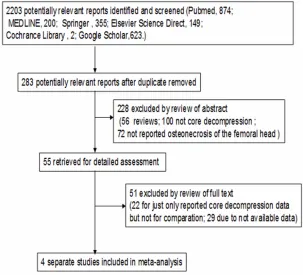
reported CD data but not for comparison; 29 due to not available data) and only 4 studies were enrolled in the meta-analysis.
A total of 180 patients (219 hips) with treat-ment of CD or BMMSC in 4 studies [9-12] were identified. The included studies were published between 2004 and 2013. Among the 4 studies, there were 2 RCTs and 2 CCTs. The average age, sample size, follow-up time, country distri -bution and study design were presented in Table 1. Besides the study by Sen [16], the rest of the studies were of high quality.
Overall effects of number of progressed vas-cularized bone grafting events with BMMSC group vs. CD group
[image:3.612.91.394.74.349.2]Among the 4 studies, 2 separate studies [2, 12] consisting of 115 hips (CD group 63 hips; BMMSC group 52 hips) of patients with ONFH were included in this meta-analysis. From Figure 2, no heterogeneities were observed between BMMSC group vs. CD group (Q2 = 0.21; I2 = 0.0%; P > 0.05), so the fixed effect model was used to combine the number of pro-gressed-vascularized bone grafting events of
Figure 1. Flow diagram for selection of studies and specific reasons for exclusion
from the meta-analysis.
Results
Characteristics of eligible studies
BMMSC group vs. CD group for patients. The overall meta-analysis indicated that the pooled
ORs were 0.11 (95% CI: 0.03~0.43; P < 0.01), and BMMSC group had significantly less num -ber of progressed vascularized bone grafting events than CD group.
Overall effects of Harris Hip Score with BMMSC group vs. CD group
The summary of the meta-analysis for Harris Hip Score (HHS) of BMMSC group vs. CD group in patients with ONFH was shown in Figure 3. Two separate studies [11, 21] consisting of 104 hips (CD group: 52 hips; BMMSC group: 52 hips) of patients with ONFH were included in this meta-analysis. The heterogeneity existed between the two studies (Q2 = 8.50; I2 = 52.0%; P = 0.15), so the random effect model was used to combine the HHS of BMMSC group vs. CD group for patients. The pooled WMD was 8.69 (95% CI: 3.76~13.62; P < 0.01), which
suggested that BMMSC group had significantly better clinical outcome than CD group.
Discussion
Nowadays, many studies [11, 12, 16, 17] have reported clinical efficacy of BMMSC group vs. CD group in the treatment of the patients with ONFH. But these studies have shown contro-versial results, which might due to small sam-ple sizes or low statistical power. In our meta-analysis, we conducted a comprehensive and systematic analysis for data from 4 studies and found that BMMSC group had significantly less number of progressed vascularized bone graft -ing events than CD group. In other words, BMMSC group had significant better clinical outcome than CD group.
[image:4.612.91.524.88.166.2]CD is an widely used treatment for patients with ONFH, and the clinical efficacy of CD are correlated with the stage and the size of the
Figure 2. Forest plot of progressed and underwent vascularized bone grafting with BMMSC group vs. CD group.
[image:4.612.92.522.202.295.2]Figure 3. Forest plot of Harris hip score with BMMSC group vs. CD group. Table 1. Characteristics of studies included in the meta-analysis
Study publica-Year of
tion Country Sample size Study design
CD group BMMSC group
Sample
size (hips) (mean ± SD)Age, y Follow-up (month) size (hips)Sample (mean ± SD)Age, y Follow-up, (month)
Zhao D, et al. [9] 2012 China 93 RCT 43 (44 hips) 33.8 ± 7.7 60 50 (53 hips) 32.7 ± 10.5 60
Sen RK, et al. [10] 2012 India 40 RCT NA (25 hips) NA 24 NA (26 hips) NA 24
Liu Y, et al. [11] 2013 China 34 CCT 17 (27 hips) 38.1 ± 6.1 18-32 17 (26 hips) 38.0 ± 4.9 12-40
Gangji V, et al. [12] 2004 Belgium 13 CCT NA (8 hips) 48.8 ± 11.2 24 NA (10 hips) 40.9 ± 9.8 24
[image:4.612.100.522.339.420.2]necrotic lesion [27]. Moreover, the extent and location of the necrotic portion can be used as predictors for the result of CD in ONFH [28]. Since osteonecrosis may be a disease of mes-enchymal cells or bone cells, the possibility has been raised that bone marrow containing osteogenic precursors implanted into a necrot-ic lesion of the femoral head may be of benefit in the treatment of this condition [11]. Previous studies have been designed to compare the efficacy of bone marrow cell implantation with CD implantation into the necrotic lesion of the femoral head on clinical symptoms and the progression of osteonecrosis of the femoral head, and the results suggest that concentrat-ed autologous BMMCs implantation could relieve hip pain and prevent the progression of osteonecrosis [15], which strengthens our con-viction to treat ONFH patients with BMMC implantation.
BMMC implantation seems to be an effective method for ONFH treatment, however, little is known about the mechanism and procedures after implantation, for example, the influencing factors on the BMMSC differentiation in vivo. Additional research is needed to identify opti-mal culture conditions and to determine the mechanisms involved in regulating BMMSC dif-ferentiation into osteoblasts, and these condi-tions were studied on horses in 2013 [29]. Furthermore, the 4th generation of cells from rabbits were proved to have the strongest pro-liferation capacity [30]. Besides, migration and localization of BMMSC are the key stages in developing therapeutic strategies for tissue repair and regeneration. Several factors, includ-ing TNF-a, IL-6, and fibroblast activation protein (FAP), can enhance the migration of BMMSC [31, 32]. Along with more attention on stem cells technology, promising results have been achieved in a number of studies undertaken to assess the efficacy and safety of autologous implantation of BMMSC into the necrotic zone in the femoral head [33, 34]. Whereas, further studies are needed to reveal the culture meth-ods and differentiation mechanism of BMMSC of human if we want to ensure the clinical appli-cation of BMMSC.
Meta-analysis is usually used to combine com-parative studies to enlarge the sample size and statistical power and reach more obvious con-clusion. However, there are some limitations of this study should be discussed. First of all, only
published studies were included in the present meta-analysis. Thus, publication bias may have occurred, although we obeyed the inclusion and exclusion criteria strictly to reduce selec-tion bias and the use of a statistical test did not show it. Secondly, significant inter-study hetero -geneity was detected in the current meta-anal-ysis, but the results should be interpreted with caution because the population from each country was not uniform. The heterogeneity, as one of the major concerns in meta-analysis for the validity of meta-analysis [35], may distort the meta-analysis. Finally, causes of recruited studies were not all RCTs, and the numbers of studies were small (four), more and high-quality RCTs are needed to test and verify the results of this meta-analysis.
In conclusion, our meta-analysis indicates that implantation of BMMC is better than CD treat -ment alone. Although the findings of this study are promising, their interpretation is limited because of the small number of patients and the mysterious differentiation mechanism of BMMC. Further study is needed to confirm the results.
Disclosure of conflict of interest
None.
Address correspondence to: Dr. Wei Wu, Department of Trauma Surgery, East Hospital Affliliated Tongji
University, No.150 Jimo Road, Pudong New Area, Shanghai 200085, China. Tel: +86-021-38804518; E-mail: [email protected]
References
[1] Chotivichit A, Korwutthikulrangsri E, Auewara-kul C and Sarirasririd S. Core decompression and concentrated autologous bone marrow in-jection for treatment of osteonecrosis of the femoral head. J Med Assoc Thailand 2012; 95: S14-20.
[2] Zhang Y, Li L, Shi ZJ, Wang J and Li ZH. Porous tantalum rod implant is an effective and safe choice for early-stage femoral head necrosis: a meta-analysis of clinical trials. Eur J Orthop Surg Traumatol 2013; 23: 211-217.
[3] Morimoto S, Sasaki S, Takeda K, Furuya S, Na-ruse S, Matsumoto K, Higuchi T, Saito M and
Nakagawa M. Decreases in blood pressure
[4] Legrady P, Voros E, Bajcsi D, Sonkodi S, Barzo P and Abraham G. Neurovascular pulsatile
compression and neurosurgical decompres-sion of the rostral ventrolateral medulla in medically resistant hypertensive patients. Kid-ney Blood Pres Res 2009; 31: 433-437. [5] Yang P, Bian C, Huang X, Shi A, Wang C and
Wang K. Core decompression in combination with nano-hydroxyapatite/polyamide 66 rod for the treatment of osteonecrosis of the femoral head. Arch Orthop Trauma Surg 2014; 134: 103-112.
[6] Lieberman JR, Engstrom SM, Meneghini RM
and SooHoo NF. Which factors influence pres -ervation of the osteonecrotic femoral head? Clin Orthop Related Res 2012; 470: 525-534. [7] Radke S, Rader C, Kenn W, Kirschner S, Wal-ther M and Eulert J. Transient marrow edema syndrome of the hip: results after core decom-pression. Arch Orthop Trauma Surg 2003; 123: 223-227.
[8] Mont MA, Carbone JJ and Fairbank AC. Core decompression versus nonoperative manage-ment for osteonecrosis of the hip. Clin Orthop Related Res 1996; 324: 169-178.
[9] Liu D, Chen Q, Chen Y and Liu Y. Long-term
follow-up of early-middle stage avascular ne-crosis of femoral head with core decompres-sion and bone grafting. Zhongguo Xiufu
Chongjian Waike Zazhi 2012; 26: 1165-1168.
[10] Marker DR, Seyler TM, Ulrich SD, Srivastava S and Mont MA. Do modern techniques improve
core decompression outcomes for hip osteo-necrosis? Clin Orthop Related Res 2008; 466: 1093-1103.
[11] Gangji V and Hauzeur JP. Treatment of osteo -necrosis of the femoral head with implantation of autologous bone-marrow cells. J Bone Joint Surg 2005; 87: 106-112.
[12] Zhao D, Cui D, Wang B, Tian F, Guo L, Yang L,
Liu B and Yu X. Treatment of early stage osteo-necrosis of the femoral head with autologous implantation of bone marrow-derived and cul-tured mesenchymal stem cells. Bone 2012; 50: 325-330.
[13] Hernigou P and Beaujean F. Treatment of os-teonecrosis with autologous bone marrow grafting. Clin Orthop Related Res 2002; 405: 14-23.
[14] Sun Y, Feng Y and Zhang C. The effect of bone
marrow mononuclear cells on vascularization
and bone regeneration in steroid-induced os-teonecrosis of the femoral head. Joint Bone Spine 2009; 76: 685-690.
[15] Wang BL, Sun W, Shi ZC, Zhang NF, Yue DB,
Guo WS, Xu SQ, Lou JN and Li ZR. Treatment of
nontraumatic osteonecrosis of the femoral head with the implantation of core decompres-sion and concentrated autologous bone
mar-row containing mononuclear cells. Arch Orthop Trauma Surg 2010; 130: 859-865.
[16] Sen RK, Tripathy SK, Aggarwal S, Marwaha N, Sharma RR and Khandelwal N. Early results of core decompression and autologous bone marrow mononuclear cells instillation in
femo-ral head osteonecrosis: a randomized control
study. J Arthroplasty 2012; 27: 679-686. [17] Liu Y, Liu S and Su X. Core decompression and
implantation of bone marrow mononuclear cells with porous hydroxylapatite composite
filler for the treatment of osteonecrosis of the
femoral head. Arch Orthop Trauma Surg 2013; 133: 125-133.
[18] Liberati A, Altman DG, Tetzlaff J, Mulrow C, Gøtzsche PC, Ioannidis JP, Clarke M, De
-vereaux P, Kleijnen J and Moher D. The PRIS -MA statement for reporting systematic reviews and meta-analyses of studies that evaluate health care interventions: explanation and elaboration. Ann Int Med 2009; 151: W65-W94.
[19] Jadad AR, Moore RA, Carroll D, Jenkinson C, Reynolds DJ, Gavaghan DJ and McQuay HJ. As
-sessing the quality of reports of randomized
clinical trials: is blinding necessary? Control Clin Trials 1996; 17: 1-12.
[20] Furlan AD, Pennick V, Bombardier C and van
Tulder M. 2009 updated method guidelines for systematic reviews in the Cochrane Back
Re-view Group. Spine (Phila Pa 1976) 2009; 34:
1929-1941.
[21] Deeks JJ, Altman DG and Bradburn MJ. Statis -tical methods for examining heterogeneity and combining results from several studies in me-ta-analysis. Systematic Reviews in Health Care: Meta-Analysis in Context. Second Edi-tion. 2001. pp. 285-312.
[22] Higgins JP, Thompson SG, Deeks JJ and Altman DG. Measuring inconsistency in meta-analy -ses. BMJ 2003; 327: 557.
[23] Mantel N and Haenszel W. Statistical aspects
of the analysis of data from retrospective stud-ies of disease. Chall Epidemiol 2004; 1: 533-553.
[24] DerSimonian R and Laird N. Meta-analysis in
clinical trials. Contr Clin Trials 1986; 7: 177-188.
[25] Begg CB and Mazumdar M. Operating charac
-teristics of a rank correlation test for publica-tion bias. Biometrics 1994; 50: 1088-1101. [26] Egger M, Davey Smith G, Schneider M and
Minder C. Bias in meta-analysis detected by a simple, graphical test. BMJ 1997; 315: 629-634.
[27] Steinberg ME, Larcom PG, Strafford B, Hosick
[28] Yoon TR, Song EK, Rowe SM and Park CH. Fail-ure after core decompression in osteonecrosis of the femoral head. Int Orthop 2001; 24: 316-318.
[29] Glynn ER, Londono AS, Zinn SA, Hoagland TA
and Govoni KE. Culture conditions for equine
bone marrow mesenchymal stem cells and ex-pression of key transcription factors during their differentiation into osteoblasts. J Anim Sci Biotechnol 2013; 4: 40.
[30] Zhang W, Zhang F, Shi H, Tan R, Han S, Ye G,
Pan S, Sun F and Liu X. Comparisons of rabbit bone marrow mesenchymal stem cell isolation and culture methods in vitro. PLoS One 2014; 9: e88794.
[31] Rattigan Y, Hsu JM, Mishra PJ, Glod J and Ba
-nerjee D. Interleukin 6 mediated recruitment
of mesenchymal stem cells to the hypoxic tu-mor milieu. Exp Cell Res 2010; 316: 3417-3424.
[32] Chung KM, Hsu SC, Chu YR, Lin MY, Jiaang WT, Chen RH and Chen X. Fibroblast activation pro-tein (FAP) is essential for the migration of bone marrow mesenchymal stem cells through RhoA activation. PLoS One 2014; 9: e88772. [33] Hernigou P and Beaujean F. Treatment of
os-teonecrosis with autologous bone marrow grafting. Clin Orthop Relat Res 2002; 14-23.
[34] Wang BL, Sun W, Shi ZC, Zhang NF, Yue DB,
Guo WS, Xu SQ, Lou JN and Li ZR. Treatment of
nontraumatic osteonecrosis of the femoral head with the implantation of core decompres-sion and concentrated autologous bone mar-row containing mononuclear cells. Arch Orthop Trauma Surg 2010; 130: 859-865.
[35] Moreno SG, Sutton AJ, Thompson JR, Ades A,
Abrams KR and Cooper NJ. A generalized