Motorola reserves the right to make changes without further notice to any products herein to improve reliability, function or design. Motorola does not assume any liability arising out of the application or use of any product or circuit described herein; neither does it convey any license under its patent rights nor the rights of others. Motorola products are not designed, intended, or authorized for use as components in systems intended for surgical implant into the body, or other applications intended to support or sustain life, or for any other application in which the failure of the Motorola product could create a situation where personal injury or death may occur. Should Buyer purchase or use Motorola products for any such unintended or unauthorized application, Buyer shall indemnify and hold Motorola and its officers, employees, subsidiaries, affiliates, and distributors harmless against all claims, costs, damages, and expenses, and reasonable attorney fees arising out of, directly or indirectly, any claim of personal injury or death associated with such unintended or unauthorized use, even if such claim alleges that Motorola was
TIM_16B8C
Block User Guide
Original Release Date: 28 Jul 2000 Revised: 11 Oct 2001
Revision History
Version Number Revision Dates EffectiveDate Author Description of Changes
01.00 04 Jul 2000 04 Jul 2000
This specification draft has been generated using BARRACUDA-ECT Ref 0.5 as the reference spec.
Changed the specs as per MSRS format. Stripped the ECT functionality The timer now has only one 16-bit Pulse Accumulator compared to four 8-bit PACs in ECT.
01.01 28 Jul 2000 28 Jul 2000
As per the MSRS2.0 format the specification draft has been modified using MAKO-TIMER 0.1 as the reference spec and the feedback from Munich on
MAKO-TIMER 0.1 incorporated.
01.02 16 Oct 2000 16 Oct 2000
Gated clock ipg_tim_core_clk and its enable signal ipg_tim_core_clk_en is added for reducing power
consumption.
01.03 23 Feb 2001 23 Feb 2001
Removed Block Diagram in section ‘Signal Description’.
Removed all internal signal description.
01.04 19 Mar 2001 19 Mar 2001
Removed ‘Signal Properties’ table in the ‘Signal Description’ section.
Removed ‘Reset Summary’ table in the ‘Resets’ section.
01.05 27 Apr 2001 27 Apr 2001
A new and simple block diagram has been added in place of Time Block Diagram in ‘Introduction’
section.
01.06 03 Aug 2001 03 Aug 2001
Headings of all register descriptions have been changed to ‘sub sections’ from ‘figure’. Prescale Factor column has been modified in Table
3-4.
01.07 11 Oct 2001 11 Oct 2001
All the pin name occurances PTx, ICx and OCx have been replaced by IOCx . ‘Module clock’ has
been changed to ‘bus clock’
Table of Contents
Section 1 Introduction
1.1 Overview. . . .9
1.2 Features . . . .9
1.3 Modes of Operation . . . .9
1.4 Block Diagrams . . . .10
Section 2 Signal Description
2.1 Overview. . . .112.2 Detailed Signal Descriptions. . . .11
2.2.1 IOC7 – Input capture and Output compare channel 7 . . . .11
2.2.2 IOC6 – Input capture and Output compare channel 6 . . . .11
2.2.3 IOC5 – Input capture and Output compare channel 5 . . . .11
2.2.4 IOC4 – Input capture and Output compare channel 4 . . . .11
2.2.5 IOC3 – Input capture and Output compare channel 3 . . . .11
2.2.6 IOC2 – Input capture and Output compare channel 2 . . . .11
2.2.7 IOC1 – Input capture and Output compare channel 1 . . . .11
2.2.8 IOC0 – Input capture and Output compare channel 0 . . . .11
Section 3 Memory Map and Registers
3.1 Overview. . . .133.2 Module Memory Map . . . .13
3.3 Register Descriptions . . . .14
3.3.1 Timer Input Capture/Output Compare Select (TIOS) . . . .15
3.3.2 Timer Compare Force Register (CFORC) . . . .15
3.3.3 Output Compare 7 Mask Register (OC7M) . . . .15
3.3.4 Output Compare 7 Data Register (OC7D) . . . .16
3.3.5 Timer Count Register (TCNT) . . . .16
3.3.6 Timer System Control Register 1 (TSCR1) . . . .17
3.3.7 Timer Toggle On Overflow Register 1 (TTOV). . . .18
3.3.8 Timer Control Register 1/Timer Control Register 2 (TCTL1/TCTL2) . . . .18
3.3.9 Timer Control Register 3/Timer Control Register 4 (TCTL3/TCTL4) . . . .20
3.3.12 Main Timer Interrupt Flag 1 (TFLG1) . . . .22
3.3.13 Main Timer Interrupt Flag 2 (TFLG2) . . . .22
3.3.14 Timer Input Capture/Output Compare Registers 0-7 . . . .23
3.3.15 16-Bit Pulse Accumulator Control Register (PACTL) . . . .24
3.3.16 Pulse Accumulator Flag Register (PAFLG) . . . .26
3.3.17 Pulse Accumulators Count Registers (PACNT) . . . .26
Section 4 Functional Description
4.1 General. . . .294.2 Prescaler . . . .30
4.3 Input Capture . . . .30
4.4 Output Compare . . . .30
4.5 Pulse Accumulator . . . .30
4.5.1 Event Counter Mode . . . .31
4.5.2 Gated Time Accumulation Mode . . . .31
Section 5 Resets
5.1 General. . . .33Section 6 Interrupts
6.1 General. . . .356.2 Description of Interrupt Operation . . . .35
6.2.1 Channel [7:0] Interrupt (C[7:0]F) . . . .35
6.2.2 Pulse Accumulator Input Interrupt (PAOVI) . . . .35
6.2.3 Pulse Accumulator Overflow Interrupt (PAOVF) . . . .35
List of Figures
List of Tables
Table 3-1 Module Memory Map . . . .13
Table 3-2 Compare Result Output Action . . . .19
Table 3-3 Edge Detector Circuit Configuration . . . .20
Table 3-4 Prescaler Selection . . . .21
Table 3-5 Pin Action . . . .25
Table 3-6 Timer Clock Selection . . . .25
Section 1 Introduction
1.1 Overview
The basic timer consists of a 16-bit, software-programmable counter driven by a seven-stage programmable prescaler.
This timer can be used for many purposes, including input waveform measurements while simultaneously generating an output waveform. Pulse widths can vary from microseconds to many seconds.
This timer contains 8 complete input capture/output compare channels and one pulse accumulator. The input capture function is used to detect a selected transition edge and record the time. The output compare function is used for generating output signals or for timer software delays. The 16-bit pulse accumulator is used to operate as a simple event counter or a gated time accumulator. The pulse accumulator shares timer channel 7 when in event mode.
A full access for the counter registers or the input capture/output compare registers should take place in one clock cycle. Accessing high byte and low byte separately for all of these registers may not yield the same result as accessing them in one word.
1.2 Features
The TIM_16B8C includes these distinctive features:
• Eight input capture/output compare channels.
• Clock prescaling.
• 16-bit counter.
• 16-bit pulse accumulator.
1.3 Modes of Operation
STOP: Timer is off since clocks are stopped.
FREEZE: Timer counter keep on running, unless TSFRZ in TSCR($06) is set to one.
WAIT: Counters keep on running, unless TSWAI in TSCR ($06) is set to one.
1.4 Block Diagrams
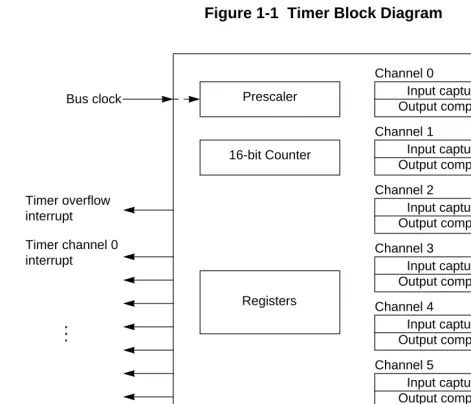
Figure 1-1 Timer Block Diagram
NOTE: For more information see the respective functional descriptions in Section 4 of this document. Prescaler 16-bit Counter Input capture Output compare 16-bit Pulse accumulator IOC0 IOC2 IOC1 IOC5 IOC3 IOC4 IOC6 IOC7 PA input interrupt PA overflow interrupt Timer overflow interrupt
Timer channel 0 interrupt
Section 2 Signal Description
2.1 Overview
The TIM_16B8C module has a total 8 external pins.
2.2 Detailed Signal Descriptions
2.2.1 IOC7 – Input capture and Output compare channel 7
This pin serves as input capture or output compare for channel 7. This can also be configured as pulse accumulator input.
2.2.2 IOC6 – Input capture and Output compare channel 6
This pin serves as input capture or output compare for channel 6.
2.2.3 IOC5 – Input capture and Output compare channel 5
This pin serves as input capture or output compare for channel 7.
2.2.4 IOC4 – Input capture and Output compare channel 4
This pin serves as input capture or output compare for channel 4.
2.2.5 IOC3 – Input capture and Output compare channel 3
This pin serves as input capture or output compare for channel 3.
2.2.6 IOC2 – Input capture and Output compare channel 2
This pin serves as input capture or output compare for channel 2.
2.2.7 IOC1 – Input capture and Output compare channel 1
This pin serves as input capture or output compare for channel 1.
2.2.8 IOC0 – Input capture and Output compare channel 0
This pin serves as input capture or output compare for channel 0.
Section 3 Memory Map and Registers
3.1 Overview
This section provides a detailed description of all memory and registers.
3.2 Module Memory Map
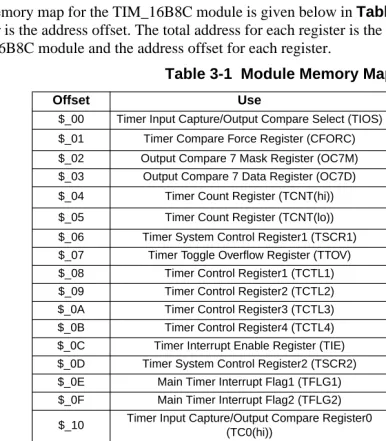
[image:13.792.116.503.240.681.2]The memory map for the TIM_16B8C module is given below inTable 3-1. The Address listed for each register is the address offset. The total address for each register is the sum of the base address for the TIM_16B8C module and the address offset for each register.
Table 3-1 Module Memory Map
Offset Use Access
$_00 Timer Input Capture/Output Compare Select (TIOS) Read/Write $_01 Timer Compare Force Register (CFORC) Read/Write1 $_02 Output Compare 7 Mask Register (OC7M) Read/Write $_03 Output Compare 7 Data Register (OC7D) Read/Write $_04 Timer Count Register (TCNT(hi)) Read/Write2 $_05 Timer Count Register (TCNT(lo)) Read/Write2 $_06 Timer System Control Register1 (TSCR1) Read/Write $_07 Timer Toggle Overflow Register (TTOV) Read/Write $_08 Timer Control Register1 (TCTL1) Read/Write $_09 Timer Control Register2 (TCTL2) Read/Write $_0A Timer Control Register3 (TCTL3) Read/Write $_0B Timer Control Register4 (TCTL4) Read/Write $_0C Timer Interrupt Enable Register (TIE) Read/Write $_0D Timer System Control Register2 (TSCR2) Read/Write $_0E Main Timer Interrupt Flag1 (TFLG1) Read/Write $_0F Main Timer Interrupt Flag2 (TFLG2) Read/Write $_10 Timer Input Capture/Output Compare Register0
(TC0(hi)) Read/Write3
$_11 Timer Input Capture/Output Compare Register0
(TC0(lo)) Read/Write3
$_12 Timer Input Capture/Output Compare Register1
(TC1(hi)) Read/Write3
$_13 Timer Input Capture/Output Compare Register1
(TC1(lo)) Read/Write3
$_14 Timer Input Capture/Output Compare Register2
(TC2(hi)) Read/Write3
$_15 Timer Input Capture/Output Compare Register2
(TC2(lo)) Read/Write3
$_16 Timer Input Capture/Output Compare Register3
NOTE: 1. Always read $00.
2. Only writable in special modes (test_mode = 1).
3. Write to these registers have no meaning or effect during input capture.
3.3 Register Descriptions
This section consists of register descriptions in address order. Each description includes a standard register diagram with an associated figure number. Details of register bit and field function follow the register diagrams, in bit order.
$_17 Timer Input Capture/Output Compare Register3
(TC3(lo)) Read/Write3
$_18 Timer Input Capture/Output Compare Register4
(TC4(hi)) Read/Write3
$_19 Timer Input Capture/Output Compare Register4
(TC4(lo)) Read/Write3
$_1A Timer Input Capture/Output Compare Register5
(TC5(hi)) Read/Write3
$_1B Timer Input Capture/Output Compare Register5
(TC5(lo)) Read/Write3
$_1C Timer Input Capture/Output Compare Register6
(TC6(hi)) Read/Write3
$_1D Timer Input Capture/Output Compare Register6
(TC6(lo)) Read/Write3
$_1E Timer Input Capture/Output Compare Register7
(TC7(hi)) Read/Write3
$_1F Timer Input Capture/Output Compare Register7
(TC7(lo)) Read/Write3
$_20 16-Bit Pulse Accumulator Control Register (PACTL) Read/Write $_21 Pulse Accumulator Flag Register (PAFLG) Read/Write $_22 Pulse Accumulator Count Register
(PACNT(hi)) Read/Write
$_23 Pulse Accumulator Count Register
(PACNT(lo)) Read/Write
$_24 – $_2C Reserved Write has no effect
Return 0 on read $_2D Timer Test Register (TIMTST) Read/Write2
$-2E – $_2F Reserved Write has no effect
Return 0 on read
3.3.1 Timer Input Capture/Output Compare Select (TIOS)
Read or write anytime.
IOS[7:0] — Input Capture or Output Compare Channel Configuration 1 = The corresponding channel acts as an output compare. 0 = The corresponding channel acts as an input capture.
3.3.2 Timer Compare Force Register (CFORC)
Read anytime but will always return $00 (1 state is transient). Write anytime.
FOC[7:0] — Force Output Compare Action for Channel 7-0
A write to this register with the corresponding data bit(s) set causes the action which is programmed for output compare “x” to occur immediately. The action taken is the same as if a successful
comparison had just taken place with the TCx register except the interrupt flag does not get set.
NOTE: A successful channel 7 output compare overrides any channel 6:0 compares. If forced output compare on any channel occurs at the same time as the successful output compare then forced output compare action will take precedence and interrupt flag won’t get set.
3.3.3 Output Compare 7 Mask Register (OC7M)
Read or write anytime.
Setting the OC7Mx (x ranges from 0 to 6) will set the corresponding port to be an output port when the corresponding TIOSx (x ranges from 0 to 6) bit is set to be an output compare.
Register offset: $_00
Bit 7 6 5 4 3 2 1 Bit 0
R
IOS7 IOS6 IOS5 IOS4 IOS3 IOS2 IOS1 IOS0
W
RESET: 0 0 0 0 0 0 0 0
Register offset:$_01
Bit 7 6 5 4 3 2 1 Bit 0
R 0 0 0 0 0 0 0 0
W FOC7 FOC6 FOC5 FOC4 FOC3 FOC2 FOC1 FOC0
RESET: 0 0 0 0 0 0 0 0
Register offset:$_02
Bit 7 6 5 4 3 2 1 Bit 0
R
OC7M7 OC7M6 OC7M5 OC7M4 OC7M3 OC7M2 OC7M1 OC7M0
W
NOTE: A successful channel 7 output compare overrides any channel 6:0 compares. For each OC7M bit that is set, the output compare action reflects the corresponding OC7D bit.
3.3.4 Output Compare 7 Data Register (OC7D)
Read or write anytime.
A channel 7 output compare can cause bits in the output compare 7 data register to transfer to the timer port data register depending on the output compare 7 mask register.
3.3.5 Timer Count Register (TCNT)
The 16-bit main timer is an up counter.
A full access for the counter register should take place in one clock cycle. A separate read/write for high byte and low byte will give a different result than accessing them as a word.
Read anytime.
Write has no meaning or effect in the normal mode; only writable in special modes (test_mode = 1).
The period of the first count after a write to the TCNT registers may be a different size because the write is not synchronized with the prescaler clock.
Register offset:$_03
Bit 7 6 5 4 3 2 1 Bit 0
R
OC7D7 OC7D6 OC7D5 OC7D4 OC7D3 OC7D2 OC7D1 OC7D0
W
RESET: 0 0 0 0 0 0 0 0
Register offset:$_04-$_05
Bit 15 14 13 12 11 10 9 8 7 6 5 4 3 2 1 Bit 0
R tcnt 15 tcnt 14 tcnt 13 tcnt 12 tcnt 11 tcnt 10 tcnt 9 tcnt 8 tcnt 7 tcnt 6 tcnt 5 tcnt 4 tcnt 3 tcnt 2 tcnt 1 tcnt t 0 W
3.3.6 Timer System Control Register 1 (TSCR1)
Read or write anytime.
TEN — Timer Enable
1 = Allows the timer to function normally.
0 = Disables the main timer, including the counter. Can be used for reducing power consumption. If for any reason the timer is not active, there is no÷64 clock for the pulse accumulator since the÷64 is generated by the timer prescaler.
TSWAI — Timer Module Stops While in Wait
1 = Disables the timer module when the MCU is in the wait mode. Timer interrupts cannot be used to get the MCU out of wait.
0 = Allows the timer module to continue running during wait. TSWAI also affects pulse accumulator.
TSFRZ — Timer Stops While in Freeze Mode
1 = Disables the timer counter whenever the MCU is in freeze mode. This is useful for emulation. 0 = Allows the timer counter to continue running while in freeze mode.
TSFRZ does not stop the pulse accumulator.
TFFCA — Timer Fast Flag Clear All
1 = For TFLG1($0E), a read from an input capture or a write to the output compare channel ($10–$1F) causes the corresponding channel flag, CnF, to be cleared. For TFLG2 ($0F), any access to the TCNT register ($04, $05) clears the TOF flag. Any access to the PACNT registers ($22, $23) clears the PAOVF and PAIF flags in the PAFLG register ($21). This has the advantage of eliminating software overhead in a separate clear sequence. Extra care is required to avoid accidental flag clearing due to unintended accesses.
0 = Allows the timer flag clearing to function normally.
Register offset:$_06
Bit 7 6 5 4 3 2 1 Bit 0
R
TEN TSWAI TSFRZ TFFCA 0 0 0 0
W
RESET: 0 0 0 0 0 0 0 0
3.3.7 Timer Toggle On Overflow Register 1 (TTOV)
Read or write anytime.
TOVx — Toggle On Overflow Bits
TOVx toggles output compare pin on overflow. This feature only takes effect when in output compare mode. When set, it takes precedence over forced output compare but not channel 7 override events.
1 = Toggle output compare pin on overflow feature enabled. 0 = Toggle output compare pin on overflow feature disabled.
3.3.8 Timer Control Register 1/Timer Control Register 2 (TCTL1/TCTL2)
Read or write anytime.
OMx — Output Mode
OLx — Output Level
These eight pairs of control bits are encoded to specify the output action to be taken as a result of a
Register offset:$_07
Bit 7 6 5 4 3 2 1 Bit 0
R
TOV7 TOV6 TOV5 TOV4 TOV3 TOV2 TOV1 TOV0
W
RESET 0 0 0 0 0 0 0 0
Register offset:$_08
7 6 5 4 3 2 1 Bit 0
R
OM7 OL7 OM6 OL6 OM5 OL5 OM4 OL4
W
RESET 0 0 0 0 0 0 0 0
Register offset:$_09
Bit 7 6 5 4 3 2 1 Bit 0
R
OM3 OL3 OM2 OL2 OM1 OL1 OM0 OL0
W
NOTE: To enable output action by OMx and OLx bits on timer port, the corresponding bit in OC7M should be cleared.
[image:19.792.153.463.92.183.2]To operate the 16-bit pulse accumulator independently of input capture or output compare 7 and 0 respectively the user must set the corresponding bits IOSx = 1, OMx = 0 and OLx = 0. OC7M7 in the OC7M register must also be cleared.
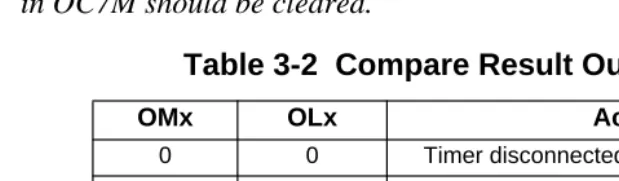
Table 3-2 Compare Result Output Action
OMx OLx Action
0 0 Timer disconnected from output pin logic
0 1 Toggle OCx output line
1 0 Clear OCx output line to zero
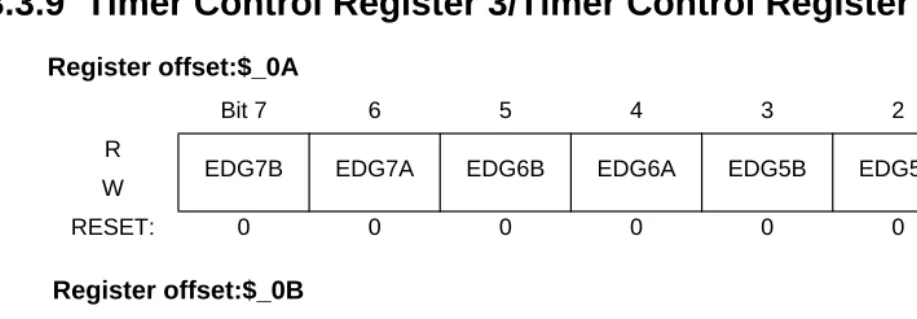
3.3.9 Timer Control Register 3/Timer Control Register 4 (TCTL3/TCTL4)
Read or write anytime.
EDGnB, EDGnA — Input Capture Edge Control
These eight pairs of control bits configure the input capture edge detector circuits.
3.3.10 Timer Interrupt Enable Register (TIE)
Register offset:$_0A
Bit 7 6 5 4 3 2 1 Bit 0
R
EDG7B EDG7A EDG6B EDG6A EDG5B EDG5A EDG4B EDG4A
W
RESET: 0 0 0 0 0 0 0 0
Register offset:$_0B
Bit 7 6 5 4 3 2 1 Bit 0
R
EDG3B EDG3A EDG2B EDG2A EDG1B EDG1A EDG0B EDG0A
W
[image:20.792.78.537.111.270.2]RESET: 0 0 0 0 0 0 0 0
Table 3-3 Edge Detector Circuit Configuration
EDGnB EDGnA Configuration
0 0 Capture disabled
0 1 Capture on rising edges only 1 0 Capture on falling edges only 1 1 Capture on any edge (rising or falling)
Register offset:$_0C
Bit 7 6 5 4 3 2 1 Bit 0
R
C7I C6I C5I C4I C3I C2I C1I C0I
W
3.3.11 Timer System Control Register 2 (TSCR2)
Read or write anytime.
TOI — Timer Overflow Interrupt Enable
1 = Hardware interrupt requested when TOF flag set. 0 = Interrupt inhibited.
TCRE — Timer Counter Reset Enable
This bit allows the timer counter to be reset by a successful output compare 7 event. This mode of operation is similar to an up-counting modulus counter.
1 = Counter reset by a successful output compare 7. 0 = Counter reset inhibited and counter free runs.
If TC7 = $0000 and TCRE = 1, TCNT will stay at $0000 continuously. If TC7 = $FFFF and TCRE = 1, TOF will never be set when TCNT is reset from $FFFF to $0000.
PR2, PR1, PR0 — Timer Prescaler Select
These three bits select the frequency of the timer prescaler clock derived from the Bus Clock as shown in Table 3-4.
The newly selected prescale factor will not take effect until the next synchronized edge where all prescale counter stages equal zero.
Register offset:$_0D
Bit 7 6 5 4 3 2 1 Bit 0
R
TOI 0 0 0 TCRE PR2 PR1 PR0
W
RESET: 0 0 0 0 0 0 0 0
[image:21.792.174.439.456.594.2]= Unimplemented or Reserved
Table 3-4 Timer Clock Selection
PR2 PR1 PR0 Timer Clock
0 0 0 Bus Clock / 1
0 0 1 Bus Clock / 2
0 1 0 Bus Clock / 4
0 1 1 Bus Clock / 8
1 0 0 Bus Clock / 16
1 0 1 Bus Clock / 32
1 1 0 Bus Clock / 64
3.3.12 Main Timer Interrupt Flag 1 (TFLG1)
These flags are set when an input capture or output compare event occurs. Clear a channel flag by writing one to it.
Read anytime. Write used in the clearing mechanism (set bits cause corresponding bits to be cleared). Writing a zero will not affect current status of the bit.
When TFFCA bit in TSCR register is set, a read from an input capture or a write into an output compare channel ($10–$1F) will cause the corresponding channel flag CxF to be cleared.
C7F–C0F — Input Capture/Output Compare Channel “x” Flag.
3.3.13 Main Timer Interrupt Flag 2 (TFLG2)
TFLG2 indicates when interrupt conditions have occurred. To clear a bit in the flag register, write the bit to one.
Read anytime. Write used in clearing mechanism (set bits cause corresponding bits to be cleared).
Any access to TCNT will clear TFLG2 register if the TFFCA bit in TSCR register is set.
TOF — Timer Overflow Flag
Set when 16-bit free-running timer overflows from $FFFF to $0000. This bit is cleared automatically by a write to the TFLG2 register with bit 7 set. (See also TCRE control bit explanation.)
Register offset:$_0E
Bit 7 6 5 4 3 2 1 Bit 0
R
C7F C6F C5F C4F C3F C2F C1F C0F
W
RESET: 0 0 0 0 0 0 0 0
Register offset:$_0F
Bit 7 6 5 4 3 2 1 Bit 0
R
TOF 0 0 0 0 0 0 0
W
RESET: 0 0 0 0 0 0 0 0
3.3.14 Timer Input Capture/Output Compare Registers 0-7
TC0 — Timer Input Capture/Output Compare Register 0 Register offset:$_10–$_11
Bit 15 14 13 12 11 10 9 8 7 6 5 4 3 2 1 BIt 0
R W tc0 15 tc0 14 tc0 13 tc0 12 tc0 11 tc0 10 tc0 9 tc0 8 tc0 7 tc0 6 tc0 5 tc0 4 tc0 3 tc0 2 tc0 1 tc0 0
RESET 0 0 0 0 0 0 0 0 0 0 0 0 0 0 0 0
TC1 — Timer Input Capture/Output Compare Register 1 Register offset:$_12–$_13
Bit 15 14 13 12 11 10 9 8 7 6 5 4 3 2 1 Bit 0
R W tc1 15 tc1 14 tc1 13 tc1 12 tc1 11 tc1 10 tc1 9 tc1 8 tc1 7 tc1 6 tc1 5 tc1 4 tc1 3 tc1 2 tc1 1 tc1 0
RESET 0 0 0 0 0 0 0 0 0 0 0 0 0 0 0 0
TC2 — Timer Input Capture/Output Compare Register 2 Register offset:$_14–$_15
Bit 15 14 13 12 11 10 9 8 7 6 5 4 3 2 1 Bit 0
R W tc2 15 tc2 14 tc2 13 tc2 12 tc2 11 tc2 10 tc2 9 tc2 8 tc2 7 tc2 6 tc2 5 tc2 4 tc2 3 tc2 2 tc2 1 tc2 0
RESET 0 0 0 0 0 0 0 0 0 0 0 0 0 0 0 0
TC3 — Timer Input Capture/Output Compare Register 3 Register offset:$_16–$_17
Bit 15 14 13 12 11 10 9 8 7 6 5 4 3 2 1 Bit 0
R W tc3 15 tc3 14 tc13 13 tc3 12 tc3 11 tc3 10 tc3 9 tc3 8 tc3 7 tc3 6 tc3 5 tc3 4 tc3 3 tc3 2 tc3 1 tc3 0
RESET 0 0 0 0 0 0 0 0 0 0 0 0 0 0 0 0
TC4 — Timer Input Capture/Output Compare Register 4 Register offset:$_18–$_19
Bit 15 14 13 12 11 10 9 8 7 6 5 4 3 2 1 Bit 0
R W tc4 15 tc4 14 tc4 13 tc4 12 tc4 11 tc4 10 tc4 9 tc4 8 tc4 7 tc4 6 tc4 5 tc4 4 tc4 3 tc4 2 tc4 1 tc4 0
RESET 0 0 0 0 0 0 0 0 0 0 0 0 0 0 0 0
TC5 — Timer Input Capture/Output Compare Register 5 Register offset:$_1A–$_1B
Bit 15 14 13 2 11 10 9 8 7 6 5 4 3 2 1 Bit 0
R W tc5 15 tc5 14 tc5 13 tc5 12 tc5 11 tc5 10 tc5 9 tc5 8 tc5 7 tc5 6 tc5 5 tc5 4 tc5 3 tc5 2 tc5 1 tc5 0
RESET 0 0 0 0 0 0 0 0 0 0 0 0 0 0 0 0
TC6 — Timer Input Capture/Output Compare Register 6 Register offset:$_1C–$_1D
Bit 15 14 13 12 11 10 9 8 7 6 5 4 3 2 1 Bit 0
R W tc6 15 tc6 14 tc6 13 tc6 12 tc6 11 tc6 10 tc6 9 tc6 8 tc6 7 tc6 6 tc6 5 tc6 4 tc6 3 tc6 2 tc6 1 tc6 0
Depending on the TIOS bit for the corresponding channel, these registers are used to latch the value of the free-running counter when a defined transition is sensed by the corresponding input capture edge detector or to trigger an output action for output compare.
Read anytime.Write anytime for output compare function.Writes to these registers have no meaning or effect during input capture. All timer input capture/output compare registers are reset to $0000.
NOTE: Read/Write access in byte mode for high byte should takes place before low byte otherwise it will give a different result.
3.3.15 16-Bit Pulse Accumulator Control Register (PACTL)
When PAEN is set, the PACT is enabled.The PACT shares the input pin with IOC7.
Read: any time Write: any time
PAEN — Pulse Accumulator System Enable 1 = Pulse Accumulator system enabled.
0 = 16-Bit Pulse Accumulator system disabled.
PAEN is independent from TEN. With timer disabled, the pulse accumulator can still function unless pulse accumulator is disabled.
TC7 — Timer Input Capture/Output Compare Register 7 Register offset:$_1E–$_1F
Bit 15 14 13 2 11 0 9 8 7 6 5 4 3 2 1 Bit 0
R W tc7 15 tc7 14 tc7 13 tc7 12 tc7 11 tc7 10 tc7 9 tc7 8 tc7 7 tc7 6 tc7 5 tc7 4 tc7 3 tc7 2 tc7 1 tc7 0
RESET 0 0 0 0 0 0 0 0 0 0 0 0 0 0 0 0
Register offset:$_20
BIT 7 6 5 4 3 2 1 BIT 0
R 0
PAEN PAMOD PEDGE CLK1 CLK0 PAOVI PAI
W
RESET: 0 0 0 0 0 0 0 0
For PAMOD bit = 0 (event counter mode).
1 = rising edges on IOC7 pin cause the count to be incremented. 0 = falling edges on IOC7 pin cause the count to be incremented. For PAMOD bit = 1 (gated time accumulation mode).
1 = IOC7 input pin low enables M (bus clock) divided by 64 clock to Pulse Accumulator and the trailing rising edge on IOC7 sets the PAIF flag.
0 = IOC7 input pin high enables M (bus clock) divided by 64 clock to Pulse Accumulator and the trailing falling edge on IOC7 sets the PAIF flag.
Table 3-5 Pin Action
If the timer is not active (TEN = 0 in TSCR), there is no divide-by-64 since the÷64 clock is generated by the timer prescaler.
CLK1, CLK0 — Clock Select Bits
Table 3-6 Timer Clock Selection
For the description of PACLK please refer Figure 1-2 16-Bit Pulse Accumulator Block Diagram.
If the pulse accumulator is disabled (PAEN = 0), the prescaler clock from the timer is always used as an input clock to the timer counter. The change from one selected clock to the other happens immediately after these bits are written.
PAOVI — Pulse Accumulator Overflow Interrupt enable 1 = interrupt requested if PAOVF is set.
0 = interrupt inhibited.
PAI — Pulse Accumulator Input Interrupt enable 1 = interrupt requested if PAIF is set. 0 = interrupt inhibited.
PAMOD PEDGE Pin Action
0 0 Falling edge
0 1 Rising edge
1 0 Div. by 64 clock enabled with pin high level 1 1 Div. by 64 clock enabled with pin low level
CLK1 CLK0 Timer Clock
3.3.16 Pulse Accumulator Flag Register (PAFLG)
Read or write anytime. When the TFFCA bit in the TSCR register is set, any access to the PACNT register will clear all the flags in the PAFLG register.
PAOVF — Pulse Accumulator Overflow Flag
Set when the 16-bit pulse accumulator overflows from $FFFF to $0000.
This bit is cleared automatically by a write to the PAFLG register with bit 1 set.
PAIF — Pulse Accumulator Input edge Flag
Set when the selected edge is detected at the IOC7 input pin.In event mode the event edge triggers PAIF and in gated time accumulation mode the trailing edge of the gate signal at the IOC7 input pin triggers PAIF.
This bit is cleared by a write to the PAFLG register with bit 0 set.
Any access to the PACNT register will clear all the flags in this register when TFFCA bit in register TSCR($06) is set.
3.3.17 Pulse Accumulators Count Registers (PACNT)
Read or write any time.
These registers contain the number of active input edges on its input pin since the last reset.
When PACNT overflows from $FFFF to $0000, the Interrupt flag PAOVF in PAFLG ($21) is set.
Register offset:$_21
BIT 7 6 5 4 3 2 1 BIT 0
R 0 0 0 0 0 0
PAOVF PAIF W
RESET: 0 0 0 0 0 0 0 0
= Unimplemented or Reserved
Register offset:$_22-$_23
Bit 15 14 13 12 11 10 9 8 7 6 5 4 3 2 1 Bit 0
R W pacnt 15 pacnt 14 pacnt 13 pacnt 12 pacnt 11 pacnt 10 pacnt 9 pacnt 8 pacnt 7 pacnt 6 pacnt 5 pacnt 4 pacnt 3 pacnt 2 pacnt 1 pacnt 0
Section 4 Functional Description
4.1 General
[image:29.792.76.533.181.701.2]This section provides a complete functional description of the timer TIM_16B8C block. Please refer to the detailed timer block diagram inFigure 4-1 as necessary.
Figure 4-1 Detailed Timer Block Diagram
PRESCALER CHANNEL 0 IOC0 PIN 16-BIT COUNTER LOGIC PR[2:1:0] DIVIDE-BY-64 TC0 EDGE DETECT PACNT(hi):PACNT(lo) PAOVF PEDGE PAOVI PAMOD PAE 16-BIT COMPARATOR TCNT(hi):TCNT(lo) CHANNEL 1 TC1 16-BIT COMPARATOR 16-BIT COUNTER INTERRUPT LOGIC TOF TOI C0F C1F EDGE DETECT IOC1 PIN LOGIC EDGE DETECT CxF CHANNEL7 TC7
16-BIT COMPARATOR C7F
IOC7 PIN LOGIC EDGE DETECT OM:OL0 TOV0 OM:OL1 TOV1 OM:O73 TOV7 EDG1A EDG1B EDG7A EDG7B EDG0B TCRE PAIF CLEAR COUNTER PAIF PAI INTERRUPT LOGIC CxI INTERRUPT REQUEST PAOVF
CH. 7 COMPARE CH.7 CAPTURE CH. 1 CAPTURE MUX CLK[1:0] PACLK PACLK/256 PACLK/65536 IOC1 PIN IOC0 PIN IOC7 PIN PACLK PACLK/256 PACLK/65536 TE
CH. 1 COMPARE CH. 0COMPARE CH. 0 CAPTURE
PA INPUT CHANNEL2
EDG0A
4.2 Prescaler
The prescaler divides the bus clock by 1,2,4,8,16,32,64 or 128. The prescaler select bits, PR[2:0], select the prescaler divisor. PR[2:0] are in timer system control register 2 (TSCR2).
4.3 Input Capture
Clearing the I/O (input/output) select bit, IOSx, configures channel x as an input capture channel. The input capture function captures the time at which an external event occurs. When an active edge occurs on the pin of an input capture channel, the timer transfers the value in the timer counter into the timer channel registers, TCx.
The minimum pulse width for the input capture input is greater than two bus clocks.
An input capture on channel x sets the CxF flag. The CxI bit enables the CxF flag to generate interrupt requests.
4.4 Output Compare
Setting the I/O select bit, IOSx, configures channel x as an output compare channel. The output compare function can generate a periodic pulse with a programmable polarity, duration, and frequency. When the timer counter reaches the value in the channel registers of an output compare channel, the timer can set, clear, or toggle the channel pin. An output compare on channel x sets the CxF flag. The CxI bit enables the CxF flag to generate interrupt requests.
The output mode and level bits, OMx and OLx, select set, clear, toggle on output compare. Clearing both OMx and OLx disconnects the pin from the output logic.
Setting a force output compare bit, FOCx, causes an output compare on channel x. A forced output compare does not set the channel flag.
A successful output compare on channel 7 overrides output compares on all other output compare channels. The output compare 7 mask register masks the bits in the output compare 7 data register. The timer counter reset enable bit, TCRE, enables channel 7 output compares to reset the timer counter. A channel 7 output compare can reset the timer counter even if the IOC7 pin is being used as the pulse accumulator input.
Gated time accumulation mode --- Counting pulses from a divide-by-64 clock. The PAMOD bit selects the mode of operation.
The minimum pulse width for the PAI input is greater than two bus clocks.
4.5.1 Event Counter Mode
Clearing the PAMOD bit configures the PACNT for event counter operation. An active edge on the IOC7 pin increments the pulse accumulator counter. The PEDGE bit selects falling edges or rising edges to increment the count.
NOTE: The PACNT input and timer channel 7 use the same pin IOC7. To use the IOC7, disconnect it from the output logic by clearing the channel 7 output mode and output level bits, OM7 and OL7. Also clear the channel 7 output compare 7 mask bit, OC7M7.
The Pulse Accumulator counter register reflect the number of active input edges on the PACNT input pin since the last reset.
The PAOVF bit is set when the accumulator rolls over from $FFFF to $0000. The pulse accumulator overflow interrupt enable bit, PAOVI, enables the PAOVF flag to generate interrupt requests.
NOTE: The pulse accumulator counter can operate in event counter mode even when the timer enable bit, TEN, is clear.
4.5.2 Gated Time Accumulation Mode
Setting the PAMOD bit configures the pulse accumulator for gated time accumulation operation. An active level on the PACNT input pin enables a divided-by-64 clock to drive the pulse accumulator. The PEDGE bit selects low levels or high levels to enable the divided-by-64 clock.
The trailing edge of the active level at the IOC7 pin sets the PAIF. The PAI bit enables the PAIF flag to generate interrupt requests.
The pulse accumulator counter register reflect the number of pulses from the divided-by-64 clock since the last reset.
Section 5 Resets
5.1 General
The reset state of each individual bit is listed within the Register Description section (see Section 3
Section 6 Interrupts
6.1 General
This section describes interrupts originated by the TIM_16B8C block.Table 6-1 lists the interrupts generated by the TIM_16B8C to communicate with the MCU.
Table 6-1 TIM_16B8C Interrupts
6.2 Description of Interrupt Operation
The TIM_16B8C uses a total of 11 interrupt vectors. The interrupt vector offsets and interrupt numbers are chip dependent.
6.2.1 Channel [7:0] Interrupt (C[7:0]F)
This active high outputs will be asserted by the module to request a timer channel 7 – 0 interrupt to be serviced by the system controller.
6.2.2 Pulse Accumulator Input Interrupt (PAOVI)
This active high output will be asserted by the module to request a timer pulse accumulator input interrupt to be serviced by the system controller.
6.2.3 Pulse Accumulator Overflow Interrupt (PAOVF)
This active high output will be asserted by the module to request a timer pulse accumulator overflow interrupt to be serviced by the system controller.
6.2.4 Timer Overflow Interrupt (TOF)
This active high output will be asserted by the module to request a timer overflow interrupt to be serviced by the system controller.
Interrupt Offset1
NOTES:
1. Chip Dependent.
Vector1 Priority1 Source Description
C[7:0]F - - - Timer Channel 7-0 Active high timer channel interrupts 7-0
PAOVI - - - Pulse Accumulator
Input Active high pulse accumulator input interrupt
PAOVF - - - Pulse Accumulator
Overflow Pulse accumulator overflow interrupt