Detecting problematic turns in human-machine interactions:
Rule-induction versus memory-based learning approaches
Antal van den Bosch
ILK / Comp. Ling.
KUB, Tilburg
The Netherlands
[email protected]
Emiel Krahmer
IPO
TU/e, Eindhoven
The Netherlands
[email protected]
Marc Swerts
CNTS
UIA, Antwerp
Belgium
[email protected]
Abstract
We address the issue of on-line detec-tion of communicadetec-tion problems in spoken dialogue systems. The useful-ness is investigated of the sequence of system question types and the word graphs corresponding to the respective user utterances. By applying both rule-induction and memory-based learning techniques to data obtained with a Dutch train time-table information system, the current paper demonstrates that the aforementioned features indeed lead to a method for problem detec-tion that performs significantly above baseline. The results are interesting from a dialogue perspective since they employ features that are present in the majority of spoken dialogue systems and can be obtained with little or no computational overhead. The results are interesting from a machine learning perspective, since they show that the rule-based method performs signific-antly better than the memory-based method, because the former is better capable of representing interactions between features.
1
Introduction
Given the state of the art of current language and speech technology, communication problems are unavoidable in present-day spoken dialogue sys-tems. The main source of these problems lies
in the imperfections of automatic speech recogni-tion, but also incorrect interpretations by the nat-ural language understanding module or wrong de-fault assumptions by the dialogue manager are likely to lead to confusion. If a spoken dialogue system had the ability to detect communication problems on-line and with high accuracy, it might be able to correct certain errors or it could in-teract with the user to solve them. For instance, in the case of communication problems, it would be beneficial to change from a relatively natural dialogue strategy to a more constrained one in order to resolve the problems (see e.g., Litman and Pan 2000). Similarly, it has been shown that users switch to a ‘marked’, hyperarticulate speak-ing style after problems (e.g., Soltau and Waibel 1998), which itself is an important source of re-cognition errors. This might be solved by using two recognizers in parallel, one trained on nor-mal speech and one on hyperarticulate speech. If there are communication problems, then the sys-tem could decide to focus on the recognition res-ults delivered by the engine trained on hyperartic-ulate speech.
six most recent system question types, communic-ation problems can be detected with an accuracy of 91%, which is a significant improvement over the relevant baseline. This shows that spoken dia-logue systems may use these features to better pre-dict whether the ongoing dialogue is problematic. In addition, the current work is interesting from a machine learning perspective. We apply two machine learning techniques: the memory-based
IB1-IGalgorithm (Aha et al. 1991, Daelemans et al. 1997) and theRIPPERrule induction algorithm (Cohen 1996). As we shall see, some interesting differences between the two approaches arise.
2
Related work
Recently there has been an increased interest in developing automatic methods to detect problem-atic dialogue situations using machine learning techniques. For instance, Litman et al. (1999) and Walker et al. (2000a) use RIPPER (Cohen 1996) to classify problematic and unproblematic dialogues. Following up on this, Walker et al. (2000b) aim at detecting problems at the utter-ance level, based on data obtained with AT&Ts How May I Help You (HMIHY) system (Gorin et al. 1997). Walker and co-workers applyRIPPERto 43 features which are automatically generated by three modules of the HMIHY system, namely the
speech recognizer (ASR), the natural language un-derstanding module (NLU) and the dialogue man-ager (DM). The best result is obtained using all features: communication problems are detected with an accuracy of 86%, a precision of 83% and a recall of 75%. It should be noted that the NLU features play first fiddle among the set of all fea-tures. In fact, using only the NLU features per-forms comparable to using all features. Walker et al. (2000b) also briefly compare the performance ofRIPPER with some other machine learning ap-proaches, and show that it performs comparable to a memory-based (instance-based) learning al-gorithm (IB, see Aha et al. 1991).
The results which Walker and co-workers scribe show that it is possible to automatically de-tect communication problems in theHMIHY sys-tem, using machine learning techniques. Their ap-proach also raises a number of interesting follow-up questions, some concerned with problem de-tection, others with the use of machine learning
techniques. (1) Walker et al. train their classi-fier on a large set of features, and show that the set of features produced by the NLU module are the most important ones. However, this leaves an important general question unanswered, namely which particular features contribute to what ex-tent? (2) Moreover, the set of features which the NLU module produces appear to be rather spe-cific to theHMIHYsystem and indicate things like
the percentage of the input covered by the relev-ant grammar fragment, the presence or absence of context shifts, and the semantic diversity of sub-sequent utterances. Many current day spoken dia-logue systems do not have such a sophisticated NLU module, and consequently it is unlikely that they have access to these kinds of features. In sum, it is uncertain whether other spoken dialogue systems can benefit from the findings described by Walker et al. (2000b), since it is unclear which tures are important and to what extent these fea-tures are available in other spoken dialogue sys-tems. Finally, (3) we agree with Walker et al. (and the machine learning community at large) that it is important to compare different machine learning techniques to find out which techniques perform well for which kinds of tasks. Walker et al. found thatRIPPERdoes not perform significantly better or worse than a memory-based learning technique. Is this incidental or does it reflect a general prop-erty of the problem detection task?
learn-ing techniques for problem detection we use both
RIPPERand the memory-basedIB1-IGalgorithm.
3
Approach
3.1 Data and Labeling The corpus we used
con-sisted of 3739 question-answer pairs, taken from 444 complete dialogues. The dialogues consist of users interacting with a Dutch spoken dialogue system which provides information about train time tables. The system prompts the user for un-known slots, such as departure station, arrival sta-tion, date, etc., in a series of questions. The sys-tem uses a combination of implicit and explicit verification strategies.
The data were annotated with a highly limited set of labels. In particular, the kind of system question and whether the reply of the user gave rise to communication problems or not. The latter feature is the one to be predicted. The following labels are used for the system questions.
O open questions (“From where to where do you
want to travel?”)
I implicit verification (“When do you want to
travel from Tilburg to Schiphol Airport?”)
E explicit verification (“So you want to travel
from Tilburg to Schiphol Airport?”)
Y yes/no question (“Do you want me to repeat the
connection?”)
M Meta-questions (“Can you please correct
me?”)
The difference between an explicit verification and a yes/no question is that the former but not the latter is aimed at checking whether what the system understood or assumed corresponds with what the user wants. If the current system ques-tion is a repetiques-tion of the previous quesques-tion it asked, this is indicated by the suffix R. A ques-tion only counts as a repetiques-tion when it has the same contents as the previous system question. Of the user inputs, we only labeled whether they gave rise to a communication problem or not. A com-munication problem arises when the value which the system assigns to a particular slot (departure station, date, etc.) does not coincide with the value given for that particular slot by the user in
his or her most recent contribution to the dialogue or when the system makes an incorrect default as-sumption (e.g., the dialogue manager assumes that the date slot should be filled with the current date, i.e., that the user wants to travel today). Commu-nication problems are generally easy to label since the spoken dialogue system under consideration here always provides direct feedback (via verific-ation questions) about what it believes the user in-tends. Consider the following exchange.
U: I want to go to Amsterdam. S: So you want to go to Rotterdam?
As soon as the user hears the explicit verification question of the system, it will be clear that his or her last turn was misunderstood. The problem-feature was labeled by two of the authors to avoid labeling errors. Differences between the two annotators were infrequent and could always easily be resolved.
3.2 Baselines Of the 3739 user utterances
1564 gave rise to communication problems (an error rate of 41.8%). The majority class is thus formed by the unproblematic user utterances, which form 58.2% of all user utterances. This suggests that the baseline for predicting com-munication problems is obtained by always predicting that there are no communication prob-lems. This strategy has an accuracy of 58.2%, and a recall of 0% (all problems are missed). The precision is not defined, and consequently neither is the
. This baseline is misleading, however, when we are interested in predicting whether the previous user utterance gave rise to communication problems. There are cases when the dialogue system is itself clearly aware of communication problems. This is in particular the case when the system repeats the question (labeled with the suffix R) or when it asks a meta-question (M). In the corpus under investigation here this happens 1024 times. It would not be
For definitions of accuracy, precision and recall see e.g., Manning and Sch¨utze (1999:268-269).
Since 0 cases are selected, one would have to divide by 0 to determine precision for this baseline.
Throughout this paper we use the
measure (van Rijsbergen 1979:174) to combine precision and recall in a single measure. By setting equal to 1, precision and recall
are given an equal weight, and the measure simplifies to ! "$#%&
(
= precision,
baseline acc (%) prec (%) rec (%)
majority-class 58.2' 0.4 — 0.0 — system-knows 85.6' 0.4 100 65.5 79.1
Table 1: Baselines
very illuminating to develop an automatic error detector which detects only those problems that the system was already aware of. Therefore we take the following as our base-line strategy for predicting whether the previous user utterance gave rise to problems, henceforth referred to as the system-knows-baseline:
if the Q(( ) is repetition or meta-question,
then predict user utterance(-1 caused problems,
else predict user utterance( -1 caused no problems.
This ‘strategy’ predicts problems with an ac-curacy of 85.6% (1024 of the 1564 problems are detected, thus 540 of 3739 decisions are wrong), a precision of 100% (of 1024 predicted problems 1024 were indeed problematic), a recall of 65.5% (1024 of the 1564 problems are predicted to be problematic) and thus an )*
of 79.1. This is a sharp baseline, but for predicting whether the previous user utterance caused problems or not the system-knows-baseline is much more informative and relevant than the majority-class-baseline. Table 1 summarizes the baselines.
3.3 Feature representations Question-answer
pairs were represented as feature vectors (or patterns) of the following form. Six features were reserved for the history of system questions asked so far in the current dialogue (6Q). Of course, if the system only asked 3 questions so far, only 3 types of system questions are stored in memory and the remaining three features for system ques-tion are not assigned a value. The representaques-tion of the user’s answer is derived from the word graph produced by the ASR module. It should be kept in mind that in general the word graph is much more complex than the recognized string. The latter typically is the most plausible path (e.g., on the basis of acoustic confidence scores) in the word graph, which itself may contain many other paths. Different systems determine the plausibility of paths in the word graph in different
ways. Here, for the sake of generality, we abstract over such differences and simply represent a word graph as a Bag of Words (BoW), collecting all words that occur in one of the paths, irrespective of the associated acoustic confidence score. A lexicon was derived of all the words and phrases that occurred in the corpus. Each word graph is represented as a sequence of bits, where the +-th bit is set to 1 if the +-th word in the pre-derived lexicon occurred at least once in the word graph corresponding to the current user utterance and 0 otherwise. Finally, for each user utterance, a feature is reserved for indicating whether it gave rise to communication problems or not. This latter feature is the one to be predicted.
whether the current user utterance will cause a problem, (4) predict on the basis of the current word graph BoW(, whether the previous user ut-terance, uttered at time(-1, caused a problem, (5) predict on the basis of the six most recent system questions, whether the previous user utterance caused a problem, (6) predict on the basis of BoW
( and 6Q ( , whether the previous user utterance caused a problem, (7) predict on the basis of the two most recent word graphs, BoW(-1 and BoW
(, whether the previous user utterance caused a problem, and finally (8) predict on the basis of the two most recent word graphs, BoW (-1 and BoW (, and the six most recent system question types 6Q ( , whether the previous user utterance caused a problem.
3.4 Learning techniques For the experiments we
used the rule-induction algorithmRIPPER(Cohen 1996) and the memory-based IB1-IG algorithm (Aha et al. 1991, Daelemans et al. 1997).,
RIPPER is a fast rule induction algorithm. It
starts with splitting the training set in two. On the basis of one half, it induces rules in a straightfor-ward way (roughly, by trying to maximize cov-erage for each rule), with potential overfitting. When the induced rules classify instances in the other half below a certain threshold, they are not stored. Rules are induced per class. By default the ordering is from low-frequency classes to high frequency ones, leaving the most frequent class as the default rule, which is generally beneficial for the size of the rule set.
The memory-basedIB1-IGalgorithm is one of the primary memory-based learning algorithms. Memory-based learning techniques can be char-acterized by the fact that they store a representa-tion of a set of training data in memory, and clas-sify new instances by looking for the most sim-ilar instances in memory. The most basic distance function between two features is the overlap met-ric in (1), where-/.103254$6 is the distance between patterns0 and4 (both consisting of7 features) and 8 is the distance between the features. If 0 is the test-case, the - measure determines which group 9 of cases4 in memory is the most sim-ilar to0 . The most frequent value for the relevant
:
We used the TiMBL software package, version 3 (Daele-mans et al. 2000) to run theIB1-IGexperiments.
category in 9 is the predicted value for 0 . Usu-ally, 9 is set to 1. Since some features are more important than others, a weighting function;=< is used. Here ;=< is the gain ratio measure. In sum, the weighted distance between vectors 0 and 4 of length 7 is determined by the following equa-tion, where 8.?>@<A25B<C6 gives a point-wise distance between features which is 1 if>@<ED
F
B< and 0 oth-erwise.
-/.10G254H6 F I
J
<
8K.?>L<25B<M6 (1)
Both learning techniques were used for the same 8 prediction tasks, and received exactly the same feature vectors as input. All experiments were performed using ten-fold cross-validation, which yields errors margins in the predictions.
4
Results
First we look at the results obtained with theIB
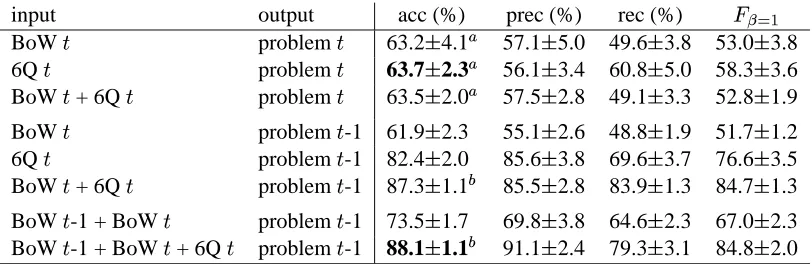
1-IGalgorithm (see Table 2). Consider the problem of predicting whether the current user utterance will cause problems. Either looking at the current word graph (BoW( ), at the six most recent sys-tem questions (6Q( ) or at both, leads to a signi-ficant improvement with respect to the majority-class-baseline.N The best results are obtained with only the system question types (although the dif-ference with the results for the other two tasks is not significant): a 63.7% accuracy and an
of 58.3. However, even though this is a signific-ant improvement over the majority-class-baseline, the accuracy is improved with only 5.5%.O
Next consider the problem of predicting whether the previous user utterance caused communication problems (these are the five remaining tasks). The best result is obtained by taking the two most recent word graphs and the six most recent system question types as input. This yields an accuracy of 88.1%, which is a significant improvement with respect to the
P
All checks for significance were performed with a one-tailedQ test.
R
As an aside, we performed one experiment with the words in the actual, transcribed user utterance at timeQ
in-stead of BoWQ, where the task is to predict whether the
input output acc (%) prec (%) rec (%)
BoW( problem( 63.2' 4.1S 57.1' 5.0 49.6' 3.8 53.0' 3.8 6Q( problem( 63.7' 2.3S 56.1' 3.4 60.8' 5.0 58.3' 3.6 BoW( + 6Q( problem( 63.5' 2.0S 57.5' 2.8 49.1' 3.3 52.8' 1.9
BoW( problem(-1 61.9' 2.3 55.1' 2.6 48.8' 1.9 51.7' 1.2 6Q( problem(-1 82.4' 2.0 85.6' 3.8 69.6' 3.7 76.6' 3.5 BoW( + 6Q( problem(-1 87.3' 1.1T 85.5' 2.8 83.9' 1.3 84.7' 1.3
[image:6.595.96.502.63.195.2]BoW( -1 + BoW( problem(-1 73.5' 1.7 69.8' 3.8 64.6' 2.3 67.0' 2.3 BoW( -1 + BoW( + 6Q( problem(-1 88.1' 1.1T 91.1' 2.4 79.3' 3.1 84.8' 2.0
Table 2: IB1-IGresults (accuracy, precision, recall, and
, with standard deviations) on the eight prediction tasks. S : this accuracy significantly improves the majority-class-baseline (UWVYX[Z*Z]\ ). T: this accuracy significantly improves the system-knows-baseline (UGV^X[Z*Z]\ ).
input output acc (%) prec (%) rec (%) *
BoW( problem( 65.1' 2.4S 58.3' 3.4 59.8' 4.2 58.9' 2.0 6Q( problem( 65.9' 2.1S
58.9' 3.5 60.7' 4.8 59.7' 3.2 BoW( + 6Q( problem( 66.0' 2.3
S
64.8' 2.6 50.3' 3.1 56.5' 1.1
BoW( problem(-1 63.2' 2.5 60.3' 5.5 36.1' 5.5 44.8' 4.6 6Q( problem(-1 83.4' 1.6 99.8' 0.4 60.4' 3.1 75.2' 2.4 BoW( + 6Q( problem(-1 90.0' 2.1T
93.2' 1.7 82.5' 4.5 87.5' 2.6
BoW( -1 + BoW( problem(-1 76.7' 2.6
74.7' 3.6 66.0' 5.7 69.9' 3.8 BoW( -1 + BoW( + 6Q( problem(-1 91.1' 1.1T
[image:6.595.93.505.259.392.2]
92.6' 2.0 85.7' 2.9 89.0' 1.5
Table 3: RIPPER results (accuracy, precision, recall, and)*
, with standard deviations) on the eight prediction tasks. S : this accuracy significantly improves the majority-class-baseline (UWVYX[Z*Z]\ ). T: this accuracy significantly improves the system-knows-baseline (U_V`X[Z*Z]\ ). : this accuracy result is sig-nificantly better than the IB1-IGresult given in Table 2 for this particular task, withUaV .05.
: this accuracy result is significantly better than theIB1-IGresult given in Table 2 for this particular task, with
UbV .001.
: this accuracy result is significantly better than theIB1-IGresult given in Table 2 for this
particular task, withUGV .01.
sharp, system-knows-baseline. In addition, the
)*
of 84.8 is nearly 6 points higher than that of the relevant, majority-class baseline.
The results obtained withRIPPERare shown in Table 3. On the problem of predicting whether the current user utterance will cause a problem,
RIPPERobtains the best results by taking as input both the current word graph and the types of the six most recent system questions, predicting prob-lems with an accuracy of 66.0%. This is a signific-ant improvement over the majority-class-baseline, but the result is not significantly better than that obtained with either the word graph or the system questions in isolation. Interestingly, the result is significantly better than the results forIB1-IGon
the same task.
On the problem of predicting whether the previ-ous user utterance caused a problem,RIPPER ob-tains the best results by taking all features into ac-count (that is: the two most recent bags of words and the six system questions).c This results in a 91.1% accuracy, which is a significant improve-ment over the sharp system-knows-baseline. This implies that 38% of the communication problems which were not detected by the dialogue system
d
1. if Q (Q) = R, then problem. (939/2)
2. if Q (Q) = Ie “naar”f BoW (Q-1)e “naar”f BoW(Q)e “om” gf BoW (Q) then problem. (135/16)
3. if “uur”f BoW(Q-1)e “om”f BoW(Q-1)e “uur”f BoW(Q)e “om”f BoW(Q) then problem. (57/4)
4. if Q(Q) = Ie Q(Q-3) = Ie “uur”f BoW (Q-1) then problem. (13/2)
5. if “naar”f BoW(Q-1)e “vanuit”f BoW (Q)e “van” gf BoW(Q) then problem. (29/4)
6. if Q(Q-1) = Ie “uur”f BoW (Q-1)e “nee”f BoW (Q) then problem. (28/7)
7. if Q(Q) = Ie “ik”f BoW(Q-1)e “van”f BoW(Q-1)e “van”f BoW(Q) then problem. (22/8)
8. if Q(Q) = Ie “van”f BoW (Q-1)e “om”f BoW(Q-1) then problem. (16/6)
9. if Q(Q) = Ee “nee”f BoW (Q) then problem. (42/10)
10. if Q(Q) = Me BoW (Q-1) =h then problem. (20/0)
11. if Q(Q-1) = Oe “ik”f BoW (Q)e “niet” in BoW(Q) then problem. (10/2)
12. if Q(Q-2) = Ie Q(Q) = Oe “wil”f BoW(Q-1) then problem. (8/0)
13. else no problem. (2114/245)
Figure 1: RIPPERrule set for predicting whether user utterance( -1 caused communication problems on the basis of the Bags of Words for( and(-1, and the six most recent system questions. Based on the entire data set. The question features are defined in section 2. The word “naar” is Dutch for to, “om” for at, “uur” for hour, “van” for from, “vanuit” is slightly archaic variant of “van” (from), “ik” is Dutch for I, “nee” for no, “niet” for not and “wil”, finally, for want. The (7 /i ) numbers at the end of each line indicate how many correct (7 ) and incorrect (i ) decisions were taken using this particular if ...then ...statement.
under investigation could be classified correctly using features which were already present in the system (word graphs and system question types). Moreover, the
is 89, which is 10 points higher than the*
associated with the system-knows baseline strategy. Notice also that thisRIP
-PER result is significantly better than the IB1-IG
results for the same task.
To gain insight into the rules learned by RIP
-PER for the last task, we applied RIPPER to the complete data set. The rules induced are dis-played in Figure 1. RIPPER’s first rule is con-cerned with repeated questions (compare with the system-knows-baseline). One important property of many other rules is that they explicitly com-bine pieces of information from the three main sources of information (the system questions, the current word graph and the previous word graph). Moreover, it is interesting to note that the words which crop up in the RIPPER rules are primarily function words. Another noteworthy feature of theRIPPER rules is that they reflect certain prop-erties which have been claimed to cue commu-nication problems. For instance, Krahmer et al. (1999), in their descriptive analysis of dialogue problems, found that repeated material is often an indication of problems, as is the use of a marked vocabulary. The rules 2, 3 and 7 are examples of the former cue, while the occurrence of the somewhat archaic “vanuit” instead of the ordinary
“van” is an example of the latter.
5
Discussion
In this study we have looked at automatic meth-ods for problem detection using simple features which are available in the vast majority of spoken dialogue systems, and require little or no com-putational overhead. We have investigated two approaches to problem detection. The first ap-proach is aimed at testing whether a user utter-ance, captured in a noisyj word graph, and/or the recent history of system utterances, would be pre-dictive of whether the utterance itself would be misrecognised. The results, which basically rep-resents a signal quality test, show that problem-atic cases could be discerned with an accuracy of about 65%. Although this is somewhat above the baseline of 58% decision accuracy when no problems would be predicted, signalling recogni-tion problems with word graph features and previ-ous system question types as predictors is a hard task. As other studies suggest (e.g., Hirschberg et al. 1999), confidence scores and acoustic/prosodic features could be of help.
The second approach tested whether the word graph for the current user utterance and/or the re-cent history of system question types could be employed to predict whether the previous user
k
utterance caused communication problems. The underlying assumption is that users will signal problems as soon as they become aware of them through the feedback provided by the system. Thus, in a sense, this second approach represents a noisy channel filtering task: the current utterance has to be decoded as signalling a problem or not. As the results show, this task can be performed at a surprisingly high level: about 91% decision ac-curacy (which is an error reduction of 38%), with an)*
of the problem category of 89. This res-ult can only be obtained using a combination of features; neither the word graph features in isola-tion nor the system quesisola-tion types in isolaisola-tion of-fer enough predictive power to reach above the sharp baseline of 86% accuracy and an )*
on the problem category of 79.
Keeping information sources isolated or combining them directly influences the relative performances of the memory-based IB1-IG
algorithm versus the RIPPER rule induction algorithm. When features are of the same type, accuracies of the memory-based and the rule-induction systems do not differ significantly (with one exception). In contrast, when features from different sources (e.g., words in the word graph and question type features) are combined,RIPPER
profits more thanIB1-IGdoes, causingRIPPERto perform significantly more accurately. The fea-ture independence assumption of memory-based learning appears to be the harming cause: by its definition, IB1-IG does not give extra weight to
apparently relevant interactions of feature values from different sources. In contrast, in nine out of the twelve rules that RIPPER produces, word
graph features and system questions type features are explicitly integrated as joint left-hand side conditions.
The current results show that for on-line detec-tion of communicadetec-tion problems at the utterance level it is already beneficial to pay attention only to the lexical information in the word graph and the sequence of system question types, features which are present in most spoken dialogue system and which can be obtained with little or no com-putational overhead. An approach to automatic problem detection is potentially very useful for spoken dialogue systems, since it gives a quantit-ative criterion for, for instance, changing the
dia-logue strategy (initiative, verification) or speech recognition engine (from one trained on normal speech to one trained on hyperarticulate speech).
Bibliography
Aha, D., Kibler, D., Albert, M. (1991), Instance-based Learning Algorithms, Machine Learning, 6:36–66.
Cohen, W. (1996), Learning trees and rules with set-valued features, Proc. 13th AAAI.
Daelemans, W., van den Bosch, A., Weijters, A. (1997),
IGTree: using trees for compression and classification in lazy learning algorithms, Artificial Intelligence
Re-view 11:407–423.
Daelemans, W., Zavrel, J., van der Sloot, K., van den Bosch, A. (2000), TiMBL: Tilburg Memory-Based Learner, version 3.0, refer-ence guide, ILK Technical Report 00-01, http://ilk.kub.nl/l ilk/papers/ilk0001.ps.gz.
Gorin, A., Riccardi, G., Wright, J. (1997), How may I Help You?, Speech Communication 23:113-127.
Hirschberg, J., Litman, D., Swerts, M. (1999), Prosodic cues to recognition errors, Proc. ASRU, Keystone, CO.
Krahmer, E., Swerts, M., Theune, M., Weegels, M., (1999), Error spotting in human-machine interactions, Proc.
EUROSPEECH, Budapest, Hungary.
Litman, D., Pan, S. (2000), Predicting and adapting to poor speech recongition in a spoken dialogue system, Proc.
17th AAAI, Austin, TX.
Litman, D., Walker, M., Kearns, M. (1999), Automatic De-tection of Poor Speech Recognition at the Dialogue Level. Proc. ACL’99, College Park, MD.
Manning, C., Sch¨utze, H., (1999), Foundations of
Statist-ical Natural Language Processing, The MIT Press,
Cambridge, MA.
van Rijsbergen, C.J. (1979), Information Retrieval, Lon-don: Buttersworth.
Soltau, H., Waibel, A. (1998), On the influence of hyper-articulated speech on recognition performance, Proc.
ICSLP’98, Sydney, Australia
Swerts, M., Litman, D., Hirschberg, J. (2000), Correc-tions in spoken dialogue systems, Proc. ICSLP 2000, Beijing, China.
Walker, M., Langkilde, I., Wright, J., Gorin, A., Litman, D. (2000a), Learning to predict problematic situations in a spoken dialogue system: Experiment with How May I Help You?, Proc. NAACL, Seattle, WA.