Effect of 100 keV Class Electron Beam Irradiation on Impact Fatigue Behavior
of PZT Ceramics
Naruya Tsuyuki
1,*, Anna Takahashi
1,*, Sagiri Takase
1,*, Daisuke Kitahara
1,*, Masae Kanda
1,2,3,
Noriyuki Inoue
1,2,4, Kaori Yuse
3, Daniel Guyomar
3, Akira Tonegawa
4, Yoshihito Matsumura
1,4and Yoshitake Nishi
1,3,41Graduate School of Engineering, Tokai University, Hiratsuka 259–1292, Japan
2Center of Applied Superconductivity & Sustainable Energy Research, Chubu University, Kasugai 487–8501, Japan
3Laboratoire de Génie Electrique et Ferroéléctricité (LGEF), INSA Lyon, Bat. Gustave Ferrié, 69621 Villeurbanne Cedex, France 4Graduate school of Science & Technology, Tokai University, Hiratsuka 259–1292, Japan
The homogeneous and quick treatment of 100 keV class electron beam irradiation (EBI) improved the resistance to impact fatigue indi-cated by the critical collision number (Nc) of impact fracture of PZT (Pb(Nb2/3Ni1/3)O3-Pb(Zr1/3Ti2/3)O3) ceramics, although an additional dose decayed them. An optimal dose of 0.086 MGy-EBI apparently improved the Nc and ECi of PZT. It could be explained by shortening the lattice constant after the collision for the PZT irradiated with the optimal dose. [doi:10.2320/matertrans.M2017250]
(Received August 9, 2017; Accepted December 26, 2017; Published February 9, 2018)
Keywords: electron beam, irradiation, PZT, fatigue, collision
1. Introduction
PZT(lead zirconate titanate: Pb(ZrxTi1−x)O3) is a complex perovskite structure of a mixed crystal constructed with lead titanate tetragonal(x < 0.52) and lead zirconate rhombohe-dral x > 0.52 crystals.1) When x is 0.525 (Morphotropic phase boundary: MPB), the marvelous performances of per-mittivity, piezoelectric effect, ferroelectricity can be broadly utilized for supersonic generator, flint, infrared sensor, en-ergy absorber and electrical power generator.2)
On the other hand, a fatigue fracture is one of serious problems in applying material systems and structures. Thus, it is important to know the collision fracture toughness, its fatigue life and its fatigue limit of the materials. However the fatigue test is usually quite time consuming. Therefore, a determination test, by which the collision fatigue limit can be precisely obtained, has been expected. If a nondestructive method of collision fatigue limit can be developed, it should be applied broadly in the fields of aerospace, civil, mechani-cal, electronic, and biomedical engineering, as well as in emerging technologies.
To evaluate the fatigue resistance for the piezoelectric ce-ramics, a nondestructive method has been suggested to eval-uate the collision fatigue limit of PZT, since the materials show large changes in electrical potential induced by pres-sure on the collision.3) Since a relationship between the maximum value of electrical potential and supplied collision energy below the collision fatigue limit has been expressed, the collision fatigue limit was nondestructively determined for PZT materials.
Both transformation of ZrO2 ceramics4) and surface com-pressive stress by potassium chemical penetration for alkali silicate glass5) have been recently developed as the new methods to strengthen ceramics. However, effective condi-tions to each material are not easily determined. On the other hand, shot-peening is convenient to activate and
ran-domize surface of metallic glass with enhancement of mean atomic distance and free volume as well as decreasing coor-dination number.6) It improves the permeability of soft mag-netic Fe-Si-B alloys glasses7) and the corrosion resistance of Fr-Cr stainless steel glass8), as well as the Vickers hardness of Pd-Cu-Si glassy alloys.9) However, it is easy to generate cracks in brittle materials, simultaneously. In order to ran-domize the brittle glass except crack generation, electron with extremely fine mass is used without (accompanying) crack formation.
The electron beam irradiation (EBI) with homogeneous low potential of 100 keV class has been suggested and de-veloped to draw the marvelous properties of strengthening and ductility enhancement for silica and silicate glass with-out crack generation.10–12) Active terminated atoms with dangling bonds13,14) have been formed in silica10) and sili-cate glasses11) treated by EBI. On the other hand, additional dose of 0.43 MGy-EBI reduces the bending strength, its strain and its fracture energy, to approximately 1/2, 1/3 and 1/6 of that untreated because of radiation damages.15) According to the results, EBI should be useful to strengthen ceramics. Therefore, the purpose of the present work is to in-vestigate effects of electron beam irradiation on fatigue re-sistance by number of impact force of PZT (Pb(Nb2/3Ni1/3)O3- Pb(Zr1/3Ti2/3)O3) ceramics.
2. Experimental procedure
2.1 PZT sample preparation
Oxide compounds of PbO, ZrO2,TiO2,NiO, and Nb2O5 (all from High Purity Chemicals, purity > 99%, Sakado and Higashi-matsuyama, Japan) were mixed for 24 h in a nylon jar with zirconia balls and then dried. The dried powders were calcined at 1153 K for 4 h. After that, the powders were dried and pressed into discs under a pressure of 1000 Pa, and sintered at 1473 K for 4 h. To obtain reproduc-ible results of fracture test PZT samples (2 mm × 2 mm × 5 mm), commercially used as a flint produced by TOKAI * Graduate Student, Tokai University
CORPORATION with high quality control, were prepared by sintering under high pressure. Although the original ox-ide composition of lead titanate zirconate was Pb(ZrxTi1−x)O3 (x = 0.525), the standard composition of PZT was currently Pb(Nb2/3Ni1/3)O3-Pb(Zr1/3Ti2/3)O3 utilized for practical applications. The metal atomic ratios of chemical composition measured by using EPMA (EPMA-1610, Electron Probe Micro Analysis, Shimazu, Kyoto) were 0.3775 +/−0.0115 for lead, 0.2915 +/−0.0065 for zirco-nium, 0.159 +/−0.002 for titanium, 0.08765 +/−0.00005 for niobium, 0.0841 +/−0.0072 for nickel, 0.050 for aluminum and 0.033 for strontium. Although crystal structure was per-ovskite confirmed by using XRD (Miniflex-2, Rigaku, Tokyo),3) angles of complex XRD peaks with high intensity of the Pb(Nb2/3Ni1/3)O3-Pb(Zr1/3Ti2/3)O3 (see Fig. 5) were higher than those (2θ = 30.917 and 31.362 deg for (101) and (110) plains, respectively) of Pb(ZrxTi1−x)O3 (x = 0.525) samples remarkably detected.3) The physical properties (PZT-5A standard) of PZT samples were 625 +/− 45 of Vickers hardness, 98 +/− 8 MPa for bending fracture strength, 0.45 +/− 0.16 MN·m−3/2 for fracture toughness value (K1C) value and 7140 kg·m−3 for density.15) The cracks were observed using a scanning electron microscopy (SEM(S-4800 type1, Hitachi high tec., Tokyo) and optical profile projection.
2.2 Condition of EBI
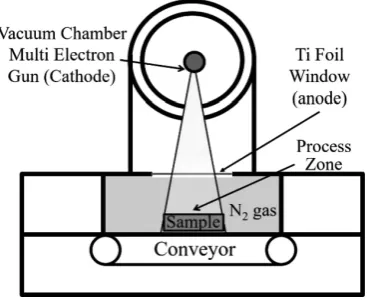
Figure 1 is a schematic of the electron beam processor (Type CB250/30/20 mA, Energy Science Inc., Woburn, MA, Iwasaki Electric Group Co. Ltd. Tokyo).16–25) The sheet-like electron beam was generated by a tungsten (W) filament in a vacuum chamber. The homogeneous irradiation was applied to the specimens with the sheet EBI with low energy through a thin titanium film window attached to the chamber with 550 mm diameter. The dose was controlled by the number (N = 1, 2, 3...) of sweeps. One sweep going one way with a low energy (acceleration potential, V: 170 kV), irradiating current density (I, 142 mA·m−2), irradiation cur-rent and conveyer speed (S: 9.56 m·min−1) was 0.0432 MGy applied for only a short time (0.23 s) with 30 s interval time between sweeps to avoid excessive heating (always less than 323 K) of the sample. The process zone kept under protec-tive N2(g) at atmospheric pressure with an O2(g) residual concentration kept below 300 ppm to prevent oxidation of
sample. The N2(g) flow rate was 1.5 L·s−1 at 0.1 MPa N2(g) pressure. The distance between sample and Ti window was 25 mm. The PZT samples in the aluminum plate holder (0.15 m × 0.15 m) carrying on a conveyor was irradiated through the homogeneous electron beam.
Since the density (ρ) of present PZT samples was 7140 kg·m−3, the penetration depth (Dth = 32.2 μm) was esti-mated by assumptions of Christenhusz & Reimer.26)
The penetration depth (Dth: μm) of EBI was expressed by the following equation26) and was obtained by using the den-sity (ρ: kg·m−3) and irradiation voltage at the specimen sur-face (V: kV).
Dth=66.7V5/3/ρ (1)
The electrical potential (V) of supecimen surface was mainly reduced due to the penetration of electrons going through the Ti window (ΔVTi) and N2 gas atmosphere (ΔVN2). This condition leads to the potential dropping esti-mated by the following equations.
V=170 keV−∆VTi−∆VN2 (2)
Using eq. (1), the dropped potential values, ΔVTi and ΔVN2 are estimated from the acceleration potential (170 keV), the 10 μm thickness (TTi) of the titanium window (density: 4540 kg·m−3), and the 25 mm distance between the sample and the window (TN2) in the N2 gas atmosphere (density:
ρN2 = 1.13 kg·m−3).
Since the dropped potential values were 22.2 keV and 15.2 keV, the mean electrical potential of specimen surface, V was obtained to be 132.6 keV as follows.
V =170 keV−22.2 keV−15.2 keV=132.6 keV (3)
Using the eq. (1), the penetration depth (Dth: m) was 32 and 80 μm for PZT and soda cover glass samples with densi-ties of 7140 and 2760 kg·m−3, respectively.
Although the experimental Dth obtained by using electron spin resonance (ESR) signals (more than 300 μm) was higher than estimated values (220 +/−40 μm) for the PEEK polymer25), the experimentally obtained depth Dth of the soda glass27) was 80 +/−20 μm determined by changes in the Vickers hardness, that was, indicator of the micro-plastic deformation. Thus, the estimation was assumed to be adapt-able for ceramics.
2.3 Impact fatigue test
The fatigue test, as shown in Fig. 2, was repeatedly per-formed by the collision of a stainless steel stick. The mass (m), length and diameter of the stick were 1.463 g, 5 mm and 4 mm, respectively. The sample size of the PZT sample was 2 mm × 2 mm × 5 mm. To load homogeneously, a hemispheric shock absorber made of 18-8 stainless steel was set between PZT sample and stick (see Fig. 2). The sample was apparently fractured by optical observation.
[image:2.595.78.262.622.772.2]eration speed (g: m·s−2) and the height (h: m) from the sample top surface to the iron stick bottom. 3)
On the other hand, the accumulative probability (P) of the median rank method19–25,28,29), which was useful for statisti-cal evaluation often used in quality control (QC), was one of the convenient ways to analyze mechanical probability. Here, the accumulative probability of the critical number of collision fracture was expressed by the following equation:
Pf =(i−0.3)/(n+0.4) (5)
Here, n and i were the total number of samples (n = 3) and
the median rank of the critical collision number of fracture (Nc) for each sample from the weakest (i = 1) to the stron-gest (i = 3), respectively. Pf values were 0.21, 0.5 and 0.79, respectively, when i values are 1, 2, and 3.
3. Results
3.1 Collision fatigue test of PZT without EBI
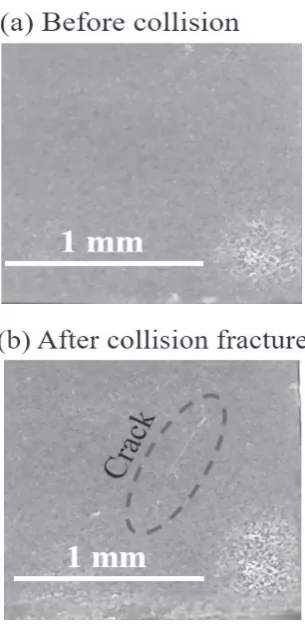
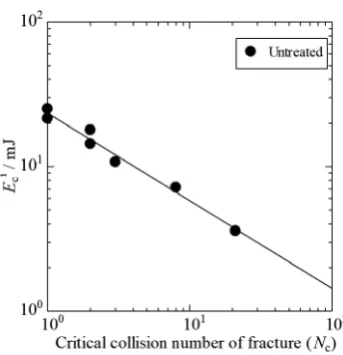
The fatigue test is repeatedly performed by the stick colli-sion against the three PZT samples at different collicolli-sion en-ergies, until the samples are apparently fractured by optical observation, as shown in Fig. 3. Figure 4 shows changes in critical collision number (Nc) against its supplied constant energy of collision (ECi) of PZT untreated. When Nc is one, that is, fracture occurs by one collision, the maximum ECi value obtained should be 25 mJ. Decreasing the ECi value from 25 to 3.6 mJ increases the Nc value from one to 21. When the collision energy becomes small enough, the total number of collisions to fracture should become infinite long.
On the other hand, when the ECi was below 3.6 mJ, the collision fracture could not be easily determined by the col-lision test. Since micro-cracks cannot be observed below the collision fatigue limit by SEM observation, the collision fa-tigue limit can be defined for the PZT sample. The long life-time on collision fatigue of the material lies below the limit, as shown in Fig. 4.
3.2 Influence of EBI on collision fatigue life of PZT
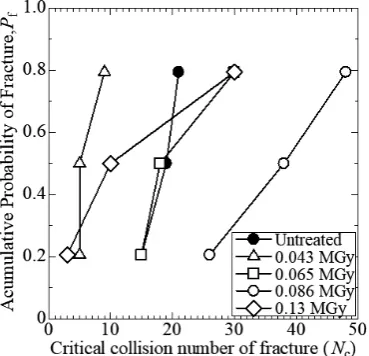
Figure 5 illustrates changes in critical collision number of fracture of PZT without EBI and with EBI of dosage varying from 0.043 to 0.13 MGy against the accumulative probabil-ity of fracture, when one collision energy is 3.6 mJ. EBI dose of 0.086 MGy apparently improves the Nc from 18 +/−
3 to 37 +/− 11 at all Pf, from 0.21 to 0.79, that is, it pro-longs the fatigue life.
EBI dose of 0.065 to 0.13 MGy remarkably improves the Nc at the high Pf value of 0.79, whereas additional EBI dose of 0.13 MGy apparently decreases the Nc values at the low and medium Pf values of 0.21 and 0.50. The minimum Nc value at the low Pf of 0.21 is found in 0.13 MGy-irradiated Fig. 2 Schematic drawing of impact fatigue tests.
Fig. 3 Optical micrograph of PZT (Pb(Nb2/3Ni1/3)O3-Pb(Zr1/3Ti2/3)O3)
surface before and after fracture with crack.
Fig. 4 Changes in the critical collision number (Nc) against its supplied constant energy of collision (ECi) of PZT (Pb(Nb2/3Ni1/
[image:3.595.93.246.231.414.2] [image:3.595.92.245.450.763.2] [image:3.595.337.517.569.751.2]PZT because of general radiation damage. On the other hand, slight dose of 0.043 MGy-EBI apparently decreases the Nc values at all Pf values.
4. Discussion
4.1 Prolonging fatigue life of PZT by optimum dose EBI
Figure 6 illustrates EBI-dose dependence of the critical collision number (Nc) of impact fracture of PZT at the me-dium Pf. As usual radiation damages occur, the additional dose of 0.13 MGy-EBI apparently decreases the Nc value at the low Pf values of 0.21, as shown in Figs. 5 and 6. On the other hand, the optimal dose of 0.086 MGy-EBI apparently improves the Nc and ECi of PZT. One of the possible reasons is that the annihilation of sharp crack tips is probably in-duced by the migration of surface atoms, since it has been often observed by using electron microscopy. Furthermore, since active terminated atoms with dangling bonds without crack generation have been formed by EBI for silica and sil-icate glasses,13,14) both strengthening and ductility enhance-ment are drawn.10–12) Using the radial distribution function of SO2 glass, optimal dose of EBI has decreased its mean atomic distance10). The compressive strain generally occurs at surface of the ceramics with similar chemical bonds.
4.2 Discussion of XRD results of untreated PZT
To explain the results of the collision test, the crystallo-graphic analysis has been performed. Figure 7 illustrates both (101) and (110) XRD peaks of PZT (Pb(Nb2/3Ni1/ 3)O3-Pb(Zr1/3Ti2/3)O3) samples with perovskite structure3) just before the first collision (see broken lines) and just after the collisions to fracture (see solid lines). Since the collisions to fracture decreases the peak angle and peak height (see Fig. 7(a)), it increases the distance of crystal plain, strongly related to the lattice constant, and disorders the crystal lat-tice sites with latlat-tice defects. The residual strain is stored and relaxed simultaneously by the collisions to fracture. The collision stores the residual strain by the formation of lattice
defects, whereas the collisions to fracture also relaxes the stored strain because of cutting the chemical bonds between metal and oxygen ions at micro-crack interface. According to the XRD results of untreated PZT in Fig. 6(a), the irre-versible stored strain is probably relaxed by the defects for-mation and crack.
4.3 Discussion of long life of PZT irradiated by optimal dose
Figure 7(b) also shows XRD peaks of PZT (Pb(Nb2/3Ni1/3)O3-Pb(Zr1/3Ti2/3)O3) samples treated by the optimal dose of 0.086 MGy-EBI just before the first colli-sion (broken line) and just after the collicolli-sions to fracture (solid line). Since the optimal dose of EBI decreases the peak angle of XRD results, as shown in Fig. 7(a) and (b) (broken lines), it decreases the peak angle which indicates the increase of lattice constant.
When the volume expansion is assumed to be induced by the oxygen enrichment and/or the annihilation of oxygen defects by the optimal dose of 0.086 MGy-EBI, it can be explained.
Since the collision after EBI with the optimal dose short-ens the lattice constant of PZT, it probably prevents the crack generation and propagation.
Therefore, the optimal dose of 0.086 MGy-EBI appar-ently increases the fatigue life, that is, it also improves the critical collision number of fracture (Nc) of PZT at all accu-mulative probabilities (Pf), as shown in Figs. 5 and 6.
4.4 Radiation damage of PZT irradiated by additional dose
Although the XRD peak angle (see broken line in Fig. 7(c)) of radiation damaged PZT with an additional dose of 0.13 MGy-EBI prior to the collision test is lower than that of untreated PZT (see broken line in Fig. 7(a)), it is slightly higher than that of PZT with the optimal dose of 0.086 MGy-EBI prior to the collision test (see broken line in Fig. 6 Changes in the critical collision number (Nc) of impact fracture of PZT (Pb(Nb2/3Ni1/3)O3-Pb(Zr1/3Ti2/3)O3) at medium accumulative
prob-ability (Pf = 0.50) against EBI dose, together with upper and lower ex-perimental errors (0.21 ≤ Pf ≤ 0.79).
Fig. 5 Changes in the critical collision number of fracture (Nc) of PZT (Pb(Nb2/3Ni1/3)O3-Pb(Zr1/3Ti2/3)O3) without EBI and with EBI of
[image:4.595.77.262.71.249.2] [image:4.595.333.516.72.270.2]Fig. 6(b)). Namely, the lattice constant at additional dose prior to the collision test is larger than that untreated, whereas it is slightly lower than that with the optimal dose. When the slight volume reduction by the additional dose EBI is assumed to be induced by oxygen desorption and for-mation of oxygen defects, it can be explained.
As shown in Fig. 7(c) with XRD peaks of radiation dam-aged PZT samples treated by the additional dose of 0.13 MGy-EBI just before the first collision (broken lines) and just after collisions to fracture (solid lines), the colli-sions to the radiation damaged PZT slightly decreases the XRD-peak angle. It increases the lattice constant because of cutting the chemical bonds between metals and oxygen ions at micro-crack interface.
Thus, the additional dose of 0.13 MGy-EBI decreases the critical collision number to fracture (Nc) of PZT, as shown in Fig. 6. Namely, the additional dose apparently decreases the fatigue life,
4.5 Relationship between logNc and logECi of untreated
PZT
Figure 8 illustrates the linear relationship between logNc and logECi of untreated PZT, when a collision is 3.6 mJ. When the hemispheric stick homogenizes the distribution of impact force on the collisions on the PZT surface, the linear relationship of untreated PZT can be obtained and expressed by the following equation.
log ECi=−1/2 log Nc(untreated)+1.3 (6)
Namely, the integrated impact energy (ECi) of untreated PZT can be inversely proportional to root Nc (Nc1/2) can be expressed by the following equations.
ECi×Nc1/2=3.6 mJ×(18+/−3)1/2
=15.3 mJ (untreated) (7)
ECi=15.3 mJ (untreated)/Nc1/2 (8)
4.6 Prediction of collision fatigue life of PZT with opti-mal dose
When the critical collision number to fracture (Nc) is 105 (106), the E
Ci is deduced to be 48.4 (15.3) μJ. Using eq. (4), the height of the stick just before falling should be 0.3 (0.1) mm.
When the linear relationship is assumed to be applied to the PZT samples with optimal dose of 0.086 MGy-EBI, it is Fig. 7 XRD peaks of PZT (Pb(Nb2/3Ni1/3)O3-Pb(Zr1/3Ti2/3)O3) untreated
(a) and treated by EBI with optimal (0.086 MGy, (b)) and additional (0.13 MGy, (c)) dosage just before the first collision (broken lines) and just after the collisions to fracture (solid lines).
[image:5.595.340.512.66.244.2] [image:5.595.65.274.67.649.2]possible that the intercept strongly depended on HLEBI dose should be obtained, as the following equation.
ECi×Nc1/2=3.6 mJ×(37+/−11)1/2
=21.9 mJ (0.086 MGy) (9)
ECi=21.9 mJ (0.086 MGy)/Nc1/2 (10)
When the critical collision number to fracture (Nc) is 105 and 106, the E
Ci can be estimated to be 69.3 and 21.9 μJ, respec-tively. Using eq. (4), the height of the stainless steel stick should be 0.48 and 15.2 mm, respectively.
Therefore, optimal dose of 0.086 MGy-EBI can be pre-dicted to improve the resistance to fatigue fracture from 48.4 and 15.3 to 69.3 and 21.9 μJ at practical high Pf values of 105 and 106, respectively.
5. Conclusion
The homogeneous and quick treatment of electron beam irradiation with low potential (EBI) improved the critical collision number (Nc) and its integrated collision energy (ECi) of impact fracture of PZT (Pb(Nb2/3Ni1/ 3)O3-Pb(Zr1/3Ti2/3)O3) ceramics, although additional dose de-cayed them.
(1) The optimal dose of 0.086 MGy-EBI apparently im-proved the Nc of PZT.
(2) Since the collision after EBI with the optimal dose shortened the lattice constant of PZT, it probably prevented the crack generation and propagation. Therefore, the long life of impact fatigue could be explained for the PZT irradi-ated with the optimal dose.
(3) Decreasing the ECi value from 25 to 3.6 mJ increased the Nc value from one to 21 for PZT untreated. The linear re-lationship between the log Nc and log ECi of untreated PZT was obtained, when one impact collision energy was 3.6 mJ.
(4) Using the linear relationship between log ECi and log Nc, the estimated values of PZT samples assumed to be pre-dicted. The optimal dose of 0.086 MGy-EBI probably im-proved the resistance to fatigue fracture from 48.4 (15.3) to 69.3 (21.9) μJ at high practical Pf of 105 (106).
Acknowledgements
This work was partly supported by the JSPS Core-to-Core Program, A. Advanced Research Networks, International research core on smart layered materials and structures for
energy saving . Our sincere gratitude also goes to Eye Electron Beam Co., Ltd. (Gyoda, Saitama, Japan) for their support with this work.
REFERENCES
1) G. Shirane and K. Suzuki: J. Phys. Soc. Jpn. 7 (1952) 333–339.
2) B. Jaffe, et.al.: J. Appl. Phys. 25 (1954) 809.
3) Y. Nishi, R. Kondoh, K. Yamada and H. Irisawa: Mater. Trans. 45
(2004) 229–232.
4) T. Sato and M. Shimada: Ceramics Jpn. 21 (1986) 613–619. 5) A.L. Zijlstra and A.J. Burggraaf: J. Non-Cryst. Solids 1 (1968) 49–68.
6) Y. Nishi, H. Harano, T. Fukunaga and K. Suzuki: Phys. Rev. B 37
(1988) 2855–2860.
7) Y. Nishi and H. Harano: J. Appl. Phys. 63 (1988) 1141–1143.
8) Y. Nishi, A. Yazawa, C. Seshimo and K. Oguri: J. Mater. Sci. Lett. 15 (1996) 1582–1583.
9) Y. Nishi, H. Harano and H. Ishizuki: J. Mater. Sci. Lett. 6 (1987) 1445–1446.
10) N. Yamaguchi, K. Oguri, A. Tonegawa and Y. Nishi: J. Jpn. Inst. Metals 68 (2004) 198–201.
11) Y. Nishi, A. Kadowaki and T. Shinoda: Mater. Trans. 45 (2004) 3314–3317.
12) K. Iwata and Y. Nishi: Mater. Trans. 50 (2009) 1519–1525.
13) D.L. Griscom and E.J. Friebele: Radiat. Eff. 65 (1982) 63–72.
14) D.L. Griscom: The Centenial Memorial Issue of the Ceramic Soc. Jpn.
99 (1991) 923–942.
15) A. Takahashi, et.al. Unpublished data.
16) R. Nomura, M. Kanda, M.C. Faudree, I. Jimbo and Y. Nishi: Mater. Trans. 57 (2016) 417–422.
17) K. Oguri, K. Fujita, M. Takahashi, Y. Omori, A. Tonegawa, N. Honda, M. Ochi, K. Takayama and Y. Nishi: J. Mater. Res. 13 (1998) 3368–3371.
18) K. Oguri, N. Iwataka, A. Tonegawa, Y. Hirose, K. Takayama and Y. Nishi: J. Mater. Res. 16 (2001) 553–557.
19) K. Oguri and Y. Nishi: Mater. Trans. 45 (2004) 1346–1349.
20) T. Takahashi, T. Morishita and Y. Nishi: J. Jpn. Inst. Metals 69 (2005) 759–762.
21) H. Kobayashi, M. Salvia and Y. Nishi: J. Jpn. Inst. Metals 70 (2006) 255–257.
22) K. Inoue, K. Iwata, T. Morishita, A. Tonegawa, M. Salvia and Y. Nishi: J. Jpn. Inst. Metals 70 (2006) 461–466.
23) K. Komai, K. Minoshima and K. Tanaka: Trans. Jpn. Soc. Mech. Eng.
64 (1998) 2300–2307.
24) H. Takei, K. Iwata, M. Salvia, A. Vautrin and Y. Nishi: Mater. Trans.
51 (2010) 2259–2265.
25) H. Takei, M. Salvia, A. Vautin, A. Tonegawa and Y. Nishi: Mater. Trans. 52 (2011) 734–739.
26) R. Christenhusz and L. Reimer: Z. Angew. Phys. 23 (1967) 396–404. 27) Y. Nishi, unpublished data.
28) Y. Miyazawa, M. Uyama, S. Ishii, M. Kanda and Y. Nishi: Mater. Trans. 54 (2013) 1166–1170.