Co-regularizing character-based and word-based models for
semi-supervised Chinese word segmentation
Xiaodong Zeng† Derek F. Wong† Lidia S. Chao† Isabel Trancoso‡ †Department of Computer and Information Science, University of Macau
‡INESC-ID / Instituto Superior T´ecnico, Lisboa, Portugal
[email protected], {derekfw, lidiasc}@umac.mo, [email protected]
Abstract
This paper presents a semi-supervised Chinese word segmentation (CWS) ap-proach that co-regularizes character-based and word-based models. Similarly to multi-view learning, the “segmentation agreements” between the two differen-t differen-types of view are used differen-to overcome differen-the scarcity of the label information on unla-beled data. The proposed approach train-s a character-batrain-sed and word-batrain-sed mod-el on labmod-eled data, respectivmod-ely, as the ini-tial models. Then, the two models are con-stantly updated using unlabeled examples, where the learning objective is maximiz-ing their segmentation agreements. The a-greements are regarded as a set of valuable constraints for regularizing the learning of both models on unlabeled data. The seg-mentation for an input sentence is decod-ed by using a joint scoring function com-bining the two induced models. The e-valuation on the Chinese tree bank reveals that our model results in better gains over the state-of-the-art semi-supervised mod-els reported in the literature.
1 Introduction
Chinese word segmentation (CWS) is a critical and a necessary initial procedure with respect to the majority of high-level Chinese language pro-cessing tasks such as syntax parsing, informa-tion extracinforma-tion and machine translainforma-tion, since Chi-nese scripts are written in continuous characters without explicit word boundaries. Although su-pervised CWS models (Xue, 2003; Zhao et al., 2006; Zhang and Clark, 2007; Sun, 2011) pro-posed in the past years showed some reasonably accurate results, the outstanding problem is that they rely heavily on a large amount of labeled
da-ta. However, the production of segmented Chi-nese texts is time-consuming and expensive, since hand-labeling individual words and word bound-aries is very hard (Jiao et al., 2006). So, one can-not rely only on the manually segmented data to build an everlasting model. This naturally pro-vides motivation for using easily accessible raw texts to enhance supervised CWS models, in semi-supervised approaches. In the past years, however, few semi-supervised CWS models have been pro-posed. Xu et al. (2008) described a Bayesian semi-supervised model by considering the segmentation as the hidden variable in machine translation. Sun and Xu (2011) enhanced the segmentation result-s by interpolating the result-statiresult-sticresult-s-baresult-sed featureresult-s de-rived from unlabeled data to a CRFs model. An-other similar trial via “feature engineering” was conducted by Wang et al. (2011).
The crux of solving semi-supervised learning problem is the learning on unlabeled data. In-spired by multi-view learning that exploits redun-dant views of the same input data (Ganchev et al., 2008), this paper proposes a semi-supervised CWS model of co-regularizing from two dif-ferent views (intrinsically two difdif-ferent models), character-based and word-based, on unlabeled da-ta. The motivation comes from that the two types of model exhibit different strengths and they are mutually complementary (Sun, 2010; Wang et al., 2010). The proposed approach begins by train-ing a character-based and word-based model on labeled data respectively, and then both models are regularized from each view by their segmen-tation agreements, i.e., the identical outputs, of unlabeled data. This paper introduces segmenta-tion agreements as gainful knowledge for guiding the learning on the texts without label information. Moreover, in order to better combine the strengths of the two models, the proposed approach uses a joint scoring function in a log-linear combination form for the decoding in the segmentation phase.
2 Segmentation Models
There are two classes of CWS models: character-based and word-character-based. This section briefly re-views two supervised models in these categories, a character-based CRFs model, and a word-based Perceptrons model, which are used in our ap-proach.
2.1 Character-based CRFs Model
Character-based models treat word segmentation as a sequence labeling problem, assigning label-s to the characterlabel-s in a label-sentence indicating their positions in a word. A 4 tag-set is used in this paper: B (beginning), M (middle), E (end) and
S (single character). Xue (2003) first proposed the use of CRFs model (Lafferty et al., 2001) in character-based CWS. Letx= (x1x2...x|x|)∈ X
denote a sentence, where each character andy = (y1y2...y|y|) ∈ Y denote a tag sequence,yi ∈ T
being the tag assigned toxi. The goal is to achieve
a label sequence with the best score in the form,
pθc(y|x) = 1
Z(x;θc)
exp{f(x, y)·θc} (1)
whereZ(x;θc)is a partition function that
normal-izes the exponential form to be a probability distri-bution, andf(x, y)are arbitrary feature functions.
The aim of CRFs is to estimate the weight param-etersθcthatmaximizes the conditional likelihood
of the training data:
ˆ
θc= argmax θc
l X
i=1
logpθc(y
i|xi)−γkθ
ck22 (2)
where γkθck22 is a regularizer on parameters to
limit overfitting on rare features and avoid degen-eracy in the case of correlated features. In this paper, this objective function is optimized by s-tochastic gradient method. For the decoding, the Viterbi algorithm is employed.
2.2 Word-based Perceptrons Model
Word-based models read a input sentence from left to right and predict whether the current piece of continuous characters is a word. After one word is identified, the method moves on and searches for a next possible word. Zhang and Clark (2007) first proposed a word-based segmentation mod-el using a discriminative Perceptrons algorithm. Given a sentencex, let us denote a possible
seg-mented sentence asw ∈ w, and the function that
enumerates a set of segmentation candidates as
GEN:w = GEN(x) for x. The objective is to
maximizethe following problem for all sentences:
ˆ
θw = argmax w=GEN(x)
|w|
X
i=1
φ(x, wi)·θw (3)
where it maps the segmented sentencewto a
glob-al feature vector φ and denotes θw as its
cor-responding weight parameters. The parameter-s θw can be estimated by using the
Perceptron-s method (CollinPerceptron-s, 2002) or other online learning algorithms, e.g., Passive Aggressive (Crammer et al., 2006). For the decoding, a beam search decod-ing method (Zhang and Clark, 2007) is used.
2.3 Comparison Between Both Models
Character-based and word-based models present different behaviors and each one has its own strengths and weakness. Sun (2010) carried out a thorough survey that includes theoretical and em-pirical comparisons from four aspects. Here, two critical properties of the two models supporting the co-regularization in this study are highlight-ed. Character-based models present better predic-tion ability for new words, since they lay more emphasis on the internal structure of a word and thereby express more nonlinearity. On the oth-er side, it is easioth-er to define the word-level fea-tures in word-based models. Hence, these models have a greater representational power and conse-quently better recognition performance for in-of-vocabulary (IV) words.
3 Semi-supervised Learning via Co-regularizing Both Models
This study proposes a co-regularized CWS model based on character-based and word-based models, built on a small amount of segmented sen-tences (labeled data) and a large amount of raw sentences (unlabeled data). The model induction process is described in Algorithm 1: given labeled dataset Dl and unlabeled dataset Du, the first
t-wo steps are training a CRFs (character-based) and Perceptrons (word-based) model on the labeled data Dl , respectively. Then, the parameters of
both models are continually updated using unla-beled examples in a learning cycle. At each iter-ation, the raw sentences in Du are segmented by
current character-based modelθcand word-based
modelθw. Meanwhile, all the segmentation
agree-ments A are collected (§ 3.1). Afterwards, the
agreementsA are used as a set of constraints to bias the learning of CRFs (§ 3.2) and Perceptron (§ 3.3) on the unlabeled data. The convergence
criterion is the occurrence of a reduction of seg-mentation agreements or reaching the maximum number of learning iterations. In the final segmen-tation phase, given a raw sentence, the decoding requires both induced models (§3.4) in measuring a segmentation score.
Algorithm 1Co-regularized CWS model induction Require: nlabeled sentencesDl;munlabeled sentencesDu
Ensure: θcandθw 1: θ0
c ←crf train(Dl) 2: θ0
w←perceptron train(Dl) 3: fort= 1...Tmaxdo 4: At
←agree(Du, θct−1, θwt−1) 5: θt
c←crf train constraints(Du,At, θtc−1) 6: θt
w←perceptron train constraints(Du,At, θtw−1) 7: end for
3.1 Agreements Between Two Models
Given a raw sentence, e.g., “我正在北京看奥运 会开幕式。(I am watching the opening ceremony
of the Olympics in Beijing.)”, the two segmenta-tions shown in Figure 1 are the predicsegmenta-tions from a character-based and word-based model. The segmentation agreements between the two mod-els correspond to the identical words. In this ex-ample, the five words, i.e. “我 (I)”, “北京
(Bei-jing)”, “看(watch)”, “开幕式(opening ceremony)”
and “。(.)”, are the agreements.
3.2 CRFs with Constraints
For the character-based model, this paper fol-lows (T¨ackstr¨om et al., 2013) to incorporate the segmentation agreements into CRFs. The main
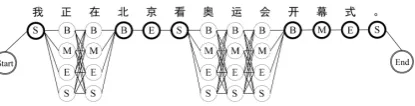
idea is to constrain the size of the tag sequence lattice according to the agreements for achieving simplified learning. Figure 2 demonstrates an ex-ample of the constrained lattice, where the bold node represents that a definitive tag derived from the agreements is assigned to the current charac-ter, e.g., “我 (I)” has only one possible tag “S” because both models segmented it to a word with a single character. Here, if the lattice of all admis-sible tag sequences for the sentence xis denoted
asY(x), the constrained lattice can be defined by ˆ
Y(x,y˜), where y˜refers to tags inferred from the
agreements. Thus, the objective function on unla-beled data is modeled as:
ˆ
θ0
c= argmax θc
m X
i=1
logpθc( ˆY(x
i,y˜i)|xi)−γkθ ck22
(4) It is a marginal conditional probability given by the total probability of all tag sequences consistent with the constrained latticeYˆ(x,y˜). This
[image:3.595.314.522.517.570.2]objec-tive can be optimized by using LBFGS-B (Zhu et al., 1997), a generic quasi-Newton gradient-based optimizer.
Figure 1: The segmentations given by character-based and word-character-based model, where the words in “2” refer to the segmentation agreements.
Figure 2: The constrained lattice representation for a given sentence, “我正在北京看奥运会开幕 式。”.
3.3 Perceptrons with Constraints
update iterationk, each raw sentencexuis
decod-ed with the current model into a segmentationzu.
If the words in outputzu do not match the
agree-ments A(xu) of the current sentencexu, the
pa-rameters are updated by adding the global feature vector of the current training example with the a-greements and subtracting the global feature vec-tor of the decoder output, as described in lines 3 and 4 of Algorithm 2.
Algorithm 2Parameter update in word-based model 1: fork= 1...K, u= 1...mdo
2: calculatezu= argmax w=GEN(x)
P|w|
i=1φ(xu, wi)·θ k−1 w
3: ifzu6=A(xu)
4: θk
w=θkw−1+φ(A(xu))−φ(zu) 5: end for
3.4 The Joint Score Function for Decoding
There are two co-regularized models as results of the previous induction steps. An intuitive idea is that both induced models are combined to conduct the segmentation, for the sake of integrating their strengths. This paper employs a log-linear inter-polation combination (Bishop, 2006) to formulate a joint scoring function based on character-based and word-based models in the decoding:
Score(w) =α·log(pθc(y|x))
+(1−α)·log(φ(x, w)·θw) (5)
where the two terms of the logarithm are the s-cores of character-based and word-based model-s, respectively, for a given segmentationw. This
composite function uses a parameterα to weight
the contributions of the two models. Theαvalue
is tuned using the development data.
4 Experiment
4.1 Setting
The experimental data is taken from the Chinese tree bank (CTB). In order to make a fair compar-ison with the state-of-the-art results, the versions of CTB-5, CTB-6, and CTB-7 are used for the e-valuation. The training, development and testing sets are defined according to the previous works. For CTB-5, the data split from (Jiang et al., 2008) is employed. For CTB-6, the same data split as recommended in the CTB-6 official document is used. For CTB-7, the datasets are formed accord-ing to the way in (Wang et al., 2011). The cor-responding statistic information on these data s-plits is reported in Table 1. The unlabeled data in
our experiments is from the XIN CMN portion of Chinese Gigaword 2.0. The articles published in 1991-1993 and 1999-2004 are used as unlabeled data, with 204 million words.
The feature templates in (Zhao et al., 2006) and (Zhang and Clark, 2007) are used in train-ing the CRFs model and Perceptrons model, respec-tively. The experimental platform is implement-ed basimplement-ed on two popular toolkits: CRF++ (Kudo, 2005) and Zpar (Zhang and Clark, 2011).
Data #Sent-train #Sent-dev #Sent-test OOV-dev OOV-test CTB-5 18,089 350 348 0.0811 0.0347 CTB-6 23,420 2,079 2,796 0.0545 0.0557 CTB-7 31,131 10,136 10,180 0.0549 0.0521
Table 1: Statistics of CTB-5, CTB-6 and CTB-7 data.
4.2 Main Results
The development sets are mainly used to tune the values of the weight factorα in Equation 5. We evaluated the performance (F-score) of our model on the three development sets by using differen-tα values, whereα is progressively increased in steps of 0.1 (0 < α < 1.0). The best performed
settings ofαfor CTB-5, CTB-6 and CTB-7 on
de-velopment data are 0.7, 0.6 and 0.6, respectively. With the chosen parameters, the test data is used to measure the final performance.
Table 2 shows the F-score results of word seg-mentation on CTB-5, CTB-6 and CTB-7 testing sets. The line of “ours” reports the performance of our semi-supervised model with the tuned pa-rameters. We first compare it with the supervised “baseline” method which joints character-based and word-based model trained only on the training set1. It can be observed that our semi-supervised
model is able to benefit from unlabeled data and greatly improves the results over the supervised baseline. We also compare our model with two state-of-the-art semi-supervised methods of Wang ’11 (Wang et al., 2011) and Sun ’11 (Sun and X-u, 2011). The performance scores of Wang ’11 are directly taken from their paper, while the results of Sun ’11 are obtained, using the program provided by the author, on the same experimental data. The
bold scores indicate that our model does achieve significant gains over these two semi-supervised models. This outcome can further reveal that us-ing the agreements from these two views to regu-larize the learning can effectively guide the mod-el toward a better solution. The third compari-son candidate is Hatori ’12 (Hatori et al., 2012) which reported the best performance in the litera-ture on these three testing sets. It is a supervised joint model of word segmentation, POS tagging and dependency parsing. Impressively, our model still outperforms Hatori ’12 on all three datasets. Although there is only a 0.01 increase on CTB-5, it can be seen as a significant improvement when considering Hatori ’12 employs much richer train-ing resources, i.e., sentences tagged with syntactic information.
Method CTB-5 CTB-6 CTB-7
Ours 98.27 96.33 96.72
[image:5.595.88.277.299.386.2]Baseline 97.58 94.71 94.87 Wang ’11 98.11 95.79 95.65 Sun ’11 98.04 95.44 95.34 Hatori ’12 98.26 96.18 96.07
Table 2: F-score (%) results of five CWS models on CTB-5, CTB-6 and CTB-7.
5 Conclusion
This paper proposed an alternative semi-supervised CWS model that co-regularizes a character- and word-based model by using their segmentation agreements on unlabeled data. We perform the agreements as valuable knowledge for the regularization. The experiment results reveal that this learning mechanism results in a positive effect to the segmentation performance.
Acknowledgments
The authors are grateful to the Science and Tech-nology Development Fund of Macau and the Re-search Committee of the University of Macau for the funding support for our research, under the ref-erence No. 017/2009/A and MYRG076(Y1-L2)-FST13-WF. The authors also wish to thank the anonymous reviewers for many helpful comments.
References
Christopher M. Bishop. 2006. Pattern recognition and machine learning.
Michael Collins. 2002. Discriminative training meth-ods for hidden markov models: Theory and exper-iments with perceptron algorithms. InProceedings
of EMNLP, pages 1-8, Philadelphia, USA.
Koby Crammer, Ofer Dekel, Joseph Keshet, Shai Shalev-Shwartz, and Yoram Singer. 2006. Online passive-aggressive algorithms. Journal of ma-chine learning research, 7:551-585.
Kuzman Ganchev, Joao Graca, John Blitzer, and Ben Taskar. 2008. Multi-View Learning over Struc-tured and Non-Identical Outputs. InProceedings of CUAI, pages 204-211, Helsinki, Finland.
Jun Hatori, Takuya Matsuzaki, Yusuke Miyao, and Jun’ichi Tsujii. 2012. Incremental Joint Approach to Word Segmentation, POS Tagging, and Depen-dency Parsing in Chinese. InProceedings of ACL, pages 1045-1053, Jeju, Republic of Korea.
Wenbin Jiang, Liang Huang, Qun Liu, and Yajuan Liu. 2008. A Cascaded Linear Model for Joint Chinese Word Segmentation and Part-of-Speech Tagging. In
Proceedings of ACL, pages 897-904, Columbus,
O-hio.
Wenbin Jiang, Liang Huang, and Qun Liu. 2009. Au-tomatic Adaptation of Annotation Standards: Chi-nese Word Segmentation and POS Tagging - A Case Study. InProceedings of ACL and the 4th IJCNLP
of the AFNLP, pages 522-530, Suntec, Singapore.
Feng Jiao, Shaojun Wang and Chi-Hoon Lee. 2006. Semi-supervised conditional random fields for im-proved sequence segmentation and labeling. In
Pro-ceedings of ACL and the 4th IJCNLP of the AFNLP,
pages 209-216, Strouds-burg, PA, USA.
Taku Kudo. 2005. CRF++: Yet another CRF toolkit. Software available athttp://crfpp.sourceforge. net. John Lafferty, Andrew McCallum, and Fernando
Pe-reira. 2001. Conditional Random Field: Prob-abilistic Models for Segmenting and Labeling Se-quence Data. In Proceedings of ICML, pages 282-289, Williams College, USA.
Weiwei Sun. 2001. Word-based and character-based word segmentation models: comparison and com-bination. InProceedings of COLING, pages 1211-1219, Bejing, China.
Weiwei Sun. 2011. A stacked sub-word model for joint Chinese word segmentation and part-of-speech tagging. InProceedings of ACL, pages 1385-1394, Portland, Oregon.
Weiwei Sun and Jia Xu. 2011. Enhancing Chinese word segmentation using unlabeled data. In
Pro-ceedings of EMNLP, pages 970-979, Scotland, UK.
Kun Wang, Chengqing Zong, and Keh-Yih Su. 2010. A Character-Based Joint Model for Chinese Word Segmentation. In Proceedings of COLING, pages 1173-1181, Bejing, China.
Yiou Wang, Jun’ichi Kazama, Yoshimasa Tsuruoka, Wenliang Chen, Yujie Zhang, and Kentaro Torisawa. 2011. Improving Chinese word segmentation and POS tagging with semi-supervised methods using large auto-analyzed data. In Proceedings of IJC-NLP, pages 309-317, Hyderabad, India.
Jia Xu, Jianfeng Gao, Kristina Toutanova and Her-mann Ney. 2008. Bayesian semi-supervised chinese word segmentation for statistical machine transla-tion. InProceedings of COLING, pages 1017-1024, Manchester, UK.
Nianwen Xue. 2003. Chinese word segmentation as character tagging. Computational Linguistics and
Chinese Language Processing, 8(1):29-48.
Yue Zhang and Stephen Clark. 2007. Chinese segmen-tation using a word-based perceptron algorithm. In
Proceedings of ACL, pages 840-847, Prague, Czech
Republic.
Yue Zhang and Stephen Clark. 2010. A fast decoder for joint word segmentation and POS-tagging using a single discriminative model. In Proceedings of
EMNLP, pages 843-852, Massachusetts, USA.
Yue Zhang and Stephen Clark. 2011. Syntactic pro-cessing using the generalized perceptron and beam search. Computational Linguistics, 37(1):105-151.
Hai Zhao, Chang-Ning Huang, Mu Li, and Bao-Liang Lu. 2006. Effective tag set selection in Chinese word segmentation via conditional random field modeling. InProceedings of PACLIC, pages 87-94, Wuhan, China.
Ciyou Zhu, Richard H. Byrd, Peihuang Lu, and Jorge Nocedal. 2006. L-BFGS-B: Fortran subroutines for large scale bound constrained optimization. ACM
Transactions on Mathematical Software,