A Markov Model of Machine Translation using
Non-parametric Bayesian Inference
Yang Feng and Trevor Cohn
Department of Computer Science The University of Sheffield Sheffield, United Kingdom
[email protected] and [email protected]
Abstract
Most modern machine translation systems use phrase pairs as translation units, al-lowing for accurate modelling of phrase-internal translation and reordering. How-ever phrase-based approaches are much less able to model sentence level effects between different phrase-pairs. We pro-pose a new model to address this im-balance, based on a word-based Markov model of translation which generates tar-get translations left-to-right. Our model encodes word and phrase level phenom-ena by conditioning translation decisions on previous decisions and uses a hierar-chical Pitman-Yor Process prior to pro-vide dynamic adaptive smoothing. This mechanism implicitly supports not only traditional phrase pairs, but also gapping phrases which are non-consecutive in the source. Our experiments on Chinese to English and Arabic to English translation show consistent improvements over com-petitive baselines, of up to +3.4 BLEU.
1 Introduction
Recent years have witnessed burgeoning develop-ment of statistical machine translation research, notably phrase-based (Koehn et al., 2003) and syntax-based approaches (Chiang, 2005; Galley et al., 2006; Liu et al., 2006). These approaches model sentence translation as a sequence of sim-ple translation decisions, such as the application of a phrase translation in phrase-based methods or a grammar rule in syntax-based approaches. In order to simplify modelling, most MT mod-els make an independence assumption, stating that the translation decisions in a derivation are in-dependent of one another. This conflicts with the intuition behind phrase-based MT, namely that translation decisions should be dependent on
con-text. On one hand, the use of phrases can mem-orize local context and hence helps to generate better translation compared to word-based models (Brown et al., 1993; Och and Ney, 2003). On the other hand, this mechanism requires each phrase to be matched strictly and to be used as a whole, which precludes the use of discontinuous phrases and leads to poor generalisation to unseen data (where large phrases tend not to match).
In this paper we propose a new model to drop the independence assumption, by instead mod-elling correlations between translation decisions, which we use to induce translation derivations from aligned sentences (akin to word alignment). We develop a Markov model over translation de-cisions, in which each decision is conditioned on previous nmost recent decisions. Our approach employs a sophisticated Bayesian non-parametric prior, namely the hierarchical Pitman-Yor Process (Teh, 2006; Teh et al., 2006) to represent back-off from larger to smaller contexts. As a result, we need only use very simple translation units – primarily single words, but can still describe complex multi-word units through correlations be-tween their component translation decisions. We further decompose the process of generating each target word into component factors: finishing the translating, jumping elsewhere in the source, emit-ting a target word and deciding the fertility of the source words.
Overall our model has the following features: 1. enabling model parameters to be shared
be-tween similar translation decisions, thereby obtaining more reliable statistics and gener-alizing better from small training sets. 2. learning a much richer set of
transla-tion fragments, such as gapping phrases, e.g., the translation for the German werde . . . ankommenin English iswill arrive . . .. 3. providing a unifying framework spanning
word-based and phrase-based model of trans-lation, while incorporating explicit
tion, insertion, deletion and reordering com-ponents.
We demonstrate our model on Chinese-English and Arabic-English translation datasets. The model produces uniformly better translations than those of a competitive phrase-based baseline, amounting to an improvement of up to 3.4 BLEU points absolute.
2 Related Work
Word based models have a long history in machine translation, starting with the venerable IBM trans-lation models (Brown et al., 1993) and the hid-den Markov model (Vogel et al., 1996). These models are still in wide-spread use today, albeit only as a preprocessing step for inferring word level alignments from sentence-aligned parallel corpora. They combine a number of factors, in-cluding distortion and fertility, which have been shown to improve word-alignment and translation performance over simpler models. Our approach is similar to these works, as we also develop a word-based model, and explicitly consider simi-lar translation decisions, alignment jumps and fer-tility. We extend these works in two important respects: 1) while they assume a simple parame-terisation by making iid assumptions about each translation factor, we instead allow for rich cor-relations by modelling sequences of translation decisions; and 2) we develop our model in the Bayesian framework, using a hierarchical Pitman-Yor Process prior with rich backoff semantics be-tween high and lower order sequences of transla-tion decisions. Together this results in a model with rich expressiveness but can still generalize well to unseen data.
More recently, a number of authors have pro-posed Markov models for machine translation. Vaswani et al. (2011) propose a rule Markov model for a tree-to-string model which models correlations between pairs of mininal rules, and use Kneser-Ney smoothing to alleviate the prob-lems of data sparsity. Similarly, Crego et al. (2011) develop a bilingual language model which incorporates words in the source and target lan-guages to predict the next unit, which they use as a feature in a translation system. This line of work was extended by Le et al. (2012) who develop a novel estimation algorithm based around discrimi-native projection into continuous spaces. Also rel-evant is Durrani et al. (2011), who present a se-quence model of translation including reordering.
Our work also uses bilingual information, using the source words as part of the conditioning con-text. In contrast to these approaches which pri-marily address the decoding problem, we focus on the learning problem of inferring alignments from parallel sentences. Additionally, we develop a full generative model using a Bayesian prior, and in-corporate additional factors besides lexical items, namely jumps in the source and word fertility.
Another aspect of this paper is the implicit sup-port for phrase-pairs that are discontinous in the source language. This idea has been developed explicitly in a number of previous approaches, in grammar based (Chiang, 2005) and phrase-based systems (Galley and Manning, 2010). The latter is most similar to this paper, and shows that discon-tinuous phrases compliment standard contiguous phrases, improving expressiveness and translation performance. Unlike their work, here we develop a complimentary approach by constructing a gen-erative model which can induce these rich rules directly from sentence-aligned corpora.
3 Model
Given a source sentence, our model infers a la-tent derivation which produces a target translation and meanwhile gives a word alignment between the source and the target. We consider a pro-cess in which the target string is generated using a left-to-right order, similar to the decoding strat-egy used by phrase-based machine translation sys-tems (Koehn et al., 2003). During this process we maintain a position in the source sentence, which can jump around to allow for different sentence ordering in the target vs. source languages. In contrast to phrase-based models, we use words as our basic translation unit, rather than multi-word phrases. Furthermore, we decompose the deci-sions involved in generating each target word to a number of separate factors, where each factor is modelled separately and conditioned on a rich his-tory of recent translation decisions.
3.1 Markov Translation
Our model generates target translation left-to-right word by word. The generative process employs the following recursive procedure to construct the target sentence conditioned on the source:
i←1
whileNot finisheddo
Step Source sentence Translation finish jump emission
0 Je le prends
1 Je le prends I no monotone Je→I
2 Je le prends I ’ll no insert null→’ll
3 Je le prends I ’ll take no forward prends→take
4 Je le prends I ’ll take that no backward le→that
5 Je le prends I ’ll take that one no stay le→one
[image:3.595.102.495.62.146.2]6 Je le prends I ’ll take that one yes
Figure 1: Translation agenda of Je le prends→I ’ll take that one.
ifξi =falsethen
Select a source word to jump to Emit a target word for the source word
end if
i←i+ 1
end while
In the generation of each target word, our model includes three separate factors: the binary finish
decision, a jump decision to move to a different source word, andemissionwhich translates or oth-erwise inserts a word in the target string. This gen-erative process resembles the sequence of transla-tion decisions considered by a standard MT de-coder (Koehn et al., 2003), but note that our ap-proach differs in that there is no constraint that all words are translated exactly once. Instead source words can be skipped or repeatedly translated. This makes the approach more suitable for learn-ing alignments, e.g., to account for word fertilities (see §3.3), while also permitting inference using Gibbs sampling (§4).
More formally, we can express our probabilistic model as
pbs(eI1, aI1|f1J) =
IY+1
i=1
p(ξi|fai−i−1n, eii−−1n)
×
I Y
i=1
p(τi|faii−−1n, eii−−1n)
×
I Y
i=1
p(ei|τi, faii−n, eii−−1n) (1)
where ξi is the finish decision for target
posi-tion i, τi is the jump decision to source wordfai andfaii−n is the source words for target positions i−n, i−n+ 1, ..., i. Each of the three distribu-tions (finish, jump and emission) is drawn respec-tive from hierarchical Pitman-Yor Process priors, as described in Section 3.2.
The jump decision τi in Equation 1 demands
further explanation. Instead of modelling jump distances explicitly, which poses problems for
generalizing between different lengths of sen-tences and general parameter explosion, we con-sider a small handful of types of jump based on the distance between the current source word ai
and the previous source word ai−1, i.e., di =
ai−ai−1.1We bin jumps into five types:
a) insert;
b) backward, ifdi<0;
c) stay, ifdi = 0;
d) monotone, ifdi = 1;
e) forward, ifdi >1.
The special jump type insert handles null align-ments, denotedai = 0which licence spurious
in-sertions in the target string.
To illustrate this translation process, Figure 1 shows the example translation<Je le prends, I ’ll
take that one>. Initially we set the source position before the first source word Je. Then in step 1, we decide not to finish (finish=no), jump to source word Je and translate it as I. Next, we again de-cide not to finish, jump to the null source word and insert’ll. The process continues until in step 6 we elect to finish (finish=yes), at which point the translation is complete, with target stringI ’ll take that one.
3.2 Hierarchical Pitman-Yor Process
The Markov assumption limits the context of each distribution to thenmost recent translation deci-sions, which limits the number of model param-eters. However for any non-trivial value n >
0, overfitting is a serious concern. We counter
the problem of a large parameter space using a Bayesian non-parametric prior, namely the hier-archical Pitman-Yor Process (PYP). The PYP de-scribes distributions over possibly infinite event spaces that follow a power law, with few events taking the majority of the probability mass and a long tail of less frequent events. We consider a hi-erarchical PYP, where a sequence of chained PYP
1For a target position aligned to null, we denote its source
priors allow backoff from larger to smaller con-texts such that our model can learn rich contextual models for known (large) contexts while also still being able to generalize well to unseen contexts (using smaller histories).
3.2.1 Pitman-Yor Process
A PYP (Pitman and Yor, 1997) is defined by its discount parameter0≤a <1, strength parameter
b > −a and base distribution G0. For a
distri-bution drawn from a PYP, G ∼ PYP(a, b, G0),
marginalising outGleads to a simple distribution which can be described using a variant of the Chi-nese Restaurant Process (CRP). In this analogy we imagine a restaurant has an infinite number of ta-bles and each table can accommodate an infinite number of customers. Each customer (a sample from G) walks in one at a time and seats them-selves at a table. Finally each table is served a communal dish (a draw fromG0), which is served
to each customer seated at the table. The assign-ment of customers to tables is such that popular tables are more likely to be chosen, and this rich-get-richer dynamic produces power-law distribu-tions with few events (the dishes at popular tables) dominating the distribution.
More formally, at timena customer enters and selects a tablekwhich is either a table having been seated (1 ≤ k ≤ K−) or an empty table (k =
K−+ 1) by
p(tn=k|t−n) = (c−
tk−a
n−1+b 1≤k≤K− aK−+b
n−1+b k=K−+ 1
wheretn is the table selected by the customern, t−nis the seating arrangement of previousn−1
customers, c−tk is the number of customers seated at tablekint−nandK− =K(t−n)is the number
of tables int−n.
If the customer sits at an empty table, a dishh is served to his table by the probability ofG0(h),
otherwise, he can only share with others the dish having been served to his table.2 Overall, the
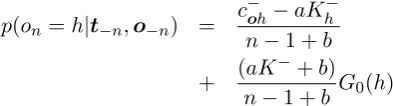
prob-ability of the customer being served a dishhis
p(on=h|t−n,o−n) =
c−oh−aKh− n−1 +b
+ (aK−+b)
n−1 +b G0(h) whereonis the dish served to the customern,o−n
is the dish accommodation of previousn−1
cus-tomers, c−oh is the number of customers who are
2We also say the customer is served with this dish.
served with the dishhino−nandKh−is the
num-ber of tables served with the dishhint−n.
The hierarchical PYP (hPYP; Teh (2006)) is an extension of the PYP in which the base distribu-tion G0 is itself a PYP distribution. This parent
(base) distribution can itself have a PYP as a base distribution, giving rise to hierarchies of arbitrary depth. Like the PYP, inference under the hPYP can be also described in terms of CRP whereby each table in one restaurant corresponds to a dish in the next deeper level, and is said to share the same dish. Whenever an empty table is seated in one level, a customer must enter the restaurant in the next deeper level and find a table to sit. This process continues until the customer is assigned a shared table or the deepest level of the hierarchy is reached. A similar process occurs when a cus-tomer leaves, where newly emptied tables must be propagated up the hierarchy in the form of depart-ing customers. There is not space for a complete treatment of the hPYP and the particulars of infer-ence; we refer the interested reader to Teh (2006).
3.2.2 A Hierarchical PYP Translation Model
We draw the distributions for the various transla-tion factors from respective hierarchical PYP pri-ors, as shown in Figure 2 for the finish, jump and emission factors. For the emission factor (Fig-ure 2c), we draw the target wordeifrom a
distribu-tion condidistribu-tioned on the last two source and target words, as well as the current source word,fai and the current jump typeτi. Here the draw of a
tar-get word corresponds to a customer entering and which target word to emit corresponds to which dish to be served to the customer in the CRP. The hierarchical prior encodes a backoff path in which the jump type is dropped first, followed by pairs of source and target words from least recent to most recent. The final backoff stages drop the current source word, terminating with the uniform base distribution over the target vocabularyV.
[image:4.595.82.279.648.701.2]ξi|fai−i−12, eii−−12∼G ξ faii−−12,e
i−1
i−2 Gξ
fi−1
ai−2,eii−−12∼ PYP
(aξ3, b ξ 3, G
ξ fai−1,ei−1) Gξf
ai−1,ei−1∼ PYP(a
ξ 2, bξ2, Gξ)
Gξ∼ PYP(aξ 1, b
ξ 1, G
ξ 0)
Gξ0∼ U(
1 2)
(a) Finish factor
τi|fai−i−12, eii−−12, t∼Gτfi−1
ai−2,eii−−12,t Gτ
faii−−12,e
i−1
i−2,t∼ PYP
(aτ
3, bτ3, Gτfai−1,ei−1,t) Gτ
fai−1,ei−1,t∼ PYP(a
τ 2, bτ2, Gτt)
Gτ
t ∼ PYP(aτ1, bτ1, Gτ0,t)
Gτ0,t∼ U
(b) Jump factor
ei|τi, faii−2, e i−1
i−2∼Geτi,faii−2,e
i−1
i−2 Geτ
i,faii−2,e
i−1
i−2∼ PYP
(ae5, be5, Gefi ai−2,e
i−1
i−2
)
Gefi
ai−2,eii−−12∼ PYP(a
e 4, be4, Gefi
ai−1,ei−1) Ge
fi
ai−1,ei−1∼ PYP(a
e 3, be3, Gefai)
Ge
fai∼ PYP(a e 2, be2, Ge)
Ge∼ PYP(ae1, be1, Ge0)
Ge 0∼ U(
1
|V|)
[image:5.595.73.525.73.198.2](c) Emission factor
Figure 2: Distributions over the translation factors and their hierarchical priors.
that a jump could not go outside the bounds of the source sentence. Accordingly we maintain sepa-rate distributions for each setting, and each has a different uniform base distribution parameterized according to the number of possible jump types.
3.3 Fertility
For each target position, our Markov model may select a source word which has been covered, which means a source word may be linked to sev-eral target positions. Therefore, we introduce fer-tility to denote the number of target positions a source word is linked to in a sentence pair. Brown et al. (1993) have demonstrated the usefulness of fertility in probability estimation: IBM models 3– 5 exhibit large improvements over models 1–2. On these grounds, we include fertility to produce our
advancedmodel,
pad(eI1, aI1|f1J) =pbs(eI1, aI1|f1J)
J Y
j=1
p(φj|fjj−n) (2)
whereφj is the fertility of source wordfj in the
sentence pair < fJ
1, eI1 > and pbs is the basic
model defined in Eq. 1. In order to avoid prob-lems of data sparsity, we bin fertility into three types, a) zero, if φ = 0; b) single, if φ = 1;
and c)multiple, ifφ >1.
We draw the fertility variables from a hierarchi-cal PYP distribution, using three levels of backoff,
φj|fjj−1 ∼G
φ fjj−1
Gφ
fjj−1 ∼ PYP(a φ
3, b
φ
3, G
φ fj)
Gφf
j ∼ PYP(a
φ
2, bφ2, Gφ)
Gφ∼ PYP(aφ1, bφ1, Gφ0)
Gφ0 ∼ U(1 3)
where we condition the fertility of each word to-ken on the toto-ken to its left, which we drop during the first stage of backoff to simple word-based fer-tility. The last level of backoff further generalises to a shared fertility across all words. In this way we gain the benefits of local context on fertility, while including more general levels to allow wider applicability.
4 Gibbs Sampling
To train the model, we use Gibbs sampling, a Markov Chain Monte Carlo (MCMC) technique for posterior inference. Specifically we seek to infer the latent sequence of translation decisions given a corpus of sentence pairs. Given the struc-ture of our model, a word alignment uniquely specifies the translation decisions and the se-quence follows the order of the target sentence left to right. Our Gibbs sampler operates by sampling an update to the alignment of each target word in the corpus. It visits each sentence pair in the corpus in a random order and resamples the align-ments for each target position as follows. First we discard the alignment to the current target word and decrement the counts of all factors affected by this alignment in their top level distributions (which will percolate down to the lower restau-rants). Next we calculate posterior probabilities for all possible alignment to this target word based on the table occupancies in the hPYP. Finally we draw an alignment and increment the table counts for the translation decisions affected by the new alignment.
More specifically, we consider sampling from Equation 2 withn= 2. When changing the
align-ment to a target word ei from j0 to j, the
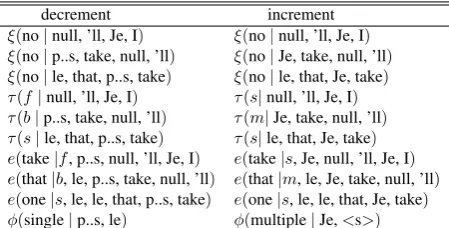
fin-ish, jumpand emission for three target positions i, i+ 1, i+ 2andfertilityfor two source positions
decrement increment
ξ(no|null, ’ll, Je, I) ξ(no|null, ’ll, Je, I)
ξ(no|p..s, take, null, ’ll) ξ(no|Je, take, null, ’ll)
ξ(no|le, that, p..s, take) ξ(no|le, that, Je, take)
τ(f|null, ’ll, Je, I) τ(s|null, ’ll, Je, I)
τ(b|p..s, take, null, ’ll) τ(m|Je, take, null, ’ll)
τ(s|le, that, p..s, take) τ(s|le, that, Je, take)
e(take|f, p..s, null, ’ll, Je, I) e(take|s, Je, null, ’ll, Je, I)
e(that|b, le, p..s, take, null, ’ll) e(that|m, le, Je, take, null, ’ll)
e(one|s, le, le, that, p..s, take) e(one|s, le, le, that, Je, take)
φ(single|p..s, le) φ(multiple|Je,<s>)
Table 1: The count update when changing the aligned source word of take fromprendstoJein Figure 1. Key: f–forward s–stay b–backward m–
monotone p..s–prends.
posterior probability
p(ai =j|t−i,o−i)∝ i+2
Y
l=i
p(ξl)p(τl)p(el)
×p(φj+ 1)p(φj0 −1) p(φj)p(φj0) (3)
whereφj, φj0are the fertilities before changing the
link and for brevity we omit the conditioning con-texts. For example, in Figure 1, we sample for target word take and change the aligned source word fromprendstoJe, then the items for which we need to decrement and increment the counts by one are shown in Table 1 and the posterior prob-ability corresponding to the new alignment is the product of the hierarchical PYP probabilities of all increment items divided by the probability of the fertility ofprendsbeingsingle.
[image:6.595.75.300.62.176.2]Maintaining the current state of the hPYP as events are incremented and decremented is non-trivial and the naive approach requires significant book-keeping and has poor runtime behaviour. For this we adopt the approach of Blunsom et al. (2009b), who present a method for maintaining table counts without needing to record the table assignments for each translation decision. Briefly, this algorithm samples the table assignment during the increment and decrement operations, which is then used to maintain aggregate table statistics. This can be done efficiently and without the need for explicit table assignment tracking.
4.1 Hyperparameter Inference
In our model, we treat all hyper-parameters {(ax, bx), x ∈ (ξ, τ, e, φ)}as latent random
vari-ables rather than fixed parameters. This means our model is parameter free, and requires no user inter-vention when adapting to different data sets. For
the discount parameter, we employ a uniform Beta distributionax∼Beta(1,1)while for the strength
parameter, we employ a vague Gamma
distribu-tion bx ∼ Gamma(10,0.1). All restaurants in
the same level share the same hyper-prior and the hyper-parameters for all levels are resampled us-ing slice samplus-ing (Johnson and Goldwater, 2009) every 10 iterations.
4.2 Parallel Implementation
As mentioned above, the hierarchical PYP takes into consideration a rich history to evaluate the probabilities of translation decisions. But this leads to difficulties when applying the model to large data sets, particularly in terms of tracking the table and customer counts. We apply the tech-nique from Blunsom et al. (2009a) of using multi-ple processors to perform approximate Gibbs sam-pling which they showed achieved equivalent per-formance to the exact Gibbs sampler. Each pro-cess performs sampling on a subset of the corpus using local counts, and communicates changes to these counts after each full iteration. All the count deltas are then aggregated by each process to re-fresh the counts at the end of each iteration. In this way each process uses slightly “out-of-date” counts, but can process the data independently of the other processes. We found that this approxi-mation improved the runtime significantly with no noticeable effect on accuracy.
5 Experiments
In principle our model could be directly used as a MT decoder or as a feature in a decoder. However in this paper we limit our focus to inducing word alignments, i.e., by using the model to infer align-ments which are then used in a standard phrase-based translation pipeline. We leave full decod-ing for later work, which we anticipate would fur-ther improve performance by exploiting gapping phrases and other phenomena that implicitly form part of our model but are not represented in the phrase-based decoder. Decoding under our model would be straight-forward in principle, as the gen-erative process was designed to closely parallel the search procedure in the phrase-based model.3
Three data sets were used in the experi-ments: two Chinese to English data sets on small (IWSLT) and larger corpora (FBIS), and Arabic
3However the reverse translation probability would be
to English translation. Our experiments seek to test how the model compares to a GIZA++ base-line, quantifies the effect of each factor in the probabilistic model (i.e., jump, fertility), and the effect of different initialisations of the sampler. We present results on translation quality and word alignment.
5.1 Data Setup
The Markov order of our model in all experiments was set ton= 2, as shown in Equation 2. For each
data set, Gibbs sampling was performed on the training set in each direction (source-to-target and target-to-source), initialized using GIZA++.4 We
used the grow heuristic to combine the GIZA++ alignments in both directions (Koehn et al., 2003), which we then intersect with the predictions of GIZA++ in the relevant translation direction. This initialisation setup gave the best results (we com-pare other initialisations in§5.2). The two Gibbs samplers were “burned in” for the first 1000 it-erations, after which we ran a further 500 itera-tions selecting every 50th sample. A phrase ta-ble was constructed using these 10 sets of multi-ple alignments after combining each pair of direc-tional alignments using thegrow-diag-final heuris-tic. Using multiple samples in this way constitutes Monte Carlo averaging, which provides a better estimate of uncertainty cf. using a single sample.5
The alignment used for the baseline results was produced by combining bidirectional GIZA++ alignments using the grow-diag-final heuristic. We used the Moses machine translation decoder (Koehn et al., 2007), using the default features and decoding settings. We compared the perfor-mance of Moses using the alignment produced by our model and the baseline alignment, evaluating translation quality using BLEU (Papineni et al., 2002) with case-insensitiven-gram matching with n= 4. We used minimum error rate training (Och,
2003) to tune the feature weights to maximise the BLEU score on the development set.
5.2 IWSLT Corpus
The first experiments are on the IWSLT data set for Chinese-English translation. The training data consists of 44k sentences from the tourism and travel domain. For the development set we use both ASR devset 1 and 2 from IWSLT 2005, and
4All GIZA++ alignments used in our experiments were
produced by IBM model4.
5The effect on translation scores is modest, roughly
amounting to +0.2 BLEU versus using a single sample.
System Dev IWSLT05
baseline 45.78 49.98
Markov+fs+e 49.13 51.54
Markov+fs+e+j 49.68 52.55
[image:7.595.320.516.60.132.2]Markov+fs+e+j+ft 51.32 53.41
Table 2: Impact of adding factors to our Markov model, showing BLEU scores on IWSLT. Key: fs– finishe–emissionj–jumpft–fertility.
for the test set we use the IWSLT 2005 test set. The language model is a 3-gram language model trained using the SRILM toolkit (Stolcke, 2002) on the English side of the training data. Because the data set is small, we performed Gibbs sampling on a single processor.
First we check the effect of the model factors
jumpand fertility. Both emission and finish fac-tors are indispensable to the generative translation process, and consequently these two factors are in-cluded in all runs. Table 2 shows translation result for various models, including a baseline and our Markov model with different combinations of fac-tors. Note that even the simplest Markov model far outperforms the GIZA++ baseline (+1.5 BLEU) despite the baseline (IBM model 4) including a number of advanced features (e.g.,jump,fertility) that are not present in the basic Markov model. This improvement is a result of the Markov model making use of rich bilingual contextual informa-tion coupled with sophisticated backoff, as op-posed to GIZA++ which considers much more lo-cal events, with nothing larger than word-class bi-grams. Our model shows large improvements as the extra factors are included. Jumpyields an im-provement of +1 BLEU by capturing consistent re-ordering patterns. Addingfertilityresults in a fur-ther +1 BLEU point improvement. Like the IBM models, our approach allows each source word to produce any number of target words. This capac-ity allows for many non-sensical alignments such as dropping many source words, or aligning sin-gle source words to several target words. Explic-itly modelling fertility allows for more consistent alignments, especially for special words such as punctuation which usually have a fertility of one.
system gdf intersection grow baseline 49.98 48.44 50.11 our model 52.96 52.79 53.41
Table 3: Machine translation performance in BLEU % on the IWSLT 2005 Chinese-English test set. The Gibbs samplers were initialized with three different alignments, shown as columns.
the results of our model. While the baseline re-sults vary by up to 1.7 BLEU points for the differ-ent alignmdiffer-ents, our Markov model provided more stable results with the biggest difference of 0.6. Among the three initialisations, we get the best result with the initialisation of grow. Gdf of-ten introduces alignment links involving function words which should instead be aligned to null. In-tersection includes many fewer alignments, typi-cally only between content words, and the sparsity means that words can only have a fertility of ei-ther0or1. This leads to the initialisation being a
strong mode which is difficult to escape from dur-ing sampldur-ing. Despite this problem, it has only a mild negative effect on the performance of our model, which is probably due to improvements in the alignments for words that truly should be dropped or aligned only to one word. Grow pro-vides a good compromise betweengdf and inter-section, and we use this initialisation in all our subsequent experiments.
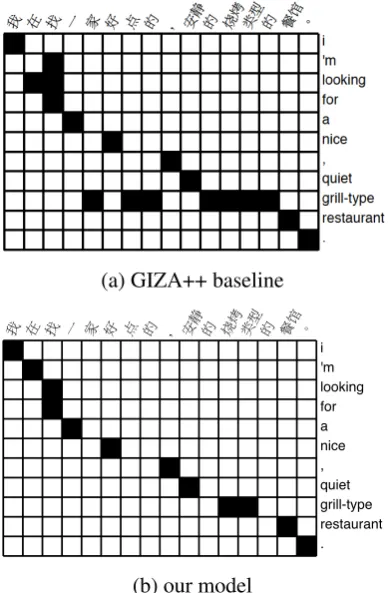
Figure 3 shows an example comparing align-ments produced by our model and the GIZA++ baseline, in both cases after combining the two di-rectional models. Note that GIZA++ has linked many function words which should be left un-aligned, by using rare English terms as garbage collectors. Consequently this only allows for the extraction of few large phrase-pairs (e.g. <在
找, ’m looking for>) and prevents the extraction of some good phrases (e.g. <烧 烤 类型 的, grill-type>, for “家” and “点 的” are wrongly aligned to “grill-type”). In contrast, our model better aligns the function words, such that many more useful phrase pairs can be extracted, i.e., <在, ’m>,<找, looking for>,<烧烤类型, grill-type> and their combinations with neighbouring phrase pairs.
5.3 FBIS Corpus
Theoretically, Bayesian models should out-perform maximum likelihood approaches on small data sets, due to their improved modelling of
un-(a) GIZA++ baseline
我 在 找 一 家 好 点 的 , 安静 的 烧烤 类型 的 餐馆 。
i 'm looking for a nice , quiet grill-type restaurant .
[image:8.595.85.282.62.106.2](b) our model
Figure 3: Comparison of an alignment inferred by the baseline vs. our approach.
certainty. For larger datasets, however, the dif-ference between the two techniques should nar-row. Hence one might expect that upon moving to larger translation datasets our gains might evap-orate. This chain of reasoning ignores the fact that our model is considerably richer than the baseline IBM models, in that we model rich contextual cor-relations between translation decisions, and con-sequently our approach has a lower inductive bias. For this reason our model should continue to im-prove with more data, by inferring better estimates of translation decisionn-grams. A caveat though is that inference by sampling becomes less effi-cient on larger data sets due to stronger modes, requiring more iterations for convergence.
[image:8.595.315.510.68.365.2]NIST02 NIST03 NIST05 baseline 33.31 30.09 29.01 our model 33.83 31.02 30.23
Table 4: Translation performance on Chinese to English translation, showing BLEU% for models trained on the FBIS data set.
and 2005. The language model is a 3-gram LM trained on Xinhua portion of the Gigaword corpus using the SRILM toolkit with modified Kneser-Ney smoothing. As the FBIS data set is large, we employed 3-processor MPI for each Gibbs sam-pler, which ran in half the time compared to using a single processor.
Table 4 shows the results on the FBIS data set. Our model outperforms the baseline on both test sets by about 1 BLEU. This provides evidence that our model performs well in the large data setting, with our rich modelling of context still proving useful. The non-parametric nature of the model al-lows for rich dynamic backoff behaviour such that it can learn accurate models in both high and low data scenarios.
5.4 Arabic English translation
Translation between Chinese and English is very difficult, particularly due to word order differences which are not handled well by phrase-based ap-proaches. In contrast Arabic to English translation needs less reordering, and phrase-based models produce better translations. This translation task is a good test for the generality of our approach. Our Ar-En training data comprises several LDC corpora,6using the same experimental setup as in
Blunsom et al. (2009a). Overall there are 276k sentence pairs and 8.21m and 8.97m words in Ara-bic and English, respectively. We evaluate on the NIST test sets from 2003 and 2005, and the 2002 test set was used for MERT training.
Table 5 shows the results. On all test sets our approach outperforms the baseline, and for the NIST03 test set the improvement is substantial, with a +0.74 BLEU improvement. In general the improvements are more modest than for the Chinese-English results above. We suggest that this is due to the structure of Arabic-English trans-lation better suiting the modelling assumptions be-hind IBM model 4, particularly its bias towards monotone translations. Consequently the
addi-6LDC2004E72, LDC2004T17, LDC2004T18,
LDC2006T02
[image:9.595.84.282.61.106.2]F1% NIST02 NIST03 NIST05 baseline 64.9 57.00 48.75 48.93 our model 65.7 57.14 49.49 48.96
Table 5: Translation performance on Arabic to English translation, showing BLEU%. Also shown is word-alignment alignment accuracy.
tional context provided by our model is less im-portant. Table 5 also reports alignment results on manually aligned Ar-En sentence pairs,7
measur-ing the F1 score for the GIZA++ baseline align-ments and the alignment from the final sample with our model.8 Our model outperforms the
base-line, although the improvement is modest.
6 Conclusions and Future Work
This paper proposes a word-based Markov model of translation which correlates translation deci-sions by conditioning on recent decideci-sions, and incorporates a hierarchical Pitman-Yor process prior permitting elaborate backoff behaviour. The model can learn sequences of translation deci-sions, akin to phrases in standard phrase-based models, while simultaneously learning word level phenomena. This mechanism generalises the concept of phrases in phrase-based MT, while also capturing richer phenomena such as gapping phrases in the source. Experiments show that our model performs well both on the small and large datasets for two different translation tasks, con-sistently outperforming a competitive baseline. In this paper the model was only used to infer word alignments; in future work we intend to develop a decoding algorithm for directly translating with the model.
Acknowledgements
This work was supported by the EPSRC (grant EP/I034750/1).
References
Phil Blunsom, Trevor Cohn, Chris Dyer, and Miles Osborne. 2009a. A Gibbs sampler for phrasal synchronous grammar induction. InProc. of ACL-IJCNLP, pages 782–790.
7LDC2012T16
8Directional alignments are intersected using the
Phil Blunsom, Trevor Cohn, Sharon Goldwater, and Mark Johnson. 2009b. A note on the implemen-tation of hierarchical dirichlet processes. InProc. of ACL-IJCNLP, pages 337–340.
Peter E. Brown, Stephen A. Della Pietra, Vincent J. Della Pietra, and Robert L. Mercer. 1993. The mathematics of statistical machine translation: Parameter estimation. Computational Linguistics, 19:263–331.
David Chiang. 2005. A hierarchical phrase-based model for statistical machine translation. InProc. of ACL, pages 263–270.
Josep Maria Crego, Franc¸ois Yvon, and Jos´e B. Mari˜no. 2011. Ncode: an open source bilingual n-gram SMT toolkit. Prague Bull. Math. Linguistics, 96:49–58.
Nadir Durrani, Helmut Schmid, and Alexander Fraser. 2011. A joint sequence translation model with in-tegrated reordering. In Proc. of ACL:HLT, pages 1045–1054.
Michel Galley and Christopher D. Manning. 2010. Accurate non-hierarchical phrase-based translation. InProc. of NAACL, pages 966–974.
Michel Galley, Jonathan Graehl, Kevin Knight, Daniel Marcu, Steve DeNeefe, Wei Wang, and Ignacio Thayer. 2006. Scalable inference and training of context-rich syntactic translation models. InProc. of ACL, pages 961–968.
Mark Johnson and Sharon Goldwater. 2009. Improv-ing nonparameteric bayesian inference: experiments on unsupervised word segmentation with adaptor grammars. InProc. of HLT-NAACL, pages 317–325.
Philipp Koehn, Franz J. Och, and Daniel Marcu. 2003. Statistical phrase-based translation. InProc. of HLT-NAACL, pages 127–133.
Philipp Koehn, Hieu Hoang, Alexandra Birch Mayne, Christopher Callison-Burch, Marcello Federico, Nicola Bertoldi, Brooke Cowan, Wade Shen, Chris-tine Moran, Richard Zens, Chris Dyer, Ondrej Bo-jar, Alexandra Constantin, and Evan Herbst. 2007. Moses: Open source toolkit for statistical machine translation. InProc. of ACL.
Hai-Son Le, Alexandre Allauzen, and Franc¸ois Yvon. 2012. Continuous space translation models with neural networks. InProc. of NAACL, pages 39–48.
Yang Liu, Qun Liu, and Shouxun Lin. 2006. Tree-to-string alignment template for statistical machine translation. In Proc. of COLING-ACL, pages 609– 616, July.
Frans J. Och and Hermann Ney. 2003. A systematic comparison of various statistical alignment models.
Computational Linguistics, 29:19–51.
Frans J. Och. 2003. Minimum error rate training in sta-tistical machine translation. InProc. of ACL, pages 160–167.
Kishore Papineni, Salim Roukos, Todd Ward, and Wei-Jing Zhu. 2002. BLEU: A method for automatic evaluation of machine translation. InProc. of ACL, pages 311–318.
Jim Pitman and Marc Yor. 1997. The two-parameter poisson-dirichlet distribution derived from a stable subordinator. The Annals of Probability, 25(2):855– 900.
Andreas Stolcke. 2002. SRILM: An extensible lan-guage modeling toolkit. InProc. of ICSLP.
Y. W. Teh, M. I. Jordan, M. J. Beal, and D. M. Blei. 2006. Hierarchical Dirichlet processes.
Journal of the American Statistical Association, 101(476):1566–1581.
Yee Whye Teh. 2006. A hierarchical Bayesian lan-guage model based on Pitman-Yor processes. In
Proc. of ACL, pages 985–992.
Ashish Vaswani, Haitao Mi, Liang Huang, and David Chiang. 2011. Rule markov models for fast tree-to-string translation. InProc. of ACL, pages 856–864.