A Mapping-Based Approach for General Formal
Human Computer Interaction Using Natural Language
Vincent Letard
LIMSI CNRS
Sophie Rosset
LIMSI CNRS
Gabriel Illouz
LIMSI CNRS
Abstract
We consider the problem of mapping nat-ural language written utterances express-ing operational instructions1to formal lan-guage expressions, applied to French and the R programming language. Developing a learning operational assistant requires the means to train and evaluate it, that is, a baseline system able to interact with the user. After presenting the guidelines of our work, we propose a model to repre-sent the problem and discuss the fit of di-rect mapping methods to our task. Finally, we show that, while not resulting in excel-lent scores, a simple approach seems to be sufficient to provide a baseline for an in-teractive learning system.
1 Introduction
Technical and theoretical advances allow achiev-ing more and more powerful and efficient opera-tions with the help of computers. However, this does not necessarily make it easier to work with the machine. Recent supervised learning work (Allen et al., 2007; Volkova et al., 2013) exploited the richness of human-computer interaction for improving the efficiency of a human performed task with the help of the computer.
Contrary to most of what was proposed so far, our long term goal is to build an assistant system learning from interaction to construct a correct for-mal language (FL) command for a given natural language (NL) utterance, see Table 1. However, designing such a system requires data collection, and early attempts highlighted the importance of usability for the learning process: a system that is hard to use (eg. having very poor performance)
1We call operational instruction the natural language
ex-pression of a command in any programming language.
would prevent from extracting useful learning ex-amples from the interaction. We thus need to pro-vide the system with a basis of abilities and knowl-edge to allow both incremental design and to keep the interest of the users, without which data turn to be way more tedious to collect. We assume that making the system usable requires the ability to provide help to the user more often than it needs help from him/her, that is an accuracy over 50%.
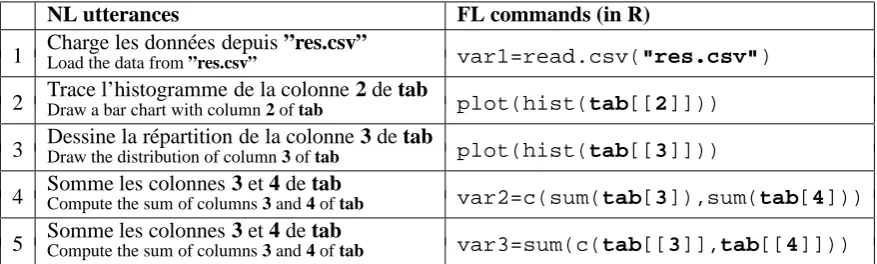
We hypothesize that a parametrized direct mapping between the NL utterances and the FL commands can reach that score. A knowledge set Kis built from parametrized versions of the asso-ciations shown in Table 1. The NL utteranceUbest fromK that is the closest to the request-utterance according to a similarity measure is chosen and its associated command C(Ubest) is adapted to the parameters of the request-utterance and returned. For example, given the request-utterance Ureq: ”Load the file data.csv”, the system should rank the utterances ofK by similarity withUreq. Con-sidering the associations represented in Table 1, the first utterance should be the best ranked, and the system should return the command:
”var1 <- read.csv("data.csv")”.
Note that several commands can be proposed at the same time to give the user alternate choices.
We use Jaccard, tf-idf, and BLEU similarity measures, and consider different selection strate-gies. We highlight that the examined similarity measures show enough complementarity to permit the use of combination methods, like vote or sta-tistical classification, to improve a posteriori the efficiency of the retrieval.
2 Related Work
2.1 Mapping Natural Language to Formal Language
Related problems have been previously processed using different learning methods. Branavan (2009,
NL utterances FL commands (in R)
1 Charge les donn´ees depuis ”res.csv”Load the data from ”res.csv” var1=read.csv("res.csv")
2 Trace l’histogramme de la colonne 2 de tabDraw a bar chart with column 2 of tab plot(hist(tab[[2]]))
3 Dessine la r´epartition de la colonne 3 de tabDraw the distribution of column 3 of tab plot(hist(tab[[3]]))
4 Somme les colonnes 3 et 4 de tabCompute the sum of columns 3 and 4 of tab var2=c(sum(tab[3]),sum(tab[4]))
[image:2.595.80.519.62.194.2]5 Somme les colonnes 3 et 4 de tabCompute the sum of columns 3 and 4 of tab var3=sum(c(tab[[3]],tab[[4]]))
Table 1: A sample of NL utterances to FL commands mapping
These examples specify the expected command to be returned for each utterance. The tokens in bold font are linked with the commands parameters, cf. section 4. Note that the relation between utterances and commands is anton. Several utterances can be associated to the same command and conversely.
2010) uses reinforcement learning to map En-glish NL instructions to a sequence of FL com-mands. The mapping takes high-level instructions and their constitution into account. The scope of usable commands is yet limited to graphical interaction possibilities. As a result, the learn-ing does not produce highly abstract schemes. In the problematic of interactive continuous learning, Artzi and Zettlemoyer (2011) build by learning a semantic NL parser based on combinatory cate-gorial grammars (CCG). Kushman and Barzilay (2013) also use CCG in order to generate regu-lar expressions corresponding to their NL descrip-tions. This constructive approach by translation allows to generalize over learning examples, while the expressive power of regular expressions cor-respond to the type-3 grammars of the Chomsky hierarchy. This is not the case for the program-ming languages since they are at least of type-2. Yu and Siskind (2013) use hidden Markov mod-els to learn a mapping between object tracks from a video sequence and predicates extracted from a NL description. The goal of their approach is different from ours but the underlying problem of finding a map between objects can be compared. The matched objects constitute here a FL expres-sion instead of a video sequence track.
2.2 Machine Translation
Machine translation usually refers to transforming a NL sentence from a source language to another sentence of the same significance in another natu-ral language, called target language. This task is achieved by building an intermediary representa-tion of the sentence structure at a given level of
abstraction, and then encoding the obtained object into the target language. While following a dif-ferent goal, one of the tasks of the XLike project (Marko Tadi´c et al., 2012) was to examine the possibility of translating statements from NL (En-glish) to FL (Cycl). Adapting such an approach to operational formal target language can be inter-esting to investigate, but we will not focus on that track for our early goal.
2.3 Information Retrieval
3 Problem Formulation
As we introduced in the first section, we represent the knowledgeK as a set of examples of a binary relation R : NL → F L associating a NL utter-ance to a FL command. If we consider the simple case of a functional and injective relation, each utterance is associated to exactly one command. This is not realistic since it is possible to reformu-late nearly any NL sentence. The case of a non in-jective relation covers better the usual cases: each command can be associated with one or more ut-terances, this situation is illustrated by the second and third examples of Table 1. Yet, the real-life case should be a non injective nor functional rela-tion. Not only multiple utterances can refer to a same command, but one single utterance can also stand for several distinct commands (see the fourth and fifth examples2in Table 1). We must consider all these associations when matching a request-utteranceUreqfor command retrieval inK.
At this point, several strategies can be used to determine what to return, with the help of the sim-ilarity measureσ :NL×NL→ Rbetween two NL utterances. Basically, we must determine if a response should be given, and if so how many commands to return. To do this, two potential strategies can be considered for selecting the as-sociated utterances inK.
The first choice focuses on the number of re-sponses that are given for each request-utterance. Thenfirst commands according to the rankings of their associated utterances inKare returned. The rankrof a given utteranceU is computed with:
r(U|Ureq) =˛˛˘U′∈K:σ(U
req, U′)> σ(Ureq, U)¯˛˛
(1)
The second strategy choice can be done by de-termining an absolute similarity threshold below which the candidate utterances from K and their associated sets of commands are considered too different to match. The resulting set of commands is given by:
Res={C∈F L: (U, C)∈K, σ(Ureq, U)< t} (2)
with t the selected threshold. Once selected the set of commands to be given as response, if there are more than one, the choice of the one to execute can be done interactively with the help of the user.
2The command 4 returns a vector of the sums of each
col-umn, while the command 5 returns the sum of the columns as a single integer.
4 Approach
We are given a simple parsing result of both the ut-terance and the command. The first step to address is the acquisition of examples and the way to up-date the knowledge. Then we examine the meth-ods for retrieving a command from the knowledge and a given request-utterance.
Correctly mapping utterances to commands re-quires at least to take their respective parameters into account (variable names, numeric values, and quoted strings). We build generic representations of utterances and commands by identifying the pa-rameters in the knowledge example pair (see Ta-ble 1), and use them to reconstruct the command with the parameters of the request-utterance.
4.1 Retrieving the Commands
We applied three textual similarity measures to our model in order to compare their strengths and weaknesses on our task: the Jaccard similarity co-efficient (Jaccard index), a tf-idf (Term frequency-inverse document frequency) aggregation, and the BLEU (Bilingual Evaluation Understudy) mea-sure.
4.1.1 Jaccard index
The Jaccard index measures a similarity between two sets valued in the same superset. For the present case, we compare the set of words of the input NL instruction and the one of the compared candidate instruction, valued in the set of possible tokens. The adapted formula for two sentencesS1 andS2results in:
J(s1, s2) = |W|W((ss1)∩W(s2)|
1)∪W(s2)| (3)
where W(S) stands for the set of words of the sentence S. The Jaccard index is a baseline to compare co-occurences of unigrams, and should be efficient mainly with corpora containing few ambiguous examples.
4.1.2 tf-idf
following aggregation of the tf-idf values for each word ofsi.
tfidfS(si, sc) = |W1(si)|
X
w∈W(si)
tfidf(w, sc, S) (4)
withS ={s|(s, com)∈K}, wheresiis the input sentence, sc ∈ S is the compared sentence, and where the tf-idf is given by:
tfidf(w, sc, S) =f(w, sc)idf(w, S) (5)
idf(w, S) =log
„
|S| |{s∈S|w∈s}|
«
(6)
where at lastf(w, s)is the frequency of the word win the sentences. As we did for the Jaccard in-dex, we performed the measures on both raw and lemmatized words. On the other hand, getting rid of the function words and closed class words is not here mandatory since the tf-idf measure already takes the global word frequency into account.
4.1.3 The BLEU measure
The bilingual evaluation understudy algorithm (Papineni et al., 2002) focuses on n-grams co-occurrences. This algorithm can be used to dis-card examples where the words ordering is too far from the candidate. It computes a modified pre-cision based on the ratio of the co-occurring n -grams within candidate and reference sentences, on the total size of the candidate normalized byn.
PBLEU(si, S) =
X
grn∈si
maxsc∈Socc(grn, sc)
grams(si, n) (7)
wheregrams(s, n) =|s| −(n−1)is the number of n-grams in the sentence s and occ(grn, s) =
P
grn′∈s[grn =grn′] is the number of occur-rences of the n-gram grn in s. BLEU also uses a brevity penalty to prevent long sentences from being too disadvantaged by then-gram based pre-cision formula. Yet, the scale of the length of the instructions in our corpus is sufficiently reduced not to require its use.
4.2 Optimizing the similarity measure
We applied several combinations of filters to the utterances compared before evaluating their sim-ilarity. We can change the set of words taken into account, discarding or not the non open-class words3. Identified non-lexical references such as
3Open-class words include nouns, verbs, adjectives,
ad-verbs and interjections.
variable names, quoted character strings and nu-meric values can also be discarded or transformed to standard substitutes. Finally, we can apply or not a lemmatization4on lexical tokens.By discard-ing non open-class words, keepdiscard-ing non-lexical ref-erences and applying the lemmatization, the sec-ond utterance of Table 1 would then become:
draw bar chart column xxVALxx xxVARxx
5 Experimental Setup
5.1 Parsing
The NL utterances first pass through an arith-metic expression finder to completely tag them be-fore the NL analyzer. They are then parsed us-ing WMATCH, a generic rule-based engine for language analysis developed by Olivier Galibert (2009). This system is modular and dispose of rules sets for both French and English. As an ex-ample, the simplified parsing result of the first ut-terance of Table 1 looks like:
<_operation>
<_action> charge|_˜V </_action> <_det> les </_det>
<_subs> donn´ees|_˜N </_subs> <_prep> depuis </_prep> <_unk> "res.csv" </_unk> </_operation>
Words tagged as unknown are considered as po-tential variable or function names. We also added a preliminary rule to identify character strings and count them among the possibly linked features of the utterance. The commands are normalized by inserting spaces between every non semantically linked character pair and we identify numeric val-ues, variable/function names and character strings as features.
Only generative forms of the commands are associated to utterances in the knowledge. This form consists in a normalized command with unre-solved references for every parameter linked with the learning utterance. These references are re-solved at the retrieving phase by matching with the tokens of the request-utterance.
5.2 Corpus Constitution
Our initial corpus consists in 605 associations be-tween 553 unique NL utterances in French and 240 unique R commands.
4Lemmatization is the process of transforming a word to
The low number of documents describing a majority of R commands and their heterogeneity make automatic example gathering not yet achiev-able. These documentations are written for human readers having global references on the task. Thus, we added each example pair manually, making sure that the element render all the example infor-mation and that the format correspond to the cor-pus specifications. Those specifications are meant to be the least restrictive, that is: a NL utterance must be written as to ask for the execution of the associated R task. It therefore should be mostly in the imperative form and reflect, for experienced people, a usual way they would express the con-cerned operation for non specialists.
5.3 Evaluation Metrics
The measures that can contribute to a relevant evaluation of the system depend on its purpose. Precision and recall values of information retrieval systems are computed as follows:
P =# correct responses
# responses given (8)
R=# correct responses
# responses in K (9)
Note that the recall value is not as important as for information retrieval: assuming that the situation showed by the fourth and fifth associations of Ta-ble 1 are not usual5, there should be few different valid commands for a given request-utterance, and most of them should be equivalent. Moreover, the number of responses given is fixed (so is the num-ber of responses in K), the recall thus gives the same information as the precision, with a linear coefficient variation.
These formulae can be applied to the ”command level”, that is measuring the accuracy of the sys-tem in terms of its good command ratio. However, the user satisfaction can be better measured at the ”utterance level” since it represents the finest gran-ularity for the user experience. We define the ut-terance precisionuP as:
uP= # correct utterances
# responses given (10)
where ”# correct utterances” stands for the num-ber of request-utterances for which the system pro-vided at least one good command.
5Increasing the tasks covering of the corpus will make
these collisions more frequent, but this hypothesis seems rea-sonable for a first approach.
6 Results and Discussion
The system was tested on 10% of the corpus (61 associations). The set of known associations K contains 85% of the corpus (514 associations), in-stead of 90% in order to allow several distinct drawings (40 were tested), and thus avoid too much noise.
6.1 Comparing similarity measures
As shown in Table 2 the tf-idf measure outper-forms the Jaccard and BLEU measures, whichever filter combination is applied. The form of the ut-terances in the corpus causes indeed the repetition of a small set of words across the associations. This can explain why the inverse document fre-quency is that better.
non-lexical included not included lemmatize yes no yes no Jaccard 36.5 36.5 21.2 23.0 tf-idf 48.0 51.9 36.5 40.4 BLEU 30.8 32.7 26.9 30.8
[image:5.595.319.512.300.389.2]chance 1.9
Table 2: Scores of precision by utterance (uP), providing 3 responses for each request-utterance.
The lemmatization and the inclusion of non open-class words (not shown here) does not seem to have a clear influence onuP, whereas including the non-lexical tokens allows a real improvement. This behaviour must result from the low length av-erage (7.5 words) of the utterances in the corpus.
0.3 0.4 0.5 0.6 0.7
1 2 3 4 5 6 7 8 9
Number of responses
Utter
ance precision (uP)
measure tfidf tfidf_inl
Figure 1: Utterance precision (uP) for a fixed number of responses by utterance. The tfidf inl curve includes the non-lexical tokens.
[image:5.595.311.517.542.661.2]Figure 1 shows the precision obtained with tfidf while increasing the number of commands given for each request-utterance. It comes out that it is useful to propose at least 3 commands to the user. It would not be interesting, though, to offer a choice of more than 5 items, because the gain on uP would be offset by the time penalty for retriev-ing the good command among the proposals.
6.2 Allowing silence
We also tested the strategy of fixing an absolute threshold to decide between response and silence. Given a request-utterance and an associated order-ing of K according to σ, the system will remain silent if the similarity of the best example inK is below the defined threshold.
Surprisingly, it turned out that for every mea-sure, the 6 best similar responses at least were all wrong. This result seems to be caused by the ex-istence, in the test set of commands uncovered by K, of some very short utterances that contain only one or two lexical tokens.
6.3 Combinations
0.0 0.2 0.4 0.6 0.8
1 2 3 4 5 6 7 8 9
Number of responses
Utter
ance precision (uP)
[image:6.595.80.276.407.543.2]method vote tfidf_inl vote_oracle learning
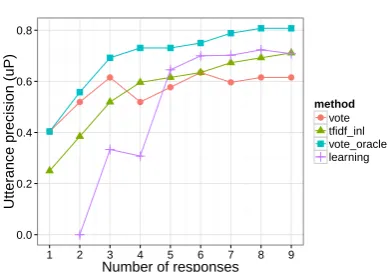
Figure 2: Comparison of the combinations with the tf-idf inl method. Oracle and actual vote are done using tf-idf, Jaccard, and BLEU, with and without non-lexical tokens. The training set for learning is the result of a run onK.
Having tested several methods giving differ-ent results, combining these methods can be very interesting depending on their complementarity. The oracle vote using the best response among the 6 best methods shows an encouraging progres-sion margin (cf. Figure 2). The actual vote it-self outperforms the best method for giving up to 3 responses (reaching 50% for only 2 responses). However, the curve position is less clear for more
responses, and tests must be performed on other drawings ofKto measure the noise influence.
The complementarity of the methods can also be exploited by training a classification model to identify when a method is better than the others. We used the similarity values as features and the measure that gave a good response as the refer-ence class label (best similarity if multiple, and ”none” class if no good response). This setup was tested with the support vector machines using lib-svm (Chang and Lin, 2011) and results are shown in Figure 2. As expected, machine learning per-forms poorly on our tiny corpus. The accuracy is under 20% and the system only learned when to use the best method, and when to give no re-sponse. Still, it manages to be competitive with the best method and should be tested again with more data and multiple drawings ofK.
7 Conclusion and Future Work
The simple mapping methods based on similar-ity ranking showed up to 60% of utterance pre-cision6remaining below a reasonable level of user sollicitation, which validate our prior hypothesis. A lot of approaches can enhance that score, such as adding or developing more suitable similarity measures (Achananuparp et al., 2008), combining learning and vote or learning to rerank utterances. However, while usable as a baseline, these methods only allow poor generalization and really need more corpus to perform well. As we pointed out, the non-functionality of the mapping relation also introduces ambiguities that cannot be solved using the only knowledge of the system.
Thanks to this baseline method, we are now able to collect more data by developing an interactive agent that can be both an intelligent assistant and a crowdsourcing platform. We are currently de-veloping a web interface for this purpose. Finally, situated human computer interaction will allow the real-time resolving of ambiguities met in the re-trieval with the help of the user or with the use of contextual information from the dialogue.
Aknowledgements
The authors are grateful to every internal and ex-ternal reviewer for their valuable advices. We also would like to thank Google for the financial sup-port for the authors participation to the conference.
6
References
Palakorn Achananuparp, Xiaohua Hu, and Xiajiong Shen. 2008. The Evaluation of Sentence
Similar-ity Measures. In Data Warehousing and Knowledge
Discovery, Springer.
James Allen, Nathanael Chambers, George Ferguson, Lucian Galescu, Hyuckchul Jung, Mary Swift, and William Tayson. 2007. PLOW: A Collaborative
Task Learning Agent. In Proceedings of the 22nd
National Conference on Artificial Intelligence.
Yoav Artzi, and Luke S. Zettlemoyer. 2011.
Boot-strapping semantic parsers from conversations.
Pro-ceedings of the conference on empirical methods in natural language processing.
S.R.K. Branavan, Luke S. Zettlemoyer, and Regina Barzilay. 2010. Reading Between the Lines:
Learn-ing to Map High-level Instructions to Commands. In
Proceedings of the 48th Annual Meeting of the As-sociation for Computational Linguistics.
S.R.K. Branavan, Harr Chen, Luke S. Zettlemoyer, and Regina Barzilay. 2009. Reinforcement Learning for
Mapping Instructions to Actions. In Proceedings of
the Joint Conference of the 47th Annual Meeting of the ACL and the 4th International Joint Conference on Natural Language Processing of the AFNLP.
Chih-Chung Chang, and Chih-Jen Lin. 2011.
LIB-SVM: A Library for Support Vector Machines. ACM
Transactions on Intelligent Systems and Technology
Olivier Galibert. 2009. Approches et m´ethodologies
pour la r´eponse automatique `a des questions adapt´ees `a un cadre interactif en domaine ouvert.
Doctoral dissertation, Universit´e Paris Sud XI.
Lynette Hirschman, and Robert Gaizauskas. 2001.
Natural language question answering: The view from here. Natural Language Engineering 7.
Cam-bridge University Press.
Nate Kushman, and Regina Barzilay. 2013. Using
Se-mantic Unification to Generate Regular Expressions from Natural Language. In Proceedings of the
Con-ference of the North American Chapter of the Asso-ciation for Computational Linguistics.
Kishore Papineni, Salim Roukos, Todd Ward, and Wei-Jing Zhu. 2002. Bleu: a Method for Automatic
Evaluation of Machine Translation. In Proceedings
of the 40th Annual Meeting of the Association for Computational Linguistics.
Marko Tadi´c, Boˇzo Bekavac, ˇZeljko Agi´c, Matea Srebaˇci´c, Daˇsa Berovi´c, and Danijela Merkler. 2012. Early machine translation based semantic
an-notation prototype XLike project www.xlike.org .
Dave Toney, Sophie Rosset, Aur´elien Max, Olivier Galibert, and ´eric Billinski. 2008. An Evaluation of
Spoken and Textual Interaction on the RITEL Inter-active Question Answering System In Proceedings
of the Sixth International Conference on Language Resources and Evaluation.
Svitlana Volkova, Pallavi Choudhury, Chris Quirk, Bill Dolan, and Luke Zettlemoyer. 2013. Lightly
Su-pervised Learning of Procedural Dialog System In
Proceedings of the 51st Annual Meeting of the As-sociation for Computational Linguistics.
Haonan Yu, and Jeffrey Mark Siskind. 2013.
Grounded Language Learning from Video De-scribed with Sentences. In Proceedings of the 51st