Large-Scale Cross-Document Coreference Using
Distributed Inference and Hierarchical Models
Sameer Singh§ Amarnag Subramanya† Fernando Pereira† Andrew McCallum§ §
Department of Computer Science, University of Massachusetts, Amherst MA 01002
†Google Research, Mountain View CA 94043
[email protected], [email protected], [email protected], [email protected]
Abstract
Cross-document coreference, the task of grouping all the mentions of each entity in a document collection, arises in information ex-traction and automated knowledge base con-struction. For large collections, it is clearly impractical to consider all possible groupings of mentions into distinct entities. To solve the problem we propose two ideas: (a) a dis-tributed inference technique that uses paral-lelism to enable large scale processing, and (b) a hierarchical model of coreference that represents uncertainty over multiple granular-ities of entgranular-ities to facilitate more effective ap-proximate inference. To evaluate these ideas, we constructed a labeled corpus of1.5million disambiguated mentions in Web pages by se-lecting link anchors referring to Wikipedia en-tities. We show that the combination of the hierarchical model with distributed inference quickly obtains high accuracy (with error re-duction of38%) on this large dataset, demon-strating the scalability of our approach.
1 Introduction
Given a collection of mentions of entities extracted from a body of text, coreference or entity resolu-tion consists of clustering the mentions such that two mentions belong to the same cluster if and only if they refer to the same entity. Solutions to this problem are important in semantic analysis and knowledge discovery tasks (Blume, 2005; Mayfield et al., 2009). While significant progress has been made in within-document coreference (Ng, 2005; Culotta et al., 2007; Haghighi and Klein, 2007; Bengston and Roth, 2008; Haghighi and Klein,
2009; Haghighi and Klein, 2010), the larger prob-lem ofcross-document coreference has not received as much attention.
Unlike inference in other language processing tasks that scales linearly in the size of the corpus, the hypothesis space for coreference grows super-exponentially with the number of mentions. Conse-quently, most of the current approaches are devel-oped on small datasets containing a few thousand mentions. We believe that cross-document coref-erence resolution is most useful when applied to a very large set of documents, such as all the news ar-ticles published during the last 20 years. Such a cor-pus would have billions of mentions. In this paper we propose a model and inference algorithms that can scale the cross-document coreference problem to corpora of that size.
Much of the previous work in cross-document coreference (Bagga and Baldwin, 1998; Ravin and Kazi, 1999; Gooi and Allan, 2004; Pedersen et al., 2006; Rao et al., 2010) groups mentions into entities with some form of greedy clustering using a pair-wise mention similarity or distance function based on mention text, context, and document-level statis-tics. Such methods have not been shown to scale up, and they cannot exploit cluster features that cannot be expressed in terms of mention pairs. We provide a detailed survey of related work in Section 6.
Other previous work attempts to address some of the above concerns by mapping coreference to in-ference on an undirected graphical model (Culotta et al., 2007; Poon et al., 2008; Wellner et al., 2004; Wick et al., 2009a). These models contain pair-wise factors between all pairs of mentions captur-ing similarity between them. Many of these mod-els also enforce transitivity and enable features over
Filmmaker Rapper
BEIJING, Feb. 21— Kevin Smith, who played the god of war in the "Xena"...
... The Physiological Basis of Politics,” by Kevin B. Smith, Douglas Oxley, Matthew Hibbing...
The filmmaker Kevin Smith returns to the role of Silent Bob...
Like Back in 2008, the Lions drafted Kevin Smith, even though Smith was badly... Firefighter Kevin Smith spent almost 20 years preparing for Sept. 11. When he...
...shorthanded backfield in the wake of Kevin Smith's knee injury, and the addition of Haynesworth...
...were coming,'' said Dallas cornerback Kevin Smith. ''We just didn't know when... ...during the late 60's and early 70's, Kevin Smith worked with several local... ...the term hip-hop is attributed to Lovebug Starski. What does it actually mean...
Nothing could be more irrelevant to Kevin Smith's audacious ''Dogma'' than ticking off...
Cornerback Firefighter
Actor Running back
[image:2.612.107.495.64.210.2]Author
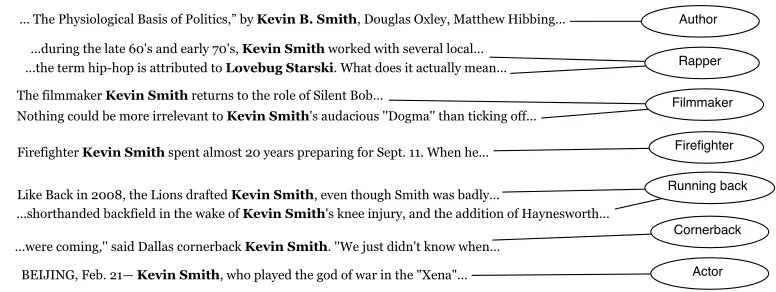
Figure 1: Cross-Document Coreference Problem: Example mentions of “Kevin Smith” from New York Times articles, with the true entities shown on the right.
entities by includingset-valued variables. Exact in-ference in these models is intractable and a number of approximate inference schemes (McCallum et al., 2009; Rush et al., 2010; Martins et al., 2010) may be used. In particular, Markov chain Monte Carlo
(MCMC) based inference has been found to work well in practice. However as the number of men-tions grows to Web scale, as in our problem of cross-document coreference, even these inference tech-niques become infeasible, motivating the need for a scalable, parallelizable solution.
In this work we first distribute MCMC-based in-ference for the graphical model representation of coreference. Entities are distributed across the ma-chines such that the parallel MCMC chains on the different machines use only local proposal distribu-tions. After a fixed number of samples on each ma-chine, we redistribute the entities among machines to enable proposals across entities that were pre-viously on different machines. In comparison to the greedy approaches used in related work, our MCMC-based inference provides better robustness properties.
As the number of mentions becomes large, high-quality samples for MCMC become scarce. To facilitate better proposals, we present a hierarchi-cal model. We addsub-entityvariables that repre-sent clusters of similar mentions that are likely to be coreferent; these are used to propose composite jumps that move multiple mentions together. We also introduce super-entity variables that represent clusters of similar entities; these are used to
dis-tribute entities among the machines such that similar entities are assigned to the same machine. These ad-ditional levels of hierarchy dramatically increase the probability of beneficial proposals even with a large number of entities and mentions.
To create a large corpus for evaluation, we iden-tify pages that have hyperlinks to Wikipedia, and ex-tract the anchor text and the context around the link. We treat the anchor text as the mention, the con-text as the document, and the title of the Wikipedia page as the entity label. Using this approach, 1.5
million mentions were annotated with43k entity la-bels. On this dataset, our proposed model yields a B3 (Bagga and Baldwin, 1998) F1 score of73.7%, improving over the baseline by16% absolute (corre-sponding to38% error reduction). Our experimen-tal results also show that our proposed hierarchical model converges much faster even though it contains many more variables.
2 Cross-document Coreference
are not ambiguous within a document. In cross-documentcoreference, the number of mentions and entities is in the millions, making the combinatorics even more daunting. Furthermore, naming ambigu-ity is much more common as the same string can refer to multiple entities in different documents, and distinct strings may refer to the same entity in differ-ent documdiffer-ents.
We show examples of ambiguities in Figure 1. Resolving the identity of individuals with thesame name is a common problem in cross-document coreference. This problem is further complicated by the fact that in some situations, these individ-uals may belong to the same field. Another com-mon ambiguity is that ofalternatenames, in which the same entity is referred to by different names or
aliases (e.g. “Bill” is often used as a substitute for “William”). The figure also shows an example of therenamingambiguity – “Lovebug Starski” refers to “Kevin Smith”, and this is an extreme form of al-ternate names. Raresingletonentities (like the fire-fighter) that may appear only once in the whole cor-pus are also often difficult to isolate.
2.1 Pairwise Factor Model
Factor graphsare a convenient representation for a probability distribution over a vector of output vari-ables given observed varivari-ables. The model that we use for coreference represents mentions (M) and en-tities (E) as random variables. Each mention can take an entity as its value, and each entity takes a set of mentions as its value. Each mention also has a feature vector extracted from the observed text men-tion and its context. More precisely, the probability of a configurationE=eis defined by
p(e)∝expP e∈e
n P
m,n∈e,n6=mψa(m, n) +P
m∈e,n /∈eψr(m, n) o
where factor ψa represents affinity between
men-tions that are coreferent according to e, and factor
ψr represents repulsion between mentions that are
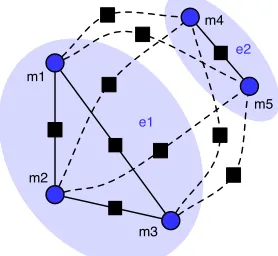
not coreferent. Different factors are instantiated for different predicted configurations. Figure 2 shows the model instantiated with five mentions over a two-entity hypothesis.
For the factor potentials, we use cosine sim-ilarity of mention context pairs (φmn) such that
m1
m2
m3 m4
m5
e1
[image:3.612.357.496.64.192.2]e2
Figure 2: Pairwise Coreference Model: Factor graph for a 2-entity configuration of 5 mentions. Affinity factors are shown with solid lines, and re-pulsion factors with dashed lines.
ψa(m, n) =φmn−bandψr(m, n) =−(φmn−b),
whereb is the bias. While one can certainly make use of a more sophisticated feature set, we leave this for future work as our focus is to scale up inference. However, it should be noted that this approach is agnostic to the particular set of features used. As we will note in the next section, we do not need to calculate features between all pairs of mentions (as would be prohibitively expensive for large datasets); instead we only compute the features as and when required.
2.2 MCMC-based Inference
Given the above model of coreference, we seek the
maximum a posteriori(MAP) configuration:
ˆ
e = arg maxep(e)
= arg maxePe∈e n
P
m,n∈e,n6=mψa(m, n)
+P
m∈e,n /∈eψr(m, n) o
Computing ˆe exactly is intractable due to the large space of possible configurations.1 Instead, we employ MCMC-based optimization to discover the MAP configuration. A proposal function q is used to propose a change e0 to the current config-uratione. This jump is accepted with the following Metropolis-Hastings acceptance probability:
α(e,e0) = min 1,
p(e0)
p(e) 1/t
q(e)
q(e0) !
(1)
wheretis the annealing temperature parameter. MCMC chains efficiently explore the high-density regions of the probability distribution. By slowly reducing the temperature, we can decrease the entropy of the distribution to encourage con-vergence to the MAP configuration. MCMC has been used for optimization in a number of related work (McCallum et al., 2009; Goldwater and Grif-fiths, 2007; Changhe et al., 2004).
The proposal function moves a randomly chosen mention l from its current entityes to a randomly
chosen entityet. For such a proposal, thelog-model
ratio is:
logp(e 0)
p(e) = X
m∈et
ψa(l, m) + X
n∈es
ψr(l, n)
−X
n∈es
ψa(l, n)− X
m∈et
ψr(l, m) (2)
Note that since only the factors between mentionl
and mentions inesandetare involved in this
com-putation, the acceptance probability of each proposal is calculated efficiently.
In general, the model may contain arbitrarily complex set of features over pairs of mentions, with parameters associated with them. Given labeled data, these parameters can be learned by Percep-tron (Collins, 2002), which uses the MAP config-uration according to the model (ˆe). There also exist more efficient training algorithms such as SampleR-ank (McCallum et al., 2009; Wick et al., 2009b) that update parameters during inference. However, we only focus on inference in this work, and the only parameter that we set manually is the biasb, which indirectly influences the number of entities inˆe. Un-less specified otherwise, in this work the initial con-figuration for MCMC is thesingletonconfiguration, i.e. all entities have a size of1.
This MCMC inference technique, which has been used in McCallum and Wellner (2004), offers sev-eral advantages over other inference techniques: (a) unlike message-passing-methods, it does not require the full ground graph, (b) we only have to exam-ine the factors that lie within the changed entities to evaluate a proposal, and (c) inference may be stopped at any point to obtain the current best con-figuration. However, the super exponential nature of the hypothesis space in cross-doc coreference ren-ders this algorithm computationally unsuitable for
large scale coreference tasks. In particular, fruit-ful proposals (that increase the model score) are ex-tremely rare, resulting in a large number of propos-als that are not accepted. We describe methods to speed up inference by 1) evaluating multiple pro-posal simultaneously (Section 3), and 2) by aug-menting our model with hierarchical variables that enable better proposal distributions (Section 4).
3 Distributed MAP Inference
The key observation that enables distribution is that the acceptance probability computation of a pro-posal only examines a few factors that arenot com-mon to the previous and next configurations (Eq. 2). Consider a pair of proposals, one that moves men-tionl from entityes to entityet, and the other that
moves mention l0 from entity e0s to entity e0t. The set of factors to compute acceptance of the first pro-posal are factors betweenl and mentions ines and et, while the set of factors required to compute
ac-ceptance of the second proposal lie between l0 and mentions in e0s and e0t. Since these set of factors are completely disjoint from each other, and the re-sulting configurations do not depend on each other, these two proposals aremutually-exclusive. Differ-ent orders of evaluating such proposals are equiv-alent, and in fact, these proposals can be proposed and evaluated concurrently. This mutual-exclusivity is not restricted only to pairs of proposals; a set of proposals are mutually-exclusive if no two propos-als require the same factor for evaluation.
Ghe-Distributor
Inference
[image:5.612.76.299.62.130.2]Inference
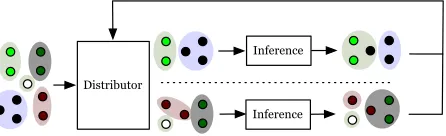
Figure 3: Distributed MCMC-based Inference: Distributor divides the entities among the machines, and the machines run inference. The process is re-peated by the redistributing the entities.
mawat, 2004) to manage the distributed computa-tion.
This approach to distribution is equivalent to in-ference with all mentions and entities on a single machine with a restricted proposer, but is faster since it exploits independencies to propose multiple jumps simultaneously. By restricting the jumps as described above, the acceptance probability calcu-lation is exact. Partitioning the entities and propos-ing local jumps are restrictions to the spropos-ingle-machine proposal distribution; redistribution stages ensure the equivalent Markov chains are still irreducible. See Singh et al. (2010) for more details.
4 Hierarchical Coreference Model
The proposal function for MCMC-based MAP infer-ence presents changes to the current entities. Since we use MCMC to reach high-scoring regions of the hypothesis space, we are interested in the changes that improve the current configuration. But as the number of mentions and entities increases, these
fruitful samples become extremely rare due to the blowup in the possible space of configurations, re-sulting in rejection of a large number of proposals. By distributing as described in the previous section, we propose samples in parallel, improving chances of finding changes that result in better configura-tions. However, due to random redistribution and a naive proposal function within each machine, a large fraction of proposals are still wasted. We address these concerns by addinghierarchyto the model.
4.1 Sub-Entities
Consider the task of proposing moves of mentions (within a machine). Given the large number of mentions and entities, the probability that a
ran-domly picked mention that is moved to a random entity results in a better configuration is extremely small. If such a move is accepted, this gives us ev-idence that the mention did not belong to the pre-vious entity, and we should also move similar men-tions from the previous entity simultaneously to the same entity. Since the proposer moves only a sin-gle mention at a time, a large number of samples may be required to discover these fruitful moves. To enable block proposals that move similar men-tions simultaneously, we introduce latentsub-entity
variables that represent groups of similar mentions within an entity, where the similarity is defined by the model. For inference, we have stages of sam-pling sub-entities (moving individual mentions) in-terleaved with stages of entity sampling (moving all mentions within a sub-entity). Even though our con-figuration space has become larger due to these ex-tra variables, the proposal distribution has also im-proved since it proposes composite moves.
4.2 Super-Entities
Another issue faced during distributed inference is that random redistribution is often wasteful. For ex-ample, if dissimilar entities are assigned to a ma-chine, none of the proposals may be accepted. For a large number of entities and machines, the probabil-ity that similar entities will be assigned to the same machine is extremely small, leading to a larger num-ber of wasted proposals. To alleviate this problem, we introducesuper-entitiesthat represent groups of similar entities. During redistribution, we ensure all entities in the same super-entity are assigned to the same machine. As for sub-entities above, inference switches between regular sampling of entities and sampling of super-entities (by moving entities). Al-though these extra variables have made the config-uration space larger, they also allow more efficient distribution of entities, leading to useful proposals.
4.3 Combined Hierarchical Model
sub-Super-Entities Entities
[image:6.612.138.479.63.166.2]Mentions Sub-Entities
Figure 4: Combined Hierarchical Modelwith factors instantiated for a hypothesis containing 2 super-entities, 4entities, and8 sub-entities, shown as colored circles, over16mentions. Dotted lines represent repulsion factors and solid lines represent affinity factors (the color denotes the type of variable that the factor touches). The boxes on factors were excluded for clarity.
entity contexts to represent the context of an entity. The factors are instantiated in the same manner as Section 2.1 except that we change the bias factor
b for each level (increasing it for sub-entities, and decreasing it for super-entities). The exact values of these biases indirectly determines the number of predicted sub-entities and super-entities.
Since these two levels of hierarchy operate at separate granularities from each other, we combine them into a single hierarchical model that contains both sub- and super-entities. We illustrate this hi-erarchical structure in Figure 4. Inference for this model takes a round-robin approach by fixing two of the levels of the hierarchy and sampling the third, cycling through these three levels. Unless specified otherwise, the initial configuration is the singleton
configuration, in which all sub-entities, entities, and super-entities are of size1.
5 Experiments
We evaluate our models and algorithms on a number of datasets. First, we compare performance on the small, publicly-available “John Smith” dataset. Sec-ond, we run the automatedPerson-X evaluation to obtain thousands of mentions that we use to demon-strate accuracy and scalability improvements. Most importantly, we create a large labeled corpus using links to Wikipedia to explore the performance in the large-scale setting.
5.1 John Smith Corpus
To compare with related work, we run an evalua-tion on the “John Smith” corpus (Bagga and
Bald-win, 1998), containing 197 mentions of the name “John Smith” from New York Times articles (la-beled to obtain 35 true entities). The bias b for our approach is set to result in the correct number of entities. Our model achieves B3 F1 accuracy of
66.4% on this dataset. In comparison, Rao et al. (2010) obtains61.8%using the model most similar to ours, while their best model (which uses sophis-ticated topic-model features that do not scale easily) achieves69.7%. It is encouraging to note that our approach, using only a subset of the features, per-forms competitively with related work. However, due to the small size of the dataset, we require fur-ther evaluation before reaching any conclusions.
5.2 Person-X Evaluation
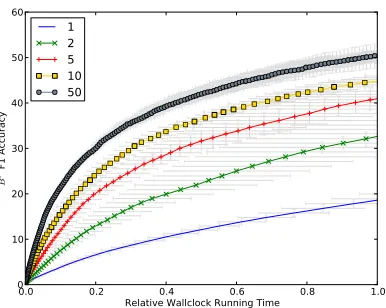
Figure 5:Person-X Evaluation of Pairwise model: Performance as number of machines is varied, aver-aged over5runs.
[image:7.612.90.283.58.212.2]Number of Entities 43,928 Number of Mentions 1,567,028 Size of Largest Entity 6,096 Average Mentions per Entity 35.7 Variance of Mentions per Entity 5191.7
Table 1: Wikipedia Link Corpus Statistics. Size of an entity is the number of mentions of that entity.
Figure 5 shows accuracy compared to relative wallclock running time for distributed inference on the flat, pairwise model. Speed and accuracy im-prove as additional machines are added, but larger number of machines lead to diminishing returns for this small dataset. Distributed inference on our hi-erarchical model is evaluated in Figure 6 against in-ference on the pairwise model from Figure 5. We see that the individual hierarchical models perform much better than the pairwise model; they achieve the same accuracy as the pairwise model in approx-imately10%of the time. Moreover, distributed in-ference on the combined hierarchical model is both faster and more accurate than the individual hierar-chical models.
5.3 Wikipedia Link Corpus
To explore the application of the proposed approach to a larger, realistic dataset, we construct a corpus based on the insight that links to Wikipedia that ap-pear on webpages can be treated as mentions, and since the links were added manually by the page au-thor, we use the destination Wikipedia page as the
Figure 6: Person-X Evaluation of Hierarchical Models: Performance of inference on hierarchical models compared to the pairwise model. Experi-ments were run using50machines.
entity the link refers to.
The dataset is created as follows: First, we crawl the web and select hyperlinks on webpages that link to an English Wikipedia page.2 The anchors of these links form our set ofmentions, with the sur-rounding block of clean text (obtained after remov-ing markup, etc.) around each link beremov-ing its con-text. We assign the title of the linked Wikipedia page as the entity label of that link. Since this set of mentions and labels can be noisy, we use the following filtering steps. All links that have less than 36 words in their block, or whose anchor text has a large string edit distance from the title of the Wikipedia page, are discarded. While this results in cases in which “President” is discarded when linked to the “Barack Obama” Wikipedia page, it was nec-essary to reduce noise. Further, we also discard links to Wikipedia pages that are concepts (such as “public_domain”) rather than entities. All enti-ties with less than 6 links to them are also discarded. Table 1 shows some statistics about our automat-ically generated data set. We randomly sampled 5% of the entities to create a development set, treating the remaining entities as the test set. Unlike the John Smith and Person-X evaluation, this data set also contains non-person entities such as organiza-tions and locaorganiza-tions.
For our models, we augment the factor potentials with mention-string similarity:
2
[image:7.612.86.285.278.345.2]ψa/r(m, n) =±(φmn−b+wSTREQ(m, n))
where STREQ is1 if mentionsm andn are string identical (0 otherwise), andw is the weight to this feature.3 In our experiments we found that setting
w= 0.8andb= 1e−4gave the best results on the development set.
[image:8.612.316.547.60.122.2]Due to the large size of the corpus, existing cross-document coreference approaches could not be ap-plied to this dataset. However, since a majority of related work consists of using clustering after defining a similarity function (Section 6), we pro-vide a baseline evaluation of clustering with Sub-Square(Bshouty and Long, 2010), a scalable, dis-tributed clustering method. Subsquare takes as in-put a weighted graph with mentions as nodes and similarity between mentions used as edge weights. Subsquare works by stochastically assigning a ver-tex to the cluster of one its neighbors if they have significant neighborhood overlap. This algorithm is an efficient form of approximate spectral cluster-ing (Bshouty and Long, 2010), and since it is given the same distances between mentions as our models, we expect it to get similar accuracy. We also gen-erate another baseline clustering by assigning men-tions with identical strings to the same entity. This mention-string clustering is also used as the initial configuration of our inference.
Figure 7: Wikipedia Link Evaluation: Perfor-mance of inference for different number of machines (N = 100,500). Mention-string match clustering is used as the initial configuration.
3Note that we do not use mention-string similarity for John Smith or Person-X as the mention strings are all identical.
Method Pairwise B
3Score
P/ R F1 P/ R F1
String-Match 30.0 / 66.7 41.5 82.7 / 43.8 57.3 Subsquare 38.2 / 49.1 43.0 87.6 / 51.4 64.8
[image:8.612.88.286.451.602.2]Our Model 44.2 / 61.4 51.4 89.4 / 62.5 73.7
Table 2: F1 Scores on the Wikipedia Link Data. The results are significant at the 0.0001 level over Subsquare according to the difference of proportions significance test.
Inference is run for20rounds of10million sam-ples each, distributed over N machines. We use
N = 100,500and the B3 F1 score results obtained set for each case are shown in Figure 7. It can be seen that N = 500 converges to a better solu-tion faster, showing effective use of parallelism. Ta-ble 2 compares the results of our approach (at con-vergence forN = 500), the baseline mention-string match and the Subsquare algorithm. Our approach significantly outperforms the competitors.
6 Related Work
Although the cross-document coreference problem is challenging and lacks large labeled datasets, its ubiquitous role as a key component of many knowl-edge discovery tasks has inspired several efforts.
hand-tuned weights, dictionaries, and heuristics to define similarity for name disambiguation (Blume, 2005; Baron and Freedman, 2008; Popescu et al., 2008). These approaches are greedy and differ in the choice of the distance function and the clustering al-gorithm used. Daum´e III and Marcu (2005) propose a generative approach to supervised clustering, and Haghighi and Klein (2010) use entity profiles to as-sist within-document coreference.
Since many related methods use clustering, there are a number of distributed clustering algorithms that may help scale these approaches. Datta et al. (2006) propose an algorithm for distributed k-means. Chen et al. (2010) describe a parallel spectral clustering algorithm. We use the Subsquare algo-rithm (Bshouty and Long, 2010) as baseline because it works well in practice. Mocian (2009) presents a survey of distributed clustering algorithms.
Rao et al. (2010) have proposed an online deter-ministic method that uses a stream of input mentions and assigns them greedily to entities. Although it can resolve mentions from non-trivial sized datasets, the method is restricted to a single machine, which is not scalable to the very large number of mentions that are encountered in practice.
Our representation of the problem as an undi-rected graphical model, and performing distributed inference on it, provides a combination of advan-tages not available in any of these approaches. First, most of the methods will not scale to the hundreds of millions of mentions that are present in real-world applications. By utilizing parallelism across ma-chines, our method can run on very large datasets simply by increasing the number of machines used. Second, approaches that use clustering are limited to using pairwise distance functions for which ad-ditional supervision and features are difficult to in-corporate. In addition to representing features from all of the related work, graphical models can also use more complex entity-wide features (Culotta et al., 2007; Wick et al., 2009a), and parameters can be learned using supervised (Collins, 2002) or semi-supervised techniques (Mann and McCallum, 2008). Finally, the inference for most of the related ap-proaches isgreedy, and earlier decisions are not re-visited. Our technique is based on MCMC inference and simulated annealing, which are able to escape local maxima.
7 Conclusions
Motivated by the problem of solving the corefer-ence problem on billions of mentions from all of the newswire documents from the past few decades, we make the following contributions. First, we intro-duce distributed version of MCMC-based inference technique that can utilize parallelism to enable scal-ability. Second, we augment the model with hierar-chical variables that facilitate fruitful proposal distri-butions. As an additional contribution, we use links to Wikipedia pages to obtain a high-quality cross-document corpus. Scalability and accuracy gains of our method are evaluated on multiple datasets.
There are a number of avenues for future work. Although we demonstrate scalability to more than a million mentions, we plan to explore performance on datasets in the billions. We also plan to examine inference on complex coreference models (such as with entity-wide factors). Another possible avenue for future work is that of learning the factors. Since our approach supports parameter estimation, we ex-pect significant accuracy gains with additional fea-tures and supervised data. Our work enables cross-document coreference on very large corpora, and we would like to explore the downstream applications that can benefit from it.
Acknowledgments
References
Amit Bagga and Breck Baldwin. 1998. Entity-based cross-document coreferencing using the vector space model. InInternational Conference on Computational Linguistics, pages 79–85.
A. Baron and M. Freedman. 2008. Who is who and what is what: experiments in cross-document co-reference. In Empirical Methods in Natural Language Process-ing (EMNLP), pages 274–283.
Eric Bengston and Dan Roth. 2008. Understanding the value of features for coreference resolution. In
Empirical Methods in Natural Language Processing (EMNLP).
Matthias Blume. 2005. Automatic entity disambigua-tion: Benefits to NER, relation extraction, link anal-ysis, and inference. In International Conference on Intelligence Analysis (ICIA).
Nader H. Bshouty and Philip M. Long. 2010. Find-ing planted partitions in nearly linear time usFind-ing ar-rested spectral clustering. In Johannes F¨urnkranz and Thorsten Joachims, editors, Proceedings of the 27th International Conference on Machine Learning (ICML-10), pages 135–142, Haifa, Israel, June. Omni-press.
Yuan Changhe, Lu Tsai-Ching, and Druzdzel Marek. 2004. Annealed MAP. InUncertainty in Artificial In-telligence (UAI), pages 628–635, Arlington , Virginia. AUAI Press.
Wen-Yen Chen, Yangqiu Song, Hongjie Bai, Chih-Jen Lin, and Edward Y. Chang. 2010. Parallel spectral clustering in distributed systems. IEEE Transactions on Pattern Analysis and Machine Intelligence. Michael Collins. 2002. Discriminative training methods
for hidden markov models: Theory and experiments with perceptron algorithm. InAnnual Meeting of the Association for Computational Linguistics (ACL). Aron Culotta, Michael Wick, and Andrew McCallum.
2007. First-order probabilistic models for coreference resolution. InNorth American Chapter of the Associa-tion for ComputaAssocia-tional Linguistics - Human Language Technologies (NAACL HLT).
S. Datta, C. Giannella, and H. Kargupta. 2006. K-Means Clustering over a Large, Dynamic Network. InSIAM Data Mining Conference (SDM).
Hal Daum´e III and Daniel Marcu. 2005. A Bayesian model for supervised clustering with the Dirichlet pro-cess prior. Journal of Machine Learning Research (JMLR), 6:1551–1577.
Jeffrey Dean and Sanjay Ghemawat. 2004. Mapreduce: Simplified data processing on large clusters. Sympo-sium on Operating Systems Design & Implementation (OSDI).
Sharon Goldwater and Tom Griffiths. 2007. A fully bayesian approach to unsupervised part-of-speech tag-ging. InAnnual Meeting of the Association for Com-putational Linguistics (ACL), pages 744–751.
Chung Heong Gooi and James Allan. 2004. Cross-document coreference on a large scale corpus. In
North American Chapter of the Association for Com-putational Linguistics - Human Language Technolo-gies (NAACL HLT), pages 9–16.
Aria Haghighi and Dan Klein. 2007. Unsupervised coreference resolution in a nonparametric bayesian model. InAnnual Meeting of the Association for Com-putational Linguistics (ACL), pages 848–855.
Aria Haghighi and Dan Klein. 2009. Simple coreference resolution with rich syntactic and semantic features. In
Empirical Methods in Natural Language Processing (EMNLP), pages 1152–1161.
Aria Haghighi and Dan Klein. 2010. Coreference reso-lution in a modular, entity-centered model. InNorth American Chapter of the Association for Computa-tional Linguistics - Human Language Technologies (NAACL HLT), pages 385–393.
Gideon S. Mann and Andrew McCallum. 2008. General-ized expectation criteria for semi-supervised learning of conditional random fields. In Annual Meeting of the Association for Computational Linguistics (ACL), pages 870–878.
Gideon S. Mann and David Yarowsky. 2003. Unsuper-vised personal name disambiguation. InNorth Amer-ican Chapter of the Association for Computational Linguistics - Human Language Technologies (NAACL HLT), pages 33–40.
Andre Martins, Noah Smith, Eric Xing, Pedro Aguiar, and Mario Figueiredo. 2010. Turbo parsers: Depen-dency parsing by approximate variational inference. In Empirical Methods in Natural Language Process-ing (EMNLP), pages 34–44, Cambridge, MA, October. Association for Computational Linguistics.
J. Mayfield, D. Alexander, B. Dorr, J. Eisner, T. Elsayed, T. Finin, C. Fink, M. Freedman, N. Garera, P. Mc-Namee, et al. 2009. Cross-document coreference res-olution: A key technology for learning by reading. In
AAAI Spring Symposium on Learning by Reading and Learning to Read.
Andrew McCallum and Ben Wellner. 2004. Conditional models of identity uncertainty with application to noun coreference. In Neural Information Processing Sys-tems (NIPS).
Andrew McCallum, Karl Schultz, and Sameer Singh. 2009. FACTORIE: Probabilistic programming via im-peratively defined factor graphs. InNeural Informa-tion Processing Systems (NIPS).
Vincent Ng. 2005. Machine learning for coreference res-olution: From local classification to global ranking. In
Annual Meeting of the Association for Computational Linguistics (ACL).
Cheng Niu, Wei Li, and Rohini K. Srihari. 2004. Weakly supervised learning for cross-document person name disambiguation supported by information extraction. In Annual Meeting of the Association for Computa-tional Linguistics (ACL), page 597.
Ted Pedersen, Anagha Kulkarni, Roxana Angheluta, Zor-nitsa Kozareva, and Thamar Solorio. 2006. An unsupervised language independent method of name discrimination using second order co-occurrence fea-tures. InInternational Conference on Intelligent Text Processing and Computational Linguistics (CICLing), pages 208–222.
Hoifung Poon, Pedro Domingos, and Marc Sumner. 2008. A general method for reducing the complexity of relational inference and its application to MCMC. InAAAI Conference on Artificial Intelligence. Octavian Popescu, Christian Girardi, Emanuele Pianta,
and Bernardo Magnini. 2008. Improving cross-document coreference. Journ´ees Internationales d’Analyse statistique des Donn´ees Textuelles, 9:961– 969.
A. Purandare and T. Pedersen. 2004. Word sense dis-crimination by clustering contexts in vector and simi-larity spaces. InConference on Computational Natu-ral Language Learning (CoNLL), pages 41–48. Delip Rao, Paul McNamee, and Mark Dredze. 2010.
Streaming cross document entity coreference reso-lution. In International Conference on Computa-tional Linguistics (COLING), pages 1050–1058, Bei-jing, China, August. Coling 2010 Organizing Commit-tee.
Yael Ravin and Zunaid Kazi. 1999. Is Hillary Rodham Clinton the president? disambiguating names across documents. InAnnual Meeting of the Association for Computational Linguistics (ACL), pages 9–16. Alexander M Rush, David Sontag, Michael Collins, and
Tommi Jaakkola. 2010. On dual decomposition and linear programming relaxations for natural language processing. In Empirical Methods in Natural Lan-guage Processing (EMNLP), pages 1–11, Cambridge, MA, October. Association for Computational Linguis-tics.
Evan Sandhaus. 2008. The New York Times annotated corpus.Linguistic Data Consortium.
Sameer Singh, Amarnag Subramanya, Fernando Pereira, and Andrew McCallum. 2010. Distributed map in-ference for undirected graphical models. In Neural Information Processing Systems (NIPS), Workshop on Learning on Cores, Clusters and Clouds.
Ben Wellner, Andrew McCallum, Fuchun Peng, and Michael Hay. 2004. An integrated, conditional model of information extraction and coreference with appli-cation to citation matching. InUncertainty in Artificial Intelligence (UAI), pages 593–601.
Michael Wick, Aron Culotta, Khashayar Rohanimanesh, and Andrew McCallum. 2009a. An entity-based model for coreference resolution. In SIAM Interna-tional Conference on Data Mining (SDM).