Proceedings of the 49th Annual Meeting of the Association for Computational Linguistics, pages 22–31, Portland, Oregon, June 19-24, 2011. c2011 Association for Computational Linguistics
Effective Use of Function Words for Rule Generalization
in Forest-Based Translation
Xianchao Wu† Takuya Matsuzaki† Jun’ichi Tsujii†‡∗
†Department of Computer Science, The University of Tokyo ‡School of Computer Science, University of Manchester
∗National Centre for Text Mining (NaCTeM) {wxc, matuzaki, tsujii}@is.s.u-tokyo.ac.jp
Abstract
In the present paper, we propose the ef-fective usage of function words to generate generalized translation rules for forest-based translation. Given aligned forest-string pairs, we extract composed tree-to-string translation rules that account for multiple interpretations of both aligned and unaligned target
func-tion words. In order to constrain the
ex-haustive attachments of function words, we limit to bind them to the nearby syntactic chunks yielded by a target dependency parser. Therefore, the proposed approach can not only capture source-tree-to-target-chunk cor-respondences but can also use forest structures that compactly encode an exponential num-ber of parse trees to properly generate target function words during decoding. Extensive experiments involving large-scale English-to-Japanese translation revealed a significant im-provement of 1.8 points in BLEU score, as compared with a strong forest-to-string base-line system.
1 Introduction
Rule generalization remains a key challenge for current syntax-based statistical machine translation (SMT) systems. On the one hand, there is a ten-dency to integrate richer syntactic information into a translation rule in order to better express the trans-lation phenomena. Thus, flat phrases (Koehn et al., 2003), hierarchical phrases (Chiang, 2005), and syn-tactic tree fragments (Galley et al., 2006; Mi and Huang, 2008; Wu et al., 2010) are gradually used in SMT. On the other hand, the use of syntactic phrases continues due to the requirement for phrase cover-age in most syntax-based systems. For example,
Mi et al. (2008) achieved a 3.1-point improvement in BLEU score (Papineni et al., 2002) by including bilingual syntactic phrases in their forest-based sys-tem. Compared with flat phrases, syntactic rules are good at capturing global reordering, which has been reported to be essential for translating between lan-guages with substantial structural differences, such as English and Japanese, which is a subject-object-verb language (Xu et al., 2009).
Forest-based translation frameworks, which make use of packed parse forests on the source and/or tar-get language side(s), are an increasingly promising approach to syntax-based SMT, being both algorith-mically appealing (Mi et al., 2008) and empirically successful (Mi and Huang, 2008; Liu et al., 2009). However, forest-based translation systems, and, in general, most linguistically syntax-based SMT sys-tems (Galley et al., 2004; Galley et al., 2006; Liu et al., 2006; Zhang et al., 2007; Mi et al., 2008; Liu et al., 2009; Chiang, 2010), are built upon word aligned parallel sentences and thus share a critical dependence on word alignments. For example, even a single spurious word alignment can invalidate a large number of otherwise extractable rules, and un-aligned words can result in an exponentially large set of extractable rules for the interpretation of these unaligned words (Galley et al., 2006).
which there were 237 target function words, which account for 76.7% of the error pairs1. This indicates that the alignments of the function words are more easily to be mistaken than content words. More-over, we found that most Japanese function words tend to align to a few English words such as ‘of’ and ‘the’, which may appear anywhere in an English sentence. Following these problematic alignments, we are forced to make use of relatively large English tree fragments to construct translation rules that tend to be ill-formed and less generalized.
This is the motivation of the present approach of re-aligning the target function words to source tree fragments, so that the influence of incorrect align-ments is reduced and the function words can be gen-erated by tree fragments on the fly. However, the current dominant research only uses 1-best trees for syntactic realignment (Galley et al., 2006; May and Knight, 2007; Wang et al., 2010), which adversely affects the rule set quality due to parsing errors. Therefore, we realign target function words to a packed forest that compactly encodes exponentially many parses. Given aligned forest-string pairs, we extract composed tree-to-string translation rules that account for multiple interpretations of both aligned and unaligned target function words. In order to con-strain the exhaustive attachments of function words, we further limit the function words to bind to their surrounding chunks yielded by a dependency parser. Using the composed rules of the present study in a baseline forest-to-string translation system results in a 1.8-point improvement in the BLEU score for large-scale English-to-Japanese translation.
2 Backgrounds
2.1 Japanese function words
In the present paper, we limit our discussion on Japanese particles and auxiliary verbs (Martin, 1975). Particles are suffixes or tokens in Japanese grammar that immediately follow modified con-tent words or sentences. There are eight types of Japanese function words, which are classified de-pending on what function they serve: case markers, parallel markers, sentence ending particles,
interjec-1
These numbers are language/corpus-dependent and are not necessarily to be taken as a general reflection of the overall qual-ity of the word alignments for arbitrary language pairs.
tory particles, adverbial particles, binding particles, conjunctive particles, and phrasal particles.
Japanese grammar also uses auxiliary verbs to give further semantic or syntactic information about the preceding main or full verb. Alike English, the extra meaning provided by a Japanese auxiliary verb alters the basic meaning of the main verb so that the main verb has one or more of the following func-tions: passive voice, progressive aspect, perfect as-pect, modality, dummy, or emphasis.
2.2 HPSG forests
Following our precious work (Wu et al., 2010), we use head-drive phrase structure grammar (HPSG) forests generated by Enju2(Miyao and Tsujii, 2008), which is a state-of-the-art HPSG parser for English. HPSG (Pollard and Sag, 1994; Sag et al., 2003) is a lexicalist grammar framework. In HPSG, linguistic entities such as words and phrases are represented by a data structure called a sign. A sign gives a factored representation of the syntactic features of a word/phrase, as well as a representation of their semantic content. Phrases and words represented by signs are collected into larger phrases by the appli-cations ofschemata. The semantic representation of the new phrase is calculated at the same time. As such, an HPSG parse forest can be considered to be a forest of signs. Making use of these signs in-stead of part-of-speech (POS)/phrasal tags in PCFG results in a fine-grained rule set integrated with deep syntactic information.
For example, an aligned HPSG forest3-string pair is shown in Figure 1. For simplicity, we only draw the identifiers for the signs of the nodes in the HPSG forest. Note that the identifiers that start with ‘c’ de-note non-terminal nodes (e.g., c0, c1), and the iden-tifiers that start with ‘t’ denote terminal nodes (e.g., t3, t1). In a complete HPSG forest given in (Wu et al., 2010), the terminal signs include features such as the POS tag, the tense, the auxiliary, the voice of a verb, etc.. The non-terminal signs include features such as the phrasal category, the name of the schema
2http://www-tsujii.is.s.u-tokyo.ac.jp/enju/index.html 3
jikken niyotte kono kekka ga kensyou sa re ta
Realign target function words 実験0 によって1 この2 結果3 が4 検証5 さ6れ7た8
this result was verified by the experiments t3 t1 t4 t8 t10 t7 t0 t6 t5 t2 t9 c9 c10 c16 c22 c4 c21 c12 c18 c19 c14 c15
c23 c8
c13 c5 c17 c3
c6
c2
c7
c11 c0
c20
c1
1-best tree 2-best tree 3-best tree
experiments by this result verified
c1
実験0 によって1 この2 結果3 が4 検証5 さ6 れ7 た8
C1 C2 C3 C4
this result was verified by the experiments
t3 t1 t4 t8 t10 t7 t0 t6 t5 t2 t9
c9 c16 c22
c45-7 | 5-8 c125-7 | 5-8 c18 c19 c14 c15
c2 c0
c215-7 | 5-8
c23 c8
c13 c5 c17 c3
c6
c7
c11 c20
[image:3.612.163.452.68.500.2]c103 | 3-4
Figure 1: Illustration of an aligned HPSG forest-string pair for English-to-Japanese translation. The chunk-level dependency tree for the Japanese sentence is shown as well.
applied in the node, etc..
3 Composed Rule Extraction
In this section, we first describe an algorithm that attaches function words to a packed forest guided by target chunk information. That is, given a triple
⟨FS, T, A⟩, namely an aligned (A) source forest
(FS) to target sentence (T) pair, we 1) tailor the
alignment A by removing the alignments for tar-get function words, 2) seek attachable nodes in the source forestFSfor each function word, and 3)
con-struct a derivation forest by topologically
travers-ingFS. Then, we identify minimal and composed
rules from the derivation forest and estimate the probabilities of rules and scores of derivations us-ing the expectation-maximization (EM) (Dempster et al., 1977) algorithm.
3.1 Definitions
In the proposed algorithm, we make use of the fol-lowing definitions, which are similar to those de-scribed in (Galley et al., 2004; Mi and Huang, 2008):
vorCcovers;
• t(v): thecorresponding spanofv, which is an index set of aligned words on another side;
• c(v): thecomplement spanof v, which is the union of corresponding spans of nodes v′ that share an identical parse tree withvbut are nei-ther antecedents nor descendants ofv;
• PA: the frontier set of FS, which contains
nodes that areconsistent with an alignment A
(gray nodes in Figure 1), i.e., t(v) ̸= ∅ and
closure(t(v))∩c(v) =∅.
The functionclosurecovers the gap(s) that may appear in the interval parameter. For example,
closure(t(c3)) = closure({0-1, 4-7}) = {0-7}. Examples of the applications of these functions can be found in Table 1. Following (Galley et al., 2006), we distinguish between minimal and com-posed rules. The composed rules are generated by combining a sequence of minimal rules.
3.2 Free attachment of target function words
3.2.1 Motivation
We explain the motivation for the present research using an example that was extracted from our train-ing data, as shown in Figure 1. In the alignment of this example, three lines (in dot lines) are used to alignwasandthewithga(subject particle), andwas withta(past tense auxiliary verb). Under this align-ment, we are forced to extract rules with relatively large tree fragments. For example, by applying the GHKM algorithm (Galley et al., 2004), a rule rooted at c0 will take c7, t4, c4, c19, t2, and c15 as the leaves. The final tree fragment, with a height of 7, contains 13 nodes. In order to ensure that this rule is used during decoding, we must generate subtrees with a height of 7 for c0. Suppose that the input for-est is binarized and that|E|is the average number of hyperedges of each node, then we must generate
O(|E|26−1)subtrees4for c0 in the worst case. Thus,
4
For one (binarized) hyperedgeeof a node, suppose there arexsubtrees in the left tail node andysubtrees in the right tail node. Then the number of subtrees guided byeis(x+ 1)× (y+ 1). Thus, the recursive formula isNh=|E|(Nh−1+ 1)2, wherehis the height of the hypergraph andNhis the number
of subtrees. Whenh= 1, we letNh= 0.
the existence of these rules prevents the generaliza-tion ability of the final rule set that is extracted.
In order to address this problem, we tailor the alignment by ignoring these three alignment pairs in dot lines. For example, by ignoring the ambiguous alignments on the Japanese function words, we en-large the frontier set to include from 12 to 19 of the 24 non-terminal nodes. Consequently, the number of extractable minimal rules increases from 12 (with three reordering rules rooted at c0, c1, and c2) to 19 (with five reordering rules rooted at c0, c1, c2, c5, and c17). With more nodes included in the fron-tier set, we can extract more minimal and composed monotonic/reordering rules and avoid extracting the less generalized rules with extremely large tree frag-ments.
3.2.2 Why chunking?
In the proposed algorithm, we use a target chunk set to constrain the attachment explosion problem because we use a packed parse forest instead of a 1-best tree, as in the case of (Galley et al., 2006). Mul-tiple interpretations of unaligned function words for an aligned tree-string pair result in a derivation for-est. Now, we have a packed parse forest in which each tree corresponds to a derivation forest. Thus, pruning free attachments of function words is prac-tically important in order to extract composed rules from this “(derivation) forest of (parse) forest”.
In the English-to-Japanese translation test case of the present study, the target chunk set is yielded by a state-of-the-art Japanese dependency parser, Cabocha v0.535(Kudo and Matsumoto, 2002). The output of Cabocha is a list ofchunks. A chunk con-tains roughly one content word (usually the head) and affixed function words, such as case markers (e.g., ga) and verbal morphemes (e.g., sa re ta, which indicate past tense and passive voice). For example, the Japanese sentence in Figure 1 is sepa-rated into four chunks, and the dependencies among these chunks are identified by arrows. These arrows point out the head chunk that the current chunk mod-ifies. Moreover, we also hope to gain a fine-grained alignment among these syntactic chunks and source tree fragments. Thereby, during decoding, we are binding the generation of function words with the generation of target chunks.
5
Algorithm 1Aligning function words to the forest
Input: HPSG forest FS, target sentence T, word alignment A = {(i, j)}, target function word set{fw}appeared in T, and target chunk set{C}
Output: a derivation forestDF
1: A′←A\ {(i, s(fw))} ◃ fw∈ {fw}
2: foreach nodev∈ PA′in topological orderdo
3: Tv←∅ ◃store the corresponding spans ofv
4: foreach function wordfw∈ {fw}do
5: iffw∈ Candt(v)∩(C)̸=∅andfware not attached
to descendants ofvthen
6: appendt(v)∪ {s(fw)}toTv
7: end if
8: end for
9: foreach corresponding spant(v)∈ Tvdo
10: R ← IDENTIFYMINRULES(v, t(v), T) ◃ range over the hyperedges ofv, and discount the factional count of each ruler∈ Rby1/|Tv|
11: create a nodeninDFfor each ruler∈ R
12: create a shared parent node⊕when|R|>1
13: end for
14: end for
3.2.3 The algorithm
Algorithm 1 outlines the proposed approach to constructing a derivation forest to include multiple interpretations of target function words. The deriva-tion forest is a hypergraph as previously used in (Galley et al., 2006), to maintain the constraint that one unaligned target word be attached to some node
vexactly once in one derivation tree. Starting from a triple ⟨FS, T, A⟩, we first tailor the alignment A
toA′by removing the alignments for target function words. Then, we traverse the nodesv∈ PA′ in
topo-logical order. During the traversal, a function word
fw will be attached tovif 1)t(v)overlaps with the
span of the chunk to whichfw belongs, and 2)fw
has not been attached to the descendants ofv. We identify translation rules that takevas the root of their tree fragments. Each tree fragment is a fron-tier tree that takes a node in the frontier set PA′
ofFS as the root node and non-lexicalized frontier
nodes or lexicalized non-frontier nodes as the leaves. Also, aminimal frontier treeused in a minimal rule is limited to be a frontier tree such that all nodes other than the root and leaves are non-frontier nodes. We use Algorithm 1 described in (Mi and Huang, 2008) to collect minimal frontier trees rooted atvin
FS. That is, we range over each hyperedges headed
atvand continue to expand downward until the
cur-A→(A′)
node s(·) t(·) c(·) consistent
c0 0-6 0-8(0-3,5-7) ∅ 1
c1 0-6 0-8(0-3,5-7) ∅ 1
c2 0-6 0-8(0-3,5-7) ∅ 1
c3 3-6 0-1,4-7(0-1, 5-7) 2,8 0
c4 3 5-7 0,8(0-3) 1
c5* 4-6 0,4(0-1) 2-8(2-3,5-7) 0(1) c6* 0-3 2-8(2-3,5-7) 0,4(0-1) 0(1) c7 0-1 2-3 0-1,4-8(0-1,5-7) 1 c8* 2-3 4-8(5-7) 0-4(0-3) 0(1)
c9 0 2 0-1,3-8(0-1,3,5-7) 1
c10 1 3 0-2,4-8(0-2,5-7) 1
c11 2-6 0-1,4-8(0-1,5-7) 2-3 0
c12 3 5-7 0,8(0-3) 1
c13* 5-6 0,4(0) 1-8(1-3,5-7) 0(1)
c14 5 4(∅) 0-8(0-3,5-7) 0
c15 6 0 1-8(1-3,5-7) 1
c16 2 4,8(∅) 0-7(0-3,5-7) 0 c17* 4-6 0,4(0-1) 2-8(2-3,5-7) 0(1)
c18 4 1 0,2-8(0,2-3,5-7) 1
c19 4 1 0,2-8(0,2-3,5-7) 1
c20* 0-3 2-8(2-3,5-7) 0,4(0-1) 0(1)
c21 3 5-7 0,8(0-3) 1
[image:5.612.315.548.71.317.2]c22 2 4,8(∅) 0-7(0-3,5-7) 0 c23* 2-3 4-8(5-7) 0-4(0-3) 0(1)
Table 1: Change of node attributes after alignment
modi-fication fromAtoA′of the example in Figure 1. Nodes
with * superscripts are consistent withA′but not
consis-tent withA.
rent set of hyperedges forms a minimal frontier tree. In the derivation forest, we use⊕nodes to man-age minimal/composed rules that share the same node and the same corresponding span. Figure 2 shows some minimal rule and⊕nodes derived from the example in Figure 1.
Even though we bind function words to their nearby chunks, these function words may still be at-tached to relative large tree fragments, so that richer syntactic information can be used to predict the function words. For example, in Figure 2, the tree fragments rooted at node c00−8 can predictgaand/or ta. The syntactic foundation behind is that, whether to usegaas a subject particle or to usewoas an ob-ject particle depends on both the left-hand-side noun phrase (kekka) and the right-hand-side verb (kensyou sa re ta). This type of nodev′(such as c0−80 ) should satisfy the following two heuristic conditions:
• v′is included in the frontier setPA′ ofFS, and
• t(v′)covers the function word, orv′is the root node ofFSif the function word is the beginning
or ending word in the target sentenceT.
c103-4
t13: result
kekka ga
* c103
t13: result
kekka
c92
t32: the
kono
c72-3
c103
c92
x0 x1
x0 x
1
c72-4
c103-4
c92
x0 x1
x0 x
1
* c62-7
c85-7
c72-3
x0ga x1
x0 x
1
* c62-7
c85-7
c72-4
x0 x1
x0 x
1
* c00-8
c16
c45-7 c50-1
c3 c72-4 c11 x2 x0 x1 ta
x0
x1 x2
+
*
c00-8
c16
c45-8 c50-1
c3 c72-4 c11
x2 x0 x1
x0
x1 x2
+ *
c00-8
c16
c45-7 c50-1
c3 c72-3 c11
x2 x0ga x1ta
x0
x1 x2
* + c00-8
c16
c45-8 c50-1
c3 c72-3 c11 x
2 x0ga x1
x0
x1 x2
*
+
t4{}:was t4{}:was t
[image:6.612.130.483.73.283.2]4{}:was t4{}:was
Figure 2: Illustration of a (partial) derivation forest. Gray nodes include some unaligned target function word(s).
Nodes annotated by “*” includega, and nodes annotated by “+” includeta.
rules as nodes, we can further combine two or more minimal rules to form composed rules nodes and can append these nodes to the derivation forest.
3.3 Estimating rule probabilities
We use the EM algorithm to jointly estimate 1) the translation probabilities and fractional counts of rules and 2) the scores of derivations in the deriva-tion forests. As reported in (May and Knight, 2007), EM, as has been used in (Galley et al., 2006) to es-timate rule probabilities in derivation forests, is an iterative procedure and prefers shorter derivations containing large rules over longer derivations con-taining small rules. In order to overcome this bias problem, we discount the fractional count of a rule by the product of the probabilities of parse hyper-edges that are included in the tree fragment of the rule.
4 Experiments
4.1 Setup
We implemented the forest-to-string decoder de-scribed in (Mi et al., 2008) that makes use of forest-based translation rules (Mi and Huang, 2008) as the baseline system for translating English HPSG forests into Japanese sentences. We analyzed the performance of the proposed translation rule sets by
Train Dev. Test
# sentence pairs 994K 2K 2K
# En 1-best trees 987,401 1,982 1,984 # En forests 984,731 1,979 1,983 # En words 24.7M 50.3K 49.9K # Jp words 28.2M 57.4K 57.1K # Jp function words 8.0M 16.1K 16.1K
Table 2: Statistics of the JST corpus. Here, En = English and Jp = Japanese.
using the same decoder.
The JST Japanese-English paper abstract corpus6 (Utiyama and Isahara, 2007), which consists of one million parallel sentences, was used for training, tuning, and testing. Table 2 shows the statistics of this corpus. Note that Japanese function words oc-cupy more than a quarter of the Japanese words. Making use of Enju 2.3.1, we generated 987,401 1-best trees and 984,731 parse forests for the En-glish sentences in the training set, with successful parse rates of 99.3% and 99.1%, respectively. Us-ing the prunUs-ing criteria expressed in (Mi and Huang, 2008), we continue to prune a parse forest by set-tingpeto be 8, 5, and 2, until there are no more than
e10 = 22,026trees in a forest. After pruning, there are an average of 82.3 trees in a parse forest.
6
[image:6.612.327.525.338.419.2]C3-T M&H-F Min-F C3-F
free fw Y N Y Y
alignment A′ A A′ A′
English side tree forest forest forest # rule 86.30 96.52 144.91 228.59 # reorder rule 58.50 91.36 92.98 162.71 # tree types 21.62 93.55 72.98 120.08 # nodes/tree 14.2 42.1 26.3 18.6 extract time 30.2 52.2 58.6 130.7
EM time 9.4 - 11.2 29.0
[image:7.612.316.537.68.206.2]# rules in dev. 0.77 1.22 1.37 2.18 # rules in test 0.77 1.23 1.37 2.15 DT(sec./sent.) 2.8 15.7 22.4 35.4 BLEU (%) 26.15 27.07 27.93 28.89
Table 3: Statistics and translation results for four types of tree-to-string rules. With the exception of ‘# nodes/tree’, the numbers in the table are in millions and the time is in hours. Here, fw denotes function word, and DT denotes the decoding time, and the BLEU scores were computed on the test set.
We performed GIZA++ (Och and Ney, 2003) and the grow-diag-final-and symmetrizing strategy (Koehn et al., 2007) on the training set to obtain alignments. The SRI Language Modeling Toolkit (Stolcke, 2002) was employed to train a five-gram Japanese LM on the training set. We evaluated the translation quality using the BLEU-4 metric (Pap-ineni et al., 2002).
Joshua v1.3 (Li et al., 2009), which is a freely available decoder for hierarchical phrase-based SMT (Chiang, 2005), is used as an external baseline system for comparison. We extracted 4.5M translation rules from the training set for the 4K En-glish sentences in the development and test sets. We used the default configuration of Joshua, with the ex-ception of the maximum number of items/rules, and the value ofk(of thek-best outputs) is set to be 200.
4.2 Results
Table 3 lists the statistics of the following translation rule sets:
• C3-T: a composed rule set extracted from the derivation forests of 1-best HPSG trees that were constructed using the approach described in (Galley et al., 2006). The maximum number of internal nodes is set to be three when gen-erating a composed rule. We free attach target function words to derivation forests;
0 5 10 15 20 25
2 12 22 32 42 52 62 72 82 92
#
o
f
ru
le
s
(M
)
# of tree nodes in rule
M&H-F
Min-F
C3-T
C3-F
Figure 3: Distributions of the number of tree nodes in the translation rule sets. Note that the curves of Min-F and C3-F are duplicated when the number of tree nodes being larger than 9.
• M&H-F: a minimal rule set extracted from HPSG forests using the extracting algorithm of (Mi and Huang, 2008). Here, we make use of the original alignments. We use the two heuris-tic conditions described in Section 3.2.3 to at-tach unaligned words to some node(s) in the forest;
• Min-F: a minimal rule set extracted from the derivation forests of HPSG forests that were constructed using Algorithm 1 (Section 3).
• C3-F: a composed rule set extracted from the derivation forests of HPSG forests. Similar to C3-T, the maximum number of internal nodes during combination is three.
We investigate the generalization ability of these rule sets through the following aspects:
1. the number of rules, the number of reordering rules, and the distributions of the number of tree nodes (Figure 3), i.e., more rules with rel-atively small tree fragments are preferred;
2. the number of rules that are applicable to the development and test sets (Table 3); and
3. the final translation accuracies.
[image:7.612.80.288.69.229.2]0 10 20 30 40 50
0.0 0.5 1.0 1.5 2.0 2.5
C3-T M&H-F Min-F C3-F
D
ec
o
d
in
g
t
im
e
(s
ec
./
se
n
t.
)
#
o
f
ru
le
s
(M
)
[image:8.612.79.292.70.203.2]# rules (M) DT
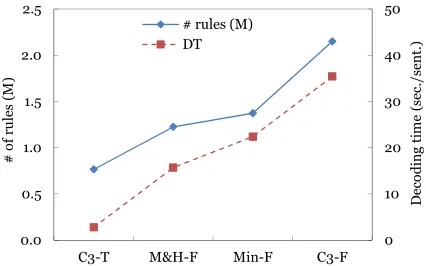
Figure 4: Comparison of decoding time and the number of rules used for translating the test set.
the final BLEU scores of T with Min-F and C3-F. Using the composed rule set C3-F in our forest-based decoder, we achieved an optimal BLEU score of 28.89 (%). Taking M&H-F as the baseline trans-lation rule set, we achieved a significant improve-ment (p <0.01) of 1.81 points.
In terms of decoding time, even though we used Algorithm 3 described in (Huang and Chiang, 2005), which lazily generated the N-best translation can-didates, the decoding time tended to be increased because more rules were available during cube-pruning. Figure 4 shows a comparison of decoding time (seconds per sentence) and the number of rules used for translating the test set. Easy to observe that, decoding time increases in a nearly linear way fol-lowing the increase of the number of rules used dur-ing decoddur-ing.
Finally, compared with Joshua, which achieved a BLEU score of 24.79 (%) on the test set with a decoding speed of 8.8 seconds per sentence, our forest-based decoder achieved a significantly better (p < 0.01) BLEU score by using either of the four types of translation rules.
5 Related Research
Galley et al. (2006) first used derivation forests of aligned tree-string pairs to express multiple inter-pretations of unaligned target words. The EM al-gorithm was used to jointly estimate 1) the trans-lation probabilities and fractional counts of rules and 2) the scores of derivations in the derivation forests. By dealing with the ambiguous word align-ment instead of unaligned target words, syntax-based re-alignment models were proposed by (May
and Knight, 2007; Wang et al., 2010) for tree-based translations.
Free attachment of the unaligned target word problem was ignored in (Mi and Huang, 2008), which was the first study on extracting tree-to-string rules from aligned forest-string pairs. This inspired the idea to re-align a packed forest and a target sen-tence. Specially, we observed that most incorrect or ambiguous word alignments are caused by function words rather than content words. Thus, we focus on the realignment of target function words to source tree fragments and use a dependency parser to limit the attachments of unaligned target words.
6 Conclusion
We have proposed an effective use of target function words for extracting generalized transducer rules for forest-based translation. We extend the unaligned word approach described in (Galley et al., 2006) from the 1-best tree to the packed parse forest. A simple yet effective modification is that, during rule extraction, we account for multiple interpretations of both aligned and unaligned target function words. That is, we chose to loose the ambiguous alignments for all of the target function words. The consider-ation behind is in order to generate target function words in a robust manner. In order to avoid gener-ating too large a derivation forest for a packed for-est, we further used chunk-level information yielded by a target dependency parser. Extensive experi-ments on large-scale English-to-Japanese translation resulted in a significant improvement in BLEU score of 1.8 points (p < 0.01), as compared with our implementation of a strong forest-to-string baseline system (Mi et al., 2008; Mi and Huang, 2008).
The present work only re-aligns target function words to source tree fragments. It will be valuable to investigate the feasibility to re-align all the tar-get words to source tree fragments. Also, it is in-teresting to automatically learn a word set for re-aligning7. Given source parse forests and a target word set for re-aligning beforehand, we argue our approach is generic and applicable to any language pairs. Finally, we intend to extend the proposed approach to tree-to-tree translation frameworks by
re-aligning subtree pairs (Liu et al., 2009; Chiang, 2010) and consistency-to-dependency frameworks by re-aligning consistency-tree-to-dependency-tree pairs (Mi and Liu, 2010) in order to tackle the rule-sparseness problem.
Acknowledgments
The present study was supported in part by a Grant-in-Aid for Specially Promoted Research (MEXT, Japan), by the Japanese/Chinese Machine Transla-tion Project through Special CoordinaTransla-tion Funds for Promoting Science and Technology (MEXT, Japan), and by Microsoft Research Asia Machine Transla-tion Theme.
Wu ([email protected]) has moved to NTT Communication Science Laborato-ries and Tsujii ([email protected]) has moved to Microsoft Research Asia.
References
David Chiang. 2005. A hierarchical phrase-based model
for statistical machine translation. In Proceedings of
ACL, pages 263–270, Ann Arbor, MI.
David Chiang. 2010. Learning to translate with source
and target syntax. InProceedings of the 48th Annual
Meeting of the Association for Computational
Linguis-tics, pages 1443–1452, Uppsala, Sweden, July.
Asso-ciation for Computational Linguistics.
A. P. Dempster, N. M. Laird, and D. B. Rubin. 1977. Maximum likelihood from incomplete data via the em
algorithm. Journal of the Royal Statistical Society,
39:1–38.
Michel Galley, Mark Hopkins, Kevin Knight, and Daniel
Marcu. 2004. What’s in a translation rule? In
Pro-ceedings of HLT-NAACL.
Michel Galley, Jonathan Graehl, Kevin Knight, Daniel Marcu, Steve DeNeefe, Wei Wang, and Ignacio
Thayer. 2006. Scalable inference and training of
context-rich syntactic translation models. In
Proceed-ings of COLING-ACL, pages 961–968, Sydney.
Liang Huang and David Chiang. 2005. Better k-best
parsing. InProceedings of IWPT.
Philipp Koehn, Franz Josef Och, and Daniel Marcu.
2003. Statistical phrase-based translation. In
Proceed-ings of the Human Language Technology and North American Association for Computational Linguistics
Conference (HLT/NAACL), Edomonton, Canada, May
27-June 1.
Philipp Koehn, Hieu Hoang, Alexandra Birch, Chris Callison-Burch, Marcello Federico, Nicola Bertoldi,
Brooke Cowan, Wade Shen, Christine Moran, Richard Zens, Chris Dyer, Ondˇrej Bojar, Alexandra Con-stantin, and Evan Herbst. 2007. Moses: Open source
toolkit for statistical machine translation. In
Proceed-ings of the ACL 2007 Demo and Poster Sessions, pages
177–180.
Taku Kudo and Yuji Matsumoto. 2002. Japanese
depen-dency analysis using cascaded chunking. In
Proceed-ings of CoNLL-2002, pages 63–69. Taipei, Taiwan.
Zhifei Li, Chris Callison-Burch, Chris Dyery, Juri Gan-itkevitch, Sanjeev Khudanpur, Lane Schwartz, Wren N. G. Thornton, Jonathan Weese, and Omar F. Zaidan.
2009. Demonstration of joshua: An open source
toolkit for parsing-based machine translation. In
Pro-ceedings of the ACL-IJCNLP 2009 Software
Demon-strations, pages 25–28, August.
Yang Liu, Qun Liu, and Shouxun Lin. 2006.
Tree-to-string alignment templates for statistical machine
transaltion. In Proceedings of COLING-ACL, pages
609–616, Sydney, Australia.
Yang Liu, Yajuan L¨u, and Qun Liu. 2009. Improving
tree-to-tree translation with packed forests. In
Pro-ceedings of ACL-IJCNLP, pages 558–566, August.
Samuel E. Martin. 1975. A Reference Grammar of
Japanese. New Haven, Conn.: Yale University Press.
Jonathan May and Kevin Knight. 2007. Syntactic
re-alignment models for machine translation. In
Pro-ceedings of the 2007 Joint Conference on Empir-ical Methods in Natural Language Processing and Computational Natural Language Learning
(EMNLP-CoNLL), pages 360–368, Prague, Czech Republic,
June. Association for Computational Linguistics. Haitao Mi and Liang Huang. 2008. Forest-based
transla-tion rule extractransla-tion. InProceedings of EMNLP, pages
206–214, October.
Haitao Mi and Qun Liu. 2010. Constituency to
depen-dency translation with forests. InProceedings of the
48th Annual Meeting of the Association for
Compu-tational Linguistics, pages 1433–1442, Uppsala,
Swe-den, July. Association for Computational Linguistics. Haitao Mi, Liang Huang, and Qun Liu. 2008.
Forest-based translation. In Proceedings of ACL-08:HLT,
pages 192–199, Columbus, Ohio.
Yusuke Miyao and Jun’ichi Tsujii. 2008. Feature forest
models for probabilistic hpsg parsing. Computational
Lingustics, 34(1):35–80.
Franz Josef Och and Hermann Ney. 2003. A system-atic comparison of various statistical alignment
mod-els. Computational Linguistics, 29(1):19–51.
Kishore Papineni, Salim Roukos, Todd Ward, and Wei-Jing Zhu. 2002. Bleu: a method for automatic
evalu-ation of machine translevalu-ation. InProceedings of ACL,
pages 311–318.
Carl Pollard and Ivan A. Sag. 1994.Head-Driven Phrase
Structure Grammar. University of Chicago Press.
Ivan A. Sag, Thomas Wasow, and Emily M. Bender.
2003. Syntactic Theory: A Formal Introduction.
Number 152 in CSLI Lecture Notes. CSLI Publica-tions.
Andreas Stolcke. 2002. Srilm-an extensible language
modeling toolkit. In Proceedings of International
Conference on Spoken Language Processing, pages
901–904.
Masao Utiyama and Hitoshi Isahara. 2007. A
japanese-english patent parallel corpus. InProceedings of MT
Summit XI, pages 475–482, Copenhagen.
Wei Wang, Jonathan May, Kevin Knight, and Daniel
Marcu. 2010. Re-structuring, labeling, and
re-aligning for syntax-based machine translation.
Com-putational Linguistics, 36(2):247–277.
Xianchao Wu, Takuya Matsuzaki, and Jun’ichi Tsujii. 2010. Fine-grained tree-to-string translation rule
ex-traction. In Proceedings of the 48th Annual
Meet-ing of the Association for Computational LMeet-inguistics,
pages 325–334, Uppsala, Sweden, July. Association for Computational Linguistics.
Peng Xu, Jaeho Kang, Michael Ringgaard, and Franz Och. 2009. Using a dependency parser to improve
smt for subject-object-verb languages. InProceedings
of HLT-NAACL, pages 245–253.
Min Zhang, Hongfei Jiang, Ai Ti Aw, Jun Sun, Sheng Li, and Chew Lim Tan. 2007. A tree-to-tree
alignment-based model for statistical machine translation. In
Proceedings of MT Summit XI, pages 535–542,