Algorithm Selection and Model Adaptation for ESL Correction Tasks
Alla Rozovskaya and Dan Roth
University of Illinois at Urbana-Champaign Urbana, IL 61801
{rozovska,danr}@illinois.edu
Abstract
We consider the problem of correcting errors made by English as a Second Language (ESL) writers and address two issues that are essen-tial to making progress in ESL error correction - algorithm selection and model adaptation to the first language of the ESL learner.
A variety of learning algorithms have been applied to correct ESL mistakes, but often comparisons were made between incompara-ble data sets. We conduct an extensive, fair comparison of four popular learning methods for the task, reversing conclusions from ear-lier evaluations. Our results hold for different training sets, genres, and feature sets.
A second key issue in ESL error correction is the adaptation of a model to the first lan-guage of the writer. Errors made by non-native speakers exhibit certain regularities and, as we show, models perform much better when they use knowledge about error patterns of the non-native writers. We propose a novel way to adapt a learned algorithm to the first language of the writer that is both cheaper to imple-ment and performs better than other adapta-tion methods.
1 Introduction
There has been a lot of recent work on correct-ing writcorrect-ing mistakes made by English as a Second Language (ESL) learners (Izumi et al., 2003; Eeg-Olofsson and Knuttson, 2003; Han et al., 2006; Fe-lice and Pulman, 2008; Gamon et al., 2008; Tetreault and Chodorow, 2008; Elghaari et al., 2010; Tetreault et al., 2010; Gamon, 2010; Rozovskaya and Roth,
2010c). Most of this work has focused on correcting mistakes in article and preposition usage, which are some of the most common error types among non-native writers of English (Dalgish, 1985; Bitchener et al., 2005; Leacock et al., 2010). Examples below illustrate some of these errors:
1. “They listen toNone*/thelecture carefully.”
2. “He is an engineer with a passionto*/for what he
does.”
In (1) the definite article is incorrectly omitted. In (2), the writer uses an incorrect preposition.
Approaches to correcting preposition and article mistakes have adopted the methods of the context-sensitive spelling correction task, which addresses the problem of correcting spelling mistakes that re-sult in legitimate words, such as confusing their
and there(Carlson et al., 2001; Golding and Roth, 1999). Acandidate setor aconfusion setis defined that specifies a list of confusable words, e.g.,{their, there}. Each occurrence of a confusable word in text is represented as a vector of features derived from a context window around the target, e.g., words and part-of-speech tags. A classifier is trained on text assumed to be error-free. At decision time, for each word in text, e.g. there, the classifier predicts the most likely candidate from the corresponding con-fusion set{their, there}.
Models for correcting article and preposition er-rors are similarly trained on error-free native English text, where the confusion set includes all articles or prepositions (Izumi et al., 2003; Eeg-Olofsson and Knuttson, 2003; Han et al., 2006; Felice and Pulman, 2008; Gamon et al., 2008; Tetreault and Chodorow, 2008; Tetreault et al., 2010).
Although the choice of a particular learning al-gorithm differs, with the exception of decision trees (Gamon et al., 2008), all algorithms used are lin-ear llin-earning algorithms, some discriminative (Han et al., 2006; Felice and Pulman, 2008; Tetreault and Chodorow, 2008; Rozovskaya and Roth, 2010c; Rozovskaya and Roth, 2010b), some probabilistic (Gamon et al., 2008; Gamon, 2010), or “counting” (Bergsma et al., 2009; Elghaari et al., 2010).
While model comparison has not been the goal of the earlier studies, it is quite common to com-pare systems, even when they are trained on dif-ferent data sets and use difdif-ferent features. Further-more, since there is no shared ESL data set, sys-tems are also evaluated on data from different ESL sources or even on native data. Several conclusions have been made when comparing systems devel-oped for ESL correction tasks. Alanguage model
was found to outperform amaximum entropy classi-fier(Gamon, 2010). However, the language model was trained on the Gigaword corpus,17·109words (Linguistic Data Consortium, 2003), a corpus sev-eral orders of magnitude larger than the corpus used to train the classifier. Similarly, web-based models built on Google Web1T 5-gram Corpus (Bergsma et al., 2009) achieve better results when compared to a maximum entropy model that uses a corpus10,000
times smaller (Chodorow et al., 2007)1.
In this work, we compare four popular learning methods applied to the problem of correcting prepo-sition and article errors and evaluate on a common ESL data set. We compare two probabilistic ap-proaches –Na¨ıve Bayes and language modeling; a discriminative algorithmAveraged Perceptron; and a count-based methodSumLM(Bergsma et al., 2009), which, as we show, is very similar to Na¨ıve Bayes, but with a different free coefficient. We train our models on data from several sources, varying train-ing sizes and feature sets, and show that there are significant differences in the performance of these algorithms. Contrary to previous results (Bergsma et al., 2009; Gamon, 2010), we find that when trained on the same data with the same features, Averaged Perceptron achieves the best performance, followed by Na¨ıve Bayes, then the language model, and fi-nally the count-based approach. Our results hold for
1
These two models also use different features.
training sets of different sizes, genres, and feature sets. We also explain the performance differences from the perspective of each algorithm.
The second important question that we address is that of adapting the decision to the source language of the writer. Errors made by non-native speakers exhibit certain regularities. Adapting a model so that it takes into consideration the specific error pat-terns of the non-native writers was shown to be ex-tremely helpful in the context of discriminative clas-sifiers (Rozovskaya and Roth, 2010c; Rozovskaya and Roth, 2010b). However, this method requires generating new training data and training a separate classifier for each source language. Our key contri-bution here is a novel, simple, and elegant adaptation method within the framework of the Na¨ıve Bayes algorithm, which yields even greater performance gains. Specifically, we show how the error patterns of the non-native writers can be viewed asa different distribution on candidate priorsin the confusion set. Following this observation, we train Na¨ıve Bayes in a traditional way, regardless of the source language of the writer, and then, only at decision time, change the prior probabilities of the model from the ones observed in the native training data to the ones corre-sponding to error patterns in the non-native writer’s source language (Section 4). A related idea has been applied in Word Sense Disambiguation to adjust the model priors to a new domain with different sense distributions (Chan and Ng, 2005).
The paper has two main contributions. First, we conduct a fair comparison of four learning algo-rithms and show that the discriminative approach Averaged Perceptron is the best performing model (Sec. 3). Our results do not support earlier conclu-sions with respect to the performance of count-based models (Bergsma et al., 2009) and language mod-els (Gamon, 2010). In fact, we show that SumLM is comparable to Averaged Perceptron trained with a 10 times smaller corpus, and language model is comparable to Averaged Perceptron trained with a2 timessmaller corpus.
The second, and most significant, of our contribu-tions is a novel way to adapt a model to the source language of the writer,without re-training the model
better than previous, more complicated methods. Section 2 presents the theoretical component of the linear learning framework. In Section 3, we describe the experiments, which compare the four learning models. Section 4 presents the key result of this work, a novel method of adapting the model to the source language of the learner.
2 The Models
The standard approach to preposition correction is to cast the problem as a multi-class classifica-tion task and train a classifier on features defined on the surrounding context2. The model selects the most likely candidate from the confusion set, where the set of candidates includes the topnmost frequent English prepositions. Our confusion set includes the top ten prepositions3: Conf Set = {on, from, for, of, about, to, at, in, with, by}. We use p to refer to a candidate preposition from Conf Set.
Letpreposition contextdenote the preposition and the window around it. For instance, “a passion to
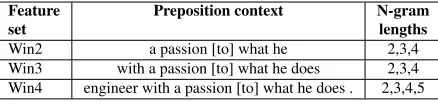
what he” is a context for window size 2. We use three feature sets, varying window size from 2 to 4 words on each side (see Table 1). All feature sets consist of word n-grams of various lengths span-ningpand all the features are of the forms−kps+m, wheres−k and s+m denote k words before andm words afterp; we show two 3-gram features for il-lustration:
1. a passionp
2. passionpwhat
We implement four linear learning models: the discriminative method Averaged Perceptron (AP); two probabilistic methods –a language model(LM) and Na¨ıve Bayes (NB); and a “counting” method
SumLM(Bergsma et al., 2009).
Each model produces a score for a candidate in the confusion set. Since all of the models are lin-ear, the hypotheses generated by the algorithms dif-fer only in the weights they assign to the features
2
We also report one experiment on the article correction task. We take the preposition correction task as an example; the article case is treated in the same way.
3This set of prepositions is also considered in other works,
e.g. (Rozovskaya and Roth, 2010b). The usage of the ten most frequent prepositions accounts for 82% of all preposition errors (Leacock et al., 2010).
Feature Preposition context N-gram
set lengths
Win2 a passion [to] what he 2,3,4 Win3 with a passion [to] what he does 2,3,4 Win4 engineer with a passion [to] what he does . 2,3,4,5
Table 1: Description of the three feature sets used in
the experiments. All feature sets consist of word n-grams of various lengths spanning the preposition and vary by n-gram length and window size.
Method Free Coefficient Feature weights AP bias parameter mistake-driven LM λ·prior(p) P
vl◦vrλvr·log(P(u|vr))
[image:3.612.316.535.69.121.2]NB log(prior(p)) log(P(f|p)) SumLM |F(S, p)| ·log(C(p)) log(P(f|p))
Table 2: Summary of the learning methods. C(p)
de-notes the number of times prepositionpoccurred in
train-ing.λis a smoothing parameter,uis the rightmost word
inf,vl◦vr denotes all concatenations of substringsvl
andvrof featurefwithoutu.
(Roth, 1998; Roth, 1999). Thus a score computed by each of the models for a prepositionpin the con-textScan be expressed as follows:
g(S, p) =C(p) + X f∈F(S,p)
wa(f), (1)
whereF(S, p) is the set of features active in con-textS relative to prepositionp,wa(f)is the weight
algorithmaassigns to featuref ∈ F, andC(p) is a free coefficient. Predictions are made using the winner-take-all approach:argmaxpg(S, p). The al-gorithms make use of the same feature set F and differ only by how the weightswa(f)andC(p)are
computed. Below we explain how the weights are determined in each method. Table 2 summarizes the four approaches.
2.1 Averaged Perceptron
We use the regularized version of AP in Learn-ing Based Java4 (LBJ, (Rizzolo and Roth, 2007)). While classical Perceptron comes with a generaliza-tion bound related to the margin of the data, Aver-aged Perceptron also comes with a PAC-like gener-alization bound (Freund and Schapire, 1999). This linear learning algorithm is known, both theoreti-cally and experimentally, to be among the best linear learning approaches and is competitive with SVM and Logistic Regression, while being more efficient in training. It also has been shown to produce state-of-the-art results on many natural language applica-tions (Punyakanok et al., 2008).
2.2 Language Modeling
Given a feature f = s−kps+m, let u denote the rightmost word inf andvl◦vr denote all concate-nations of substringsvlandvrof featuref without u. The language model computes several probabil-ities of the form P(u|vr). If f =“with a passion pwhat”, then u =“what”, and vr ∈ {“with a
pas-sionp”, “a passionp”, “passionp”, “p”}. In prac-tice, these probabilities are smoothed and replaced with their corresponding log values, and the total weight contribution off to the scoring function of p is P
vl◦vrλvr ·log(P(u|vr)). In addition, this
scoring function has a coefficient that only depends onp: C(p) =λ·prior(p)(see Table 2). Theprior
probability of a candidatepis:
prior(p) = P C(p) q∈Conf SetC(q)
, (2)
where C(p) and C(q) denote the number of times prepositionpandq, respectively, occurred in the training data. We implement a count-based LM with Jelinek-Mercer linear interpolation as a smoothing method5 (Chen and Goodman, 1996),
where each n-gram length, from 1 ton, is associated with an interpolation smoothing weightλ. Weights are optimized on a held-out set of ESL sentences.
Win2 and Win3 features correspond to 4-gram LMs and Win4 to 5-gram LMs. Language models are trained with SRILM (Stolcke, 2002).
4LBJ can be downloaded fromhttp://cogcomp.cs.
illinois.edu.
5Unlike other LM methods, this approach allows us to train
LMs on very large data sets. Although we found that backoff LMs may perform slightly better, they still maintain the same hierarchy in the order of algorithm performance.
2.3 Na¨ıve Bayes
NB is another linear model, which is often hard to beat using more sophisticated approaches. NB ar-chitecture is also particularly well-suited for adapt-ing the model to the first language of the writer (Sec-tion 4). Weights in NB are determined, similarly to LM, by the feature counts and thepriorprobability of each candidatep (Eq. (2)). For each candidate p, NB computes the joint probability of p and the feature spaceF, assuming that the features are con-ditionally independent givenp:
g(S, p) = log{prior(p)· Y
f∈F(S,p)
P(f|p)}
= log(prior(p)) +
+ X
f∈F(S,p)
log(P(f|p)) (3)
NB weights and its free coefficient are also summa-rized in Table 2.
2.4 SumLM
For candidate p, SumLM (Bergsma et al., 2009)6 produces a score by summing over the logs of all feature counts:
g(S, p) = X
f∈F(S,p)
log(C(f))
= X
f∈F(S,p)
log(P(f|p)C(p))
= |F(S, p)|C(p) + X
f∈F(S,p)
log(P(f|p))
where C(f) denotes the number of times n-gram featuref was observed withpin training. It should be clear from equation 3 that SumLM is very similar to NB, with a different free coefficient (Table 2).
3 Comparison of Algorithms
3.1 Evaluation Data
We evaluate the models using a corpus of ESL es-says, annotated7 by native English speakers (Ro-zovskaya and Roth, 2010a). For each preposition
6
SumLM is one of several related methods proposed in this work; its accuracy on the preposition selection task on native English data nearly matches the best model, SuperLM (73.7% vs. 75.4%), while being much simpler to implement.
7
The annotation of the ESL corpus can be downloaded from
Source Prepositions Articles language Total Incorrect Total Incorrect Chinese 953 144 1864 150 Czech 627 28 575 55 Italian 687 43 - -Russian 1210 85 2292 213 Spanish 708 52 - -All 4185 352 4731 418
Table 3: Statistics on prepositions and articles in the
ESL data. Column Incorrect denotes the number of
cases judged to be incorrect by the annotator.
(article) used incorrectly, the annotator indicated the correct choice. The data include sentences by speak-ers of five first languages. Table 3 shows statistics by the source language of the writer.
3.2 Training Corpora
We use two training corpora. The first corpus,
WikiNYT, is a selection of texts from English Wikipedia and the New York Times section of the Gigaword corpus and contains107preposition con-texts. We build models of 3 sizes8:106,5·106, and
107.
To experiment with larger data sets, we use the Google Web1T 5-gram Corpus, which is a collec-tion of n-gram counts of length one to five over a corpus of1012words. The corpus contains2.6·1010 prepositions. We refer to this corpus asGoogleWeb. We stress thatGoogleWebdoes not contain com-plete sentences, but only n-gram counts. Thus, we cannot generate training data for AP for feature sets Win3 and Win4: Since the algorithm does not as-sume feature independence, we need to have 7 and 9-word sequences, respectively, with a preposition in the middle (as shown in Table 1) and their corpus frequencies. The other three models can be eval-uated with the n-gram counts available. For exam-ple, we compute NB scores by obtaining the count of each feature independently, e.g. the count for left context 5-gram “engineer with a passionp” and right context 5-gram “p what he does .”, due to the con-ditional independence assumption that NB makes. OnGoogleWeb, we train NB, SumLM, and LM with three feature sets: Win2, Win3, and Win4.
From GoogleWeb, we also generate a smaller training set of size 108: We use 5-grams with a preposition in the middle and generate a new
8Training size
refers to the number of preposition contexts.
count, proportional to the size of the smaller cor-pus9. For instance, a preposition 5-gram with a count of 2600 inGoogleWeb, will have a count of 10 inGoogleW eb-108.
3.3 Results
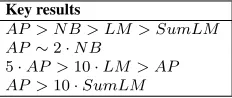
Our key results of the fair comparison of the four algorithms are shown in Fig. 1 and summarized in Table 4. The table shows that AP trained on5·106
preposition contexts performs as well as NB trained on 107 (i.e., with twice as much data; the perfor-mance of LM trained on107 contexts is better than that of AP trained with 10 times less data (106), but not as good as that of AP trained with half as much data (5·106); AP outperforms SumLM, when the lat-ter uses 10 times more data. Fig. 1 demonstrates the performance results reported in Table 4; it shows the behavior of different systems with respect to preci-sionandrecallon the error correction task. We gen-erate the curves by varying the decision threshold on the confidence of the classifier (Carlson et al., 2001) and propose a correction only when the confidence of the classifier is above the threshold. A higher pre-cision and a lower recall are obtained when the de-cision threshold is high, and vice versa.
Key results
AP > N B > LM > SumLM AP ∼2·N B
5·AP >10·LM > AP AP >10·SumLM
Table 4:Key results on the comparison of algorithms.
2·N Brefers toN Btrained with twice as much data as
AP;10·LM refers toLM trained with 10 times more
data asAP;10·SumLMrefers toSumLMtrained with
10 times more data asAP. These results are also shown
in Fig. 1.
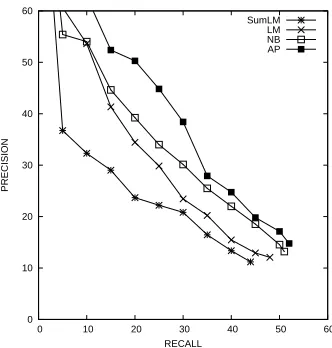
We now show a fair comparison of the four algo-rithms for different window sizes, training data and training sizes. Figure 2 compares the models trained onW ikiN Y T-107 corpus for Win4. AP is the su-perior model, followed by NB, then LM, and finally SumLM.
Results for other training sizes and feature10 set
9
Scaling downGoogleW ebintroduces some bias but we be-lieve that it should not have an effect on our experiments.
10
[image:5.612.369.485.411.460.2]0 10 20 30 40 50 60
0 10 20 30 40 50 60
PRECISION
RECALL
[image:6.612.333.499.53.227.2]SumLM-107 LM-107 NB-107 AP-106 AP-5*106 AP-107
Figure 1: Algorithm comparison across different
training sizes. (WikiNYT, Win3). AP (106 preposition
contexts) performs as well as SumLM with 10 times more data, and LM requires at least twice as much data to achieve the performance of AP.
configurations show similar behavior and are re-ported in Table 5, which provides model compari-son in terms ofAverage Area Under Curve(AAUC, (Hanley and McNeil, 1983)). AAUC is a measure commonly used to generate a summary statistic and is computed here as an average precision value over 12 recall points (from 5 to 60):
AAU C= 1
12 ·
12 X
i=1
P recision(i·5)
The Table also shows results on thearticle correc-tion task11.
Training data Feature Performance (AAU C) set AP NB LM SumLM
W ikiN Y T-5·106 W in3 26 22 20 13
W ikiN Y T-107 W in4 33 28 24 16
GoogleW eb-108 W in2 30 29 28 15
GoogleW eb W in4 - 44 41 32 Article
W ikiN Y T-5·106 W in3 40 39 - 30
Table 5: Performance Comparison of the four
algo-rithms for different training data, training sizes, and win-dow sizes. Each row shows results for training data of the
same size. The last row shows performance on thearticle
correctiontask. All other results are for prepositions.
11We do not evaluate the LM approach on the article
correc-tion task, since with LM it is difficult to handle missing article errors, one of the most common error types for articles, but the expectation is that it will behave as it does for prepositions.
0 10 20 30 40 50 60
0 10 20 30 40 50 60
PRECISION
RECALL
SumLM LM NB AP
Figure 2: Model Comparison for training data of the
same size: Performance of models for feature setWin4
trained onW ikiN Y T-107.
3.3.1 Effects of Window Size
We found that expanding window size from 2 to 3 is helpful for all of the models, but expanding win-dow to 4 is only helpful for the models trained on
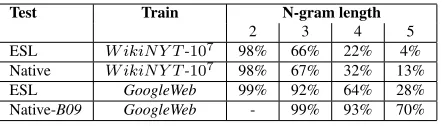
GoogleWeb(Table 6). Compared toWin3,Win4has five additional 5-gram features. We look at the pro-portion of features in the ESL data that occurred in two corpora: W ikiN Y T-107 and GoogleWeb (Ta-ble 7). We observe that only 4% of test 5-grams oc-cur inW ikiN Y T-107. This number goes up 7 times to 28% forGoogleWeb, which explains why increas-ing the window size is helpful for this model. By comparison, a set of native English sentences (dif-ferent from the training data) has 50% more 4-grams and about 3 times more 5-grams, because ESL sen-tences often contain expressions not common for na-tive speakers.
Training data Performance (AAU C) Win2 Win3 Win4
[image:6.612.92.262.55.226.2]GoogleW eb 35 39 44
Table 6:Effect of Window Sizein terms ofAAU C.
Per-formance improves, as the window increases.
4 Adapting to Writer’s Source Language
[image:6.612.74.299.497.579.2]Test Train N-gram length
2 3 4 5
ESL W ikiN Y T-107 98% 66% 22% 4%
Native W ikiN Y T-107 98% 67% 32% 13%
[image:7.612.78.299.68.131.2]ESL GoogleWeb 99% 92% 64% 28% Native-B09 GoogleWeb - 99% 93% 70%
Table 7: Feature coverage for ESL and native data.
Percentage of test n-gram features that occurred in train-ing.Nativerefers to data from Wikipedia and NYT.B09
refers to statistics from Bergsma et al. (2009).
Roth, 2010a). For instance, a Chinese learner of English might say “congratulationstothis achieve-ment” instead of “congratulationson this achieve-ment”, while a Russian speaker might say “congrat-ulationswiththis achievement”.
A system performs much better when it makes use of knowledge about typical errors. When trained on annotated ESL data instead of native data, sys-tems improve both precision and recall (Han et al., 2010; Gamon, 2010). Annotated data include both the writer’s preposition and the intended (correct) one, and thus the knowledge about typical errors is made available to the system.
Another way to adapt a model to the first language is to generate in native training data artificial errors mimicking the typical errors of the non-native writ-ers (Rozovskaya and Roth, 2010c; Rozovskaya and Roth, 2010b). Henceforth, we refer to this method, proposed within the discriminative framework AP, asAP-adapted. To determine typical mistakes, error statistics are collected on a small set of annotated ESL sentences. However, for the model to use these language-specific error statistics, a separate classi-fier for each source language needs to be trained.
We propose a novel adaptation method, which shows performance improvement overAP-adapted. Moreover, this method is much simpler to imple-ment, since there is no need to train per source lan-guage; only one classifier is trained. The method relies on the observation that error regularities can be viewed as adistribution on priors over the cor-rection candidates. Given a prepositionsin text, the
priorfor candidatepis the probability thatpis the correct preposition fors. If a model is trained on na-tive data without adaptation to the source language, candidate priors correspond to the relative frequen-cies of the candidates in the native training data. More importantly, these priors remain the same
re-gardless of the source language of the writer or of the preposition used in text. From the model’s per-spective, it means that a correction candidate, for exampleto, is equally likely given that the author’s preposition isfororfrom, which is clearly incorrect and disagrees with the notion that errors are regular and language-dependent.
We use the annotated ESL data and define
adapted candidate priors that are dependent on the author’s preposition and the author’s source lan-guage. Lets be a preposition appearing in text by a writer of source language L1, andp a correction candidate. Then theadaptedprior ofpgivensis:
prior(p, s, L1) = CL1(s, p)
CL1(s) ,
where CL1(s) denotes the number of times s
ap-peared in the ESL data byL1writers, andCL1(s, p)
denotes the number of timespwas the correct prepo-sition whenswas used by anL1writer.
Table 8 shows adapted candidate priors for two author’s choices – when an ESL writer usedonand
at– based on the data from Chinese learners. One key distinction of the adapted priors is the high prob-ability assigned to the author’s preposition: the new prior forongiven that it is also the preposition found in text is0.70, vs. the0.07prior based on the native data. The adapted prior of prepositionp, whenpis used, is always high, because the majority of prepo-sitions are used correctly. Higher probabilities are also assigned to those candidates that are most often observed as corrections for the author’s preposition. For example, the adapted prior foratwhen the writer choseonis 0.10, since onis frequently incorrectly chosen instead ofat.
To determine a mechanism to inject the adapted priors into a model, we note that while all of our models use priors in some way, NB architecture di-rectly specifies the prior probability as one of its pa-rameters (Sec. 2.3). We thus train NB in a traditional way, on native data, and then replace the prior com-ponent in Eq. (3) with the adapted prior, language and preposition dependent, to get the score forpof theNB-adaptedmodel:
g(S, p) =log{prior(p, s, L1)· Y
f∈F(S,p)
Candidate Global Adapted prior
[image:8.612.329.501.60.231.2]prior author’s prior author’s prior choice choice of 0.25 on 0.03 at 0.02 to 0.22 on 0.06 at 0.00 in 0.15 on 0.04 at 0.16 for 0.10 on 0.00 at 0.03 on 0.07 on 0.70 at 0.09 by 0.06 on 0.00 at 0.02 with 0.06 on 0.04 at 0.00 at 0.04 on 0.10 at 0.75 from 0.04 on 0.00 at 0.02 about 0.01 on 0.03 at 0.00
Table 8: Examples of adapted candidate priors for
two author’s choices –onand at– based on the
er-rors made by Chinese learners. Global prior denotes
the probability of the candidate in the standard model and is based on the relative frequency of the candidate
in native training data. Adapted priorsare dependent on
the author’s preposition and the author’s first language. Adapted priors for the author’s choice are very high. Other candidates are given higher priors if they often ap-pear as corrections for the author’s choice.
We stress that in the new method there is no need to train per source language, as with previous adap-tion methods. Only one model is trained, and only at decision time, we change the prior probabilities of the model. Also, while we need a lot of data to train the model, only one parameter depends on annotated data. Therefore, with rather small amounts of data, it is possible to get reasonably good estimates of these prior parameters.
In the experiments below, we compare four mod-els: AP, NB AP-adapted and NB-adapted. AP-adapted is the adaptation through artificial errors andNB-adaptedis the method proposed here. Both of the adapted models use the same error statistics in k-fold cross-validation (CV): We randomly partition the ESL data intok parts, with each part tested on the model that uses error statistics estimated on the remainingk−1parts. We also remove all prepo-sition errors that occurred only once (23% of all er-rors) to allow for a better evaluation of the adapted models. Although we observe similar behavior on all the data, the models especially benefit from the adapted priors when a particular error occurred more than once. Since the majority of errors are not due to chance, we focus on those errors that the writers will make repeatedly.
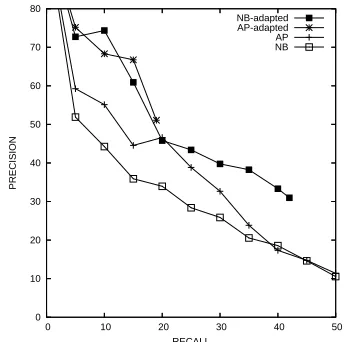
Fig. 3 shows the four models trained on W ikiN Y T-107. First, we note that the adapted
0 10 20 30 40 50 60 70 80
0 10 20 30 40 50
PRECISION
RECALL
NB-adapted AP-adapted AP NB
Figure 3:Adapting to Writer’s Source Language.
NB-adaptedis the method proposed here. AP-adaptedand
NB-adaptedresults are obtained using 2-fold CV, with 50% of the ESL data used for estimating the new priors. All models are trained onW ikiN Y T-107.
models outperform their non-adapted counterparts with respect to precision. Second, for the recall points less than 20%, the adapted models obtain very similar precision values. This is interesting, espe-cially becauseNBdoes not perform as well asAP, as we also showed in Sec. 3.3. Thus,NB-adapted not only improves overNB, but its gap compared to the latter is much wider than the gap between the AP-based systems. Finally, an important performance distinction between the two adapted models is the loss in recall exhibited byAP-adapted – its curve is shorter becauseAP-adaptedis very conservative and does not propose many corrections. In contrast, NB-adaptedsucceeds in improving its precision overNB
with almost no recall loss.
To evaluate the effect of the size of the data used to estimate the new priors, we compare the perfor-mance ofNB-adapted models in three settings: 2-fold CV,10-fold CV, andLeave-One-Out(Figure 4). In2-fold CV, priors are estimated on 50% of the ESL data, in10-fold on 90%, and inLeave-One-Outon all data but the testing example. Figure 4 shows the averaged results over 5 runs of CV for each setting. The model converges very quickly: there is almost no difference between 10-fold CV and Leave-One-Out, which suggests that we can get a good estimate of the priors using just a little annotated data.
[image:8.612.81.295.62.190.2]0 10 20 30 40 50 60 70 80 90
0 10 20 30 40 50 60
PRECISION
RECALL
[image:9.612.94.261.65.236.2]NB-adapted-LeaveOneOut NB-adapted-10-fold NB-adapted-2-fold NB
Figure 4: How much data are needed to estimate
adapted priors. Comparison of NB-adapted models
trained onGoogleWebthat use different amounts of data
to estimate the new priors. In2-fold CV, priors are
es-timated on 50% of the data; in10-fold on 90% of the
data; inLeave-One-Out, the new priors are based on all
the data but the testing example.
GoogleW eb is several orders of magnitude larger, the adapted model behaves better for this corpus.
So far, we have discussed performance in terms of precision and recall, but we can also discuss it in terms of accuracy, to see how well the algorithm is performing compared to thebaselineon the task. Following Rozovskaya and Roth (2010c), we con-sider as the baseline the accuracy of the ESL data before applying the model12, or the percentage of prepositions used correctly in the test data. From Table 3, the baseline is 93.44%13. Compared to this high baseline, NB trained on W ikiN Y T-107 achieves an accuracy of 93.54, and NB-adapted
achieves an accuracy of93.9314.
Training data Algorithms NB NB-adapted
W ikiN Y T-107 29 53
GoogleW eb 38 62
Table 9: Adapting to writer’s source language.
Re-sults are reported in terms ofAAU C.NB-adaptedis the
model with adapted priors. Results forNB-adaptedare
based on 10-fold CV.
12
Note that this baseline is different from themajority base-line used in the prepositionselectiontask, since here we have the author’s preposition in text.
13This is the baseline after removing the singleton errors. 14
We select the best accuracy among different values that can be achieved by varying the decision threshold.
5 Conclusion
We have addressed two important issues in ESL error correction, which are essential to making progress in this task. First, we presented an exten-sive, fair comparison of four popular linear learning models for the task and demonstrated that there are significant performance differences between the ap-proaches. Since all of the algorithms presented here are linear, the only difference is in how they learn the weights. Our experiments demonstrated that the discriminative approach (AP) is able to generalize better than any of the other models. These results correct earlier conclusions, made with incompara-ble data sets. The model comparison was performed using two popular tasks – correcting errors in article and preposition usage – and we expect that our re-sults will generalize to other ESL correction tasks.
The second, and most important, contribution of the paper is a novel method that allows one to adapt the learned model to the source language of the writer. We showed that error patterns can be viewed as a distribution on priors over the correc-tion candidates and proposed a method of injecting the adapted priors into the learned model. In ad-dition to performing much better than the previous approaches, this method is also very cheap to im-plement, since it does not require training a separate model for each source language, but adapts the sys-tem to the writer’s language at decision time.
Acknowledgments
The authors thank Nick Rizzolo for many helpful discussions. The authors also thank Josh Gioja, Nick Rizzolo, Mark Sammons, Joel Tetreault, Yuancheng Tu, and the anonymous reviewers for their insight-ful comments. This research is partly supported by a grant from the U.S. Department of Education.
References
S. Bergsma, D. Lin, and R. Goebel. 2009. Web-scale
n-gram models for lexical disambiguation. In21st
In-ternational Joint Conference on Artificial Intelligence, pages 1507–1512.
J. Bitchener, S. Young, and D. Cameron. 2005. The ef-fect of different types of corrective feedback on ESL
student writing.Journal of Second Language Writing.
[image:9.612.118.257.538.579.2]National Conference on Innovative Applications of Ar-tificial Intelligence (IAAI), pages 45–50.
Y. S. Chan and H. T. Ng. 2005. Word sense
disambigua-tion with distribudisambigua-tion estimadisambigua-tion. In Proceedings of
IJCAI 2005.
S. Chen and J. Goodman. 1996. An empirical study of
smoothing techniques for language modeling. In
Pro-ceedings of ACL 1996.
M. Chodorow, J. Tetreault, and N.-R. Han. 2007. Detec-tion of grammatical errors involving preposiDetec-tions. In
Proceedings of the Fourth ACL-SIGSEM Workshop on Prepositions, pages 25–30, Prague, Czech Republic, June. Association for Computational Linguistics.
G. Dalgish. 1985. Computer-assisted ESL research.
CALICO Journal, 2(2).
J. Eeg-Olofsson and O. Knuttson. 2003. Automatic
grammar checking for second language learners - the
use of prepositions. Nodalida.
A. Elghaari, D. Meurers, and H. Wunsch. 2010. Ex-ploring the data-driven prediction of prepositions in
english. In Proceedings of COLING 2010, Beijing,
China.
R. De Felice and S. Pulman. 2008. A classifier-based ap-proach to preposition and determiner error correction
in L2 English. InProceedings of the 22nd
Interna-tional Conference on ComputaInterna-tional Linguistics (Col-ing 2008), pages 169–176, Manchester, UK, August. Y. Freund and R. E. Schapire. 1999. Large margin
clas-sification using the perceptron algorithm. Machine
Learning, 37(3):277–296.
M. Gamon, J. Gao, C. Brockett, A. Klementiev, W. Dolan, D. Belenko, and L. Vanderwende. 2008. Using contextual speller techniques and language
modeling for ESL error correction. InProceedings of
IJCNLP.
M. Gamon. 2010. Using mostly native data to correct
errors in learners’ writing. InNAACL, pages 163–171,
Los Angeles, California, June.
A. R. Golding and D. Roth. 1999. A Winnow based
approach to context-sensitive spelling correction.
Ma-chine Learning, 34(1-3):107–130.
N. Han, M. Chodorow, and C. Leacock. 2006. Detecting errors in English article usage by non-native speakers.
Journal of Natural Language Engineering, 12(2):115– 129.
N. Han, J. Tetreault, S. Lee, and J. Ha. 2010.
Us-ing an error-annotated learner corpus to develop and
ESL/EFL error correction system. In LREC, Malta,
May.
J. Hanley and B. McNeil. 1983. A method of comparing the areas under receiver operating characteristic curves
derived from the same cases. Radiology, 148(3):839–
843.
E. Izumi, K. Uchimoto, T. Saiga, T. Supnithi, and H. Isa-hara. 2003. Automatic error detection in the Japanese
learners’ English spoken data. InThe Companion
Vol-ume to the Proceedings of 41st Annual Meeting of the Association for Computational Linguistics, pages 145–148, Sapporo, Japan, July.
C. Leacock, M. Chodorow, M. Gamon, and J. Tetreault. 2010. Morgan and Claypool Publishers.
J. Lee and S. Seneff. 2008. An analysis of grammatical
errors in non-native speech in English. InProceedings
of the 2008 Spoken Language Technology Workshop. V. Punyakanok, D. Roth, and W. Yih. 2008. The
impor-tance of syntactic parsing and inference in semantic
role labeling.Computational Linguistics, 34(2).
N. Rizzolo and D. Roth. 2007. Modeling Discriminative
Global Inference. InProceedings of the First
Inter-national Conference on Semantic Computing (ICSC), pages 597–604, Irvine, California, September. IEEE. D. Roth. 1998. Learning to resolve natural language
am-biguities: A unified approach. InProceedings of the
National Conference on Artificial Intelligence (AAAI), pages 806–813.
D. Roth. 1999. Learning in natural language. InProc. of
the International Joint Conference on Artificial Intelli-gence (IJCAI), pages 898–904.
A. Rozovskaya and D. Roth. 2010a. Annotating ESL
errors: Challenges and rewards. InProceedings of the
NAACL Workshop on Innovative Use of NLP for Build-ing Educational Applications.
A. Rozovskaya and D. Roth. 2010b. Generating con-fusion sets for context-sensitive error correction. In
Proceedings of the Conference on Empirical Methods in Natural Language Processing (EMNLP).
A. Rozovskaya and D. Roth. 2010c. Training paradigms
for correcting errors in grammar and usage. In
Pro-ceedings of the NAACL-HLT.
A. Stolcke. 2002. Srilm-an extensible language
mod-eling toolkit. In Proceedings International
Confer-ence on Spoken Language Processing, pages 257–286, November.
J. Tetreault and M. Chodorow. 2008. The ups and
downs of preposition error detection in ESL writing. InProceedings of the 22nd International Conference on Computational Linguistics (Coling 2008), pages 865–872, Manchester, UK, August.