Morphological Richness Offsets Resource Demand- Experiences in
Constructing a POS Tagger for Hindi
Smriti Singh Kuhoo Gupta
Department of Computer Science and Engineering Indian Institute of Technology, Bombay
Powai, Mumbai 400076 Maharashtra, India
{smriti,kuhoo,manshri,pb}@cse.iitb.ac.in
Manish Shrivastava Pushpak Bhattacharyya
Abstract
In this paper we report our work on building a POS tagger for a morpholog-ically rich language- Hindi. The theme of the research is to vindicate the stand that- if morphology is strong and har-nessable, then lack of training corpora is not debilitating. We establish a method-ology of POS tagging which the re-source disadvantaged (lacking annotated corpora) languages can make use of. The methodology makes use of locally an-notated modestly-sized corpora (15,562 words), exhaustive morpohological anal-ysis backed by high-coverage lexicon and a decision tree based learning algo-rithm (CN2). The evaluation of the sys-tem was done with 4-fold cross valida-tion of the corpora in the news domain (www.bbc.co.uk/hindi). The current ac-curacy of POS tagging is 93.45% and can be further improved.
1 Motivation and Problem Definition
Part-Of-Speech (POS) tagging is a complex
task fraught with challenges like ambiguity of
parts of speech and handling of “lexical ab-sence” (proper nouns, foreign words, deriva-tionally morphed words, spelling variationsand
other unknown words) (Manning and Schutze, 2002). For English there are many POS tag-gers, employing machine learning techniques
like transformation-based error-driven learning (Brill, 1995), decision trees (Black et al., 1992), markov model (Cutting et al. 1992),
maxi-mum entropy methods (Ratnaparkhi, 1996) etc.
There are also taggers which are hybrid using both stochastic and rule-based approaches, such as CLAWS (Garside and Smith, 1997). The accuracy of these taggers ranges from 93-98% approximately. English has annotated corpora in abundance, enabling usage of powerful data driven machine learning methods. But, very few languages in the world have the resource advan-tage that English enjoys.
languages, since the former demands subtle lin-guistic expertise and the latter variously per-muted corpora.
1.1 Previous Work on Hindi POS Tagging
There is some amount of work done on morphology-based disambiguation in Hindi POS
tagging. Bharati et al. (1995) in their work
on computational Paninian parser, describe a technique where POS tagging is implicit and is
merged with the parsing phase. Rayet al.(2003)
proposed an algorithm that identifies Hindi word groups on the basis of the lexical tags of the indi-vidual words. Their partial POS tagger (as they call it) reduces the number of possible tags for a given sentence by imposing some constraints on the sequence of lexical categories that are pos-sible in a Hindi sentence. UPENN also has an
online Hindi morphological tagger1but there
ex-ists no literature discussing the performance of the tagger.
1.2 Our Approach
We present in this paper a POS tagger for Hindi- the national language of India, spoken by 500 million people and ranking 4th in the world. We establish a methodology of POS
tag-ging whichthe resource disadvantaged
(lack-ing annotated corpora) languages can make use of. This methodology uses locally anno-tated modestly sized corpora (15,562 words), ex-haustive morphological analysis backed by high-coverage lexicon and a decision tree based learn-ing algorithm- CN2 (Clark and Niblett, 1989). To the best of our knowledge, such an approach has never been tried out for Hindi. The heart of the system is the detailed linguistic analysis of morphosyntactic phenomena, adroit handling of suffixes, accurate verb group identification and learning of disambiguation rules.
The approach can be used for other inflec-tional languages by providing the language spe-cific resources in the form of suffix replacement rules (SRRs), lexicon, group identification and
morpheme analysis rules etc. and keeping the
1http://ccat.sas.upenn.edu/plc/tamilweb/hindi.html
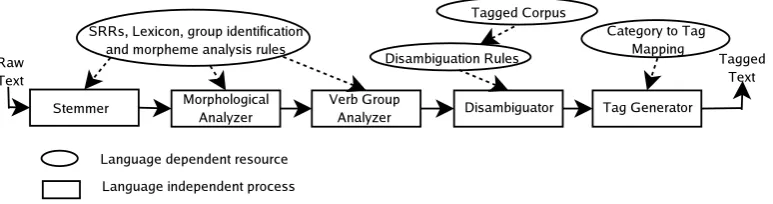
processes the same as shown in Figure 1. The similar kind of work exploiting morphological information to assign POS tags is under progress for Marathi which is also an Indian language.
In what follows, we discuss in section 2 the challenges in Hindi POS tagging followed by a section on morphological structure of Hindi. Section 4 presents the design of Hindi POS tag-ger. The experimental setup and results are given in sections 5 and 6. Section 7 concludes the pa-per.
2 Challenges of POS Tagging in Hindi
The inter-POS ambiguity surfaces when a word or a morpheme displays an ambiguity across POS categories. Such a word has multiple en-tries in the lexicon (one for each category). After stemming, the word would be assigned all pos-sible POS tags based on the number of entries it has in the lexicon. The complexity of the task can be understood looking at the following En-glish sentence where the word ‘back’ falls into three different POS
categories-“I get back to the back seat to give rest to my back.”
The complexity further increases when it comes to tagging a free-word order language like Hindi where almost all the permutations of words in a clause are possible (Shrivastava et al., 2005). This phenomenon in the language, makes the task of a stochastic tagger difficult.
Intra-POS ambiguity arises when a word has
one POS with different feature values, e.g., the
word ‘
’ {laDke} (boys/boy) in Hindi is a
noun but can be analyzed in two ways in terms of its feature values:
1. POS:Noun,Number: Sg,Case: Oblique
.
maine laDke ko ek aam diyaa. I-erg boy to one mango gave.
I gave a mango to the boy.
2. POS:Noun,Number: Pl,Case:Direct
! "#$
.
laDke aam khaate hain. Boys mangoes eat.
One of the difficult tasks here is to choose the appropriate tag based on the morphology of the word and the context used. Also, new words ap-pear all the time in the texts. Thus, a method for determining the tag of a new word is needed when it is not present in the lexicon. This is done using context information and the informa-tion coded in the affixes, as affixes in Hindi (es-pecially in nouns and verbs) are strong indica-tors of a word’s POS category. For example, it
is possible to determine that the word ‘%
&'
’
{jaaegaa}(will go) is a verb, based on the
envi-ronment in which it appears and the knowledge
that it carries the inflectional suffix -&'
{egaa}
that attaches to the base verb ‘%
’{jaa}.
2.1 Ambiguity Schemes
The criterion to decide whether the tag of a word
is aNounor aVerbis entirely different from that
of whether a word is anAdjectiveor anAdverb.
For example, the word ‘(*) ’ can occur as
con-junction,post-position or anoun(as shown
pre-viously), hence it falls in an Ambiguity Scheme
‘Conjunction-Noun-Postposition’. We grouped all the ambiguous words into sets according to theAmbiguity Schemesthat are possible in Hindi,
e.g., Adjective-Noun, Adjective-Adverb,
Noun-Verb, etc. This idea was first proposed by
Or-phanoset al. (1999) for Modern Greek POS
tag-ging.
3 Morphological Structure Of Hindi
In Hindi, Nouns inflect for number and case.
To capture their morphological variations, they
can be categorized into various paradigms2
(Narayana, 1994) based on their vowel ending,
gender, numberandcase information. We have a list of around 29,000 Hindi nouns that are
catego-rized into such paradigms3. Looking at the
mor-phological patterns of the words in a paradigm, suffix-replacement rules have been developed. These rules help in separating out a valid suffix
2A paradigm systematically arranges and identifies the
uninflected forms of the words that share similar inflec-tional patterns.
3Anusaaraka system developed at IIT Kanpur (INDIA)
uses similar noun sets in the form of paradigms
from an inflected word to output the correct stem and consequently, get the correct root.
Hindi Adjectives may be inflected or
unin-flected, e.g., ‘+
-,.
’ {chamkiilaa} (shiny),
‘/102
’{acchaa}(nice), ‘354*
’{lambaa}(long)
inflect based on the number and case values of
their head nouns while ‘67
8
) ’ {sundar}
(beauti-ful), ‘9
)
,
’{bhaarii}(heavy) etc. do not inflect.
HindiVerbsinflect for the following
grammat-ical properties (GNPTAM):
1. Gender: Masculine, Feminine,
Non-specific
2. Number: Singular, Plural, Non-specific
3. Person: 1st, 2nd and 3rd
4. Tense: Past, Present, Future
5. Aspect: Perfective, Completive, Frequenta-tive, Habitual, DuraFrequenta-tive, IncepFrequenta-tive, Stative
6. Modality: Imperative, Probabilitive, Sub-junctive, Conditional, Deontic, Abilitive, Permissive
The morphemes attached to a verb along with their corresponding analyses help identify values for GNPTAM features for a given verb form.
Division of Information Load in Hindi Verb Groups
A Verb Group (VG) primarily comprises main verb and auxiliaries. Constituents like particles,
negation markers, conjunction, etc. can also
occur within a VG. It is important to know how much of GNPTAM feature information is stored in VG constituents individually and what is the load division in the absence or presence of auxil-iaries. In a Hindi VG, when there is no auxiliary present, the complete information load falls on the main verb which carries information for GNPTAM features. In presence of auxiliaries, the load gets shared between the main verb and auxiliaries, and is represented in the form of different morphemes (inflected or uninflected),
4*
(
)
#:;#<=
main bol paa rahaa hoon
I am able to speak
1. Main verb ‘4*
’ {bol} is uninflected and
does not carry any information for any of the GNPTAM features.
2. ‘(
’{paa}is uninflected and gives modality
information,i.e., Abilitive.
3. ‘) #:
’ {rahaa} gives Number (Sg), Gender
(Masculine), Aspect (Durative) 4. ‘#<=
’ {hoon} gives Number (Sg), Person
(1st), Tense (Present)
Gerund Identification
In Hindi, the attachment of verbal suffixes like
‘
’ {naa} and ‘
’ {ne} to a verb root results
either in a gerund like ‘"
)
’ {tairnaa}
(swim-ming)or in an infinitival verb form like ‘"
)
’
{tairnaa}(to swim). We observed that it is easy
to detect a gerund if it is followed by a case-marker or by any other infinitival verb form.
4 Design of Hindi POS Tagger
4.1 Morphology Driven Tagger
Morphology driven tagger makes use of the affix information stored in a word and assigns a POS tag using no contextual information. Though, it does take into account the previous and the next word in a VG to correctly identify the main verb and the auxiliaries, other POS categories are identified through lexicon lookup of the root
form. The current lexicon4 has around 42,000
entries belonging to the major categories as men-tioned in Figure 3. The format of each entry is
hwordi,hparadigmi,hcategoryi.
The process does not involve learning or dis-ambiguation of any sort and is completely driven by hand-crafted morphology rules. The architec-ture of the tagger is shown in Figure 1. The work progresses at two levels:
4The lexicon was developed
us-ing the wordlist from Hindi Wordnet (http://www.cfilt.iitb.ac.in/wordnet/webhwn/) and par-tial noun list from Anusaraka. It is being enhanced by adding new words from the corpus and removing the inconsistencies.
1. At Word Level: Astemmeris used in con-junction with lexicon and Suffix Replace-ment Rules (SRRs) to output all possible root-suffix pairs along with POS category label for a word. There is a possibility that the input word is not found in the lexicon and does not carry any inflectional suffix. In
such a case,derivational morphology rules
are applied.
2. At Group Level: At this level a Morpho-logical Analyzer(MA) uses the information encoded in the extracted suffix to add mor-phological information to the word. For nouns, the information provided by the
suf-fixes is restricted only to ‘Number’. ‘Case’
can be inferred later by looking at the neigh-bouring words.
For verbs, GNP values are found at the word level, while TAM values are identified dur-ing the VG Identification phase, described later. The analysis of the suffix is done in
a discrete manner, i.e., each component of
the suffix is analyzed separately. A mor-pheme analysis table comprising individ-ual morphemes with their paradigm infor-mation and analyses is used for this
pur-pose. MA’s output for the word >?8&@,
{khaaoongii}(will eat)looks like
-Stem: (eat)
Suffix:?5&,
Category:Verb
Morpheme 1:?
Analysis: 1 Per, Sg
Morpheme 2:&
Analysis: Future
Morpheme 3:A Analysis: Feminine
4.1.1 Verb Group Identification
The structure of a Hindi VG is relatively rigid and can be captured well using simple
syntac-tic rules. In Hindi, certain auxiliaries like ’)
#
’
{rah}, ’(
’ {paa}, ’6
’, {sak} or ’(
’ {paD}
con-Figure 1: Overall Architecture of the Tagger
Table 1: Average Accuracy(%) Comparison of Various Approaches
LLB LLBD MD BL LB
61.19 86.77 73.62 82.63 93.45
struct an auxiliary till a non-VG constituent is en-countered. Main verb and copula verb can take the head position of a VG and can occur with or without auxiliary verbs. Auxiliary verbs, on the other hand, always come along with a main verb or a copula verb. This results in a very high ac-curacy of 99.5% for verb auxiliaries. Ambiguity between a main verb and a copula verb remains unresolved at this level and asks for disambigua-tion rules.
4.2 Need for Disambiguation
The accuracy obtained by simple lexicon lookup based approach (LLB) comes out to be 61.19%. The morphology-driven tagger, on the other hand, performs better than just lexicon lookup but still results in considerable ambiguity. These results are significant as they present a strong case in favor of using detailed morphological analysis. Similar observation has been presented
by Uchimotoet al.(2001) for Japanese language.
According to the tagging performed by SRRs
and the lexicon, a word receivesn tags if it
be-longs tonPOSs. If we consider multiple tags for
a word as an error of the tagger (even when the options contain the correct tag for a word), then the accuracy of the tagger comes to be 73.62% (as shown in Table 1). The goal is to keep the
contextually appropriate tag and eliminate oth-ers which can be achieved by devising a disam-biguation technique. The disamdisam-biguation task can be naively addressed by choosing the most frequent tag for a word. This approach is also known as baseline (BL) tagging. The baseline accuracy turns out to be 82.63% which is still higher than that of the morphology-driven
tag-ger5. The drawback with baseline tagging is that
its accuracy cannot be further improved. On the other hand, there is enough room for improving upon the accuracy of morphology-driven (MD) tagger. It is quite evident that though the MD tagger works well for VG and many close cate-gories, around 30% of the words are either am-biguous or unknown. Hence, a disambiguation stage is needed to shoot up the accuracy.
The common choice for disambiguation rule learning in POS tagging task is usually ma-chine learning techniques mainly focussing on decision tree based algorithms (Orphanos and Christodoulalds, 1999), neural networks
(Schmid, 1994),etc. Among the various decision
tree based algorithms like ID3, AQR, ASSIS-TANT and CN2, CN2 is known to perform better than the rest (Clark and Niblett, 1989). Since no such machine learning technique has been used for Hindi language, we thought of choosing CN2
as it performs well on noisy data6.
5These numbers may change if we experiment on a
dif-ferent dataset
6The training annotated corpora becomes noisy by
[image:5.595.111.498.79.181.2]4.2.1 Training Corpora
We set up a corpus, collecting sentences from
BBC news site7 and let the morphology-driven
tagger assign morphosyntactic tags to all the words. For an ambiguous word, the contextually appropriate POS tag is manually chosen. Un-known words are assigned a correct tag based on their context and usage.
4.2.2 Learning
Out of the completely manually corrected cor-pora of 15,562 tokens, we created training
in-stances for eachAmbiguity Scheme and for
Un-knownwords. These training instances take into account the POS categories of the neighbouring
words and not the feature values8. The
experi-ments were carried out for different context win-dow sizes ranging from 2 to 20 to find the best configuration.
4.2.3 Rule Generation
The rules are generated from the training cor-pora by extracting the ambiguity scheme (AS) of each word. If the word is not present in the lexi-con then its AS is set as ‘unknown’. Once the AS is identified, a training instance is formed. This training instance contains the neighbouring cor-rect POS categories as attributes. The number of neighbours included in the training instance is the window size for CN2. After all the ambigu-ous words are processed and training instances for all seen ASs are created, the CN2 algorithm is applied over the training instances to gener-ate actual rule-sets for each AS. The CN2
algo-rithm gives one set of If-Then rules (either
or-dered or unoror-dered) for each AS including
‘un-known’9. The AS of every ambiguous word is
formed while tagging. A corresponding rule-set for that AS is then identified and traversed to get the contextually appropriate rule. The resultant
7http://www.bbc.co.uk/hindi/
8Considering that a tag encodes 0 to 6 morphosyntactic
features and each feature takes either one or a disjunction of 2 to 7 values, the total number of different tags can count up to several hundreds
9We used the CN2 algorithm implementation (1990)
by Robin Boswell. The software is available at ftp://ftp.cs.utexas.edu/pub/pclark/cn2.tar.Z
category outputted by this rule is then assigned to the ambiguous word. The traversal rule differs for ordered and unordered implementation. The POS of an unknown word is guessed by
travers-ing the rule-set for unknown words10and
assign-ing it the resultant tag.
5 Experimental Setup
The experimentation involved, first, identifying the best parameter values for the CN2 algorithm and second, evaluating the performance of the disambiguation rules generated by CN2 for the POS tagging task.
5.1 CN2 Parameters
The various parameters in CN2 algorithm are: rule type (ordered or unordered), star size, sig-nificance threshold and size of the training in-stances (window size). The best results are em-pirically achieved with ordered rules, star size as 1, significance threshold as 10 and window size
4,i.e., two neighbours on either side are used to
generate the training instances.
5.2 Evaluation
The tests are performed on contiguous partitions of the corpora (15,562 words) that are 75% training set and 25% testing set.
Accuracy = no. of single correct tags total no. of tokens
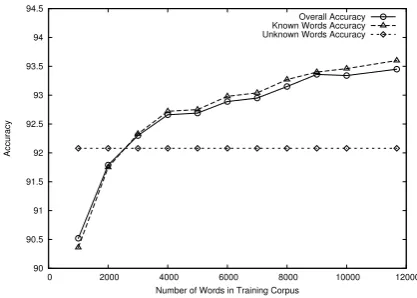
The results are obtained by performing a 4-fold cross validation over the corpora. Figure 2 gives the learning curve of the disambiguation module for varying corpora sizes starting from 1000 to the complete training corpora size. The accuracy for known and unknown words is also measured separately.
6 Results and Discussion
The average accuracy of the learning based (LB) tagger after 4-fold cross validation is 93.45%. To
10Most of the unknown words are proper nouns, which
90 90.5 91 91.5 92 92.5 93 93.5 94 94.5
0 2000 4000 6000 8000 10000 12000
Accuracy
[image:7.595.82.291.78.227.2]Number of Words in Training Corpus Overall Accuracy Known Words Accuracy Unknown Words Accuracy
Figure 2: POS Learning Curve
the best of our knowledge no comparable results have been reported so far for Hindi.
From Table 1, we can see that the disam-biguation module brings up the accuracy of sim-ple lexicon lookup based approach by around 25% (LLBD). The overall average accuracy is also brought up by around 20% by augmenting the morphology-driven (MD) tagger by a dis-ambiguation module; hence justifying our belief that a disambiguation module over a morphology driven approach yields better results.
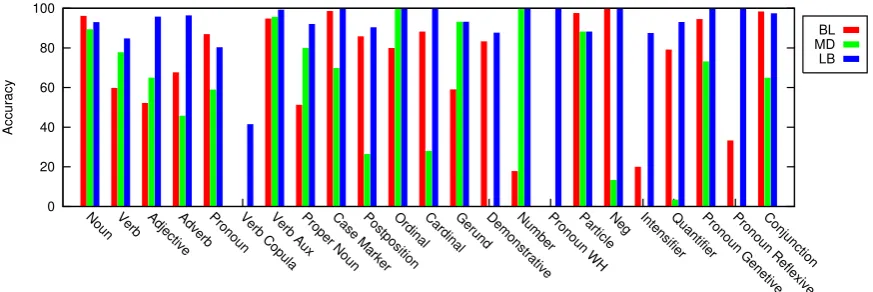
One interesting observation is the performance of the tagger on individual POS categories. Fig-ure 3 shows clearly that the per POS accuracies of the LB tagger highly exceeds those of the MD and BL tagger for most categories. This means that the disambiguation module correctly dis-ambiguates and correctly identifies the unknown words too. The accuracy on unknown words, as earlier shown in Figure 2, is very high at 92.08%. The percentage of unknown words in the test cor-pora is 0.013. It seems independent of the size of training corpus because the corpora is unbal-anced having most of the unknowns as proper nouns. The rules are formed on this bias, and hence the application of these rules assigns PPN tag to an unknown which is mostly the case.
From Figure 3 again we see that the accuracy on some categories remains very low even after disambiguation. This calls for some detailed fail-ure analysis. By looking at the categories hav-ing low accuracy, such as pronoun, intensifier,
demonstratives and verb copula, we find that all of them are highly ambiguous and, almost invari-ably, very rare in the corpus. Also, most of them are hard to disambiguate without any semantic information.
7 Conclusions & Future Work
We have described in this paper a POS tagger for Hindi which can overcome the handicap of anno-tated corpora scarcity by exploiting the rich mor-phology of the language and the relatively rigid word-order within a VG. The whole work was driven by hunting down the factors that lower the
accuracy ofVerbsand weeding them out. A
de-tailed study of accuracy distribution across the POS tags pointed out the cases calling for elab-orate disambiguation rules. A major strength of the work is the learning of disambiguation rules, which otherwise would have been hand-coded, thus demanding exhaustive analysis of language phenomena. Attaining an accuracy of close to 94%, from a corpora of just about 15,562 words
lends credence to the belief that “morphological
richness can offset resource scarcity”. The work could lead such efforts of POS tag building for all those languages which have rich morphology, but cannot afford to invest a lot in creating large annotated corpora.
Several interesting future directions suggest themselves. It will be worthwhile to investigate a statistical approach like Conditional Random Fields in which the feature functions would be constructed from morphology. The next logi-cal step from the POS tagger is a chunker for Hindi. In fact a start on this has already been made through VG identification.
References
A. Ratnaparakhi. 1996. A Maximum Entropy
Part-Of-Speech Tagger.EMNLP 1996
A. Bharati, V. Chaitanya, R. Sangal 1995. Natural
Language Processing : A Paninian Perspective.
Prentice Hall India.
A. Kuba, A. Hcza, J. Csirik 2004. POS Tagging of Hungarian with Combined Statistical and
0 20 40 60 80 100
Conjunction Pronoun Reflexive Pronoun Genetive Quantifier Intensifier Neg Particle Pronoun WH Number Demonstrative Gerund Cardinal Ordinal Postposition Case Marker Proper Noun Verb Aux Verb Copula Pronoun Adverb Adjective Verb Noun
Accuracy
[image:8.595.84.521.81.227.2]BL MD LB
Figure 3: Per-POS Accuracy Distribution
B. Megyesi. 1999. Improving Brill’s POS tagger for
an agglutinative language. Joint Sigdat
Confer-ence EMNLP/VLC 1999.
C. D. Manning and H. Schutze. 2002. Foundations
of Statistical Natural Language Processing, MIT
Press 2002.
D. Cutting et al. 1992. A practical part-of-speech
tagger.In Proc. of the Third Conf. on Applied
Nat-ural Language Processing. ACL 1992.
E. Brill. 1995. Transformation-Based Error Driven Learning and Natural Language Processing: A
Case Study in Part-of-Speech Tagging.
Compu-tational Linguistics 21(94): 543-566. 1995.
E. Black et al. 1992.Decision tree models applied to
the labeling of text with parts-of-speech. In Darpa
Workshop on Speech and Natural Language 1992. G. Leech, R. Garside and M. Bryant. 1992.
Auto-matic POS-Tagging of the corpus. BNC2
POS-tagging Manual.
G. Orphanos, D. Kalles, A. Papagelis, D. Christodoulakis. 1999 Decision trees and NLP:
A Case Study in POS Tagging. In proceedings of
ACAI 1999.
H. Schmid 1994Part-of-Speech Tagging with Neural
Networks. In proceedings of COLING 1994.
J. Hajic, P. Krbec, P. Kveton, K. Oliva, V. Petkevic
2001 A Case Study in Czech Tagging. In
Pro-ceedings of the 39th Annual Meeting of the ACL 2001
K. Uchimoto, S. Sekine, H. Isahara. 2001. The Un-known Word Problem: a Morphological Analysis of Japanese Using Maximum Entropy Aided by a
Dictionary. In Proceedings of the Conference on
EMNLP 2001
K. Oflazer and I. Kuruoz. 1994. Tagging and
mor-phological disambiguation of Turkish text. In
Pro-ceedings of the 4 ACL Conference on Applied Nat-ural Language Processing Conference 1994 M. Shrivastava, N. Agrawal, S. Singh, P.
Bhat-tacharya. 2005. Harnessing Morphological
Anal-ysis in POS Tagging Task. In Proceedings of the
ICON 2005
P. R. Ray , V. Harish, A. Basu and S. Sarkar 2003.
Part of Speech Tagging and Local Word Group-ing Techniques for Natural Language ParsGroup-ing in
Hindi. In Proceedings of ICON 2003
P. Clark and T. Niblett 1989. The CN2 Induction
Algorithm. Journal of Machine Learning, vol(3),
pages 261-283, 1989
R. Garside, N. Smith 1997. A hybrid grammatical
tagger: CLAWS4. In R. Garside, G. Leech, A.
McEnery (eds.) Corpus annotation: Linguistic in-formation from computer text corpora. Longman. Pp. 102-121.
C. Samuelsson and A. Voutilainen 1997.
Compar-ing a LCompar-inguistic and a Stochastic Tagger.In Procs.
Joint 35th Annual Meeting of the ACL and 8th Conference of the European Chapter of the ACL 1997.
Y. Tlili-Guiassa 2006. Hybrid Method for Tagging
Arabic Text. Journal of Computer Science 2 (3):