Using Conditional Random Fields to Predict Pitch Accents in
Conversational Speech
Michelle L. Gregory
Linguistics Department University at Buffalo
Buffalo, NY 14260
Yasemin Altun
Department of Computer Science Brown University
Providence, RI 02912
Abstract
The detection of prosodic characteristics is an im-portant aspect of both speech synthesis and speech recognition. Correct placement of pitch accents aids in more natural sounding speech, while automatic detection of accents can contribute to better word-level recognition and better textual understanding. In this paper we investigate probabilistic, contex-tual, and phonological factors that influence pitch accent placement in natural, conversational speech in a sequence labeling setting. We introduce Con-ditional Random Fields (CRFs) to pitch accent pre-diction task in order to incorporate these factors ef-ficiently in a sequence model. We demonstrate the usefulness and the incremental effect of these fac-tors in a sequence model by performing experiments on hand labeled data from the Switchboard Corpus. Our model outperforms the baseline and previous models of pitch accent prediction on the Switch-board Corpus.
1 Introduction
The suprasegmental features of speech relay critical information in conversation. Yet, one of the ma-jor roadblocks to natural sounding speech synthe-sis has been the identification and implementation of prosodic characteristics. The difficulty with this task lies in the fact that prosodic cues are never ab-solute; they are relative to individual speakers, gen-der, dialect, discourse context, local context, phono-logical environment, and many other factors. This is especially true of pitch accent, the acoustic cues that make one word more prominent than others in an utterance. For example, a word with a fundamen-tal frequency (f0) of 120 Hz would likely be quite prominent in a male speaker, but not for a typical fe-male speaker. Likewise, the accent on the utterance ”Jon’s leaving.” is critical in determining whether it is the answer to the question ”Who is leaving?” (”JON’s leaving.”) or ”What is Jon doing?” (”Jon’s LEAVING.”). Accurate pitch accent prediction lies in the successful combination of as many of the
con-textual variables as possible. Syntactic information such as part of speech has proven to be a success-ful predictor of accentuation (Hirschberg, 1993; Pan and Hirschberg, 2001). In general, function words are not accented, while content words are. Vari-ous measures of a word’s informativeness, such as the information content (IC) of a word (Pan and McKeown, 1999) and its collocational strength in a given context (Pan and Hirschberg, 2001) have also proven to be useful models of pitch accent. How-ever, in open topic conversational speech, accent is very unpredictable. Part of speech and the infor-mativeness of a word do not capture all aspects of accentuation, as we see in this example taken from Switchboard, where a function word gets accented (accented words are in uppercase):
I, I have STRONG OBJECTIONS to THAT.
Accent is also influenced by aspects of rhythm and timing. The length of words, in both number of phones and normalized duration, affect its likeli-hood of being accented. Additionally, whether the immediately surrounding words bear pitch accent also affect the likelihood of accentuation. In other words, a word that might typically be accented may be unaccented because the surrounding words also bear pitch accent. Phrase boundaries seem to play a role in accentuation as well. The first word of in-tonational phrases (IP) is less likely to be accented while the last word of an IP tends be accented. In short, accented words within the same IP are not in-dependent of each other.
(HMM) for pitch accent prediction (Pan and McK-eown, 1999; Conkie et al., 1999). Pan and McKe-own (1999) demonstrate the effectiveness of a se-quence model over a rule induction system, RIP-PER, that treats each label independently by show-ing that HMMs outperform RIPPER when the same variables are used.
Until recently, HMMs were the predominant for-malism to model label sequences. However, they have two major shortcomings. They are trained non-discriminatively using maximum likelihood es-timation to model the joint probability of the ob-servation and label sequences. Also, they require questionable independence assumptions to achieve efficient inference and learning. Therefore, vari-ables used in Hidden Markov models of pitch ac-cent prediction have been very limited, e.g. part of speech and frequency (Pan and McKeown, 1999). Discriminative learning methods, such as Maximum Entropy Markov Models (McCallum et al., 2000), Projection Based Markov Models (Punyakanok and Roth, 2000), Conditional Random Fields (Lafferty et al., 2001), Sequence AdaBoost (Altun et al., 2003a), Sequence Perceptron (Collins, 2002), Hid-den Markov Support Vector Machines (Altun et al., 2003b) and Maximum-Margin Markov Net-works (Taskar et al., 2004), overcome the limita-tions of HMMs. Among these methods, CRFs is the most common technique used in NLP and has been successfully applied to Part-of-Speech Tag-ging (Lafferty et al., 2001), Named-Entity Recog-nition (Collins, 2002) and shallow parsing (Sha and Pereira, 2003; McCallum, 2003).
The goal of this study is to better identify which words in a string of text will bear pitch accent. Our contribution is two-fold: employing new pre-dictors and utilizing a discriminative model. We combine the advantages of probabilistic, syntactic, and phonological predictors with the advantages of modeling pitch accent in a sequence labeling setting using CRFs (Lafferty et al., 2001).
The rest of the paper is organized as follows: In Section 2, we introduce CRFs. Then, we describe our corpus and the variables in Section 3 and Sec-tion 4. We present the experimental setup and report results in Section 5. Finally, we discuss our results (Section 6) and conclude (Section 7).
2 Conditional Random Fields
CRFs can be considered as a generalization of lo-gistic regression to label sequences. They define a conditional probability distribution of a label se-quenceygiven an observation sequence x. In this paper, x = (x1, x2, . . . , xn)denotes a sentence of
length nand y = (y1, y2, . . . , yn) denotes the la-bel sequence corresponding to x. In pitch accent prediction,xt is a word andyt is a binary label de-noting whetherxtis accented or not.
CRFs specify a linear discriminative function F
parameterized byΛover a feature representation of the observation and label sequence Ψ(x,y). The model is assumed to be stationary, thus the feature representation can be partitioned with respect to po-sitionstin the sequence and linearly combined with respect to the importance of each feature ψk,
de-noted by λk. Then the discriminative function can
be stated as in Equation 1:
F(x,y; Λ) =X
t
hΛ,Ψt(x,y)i (1)
Then, the conditional probability is given by
p(y|x; Λ) = 1
Z(x,Λ)F(x,y; Λ) (2)
where Z(x,Λ) = Py¯F(x,y¯; Λ) is a normaliza-tion constant which is computed by summing over all possible label sequencesy¯of the observation se-quencex.
We extract two types of features from a sequence pair:
1. Current label and information about the obser-vation sequence, such as part-of-speech tag of a word that is within a window centered at the word currently labeled, e.g. Is the current word pitch accented and the part-of-speech tag of the previous word=Noun?
2. Current label and the neighbors of that label, i.e. features that capture the inter-label depen-dencies, e.g. Is the current word pitch accented and the previous word not accented?
Since CRFs condition on the observation se-quence, they can efficiently employ feature repre-sentations that incorporate overlapping features, i.e. multiple interacting features or long-range depen-dencies of the observations, as opposed to HMMs which generate observation sequences.
In this paper, we limit ourselves to 1-order Markov model features to encode inter-label de-pendencies. The information used to encode the observation-label dependencies is explained in de-tail in Section 4.
sum of the conditional probabilities of each training label sequence yi, given the observation sequence xi, whereD ≡ {(xi,yi) :i= 1, . . . , m}. CRFs are known to overfit, especially with noisy data if not regularized. To overcome this problem, we penalize the objective function by adding a Gaussian prior (a term proportional to the squared norm||Λ||2) as suggested in (Johnson et al., 1999). Then the loss function is given as:
L(Λ;D) = −
m
X
i
logp(yi|xi; Λ) +
1 2c||Λ||
2
= −
m
X
i
F(xi,yi; Λ) + logZ(xi,Λ)
+ 1
2c||Λ|| 2
(3)
wherecis a constant.
Lafferty et al. (2001), proposed a modification of improved iterative scaling for parameter estima-tion in CRFs. However, gradient-based methods have often found to be more efficient for minimizing Equation 3 (Minka, 2001; Sha and Pereira, 2003). In this paper, we use the conjugate gradient descent method to optimize the above objective function. The gradients are computed as in Equation 4:
∇ΛL =
m
X
i
X
t
Ep[Ψt(xi,y)]−Ψt(xi,yi)
+ cΛ (4)
where the expectation is with respect to all possi-ble label sequences of the observation sequence xi and can be computed using the forward backward algorithm.
Given an observation sequence x, the best label sequence is given by:
ˆ
y= arg max
y
F(x,y; ˆΛ) (5)
where Λˆ is the parameter vector that minimizes L(Λ;D). The best label sequence can be identified by performing the Viterbi algorithm.
3 Corpus
The data for this study were taken from the Switch-board Corpus (Godfrey et al., 1992), which con-sists of 2430 telephone conversations between adult speakers (approximately 2.4 million words). Partic-ipants were both male and female and represented all major dialects of American English. We used a portion of this corpus that was phonetically hand-transcribed (Greenberg et al., 1996) and segmented
into speech boundaries at turn boundaries or pauses of more than 500 ms on both sides. Fragments con-tained seven words on average. Additionally, each word was coded for probabilistic and contextual information, such as word frequency, conditional probabilities, the rate of speech, and the canonical pronunciation (Fosler-Lussier and Morgan, 1999).
The dataset used in all analysis in this study con-sists of only the first hour of the database, comprised of 1,824 utterances with 13,190 words. These utter-ances were hand coded for pitch accent and intona-tional phrase brakes.
3.1 Pitch Accent Coding
The utterances were hand labeled for accents and boundaries according to the Tilt Intonational Model (Taylor, 2000). This model is characterized by a series of intonational events: accents and bound-aries. Labelers were instructed to use duration, am-plitude, pausing information, and changes in f0 to identify events. In general, labelers followed the ba-sic conventions of EToBI for coding (Taylor, 2000). However, the Tilt coding scheme was simplified. Accents were coded as either major or minor (and some rare level accents) and breaks were either ris-ing or fallris-ing. Agreement for the Tilt codris-ing was reported at 86%. The CU coding also used a simpli-fied EToBI coding scheme, with accent types con-flated and only major breaks coded. Accent and break coding pair-wise agreement was between 85-95% between coders, with a kappa κof 71%-74% where κ is the difference between expected agree-ment and actual agreeagree-ment.
4 Variables
The label we were predicting was a binary distinc-tion of accented or not. The variables we used for prediction fall into three main categories: syntac-tic, probabilistic variables, which include word fre-quency and collocation measures, and phonological variables, which capture aspects of rhythm and tim-ing that affect accentuation.
4.1 Syntactic variables
The only syntactic category we used was a four-way classification for hand-generated part of speech (POS): Function, Noun, Verb, Other, where Other includes all adjectives and adverbs1. Table 1 gives the percentage of accented and unaccented items by POS.
1
Accented Unaccented
Function 21% 79%
Verb 59% 41%
Noun 30% 70%
[image:4.595.352.506.70.152.2]Other 49% 51%
Table 1: Percentage of accented and unaccented items by POS.
Variable Definition Example
Unigram logp(wi) and, I
Bigram logp(wi|wi−1) roughing it
Rev Bigram logp(wi|wi+1) rid of
Joint logp(wi−1, wi) and I
Rev Joint logp(wi, wi+1) and I
Table 2: Definition of probabilistic variables.
4.2 Probabilistic variables
Following a line of research that incorporates the information content of a word as well as collo-cation measures (Pan and McKeown, 1999; Pan and Hirschberg, 2001) we have included a number of probabilistic variables. The probabilistic vari-ables we used were the unigram frequency, the pre-dictability of a word given the preceding word (bi-gram), the predictability of a word given the follow-ing word (reverse bigram), the joint probability of a word with the preceding (joint), and the joint prob-ability of a word with the following word (reverse joint). Table 2 provides the definition for these, as well as high probability examples from the cor-pus (the emphasized word being the current target). Note all probabilistic variables were inlogscale.
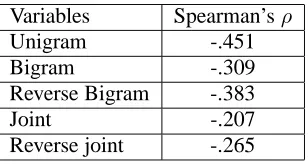
The values for these probabilities were obtained using the entire 2.4 million words of SWBD2. Table 3 presents the Spearman’s rank correlation coeffi-cient between the probabilistic measures and accent (Conover, 1980). These values indicate the strong correlation of accents to the probabilistic variables. As the probability increases, the chance of an accent decreases. Note that all values are significant at the
p < .001level.
We also created a combined part of speech and unigram frequency variable in order to have a vari-able that corresponds to the varivari-able used in (Pan
2
Our current implementation of CRF only takes categorical variables, thus for the experiments, all probabilistic variables were binned into 5 equal categories. We also tried more bins and produced similar results, so we only report on the 5-binned categories. We computed correlations between pitch accent and the original 5 variables as well as the binned variables and they are very similar.
Variables Spearman’sρ
Unigram -.451
Bigram -.309
Reverse Bigram -.383
Joint -.207
[image:4.595.99.269.70.137.2]Reverse joint -.265
Table 3: Spearman’s correlation values for the prob-abilistic measures.
and McKeown, 1999).
4.3 Phonological variables
The last category of predictors, phonological vari-ables, concern aspects of rhythm and timing of an utterance. We have two main sources for these vari-ables: those that can be computed solely from a string of text (textual), and those that require some sort of acoustic information (acoustic). Sun (2002) demonstrated that the number of phones in a syl-lable, the number of syllables in a word, and the position of a word in a sentence are useful predic-tors of which syllables get accented. While Sun was concerned with predicting accented syllables, some of the same variables apply to word level targets as well. For our textual phonological features, we in-cluded the number of syllables in a word and the number of phones (both in citation form as well as transcribed form). Instead of position in a sentence, we used the position of the word in an utterance since the fragments do not necessarily correspond to sentences in the database we used. We also made use of the utterance length. Below is the list of our textual features:
• Number of canonical syllables
• Number of canonical phones
• Number of transcribed phones
• The length of the utterance in number of words
• The position of the word in the utterance
[image:4.595.81.290.191.272.2]Feature χ2 Sig canonical syllables 1636 p < .001 canonical phones 2430 p < .001 transcribed phones 2741 p < .001
utt length 80 p < .005
utt position 295 p < .001
duration 3073 p < .001
[image:5.595.94.278.69.218.2]speech rate 101 p < .001 following pause 27 p < .001 foll filled pause 328 p < .001 foll IP boundary 1047 p < .001
Table 4: Significance of phonological features on pitch accent prediction.
included following pauses and filled pauses as pre-dictors. Below is the list of our acoustic features:
• Log of duration in milliseconds normalized by number of canonical phones binned into 5 equal categories.
• Log Speech Rate; calculated on strings of speech bounded on either side by pauses of 300 ms or greater and binned into 5 equal cat-egories.
• Following pause; a binary distinction of whether a word is followed by a period of si-lence or not.
• Following filled pause; a binary distinction of whether a word was followed by a filled pause (uh, um) or not.
• Following IP boundary
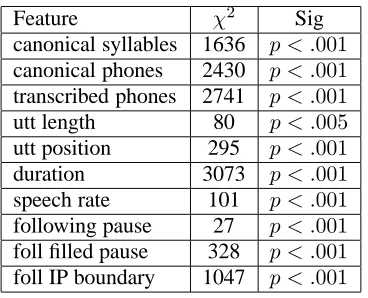
Table 4 indicates that each of these features sig-nificantly affect the presence of pitch accent. While certainly all of these variables are not independent of on another, using CRFs, one can incorporate all of these variables into the pitch accent prediction model with the advantage of making use of the de-pendencies among the labels.
4.4 Surrounding Information
Sun (2002) has shown that the values immediately preceding and following the target are good predic-tors for the value of the target. We also experi-mented with the effects of the surrounding values by varying the window size of the observation-label feature extraction described in Section 2. When the window size is 1, only values of the word that is la-belled are incorporated in the model. When the win-dow size is 3, the values of the previous and the fol-lowing words as well as the current word are incor-porated in the model. Window size 5 captures the
values of the current word, the two previous words and the two following words.
5 Experiments and Results
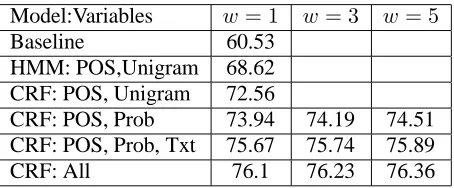
All experiments were run using 10 fold cross-validation. We used Viterbi decoding to find the most likely sequence and report the performance in terms of label accuracy. We ran all experiments with varying window sizes (w∈ {1,3,5}). The baseline which simply assigns the most common label, un-accented, achieves60.53±1.50%.
Previous research has demonstrated that part of speech and frequency, or a combination of these two, are very reliable predictors of pitch accent. Thus, to test the worthiness of using a CRF model, the first experiment we ran was a comparison of an HMM to a CRF using just the combination of part of speech and unigram. The HMM score (referred as HMM:POS, Unigram in Table 5) was68.62±1.78, while the CRF model (referred as CRF:POS, Uni-gram in Table 5) performed significantly better at 72.56±1.86. Note that Pan and McKeown (1999) reported 74% accuracy with their HMM model. The difference is due to the different corpora used in each case. While they also used spontaneous speech, it was a limited domain in the sense that it was speech from discharge orders from doctors at one medical facility. The SWDB corpus is open domain conversational speech.
In order to capture some aspects of the IC and collocational strength of a word, in the second ex-periment we ran part of speech plus all of the prob-abilistic variables (referred as CRF:POS, Prob in Table 5). The model accuracy was 73.94%, thus improved over the model using POS and unigram values by 1.38%.
In the third experiment we wanted to know if TTS applications that made use of purely textual input could be aided by the addition of timing and rhythm variables that can be gleaned from a text string. Thus, we included the textual features described in Section 4.3 in addition to the probabilistic and syn-tactic features (referred as CRF:POS, Prob, Txt in Table 5). The accuracy was improved by 1.73%.
For the final experiment, we added the acoustic variable, resulting in the use of all the variables de-scribed in Section 4 (referred as CRF:All in Table 5). We get about 0.5% increase in accuracy, 76.1% with a window of sizew= 1.
Model:Variables w= 1 w= 3 w= 5
Baseline 60.53
HMM: POS,Unigram 68.62
CRF: POS, Unigram 72.56
CRF: POS, Prob 73.94 74.19 74.51
CRF: POS, Prob, Txt 75.67 75.74 75.89
[image:6.595.73.300.71.165.2]CRF: All 76.1 76.23 76.36
Table 5: Test accuracy of pitch accent prediction on SWDB using various variables and window sizes.
6 Discussion
Pitch accent prediction is a difficult task, in that, the number of different speakers, topics, utterance frag-ments and disfluent production of the SWBD corpus only increase this difficulty. The fact that 21% of the function words are accented indicates that mod-els of pitch accent that mostly rely on part of speech and unigram frequency would not fair well with this corpus. We have presented a model of pitch accent that captures some of the other factors that influence accentuation. In addition to adding more probabilis-tic variables and phonological factors, we have used a sequence model that captures the interdependence of accents within a phrase.
Given the distinct natures of corpora used, it is difficult to compare these results with earlier mod-els. However, in experiment 1 (HMM: POS, Uni-gram vs CRF: POS, UniUni-gram) we have shown that a CRF model achieves a better performance than an HMM model using the same features. However, the real strength of CRFs comes from their ability to incorporate different sources of information effi-ciently, as is demonstrated in our experiments.
We did not test directly the probabilistic measures (or collocation measures) that have been used before for this task, namely information content (IC) (Pan and McKeown, 1999) and mutual information (Pan and Hirschberg, 2001). However, the measures we have used encompass similar information. For ex-ample, IC is only the additive inverse of our unigram measure:
IC(w) =−logp(w) (6)
Rather than using mutual information as a measure of collocational strength, we used unigram, bigram and joint probabilities. A model that includes both joint probability and the unigram probabilities ofwi
andwi−1is comparable to one that includes mutual
information.
Just as the likelihood of a word being accented is influenced by a following silence or IP bound-ary, the collocational strength of the target word
with the following word (captured by reverse bi-gram and reverse joint) is also a factor. With the use of POS, unigram, and all bigram and joint prob-abilities, we have shown that (a) CRFs outperform HMMs, and (b) our probabilistic variables increase accuracy from a model that include POS + unigram (73.94% compared to 72.56%).
For tasks in which pitch accent is predicted solely based on a string of text, without the addition of acoustic data, we have shown that adding aspects of rhythm and timing aids in the identification of accent targets. We used the number of words in an utterance, where in the utterance a word falls, how long in both number of syllables and number of phones all affect accentuation. The addition of these variables improved the model by nearly 2%. These results suggest that Accent prediction models that only make use of textual information could be improved with the addition of these variables.
While not trying to provide a complete model of accentuation from acoustic information, in this study we tested a few acoustic variables that have not yet been tested. The nature of the SWBD cor-pus allowed us to investigate the role of disfluencies and widely variable durations and speech rate on ac-centuation. Especially speech rate, duration and sur-rounding silence are good predictors of pitch accent. The addition of these predictors only slightly im-proved the model (about .5%). Acoustic features are very sensitive to individual speakers. In the corpus, there are many different speakers of varying ages and dialects. These variables might become more useful if one controls for individual speaker differ-ences. To really test the usefulness of these vari-ables, one would have to combine them with acous-tic features that have been demonstrated to be good predictors of pitch accent (Sun, 2002; Conkie et al., 1999; Wightman et al., 2000).
7 Conclusion
information, controlling for individual speaker dif-ference and also apply different discriminative se-quence labeling techniques to pitch accent predic-tion task.
8 Acknowledgements
This work was partially funded by CAREER award #IIS 9733067 IGERT. We would also like to thank Mark Johnson for the idea of this project, Dan Ju-rafsky, Alan Bell, Cynthia Girand, and Jason Bre-nier for their helpful comments and help with the database.
References
Y. Altun, T. Hofmann, and M. Johnson. 2003a. Discriminative learning for label sequences via boosting. In Proc. of Advances in Neural Infor-mation Processing Systems.
Y. Altun, I. Tsochantaridis, and T. Hofmann. 2003b. Hidden markov support vector machines. In Proc. of 20th International Conference on Ma-chine Learning.
M. Collins. 2002. Discriminative training meth-ods for Hidden Markov Models: Theory and ex-periments with perceptron algorithms. In Proc. of Empirical Methods of Natural Language Pro-cessing.
A. Conkie, G. Riccardi, and R. Rose. 1999. Prosody recognition from speech utterances us-ing acoustic and lus-inguistic based models of prosodic events. In Proc. of EUROSPEECH’99. W. J. Conover. 1980. Practical Nonparametric
Statistics. Wiley, New York, 2nd edition.
E. Fosler-Lussier and N. Morgan. 1999. Effects of speaking rate and word frequency on conversa-tional pronunci ations. In Speech Communica-tion.
J. Godfrey, E. Holliman, and J. McDaniel. 1992. SWITCHBOARD: Telephone speech corpus for research and develo pment. In Proc. of the Inter-national Conference on Acoustics, Speech, and Signal Processing.
S. Greenberg, D. Ellis, and J. Hollenback. 1996. In-sights into spoken language gleaned from pho-netic transcripti on of the Switchboard corpus. In Proc. of International Conference on Spoken Language Processsing.
J. Hirschberg. 1993. Pitch accent in context: Pre-dicting intonational prominence from text. Artifi-cial Intelligence, 63(1-2):305–340.
M. Johnson, S. Geman, S. Canon, Z. Chi, and S. Riezler. 1999. Estimators for stochastic unification-based grammars. In Proc. of ACL’99 Association for Computational Linguistics.
J. Lafferty, A. McCallum, and F. Pereira. 2001. Conditional random fields: Probabilistic models for segmenting and labeling sequence data. In Proc. of 18th International Conference on Ma-chine Learning.
A. McCallum, D. Freitag, and F. Pereira. 2000. Maximum Entropy Markov Models for Infor-mation Extraction and Segmentation. In Proc. of 17th International Conference on Machine Learning.
A. McCallum. 2003. Efficiently inducing features of Conditional Random Fields. In Proc. of Un-certainty in Articifical Intelligence.
T. Minka. 2001. Algorithms for maximum-likelihood logistic regression. Technical report, CMU, Department of Statistics, TR 758.
S. Pan and J. Hirschberg. 2001. Modeling local context for pitch accent prediction. In Proc. of ACL’01, Association for Computational Linguis-tics.
S. Pan and K. McKeown. 1999. Word informa-tiveness and automatic pitch accent modeling. In Proc. of the Joint SIGDAT Conference on EMNLP and VLC.
V. Punyakanok and D. Roth. 2000. The use of classifiers in sequential inference. In Proc. of Advances in Neural Information Processing Sys-tems.
F. Sha and F. Pereira. 2003. Shallow parsing with conditional random fields. In Proc. of Human Language Technology.
Xuejing Sun. 2002. Pitch accent prediction using ensemble machine learning. In Proc. of the In-ternational Conference on Spoken Language Pro-cessing.
B. Taskar, C. Guestrin, and D. Koller. 2004. Max-margin markov networks. In Proc. of Advances in Neural Information Processing Systems. P. Taylor. 2000. Analysis and synthesis of
intona-tion using the Tilt model. Journal of the Acousti-cal Society of America.