Employing Topic Models for Pattern-based Semantic Class Discovery
Huibin Zhang
1*Mingjie Zhu
2*Shuming Shi
3Ji-Rong Wen
3 1Nankai University
2University of Science and Technology of China
3Microsoft Research Asia
{v-huibzh, v-mingjz, shumings, jrwen}@microsoft.com
Abstract
A semantic class is a collection of items (words or phrases) which have semantically peer or sibling relationship. This paper studies the employment of topic models to automati-cally construct semantic classes, taking as the source data a collection of raw semantic classes (RASCs), which were extracted by ap-plying predefined patterns to web pages. The primary requirement (and challenge) here is dealing with multi-membership: An item may belong to multiple semantic classes; and we need to discover as many as possible the dif-ferent semantic classes the item belongs to. To adopt topic models, we treat RASCs as “doc-uments”, items as “words”, and the final se-mantic classes as “topics”. Appropriate preprocessing and postprocessing are per-formed to improve results quality, to reduce computation cost, and to tackle the fixed-k constraint of a typical topic model. Experi-ments conducted on 40 million web pages show that our approach could yield better re-sults than alternative approaches.
1
Introduction
Semantic class construction (Lin and Pantel, 2001; Pantel and Lin, 2002; Pasca, 2004; Shinza-to and Torisawa, 2005; Ohshima et al., 2006) tries to discover the peer or sibling relationship among terms or phrases by organizing them into semantic classes. For example, {red, white, black…} is a semantic class consisting of color instances. A popular way for semantic class dis-covery is pattern-based approach, where prede-fined patterns (Table 1) are applied to a
This work was performed when the authors were interns at Microsoft Research Asia
collection of web pages or an online web search engine to produce some raw semantic classes (abbreviated as RASCs, Table 2). RASCs cannot be treated as the ultimate semantic classes, be-cause they are typically noisy and incomplete, as shown in Table 2. In addition, the information of one real semantic class may be distributed in lots of RASCs (R2 and R3 in Table 2).
Type Pattern
SENT NP {, NP}*{,} (and|or) {other} NP TAG <UL> <LI>item</LI> … <LI>item</LI> </UL>
TAG <SELECT> <OPTION>item…<OPTION>item </SELECT>
* SENT: Sentence structure patterns; TAG: HTML Tag patterns
Table 1. Sample patterns
R1: {gold, silver, copper, coal, iron, uranium} R2: {red, yellow, color, gold, silver, copper} R3: {red, green, blue, yellow}
R4: {HTML, Text, PDF, MS Word, Any file type} R5: {Today, Tomorrow, Wednesday, Thursday, Friday, Saturday, Sunday}
R6: {Bush, Iraq, Photos, USA, War}
Table 2. Sample raw semantic classes (RASCs)
This paper aims to discover high-quality se-mantic classes from a large collection of noisy RASCs. The primary requirement (and chal-lenge) here is to deal with multi-membership, i.e., one item may belong to multiple different seman-tic classes. For example, the term “Lincoln” can simultaneously represent a person, a place, or a car brand name. Multi-membership is more pop-ular than at a first glance, because quite a lot of English common words have also been borrowed as company names, places, or product names. For a given item (as a query) which belongs to multiple semantic classes, we intend to return the semantic classes separately, rather than mixing all their items together.
Existing pattern-based approaches only pro-vide very limited support to multi-membership. For example, RASCs with the same labels (or hypernyms) are merged in (Pasca, 2004) to
erate the ultimate semantic classes. This is prob-lematic, because RASCs may not have (accurate) hypernyms with them.
In this paper, we propose to use topic models to address the problem. In some topic models, a document is modeled as a mixture of hidden top-ics. The words of a document are generated ac-cording to the word distribution over the topics corresponding to the document (see Section 2 for details). Given a corpus, the latent topics can be obtained by a parameter estimation procedure. Topic modeling provides a formal and conve-nient way of dealing with multi-membership, which is our primary motivation of adopting top-ic models here. To employ toptop-ic models, we treat RASCs as “documents”, items as “words”, and the final semantic classes as “topics”.
There are, however, several challenges in ap-plying topic models to our problem. To begin with, the computation is intractable for processing a large collection of RASCs (our da-taset for experiments contains 2.7 million unique RASCs extracted from 40 million web pages). Second, typical topic models require the number of topics (k) to be given. But it lacks an easy way of acquiring the ideal number of semantic classes from the source RASC collection. For the first challenge, we choose to apply topic models to the RASCs containing an item q, rather than the whole RASC collection. In addition, we also per-form some preprocessing operations in which some items are discarded to further improve effi-ciency. For the second challenge, considering that most items only belong to a small number of semantic classes, we fix (for all items q) a topic number which is slightly larger than the number of classes an item could belong to. And then a postprocessing operation is performed to merge the results of topic models to generate the ulti-mate semantic classes.
Experimental results show that, our topic model approach is able to generate higher-quality semantic classes than popular clustering algo-rithms (e.g., K-Medoids and DBSCAN).
We make two contributions in the paper: On one hand, we find an effective way of construct-ing high-quality semantic classes in the pattern-based category which deals with multi-membership. On the other hand, we demonstrate, for the first time, that topic modeling can be uti-lized to help mining the peer relationship among words. In contrast, the general related relation-ship between words is extracted in existing topic modeling applications. Thus we expand the ap-plication scope of topic modeling.
2
Topic Models
In this section we briefly introduce the two wide-ly used topic models which are adopted in our paper. Both of them model a document as a mix-ture of hidden topics. The words of every docu-ment are assumed to be generated via a generative probability process. The parameters of the model are estimated from a training process over a given corpus, by maximizing the likelih-ood of generating the corpus. Then the model can be utilized to inference a new document.
pLSI: The probabilistic Latent Semantic In-dexing Model (pLSI) was introduced in Hof-mann (1999), arose from Latent Semantic Indexing (Deerwester et al., 1990). The follow-ing process illustrates how to generate a docu-ment d in pLSI:
1. Pick a topic mixture distribution 𝑝(∙ |𝑑). 2. For each word wi in d
a. Pick a latent topic z with the probabil-ity 𝑝(𝑧|𝑑) for wi
b. Generate wi with probability 𝑝(𝑤𝑖|𝑧)
So with k latent topics, the likelihood of gene-rating a document d is
𝑝(𝑑) = 𝑝 𝑤𝑖 𝑧 𝑝(𝑧|𝑑)
𝑧 𝑖
(2.1)
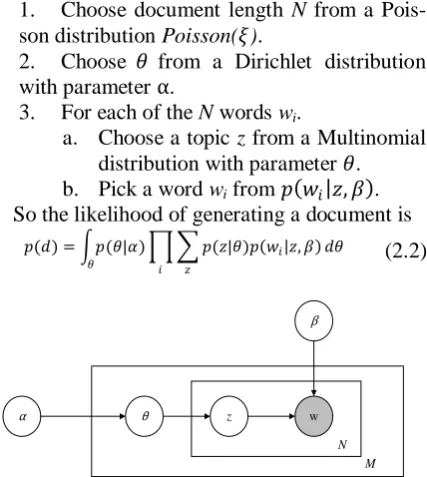
LDA (Blei et al., 2003): In LDA, the topic mixture is drawn from a conjugate Dirichlet prior that remains the same for all documents (Figure 1). The generative process for each document in the corpus is,
1. Choose document length N from a Pois-son distribution PoisPois-son(𝜉).
2. Choose 𝜃 from a Dirichlet distribution with parameter α.
3. For each of the N words wi.
a. Choose a topic z from a Multinomial distribution with parameter 𝜃. b. Pick a word wi from 𝑝 𝑤𝑖 𝑧, 𝛽 .
So the likelihood of generating a document is
𝑝(𝑑) = 𝑝(𝜃|𝛼)
𝜃 𝑝(𝑧|𝜃)𝑝 𝑤𝑖
𝑧, 𝛽 𝑑𝜃
𝑧
[image:2.595.311.525.477.716.2]𝑖 (2.2)
Figure 1. Graphical model representation of LDA, from Blei et al. (2003)
w
θ z
α
β
3
Our Approach
The source data of our approach is a collection (denoted as CR) of RASCs extracted via applying
patterns to a large collection of web pages. Given an item as an input query, the output of our ap-proach is one or multiple semantic classes for the item. To be applicable in real-world dataset, our approach needs to be able to process at least mil-lions of RASCs.
3.1
Main IdeaAs reviewed in Section 2, topic modeling pro-vides a formal and convenient way of grouping documents and words to topics. In order to apply topic models to our problem, we map RASCs to documents, items to words, and treat the output topics yielded from topic modeling as our seman-tic classes (Table 3). The motivation of utilizing topic modeling to solve our problem and building the above mapping comes from the following observations.
1) In our problem, one item may belong to multiple semantic classes; similarly in topic modeling, a word can appear in multiple top-ics.
2) We observe from our source data that some RASCs are comprised of items in mul-tiple semantic classes. And at the same time, one document could be related to multiple topics in some topic models (e.g., pLSI and LDA).
Topic modeling Semantic class construction
word item (word or phrase)
document RASC
topic semantic class
Table 3. The mapping from the concepts in topic modeling to those in semantic class construction
Due to the above observations, we hope topic modeling can be employed to construct semantic classes from RASCs, just as it has been used in assigning documents and words to topics.
There are some critical challenges and issues which should be properly addressed when topic models are adopted here.
Efficiency: Our RASC collection CR contains
about 2.7 million unique RASCs and 26 million (1 million unique) items. Building topic models directly for such a large dataset may be computa-tionally intractable. To overcome this challenge, we choose to apply topic models to the RASCs containing a specific item rather than the whole RASC collection. Please keep in mind that our
goal in this paper is to construct the semantic classes for an item when the item is given as a query. For one item q, we denote CR(q) to be all
the RASCs in CR containing the item. We believe
building a topic model over CR(q) is much more
effective because it contains significantly fewer “documents”, “words”, and “topics”. To further improve efficiency, we also perform preprocess-ing (refer to Section 3.4 for details) before build-ing topic models for CR(q), where some
low-frequency items are removed.
Determine the number of topics: Most topic models require the number of topics to be known beforehand1. However, it is not an easy task to automatically determine the exact number of se-mantic classes an item q should belong to. Ac-tually the number may vary for different q. Our solution is to set (for all items q) the topic num-ber to be a fixed value (k=5 in our experiments) which is slightly larger than the number of se-mantic classes most items could belong to. Then we perform postprocessing for the k topics to produce the final properly semantic classes.
In summary, our approach contains three phases (Figure 2). We build topic models for every CR(q), rather than the whole collection CR.
[image:3.595.310.528.481.606.2]A preprocessing phase and a postprocessing phase are added before and after the topic model-ing phase to improve efficiency and to overcome the fixed-k problem. The details of each phase are presented in the following subsections.
Figure 2. Main phases of our approach
3.2
Adopting Topic ModelsFor an item q, topic modeling is adopted to process the RASCs in CR(q) to generate k
seman-tic classes. Here we use LDA as an example to
1
Although there is study of non-parametric Bayesian mod-els (Li et al., 2007) which need no prior knowledge of topic number, the computational complexity seems to exceed our efficiency requirement and we shall leave this to future work.
R580 R1
R2
CR Item q
Preprocessing 𝑅400∗
𝑅1∗ 𝑅2∗
T5 T1 T2
C3 C1 C2
Topic modeling
Postprocessing T3
T4
illustrate the process. The case of other genera-tive topic models (e.g., pLSI) is very similar.
According to the assumption of LDA and our concept mapping in Table 3, a RASC (“docu-ment”) is viewed as a mixture of hidden semantic classes (“topics”). The generative process for a RASC R in the “corpus” CR(q) is as follows,
1) Choose a RASC size (i.e., the number of items in R): NR ~ Poisson(𝜉).
2) Choose a k-dimensional vector 𝜃𝑅 from a Dirichlet distribution with parameter 𝛼. 3) For each of the NR items an:
a) Pick a semantic class 𝑧𝑛 from a mul-tinomial distribution with parameter 𝜃𝑅.
b) Pick an item an from 𝑝(𝑎𝑛|𝑧𝑛, 𝛽),
where the item probabilities are pa-rameterized by the matrix 𝛽.
There are three parameters in the model: 𝜉 (a scalar), 𝛼 (a k-dimensional vector), and 𝛽 (a 𝑘 × 𝑉 matrix where V is the number of distinct items in CR(q)). The parameter values can be
ob-tained from a training (or called parameter esti-mation) process over CR(q), by maximizing the
likelihood of generating the corpus. Once 𝛽 is determined, we are able to compute 𝑝(𝑎|𝑧, 𝛽), the probability of item a belonging to semantic class z. Therefore we can determine the members of a semantic class z by selecting those items with high 𝑝 𝑎 𝑧, 𝛽 values.
The number of topics k is assumed known and fixed in LDA. As has been discussed in Section 3.1, we set a constant k value for all different CR(q). And we rely on the postprocessing phase
to merge the semantic classes produced by the topic model to generate the ultimate semantic classes.
When topic modeling is used in document classification, an inference procedure is required to determine the topics for a new document. Please note that inference is not needed in our problem.
One natural question here is: Considering that in most topic modeling applications, the words within a resultant topic are typically semantically related but may not be in peer relationship, then what is the intuition that the resultant topics here are semantic classes rather than lists of generally related words? The magic lies in the “docu-ments” we used in employing topic models. Words co-occurred in real documents tend to be semantically related; while items co-occurred in RASCs tend to be peers. Experimental results show that most items in the same output seman-tic class have peer relationship.
It might be noteworthy to mention the exchan-geability or “bag-of-words” assumption in most topic models. Although the order of words in a document may be important, standard topic mod-els neglect the order for simplicity and other rea-sons2. The order of items in a RASC is clearly much weaker than the order of words in an ordi-nary document. In some sense, topic models are more suitable to be used here than in processing an ordinary document corpus.
3.3
Preprocessing and PostprocessingPreprocessing is applied to CR(q) before we build
topic models for it. In this phase, we discard from all RASCs the items with frequency (i.e., the number of RASCs containing the item) less than a threshold h. A RASC itself is discarded from CR(q) if it contains less than two items after
the item-removal operations. We choose to re-move low-frequency items, because we found that low-frequency items are seldom important members of any semantic class for q. So the goal is to reduce the topic model training time (by reducing the training data) without sacrificing results quality too much. In the experiments sec-tion, we compare the approaches with and with-out preprocessing in terms of results quality and efficiency. Interestingly, experimental results show that, for some small threshold values, the results quality becomes higher after preprocess-ing is performed. We will give more discussions in Section 4.
In the postprocessing phase, the output seman-tic classes (“topics”) of topic modeling are merged to generate the ultimate semantic classes. As indicated in Sections 3.1 and 3.2, we fix the number of topics (k=5) for different corpus CR(q)
in employing topic models. For most items q, this is a larger value than the real number of se-mantic classes the item belongs to. As a result, one real semantic class may be divided into mul-tiple topics. Therefore one core operation in this phase is to merge those topics into one semantic class. In addition, the items in each semantic class need to be properly ordered. Thus main operations include,
1) Merge semantic classes
2) Sort the items in each semantic class Now we illustrate how to perform the opera-tions.
Merge semantic classes: The merge process is performed by repeatedly calculating the
2
larity between two semantic classes and merging the two ones with the highest similarity until the similarity is under a threshold. One simple and straightforward similarity measure is the Jaccard coefficient,
𝑠𝑖𝑚 𝐶1, 𝐶2 =
𝐶1∩ 𝐶2
𝐶1∪ 𝐶2 (3.1)
where 𝐶1∩ 𝐶2 and 𝐶1∪ 𝐶2 are respectively the
intersection and union of semantic classes C1 and C2. This formula might be over-simple, because the similarity between two different items is not exploited. So we propose the following measure,
𝑠𝑖𝑚 𝐶1, 𝐶2 = 𝑎∈𝐶1 𝑏∈𝐶2𝑠𝑖𝑚(𝑎, 𝑏)
𝐶1 ∙ 𝐶2 (3.2) where |C| is the number of items in semantic class C, and sim(a,b) is the similarity between items a and b, which will be discussed shortly. In Section 4, we compare the performance of the above two formulas by experiments.
Sort items: We assign an importance score to every item in a semantic class and sort them ac-cording to the importance scores. Intuitively, an item should get a high rank if the average simi-larity between the item and the other items in the semantic class is high, and if it has high similari-ty to the query item q. Thus we calculate the im-portance of item a in a semantic class C as follows,
𝑔 𝑎|𝐶 = 𝜆 ∙sim(a,C)+(1-𝜆) ∙sim(a,q) (3.3)
where 𝜆 is a parameter in [0,1], sim(a,q) is the similarity between a and the query item q, and sim(a,C) is the similarity between a and C, calcu-lated as,
𝑠𝑖𝑚 𝑎, 𝐶 = 𝑏∈𝐶𝑠𝑖𝑚(𝑎, 𝑏)
𝐶 (3.4)
Item similarity calculation: Formulas 3.2, 3.3, and 3.4 rely on the calculation of the similar-ity between two items.
One simple way of estimating item similarity is to count the number of RASCs containing both of them. We extend such an idea by distinguish-ing the reliability of different patterns and pu-nishing term similarity contributions from the same site. The resultant similarity formula is,
𝑠𝑖𝑚(𝑎, 𝑏) = log(1 + 𝑤(𝑃(𝐶𝑖,𝑗))
𝑘𝑖
𝑗 =1
)
𝑚
𝑖=1
(3.5)
where Ci,j is a RASC containing both a and b,
P(Ci,j) is the pattern via which the RASC is
ex-tracted, and w(P) is the weight of pattern P. As-sume all these RASCs belong to m sites with Ci,j
extracted from a page in site i, and ki being the
number of RASCs corresponding to site i. To determine the weight of every type of pattern, we
randomly selected 50 RASCs for each pattern and labeled their quality. The weight of each kind of pattern is then determined by the average quality of all labeled RASCs corresponding to it.
The efficiency of postprocessing is not a prob-lem, because the time cost of postprocessing is much less than that of the topic modeling phase.
3.4
Discussion3.4.1 Efficiency of processing popular items Our approach receives a query item q from users and returns the semantic classes containing the query. The maximal query processing time should not be larger than several seconds, be-cause users would not like to wait more time. Although the average query processing time of our approach is much shorter than 1 second (see Table 4 in Section 4), it takes several minutes to process a popular item such as “Washington”, because it is contained in a lot of RASCs. In or-der to reduce the maximal online processing time, our solution is offline processing popular items and storing the resultant semantic classes on disk. The time cost of offline processing is feasible, because we spent about 15 hours on a 4-core machine to complete the offline processing for all the items in our RASC collection.
3.4.2 Alternative approaches
One may be able to easily think of other ap-proaches to address our problem. Here we dis-cuss some alternative approaches which are treated as our baseline in experiments.
RASC clustering: Given a query item q, run a clustering algorithm over CR(q) and merge all
RASCs in the same cluster as one semantic class. Formula 3.1 or 3.2 can be used to compute the similarity between RASCs in performing cluster-ing. We try two clustering algorithms in experi-ments: K-Medoids and DBSCAN. Please note k-means cannot be utilized here because coordi-nates are not available for RASCs. One draw-back of RASC clustering is that it cannot deal with the case of one RASC containing the items from multiple semantic classes.
Item clustering: By Formula 3.5, we are able to construct an item graph GI to record the
neighbors (in terms of similarity) of each item. Given a query item q, we first retrieve its neigh-bors from GI, and then run a clustering algorithm
multiple semantic classes. As a result, when we input “gold” as the query, the item “silver” can only be assigned to one semantic class, although the term can simultaneously represents a color and a chemical element.
4
Experiments
4.1
Experimental SetupDatasets: By using the Open Directory Project (ODP3) URLs as seeds, we crawled about 40 mil-lion English web pages in a breadth-first way. RASCs are extracted via applying a list of sen-tence structure patterns and HTML tag patterns (see Table 1 for some examples). Our RASC col-lection CR contains about 2.7 million unique
RASCs and 1 million distinct items.
Query set and labeling: We have volunteers to try Google Sets4, record their queries being used, and select overall 55 queries to form our query set. For each query, the results of all ap-proaches are mixed together and labeled by fol-lowing two steps. In the first step, the standard (or ideal) semantic classes (SSCs) for the query are manually determined. For example, the ideal semantic classes for item “Georgia” may include Countries, and U.S. states. In the second step, each item is assigned a label of “Good”, “Fair”, or “Bad” with respect to each SSC. For example, “silver” is labeled “Good” with respect to “col-ors” and “chemical elements”. We adopt metric MnDCG (Section 4.2) as our evaluation metric.
Approaches for comparison: We compare our approach with the alternative approaches dis-cussed in Section 3.4.2.
LDA: Our approach with LDA as the topic model. The implementation of LDA is based on Blei’s code of variational EM for LDA5
.
pLSI: Our approach with pLSI as the topic model. The implementation of pLSI is based on Schein, et al. (2002).
KMedoids-RASC: The RASC clustering ap-proach illustrated in Section 3.4.2, with the K-Medoids clustering algorithm utilized.
DBSCAN-RASC: The RASC clustering ap-proach with DBSCAN utilized.
KMedoids-Item: The item clustering ap-proach with the K-Medoids utilized.
DBSCAN-Item: The item clustering ap-proach with the DBSCAN clustering algo-rithm utilized.
3
http://www.dmoz.org 4
http://labs.google.com/sets 5
http://www.cs.princeton.edu/~blei/lda-c/
K-Medoids clustering needs to predefine the cluster number k. We fix the k value for all dif-ferent query item q, as has been done for the top-ic model approach. For fair comparison, the same postprocessing is made for all the approaches. And the same preprocessing is made for all the approaches except for the item clustering ones (to which the preprocessing is not applicable).
4.2
Evaluation MethodologyEach produced semantic class is an ordered list of items. A couple of metrics in the information retrieval (IR) community like Precision@10, MAP (mean average precision), and nDCG (normalized discounted cumulative gain) are available for evaluating a single ranked list of items per query (Croft et al., 2009). Among the metrics, nDCG (Jarvelin and Kekalainen, 2000) can handle our three-level judgments (“Good”, “Fair”, and “Bad”, refer to Section 4.1),
𝑛𝐷𝐶𝐺@𝑘 = 𝐺 𝑖 /log(𝑖 + 1)
𝑘 𝑖=1
𝐺∗ 𝑖 /log(𝑖 + 1) 𝑘
𝑖=1
(4.1)
where G(i) is the gain value assigned to the i’th item, and G*(i) is the gain value assigned to the i’th item of an ideal (or perfect) ranking list.
Here we extend the IR metrics to the evalua-tion of multiple ordered lists per query. We use nDCG as the basic metric and extend it to MnDCG.
Assume labelers have determined m SSCs (SSC1~SSCm, refer to Section 4.1) for query q
and the weight (or importance) of SSCi is wi.
As-sume n semantic classes are generated by an ap-proach and n1 of them have corresponding SSCs
(i.e., no appropriate SSC can be found for the remaining n-n1 semantic classes). We define the
MnDCG score of an approach (with respect to query q) as,
𝑀𝑛𝐷𝐶𝐺 𝑞 =𝑛1
𝑛 ∙
𝑤𝑖∙ 𝑆𝑐𝑜𝑟𝑒(SSC𝑖)
𝑚 i=1
𝑤𝑖 m
i=1 (4.2)
where
𝑆𝑐𝑜𝑟𝑒 𝑆𝑆𝐶𝑖 =
0 𝑖𝑓 𝑘𝑖= 0
1
𝑘𝑖𝑗 ∈[1, 𝑘max𝑖](𝑛𝐷𝐶𝐺 𝐺𝑖,𝑗 ) 𝑖𝑓 𝑘𝑖≠ 0
(4.3)
In the above formula, nDCG(Gi,j) is the nDCG
score of semantic class Gi,j; and ki denotes the
number of semantic classes assigned to SSCi. For
a list of queries, the MnDCG score of an algo-rithm is the average of all scores for the queries.
i). One semantic class is wrongly split into multiple ones: Punished by dividing 𝑘𝑖 in Formula 4.3;
ii).A semantic class is too noisy to be as-signed to any SSC: Processed by the “n1/n” in Formula 4.2;
iii). Fewer semantic classes (than the number of SSCs) are produced: Punished in For-mula 4.3 by assigning a zero value.
iv). Wrongly merge multiple semantic classes into one: The nDCG score of the merged one will be small because it is computed with respect to only one single SSC.
The gain values of nDCG for the three relev-ance levels (“Bad”, “Fair”, and “Good”) are re-spectively -1, 1, and 2 in experiments.
4.3
Experimental Results4.3.1 Overall performance comparison
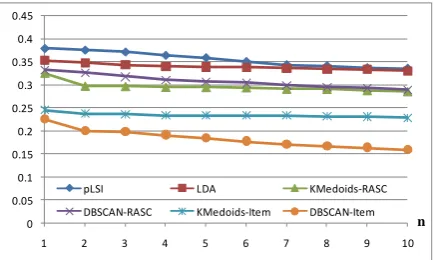
Figure 3 shows the performance comparison be-tween the approaches listed in Section 4.1, using metrics MnDCG@n (n=1…10). Postprocessing is performed for all the approaches, where For-mula 3.2 is adopted to compute the similarity between semantic classes. The results show that that the topic modeling approaches produce higher-quality semantic classes than the other approaches. It indicates that the topic mixture assumption of topic modeling can handle the multi-membership problem very well here. Among the alternative approaches, RASC clus-tering behaves better than item clusclus-tering. The reason might be that an item cannot belong to multiple clusters in the two item clustering ap-proaches, while RASC clustering allows this. For the RASC clustering approaches, although one item has the chance to belong to different seman-tic classes, one RASC can only belong to one semantic class.
Figure 3. Quality comparison (MnDCG@n) among approaches (frequency threshold h = 4 in
preprocess-ing; k = 5 in topic models)
4.3.2 Preprocessing experiments
Table 4 shows the average query processing time and results quality of the LDA approach, by va-rying frequency threshold h. Similar results are observed for the pLSI approach. In the table, h=1 means no preprocessing is performed. The aver-age query processing time is calculated over all items in our dataset. As the threshold h increases, the processing time decreases as expected, be-cause the input of topic modeling gets smaller. The second column lists the results quality (measured by MnDCG@10). Interestingly, we get the best results quality when h=4 (i.e., the items with frequency less than 4 are discarded). The reason may be that most low-frequency items are noisy ones. As a result, preprocessing can improve both results quality and processing efficiency; and h=4 seems a good choice in pre-processing for our dataset.
h Avg. Query Proc.
Time (seconds)
Quality (MnDCG@10)
1 0.414 0.281
2 0.375 0.294
3 0.320 0.322
4 0.268 0.331
5 0.232 0.328
6 0.210 0.315
7 0.197 0.315
8 0.184 0.313
9 0.173 0.288
Table 4. Time complexity and quality comparison among LDA approaches of different thresholds
[image:7.595.306.526.524.654.2]4.3.3 Postprocessing experiments
Figure 4. Results quality comparison among topic modeling approaches with and without postprocessing
(metric: MnDCG@10)
The effect of postprocessing is shown in Figure 4. In the figure, NP means no postprocessing is performed. Sim1 and Sim2 respectively mean Formula 3.1 and Formula 3.2 are used in post-processing as the similarity measure between
0 0.05 0.1 0.15 0.2 0.25 0.3 0.35 0.4 0.45
1 2 3 4 5 6 7 8 9 10
pLSI LDA KMedoids-RASC
DBSCAN-RASC KMedoids-Item DBSCAN-Item n
0.27 0.28 0.29 0.3 0.31 0.32 0.33 0.34
LDA pLSI
NP
Sim1
[image:7.595.73.291.594.724.2]semantic classes. The same preprocessing (h=4) is performed in generating the data. It can be seen that postprocessing improves results quality. Sim2 achieves more performance improvement than Sim1, which demonstrates the effectiveness of the similarity measure in Formula 3.2.
[image:8.595.72.290.252.519.2]4.3.4 Sample results
Table 5 shows the semantic classes generated by our LDA approach for some sample queries in which the bad classes or bad members are hig-hlighted (to save space, 10 items are listed here, and the query itself is omitted in the resultant semantic classes).
Query Semantic Classes
apple
C1: ibm, microsoft, sony, dell, toshiba, sam-sung, panasonic, canon, nec, sharp … C2: peach, strawberry, cherry, orange, bana-na, lemon, pineapple, raspberry, pear, grape …
gold
C1: silver, copper, platinum, zinc, lead, iron, nickel, tin, aluminum, manganese … C2: silver, red, black, white, blue, purple, orange, pink, brown, navy …
C3: silver, platinum, earrings, diamonds, rings, bracelets, necklaces, pendants, jewelry, watches …
C4: silver, home, money, business, metal, furniture, shoes, gypsum, hematite, fluorite …
lincoln
C1: ford, mazda, toyota, dodge, nissan, hon-da, bmw, chrysler, mitsubishi, audi … C2: bristol, manchester, birmingham, leeds, london, cardiff, nottingham, newcastle, shef-field, southampton …
C3: jefferson, jackson, washington, madison, franklin, sacramento, new york city, monroe,
Louisville, marion …
computer science
C1: chemistry, mathematics, physics, biolo-gy, psycholobiolo-gy, education, history, music, business, economics …
Table 5. Semantic classes generated by our approach for some sample queries (topic model = LDA)
5
Related Work
Several categories of work are related to ours. The first category is about set expansion (i.e., retrieving one semantic class given one term or a couple of terms). Syntactic context information is used (Hindle, 1990; Ruge, 1992; Lin, 1998) to compute term similarities, based on which simi-lar words to a particusimi-lar word can directly be returned. Google sets is an online service which, given one to five items, predicts other items in the set. Ghahramani and Heller (2005) introduce a Bayesian Sets algorithm for set expansion. Set expansion is performed by feeding queries to web search engines in Wang and Cohen (2007) and Kozareva (2008). All of the above work only
yields one semantic class for a given query. Second, there are pattern-based approaches in the literature which only do limited integration of RASCs (Shinzato and Torisawa, 2004; Shinzato and Torisawa, 2005; Pasca, 2004), as discussed in the introduction section. In Shi et al. (2008), an ad-hoc approach was proposed to discover the multiple semantic classes for one item. The third category is distributional similarity approaches which provide multi-membership support (Har-ris, 1985; Lin and Pantel, 2001; Pantel and Lin, 2002). Among them, the CBC algorithm (Pantel and Lin, 2002) addresses the multi-membership problem. But it relies on term vectors and centro-ids which are not available in pattern-based ap-proaches. It is therefore not clear whether it can be borrowed to deal with multi-membership here. Among the various applications of topic modeling, maybe the efforts of using topic model for Word Sense Disambiguation (WSD) are most relevant to our work. In Cai et al (2007), LDA is utilized to capture the global context information as the topic features for better performing the WSD task. In Boyd-Graber et al. (2007), Latent Dirichlet with WordNet (LDAWN) is developed for simultaneously disambiguating a corpus and learning the domains in which to consider each word. They do not generate semantic classes.
6
Conclusions
We presented an approach that employs topic modeling for semantic class construction. Given an item q, we first retrieve all RASCs containing the item to form a collection CR(q). Then we
per-form some preprocessing to CR(q) and build a
topic model for it. Finally, the output semantic classes of topic modeling are post-processed to generate the final semantic classes. For the CR(q)
which contains a lot of RASCs, we perform of-fline processing according to the above process and store the results on disk, in order to reduce the online query processing time.
We also proposed an evaluation methodology for measuring the quality of semantic classes. We show by experiments that our topic modeling approach outperforms the item clustering and RASC clustering approaches.
Acknowledgments
References
David M. Blei, Andrew Y. Ng, and Michael I. Jordan. 2003. Latent dirichlet allocation. J. Mach. Learn. Res., 3:993–1022.
Bruce Croft, Donald Metzler, and Trevor Strohman. 2009. Search Engines: Information Retrieval in Practice. Addison Wesley.
Jordan Boyd-Graber, David Blei, and Xiaojin Zhu.2007. A topic model for word sense disambig-uation. In Proceedings EMNLP-CoNLL 2007, pag-es 1024–1033, Prague, Czech Republic, June. Association for Computational Linguistics.
Jun Fu Cai, Wee Sun Lee, and Yee Whye Teh. 2007. NUS-ML: Improving word sense disambiguation using topic features. In Proceedings of the Interna-tional Workshop on Semantic Evaluations, volume 4.
Scott Deerwester, Susan T. Dumais, GeorgeW. Fur-nas, Thomas K. Landauer, and Richard Harshman. 1990. Indexing by latent semantic analysis. Journal of the American Society for Information Science, 41:391–407.
Zoubin Ghahramani and Katherine A. Heller. 2005. Bayesian Sets. In Advances in Neural Information Processing Systems (NIPS05).
Thomas L. Griffiths, Mark Steyvers, David M. Blei,and Joshua B. Tenenbaum. 2005. Integrating topics and syntax. In Advances in Neural Informa-tion Processing Systems 17, pages 537–544. MIT Press
Zellig Harris. Distributional Structure. The Philoso-phy of Linguistics. New York: Oxford University Press. 1985.
Donald Hindle. 1990. Noun Classification from Pre-dicate-Argument Structures. In Proceedings of ACL90, pages 268–275.
Thomas Hofmann. 1999. Probabilistic latent semantic indexing. In Proceedings of the 22nd annual inter-national ACM SIGIR99, pages 50–57, New York, NY, USA. ACM.
Kalervo Jarvelin, and Jaana Kekalainen. 2000. IR Evaluation Methods for Retrieving Highly Rele-vant Documents. In Proceedings of the 23rd An-nual International ACM SIGIR Conference on Research and Development in Information Retriev-al (SIGIR2000).
Zornitsa Kozareva, Ellen Riloff and Eduard Hovy. 2008. Semantic Class Learning from the Web with Hyponym Pattern Linkage Graphs, In Proceedings of ACL-08.
Wei Li, David M. Blei, and Andrew McCallum. Non-parametric Bayes Pachinko Allocation. In
Proceed-ings of Conference on Uncertainty in Artificial In-telligence (UAI), 2007.
Dekang Lin. 1998. Automatic Retrieval and Cluster-ing of Similar Words. In ProceedCluster-ings of COLING-ACL98, pages 768-774.
Dekang Lin and Patrick Pantel. 2001. Induction of Semantic Classes from Natural Language Text. In Proceedings of SIGKDD01, pages 317-322.
Hiroaki Ohshima, Satoshi Oyama, and Katsumi Tana-ka. 2006. Searching coordinate terms with their context from the web. In WISE06, pages 40–47.
Patrick Pantel and Dekang Lin. 2002. Discovering Word Senses from Text. In Proceedings of SIGKDD02.
Marius Pasca. 2004. Acquisition of Categorized Named Entities for Web Search. In Proc. of 2004 CIKM.
Gerda Ruge. 1992. Experiments on Linguistically-Based Term Associations. In Information Processing & Management, 28(3), pages 317-32.
Andrew I. Schein, Alexandrin Popescul, Lyle H. Ungar and David M. Pennock. 2002. Methods and metrics for cold-start recommendations. In Pro-ceedings of SIGIR02, pages 253-260.
Shuming Shi, Xiaokang Liu and Ji-Rong Wen. 2008. Pattern-based Semantic Class Discovery with Mul-ti-Membership Support. In CIKM2008, pages 1453-1454.
Keiji Shinzato and Kentaro Torisawa. 2004. Acquir-ing Hyponymy Relations from Web Documents. In HLT/NAACL04, pages 73–80.
Keiji Shinzato and Kentaro Torisawa. 2005. A Simple WWW-based Method for Semantic Word Class Acquisition. In RANLP05.