Generating Entailment Rules from FrameNet
Roni Ben Aharon
Department of Computer Science Bar-Ilan University
Ramat Gan, Israel
Idan Szpektor
Yahoo! Research Haifa, Israel
Ido Dagan
Department of Computer Science Bar-Ilan University
Ramat Gan, Israel
Abstract
Many NLP tasks need accurate knowl-edge for semantic inference. To this end, mostly WordNet is utilized. Yet Word-Net is limited, especially for inference be-tween predicates. To help filling this gap, we present an algorithm that generates inference rules between predicates from FrameNet. Our experiment shows that the novel resource is effective and comple-ments WordNet in terms of rule coverage.
1 Introduction
Many text understanding applications, such as Question Answering (QA) and Information Ex-traction (IE), need to infer a target textual mean-ing from other texts. This need was proposed as a generic semantic inference task under the Textual Entailment (TE) paradigm (Dagan et al., 2006).
A fundamental component in semantic infer-ence is the utilization of knowledge resources. However, a major obstacle to improving semantic inference performance is the lack of such knowl-edge (Bar-Haim et al., 2006; Giampiccolo et al., 2007). We address one prominent type of infer-ence knowledge known asentailment rules, focus-ing specifically on rules between predicates, such as ‘cureX⇒Xrecover’.
We aim at highly accurate rule acquisition, for which utilizing manually constructed sources seem appropriate. The most widely used manual resource is WordNet (Fellbaum, 1998). Yet it is in-complete for generating entailment rules between predicates (Section 2.1). Hence, other manual re-sources should also be targeted.
In this work1, we explore how FrameNet (Baker et al., 1998) could be effectively used for generating entailment rules between predicates.
1The detailed description of our work can be found in (Ben Aharon, 2010).
FrameNet is a manually constructed database based on Frame Semantics. It models the semantic argument structure of predicates in terms of proto-typical situations calledframes.
Prior work utilized FrameNet’s argument map-ping capabilities but took entailment relations from other resources, namely WordNet. We propose a novel method for generating ment rules from FrameNet by detecting the entail-ment relations implied in FrameNet. We utilize FrameNet’s annotated sentences and relations be-tween frames to extract both the entailment rela-tions and their argument mappings.
Our analysis shows that the rules generated by our algorithm have a reasonable “per-rule” accu-racy of about 70%2. We tested the generated rule-set on an entailment testbed derived from an IE benchmark and compared it both to WordNet and to state-of-the-art rule generation from FrameNet. Our experiment shows that our method outforms prior work. In addition, our rule-set’s per-formance is comparable to WordNet and it is com-plementary to WordNet when uniting the two re-sources. Finally, additional analysis shows that our rule-set accuracy is 90% in practical use.
2 Background
2.1 Entailment Rules and their Acquisition
To generate entailment rules, two issues should be addressed: a) identifying the lexical entailment relations between predicates, e.g. ‘cure ⇒ re-cover’; b) mapping argument positions, e.g. ‘cure X ⇒ X recover’. The main approach for gener-ating highly accurate rule-sets is to use manually constructed resources. To this end, most systems mainly utilize WordNet (Fellbaum, 1998), being the most prominent lexical resource with broad coverage of predicates. Furthermore, some of its
2The rule-set is available at: http://www.cs.biu.
ac.il/˜nlp/downloads
relations capture types of entailment relations, in-cluding synonymy, hypernymy, morphologically-derived,entailmentandcause.
Yet, WordNet is limited for entailment rule gen-eration. First, many entailment relations, no-tably for the WordNet entailment and cause re-lation types, are missing, e.g. ‘elect ⇒ vote’. Furthermore, WordNet does not include argument mapping between related predicates. Thus, only substitutable WordNet relations (synonymy and hypernymy), for which argument positions are preserved, could be used to generate entailment rules. The other non-substitutable relations, e.g. cause(‘kill⇒die’) andmorphologically-derived (‘meet.v⇔meeting.n’), cannot be used.
2.2 FrameNet
FrameNet (Baker et al., 1998) is a knowledge-base offrames, describing prototypical situations. Frames can be related to each other by inter-frame relations, e.g.Inheritance,Precedence,Usageand Perspective.
For each frame, several semantic roles are spec-ified, called frame elements (FEs), denoting the participants in the situation described. Each FE may be labeled ascoreif it is central to the frame. For example, some core FEs of theCommerce pay frame areBuyerandGoods, while a non-core FE isPlace. Each FE may also be labeled with a se-mantic type, e.g.Sentient,Event, andTime.
A frame includes a list of predicates that can evoke the described situation, calledlexical units (LUs). LUs are mainly verbs but may also be nouns or adjectives. For example, the frame Com-merce paylists the LUspay.vandpayment.n.
Finally, FrameNet contains annotated sentences that represent typical LU occurrences in texts. Each annotation refers to one LU in a specific frame and the FEs of the frame that occur in the sentence. An example sentence is“IBuyerhave to
pay the billsM oney”. Each sentence is
accompa-nied by avalence pattern, which provides, among other info, grammatical functions of the core FEs with respect to the LU. The valence pattern of the above sentence is[(Buyer Subj), (Money Obj)].
2.3 Using FrameNet for Semantic Inference
To the best of our knowledge, the only work that utilized FrameNet for entailment rule generation is LexPar (Coyne and Rambow, 2009). LexPar first identifies lexical entailment relations by go-ing over all LU pairs which are either in the
same frame or whose frames are related by one of FrameNet’s inter-frame relations. Each candidate pair is considered entailing if the two LUs are ei-ther synonyms or in a direct hypernymy relation in WordNet (providing the vast majority of LexPar’s relations), or if their related frames are connected via thePerspectiverelation in FrameNet.
Then, argument mappings between each entail-ing LU pair are extracted based on the core FEs that are shared between the two LUs. The syntac-tic positions of the shared FEs are taken from the valence patterns of the LUs. A LexPar rule exam-ple is presented in Figure 3 (top part).
Since most of LexPar’s entailment relations are based on WordNet’s relations, LexPar’s rules could be viewed as an intersection of WordNet and FrameNet lexical relations, accompanied with ar-gument mappings taken from FrameNet.
3 Rule Extraction from FrameNet
The above prior work identified lexical entailment relations mainly from WordNet, which limits the use of FrameNet in two ways. First, some rela-tions that appear in FrameNet are missed because they do not appear in WordNet. Second, unlike FrameNet, WordNet does not include argument mappings for its relations. Thus, prior work for rule generation considered only substitutable rela-tions from WordNet (synonyms and hypernyms), not utilizing FrameNet’s capability to map argu-ments of non-substitutable relations.
Our goal in this paper is to generate entail-ment rules solely from the information within FrameNet. We present a novel algorithm for gen-erating entailment rules from FrameNet, called FRED (FrameNet Entailment-rule Derivation), which operates in three steps: a) extracting tem-plates for each LU; b) detecting lexical entailment relations between pairs of LUs; c) generating en-tailment rules by mapping the arguments between two LUs in each entailing pair.
3.1 Template Extraction
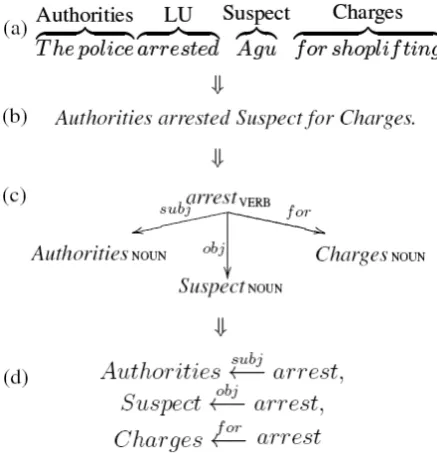
ar-Figure 1: Template extraction for a sentence con-taining the LU‘arrest’.
gument mapping by decomposing templates with several arguments into unary ones (Szpektor and Dagan, 2008). Figure 1 exemplifies this process.
As a pre-parsing step, all FE phrases in a given sentence are replaced by their related FE names, excluding syntactic information such as preposi-tions or possessives (step (b) in Figure 1). Then, the sentence is parsed using the Minipar depen-dency parser (Lin, 1998) (step (c)). Finally, a path in the parse-tree is extracted between each FE node and the node of the LU (step (d)). Each ex-tracted path is converted into a template by replac-ing the FE node with an argument variable.
We simplify each extracted path by removing nodes along the path that are not part of the syn-tactic relation between the LU and the FE, such as conjunctions and other FE nodes. For example,
‘Authorities ←−subj enter conj−→arrest’is simplified
into‘Authorities←−subjarrest’.
Some templates originated from different anno-tated sentences share the same LU and syntactic structure, but differ in their FEs. Usually, one of these templates is incorrect, due to erroneous parse
(e.g.‘Suspect←−obj arrest’is a correct template, in
contrast to‘Charges ←−obj arrest’). We thus keep only the most frequently annotated template out of the identical templates, assuming it is the correct one.
3.2 Identifying Lexical Entailment Relations
FrameNet groups LUs in frames and describes re-lations between frames. However, rere-lations be-tween LUs are not explicitly defined. We next de-scribe how we automatically extract several types of lexical entailment relations between LUs using two approaches.
In the first approach, LUs in the same frame that are morphological derivations of each other, e.g. ‘negotiation.n’and‘negotiate.v’, are marked as paraphrases. We take morphological derivation information from the CATVAR database (Habash and Dorr, 2003).
The second approach is based on our observa-tion that some LUs express the prototypical situ-ation that their frame describes, which we denote dominant LUs. For example, the LU‘recover’is dominant for the Recoveryframe. We mark LUs as dominant if they are morphologically derived from the frame’s name.
Our assumption is that since dominant LUs ex-press the frame’s generic meaning, their meaning is likely to be entailed by the other LUs in this frame. Consequently, we generate such lexical rules between any dominant LU and any other LU in a given frame, e.g. ‘heal⇒recover’ and ‘con-valescence⇒recover’ for theRecoveryframe.
In addition, we assume that if two frames are related by some type of entailment relation, their dominant LUs are also related by the same rela-tion. Accordingly, we extract entailment relations between dominant LUs of frames that are con-nected via theInheritance,CauseandPerspective relations, where Inheritance and Cause generate directional entailment relations (e.g. ‘choose ⇒
decide’ and ‘cure⇒recover’, respectively) while Perspectivegenerates bidirectional paraphrase re-lations (e.g. ‘transfer⇔receive’).
Finally, we generate the transitive closure of the set of lexical relations identified by the above methods. For example, the combination of ‘sell⇔
buy’ and ‘buy⇒get’ generates ‘sell⇒get’.
3.3 Generating Entailment Rules
The final step in the FRED algorithm generates lexical syntactic entailment rules from the ex-tracted templates and lexical entailment relations.
[image:3.595.71.290.65.292.2]Lexical Relation: cure⇒recovery
Templates:
P atient←−obj cure (curePatient)
Af f liction←−of cure (cure ofAffliction)
P atient←−genrecovery (Patient’s recovery)
P atient←−of recovery (recovery ofPatient)
Af f lictionf rom←− recovery (recovery fromAffliction) Intra-LU Entailment Rules:
P atient←−genrecovery⇐⇒P atient←−of recovery
Inter-LU Entailment Rules:
P atient←−obj cure=⇒P atient←−gen recovery
P atient←−obj cure=⇒P atient←−of recovery
[image:4.595.93.272.324.388.2]Af f liction←−of cure=⇒Af f lictionf rom←− recovery
Figure 2: Some entailment rules generated for the lexical relation ‘cure.v⇒recovery.n’.
Configuration R (%) P (%) F1
No-Rules 13.8 57.7 20.9
LexPar 14.1 42.9 17.4
WordNet 18.3 32.2 17.8
FRED 17.6 55.1 24.6
FRED∪WordNet 21.8 33.3 20.9
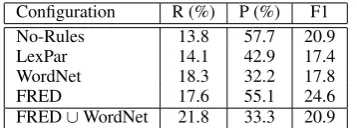
Table 1: Macro average Recall (R), Precision (P) and F1 results for the tested configurations.
to each of the LUs, denoted by Tlef tf e andTrightf e .
Finally, for each template pair,l ∈ Tlef tf e andr ∈
Trightf e , the rule ‘l ⇒r’ is generated. In addition, we generate paraphrase rules between the various templates including the same FE and the same LU. Figure 2 illustrates this process.
To improve rule quality, we filter out rules that map FEs of adjunct-like semantic types, such as Time and Location, since different templates of such FEs may have different semantic meanings
(e.g. ‘T ime bef ore←− arrive’ ‘T ime af ter←− arrive’). Thus, it is hard to identify those template pairs that correctly map these FEs for entailment.
We manually evaluated a random sample of 250 rules from the resulting rule-set, out of which we judged 69% as correct.
4 Application-based Evaluation
4.1 Experimental Setup
We would like to evaluate the overall utility of our resource for NLP applications, assessing the cor-rectness of the actual rule applications performed
in practice, as well as to compare its performance to related resources. To this end, we follow the ex-perimental setup presented in (Szpektor and Da-gan, 2009), which utilized the ACE 2005 event dataset3 as a testbed for entailment rule-sets. We briefly describe this setup here.
The task is to extract argument mentions for 26 events, such asSueandAttack, from the ACE annotated corpus, using a given tested entailment rule-set. Each event is represented by a set of unary seed templates, one for each event argu-ment. Some seed templates for Attack are
‘At-tacker←−subjattack’ and ‘attack−→objTarget’.
Argument mentions are found in the ACE cor-pus by matching either the seed templates or tem-plates entailing them found in the tested rule-set. We manually added for each event its relevant WordNet synset-ids and FrameNet frame-ids, so only rules fitting the event target meaning will be extracted from the tested rule-sets.
4.2 Tested Configurations
We evaluated several rule-set configurations:
No-Rules The system matches only the seed templates directly, without any additional rules.
WordNet Rules are generated from WordNet 3.0, using only thesynonymyandhypernymy rela-tions (see Section 2.1). Transitive chaining of re-lations is allowed (Moldovan and Novischi, 2002).
LexPar Rules are generated from the publicly available LexPar database. We generated unary rules from each LexPar rule based on a manually constructed mapping from FrameNet grammatical functions to Minipar dependency relations. Fig-ure 3 presents an example of this procedFig-ure.
FRED Rules are generated by our algorithm.
FRED∪WordNet The union of the rule-sets of FRED and WordNet.
4.3 Results
Each configuration was tested on each ACE event. We measured recall, precision and F1. Table 1 reports macro averages of the three measures over the 26 ACE events.
As expected, usingNo-Rulesachieves the high-est precision and the lowhigh-est recall compared to all other configurations. When adding LexPar rules,
LexPar rule:
Lexemes: arrest−→apprehend
Valencies: [(Authorities Subj), (Suspect Obj), (Offense (for))]=⇒[(Authorities Subj), (Suspect Obj), (Offense (in))] Generated unary rules:
Xsubj←−arrest=⇒Xsubj←−apprehend , arrest−→obj Y=⇒apprehend−→obj Y , arrest−→f or Z=⇒apprehend−→in Z
Figure 3: An example for generation of unary entailment rules from a LexPar rule.
only a slight increase in recall is gained. This shows that the subset of WordNet rules captured by LexPar (Section 2.3) might be too small for the ACE application setting.
When using all WordNet’s substitutable rela-tions, a substantial relative increase in recall is achieved (32%). Yet, precision decreases dramat-ically (relative decrease of 44%), causing an over-all decrease in F1. Most errors are due to correct WordNet rules whose LHS is ambiguous. Since we do not apply a WSD module, these rules are also incorrectly applied to other senses of the LHS. While this phenomenon is common to all rule-sets, WordNet suffers from it the most since it contains many infrequent word senses.
Our main result is that using FRED’s rule-set, recall increases significantly, a relative increase of 27% compared to No-Rules, while precision hardly decreases. Hence, overall F1 is the high-est compared to all other configurations (a rela-tive increase of 17% compared to No-Rules). The improvement in F1 is statistically significant com-pared to all other configurations, according to the two-sided Wilcoxon signed rank test at the level of 0.01 (Wilcoxon, 1945).
FRED preforms significantly better than LexPar in both recall, precision and F1 (a relative increase of 25%, 28% and 41% respectively). For example, LexPar hardly utilizes FrameNet’s argument map-ping capabilities since most of its rules are based on a sub-set of WordNet’s substitutable relations.
FRED’s precision is substantially higher than WordNet. This mostly results from the fact that FrameNet mainly contains common senses of predicates while WordNet includes many rare word senses; which, as said above, harms preci-sion when WSD is not applied. Error analysis showed that only 7.5% of incorrect extractions are due to erronous rules in FRED, while the majority of errors are due to sense mismatch or syntactic matching errors of the seed templates ot entailing templates in texts.
FRED’s Recall is somewhat lower than
Word-Net, since FrameNet is a much smaller resource. Yet, its rules are mostly complementary to those from WordNet. This added value is demon-strated by the 19% recall increase for the union of FRED and WordNet rule-sets compared to Word-Net alone. FRED provides mainly argument map-pings for non-substitutable WordNet relations, e.g. ‘attack.n onX⇒attack.vX’, but also lexical re-lations that are missing from WordNet, e.g. ‘am-bush.v⇒attack.v’.
Overall, our experiment shows that the rule-base generated by FRED seems an appropri-ate complementary resource to the widely used WordNet-based rules in semantic inference and expansion over predicates. This suggestion is es-pecially appealing since our rule-set performs well even when a WSD module is not applied.
5 Conclusions
We presented FRED, a novel algorithm for gener-ating entailment rules solely from the information contained in FrameNet. Our experiment showed that FRED’s rules perform substantially better than LexPar, the only prior rule-set derived from FrameNet. In addition, FRED’s rule-set largely complements the rules generated from WordNet because it contains argument mappings between non-substitutable predicates, which are missing from WordNet, as well as lexical relations that are not included in WordNet.
In future work we plan to investigate combin-ing FrameNet and WordNet rule-sets in a transitive manner, instead of their simple union.
Acknowledgments
References
Collin Baker, Charles Fillmore, and John Lowe. 1998.
The berkeley framenet project. In Proceedings of
COLING-ACL, Montreal, Canada.
Roy Bar-Haim, Ido Dagan, Bill Dolan, Lisa Ferro, Danilo Giampiccolo, Bernardo Magnini, and Idan Szpektor. 2006. The second pascal recognising
tex-tual entailment challenge. InSecond PASCAL
Chal-lenge Workshop for Recognizing Textual Entailment.
Roni Ben Aharon. 2010. Generating entailment rules from framenet. Master’s thesis, Bar-Ilan University.
Robert Coyne and Owen Rambow. 2009. Lexpar: A freely available english paraphrase lexicon
automat-ically extracted from framenet. In Proceedings of
the Third IEEE International Conference on Seman-tic Computing.
Ido Dagan, Oren Glickman, and Bernardo Magnini.
2006. The pascal recognising textual entailment
challenge. In Lecture Notes in Computer Science,
volume 3944, pages 177–190.
Christiane Fellbaum, editor. 1998. WordNet: An
Elec-tronic Lexical Database. MIT Press, Cambridge, Massachusetts.
Danilo Giampiccolo, Bernardo Magnini, Ido Dagan, and Bill Dolan. 2007. The third pascal recogniz-ing textual entailment challenge. InProceedings of the ACL-PASCAL Workshop on Textual Entailment and Paraphrasing.
Nizar Habash and Bonnie Dorr. 2003. A categorial
variation database for english. In Proceedings of
the North American Association for Computational Linguistics (NAACL ’03), pages 96–102, Edmonton, Canada. Association for Computational Linguistics.
Dekang Lin. 1998. Dependency-based evaluation of
minipar. InProceedings of the Workshop on
Evalu-ation of Parsing Systems at LREC.
Dan Moldovan and Adrian Novischi. 2002. Lexical
chains for question answering. In Proceedings of
COLING.
Idan Szpektor and Ido Dagan. 2008. Learning
en-tailment rules for unary templates. InProceedings
of the 22nd International Conference on Compu-tational Linguistics (Coling 2008), pages 849–856, Manchester, UK, August.
Idan Szpektor and Ido Dagan. 2009. Augmenting
wordnet-based inference with argument mapping. In Proceedings of the 2009 Workshop on Applied Textual Inference, pages 27–35, Suntec, Singapore, August.