Beyond NomBank:
A Study of Implicit Arguments for Nominal Predicates
Matthew Gerber and Joyce Y. Chai Department of Computer Science
Michigan State University East Lansing, Michigan, USA {gerberm2,jchai}@cse.msu.edu
Abstract
Despite its substantial coverage, Nom-Bank does not account for all within-sentence arguments and ignores extra-sentential arguments altogether. These ar-guments, which we callimplicit, are im-portant to semantic processing, and their recovery could potentially benefit many NLP applications. We present a study of implicit arguments for a select group of frequent nominal predicates. We show that implicit arguments are pervasive for these predicates, adding 65% to the coverage of NomBank. We demonstrate the feasibil-ity of recovering implicit arguments with a supervised classification model. Our re-sults and analyses provide a baseline for future work on this emerging task.
1 Introduction
Verbal and nominal semantic role labeling (SRL) have been studied independently of each other (Carreras and M`arquez, 2005; Gerber et al., 2009) as well as jointly (Surdeanu et al., 2008; Hajiˇc et al., 2009). These studies have demonstrated the maturity of SRL within an evaluation setting that restricts the argument search space to the sentence containing the predicate of interest. However, as shown by the following example from the Penn TreeBank (Marcus et al., 1993), this restriction ex-cludes extra-sentential arguments:
(1) [arg0 The two companies] [predproduce] [arg1 market pulp, containerboard and white paper]. The goods could be manufactured closer to customers, saving [predshipping] costs.
The first sentence in Example 1 includes the Prop-Bank (Kingsbury et al., 2002) analysis of the ver-bal predicateproduce, wherearg0 is the agentive
producer andarg1is the produced entity. The sec-ond sentence contains an instance of the nominal predicateshippingthat is not associated with argu-ments in NomBank (Meyers, 2007).
From the sentences in Example 1, the reader can infer thatThe two companiesrefers to the agents (arg0) of theshipping predicate. The reader can also infer that market pulp, containerboard and white paper refers to the shipped entities (arg1 of shipping).1 These extra-sentential arguments
have not been annotated for the shipping predi-cate and cannot be identified by a system that re-stricts the argument search space to the sentence containing the predicate. NomBank also ignores many within-sentence arguments. This is shown in the second sentence of Example 1, where The goodscan be interpreted as thearg1 ofshipping. These examples demonstrate the presence of argu-ments that are not included in NomBank and can-not easily be identified by systems trained on the resource. We refer to these arguments asimplicit.
This paper presents our study of implicit ar-guments for nominal predicates. We began our study by annotating implicit arguments for a se-lect group of predicates. For these predicates, we found that implicit arguments add 65% to the ex-isting role coverage of NomBank.2 This increase has implications for tasks (e.g., question answer-ing, information extraction, and summarization) that benefit from semantic analysis. Using our an-notations, we constructed a feature-based model for automatic implicit argument identification that unifies standard verbal and nominal SRL. Our re-sults indicate a 59% relative (15-point absolute) gain inF1 over an informed baseline. Our analy-ses highlight strengths and weaknesanaly-ses of the ap-proach, providing insights for future work on this emerging task.
1In PropBank and NomBank, the interpretation of each role (e.g.,arg0) is specific to a predicate sense.
2
Role coverage indicates the percentage of roles filled.
In the following section, we review related re-search, which is historically sparse but recently gaining traction. We present our annotation effort in Section 3, and follow with our implicit argu-ment identification model in Section 4. In Section 5, we describe the evaluation setting and present our experimental results. We analyze these results in Section 6 and conclude in Section 7.
2 Related work
Palmer et al. (1986) made one of the earliest at-tempts to automatically recover extra-sentential arguments. Their approach used a fine-grained do-main model to assess the compatibility of candi-date arguments and the slots needing to be filled.
A phenomenon similar to the implicit argu-ment has been studied in the context of Japanese anaphora resolution, where a missing case-marked constituent is viewed as a zero-anaphoric expres-sion whose antecedent is treated as the implicit ar-gument of the predicate of interest. This behavior has been annotated manually by Iida et al. (2007), and researchers have applied standard SRL tech-niques to this corpus, resulting in systems that are able to identify missing case-marked expres-sions in the surrounding discourse (Imamura et al., 2009). Sasano et al. (2004) conducted sim-ilar work with Japanese indirect anaphora. The authors used automatically derived nominal case frames to identify antecedents. However, as noted by Iida et al., grammatical cases do not stand in a one-to-one relationship with semantic roles in Japanese (the same is true for English).
Fillmore and Baker (2001) provided a detailed case study of implicit arguments (termed null in-stantiationsin that work), but did not provide con-crete methods to account for them automatically. Previously, we demonstrated the importance of fil-tering out nominal predicates that take no local ar-guments (Gerber et al., 2009); however, this work did not address the identification of implicit ar-guments. Burchardt et al. (2005) suggested ap-proaches to implicit argument identification based on observed coreference patterns; however, the au-thors did not implement and evaluate such meth-ods. We draw insights from all three of these studies. We show that the identification of im-plicit arguments for nominal predicates leads to fuller semantic interpretations when compared to traditional SRL methods. Furthermore, motivated by Burchardt et al., our model uses a quantitative
analysis of naturally occurring coreference pat-terns to aid implicit argument identification.
Most recently, Ruppenhofer et al. (2009) con-ducted SemEval Task 10, “Linking Events and Their Participants in Discourse”, which evaluated implicit argument identification systems over a common test set. The task organizers annotated implicit arguments across entire passages, result-ing in data that cover many distinct predicates, each associated with a small number of annotated instances. In contrast, our study focused on a se-lect group of nominal predicates, each associated with a large number of annotated instances.
3 Data annotation and analysis
3.1 Data annotation
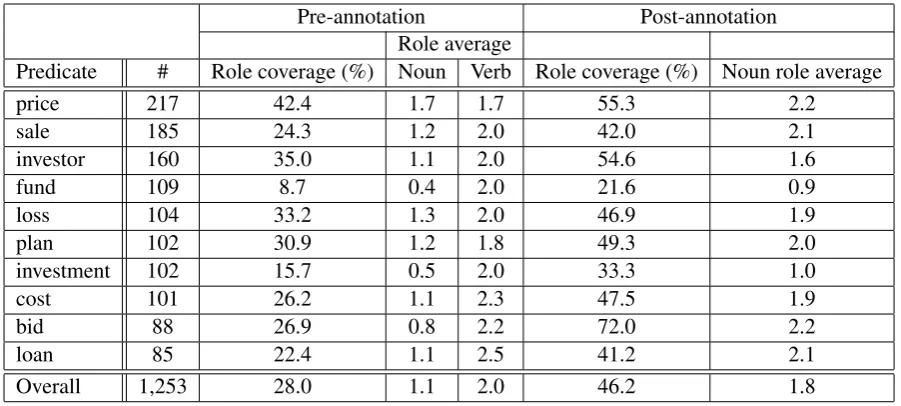
Implicit arguments have not been annotated within the Penn TreeBank, which is the textual and syn-tactic basis for NomBank. Thus, to facilitate our study, we annotated implicit arguments for instances of nominal predicates within the stan-dard training, development, and testing sections of the TreeBank. We limited our attention to nom-inal predicates with unambiguous role sets (i.e., senses) that are derived from verbal role sets. We then ranked this set of predicates using two pieces of information: (1) the average difference between the number of roles expressed in nominal form (in NomBank) versus verbal form (in PropBank) and (2) the frequency of the nominal form in the cor-pus. We assumed that the former gives an indica-tion as to how many implicit roles an instance of the nominal predicate might have. The product of (1) and (2) thus indicates the potential prevalence of implicit arguments for a predicate. To focus our study, we ranked the predicates in NomBank ac-cording to this product and selected the top ten, shown in Table 1.
We annotated implicit arguments document-by-document, selecting all singular and plural nouns derived from the predicates in Table 1. For each missing argument position of each predicate in-stance, we inspected the local discourse for a suit-able implicit argument. We limited our attention to the current sentence as well as all preceding sen-tences in the document, annotating all mentions of an implicit argument within this window.
In the remainder of this paper, we will useiargn
to refer to an implicit argument position n. We will useargnto refer to an argument provided by
Pre-annotation Post-annotation Role average
Predicate # Role coverage (%) Noun Verb Role coverage (%) Noun role average
price 217 42.4 1.7 1.7 55.3 2.2
sale 185 24.3 1.2 2.0 42.0 2.1
investor 160 35.0 1.1 2.0 54.6 1.6
fund 109 8.7 0.4 2.0 21.6 0.9
loss 104 33.2 1.3 2.0 46.9 1.9
plan 102 30.9 1.2 1.8 49.3 2.0
investment 102 15.7 0.5 2.0 33.3 1.0
cost 101 26.2 1.1 2.3 47.5 1.9
bid 88 26.9 0.8 2.2 72.0 2.2
loan 85 22.4 1.1 2.5 41.2 2.1
[image:3.595.74.525.61.264.2]Overall 1,253 28.0 1.1 2.0 46.2 1.8
Table 1: Predicates targeted for annotation. The second column gives the number of predicate instances annotated.Pre-annotationnumbers only include NomBank annotations, whereasPost-annotation num-bers include NomBank and implicit argument annotations. Role coverageindicates the percentage of roles filled.Role averageindicates how many roles, on average, are filled for an instance of a predicate’s noun form or verb form within the TreeBank. Verbal role averages were computed using PropBank.
predicate instances. Below, we give an example annotation for an instance of theinvestment predi-cate:
(2) [iarg0Participants] will be able to transfer [iarg1money] to [iarg2 other investment funds]. The [pinvestment] choices are limited to [iarg2 a stock fund and a money-market fund].
NomBank does not associate this instance of in-vestment with any arguments; however, we were able to identify the investor (iarg0), the thing in-vested (iarg1), and two mentions of the thing in-vested in (iarg2).
Our data set was also independently annotated by an undergraduate linguistics student. For each missing argument position, the student was asked to identify the closest acceptable implicit argu-ment within the current and preceding sentences. The argument position was left unfilled if no ac-ceptable constituent could be found. For a miss-ing argument position, the student’s annotation agreed with our own if both identified the same constituent or both left the position unfilled. Anal-ysis indicated an agreement of 67% using Cohen’s kappa coefficient (Cohen, 1960).
3.2 Annotation analysis
Role coverage for a predicate instance is equal to the number of filled roles divided by the number
of roles in the predicate’s lexicon entry. Role cov-erage for the marked predicate in Example 2 is 0/3 for NomBank-only arguments and 3/3 when the annotated implicit arguments are also consid-ered. Returning to Table 1, the third column gives role coverage percentages for NomBank-only ar-guments. The sixth column gives role coverage percentages when both NomBank arguments and the annotated implicit arguments are considered. Overall, the addition of implicit arguments created a 65% relative (18-point absolute) gain in role cov-erage across the 1,253 predicate instances that we annotated.
The predicates in Table 1 are typically associ-ated with fewer arguments on average than their corresponding verbal predicates. When consid-ering NomBank-only arguments, this difference (compare columns four and five) varies from zero (forprice) to a factor of five (forfund). When im-plicit arguments are included in the comparison, these differences are reduced and many nominal predicates express approximately the same num-ber of arguments on average as their verbal coun-terparts (compare the fifth and seventh columns).
sen-0.4 0.5 0.6 0.7 0.8 0.9 1
0 2 4 6 8 10 12 18 28 46
Sentences prior
Im
p
li
c
it
a
rg
u
m
e
n
ts
re
s
o
lv
e
[image:4.595.73.289.62.209.2]d
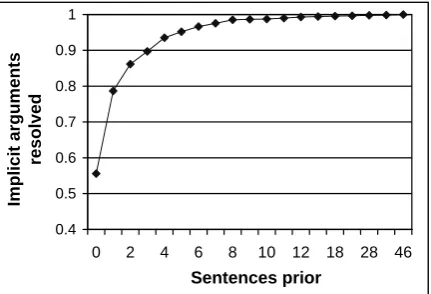
Figure 1: Location of implicit arguments. For missing argument positions with an implicit filler, they-axis indicates the likelihood of the filler be-ing found at least once in the previousxsentences.
tences for resolution; however, a vast majority of these can be resolved within the previous few sen-tences. Section 6 discusses implications of this skewed distribution.
4 Implicit argument identification
4.1 Model formulation
In our study, we assumed that each sentence in a document had been analyzed for PropBank and NomBank predicate-argument structure. Nom-Bank includes a lexicon listing the possible ar-gument positions for a predicate, allowing us to identify missing argument positions with a simple lookup. Given a nominal predicate instancepwith a missing argument position iargn, the task is to
search the surrounding discourse for a constituent
cthat fillsiargn. Our model conducts this search
over all constituents annotated by either PropBank or NomBank with non-adjunct labels.
A candidate constituent c will often form a coreference chain with other constituents in the discourse. Consider the following abridged sen-tences, which are adjacent in their Penn TreeBank document:
(3) [Mexico] desperately needs investment.
(4) Conservative Japanese investors are put off by [Mexico’s] investment regulations.
(5) Japan is the fourth largest investor in [cMexico], with 5% of the total [pinvestments].
NomBank does not associate the labeled instance ofinvestment with any arguments, but it is clear
from the surrounding discourse that constituentc
(referring to Mexico) is the thing being invested in (the iarg2). When determining whether c is the
iarg2 ofinvestment, one can draw evidence from other mentions inc’s coreference chain. Example 3 states that Mexico needs investment. Example 4 states that Mexico regulates investment. These propositions, which can be derived via traditional SRL analyses, should increase our confidence that
cis theiarg2ofinvestmentin Example 5.
Thus, the unit of classification for a candi-date constituentcis the three-tuplehp, iargn, c0i,
wherec0 is a coreference chain comprisingc and its coreferent constituents.3 We defined a binary classification function P r(+| hp, iargn, c0i) that
predicts the probability that the entity referred to by cfills the missing argument positioniargn of
predicate instancep. In the remainder of this pa-per, we will refer to c as the primary filler, dif-ferentiating it from other mentions in the corefer-ence chainc0. In the following section, we present the feature set used to represent each three-tuple within the classification function.
4.2 Model features
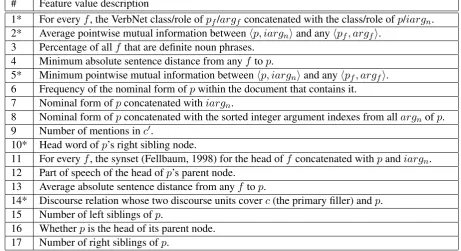
Starting with a wide range of features, we per-formed floating forward feature selection (Pudil et al., 1994) over held-out development data com-prising implicit argument annotations from section 24 of the Penn TreeBank. As part of the feature selection process, we conducted a grid search for the best per-class cost within LibLinear’s logistic regression solver (Fan et al., 2008). This was done to reduce the negative effects of data imbalance, which is severe even when selecting candidates from the current and previous few sentences. Ta-ble 2 shows the selected features, which are quite different from those used in our previous work to identify traditional semantic arguments (Gerber et al., 2009).4 Below, we give further explanations for some of the features.
Feature 1models the semantic role relationship between each mention inc0 and the missing argu-ment positioniargn. To reduce data sparsity, this
feature generalizes predicates and argument posi-tions to their VerbNet (Kipper, 2005) classes and
3
We used OpenNLP for coreference identification: http://opennlp.sourceforge.net
4
# Feature value description
1* For everyf, the VerbNet class/role ofpf/argf concatenated with the class/role ofp/iargn.
2* Average pointwise mutual information betweenhp, iargniand anyhpf, argfi.
3 Percentage of allf that are definite noun phrases. 4 Minimum absolute sentence distance from anyf top.
5* Minimum pointwise mutual information betweenhp, iargniand anyhpf, argfi.
6 Frequency of the nominal form ofpwithin the document that contains it. 7 Nominal form ofpconcatenated withiargn.
8 Nominal form ofpconcatenated with the sorted integer argument indexes from allargnofp.
9 Number of mentions inc0.
10* Head word ofp’s right sibling node.
11 For everyf, the synset (Fellbaum, 1998) for the head offconcatenated withpandiargn.
12 Part of speech of the head ofp’s parent node. 13 Average absolute sentence distance from anyf top.
14* Discourse relation whose two discourse units coverc(the primary filler) andp. 15 Number of left siblings ofp.
[image:5.595.67.529.66.317.2]16 Whetherpis the head of its parent node. 17 Number of right siblings ofp.
Table 2: Features for determining whethercfillsiargnof predicatep. For each mentionf (denoting a
filler) in the coreference chainc0, we definepf andargf to be the predicate and argument position off.
Features are sorted in descending order of feature selection gain. Unless otherwise noted, all predicates were normalized to their verbal form and all argument positions (e.g.,argnandiargn) were interpreted
as labels instead of word content. Features marked with an asterisk are explained in Section 4.2.
semantic roles using SemLink.5 For explanation purposes, consider again Example 1, where we are trying to fill theiarg0 ofshipping. Letc0 contain a single mention,The two companies, which is the
arg0 of produce. As described in Table 2, fea-ture 1 is instantiated with a value ofcreate.agent
-send.agent, wherecreateandsendare the VerbNet classes that containproduceandship, respectively. In the conversion to LibLinear’s instance repre-sentation, this instantiation is converted into a sin-gle binary feature create.agent-send.agent whose value is one. Features 1 and 11 are instantiated once for each mention in c0, allowing the model to consider information from multiple mentions of the same entity.
Features 2 and 5 are inspired by the work of Chambers and Jurafsky (2008), who inves-tigated unsupervised learning of narrative event sequences using pointwise mutual information (PMI) between syntactic positions. We used a sim-ilar PMI score, but defined it with respect to se-mantic arguments instead of syntactic dependen-cies. Thus, the values for features 2 and 5 are computed as follows (the notation is explained in
5http://verbs.colorado.edu/semlink
the caption for Table 2):
pmi(hp, iargni,hpf, argfi) =
log Pcoref(hp, iargni,hpf, argfi) Pcoref(hp, iargni,∗)Pcoref(hpf, argfi,∗)
(6)
To compute Equation 6, we first labeled a subset of the Gigaword corpus (Graff, 2003) using the ver-bal SRL system of Punyakanok et al. (2008) and the nominal SRL system of Gerber et al. (2009). We then identified coreferent pairs of arguments using OpenNLP. Suppose the resulting data has
N coreferential pairs of argument positions. Also suppose thatM of these pairs comprisehp, argni
and hpf, argfi. The numerator in Equation 6 is
defined as MN. Each term in the denominator is obtained similarly, except thatM is computed as the total number of coreference pairs compris-ing an argument position (e.g.,hp, argni) andany
Feature 10does not depend onc0and is specific to each predicate. Consider the following exam-ple:
(7) Statistics Canada reported that its [arg1 industrial-product] [pprice] index dropped 2% in September.
The “[pprice] index” collocation is rarely associ-ated with anarg0in NomBank or with aniarg0in our annotations (both argument positions denote the seller). Feature 10 accounts for this type of be-havior by encoding the syntactic head ofp’s right sibling. The value of feature 10 for Example 7 is
price:index. Contrast this with the following:
(8) [iarg0The company] is trying to prevent further [pprice] drops.
The value of feature 10 for Example 8 is
price:drop. This feature captures an important dis-tinction between the two uses of price: the for-mer rarely takes aniarg0, whereas the latter often does. Features 12 and 15-17 account for predicate-specific behaviors in a similar manner.
Feature 14 identifies the discourse relation (if any) that holds between the candidate constituent
cand the filled predicatep. Consider the following example:
(9) [iarg0SFE Technologies] reported a net loss of $889,000 on sales of $23.4 million.
(10) That compared with an operating [ploss] of [arg1 $1.9 million] on sales of $27.4 million in the year-earlier period.
In this case, acomparisondiscourse relation (sig-naled by the underlined text) holds between the first and sentence sentence. The coherence pro-vided by this relation encourages an inference that identifies the markediarg0 (the loser). Through-out our study, we used gold-standard discourse re-lations provided by the Penn Discourse TreeBank (Prasad et al., 2008).
5 Evaluation
We trained the feature-based logistic regression model over 816 annotated predicate instances as-sociated with 650 implicitly filled argument posi-tions (not all predicate instances had implicit ar-guments). During training, a candidate three-tuple hp, iargn, c0iwas given a positive label if the
can-didate implicit argumentc(the primary filler) was
annotated as filling the missing argument position. To factor out errors from standard SRL analyses, the model used gold-standard argument labels pro-vided by PropBank and NomBank. As shown in Figure 1 (Section 3.2), implicit arguments tend to be located in close proximity to the predicate. We found that using all candidate constituentscwithin the current and previous two sentences worked best on our development data.
We compared our supervised model with the simple baseline heuristic defined below:6
Fill iargn for predicate instance p
with the nearest constituent in the two-sentence candidate window that fills
argnfor a different instance ofp, where
all nominal predicates are normalized to their verbal forms.
The normalization allows an existingarg0 for the verb invested to fill an iarg0 for the noun
in-vestment. We also evaluated an oracle model that made gold-standard predictions for candidates within the two-sentence prediction window.
We evaluated these models using the methodol-ogy proposed by Ruppenhofer et al. (2009). For each missing argument position of a predicate in-stance, the models were required to either (1) iden-tify a single constituent that fills the missing argu-ment position or (2) make no prediction and leave the missing argument position unfilled. We scored predictions using the Dice coefficient, which is de-fined as follows:
2∗ |P redictedT
T rue|
|P redicted|+|T rue| (11)
P redicted is the set of tokens subsumed by the constituent predicted by the model as filling a missing argument position. T rue is the set of tokens from a single annotated constituent that fills the missing argument position. The model’s prediction receives a score equal to the maxi-mum Dice overlap across any one of the annotated fillers. Precision is equal to the summed predic-tion scores divided by the number of argument po-sitions filled by the model. Recall is equal to the summed prediction scores divided by the number of argument positions filled in our annotated data. Predictions not covering the head of a true filler were assigned a score of zero.
Baseline Discriminative Oracle
# Imp. # P R F1 P R F1 p R F1
sale 64 60 50.0 28.3 36.2 47.2 41.7 44.2 0.118 80.0 88.9
price 121 53 24.0 11.3 15.4 36.0 32.6 34.2 0.008 88.7 94.0
investor 78 35 33.3 5.7 9.8 36.8 40.0 38.4 <0.001 91.4 95.5
bid 19 26 100.0 19.2 32.3 23.8 19.2 21.3 0.280 57.7 73.2
plan 25 20 83.3 25.0 38.5 78.6 55.0 64.7 0.060 82.7 89.4
cost 25 17 66.7 23.5 34.8 61.1 64.7 62.9 0.024 94.1 97.0
loss 30 12 71.4 41.7 52.6 83.3 83.3 83.3 0.020 100.0 100.0
loan 11 9 50.0 11.1 18.2 42.9 33.3 37.5 0.277 88.9 94.1
investment 21 8 0.0 0.0 0.0 40.0 25.0 30.8 0.182 87.5 93.3
fund 43 6 0.0 0.0 0.0 14.3 16.7 15.4 0.576 50.0 66.7
[image:7.595.76.525.62.251.2]Overall 437 246 48.4 18.3 26.5 44.5 40.4 42.3 <0.001 83.1 90.7
Table 3: Evaluation results. The second column gives the number of predicate instances evaluated. The third column gives the number of ground-truth implicitly filled argument positions for the predicate instances (not all instances had implicit arguments). P, R, and F1 indicate precision, recall, and F-measure (β = 1), respectively. p-values denote the bootstrapped significance of the difference in F1 between the baseline and discriminative models. Oracle precision (not shown) is 100% for all predicates.
Our evaluation data comprised 437 predicate in-stances associated with 246 implicitly filled ar-gument positions. Table 3 presents the results. Predicates with the highest number of implicit ar-guments - sale and price - showed F1 increases of 8 points and 18.8 points, respectively. Over-all, the discriminative model increasedF1 perfor-mance 15.8 points (59.6%) over the baseline.
We measured human performance on this task by running our undergraduate assistant’s annota-tions against the evaluation data. Our assistant achieved an overall F1 score of 58.4% using the same candidate window as the baseline and dis-criminative models. The difference inF1between the discriminative and human results had an ex-act p-value of less than 0.001. All significance testing was performed using a two-tailed bootstrap method similar to the one described by Efron and Tibshirani (1993).
6 Discussion
6.1 Feature ablation
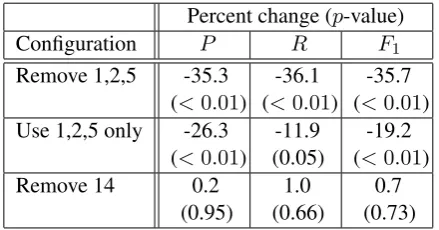
We conducted an ablation study to measure the contribution of specific feature sets. Table 4 presents the ablation configurations and results. For each configuration, we retrained and retested the discriminative model using the features de-scribed. As shown, we observed significant losses when excluding features that relate the seman-tic roles of mentions in c0 to the semantic role
Percent change (p-value)
Configuration P R F1
Remove 1,2,5 -35.3
(<0.01)
-36.1 (<0.01)
-35.7 (<0.01) Use 1,2,5 only -26.3
(<0.01)
-11.9 (0.05)
-19.2 (<0.01)
Remove 14 0.2
(0.95)
1.0 (0.66)
0.7 (0.73)
Table 4: Feature ablation results. The first column lists the feature configurations. All changes are percentages relative to the full-featured discrimi-native model. p-values for the changes are indi-cated in parentheses.
of the missing argument position (first configura-tion). The second configuration tested the effect of using onlythe SRL-based features. This also re-sulted in significant performance losses, suggest-ing that the other features contribute useful infor-mation. Lastly, we tested the effect of removing discourse relations (feature 14), which are likely to be difficult to extract reliably in a practical set-ting. As shown, this feature did not have a statis-tically significant effect on performance and could be excluded in future applications of the model.
6.2 Unclassified true implicit arguments
[image:7.595.307.527.342.457.2]generate a candidate constituentcthat was a cor-rect implicit argument. Without such a candidate, the system stood no chance of identifying a cor-rect implicit argument. Two factors contributed to this type of error, the first being our assumption that implicit arguments are also core (i.e., argn)
arguments to traditional SRL structures. Approxi-mately 8% of the overall error was due to a failure of this assumption. In many cases, the true im-plicit argument filled a non-core (i.e., adjunct) role within PropBank or NomBank.
More frequently, however, true implicit argu-ments were missed because the candidate window was too narrow. This accounts for 12% of the overall error. Oracle recall (second-to-last col-umn in Table 3) indicates the nominals that suf-fered most from windowing errors. For exam-ple, the sale predicate was associated with the highest number of true implicit arguments, but only 80% of those could be resolved within the two-sentence candidate window. Empirically, we found that extending the candidate window uni-formly for all predicates did not increase perfor-mance on the development data. The oracle re-sults suggest that predicate-specific window set-tings might offer some advantage.
6.3 Theinvestmentandfundpredicates
In Section 4.2, we discussed the pricepredicate, which frequently occurs in the “[p price] index” collocation. We observed that this collocation is rarely associated with either an overt arg0 or an implicit iarg0. Similar observations can be made for theinvestmentandfundpredicates. Al-though these two predicates are frequent, they are rarely associated with implicit arguments: invest-menttakes only eight implicit arguments across its 21 instances, and fundtakes only six implicit ar-guments across its 43 instances. This behavior is due in large part to collocations such as “[p in-vestment] banker”, “stock [pfund]”, and “mutual [pfund]”, which use predicate senses that are not eventive. Such collocations also violate our as-sumption that differences between the PropBank and NomBank argument structure for a predicate are indicative of implicit arguments (see Section 3.1 for this assumption).
Despite their lack of implicit arguments, it is important to account for predicates such as in-vestmentandfundbecause incorrect prediction of implicit arguments for them can lower precision.
This is precisely what happened for thefund pred-icate, where the model incorrectly identified many implicit arguments for “stock [pfund]” and “mu-tual [pfund]”. The left context offundshould help the model avoid this type of error; however, our feature selection process did not identify any over-all gains from including this information.
6.4 Improvements versus the baseline
The baseline heuristic covers the simple case where identical predicates share arguments in the same position. Thus, it is interesting to examine cases where the baseline heuristic failed but the discriminative model succeeded. Consider the fol-lowing sentence:
(12) Mr. Rogers recommends that [pinvestors] sell [iarg2takeover-related stock].
Neither NomBank nor the baseline heuristic asso-ciate the marked predicate in Example 12 with any arguments; however, the feature-based model was able to correctly identify the markediarg2 as the entity being invested in. This inference captured a tendency of investors to sell the things they have invested in.
We conclude our discussion with an example of an extra-sentential implicit argument:
(13) [iarg0Olivetti] has denied that it violated the rules, asserting that the shipments were properly licensed. However, the legality of these [psales] is still an open question.
As shown in Example 13, the system was able to correctly identifyOlivettias the agent in the sell-ing event of the second sentence. This inference involved two key steps. First, the system identified coreferent mentions ofOlivettithat participated in exporting and supplying events (not shown). Sec-ond, the system identified a tendency for exporters and suppliers to also be sellers. Using this knowl-edge, the system extracted information that could not be extracted by the baseline heuristic or a tra-ditional SRL system.
7 Conclusions and future work
exist in isolation. As shown throughout this paper, they are usually embedded in a coherent and se-mantically rich discourse that must be taken into account. We have presented a preliminary study of implicit arguments for nominal predicates that focused specifically on this problem.
Our contribution is three-fold. First, we have created gold-standard implicit argument annota-tions for a small set of pervasive nominal predi-cates.7 Our analysis shows that these annotations
add 65% to the role coverage of NomBank. Sec-ond, we have demonstrated the feasibility of re-covering implicit arguments for many of the pred-icates, thus establishing a baseline for future work on this emerging task. Third, our study suggests a few ways in which this research can be moved forward. As shown in Section 6, many errors were caused by the absence of true implicit arguments within the set of candidate constituents. More in-telligent windowing strategies in addition to al-ternate candidate sources might offer some im-provement. Although we consistently observed development gains from using automatic coref-erence resolution, this process creates errors that need to be studied more closely. It will also be important to study implicit argument patterns of non-verbal predicates such as the partitivepercent. These predicates are among the most frequent in the TreeBank and are likely to require approaches that differ from the ones we pursued.
Finally, any extension of this work is likely to encounter a significant knowledge acquisition bot-tleneck. Implicit argument annotation is difficult because it requires both argument and coreference identification (the data produced by Ruppenhofer et al. (2009) is similar). Thus, it might be produc-tive to focus future work on (1) the extraction of relevant knowledge from existing resources (e.g., our use of coreference patterns from Gigaword) or (2) semi-supervised learning of implicit argument models from a combination of labeled and unla-beled data.
Acknowledgments
We would like to thank the anonymous review-ers for their helpful questions and comments. We would also like to thank Malcolm Doering for his annotation effort. This work was supported in part by NSF grants IIS-0347548 and IIS-0840538.
7
Our annotation data can be freely downloaded at http://links.cse.msu.edu:8000/lair/projects/semanticrole.html
References
Aljoscha Burchardt, Anette Frank, and Manfred Pinkal. 2005. Building text meaning representa-tions from contextually related frames - a case study. InProceedings of the Sixth International Workshop on Computational Semantics.
Xavier Carreras and Llu´ıs M`arquez. 2005. Introduc-tion to the CoNLL-2005 shared task: Semantic role labeling.
Nathanael Chambers and Dan Jurafsky. 2008. Unsu-pervised learning of narrative event chains. In Pro-ceedings of the Association for Computational Lin-guistics, pages 789–797, Columbus, Ohio, June. As-sociation for Computational Linguistics.
Jacob Cohen. 1960. A coefficient of agreement for nominal scales. Educational and Psychological Measurement, 20(1):3746.
Bradley Efron and Robert J. Tibshirani. 1993. An In-troduction to the Bootstrap. Chapman & Hall, New York.
Rong-En Fan, Kai-Wei Chang, Cho-Jui Hsieh, Xiang-Rui Wang, and Chih-Jen Lin. 2008. LIBLINEAR: A Library for Large Linear Classification. Journal of Machine Learning Research, 9:1871–1874.
Christiane Fellbaum. 1998. WordNet: An Electronic Lexical Database (Language, Speech, and Commu-nication). The MIT Press, May.
C.J. Fillmore and C.F. Baker. 2001. Frame semantics for text understanding. InProceedings of WordNet and Other Lexical Resources Workshop, NAACL.
Matthew Gerber, Joyce Y. Chai, and Adam Meyers. 2009. The role of implicit argumentation in nominal SRL. InProceedings of the North American Chap-ter of the Association for Computational Linguistics, pages 146–154, Boulder, Colorado, USA, June.
David Graff. 2003. English Gigaword. Linguistic Data Consortium, Philadelphia.
Jan Hajiˇc, Massimiliano Ciaramita, Richard Johans-son, Daisuke Kawahara, Maria Ant`onia Mart´ı, Llu´ıs M`arquez, Adam Meyers, Joakim Nivre, Sebastian Pad´o, Jan ˇStˇep´anek, Pavel Straˇn´ak, Mihai Surdeanu, Nianwen Xue, and Yi Zhang. 2009. The CoNLL-2009 shared task: Syntactic and semantic dependen-cies in multiple languages. In Proceedings of the Thirteenth Conference on Computational Natural Language Learning (CoNLL 2009): Shared Task, pages 1–18, Boulder, Colorado, June. Association for Computational Linguistics.
Kenji Imamura, Kuniko Saito, and Tomoko Izumi. 2009. Discriminative approach to predicate-argument structure analysis with zero-anaphora res-olution. In Proceedings of the ACL-IJCNLP 2009 Conference Short Papers, pages 85–88, Suntec, Sin-gapore, August. Association for Computational Lin-guistics.
P. Kingsbury, M. Palmer, and M. Marcus. 2002. Adding semantic annotation to the Penn TreeBank. InProceedings of the Human Language Technology Conference (HLT’02).
Karin Kipper. 2005.VerbNet: A broad-coverage, com-prehensive verb lexicon. Ph.D. thesis, Department of Computer and Information Science University of Pennsylvania.
Mitchell Marcus, Beatrice Santorini, and Mary Ann Marcinkiewicz. 1993. Building a large annotated corpus of English: the Penn TreeBank. Computa-tional Linguistics, 19:313–330.
Adam Meyers. 2007. Annotation guidelines for NomBank - noun argument structure for PropBank. Technical report, New York University.
Martha S. Palmer, Deborah A. Dahl, Rebecca J. Schiff-man, Lynette HirschSchiff-man, Marcia Linebarger, and John Dowding. 1986. Recovering implicit infor-mation. InProceedings of the 24th annual meeting on Association for Computational Linguistics, pages 10–19, Morristown, NJ, USA. Association for Com-putational Linguistics.
Patrick Pantel and Deepak Ravichandran. 2004. Automatically labeling semantic classes. In Daniel Marcu Susan Dumais and Salim Roukos, ed-itors, HLT-NAACL 2004: Main Proceedings, pages 321–328, Boston, Massachusetts, USA, May 2 -May 7. Association for Computational Linguistics.
Rashmi Prasad, Alan Lee, Nikhil Dinesh, Eleni Milt-sakaki, Geraud Campion, Aravind Joshi, and Bonnie Webber. 2008. Penn discourse treebank version 2.0. Linguistic Data Consortium, February.
P. Pudil, J. Novovicova, and J. Kittler. 1994. Floating search methods in feature selection. Pattern Recog-nition Letters, 15:1119–1125.
Vasin Punyakanok, Dan Roth, and Wen-tau Yih. 2008. The importance of syntactic parsing and infer-ence in semantic role labeling. Comput. Linguist., 34(2):257–287.
Josef Ruppenhofer, Caroline Sporleder, Roser Morante, Collin Baker, and Martha Palmer. 2009. Semeval-2010 task 10: Linking events and their participants in discourse. In Proceedings of the Workshop on Semantic Evaluations: Recent Achievements and Future Directions (SEW-2009), pages 106–111, Boulder, Colorado, June. Associa-tion for ComputaAssocia-tional Linguistics.
Ryohei Sasano, Daisuke Kawahara, and Sadao Kuro-hashi. 2004. Automatic construction of nominal case frames and its application to indirect anaphora resolution. In Proceedings of Coling 2004, pages 1201–1207, Geneva, Switzerland, Aug 23–Aug 27. COLING.