Feature Lattices for M a x i m u m Entropy Modelling
A n d r e i M i k h e e v *
H C R C , L a n g u a g e T e c h n o l o g y G r o u p , U n i v e r s i t y of E d i n b u r g h , 2 B u c c l e u c h Place, E d i n b u r g h E H 8 9LW, S c o t l a n d , UK.
e-mail: Andrei. M i k h e e v @ e d . a c . u k
A b s t r a c t
Maximum entropy framework proved to be ex- pressive and powerful for the statistical lan- guage modelling, but it suffers from the com- putational expensiveness of the model build- ing. The iterative scaling algorithm that is used for the parameter estimation is computation- ally expensive while the feature selection pro- cess might require to estimate parameters for many candidate features many times. In this paper we present a novel approach for building m a x i m u m entropy models. Our approach uses the feature collocation lattice and builds com- plex candidate features without resorting to it- erative scaling.
1 I n t r o d u c t i o n
Maximum entropy modelling has been recently introduced to the NLP c o m m u n i t y and proved to be an expressive and powerful framework. The m a x i m u m entropy model is a model which fits a set of pre-defined constraints and assumes m a x i m u m ignorance about everything which is not subject to its constraints thus assigning such cases with the most uniform distribution. The most uniform distribution will have the entropy on its m a x i m u m
Because of its ability to handle overlapping features the m a x i m u m entropy framework pro- vides a principle way to incorporate informa- tion from multiple knowledge sources. It is superior t o t r a d i t i o n a l l y used for this purpose linear interpolation and Katz back-off method. (Rosenfeld, 1996) evaluates in detail a maxi- m u m entropy language model which combines unigrams, bigrams, trigrams and long-distance trigger words, and provides a thorough analysis of all the merits of the approach.
* Now at Harlequin Ltd.
T h e iterative scaling algorithm
(Darroch&Ratcliff, 1972) applied for the pa- rameter estimation of m a x i m u m entropy mod- els computes a set of feature weights (As) which ensure that the model fits the reference distri- b u t i o n and does not make spurious assumptions (as required by the m a x i m u m entropy principle) about events beyond the reference distribution. It, however, does not guarantee that t h e fea- tures employed by the model are good features and the model is useful. T h u s the most im- p o r t a n t part of the model building is the fea- ture selection procedure. The key idea of the feature selection is that if we notice an interac- tion between certain features we should build a more complex feature which will account for this interaction. T h e newly added feature should improve the model: its Kullback-Leibler diver- gence from the reference distribution should de- crease and the conditional m a x i m u m entropy model will also have the greatest log-likelihood (L) value:
make feature ranking computationally tractable in (Della P i e t r a et al., 1995) and (Berger et al., 1996) a simplified process proposed: at the fea- ture ranking stage when adding a new feature to the model, all previously c o m p u t e d parame- ters are kept fixed and, thus, we have to fit only one new constraint imposed by the candidate feature. T h e n after the best ranked feature has been established, it is added to the feature space and the weights for all the features are recom- puted. This approach estimates good features relatively fast b u t it does not guarantee t h a t at every single point we add the best feature be- cause when we a d d a new feature to the model
all
its parameters can change.In this paper we present a novel approach to feature selection for the m a x i m u m entropy mod- els. Our approach uses a feature collocation lat- tice and selects candidate features without re- sorting to the iterative scaling.
2 F e a t u r e C o l l o c a t i o n L a t t i c e
We start the modelling process by building a sample space w to train our model on. The sam- ple space consists of observed events of interest m a p p e d to a set of atomic features T which we should define beforehand. T h u s every observa- tion from the sample space is a binary vector of atomic features: if an observation includes a certain feature, its corresponding bit in the vector is turned on (set to 1) otherwise it is 0.
When we have a set of atomic features T and a training sample of configurations w, we can build the feature collocation lattice. Such collo- cation lattice will represent, in fact, the factorial constraint space (X) for the m a x i m u m entropy model and at the same time will contain all seen and logically implied configurations (w+). For- mally, the feature collocation lattice is a 3-ple: (0, C_, ~w) where
0 is a set of nodes of the lattice which corre- sponds to the union of the feature space of the m a x i m u m entropy model and the con- figuration space: 0 = X U ~ ( w ) . In fact, the nodes in the lattice (0) can have dual in- terpretation - on one hand they can act as m a p p e d configurations from the extended configuration space (w +) and on the other hand they can act as features from the con- straint space (X);
• C_ is a transitive, a n t i s y m m e t r i c relation over 0 x 0 - a partial ordering. We also will need the indicator function to flag w h e t h e r the relation C holds from node i to node k:
1
il OiC_Ok
foi(Ok) = 0 otherwise
~w is a set of
configuration frequency counts
of the nodes (0) of the lattice. This repre- sents how many times we saw a particu- lar configuration in our training samples. Because of the dual interpretation of the nodes, a node can also be associated with itsfeature frequency count
i.e. the num- ber of times we see this feature combina- tion anywhere in the lattice. Thefeature
frequency
of a node will then b e ~X(0k) = ~0~e0 f0k(0i) * ~0~ which is the sum of all the configuration frequency counts (~w) of the descendant nodes.Suppose we have a lattice of nodes
A,B,[AB]
with obvious relations: A C_ [AB]; B C_ [AB]:A "~ [AB] ~, B
The configuration frequency ~,~ will be the number of times we saw A b u t not
[AB]
and then the feature frequency of A will be: ~ = ~ + ~,~B i.e. the n u m b e r of times we saw A in all the nodes.
the node [ABD], relate it to the nodes [ABCD] and [ABDE] and set its configuration frequency to 0. If [ABCD] had already existed in the lat- tice, we would simply incremented its configu- ration frequency: ~[WABCD ] ~- ~[WABcD ] + 1.
Thus in the feature lattice we have nodes with non-zero configuration frequencies, which we call reference nodes and nodes with zero config- uration frequencies which we call latent or hid- den nodes. Reference nodes actually represent the observed configuration space (w). Hidden nodes are never observed on their own but only as parts of the reference nodes and represent possible generalizations about domain: low- complexity constraints (X) and logically possi- ble configurations (w+).
This method of building the feature colloca- tion lattice ensures that along with true obser- vations it contains hidden nodes which can pro- vide generalizations about the domain. At the same time there is no over-generation of the hid- den nodes: no logically impossible feature com- binations and no hidden nodes without general- ization power are included.
3 F e a t u r e S e l e c t i o n
After we constructed from a set of samples the feature collocation lattice (0, C_,(~), which we will call the empirical lattice, we try to esti- mate which features contribute and which do not to the frequency distribution on the refer- ence nodes. Thus only the predictive features will be retained in the lattice. The optimized feature space can be seen as a feature lattice de- fined over the empirical feature lattice: 0' C_ 0 and initially it is empty: 0' =j0. We build the optimized lattice by incrementally adding a fea- ture (atomic or complex) from the empirical lat- tice, together with the nodes which are the min- imal collocations of this feature with the nodes already included into the optimized lattice. The necessity to add the collocations comes from the fact that the features (or nodes) can overlap with each other and we want to have a unique node for such overlap. So if in the optimized feature lattice there is just one feature A, then when we add the feature B we also have to add the collocation [AB] if it exists in the empirical lattice. The configuration frequency of a node in the optimized lattice ((,w) then can be corn-
puted as:
t W _ _
(1)
Thus a node in the optimized lattice takes all configuration frequencies ((w) of itself and the above related nodes if these nodes do not belong to the optimized lattice themselves and there is no higher node in the optimized lattice related to them.
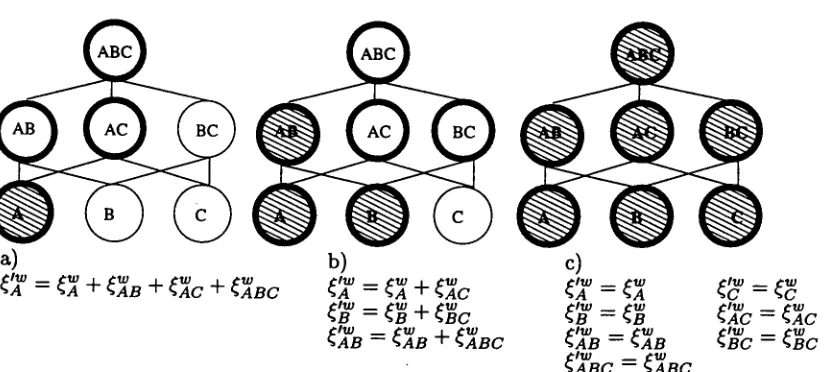
Figure i shows how the configuration frequen- cies in the optimized lattice are redistributed when adding a new feature. First the lat- tice is empty. When we add the feature A to the optimized lattice (Figure 1.a), because no other features are present in the optimized lattice, it takes all the configuration frequen- cies of the nodes where we see the feature A: ~ = ~ + ~ B + ~ C + ~BC" Case b) of Fig- ure 1 represents the situation w h e n we add the feature B to the optimized lattice which already includes the feature A. Apart from the node B we also add the collocation of the nodes A and B to the optimized lattice. N o w we have to re- distribute the configuration frequencies in the optimized lattice. T h e configuration frequency
of the node A now will become the number of times of seeing the feature A but not the fea- ture combination AB: ('A w = ~1 + ~ C " T h e configuration frequency of the node B will be the number of times of seeing the node B but not the n o d e A B : ~ = ~ + w (BC" The con- figuration frequency of the node A B will be: ~ B = %ABCW -b %ABC'¢W When we add the feature C to the optimized lattice (Figure 1.c) we produce a fully saturated lattice identical to the empiri- cal lattice, since the node C will collocate with the node A producing A C and will collocate with the node B producing BC. These nodes in their turn will collocate with each other and with the node A B producing the node A B C .
During the optimized lattice construction all the features (atomic and complex) from the em- pirical lattice compete, and we include the one which results in a optimized lattice with the smallest divergence D(p [I P') and equation ??) and therefore with the greatest log-likelihood Lp(p') , where:
a)
~'~' = ¢~ + ,'.~ + ¢~.c + ~'~.~c
b) c)
~
= ¢~ + ~ ] c ~ =~]
~
=~
= + ~ ~ = , ~ = ~
(~c
=~ c
~T~c
=
~ c
Figure 1: This figure shows the redistribution of the configuration frequencies in the optimized feature lattice when adding new nodes. Case a) stands for adding the feature A to the e m p t y lattice, case b) stands for adding the feature B to the lattice with the feature A and case c) stands for adding the feature C to the lattice with the atomic features A and B and their collocations. The unfilled nodes stand for the nodes in the empirical lattice which don't have reference in the optimized lattice. The nodes in bold s t a n d for the nodes decided by the optimized lattice (i.e. t h e y can be assigned with non-default probabilities).
the empirical lattice:
p(Oi)=--~°~
where
N = ~_, ~
(2) No~eo
• p'(Si) is the probability assigned to the i-th node using only the nodes included into the optimized lattice.
but there is just one undecided node (C) which is not shown in bold. So the probabilities for the nodes will be:
I%~ %¢t.u./ ¢ i w
= / ( A ) / ( e c ) = p'(B)
/(ABC) =/(AB) /(C) -- ~
N is the total count on the empirical lattice and
{ ~_~_. . -, is calculated as shown in equation 2:
~f u ~ E u
p'(Oi) =
~ '/ O, ¢ O' &
N = ~.~ + ~ + ~ + ~ B + ~'~C + ~'~BC"
[30~: oj e 0' & 0r c o,] &
[~0k : 0k e 0' & "e~ c 0~ & 0j c 8k] The presented above m e t h o d provides us with 1/]Y
] oth~,.,,ise
- an efficient way of selecting only important fea-(3) The optimized lattice assigns the probabil- ity to a node in the empirical lattice equal to that of its most specific sub-node from the optimized lattice. For reference nodes which do not have sub-nodes in the opti- mized lattice at all (undecided nodes) ac- cording to the m a x i m u m entropy principle we assign the uniform probability of mak- ing an arbitrary prediction.
For instance, for the example on Figure 1.b the optimized lattice includes only three nodes
[image:4.612.76.488.103.289.2]3. Another consideration which we apply during the lattice building is to penalize the develop- ment of low frequency (but not zero frequency) nodes i.e. the nodes with no reliable statistics on them. T h u s we s m o o t h the estimates on such nodes with the uniform distribution (which has the entropy on its maximum):
p"(Oi) = L * ~ + (1 - L ) * p'(Oi) w h e r e L =
THRESHOLD THRESHOLD+~'O~
So for high frequency nodes this smoothing is very minor b u t for nodes w i t h frequencies less t h a n two thresholds the p e n a l t y will be consid- erable. This will favor nodes which do not cre- ate sparce collocations with other nodes.
The described m e t h o d is similar in spirit to the m e t h o d of word trigger incorporation to a trigram model suggested in (Rosenfeld, 1996): if a trigram predicts well enough there is no need for an additional trigger. T h e main differ- ence is that we do not r e c o m p u t e the m a x i m u m entropy model every time b u t use our own fre- quency redistribution m e t h o d over the colloca- tion lattice. This is the crucial difference which makes a tremendous saving in time. We also do not require a newly a d d e d feature to be ei- ther atomic or a collocation of an atomic feature with a feature already included into the model as it was proposed in (Della P i e t r a et al., 1995) (Berger et al., 1996). All the features are cre- ated equal and the model should decide on the level of granularity by itself.
4 M o d e l G e n e r a l i z a t i o n
After we have chosen a subset of features for our model, we restrict our feature lattice to the op- timized lattice. Now we can c o m p u t e the max- imum entropy model taking the reference prob- abilities (which are configuration probabilities) as in equation 3.
The nodes from the optimized lattice serve b o t h as possible domain configurations and as potential constraint features to our model. We, however, want to constrain only the nodes with the reliable statistics on t h e m in order not to overfit the model. This in its t u r n will take off certain c o m p u t a t i o n a l load, since we expect a considerable n u m b e r of fragmented (simply in- frequent) nodes in the optimized lattice. This comes from the requirement to build all the col- locations when we add a new node. Although
m a n y top-level nodes will not b e constrained, the information from such infrequent nodes will not be lost completely - it will c o n t r i b u t e to more general nodes since for every constrained node we marginalize Over all its u n c o n s t r a i n e d descendants (more specific nodes). T h u s as possible constraints for the model we will con- sider only those nodes from the o p t i m i z e d lat- tice, whose marginalized over responses feature frequency counts I are greater t h a n a certain threshold, e.g.: ~0x__ ~ y > 5. This considera- = ( , ) tion is slightly different from the one suggested in (Ristad, 1996) where it was p r o p o s e d to un- constrain nodes with infrequent j o i n t feature frequency counts. T h u s if we saw a certain fea- ture configuration say 5,000 times and it always gave a single response we suggest to constrain as well the observation t h a t we never saw this configuration with the other responses. If we applied the suggestion of (Ristad, 1996) and cut out on the basis of the joint frequency we would lose the negative evidence, which is quite reliable j u d g i n g by the total frequency of the observation.
Initially we constrain all the nodes which sat- isfy the above requirement. In order to gener- alize and simplify our m a x i m u m e n t r o p y model, we uncgnstrain the most specific features, com- p u t e a new simplified m a x i m u m entropy model, and if it still predicts well, we r e p e a t the pro- cess. So our aim is to remove from the con- straints as m a n y top level nodes as possible w i t h o u t losing the model fitness to the refer- ence d i s t r i b u t i o n (15) of the optimized feature lattice. T h e necessary condition for a node to be taken as a candidate to unconstrain, is t h a t this node s h o u l d n ' t have any constrained nodes above it. T h e r e is also a natural ranking for the c a n d i d a t e nodes: the closer to 1 the weight (),) of a such a node is, the less it is i m p o r t a n t for the model. We can set a certain thresh- old on the weights, so all the c a n d i d a t e nodes whose As differ from 1 less t h a n this threshold will be u n c o n s t r a i n e d in one go. Therefore we don't have to use the iterative scaling for feature ranking and a p p l y it only for model recompu- tation, possibly un-constraining several feature configurations (nodes) at once. This m e t h o d , in fact, resembles the Backward Sequential Search
(BSS) proposed in (Pedersen&Bruce, 1997) for decomposable models. T h e r e is also a sig- nificant reduction in computational load since the generalized smaller model deviates from the previous larger model only in a small n u m b e r of constraints. So we use the parameters of t h a t larger model 2 as the initial values for the itera- tive scaling algorithm. This proved to decrease the number of required iterations by about ten- fold, which makes a tremendous saving in time. There can be m a n y possible criteria when to stop the generalization algorithm. T h e sim- plest one is just to set a predefined threshold on the deviation D(fi II P) of the generalized model from the reference distribution. (Peder- sen&Bruce, 1997) suggest to use Akaike's Infor- mation Criteria (AIC) to judge the acceptabil- ity of a new model. AIC rewards good model fit and penalizes models with high complexity mea- sured in the n u m b e r of features. We adopted the stop condition suggested in (Berger et al., 1996) - the maximization of the likelihood on a cross-validation set of samples which is unseen at the p a r a m e t e r estimation.
5 A p p l i c a t i o n : F u l l s t o p P r o b l e m
Sentence b o u n d a r y disambiguation has recently gained certain attention of the language engi- neering community. It is required for most text processing tasks such as, tagging, parsing, par- allel corpora alignment etc., and, as it t u r n e d out to be, this is a non-trivial task itself. A period can act as the end of a sentence or be a part of an abbreviation, but when an abbre- viation is the last word in a sentence, the pe- riod denotes the end of a sentence as well. T h e simplest "period-space-capital_letter" approach works well for simple texts but is r a t h e r unre- liable for texts with m a n y proper names and abbreviations at the end of sentence as, for in- stance, the Wall Street Journal (WSJ) corpus ( (Marcus et al., 1993) ).
One well-known trainable systems - SATZ - is described in (Palmer&Hearst, 1997). It uses a neural network with two layers of hid- den units. It was trained on the most prob- able parts-of-speech of three words before and three words after the period using 573 samples from the WSJ corpus. It was then tested on
2instead of the uniform distribution as prescribed in the step 1 of the Improved Iterative Scaling algorithm.
unseen 27,294 sentences from the same corpus and achieved 1.5% error rate. A n o t h e r auto- matically trainable system described in (Rey- n a r & R a t n a p a r k h i , 1997). This system is sim- ilar to ours in t h e model choice - it uses the m a x i m u m entropy framework. It was t r a i n e d on two different feature sets and scored 1.2% error rate on the corpus t u n e d feature set a n d 2% error rate on a more portable feature set. T h e features themselves were words and their classes in t h e immediate context of the period mark. ( R e y n a r & R a t n a p a r k h i , 1997) don't re- port on t h e n u m b e r of features utilized by their model and d o n ' t describe their approach to fea- ture selection b u t judging by the time their sys- t e m was t r a i n e d (18 minutes 3) it did not aim to produce t h e best performing feature-set b u t estimated a given one.
To tackle this problem we applied our m e t h o d to a m a x i m u m entropy model which used a lexicon of words associated with one or more categories from the set: abbreviation, proper noun, content word, closed-class word. This model employed atomic features such as the lex- icon information for the words before and after the period, their capitalization and spellings. For training we collected from the WSJ cor- pus 51,000 samples of the form
(Y, F..F)
and(N, F..F),
where Y stands for the end of sen-tence, N stands for otherwise and F s stand for the atomic features of the model. We started to built the model with 238 most frequent atomic features which gave us the collocation lattice of 8,245 nodes in 8 minutes of processor time on five SUN Ultra-1 workstations working in par- allel by means of multi-threading and R e m o t e Process Communication. W h e n we applied the feature selection algorithm (section 3), we in 53 minutes boiled the lattice down to 769 nodes. T h e n constraining all the nodes, we compiled a m a x i m u m entropy model in about 15 minutes and t h e n using the constraint removal process in two hours we boiled the constraint space down to 283. In this set only 31 atomic features re- mained. This model was detected to achieve the best performance on a specified cross-validation set. For the evaluation we used the same 27,294 sentences as in (Palmer&Hearst, 1997) 4 which
aPersonal communication
were also used by (Reynar&Ratnaparkhi, 1997) in the evaluation of their system. These sen- tences, of course, were not seen at the train- ing phase of our model. Our model achieved 99,2477% accuracy which is the highest quoted score on this test-set known to the authors. We attribute this to the fact that although we started with roughly the same atomic features as (Reynar&Ratnaparkhi, 1997) our system created complex features with higher prediction power.
6 C o n c l u s i o n
In this paper we presented a novel approach for building m a x i m u m entropy models. Our ap- proach uses a feature collocation lattice and se- lects the candidate features without resorting to iterative scaling. Instead we use our own frequency redistribution algorithm. After the candidate features have been selected we, us- ing the iterative scaling, compute a fully satu- rated model for the maximal constraint space and then apply relaxation to the most specific constraints.
We applied the described m e t h o d to sev- eral language modelling tasks such as sentence boundary disambiguation, part-of-speech tag- ging, stress prediction in continues speech gen- eration, etc., and proved its feasibility for select- ing and building the models with the complex- ity of tens of thousands constraints. We see the major achievement of our m e t h o d in building compact models with only a fraction of possi- ble features (usually there is a few hundred fea- tures) and at the same time performing at least as good as state-of-the-art: in fact, our sen- tence boundary disambiguater scored the high- est known to the author accuracy (99.2477%) and our part-of-speech tagging model general- ized for a new domain with only a tiny degra- dation in performance.
A potential drawback of our approach is that we require to build the feature collocation lat- tice for the whole observed feature-space which might not be feasible for applications with hun- dreds of thousands of features. So one of the directions in our future work is to find effi- cient ways for a decomposition of the feature lattice into non-overlapping sub-lattices which then can be handled by our method. Another avenue for further improvement is to introduce
the "or" operation on the nodes of the lattice. This can provide a further generalization over the features employed by the model.
7 A c k n o w l e d g e m e n t s
The work reported in this paper was s u p p o r t e d in part by grant GR/L21952 (Text Tokenisa- tion Tool) from the Engineering and Physical Sciences Research Council, UK. We would also like to acknowledge that this work was based on a long-standing collaborative relationship with Steve Finch.
R e f e r e n c e s
A. Berger, S. Della Pietra, V. Della Pietra, 1996. A M a x i m u m Entropy Approach to Nat- ural Language Processing In
Computational
Linguistics
vol.22(1)J.N. Darroch and D. Ratcliff 1972. Generalized Iterative Scaling for Log-Linear Models.
The
Annals of Mathematical Statistics,
43(5). S. Della Pietra, V.. Della Pietra, and J. Lafferty1995. Inducing Features of R a n d o m Fields Technical report CMU-CS-95-144
M. Marcus, M.A. Marcinkiewicz, and B. San- torini 1993. Building a Large A n n o t a t e d Cor- pus of English: T h e P e n n Treebank. In
Com-
putational Linguistics,
vol 19(2), ACL. D. D. Palmer and M. A. Hearst 1997. AdaptiveMultilingual Sentence Boundary Disambigua- tion. In
Computational Linguistics,
vol 23(2), ACL. pp. 241-269T. Pedersen and R. Bruce 1997. A New Su- pervised Learning Algorithm for Word Sense Disambiguation. In
Proceedings of the Four-
teenth National Conference on Artificial In-
telligence,
Providence, RI.J. C. Reynar and A. Ratnaparkhi 1997. A Maximum Entropy Approach to Identifying Sentence Boundaries. In
Proceedings of the
Fifth A CL Conference on Applied Natural
Language Processing (ANLP'97),
Washing- ton D.C., ACL.E. S. Ristad 1996. M a x i m u m Entropy Mod- elling Toolkit.
Documentation for Version
1.3 Beta, Draft,
R. Rosenfeld 1996. A Maximum Entropy
Approach to Adaptive Statistical Language Learning. In