Using Linguistic Knowledge in Automatic Abstracting
Horacio S a g g i o nDdpartement d'Informatique et Recherche Opdrationnelle Universitd de Montrdal
CP 6128, Succ Centre-Ville Montrdal, Qudbec, Canada, H3C 3J7
Fax: +1-514-343-5834 saggion@iro, umontreal, ca
A b s t r a c t
We present work on the automatic generation of short indicative-informative abstracts of scien- tific and technical articles. The indicative part of the abstract identifies the topics of the docu- ment while the informative part of the abstract elaborate some topics according to the reader's interest by motivating the topics, describing en- tities and defining concepts. We have defined our method of automatic abstracting by study- ing a corpus professional abstracts. The method also considers the reader's interest as essential in the process of abstracting.
1 I n t r o d u c t i o n
The idea of producing abstracts or summaries by automatic means is not new, several methodologies have been proposed and tested for automatic abstracting including among others: word distribution (Luhn, 1958); rhetor- ical analysis (Marcu, 1997); and probabilistic models (Kupiec et al., 1995). Even though some approaches produce acceptable abstracts for specific tasks, it is generally agreed that the problem of coherent selection and expres- sion of information in automatic abstracting remains (Johnson, 1995). One of the main problems is how to ensure the preservation of the message of the original text if sentences picked up from distant parts of the source text are juxtaposed and presented to the reader. Rino and Scott (1996) address the problem of coherent selection for gist preservation, however they depend on the availability of a complex meaning representation which in practice is difficult to obtain from the raw text.
In our work, we are concerned with the auto- matic generation of short indicative-informative abstract for technical and scientific papers. We
base our methodology on a study of a corpus of professional abstracts and source or parent doc- uments. Our method also considers the reader's interest as essential in the process of abstract- ing.
2 T h e C o r p u s
The production of professional abstracts has long been object of study (Cremmins, 1982). In particular, it has been argued that structural parts of parent documents such as introduc- tions and conclusions are important in order to obtain the information for the topical sentence (Endres-Niggemeyer et al., 1995). We have been investigating which kind of information is re- ported in professional abstracts as well as where the information lies in parent documents and how it is conveyed. In Figure 1, we show a pro- fessional abstract from the "Computer and Con- trol Abstracts" journal, this kind of abstract aims to alert readers about the existence of a new article in a particular field. The example contains information about the author's inter- est, the author's development and the overview of the parent document. All the information reported in this abstract was found in the in- troduction of its parent document.
The production of understandable and maintainable expert systems using the current gen- eration of multiparadigm development tools is addressed. This issue is discussed in the context of COMPASS, a large and complex expert system that helps maintain an elec- tronic telephone exchange. As part of the work on COMPASS, several techniques to aid maintainability were developed and successfully implemented. Some of the techniques were new, others were derived from traditional software engineering but modified to fit the rapid prototyping approach of expert system building. An overview of the COMPASS project is presented, software problem areas are identified, solutions adopted in the final system are described and how these solutions can be generalized is discussed.
Figure h Professional Abstract: CCA 58293 (1990 vol.25 no.293). Parent Document: "Maintain- ability Techniques in Developing Large Expert Systems." D.S. Prerau et al. IEEE Expert, vol.5, no.3, p.71-80, June 1990.
that it is not enough to produce a good infor- mative abstract (i.e. we hardly find the results of an investigation in the introduction of a re- search paper).
3 Conceptual and Linguistic
I n f o r m a t i o n
The complex process of scientific discovery that starts with the identification of a research problem and eventually ends with an answer to the problem (Bunge, 1967), would generally be disseminated in a technical or scientific paper: a complex record of knowledge containing, among others, references to the following con- cepts the author, the author's affiliation, others authors, the authors' development, the authors' interest, the research article and its components (sections, figures, tables, etc.), the problem un- der consideration, the authors' solution, others' solution, the topics of the research article, the motivation for the study, the importance of the study, what the author found, what the author think, what others have done, and so forth. Those concepts are systematically selected for inclusion in professional abstracts. We have noted that some of them are lexically marked while others appear as arguments of predicates conveying specific relations in the domain of discourse. For example, in an expression such as "We found significant reductions in ..." the verb "find" takes as an argument a result and in the expression "The lack of a library severely limits the impact of..." the verb "limit" entails a problem.
We have used our corpus and a set of more
than 50 complete technical articles in order to deduce a conceptual model and to gather lexical information conveying concepts and relations. Although our conceptual model does not deal with all the intricacies of the domain, we believe it covers most of the important in- formation relevant for an abstract. In order to obtain linguistic expressions marking concepts and relation, we have tagged our corpus with a POS tagger (Foster, 1991) and we have used a thesaurus (Vianna, 1980) to semantically classify the lexical items (most of them are polysemous). Figure 2, gives an overview of some concepts, relations and lexical items so far identified.
Concepts/Relations Explanation
Lexical Items
make know The author mark the topic of the document describe, expose, present, ...
study The author is engaged in study analyze, examine, explore, ...
express interest The author is interested in address, concern, interest,...
experiment The author is engaged in experimentation experiment, test, try out, ...
identify goal The author identify the research goal necessary, focus on, ...
explain The author gives explanations explain, interpret, justify,...
define a concept is being defined define, be, ...
describe entity is being described compose, form, ...
authors The authors of the article We, I, author,...
paper The technical article article, here, paper, study, ...
institutions authors' affiliation University, UniversitY, ...
other researchers Other researchers Proper Noun (Year), ...
problem The problem under consideration difficulty, issue, problem, ...
method The method used in the study equipment, methodology, ...
results The results obtained result, find, reveal, ...
'hypotheses The assumptions of the author assumption, hypothesis ....
Figure 2: Some Conceptual and Linguistic Information
4
G e n e r a t i n g A b s t r a c t s
It is generally accepted that there is no such thing as an ideal abstract, but different kinds of abstracts for different purposes and tasks (McK- eown et al., 1998). We aim at the generation of a type of abstract well recognized in the lit- erature: short indicative-informative abstracts. The indicative part identifies the topics of the document (what the authors present, discuss, address, etc.) while the informative part elabo- rates some topics according to the reader's inter- est by motivating the topics, describing entities, defining concepts and so on. This kind of ab- stract could be used in tasks such as accessing the content of the document and deciding if the parent document is worth reading. Our method of automatic abstracting relies on:
• the identification of sentences containing domain specific linguistic patterns;
• the instantiation of templates using the se- lected sentences;
• the identification of the topics of the docu- ment and;
• the presentation of the information using re-generation techniques.
The templates represent different kinds of information we have identified as important for
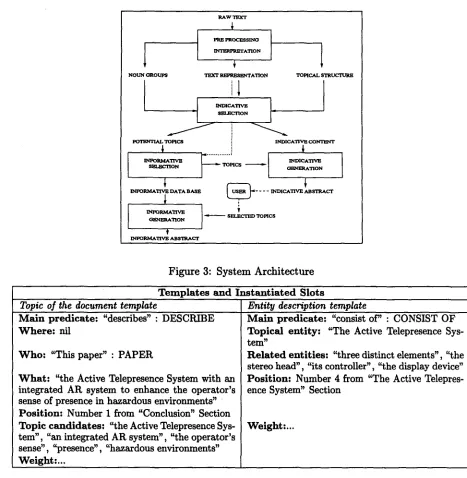
[image:3.612.71.567.75.300.2]The overall process of automatic abstracting shown in Figure 3 is composed of the following steps:
Pre-processing and Interpretation: The raw text is tagged and transformed in a structured representation allowing the following processes to access the structure of the text (words, groups of words, titles, sentences, paragraphs, sections, and so on). Domain specific transducers are applied in order to identify possible concepts in the discourse domain (such as the authors, the paper, ref- erences to other authors, institutions and so on) and linguistic transducers are applied in order to identify noun groups and verb groups. Afterwards, semantic tags marking discourse domain relations and concepts are added to the different elements of the structure.
Additionally, the process extracts noun groups, computes noun group distribution (assigning a weight to each noun group) and generates the topical structure of the paper: a structure with n + 1 components where n is the number of sections in the document. Component i (0 < i < n) contains the noun groups extracted from the title of section i (0 indicates the title of the document). The structure is used in the se- lection of the content for the indicative abstract.
Indicative Selection: Its function is to identify potential topics of the document and to construct a pool of "propositions" introducing the topics. The indicative templates are used to this end: sentences are selected, filtered and used to instantiate the templates using patterns identified during the analysis of the corpus. The instantiated templates obtained in this step constitute the indicative data base. Each template contains, in addition to their specific slots, the following: the
topic candidate
slot which is filled in with the noun groups of the sentence used for instantiation, the
weight
slot filled in with the sum of the weights of the noun groups in the
topic candidate
slot and, theposition
slot filled in with the position of the sentence (section number and sentence number) which instantiated the template. In Figure 4, the "topic of the document" template appears instantiated using the sentence "this paper describes the Active Telepresence Systemwith an integrated AR system to enhance the operator's sense of presence in hazardous environments."
In order to select the content for the indicative abstract the system looks for a "match" be- tween the topical structure and the templates in the indicative data base: the system tries all the matches between noun groups in the topical structure and noun groups in the topic candidate slots. One template is selected for each component of the topical structure: the template with more matches. The selected templates constitute the content of the indica- tive abstract and the noun groups in the topic candidate slots constitute the potential topics.
Informative Selection: this process aims to confirm which of the potential top- ics computed by the indicative selection are actual topics (i.e. topics the system could informatively expand according to the reader interest) and produces a pool of "proposi- tions" elaborating the topics. All informative templates are used in this step, the process considers sentences containing the potential topics and matching informative patterns. The instantiated informative templates constitute the informative data base and the potential topics appearing in the informative templates form the topics of the document.
1
N O U N G R O U P S
J POTENTLAL TOPICS
INPORMATIVB ~ O N
RAW ~
I PRE PROCESSINO ~ITIERI~RTA'r[ON
TEXT ~ A T I O N
_ I INDICATIVE
1
TOPICAL $TRUCrUR~
INDICA"IIVlg (~ 0 ~
1
i
...
INDICATIVE
II~PORMATIVB DATA BASE ~ USER l "~ .. . . INDICATIVE ABSTRACT
INPORMA'nVE ~ ~'
i GENEZ~ATION $1~..EC'I'~D TOPICS
t
[image:5.612.73.540.70.548.2]INPORMATIVE ABSTRACT
Figure 3: System Architecture
T e m p l a t e s a n d I n s t a n t i a t e d Slots
Topic ol the document template Entity description template M a i n predicate: "describes": DESCRIBE
W h e r e : nil
Who: "This paper": PAPER
W h a t : "the Active Telepresence System with an
integrated AR system to enhance the operator's sense of presence in hazardous environments" "
Position: Number 1 from "Conclusion" Section
Topic candidates: "the Active Telepresence Sys- tem", "an integrated AR system", "the operator's sense", "presence", "hazardous environments"
W e i g h t :...
M a i n predicate: "consist of" : CONSIST OF Topical entity: "The Active Telepresence Sys- tem"
R e l a t e d entities: "three distinct elements", "the
stereo head", "its controller", "the display device" Position: Number 4 from "The Active Telepres- ence System" Section
[image:5.612.193.439.76.327.2]Weight:...
Figure 4: Some Instantiated Templates for the article "Augmenting reality for telerobotics: unifying real and virtual worlds" J. Pretlove, Industrial Robot, voi.25, issue 6, 1998.
Describes the Active Telepresence System with an integrated AR system to enhance the operator's sense of presence in hazardous environments.
Topics: Active Telepresence System (de-
scription); AR system (description); AR (definition)
If the reader choses to expand the description of the topic "Active Telepresence System", the following text will be presented:
The Active Telepresence System consists of three distinct elements: the stereo head, its controller and the display device.
processes of indicative and informative selection and we are developping the generation step.
5 D i s c u s s i o n
In this paper, we have presented a new method of automatic abstracting based on the re- sults obtained from the study of a corpus of professional abstracts and parent docu- ments. In order to implement the model, we rely on techniques in finite state processing, instantiation of templates and re-generation techniques. Paice and Jones (1993) have already used templates representing specific information in a restricted domain in order to generate indicative abstracts. Instead, we aim at the generation of indicative-informative abstracts for domain independent texts. Radev and McKeown (1998) also used instantiated templates, but in order to produce summaries of multiple documents. They focus on the generation of the text while we are address- ing the overall process of automatic abstracting.
We are testing our method using long tech- nical articles found on the "Web." Some out- standing issues axe: the problem of co-reference, the problem of polysemy of the lexical items, the re-generation techniques and the evaluation of the methodology which will be based on the judgment of readers.
A c k n o w l e d g m e n t s
I would like to thank my adviser, Prof. Guy Lapalme for encouraging me to present this work. This work is supported by Agence Cana- dienne de D~veloppement International (ACDI) and Ministerio de Educaci6n de la Naci6n de la Repdblica Argentina, Resoluci6n 1041/96.
R e f e r e n c e s
M. Bunge. 1967. Scienti-fc Research I. The Search for System. Springer-Verlag New York Inc.
E.T. Cremmins. 1982. The Art o-f Abstracting. ISI PRESS.
B. Endres-Niggemeyer, E. Maier, and A. Sigel. 1995. How to implement a naturalistic model of abstracting: Four core working steps of an expert abstractor. Information Processing ?J Management, 31(5):631-674.
G. Foster. 1991. Statistical lexical disam- biguation. Master's thesis, McGill University, School of Computer Science.
F. Johnson. 1995. Automatic abstracting re- search. Library Review, 44(8):28-36.
J. Kupiec, J. Pedersen, and F. Chen. 1995. A trainable document summarizer. In Proc. o-f the 18th ACM-SIGIR Conference, pages 68- 73.
H.P. Luhn. 1958. The automatic creation of lit- erature abstracts. IBM Journal o? Research Development, 2(2):159-165.
D. Marcu. 1997. From discourse structures to text summaries. In The Proceedings of the A CL'97/EA CL'97 Workshop on Intelligent Scalable Text Summarization, pages 82-88, Madrid, Spain, July 11.
K. McKeown, D. Jordan, and V. Hatzivas- siloglou. 1998. Generating patient-specific summaries of on-line literature. In Intelli- gent Text Summarization. Papers from the 1998 A A A I Spring Symposium. Technical Re- port SS-98-06, pages 34-43, Standford (CA), USA, March 23-25. The AAAI Press.
C.D. Paice and P.A. Jones. 1993. The iden- tification of important concepts in highly structured technical papers. In R. Korfhage, E. Rasmussen, and P. Willett, editors, Proc. o-f the 16th ACM-SIGIR Conference, pages 69-78.
D.R. Radev and K.R. McKeown. 1998. Gener- ating natural language summaries from mul- tiple on-line sources. Computational Linguis- tics, 24(3):469-500.
L.H.M. Rino and D. Scott. 1996. A discourse model for gist preservation. In D.L. Borges and C.A.A. Kaestner, editors, Proceedings o-f the 13th Brazilian Symposium on Artificial Intelligence, SBIA '96, Advances in Artificial Intelligence, pages 131-140. Springer, Octo- ber 23-25, Curitiba, Brazil.
H. Saggion and G. Lapalme. 1998. Where does information come from? corpus analysis for automatic abstracting. In RIFRA'98. Ren- contre Internationale sur l'extraction le Fil- trate et le Rdsumd Automatique, pages 72-83. F. de M. Vianna, editor. 1980. Roger's II. The