Dialogue Management in Vector-Based Call Routing
Jennifer Chu-Carroll and Bob Carpenter
L u c e n t T e c h n o l o g i e s B e l l L a b o r a t o r i e s 6 0 0 M o u n t a i n A v e n u e
M u r r a y H i l l , N J 0 7 9 7 4 , U . S . A .
E - m a i l : { j e n c c , c a r p } @ r e s e a r c h . b e l l - l a b s . c o r n
Abstract
This paper describes a domain independent, automat- ically trained call router which directs customer calls based on their response to an open-ended "How may I di- rect your call?" query. Routing behavior is trained from a corpus of transcribed and hand-routed calls and then carried out using vector-based information retrieval tech- niques. Based on the statistical discriminating power of the n-gram terms extracted from the caller's request, the caller is 1) routed to the appropriate destination, 2) trans- ferred to a human operator, or 3) asked a disambigua- tion question. In the last case, the system dynamically generates queries tailored to the caller's request and the destinations with which it is consistent. Our approach is domain independent and the training process is fully automatic. Evaluations over a financial services call cen- ter handling hundreds of activities with dozens of desti- nations demonstrate a substantial improvement on exist- ing systems by correctly routing 93.8% of the calls after punting 10.2% of the calls to a human operator.
1 Introduction
The call routing task involves directing a user's call to the appropriate destination within a call center or pro- viding some simple information, such as loan rates. In current systems, the user's goals are typically gleaned via a touch-tone system employing a rigid hierarchical menu. The primary disadvantages of navigating menus for users are the time it takes to listen to all the options and the difficulty of matching their goals to the options; these problems are compounded by the necessity of de- scending a nested hierarchy of choices to zero in on a particular activity. Even simple requests such as " I ' d like my savings account balance" may require users to nav- igate as many as four or five nested menus with four or five options each. We have developed an alternative to touch-tone menus that allows users to interact with a call router in natural spoken English dialogues just as they would with a human operator.
Human operators respond to a caller request by 1) routing the call to an appropriate destination, or 2) query- ing the caller for further information to determine where to route the call. Our automatic call router has these two options as well as a third option of sending the call to a
human operator. The rest of this paper provides both a description and an evaluation of an automatic call router driven by vector-based information retrieval techniques. After introducing our fundamental routing technique, we focus on the disambiguation query generation module. Our disambiguation module is based on the same sta- tistical training as routing, and dynamically generates queries tailored to the caller's request and the destina- tions with which it is consistent. The main advantages of our system are that 1) it is domain independent, 2) it is trained fully automatically to both route and disam- biguate requests, and 3) its performance is sufficient for use in the field, substantially improving on that of previ- ous systems.
2 Related Work
Call routing is similar to topic identification (Mc- Donough et al., 1994) and document routing (Harman, 1995) in identifying which one of n topics (destinations) most closely matches a caller's request. Call routing is distinguished from these activities by requiring a single destination, but allowing a request to be refined in an in- teractive dialogue. We are further interested in carrying out the routing using natural, conversational language.
The only work on call routing to date that we are aware of is that by Gorin et al. (to appear). They se- lect salient phrase fragments from caller requests, such as
made a long distance and the area code for. These phrase fragments are used to determine the most likely destina- tion(s), which they refer to as call type(s), for the request either by computing the a posteriori probability for each call type or by passing the fragments through a neural network classifier. Abella and Gorin (1997) utilized the Boolean formula minimization algorithm for combining the resulting set of call types based on a hand-coded hi- erarchy of call types. Their intention is to utilize the out- come of this algorithm to select from a set of dialogue strategies for response generation.
3 C o r p u s A n a l y s i s
Name Activity Indirect # of calls 949 3271 277 % of all calls 21.1% 72.7% 6.2%
Table 1: Semantic Types of Caller Requests
dialogue actions f o r response generation. The call cen- ter provides financial services in hundreds of categories in the general areas of banking, credit cards, loans, insur- ance and investments; we concentrated on the 23 desti- nations for which we had at least 10 calls in the corpus.
3.1 Semantics o f Caller Requests
The operator provides an open-ended prompt o f "How may I direct your call?" We classified user responses into three categories. First, callers may explicitly pro- vide a destination name, either by itself or embedded in a complete sentence, such as "may I have consumer lending?" Second, callers may describe the activity they would like to perform. Such requests may be unambigu- ous, such as "l'd like my checking account balance", or ambiguous, such as "car loans please", which in our call center can be resolved to either consumer lending, which handles new car loans, or to loan services, which handles existing car loans. Third, a caller can provide an indirect request, in which they describe their goal in a round- about way, often including irrelevant information. This often occurs when the caller either is unfamiliar with the call center hierarchy or does not have a concrete idea of how to achieve the goal, as in "ah I'm calling 'cuz ah a friend gave me this number and ah she told me ah with this number I can buy some cars or whatever but she didn't know how to explain it to me so l just called you you know to get that information."
Table 1 shows the distribution of caller requests in our corpus with respect to these semantic types. Our analysis shows that in the vast majority of calls, the request was based on destination name or activity. Since there is a fairly small number (dozens to hundreds) of activities be- ing handled by each destination, requests based on name and activity are expected to be more predictable and thus more suitable for handling by an automatic call router. Thus, our goal is to automatically route those calls based on name and activity, while leaving the indirect or inap- propriate requests to human call operators.
3.2 Dialogue Actions for Response Generation
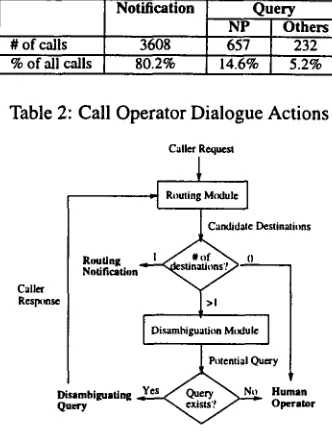
We also analyzed the operator's responses to caller re- quests to determine the dialogue actions needed for re- sponse generation in our automatic call router. We found that in the call routing task, the call operator either no- tifies the customer of the routing destination or asks a disambiguating query.l
lln cases where the operator generates an acknowledgment, such as uh-huh, midway through the caller's request, we analyzed the next operator utterance.
Notification
# of calls 3608 % of all calls 80.2%
Query NP I Others 657 232 14.6% 5.2%
Table 2: Call Operator Dialogue Actions
Caller
Reslxmse
Caller Request
-I
I
andidale Destinations
R,,,a,z t_!..~+o.,~,L.o.,~ 0
N o t i f i c a t h m ~
~
ential QueryDisambiRuating Yes f Query ~ Human
Query ~ - Operator
Figure 1: Call Router Architecture
Table 2 shows the frequency that each dialogue ac- tion should be employed based strictly on the presence of ambiguity in the caller requests in our corpus. We fur- ther analyzed those calls considered ambiguous within our call center and noted that 75% of such ambiguous re- quests involve underspecified noun phrases, such as re- questing car loans without specifying whether it is an existing or new car loan. The remaining 25% of the ambiguous requests involve underspecified verb phrases, such as asking to transfer funds without specifying the types of accounts to and from which the transfer will oc- cur, or missing verb phrases, such as asking for direct deposit without specifying whether the caller wants to set up or change an existing direct deposit.
4 Dialogue Management in Call Routing
Our call router consists of two components: the rout- ing module and the disambiguation module. The rout- ing module takes a caller request and determines a set of destinations to which the call can reasonably be routed. If there is exactly one such destination, the call is routed there and the customer notified; if there are multiple des- tinations, the disambiguation module is invoked in an at- tempt to formulate a query; and if there is no appropriate destination or if a reasonable disambiguation query can- not be generated, the call is routed to an operator. Fig- ure I shows a diagram outlining this process.4.1 The Routing M o d u l e
Our approach is novel in its application of information retrieval techniques to select candidate destinations for a call. We treat call routing as an instance of document routing, where a collection of judged documents is used for training and the task is to judge the relevance of a set of test documents (Schiitze et al., 1995). More specifi-
[image:2.612.106.269.90.120.2] [image:2.612.342.508.92.308.2]cally, each destination in our call center is represented as a collection o f documents (transcriptions of calls routed to that destination), and given a caller request, we judge the relevance o f the request to each destination.
4.1.1 The Training Process
Document Construction Our training corpus consists o f 3753 calls each o f which is hand-routed to one o f 23 destinations. 2 Our first step is to create one (virtual) document per destination, which contains the text o f the callers' contributions to all calls routed to that destina- tion.
M o r p h o l o g i c a l F i l t e r i n g We filter each (virtual) doc- ument through the morphological processor of the Bell L a b s ' Text-to-Speech synthesizer (Sproat, 1997) to ex- tract the root form o f each word in the corpus. Next, the root forms o f caller utterances are filtered through two lists, the ignore list and the stop list, in order to build a better n - g r a m model. The ignore list consists o f noise words, such as uh and um, which sometimes get in the way o f proper n - g r a m extraction, as in "I'd like to speak to someone about a car uh loan". With noise word filtering, we can properly extract the bigram "car, loan". The stop list enumerates words that do not discriminate between destinations, such as the, be, and afternoon. We modified the standard stop list distributed with the S M A R T information retrieval system (Salton, 1971) to include domain specific terms and proper names that occurred in the training corpus. Note that when a stop word is filtered out o f the caller utterance, a place- holder is inserted to prevent the words preceding and fol- lowing the stop word to form n-grams. For instance, af- ter filtering the stop words out o f "I want to check on an account", the utterance becomes "<sw> <sw> <sw> check <sw> <sw> account". Without the placeholders, we would extract the bigram "check, account", just as if the caller had used the term checking account.
Term E x t r a c t i o n We extract the n - g r a m terms that oc- cur more frequently than a pre-determined threshold and do not contain any stop words. Our current system uses unigrams that occurred at least twice and bigrams and trigrams that occurred at least three times in the corpus. No 4-grams occurred three times.
Term-Document M a t r i x Once the set o f relevant terms is determined, we construct an m x n term- document frequency matrix A whose rows represent the m terms, whose columns represent the n destinations, and where an entry At,a is the frequency with which term t occurs in calls to destination d.
It is often advantageous to weight the raw counts to fine tune the contribution o f each term to routing. We begin by normalizing the row vectors representing terms by making them each o f unit length. Thus we di- vide each row At in the original matrix by its length,
2These 3753 calls are a subset of the corpus of 4497 calls used in
o u r corpus analysis. We excluded those ambiguous calls that were not
resolved by the operator.
A 2 1/2
( E l < e < n
t,e)
.
Our second weighting is based on the n-oti-on that a term that only occurs in a few docu- ments is more important in discriminating among docu- ments than a term that occurs in nearly every document. We use the inverse document frequency (IDF) weighting scheme (Sparck Jones, 1972) whereby a term is weighted inversely to the number o f documents in which it occurs, by means oflDF(t) = log 2 n / d ( t ) where t is a term, n is the total number o f documents in the corpus, and d(t) is the number of documents containing the term t. Thus we obtain a weighted matrix B , whose elements are given by Bt,a = At,a x IDF(t)/(~-~x<e< n A2,e)x/2.Vector Representation To reduce the dimensional- ity of our vector representations for terms and doc- uments, we applied the singular value decomposition (Deerwester et al., 1990) to the m x n matrix B o f weighted term-document frequencies. Specifically, we take B = U S V T, where U is an m x r orthonormal ma- trix (where r is the rank o f B), V is an n x r orthonor- mal matrix, and S is an r x r diagonal matrix such that Sl,1 ~_~ 82,2 ~> " ' " ~> Sr,r ~ O.
We can think o f each row in U as an r - d i m e n s i o n a l vector that represents a term, whereas each row in V is an r-dimensional vector representing a document. With appropriate scaling of the axes by the singular values on the diagonal o f S, we can compare documents to documents and terms to terms using their corresponding points in this new r - d i m e n s i o n a l space (Deerwester et al., 1990). For instance, to employ the dot product o f two vectors as a measure of their similarity as is com- mon in information retrieval (Salton, 1971), we have the matrix B T B whose elements contain the dot product o f document vectors. Because S is diagonal and U is or- thonormal, B T B = V S Z V T = V S ( V S ) T. Thus, ele- ment i, j in B T B , representing the dot product between document vectors i and j , can be computed by taking the dot product between the i and j rows o f the matrix V S . In other words, we can consider rows in the matrix V S as vectors representing documents for the purpose o f document/document comparison. A n element o f the original matrix Bi,j, representing the degree o f associa- tion between the ith term and the j t h document, can be recovered by multiplying the ith term vector by the j t h scaled document vector, namely B i j = U i ( ( V S ) j ) T.
4.1.2 Call Routing
Given the vector representations o f terms and documents (destinations) in r - d i m e n s i o n a l space, how do we deter- mine to which destination a new call should be routed? Our process for vector-based call routing consists o f the following four steps:
one bigram term, "saving, account", and two unigrams, "check" and "balance".
Pseudo-Document Generation Given the extracted terms from a caller request, we can represent the request as an m-dimensional vector Q where each component Qi represents the number of times that the ith term occurred in the caller's request. We then create an r-dimensional pseudo-document vector D = QU, following the stan- dard methodology of vector-based information retrieval (see (Deerwester et al., 1990)). Note that D is simply the sum of the term vectors Ui for all terms occurring in the caller's request, weighted by their frequency of oc- currence in the request, and is scaled properly for docu- ment/document comparison.
Scoring Once the vector D for the pseudo-document is determined, we compare it with the document vectors by computing the cosine between D and each scaled docu- ment vectors in VS. Next, we transform the cosine score for each destination using a sigmoid function specifically fitted for that destination to obtain a confidence score that represents the router's confidence that the call should be routed to that destination.
The reason for the mapping from cosine scores to con- fidence scores is because the absolute degree of similar- ity between a request and a destination, as given by the cosine value between their vector representations, does not translate directly into the likelihood for correct rout- ing. Instead, some destinations may require a higher co- sine value, i.e., a closer degree of similarity, than others in order for a request to be correctly associated with those destinations. Thus we collected, for each destination, a set of cosine value/routing value pairs over all calls in the training data, where the routing value is 1 if the call should be routed to that destination and 0 otherwise. Then for each destination, we used the least squared error method in fitting a sigmoid function, 1/(1 + e-(a~+b)), to the set of cosine/routing pairs.
We tested the routing performance using cosine vs. confidence values on 307 unseen unambiguous requests. In each case, we selected the destination with the high- est cosine/confidence score to be the target destination. Using strict cosine scores, 92.2% of the calls are routed to the correct destination. On the other hand, using sig- moid confidence fitting, 93.5% of the calls are correctly routed. This yields a relative reduction in error rate of 16.7%.
Decision Making The outcome of the routing module is a set of destinations whose confidence scores are above a pre-determined threshold. These candidate destinations represent those to which the caller's request can reason- ably be routed. If there is only one such destination, then the call is routed and the caller notified; if there are two or more possible destinations, the disambiguation mod- ule is invoked in an attempt to formulate a query; other- wise, the the call is routed to an operator.
To determine the optimal value for the threshold, we
I
0.8 0.6 0.4 0.2 0 0
U p p c d ~ n d
L~,wcrb~mnd
0.1 0.2 0.3 0.4 0.5 0.6 0.7 0.8 0.9
Thr~h~dd
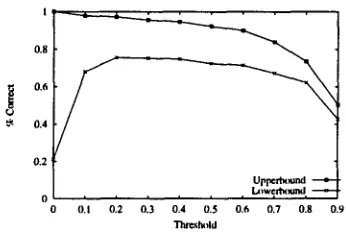
Figure 2: Router Performance vs. Threshold
ran a series of experiments to compute the upperbound and lowerbound of the router's performance varying the threshold from 0 to 0.9 at 0.1 intervals. The lowerbound represents the percentage of calls that are routed cor- rectly, while the upperbound indicates the percentage of calls that have the potential to be routed correctly after disambiguation (see section 5 for details on upperbound and lowerbound measures). The results in Figure 2 show 0.2 to be the threshold that yields optimal performance.
4.2 The Disambiguation Module
The disambiguation module attempts to formulate an ap- propriate query to solicit further information from the caller in order to determine a unique destination to which the call should be routed. To generate an appropriate query, the caller's request and the candidate destinations must both be taken into account. We have developed a vector-based method for dynamically generating dis- ambiguation queries by first selecting a set of terms and then forming a wh or yes-no question from these selected t e r m s .
The terms selected by the disambiguation mechanism are those terms related to the original request that can likely be used to disambiguate among the candidate des- tinations. These terms are chosen by filtering all terms based on the following three criteria:
I. Closeness: We choose terms that are close (by the cosine measure) to the differences between the scaled pseudo-document query vector, D, and vec- tors representing the candidate destinations in V S . The intuition is that adding terms close to the differ- ences will disambiguate the original query.
2. Relevance: From the close terms, we construct a set of relevant terms which are terms that further specify a term in the original request. A close term is considered relevant if it can be combined with a term in the request to form a valid n-gram term, and the relevant term will be the resulting n-gram tenn. For instance, if "car,loan" is in the original request, then both "new" and "new, car" would produce the relevant term "new, car, loan"
3. Disambiguating power: Finally, we restrict at- tention to relevant terms that can be added to the
[image:4.612.341.514.88.204.2]original request to result in an unambiguous rout- ing using the routing mechanism described in Sec- tion 4.1.2. If none o f the relevant terms satisfy this criterion, then we include all relevant terms in the set of disambiguating terms. Thus, instead of giving up the disambiguation process when no one term is predicted to resolve the ambiguity, the system may pose a question which further specifies the request and then select a disambiguating term based on this refined (although still ambiguous) request.
The result o f this filtering process is a finite set of terms which are relevant to the original ambiguous query and, when added to it, are likely to resolve the ambigu- ity. If a significant number of these terms share a head word, such as loan, the system asks the wh-question "for what type o f loan ?'" Otherwise, the term that occurred most frequently in the training data is selected, based on the heuristic that a more c o m m o n term is likely to be relevant than an obscure term, and a yes-no question is formed based on this term. A third alternative would be to ask a disjunctive question, but we have not yet ex- plored this possibility. Figure 1 shows that after the sys- tem poses its query, it attempts to route the refined re- quest, which is the original request augmented with the caller response to the system's query. In the case of wh- questions, n-gram terms are extracted from the caller's response. In the case of yes-no questions, the system de- termines whether a y e s or no answer is given. 3 In the for- mer case, the disambiguating term used to form the query is considered the caller response, while in the latter case, the response is treated as in responses to wh-questions.
Note that our disambiguation mechanism, like our ba- sic routing technique, is fully domain-indepefident. It utilizes a set of n-gram terms, as well as term and doc- ument vectors that were obtained by the training of the call router. Thus, porting the call router to a new domain requires no change in the disambiguation module.
4.3 E x a m p l e
To illustrate our call router, consider the request "loans please." This request is ambiguous because our call center handles mortgage loans separately from all other types o f loans, and for all other loans, existing loans and new loans are again handled by different departments.
Given this request, the call router first extracts the rel- evant n-gram terms, which in this case results in the uni- gram "'loan". It then computes a pseudo-document vec- tor that represents this request, which is compared in turn with the 23 vectors representing all destinations in the call center. The cosine values between the request and each destination are then mapped into confidence values.
3 In our current system, a response is considered a yes response only if it explicitly contains the word yes. However, as discussed in (Green and Carberry, 1994; Hockey et al., 1997), responses to yes-no questions may not explicitly contain a yes or no term. We leave incorporating a more sophisticated response understanding model, such as (Green and Carberry, 1994), into our system for future work.
Using a confidence threshold of 0.2, we have two can- didate destinations, Loan Servicing and Consumer Lend- ing; thus the disambiguation module is invoked.
Our disambiguation module first selects from all n- gram terms those whose term vectors are close to the dif- ference between the request vector and either of the two candidate destination vectors. This results in a list of 60 close terms, the vast majority of which are semantically close to "loan", such as "auto, loan", "payoff", and "owe". Next, the relevant terms are constructed from the set of close terms. This results in a list of 27 relevant terms, including "'auto, loan" and "loan,payoff", but ex- cluding owe, since neither "loan, o w e " nor "owe, loan" constitutes a valid bigram. The third step is to select those relevant terms with disambiguation power, result- ing in 18 disambiguating terms. Since 11 of these disam- biguating terms share a head noun loan, a wh-question is generated based on this head word, resulting in the query
"for what type o f loan ?"
Suppose in response to the system's query, the user answers "car loan". The router then adds the new bi- gram "car, loan" to the original request and attempts to route the refined request. This refined request is again ambiguous between Loan Servicing and Consumer Lend- ing since the caller did not specify whether it was an ex- isting or new car loan. Again, the disambiguation mod- ule selects the close, relevant, and disambiguating terms, resulting in a unique term "exist, car, loan". Thus, the system generates the yes-no question "is this about an existing car loan ? ,4 If the user responds "yes", then the trigram term "exist, car, loan" is added to the refined re- quest and the call routed to Loan Servicing; if the user says "'no, it's a new car loan", then "new, car, loan" is extracted from the response and the call routed to Con- sumer Lending.
5
E v a l u a t i o n
5.1 The Routing Module
We performed an evaluation of the routing module o f our call router on a fresh set of 389 calls to a human opera- tor. 5 Out of the 389 requests, 307 are unambiguous and routed to their correct destinations, and 82 were ambigu- ous and annotated with a list of candidate destinations. Unfortunately, in this test set, only the caller's first ut- terance was transcribed. Thus we have no information about where the ambiguous calls were eventually routed. The routing decision made for each call is classified into one of 8 groups, as shown in Figure 3. For instance,
4Our current system uses simple template filling for response gener- ation by utilizing a manually constructed mappings from n-gram terms to their inflected forms, such as from "exist, car, loan" to "an existing car loan ".
Is request actually unambiguous?
Is call routed by router? Is call routed by router?
ye<
correct? contains correct? one of possible? overlaps with possible?
la l b 2a 2b 3a 3b 4a 4b
Figure 3: Classification of Router Outcome
Unambiguous Ambiguous All ]
Requests Requests I Requests
I
LB la/(i+2) 4a/(3+4) | (1 a+4a)/all
UB
Table 3: Calculation of Upperbounds and Lowerbounds
group l a contains those calls which are 1) actually unam- biguous, 2) considered unambiguous by the router, and 3) routed to the correct destination. On the other hand, group 3b contains those calls which are 1) actually am- biguous, 2) considered by the router to be unambiguous, and 3) routed to a destination which is not one of the potential destinations.
We evaluated the router's performance on three sub- sets of our test data, unambiguous requests alone, am- biguous requests alone, and all requests combined. For each set of data, we calculated a lowerbound perfor- mance, which measures the percentage of calls that are correctly routed, and an upperbound performance, which measures the percentage of calls that are either correctly routed or have the potential to be correctly routed. Ta- ble 3 shows how the upperbounds and lowerbounds are computed based on the classification in Figure 3 for each of the three data sets. For instance, for unambiguous re- quests (classes 1 and 2), the lowerbound is the number of calls actually routed to the correct destination (la) divided by the number of total unambiguous requests, while the upperbound is the number of calls actually routed to the correct destination (1 a) plus the number of calls which the router finds to be ambiguous between the correct destination and some other destination(s) (2a), di- vided by the number of unambiguous queries. The calls in category 2a are considered to be potentially correct be- cause it is likely that the call will be routed to the correct destination after disambiguation.
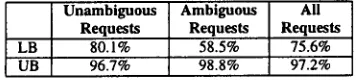
Table 4 shows the upperbound and lowerbound perfor- mance for each of the three test sets. These results show
Unambiguous Ambiguous All
Requests Requests Requests
LB 80.1% 58.5% 75.6%
UB 96.7% 98.8% 97.2%
Table 4: Router Performance with Threshold = 0.2
that the system's overall performance will fall some- where between 75.6% and 97.2%. The actual perfor- mance of the system is determined by two factors: 1) the performance of the disambiguation module, which de- termines the correct routing rate of the 16.6% of the un- ambiguous calls that were considered ambiguous by the router (class 2a), and 2) the percentage of calls that were routed correctly out of the 40.4% ambiguous calls that were considered unambiguous and routed by the router (class 3a). Note that the performance figures in Table 4 are the result of 100% automatic routing, since no re- quest in our test set failed to evoke at least one candidate destination. In the next sections, we discuss the perfor- mance of the disambiguation module, which determines the overall system performance, and show how allowing calls to be punted to operators affects the system's per- formance.
5.2 The Disambiguation M o d u l e
To evaluate our disambiguation module, we needed dia- logues which satisfy two criteria: 1) the caller's first ut- terance is ambiguous, and 2) the operator asked a follow- up question to disambiguate the query and subsequently routed the call to the appropriate destination. We used 157 calls that meet these two criteria as our test set. Note that this test set is disjoint from the test set used in the evaluation of the router (Section 5. I), since none of the transcribed calls in the latter test set satisfied criterion
(2).
For each ambiguous call, the first user utterance was given to the router as input. The outcome of the router was classified as follows:
1. Unambiguous: in this case the call was routed to the selected destination. This routing was considered correct if the selected destination was the same as the actual destination and incorrect otherwise.
2. Ambiguous: in this case the router attempted to ini- tiate disambiguation. The outcome of the routing of these calls were determined as follows:
(a) Correct, if a disambiguation query was gener- ated which, when answered, led to the correct destination.
(b) Incorrect, if a disambiguation query was gen- erated which, when answered, could not lead to a correct destination.
(c) Reject, if the router could not form a sensi- ble query or was unable to gather sufficient in- formation from the user after its queries and routed the call to an operator.
Table 5 shows the number of calls that fall into each of the 5 categories. Out of the 157 calls, the router au- tomatically routed 115 of them either with or without disambiguation (73.2%). Furthermore, 87.0% of these routed calls were routed to the correct destination. No- tice that out of the 52 ambiguous calls that the router con- sidered unambiguous, 40 were routed correctly (76.9%).
[image:6.612.75.297.83.260.2] [image:6.612.98.278.659.700.2]Routed As Unambiguous Routed As Ambiguous
c° ct
1 4 0
lnco ct
l 2
C° c' I X°c°?°t I eje°t
60
42
Table 5: Performance of Disambiguation Module on Ambiguous Calls
Correct Incorrect Reject
Class 1 63.2% 1.3% 0%
Class 2 7.5% 1.7% 5.3%
Class 3 6.5% 2.2% 0%
Class 4 7.0% 0.4% 4.9%
Total 84.2% 5.6% 10.2%
Table 6: Overall Performance of Call Router
This is simply because our vector-based router is able to distinguish between cases where an ambiguous query is equally likely to be routed to more than one destination, and situations where the likelihood of one potential desti- nation overwhelms that of the other(s). In the latter case, the router routes the call to the most likely destination in- stead of initiating disambiguation, which has been shown to be an effective strategy; not surprisingly, human op- erators are also prone to guess the destination based on likelihood and route callers without disambiguation.
5.3 Overall Performance
Combining results from Section 5.2 for ambiguous calls with results from Section 5.1 for unambiguous calls leads to the overall performance of the call router in Table 6. The table shows the number of calls that will be correctly routed, incorrectly routed, and rejected, if we apply the performance of the disambiguation module (Table 5) to the calls that fall into each class in the evaluation of the routing module (Section 5.1). Our results show that out of the 389 calls in our test set, 89.8% of the calls will be automatically routed by the call router. Of these calls, 93.8% (which constitutes 84.2% of all calls) will be routed to their correct destinations. This is substan- tially better than the results obtained by Gorin et al., who report an 84% correct routing rate with a 10% false rejec- tion rate (routed to an operator when the call could have been automatically routed) on 14 destinations (Gorin et al., to appear). 6
6
Conclusions
We described and evaluated a domain independent, au- tomatically trained call router that takes one of three ac- tions in response to a caller's request. It can route the call to a destination within the call center, attempt to
6Gorin et al.'s results are measured without the possibility of system queries. To provide a fair comparison, we evaluated our muting module on all 389 calls in our test set using the scoring method described in (Gorin et al., to appear) (which corresponds roughly to our upperbound measure), and achieved a 94. ! % correct routing rate to 23 destinations when all calls are automatically routed (no false rejection), a substantial improvement over their system.
formulate a disambiguating query, or route the call to a human operator. The routing module of the call router selects a set of candidate destinations based on n-gram terms extracted from the caller request and a vector- based comparison between these n-gram terms and each possible destination. If disambiguation is necessary, a yes-no question or wh-question is dynamically generated from among known n-gram terms in the domain based on closeness, relevance, and disambiguating power, thus tailoring the disambiguating query to the original request and the candidate destinations. Finally, our system per- forms substantially better than the best previously exist- ing system, achieving an overall 93.8% correct routing rate for automatically routed calls when rejecting 10.2% of all calls.
Acknowledgments
We would like to thank Christer Samuelsson and Jim Hi- eronymus for helpful discussions, and Diane Litman for comments on an earlier draft of this paper.
References
A. Abella and A. Gorin. 1997. Generating semantically consistent inputs to a dialog manager. In Proc. EU- ROSPEECH, pages 1879-1882.
B. Carpenter and J. Chu-Carroll. submitted. Natural language call routing: A robust, self-organizing ap- proach.
S. Deerwester, S. Dumais, G. Furnas, T. Landauer, and R. Harshman. 1990. Indexing by latent semantic anal- ysis. Journal of the American Society for Information Science, 41:391-407.
A. Gorin, G. Riccardi, and J. Wright. to appear. How may I help you? Speech Communication.
N. Green and S. Carberry. 1994. A hybrid reasoning model for indirect answers. In Proc. ACL, pages 5 8 - 65.
D. Harman. 1995. Overview of the fourth Text REtrieval Conference. In Proc. TREC.
B. Hockey, D. Rossen-Knill, B. Spejewski, M. Stone, and S. Isard. 1997. Can you predict responses to yes/no questions? yes, no, and stuff. In Proc. EU- ROSPEECH, pages 2267-2270.
J. McDonough, K. Ng, P. Jeanrenaud, H. Gish, and J. R. Rohlicek. 1994. Approaches to topic identification on the switchboard corpus. In Proc. ICASSP, pages 385- 388.
G. Salton. 1971. The SMART Retrieval System. Prentice Hall.
H. Schtitze, D. Hull, and J. Pedersen. 1995. A compari- son of classifiers and document representations for the routing problem. In Proc. SIGIR.
K. Sparck Jones. 1972. A statistical interpretation of term specificity and its application in retrieval. Jour- nal of Documentation, 28:11-20.