Obtaining Copper with Harmonic Structure for the Optimal Balance
of Structure-Performance Relationship
Dmitry Orlov
1,+, Hiroshi Fujiwara
2and Kei Ameyama
31Ritsumeikan Global Innovation Research Organization, Ritsumeikan University, Kusatsu 525-8577, Japan 2Department of Mechanical and Systems Engineering, Faculty of Science and Engineering,
Doshisha University, Kyotanabe 610-0394, Japan
3College of Science and Engineering, Department of Mechanical Engineering, Ritsumeikan University, Kusatsu 525-8577, Japan
Materials having bimodal grain structures are known for the good balance of strength and ductility. However, methods for their fabrication often lack the control of such structure characteristics. In this work, the principles of“harmonic”structure fabrication allowing to control both topology and scale of the bimodal structure heterogeneity have been concisely formulated. The feasibility to form the“harmonic structure”in pure copper has been demonstrated, and the advantages of tensile performance of the material with such a structure is analyzed.
[doi:10.2320/matertrans.MH201320]
(Received April 16, 2013; Accepted June 18, 2013; Published July 26, 2013)
Keywords: copper, powder metals, bimodal structure topology, harmonic structure, mechanical properties
1. Introduction
Obtaining better materials with better structure-perform-ance relationship is a quest as long as the human being history. The history also teaches that a tool among the best for the structure-performance relationship control is plastic deformation processing.16)
Approximately two decades ago it had been demonstrated that the refinement of materials structure to“Nano”scale by deformation processing and other means is the best way to achieve ultimate strength.7,8) However, increase in strength
usually comes at the expense of decrease in ductility. Therefore, conventional coarse-grained metals typically demonstrate relatively low strength and high ductility, while their Nano- or ultra-fine grained (UFG) counterparts high strength and low ductility.46)
Usually, strength-ductility ratio is thought to be dependent on mean grain size. However, it has been demonstrated recently that such a ratio also strongly depends on grain size distribution.9) For instance, Wang et al.10) provided exper-imental evidence that bimodal grain size distribution can lead to the balance of elevated strength and still high ductility, while Joshi et al.11)and Berbenniet al.9) presented
theoret-ical models linking the mechantheoret-ical and microstructure characteristics for such a case. Nonetheless, performance of bi-modal microstructures, as well as development of reliable methods for their formation, still requires thorough inves-tigation.12) In addition, most of the methods for bimodal
structure formation reported to date lack the control of topology of grain size distribution.
Recently, Ameyama and co-workers proposed an ap-proach, which allows achieving both high strength and high ductility in metallic materials through the formation of so-called “harmonic”structure.13,14) It is essentially a structure having bimodal grain size distribution. However, in addition to be bimodal, the term “harmonic” signifies that this structure has a specific topology:“fine”and “coarse”grains
in it are positioned in a periodic, or the “harmonic” order. A schematic illustration of such a microstructure is shown in Fig. 1.
In this work, we would like to concisely formulate main principles of this approach as follows. First, different techniques, e.g., mechanical milling (MM) or high-energy ball milling, are used to obtain grain refinement in the periphery (shell) of metal powder particles, while keeping their internal (core) structure unchanged. Then, other special techniques, e.g., spark plasma sintering or hot roll sintering (HRS), are used to consolidate these powders achieving almost null porosity, whilst preserving the heterogeneous structure. As a result, bulk solid products having large distribution of grain sizes in their microstructure, typically bimodal, can be obtained. Main advantage of this approach is the ability to control both topology and scale of the structure heterogeneity in bulk solids.
Hereafter, we (i) investigate the feasibility of such approach to form harmonic structure in pure copper, and (ii) report and analyze the dependence of mechanical properties in this material on the parameters of harmonic structure.
2. Experimental Materials and Methods
Experimental method used for the fabrication of bulk copper billets with harmonic structure is shown schematically in Fig. 1. It involved mechanical milling, vacuum sealing of the processed powders, heat treatments and hot-roll sintering. As an initial material, commercially supplied gas-atomized spherical Cu powder (99.96%purity) with mean particle size of 100 µm was used. The initial powder was mixed with tungsten carbide (WC) balls 5 mm in diameter at the ball : powder ratio 20 : 1, by weight. Then, the mixture was placed into WC vial, sealed with argon gas and mechanically milled on a Fritch P-5 planetary ball mill for 5 h (18 ks) at ambient temperature with rotation speed 200 rpm.
In order to avoid potential contamination of the powder with WC from the balls and the vial material, the latter were pre-covered with Cu. For this purpose, a preliminary“blank
+Senior Researcher, Ritsumeikan University
Special Issue on Advanced Materials Science in Bulk Nanostructured Metals II
run”of the mechanical milling operation was carried out with a“dummy”Cu powder of similar purity at 200 rpm for 1 h. After that, the MM instruments were washed with ethanol and dried. These procedures allowed producing even layer of copper on the surfaces of both the vial and the balls therefore keeping contamination of the powder of interest to minimum. Chemical analysis with “inductively coupled plasma-atomic emission spectroscopy”revealed that in thefinal products the content of tungsten never exceeded 0.0018 mass%, oxygen 0.020 mass% and the purity of Cu remained to be at least 99.80%.
Following the mechanical milling, the MM powder was placed into 60 mm long Cu pipes with internal diameter 10 mm and wall thickness 1 mm. The pipes containing the MM powder were evacuated and sealed on both ends, see Fig. 1. Then, they were pre-heated in a muffle furnace at 873 K for 10 min and hot rolled in five passes, with brief sample re-heating between the passes, to achieve a total reduction in thickness of 90% (equivalent vonMises strain
¾μ2), Fig. 1. This procedure leads to the consolidation, or sintering, of the MM powder and therefore we call it HRS. Finally, the pipes were opened and the HRS samples having harmonic structure whilst virtually null porosity (<0.01%) were extracted.
The powders and microstructures were analyzed with scanning electron microscopy (SEM) and electron back-scatter diffraction (EBSD) analysis. For the SEM observa-tions and the EBSD mapping, Schottky Emission variable pressure field emission gun VP FE-SEM Hitachi SU6600 microscope equipped with Oxford Instruments HKL NordlysMax EBSD detector was used. “AZTech” system was used for the EBSD data acquisition, and“Channel 5”for the analysis. Specimens for SEM and EBSD analysis were prepared by conventional metallographic sample preparation procedures with final polishing in colloidal silica for 1 h.
The mechanical performance of the fabricated samples was evaluated in tensile tests. The tests were carried out using a Shimadzu AGS-10kN universal testing machine operating at initial strain rate 8.5©10¹4s¹1. Specimens for the tensile
testing having gauge length 10 mm and width 2 mm were cut by electric discharge machining and ground on SiC paper to thickness 0.9 mm.
3. Results and Discussion
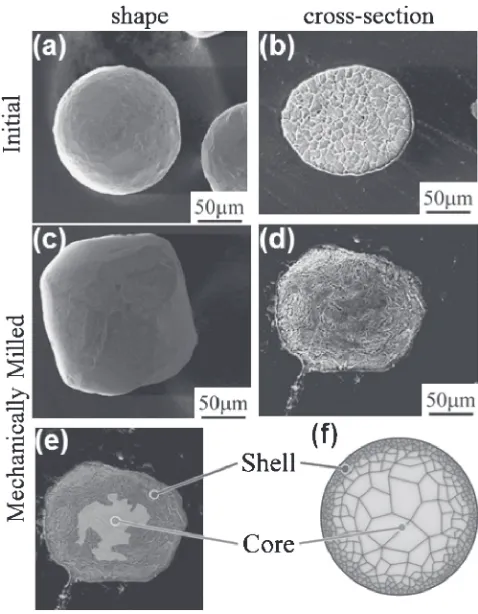
3.1 Structure and morphology of the initial powder Typical morphology of the initial particles and their microstructure are shown in Figs. 2(a) and 2(b), respectively. It can be seen that the initial powder particles indeed have almost ideally spherical shape and average grain size of approximately 13 µm rather homogeneously distributed in the particle cross-section.
Fig. 1 Scheme of fabrication of commercially pure copper with harmonic structure.
[image:2.595.148.445.72.250.2] [image:2.595.307.546.288.595.2]3.2 Structure of the mechanically milled powder The morphology of the MM powder particles and their microstructure are shown in Figs. 2(c) and 2(d), respectively. After the MM processing, the particle net shape becomes irregular, and its surface indicate traces of plastic deforma-tion, Fig. 2(c). Fine alternating dark/light grey contrast on the periphery of particle cross-section indicates significant grain refinement leading to the formation of “shell” area, Fig. 2(d). At the same time, rather homogeneous darker contrast in the middle of the particle, or the “core” area, suggests insignificant alteration of the initial structure, Fig. 2(d). In Fig. 2(e) the shell and the core areas are highlighted for clarity. In Fig. 2(f ), the schematic of the particle microstructure topology is shown. The quantitative analysis of the image in Fig. 2(e) reveals that the shell area occupies approximately 60%of the particle.
The development of heterogeneous shell/core structure during MM processing should be attributed to the balance between the ball size and the weight ratio of balls to powder. This balance is very different for different materials, and therefore should be optimised for each particular case. The general tendency is such that larger-weight (diameter) balls make higher impact on particles leading to deeper penetration of the shell area into the deformed particles. Similar effect has the increase of rotation speed during MM. The increase of balls fraction in the ball/powder mixture leads to the increase of collisions between the powder particles and the balls, and hence to the faster rate of saturation in grain refinement. In the present study, WC balls of 5 mm in diameter at the ball : powder weight ratio 20 : 1 milled for
5 h at a rotation speed of 200 rpm are found to be optimal for the formation of desired heterogeneity of particles’ microstructure.
3.3 Structure of the sintered compacts
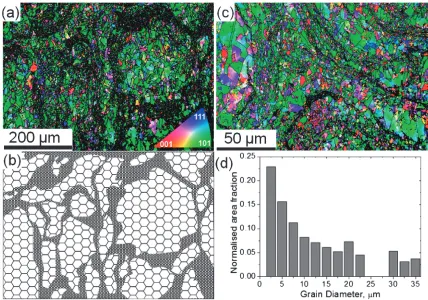
The results of EBSD analysis revealing the structure of the consolidated samples are presented in Fig. 3. Inverse pole figure (IPF) EBSD map scanned with the step size of 1 µm, Fig. 3(a), along with its schematic in Fig. 3(b), clearly demonstrate that the microstructure has “core”areas with average grain size 13 µm surrounded by “shell”areas. The latter has much finer grain sizes and therefore appreciably lower image quality at the selected step size of scan, as indicated by high concentration of grain boundaries (black lines) and black spots where orientations cannot be detected. Therefore, the IPF map from 0.2 µm step size scans showing a “shell” area at the triple junction of the cores is presented in Fig. 3(c). The average grain size in it is
μ0.8 µm.
A very important feature of the entire structure is a closed, or interconnected, network of the “shell”. The histogram of grain size distribution in such a microstructure is shown in Fig. 3(d). It was measured as “equivalent area diameters” using HKL“Channel 5”software package for the analysis of EBSD data. The histogram unambiguously reveals a bimodal distribution with one peak in fine-grain area,¯1 µm, and a standalone population of coarse-grained,²30 µm, structure. Owing to the bimodality and such a topology, this structure can be characterised not only as a “bimodal”, but also as
“harmonic”.
[image:3.595.83.511.69.369.2]3.4 Tensile performance of the pure Cu with harmonic structure
For the analysis of mechanical performance of such harmonic-structure, bulk Cu samples having the same 99.96%purity were used as reference materials in both fully recrystallized coarse-grained and cold rolled to 90% of engineering strain conditions. Hereafter, these material conditions will be referred to as “Bulk” and “CR90”, respectively. A grain size in the Bulk material is 20.8 µm, while in CR90 material ¹2.5 µm.
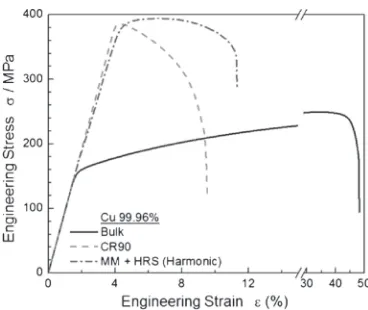
Results of the tensile tests are shown in Fig. 4 by representative stressstrain curves. Bulk Cu sample has a relatively low tensile strength (yield strengthYS=156 MPa and ultimate tensile strength UTS=247 MPa), large total elongation EF=48% and uniform elongation EU=30%.
These properties are typical for pure fully recrystallized Cu, e.g.15,16)The tensile properties in the CR90 sample are at the level of YS=360 MPa, UTS=385 MPa, EU=0.3% and
EF=9.2% that is also typical for commercially pure Cu heavily deformed to the strain level of ¾μ2.16) As known from the literature, such a short strain hardening stage can be attributed to the highly developed substructure by the deformation processing before the tests. Further analysis of the material microstructure in the CR90 condition did not reveal any new features compared to what has already been reported by other researchers, e.g.16)
However, very interesting set of tensile properties can be found in the mechanically milled and hot roll sintered sample. Namely, the highest strength among samples tested in this study, UTS=395 MPa, is recorded in the harmonic structured material, Fig. 4. An important fact is that it is accompanied by uniform elongation EU=2.6% within the total elongation of EFμ8%. Such an extended strain
hardening stage accompanied with such a highUTSis quite a unique combination not readily achievable in pure Cu. Another unique property of this sample is modestly high yield strengthYS=194 MPa, which grows sharply up to the strain ofeμ0.4%, and then gradually saturates byeμ2.6%, theEU.
Note, all the tensile elongation characteristics mentioned above refer to plastic strain levels. Due to the technical
they are reflected by lower than nominal values of elastic modulus, which causes slightly exaggerated values of nominal strain. Therefore, in the reported quantitative strain characteristics the elastic component of strain was subtracted from the nominal strain levels to minimize the experimental error. Nevertheless, despite potential errors in the quantitative strain characteristics, the qualitative differences in stressstrain behavior and stress levels are fully reliable.
The combination of tensile characteristics in the harmonic-structured Cu is comparable to those of the same purity Cu after 117)or 1618) passes of equal channel angular pressing,
after 2 passes of accumulative roll bonding16) as well as
4NCu after multiple deformation to strain 5.4.19) Such
properties are also superior compared to those of commer-cially available pure Cu.20)
The unique mechanical behavior of the harmonic-structured material can be understood according to the scheme shown in Fig. 5. In this scheme, deformation of a
“representative volume element” (RVE) of the harmonic-structured material (an elementary unit consisting of the core enclosed into the shell) is presented on the left-hand side. The RVE itself deforms heterogeneously. However, the entire sample, being homogeneous on macroscale, deforms homo-geneously, as indicated on the right-hand side of Fig. 5. At early stages of deformation, the stronger “shell” area still deforms elastically, while softer “core” area already under-goes plastic deformation. Such a behavior leads to the increase of strain hardening stage, and hence to the delay of strain localisation. At the developed deformation stages, when strain hardening in the softer “core” equalizes its strength with the shell-area material, the localisation of strain takes place and necking begins to evolve.
The harmonic core/shell structure might be considered as an“artificial composite”consisting of two phases with the same modulus of elasticity but different strengths. During tensile loading, upon reaching the yield strength of softer core at μ0.2% proof strain, the core starts to deform plastically, while stronger shell still deforms elastically. This leads to the slight bend of the stressstrain curve continued with almost linear growth, Fig. 4. The strain hardening in the core areas is very intense since they occupy volumes
“enclosed”in the shell material. Upon reaching the strain of
μ0.4%, plasticflow begins also in the shell, which leads to another distinct bend of the stressstrain curve and faster decrease in the strain hardening rate. Further straining results in the substantial uniform elongation typical for coarse-grained materials that have good capacity for strain harden-ing. The stressstrain curve also reveals significant post-necking deformation, which is typical for fine-grained materials. These features illustrate the unique mechanical performance of the harmonic-structured copper, which combines the benefits of high-strength and extended post-necking deformation offine-grained material as well as good strain hardening capacity of the coarse-grained one.
[image:4.595.76.260.67.222.2]4. Conclusions
The principles of “harmonic”structure fabrication allow-ing the control of both topology and scale of the structure heterogeneity have been concisely formulated in this work. The feasibility to form the “harmonic structure” in pure copper is demonstrated, and the advantage of tensile performance of the material with such a structure is analyzed. This opens up a new avenue for the design concept of advanced materials having superior performance. The con-tinuation of this work is seen in the development of a mathematical model describing the structure-performance relationship in such materials, and detailed investigation of the effects of core/shell grain size and fraction ratios on mechanical performance in Cu and other materials.
Acknowledgements
This research was supported by the Japan Science and Technology Agency (JST) under Collaborative Research Based on Industrial Demand “Heterogeneous Structure Control: Towards Innovative Development of Metallic Structural Materials”, and by the Grant-in-Aid for Scientific Research on Innovative Area,“Bulk Nanostructured Metals”, through MEXT, Japan (contract No. 22102004). These supports are gratefully appreciated.
REFERENCES
1) G. I. Taylor: J. Inst. MetalsLXII(1938) 307324. 2) E. O. Hall:Proc. Phys. Soc. B64(1951) 747753.
3) N. J. Petch: J. Iron Steel Res. Int.174(1953) 2528.
4) G. Langford and M. Cohen: T. Am. Soc. Metal.62(1969) 623638. 5) U. F. Kocks and H. Mecking:Prog. Mater. Sci.48(2003) 171273.
6) Y. Estrin and A. Vinogradov:Acta Mater.61(2013) 782817.
7) H. Gleiter:Prog. Mater. Sci.33(1989) 223315.
8) R. Valiev:Nature419(2002) 887889.
9) S. Berbenni, V. Favier and M. Berveiller:Int. J. Plasticity23(2007) 114142.
10) Y. Wang, M. Chen, F. Zhou and E. Ma:Nature419(2002) 912915.
11) S. Joshi, K. Ramesh, B. Han and E. Lavernia:Metall. Mater. Trans. A
37(2006) 23972404.
12) H. W. Höppel, M. Korn, R. Lapovok and H. Mughrabi: J. Phys.: Conference Series240(2010) 012147.
13) H. Fujiwara, R. Akada, A. Noro, Y. Yoshita and K. Ameyama:Mater. Trans.49(2008) 9096.
14) T. Sekiguchi, K. Ono, H. Fujiwara and K. Ameyama:Mater. Trans.51
(2010) 3945.
15) D. Orlov and A. Vinogradov:Mater. Sci. Eng. A530(2011) 174182.
16) N. Takata, S.-H. Lee and N. Tsuji:Mater. Lett.63(2009) 17571760.
17) A. Vinogradov, M. Maruyama, Y. Kaneko and S. Hashimoto:Philos. Mag.92(2012) 666689.
18) F. Dalla Torre, R. Lapovok, J. Sandlin, P. F. Thomson, C. H. J. Davies and E. V. Pereloma:Acta Mater.52(2004) 48194832.
19) A. Belyakov, T. Sakai, H. Miura and K. Tsuzaki:Philos. Mag. A81
(2001) 26292643.
20) http://www.copper.org/, C.D.A. Inc., (2012).
[image:5.595.107.496.70.140.2]