Selection of Effective Contextual Information
for Automatic Synonym Acquisition
Masato Hagiwara, Yasuhiro Ogawa, and Katsuhiko Toyama Graduate School of Information Science,
Nagoya University
Furo-cho, Chikusa-ku, Nagoya, JAPAN 464-8603
{hagiwara, yasuhiro, toyama}@kl.i.is.nagoya-u.ac.jp
Abstract
Various methods have been proposed for automatic synonym acquisition, as syn-onyms are one of the most
fundamen-tal lexical knowledge. Whereas many
methods are based on contextual clues of words, little attention has been paid to what kind of categories of contex-tual information are useful for the pur-pose. This study has experimentally inves-tigated the impact of contextual informa-tion selecinforma-tion, by extracting three kinds of word relationships from corpora: depen-dency, sentence co-occurrence, and
prox-imity. The evaluation result shows that
while dependency and proximity perform relatively well by themselves, combina-tion of two or more kinds of contextual in-formation gives more stable performance. We’ve further investigated useful selection of dependency relations and modification categories, and it is found that modifi-cation has the greatest contribution, even greater than the widely adopted subject-object combination.
1 Introduction
Lexical knowledge is one of the most important re-sources in natural language applications, making it almost indispensable for higher levels of syntacti-cal and semantic processing. Among many kinds of lexical relations, synonyms are especially use-ful ones, having broad range of applications such as query expansion technique in information re-trieval and automatic thesaurus construction.
Various methods (Hindle, 1990; Lin, 1998; Hagiwara et al., 2005) have been proposed for
syn-onym acquisition. Most of the acquisition meth-ods are based on distributional hypothesis (Har-ris, 1985), which states that semantically similar words share similar contexts, and it has been ex-perimentally shown considerably plausible.
However, whereas many methods which adopt the hypothesis are based on contextual clues con-cerning words, and there has been much consid-eration on the language models such as Latent Semantic Indexing (Deerwester et al., 1990) and Probabilistic LSI (Hofmann, 1999) and synonym acquisition method, almost no attention has been paid to what kind of categories of contextual infor-mation, or their combinations, are useful for word featuring in terms of synonym acquisition.
For example, Hindle (1990) used
co-occurrences between verbs and their subjects and objects, and proposed a similarity metric based on mutual information, but no exploration concerning the effectiveness of other kinds of word relationship is provided, although it is extendable to any kinds of contextual information. Lin (1998) also proposed an information theory-based similarity metric, using a broad-coverage parser and extracting wider range of grammatical relationship including modifications, but he didn’t further investigate what kind of relationships actually had important contributions to
acquisi-tion, either. The selection of useful contextual
information is considered to have a critical impact on the performance of synonym acquisition. This is an independent problem from the choice of language model or acquisition method, and should therefore be examined by itself.
The purpose of this study is to experimen-tally investigate the impact of contextual infor-mation selection for automatic synonym
acqui-sition. Because nouns are the main target of
synonym acquisition, here we limit the target of acquisition to nouns, and firstly extract the co-occurrences between nouns and three categories of contextual information — dependency, sentence co-occurrence, and proximity — from each of three different corpora, and the performance of individual categories and their combinations are evaluated. Since dependency and modification re-lations are considered to have greater contribu-tions in contextual information and in the depen-dency category, respectively, these categories are then broken down into smaller categories to ex-amine the individual significance.
Because the consideration on the language model and acquisition methods is not the scope of the current study, widely used vector space model
(VSM), tf·idf weighting scheme, and cosine
mea-sure are adopted for similarity calculation. The re-sult is evaluated using two automatic evaluation methods we proposed and implemented: discrimi-nation rate and correlation coefficient based on the existing thesaurus WordNet.
This paper is organized as follows: in Section 2, three kinds of contextual information we use are described, and the following Section 3 explains the synonym acquisition method. In Section 4 the evaluation method we employed is detailed, which consists of the calculation methods of reference similarity, discrimination rate, and correlation co-efficient. Section 5 provides the experimental con-ditions and results of contextual information se-lection, followed by dependency and modification selection. Section 6 concludes this paper.
2 Contextual Information
In this study, we focused on three kinds of con-textual information: dependency between words, sentence occurrence, and proximity, that is, co-occurrence with other words in a window, details of which are provided the following sections.
2.1 Dependency
The first category of the contextual information we employed is the dependency between words in a sentence, which we suppose is most commonly used for synonym acquisition as the context of words. The dependency here includes predicate-argument structure such as subjects and objects of verbs, and modifications of nouns. As the ex-traction of accurate and comprehensive grammat-ical relations is in itself a difficult task, the
so-dependent
mod
ncmod xmod cmod detmod
arg_mod arg aux conj
subj_or_dobj
subj
ncsubj xsubj csubj
comp
obj clausal
obj2 dobj iobj
xcomp ccomp mod
subj
[image:2.595.307.522.66.284.2]obj
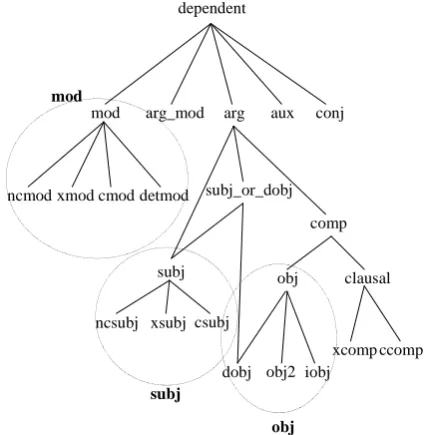
Figure 1: Hierarchy of grammatical relations and groups
phisticated parser RASP Toolkit (Briscoe and Car-roll, 2002) was utilized to extract this kind of word relations. RASP analyzes input sentences and provides wide variety of grammatical infor-mation such as POS tags, dependency structure, and parsed trees as output, among which we paid attention to dependency structure called grammat-ical relations (GRs) (Briscoe et al., 2002).
GRs represent relationship among two or more words and are specified by the labels, which con-struct the hierarchy shown in Figure 1. In this hier-archy, the upper levels correspond to more general relations whereas the lower levels to more specific ones. Although the most general relationship in GRs is “dependent”, more specific labels are as-signed whenever possible. The representation of the contextual information using GRs is as fol-lows. Take the following sentence for example:
Shipments have been relatively level since January, the Commerce Depart-ment noted.
RASP outputs the extracted GRs asn-ary
rela-tions as follows:
(ncsubj note Department obj) (ncsubj be Shipment _) (xcomp _ be level) (mod _ level relatively) (aux _ be have)
(detmod _ Department the) (ncmod _ be Department)
While most of GRs extracted by RASP are bi-nary relations of head and dependent, there are some relations that contain additional slot or ex-tra information regarding the relations, as shown “ncsubj” and “ncmod” in the above example. To obtain the final representation that we require for synonym acquisition, that is, the co-occurrence between words and their contexts, these relation-ships must be converted to binary relations, i.e., co-occurrence. We consider the concatenation of all the rest of the target word as context:
Department ncsubj:note:*:obj
shipment ncsubj:be:*:_
January ncmod:since:be:*
Department mod:_:*:note
Department ncmod:_:*:Commerce
Commerce ncmod:_:Department:*
Department detmod:_:*:the
Department ncmod:_:be:*
The slot for the target word is replaced by “*” in the context. Note that only the contexts for nouns are extracted because our purpose here is the auto-matic extraction of synonymous nouns.
2.2 Sentence Co-occurrence
As the second category of contextual information, we used the sentence co-occurrence, i.e., which sentence words appear in. Using this context is, in other words, essentially the same as featuring words with the sentences in which they occur. Treating single sentences as documents, this fea-turing corresponds to exploiting transposed term-document matrix in the information retrieval con-text, and the underlying assumption is that words that commonly appear in the similar documents or sentences are considered semantically similar.
2.3 Proximity
The third category of contextual information, proximity, utilizes tokens that appear in the vicin-ity of the target word in a sentence. The basic as-sumption here is that the more similar the distri-bution of proceeding and succeeding words of the target words are, the more similar meaning these two words possess, and its effectiveness has been previously shown (Macro Baroni and Sabrina Bisi, 2004). To capture the word proximity, we consider a window with a certain radius, and treat the la-bel of the word and its position within the window as context. The contexts for the previous example sentence, when the window radius is 3, are then:
shipment R1:have
shipment R2:be
shipment R3:relatively
January L1:since
January L2:level
January L3:relatively
January R1:,
January R2:the
January R3:Commerce
Commerce L1:the
Commerce L2:,
Commerce L3:January
Commerce R1:Department
...
Note that the proximity includes tokens such as punctuation marks as context, because we suppose they offer useful contextual information as well.
3 Synonym Acquisition Method
The purpose of the current study is to investigate the impact of the contextual information selection, not the language model itself, we employed one of the most commonly used method: vector space
model (VSM) and tf·idf weighting scheme. In this
framework, each word is represented as a vector in a vector space, whose dimensions correspond to contexts. The elements of the vectors given by
tf·idf are the co-occurrence frequencies of words
and contexts, weighted by normalized idf. That is, denoting the number of distinct words and
con-texts asN andM, respectively,
wi =t[tf(wi, c1)·idf(c1)...tf(wi, cM)·idf(cM)], (1)
where tf(wi, cj)is the co-occurrence frequency of
wordwiand contextcj. idf(cj)is given by
idf(cj) =
log(N/df(cj))
maxklog(N/df(vk)), (2)
where df(cj)is the number of distinct words that
co-occur with contextcj.
Although VSM and tf·idf are naive and simple
compared to other language models like LSI and PLSI, they have been shown effective enough for the purpose (Hagiwara et al., 2005). The similar-ity between two words are then calculated as the cosine value of two corresponding vectors.
4 Evaluation
and by comparing the reference and obtained sim-ilarities, two evaluation measures, discrimination rate and correlation coefficient, are calculated au-tomatically as described in Sections 4.2 and 4.3.
4.1 Reference similarity calculation using WordNet
As the basis for automatic evaluation methods, the reference similarity, which is the answer value that similarity of a certain pair of words “should take,” is required. We obtained the reference similarity using the calculation based on thesaurus tree struc-ture (Nagao, 1996). This calculation method re-quires no other resources such as corpus, thus it is simple to implement and widely used.
The similarity between word sensewiand word
sensevjis obtained using tree structure as follows.
Let the depth1of nodewibedi, the depth of node
vj bedj, and the maximum depth of the common
ancestors of both nodes be ddca. The similarity
betweenwiandvj is then calculated as
sim(wi, vj) = 2·ddca di+dj
, (3)
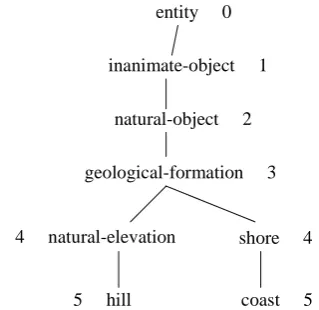
which takes the value between 0.0 and 1.0. Figure 2 shows the example of calculating the similarity between the word senses “hill” and “coast.” The number on the side of each word sense represents the word’s depth. From this tree structure, the similarity is obtained:
sim(“hill”,“coast”) = 2·3
5 + 5 = 0.6. (4)
The similarity between word w with senses
w1, ..., wnand wordvwith sensesv1, ..., vmis
de-fined as the maximum similarity between all the pairs of word senses:
sim(w, v) = max
i,j sim(wi, vj), (5)
whose idea came from Lin’s method (Lin, 1998).
4.2 Discrimination Rate
The following two sections describe two evalua-tion measures based on the reference similarity. The first one is discrimination rate (DR). DR, orig-inally proposed by Kojima et al. (2004), is the rate
1To be precise, the structure of WordNet, where some word senses have more than one parent, isn’t a tree but a DAG. The depth of a node is, therefore, defined here as the “maximum distance” from the root node.
entity 0
inanimate-object 1
natural-object 2
geological-formation 3
4 natural-elevation
5 hill
shore 4
[image:4.595.337.497.65.220.2]coast 5
Figure 2: Example of automatic similarity calcu-lation based on tree structure
(answer, reply) (phone, telephone) (sign, signal) (concern, worry)
(animal, coffee) (him, technology) (track, vote) (path, youth)
… …
highly related unrelated
Figure 3: Test-sets for discrimination rate calcula-tion.
(percentage) of pairs(w1, w2)whose degree of
as-sociation between two words w1, w2 is
success-fully discriminated by the similarity derived by the method under evaluation. Kojima et al. dealt with three-level discrimination of a pair of words, that is, highly related (synonyms or nearly syn-onymous), moderately related (a certain degree of association), and unrelated (irrelevant). However, we omitted the moderately related level and lim-ited the discrimination to two-level: high or none, because of the difficulty of preparing a test set that consists of moderately related pairs.
The calculation of DR follows these steps: first, two test sets, one of which consists of highly re-lated word pairs and the other of unrere-lated ones, are prepared, as shown in Figure 3. The
similar-ity betweenw1 andw2is then calculated for each
pair(w1, w2)in both test sets via the method
un-der evaluation, and the pair is labeled highly
re-lated when similarity exceeds a given thresholdt
and unrelated when the similarity is lower thant.
The number of pairs labeled highly related in the highly related test set and unrelated in the
[image:4.595.307.526.283.374.2]DR is then given by:
1 2
µ na
Na + nb Nb

, (6)
where Na and Nb are the numbers of pairs in
highly related and unrelated test sets, respectively.
Since DR changes depending on thresholdt,
max-imum value is adopted by varyingt.
We used the reference similarity to create these
two test sets. Firstly, Np = 100,000 pairs of
words are randomly created using the target
vo-cabulary set for synonym acquisition. Proper
nouns are omitted from the choice here because of their high ambiguity. The two testsets are then
created extractingn = 2,000most related (with
high reference similarity) and unrelated (with low reference similarity) pairs.
4.3 Correlation coefficient
The second evaluation measure is correlation co-efficient (CC) between the obtained similarity and the reference similarity. The higher CC value is, the more similar the obtained similarities are to WordNet, thus more accurate the synonym acqui-sition result is.
The value of CC is calculated as follows. Let
the set of the sample pairs bePs, the sequence of
the reference similarities calculated for the pairs in Ps be r = (r1, r2, ..., rn), the corresponding
sequence of the target similarity to be evaluated be r = (s1, s2, ..., sn), respectively. Correlation
coefficientρis then defined by:
ρ=
1
n
Pn
i=1(ri−¯r)(si−s¯)
σrσs
, (7)
wherer,¯ ¯s, σr,andσs represent the average of r
ands and the standard deviation of r ands,
re-spectively. The set of the sample pairs Ps is
cre-ated in a similar way to the preparation of highly related test set used in DR calculation, except that
we employed Np = 4,000, n = 2,000to avoid
extreme nonuniformity.
5 Experiments
Now we desribe the experimental conditions and results of contextual information selection.
5.1 Condition
We used the following three corpora for the ex-periment: (1) Wall Street Journal (WSJ) corpus (approx. 68,000 sentences, 1.4 million tokens),
(2) Brown Corpus (BROWN) (approx. 60,000
sentences, 1.3 million tokens), both of which are contained in Treebank 3 (Marcus, 1994), and (3) written sentences in WordBank (WB) (approx. 190,000 sentences, 3.5 million words) (Hyper-Collins, 2002). No additional annotation such as POS tags provided for Treebank was used, which means that we gave the plain texts stripped off any additional information to RASP as input.
To distinguish nouns, using POS tags annotated by RASP, any words with POS tags APP, ND, NN, NP, PN, PP were labeled as nouns. The window radius for proximity is set to 3. We also set a
thresholdtf on occurrence frequency in order to
filter out any words or contexts with low frequency and to reduce computational cost. More
specifi-cally, any wordswsuch thatPctf(w, c)< tf and
any contexts c such that Pwtf(w, c) < tf were
removed from the co-occurrence data. tf was set
totf = 5for WSJ and BROWN, andtf = 10for
WB in Sections 5.2 and 5.3, andtf = 2for WSJ
and BROWN andtf = 5for WB in Section 5.4.
5.2 Contextual Information Selection
In this section, we experimented to discover what kind of contextual information extracted in Sec-tion 2 is useful for synonym extracSec-tion. The per-formances, i.e. DR and CC are evaluated for each of the three categories and their combinations.
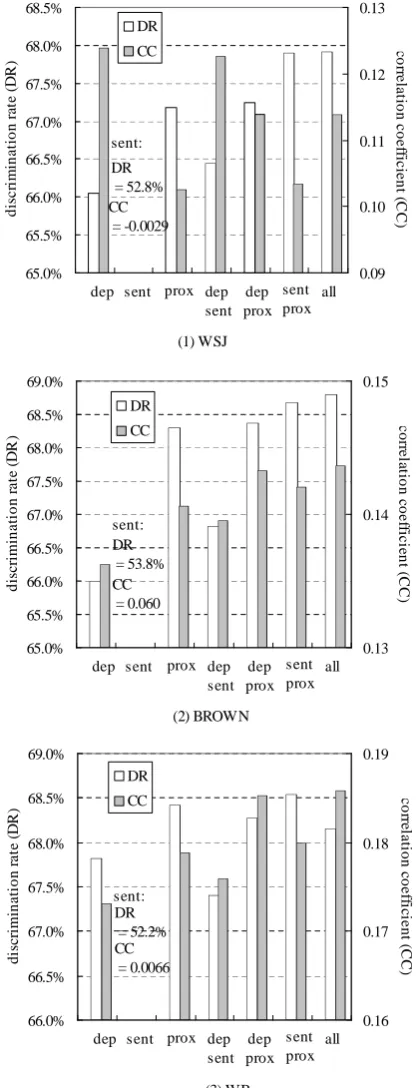
The evaluation result for three corpora is shown in Figure 4. Notice that the range and scale of the vertical axes of the graphs vary according to cor-pus. The result shows that dependency and prox-imity perform relatively well alone, while sen-tence co-occurrence has almost no contributions to performance. However, when combined with other kinds of context information, every category, even sentence co-occurrence, serves to “stabilize” the overall performance, although in some cases combination itself decreases individual measures slightly. It is no surprise that the combination of all categories achieves the best performance. There-fore, in choosing combination of different kinds of context information, one should take into consid-eration the economical efficiency and trade-off be-tween computational complexity and overall per-formance stability.
5.3 Dependency Selection
65.0% 65.5% 66.0% 66.5% 67.0% 67.5% 68.0% 68.5% d is c ri m in a ti o n r at e ( D R )a 0.09 0.10 0.11 0.12 0.13 co rr e la ti o n c o e ff ic ie n t ( C C )) DR CC
dep sent prox dep sent dep prox sent prox all (1) WSJ DR = 52.8% CC = -0.0029 sent: 65.0% 65.5% 66.0% 66.5% 67.0% 67.5% 68.0% 68.5% 69.0% d is cr im in a ti o n r a te ( D R )a 0.13 0.14 0.15 c o rr e la ti o n c o e ff ic ie n t ( C C )) DR CC
dep sent prox dep sent dep prox sent prox all (2) BROWN DR = 53.8% CC = 0.060 sent: 66.0% 66.5% 67.0% 67.5% 68.0% 68.5% 69.0% d is cr im in a ti o n r a te ( D R )a 0.16 0.17 0.18 0.19 c o rr el a ti o n c o e ff ic ie n t ( C C )) DR CC
[image:6.595.76.286.95.640.2]dep sent prox dep sent dep prox sent prox all (3) WB DR = 52.2% CC = 0.0066 sent:
Figure 4: Contextual information selection perfor-mances
Discrimination rate (DR) and correlation coefficient (CC) for (1) Wall Street Journal corpus, (2) Brown Corpus, and
(3) WordBank.
of GRs are considered for comparison conve-nience: (1) subj group (“subj”, “ncsubj”, “xsubj”, and “csubj”), (2) obj group (“obj”, “dobj”, “obj2”, and “iobj”), (3) mod group (“mod”, “ncmod”, “xmod”, “cmod”, and “detmod”), and (4) etc group (others), as shown in the circles in Figure 1. This is because distinction between relations in a group is sometimes unclear, and is consid-ered to strongly depend on the parser implemen-tation. The final target is seven kinds of combina-tions of the above four groups: subj, obj, mod, etc, subj+obj, subj+obj+mod, and all.
The two evaluation measures are similarly cal-culated for each group and combination, and shown in Figure 5. Although subjects, objects, and their combination are widely used contextual information, the performances for subj and obj categories, as well as their combination subj+obj,
were relatively poor. On the contrary, the
re-sult clearly shows the importance of modification, which alone is even better than widely adopted subj+obj. The “stabilization effect” of combina-tions observed in the previous experiment is also confirmed here as well.
Because the size of the co-occurrence data varies from one category to another, we conducted another experiment to verify that the superiority of the modification category is simply due to the difference in the quality (content) of the group, not the quantity (size). We randomly extracted 100,000 pairs from each of mod and subj+obj cat-egories to cancel out the quantity difference and compared the performance by calculating aver-aged DR and CC of ten trials. The result showed that, while the overall performances substantially decreased due to the size reduction, the relation between groups was preserved before and after the extraction throughout all of the three corpora, al-though the detailed result is not shown due to the space limitation. This means that what essentially contributes to the performance is not the size of the modification category but its content.
5.4 Modification Selection
“det-54.0% 56.0% 58.0% 60.0% 62.0% 64.0% 66.0% 68.0% d is c ri m in a ti o n r at e ( D R )a 0.00 0.02 0.04 0.06 0.08 0.10 0.12 0.14 co rr e la ti o n c o e ff ic ie n t ( C C )) DR CC
subj obj mod etc subj obj subj obj mod all (1) WSJ 54.0% 56.0% 58.0% 60.0% 62.0% 64.0% 66.0% 68.0% d is c ri m in a ti o n r a te ( D R )a 0.00 0.02 0.04 0.06 0.08 0.10 0.12 0.14 0.16 c o rr e la ti o n c o e ff ic ie n t ( C C )) DR CC
subj obj mod etc subj obj subj obj mod all (2) BROWN 54.0% 56.0% 58.0% 60.0% 62.0% 64.0% 66.0% 68.0% 70.0% d is c ri m in a ti o n r a te ( D R )a 0.00 0.02 0.04 0.06 0.08 0.10 0.12 0.14 0.16 0.18 0.20 c o rr e la ti o n c o ef fi ci e n t ( C C )) DR CC
[image:7.595.313.519.99.651.2]subj obj mod etc subj obj subj obj mod all (3) WB
Figure 5: Dependency selection performances
Discrimination rate (DR) and correlation coefficient (CC) for (1) Wall Street Journal corpus, (2) Brown Corpus, and
[image:7.595.78.285.100.665.2](3) WordBank. 50.0% 52.0% 54.0% 56.0% 58.0% 60.0% 62.0% 64.0% 66.0% d is c ri m in a ti o n r at e ( D R )a 0.00 0.02 0.04 0.06 0.08 0.10 0.12 co rr e la ti o n c o e ff ic ie n t ( C C )) DR CC detmod ncmod-n ncmod-j ncmod-p etc all (1) WSJ 50.0% 52.0% 54.0% 56.0% 58.0% 60.0% 62.0% 64.0% 66.0% d is cr im in a ti o n r a te ( D R )a 0.00 0.02 0.04 0.06 0.08 0.10 0.12 0.14 c o rr e la ti o n c o e ff ic ie n t ( C C )) DR CC detmod ncmod-n ncmod-j ncmod-p etc all (2) BROWN CC = -0.018 57.0% 59.0% 61.0% 63.0% 65.0% 67.0% d is c ri m in a ti o n r a te ( D R )a 0.04 0.06 0.08 0.10 0.12 0.14 0.16 0.18 c o rr el a ti o n c o e ff ic ie n t ( C C )) DR CC detmod ncmod-n ncmod-j ncmod-p etc all (3) WB
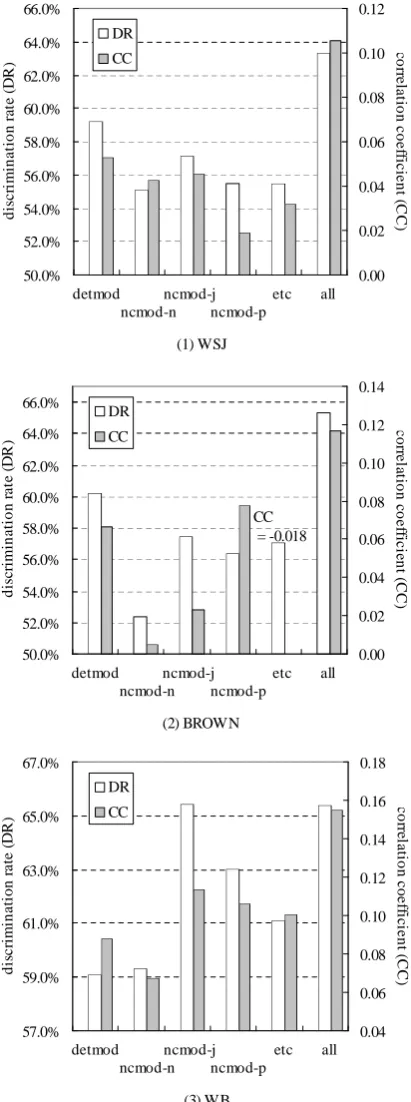
Figure 6: Modification selection performances
Discrimination rate (DR) and correlation coefficient (CC) for (1) Wall Street Journal corpus, (2) Brown Corpus, and
mod”, i.e., the modifying word is a determiner, (2) ncmod-n, when the GR label is “ncmod” and the modifying word is a noun, (3) ncmod-j, when the GR label is “ncmod” and the modifying word is an adjective or number, (4) ncmod-p, when the GR label is “ncmod” and the modification is through a preposition (e.g. “state” and “affairs” in “state of affairs”), and (5) etc (others).
The performances for each modification cate-gory are evaluated and shown in Figure 6. Al-though some individual modification categories such as detmod and ncmod-j outperform other cat-egories in some cases, the overall observation is that all the modification categories contribute to synonym acquisition to some extent, and the ef-fect of individual categories are accumulative. We therefore conclude that the main contributing fac-tor on utilizing modification relationship in syn-onym acquisition isn’t the type of modification, but the diversity of the relations.
6 Conclusion
In this study, we experimentally investigated the impact of contextual information selection, by ex-tracting three kinds of contextual information — dependency, sentence co-occurrence, and proxim-ity — from three different corpora. The acqui-sition result was evaluated using two evaluation measures, DR and CC using the existing thesaurus WordNet. We showed that while dependency and proximity perform relatively well by themselves, combination of two or more kinds of contextual information, even with the poorly performing sen-tence co-occurrence, gives more stable result. The selection should be chosen considering the trade-off between computational complexity and overall performance stability. We also showed that modi-fication has the greatest contribution to the acqui-sition of all the dependency relations, even greater than the widely adopted subject-object combina-tion. It is also shown that all the modification cate-gories contribute to the acquisition to some extent. Because we limited the target to nouns, the re-sult might be specific to nouns, but the same exper-imental framework is applicable to any other cate-gories of words. Although the result also shows the possibility that the bigger the corpus is, the better the performance will be, the contents and size of the corpora we used are diverse, so their relationship, including the effect of the window ra-dius, should be examined as the future work.
References
Marco Baroni and Sabrina Bisi 2004. Using cooccur-rence statistics and the web to discover synonyms in a technical language. Proc. of the Fourth
Interna-tional Conference on Language Resources and Eval-uation (LREC 2004).
Ted Briscoe and John Carroll. 2002. Robust Accu-rate Statistical Annotation of General Text. Proc. of
the Third International Conference on Language Re-sources and Evaluation (LREC 2002), 1499–1504.
Ted Briscoe, John Carroll, Jonathan Graham and Ann Copestake 2002. Relational evaluation schemes.
Proc. of the Beyond PARSEVAL Workshop at the Third International Conference on Language Re-sources and Evaluation, 4–8.
Scott Deerwester, et al. 1990. Indexing by Latent Se-mantic Analysis. Journal of the American Society
for Information Science, 41(6):391–407.
Christiane Fellbaum. 1998. WordNet: an electronic
lexical database. MIT Press.
Masato Hagiwara, Yasuhiro Ogawa, Katsuhiko Toyama. 2005. PLSI Utilization for Automatic Thesaurus Construction. Proc. of The Second
In-ternational Joint Conference on Natural Language Processing (IJCNLP-05), 334–345.
Zellig Harris. 1985. Distributional Structure. Jerrold J. Katz (ed.) The Philosophy of Linguistics. Oxford University Press. 26–47.
Donald Hindle. 1990. Noun classification from predicate-argument structures. Proc. of the 28th
An-nual Meeting of the ACL, 268–275.
Thomas Hofmann. 1999. Probabilistic Latent Seman-tic Indexing. Proc. of the 22nd International
Con-ference on Research and Development in Informa-tion Retrieval (SIGIR ’99), 50–57.
Kazuhide Kojima, Hirokazu Watabe, and Tsukasa Kawaoka. 2004. Existence and Application of Common Threshold of the Degree of Association.
Proc. of the Forum on Information Technology (FIT2004) F-003.
Collins. 2002. Collins Cobuild Mld Major New Edi-tion CD-ROM. HarperCollins Publishers.
Dekang Lin. 1998. Automatic retrieval and clustering of similar words. Proc. of the 36th Annual
Meet-ing of the Association for Computational LMeet-inguis- Linguis-tics and 17th International Conference on Compu-tational linguistics (COLING-ACL ’98), 786–774.
Mitchell P. Marcus, Beatrice Santorini, and Mary Ann Marcinkiewicz. 1994. Building a large annotated corpus of English: The Penn treebank.
Computa-tional Linguistics, 19(2):313–330.
Makoto Nagao (ed.). 1996. Shizengengoshori.