Proceedings of the 49th Annual Meeting of the Association for Computational Linguistics:shortpapers, pages 30–36,
HITS-based Seed Selection and Stop List Construction for Bootstrapping
Tetsuo Kiso Masashi Shimbo Mamoru Komachi Yuji Matsumoto
Graduate School of Information Science Nara Institute of Science and Technology
Ikoma, Nara 630-0192, Japan
{tetsuo-s,shimbo,komachi,matsu}@is.naist.jp
Abstract
In bootstrapping (seed set expansion), select-ing good seeds and creatselect-ing stop lists are two effective ways to reduce semantic drift, but these methods generally need human super-vision. In this paper, we propose a graph-based approach to helping editors choose ef-fective seeds and stop list instances,
appli-cable to Pantel and Pennacchiotti’sEspresso
bootstrapping algorithm. The idea is to select seeds and create a stop list using the rankings of instances and patterns computed by Klein-berg’s HITS algorithm. Experimental results on a variation of the lexical sample task show the effectiveness of our method.
1 Introduction
Bootstrapping (Yarowsky, 1995; Abney, 2004) is a technique frequently used in natural language pro-cessing to expand limited resources with minimal supervision. Given a small amount of sample data (seeds) representing a particular semantic class of interest, bootstrapping first trains a classifier (which often is a weighted list of surface patterns character-izing the seeds) using the seeds, and then apply it on the remaining data to select instances most likely to be of the same class as the seeds. These selected in-stances are added to the seed set, and the process is iterated until sufficient labeled data are acquired.
Many bootstrapping algorithms have been pro-posed for a variety of tasks: word sense disambigua-tion (Yarowsky, 1995; Abney, 2004), informadisambigua-tion extraction (Hearst, 1992; Riloff and Jones, 1999; Thelen and Riloff, 2002; Pantel and Pennacchiotti, 2006), named entity recognition (Collins and Singer, 1999), part-of-speech tagging (Clark et al., 2003),
and statistical parsing (Steedman et al., 2003; Mc-Closky et al., 2006).
Bootstrapping algorithms, however, are known to suffer from the problem calledsemantic drift: as the iteration proceeds, the algorithms tend to select in-stances increasingly irrelevant to the seed inin-stances (Curran et al., 2007). For example, suppose we want to collect the names of common tourist sites from a web corpus. Given seed instances{New York City,
Maldives Islands}, bootstrapping might learn, at one point of the iteration, patterns like “pictures of X”
and“photos of X,”which also co-occur with many irrelevant instances. In this case, a later iteration would likely acquire frequent words co-occurring with thesegeneric patterns, such asMichael Jack-son.
Previous work has tried to reduce the effect of se-mantic drift by making thestop listof instances that must not be extracted (Curran et al., 2007; McIntosh and Curran, 2009). Drift can also be reduced with carefully selected seeds. However, both of these ap-proaches require expert knowledge.
avoid semantic drift, in this paper we take advantage of this similarity to make better use of Espresso.
We demonstrate the effectiveness of our approach on a word sense disambiguation task.
2 Background
In this section, we review related work on seed se-lection and stop list construction. We also briefly in-troduce the Espresso bootstrapping algorithm (Pan-tel and Pennacchiotti, 2006) for which we build our seed selection and stop list construction methods.
2.1 Seed Selection
The performance of bootstrapping can be greatly in-fluenced by a number of factors such as the size of the seed set, the composition of the seed set and the coherence of the concept being expanded (Vyas et al., 2009). Vyas et al. (2009) studied the impact of the composition of the seed sets on the expansion performance, confirming that seed set composition has a significant impact on the quality of expansions. They also found that the seeds chosen by non-expert editors are often worse than randomly chosen ones. A similar observation was made by McIntosh and Curran (2009), who reported that randomly chosen seeds from the gold-standard set often outperformed seeds chosen by domain experts. These results sug-gest that even for humans, selecting good seeds is a non-trivial task.
2.2 Stop Lists
Yangarber et al. (2002) proposed to run multiple bootstrapping sessions in parallel, with each session trying to extract one of several mutually exclusive semantic classes. Thus, the instances harvested in one bootstrapping session can be used as the stop list of the other sessions. Curran et al. (2007) pur-sued a similar idea in theirMutual Exclusion Boot-strapping, which uses multiple semantic classes in addition to hand-crafted stop lists. While multi-class bootstrapping is a clever way to reduce human su-pervision in stop list construction, it is not generally applicable to bootstrapping for a single class. To ap-ply the idea of multi-class bootstrapping to single-class bootstrapping, one has to first find appropri-ate competing semantic classes and good seeds for them, which is in itself a difficult problem. Along this line of research, McIntosh (2010) recently used
Algorithm 1Espresso algorithm
1: Input: Seed vectori0
2: Instance-pattern co-occurrence matrixA
3: Instance cutoff parameterk 4: Pattern cutoff parameterm 5: Number of iterationsτ 6: Output: Instance score vectori
7: Pattern score vectorp
8: functionESPRESSO(i0,A,k,m,τ) 9: i←i0
10: fort=1,2, ...,τdo
11: p←ATi
12: Scalepso that the components sum to one. 13: p←SELECTKBEST(p,k)
14: i←Ap
15: Scaleiso that the components sum to one. 16: i←SELECTKBEST(i,m)
17: return iandp
18: functionSELECTKBEST(v,k)
19: Retain only theklargest components ofv, resetting the remaining components to 0.
20: return v
clustering to find competing semantic classes (nega-tive categories).
2.3 Espresso
Espresso (Pantel and Pennacchiotti, 2006) is one of the state-of-the-art bootstrapping algorithms used in many natural language tasks (Komachi and Suzuki, 2008; Abe et al., 2008; Ittoo and Bouma, 2010; Yoshida et al., 2010). Espresso takes advantage of pointwise mutual information (pmi) (Manning and Sch¨utze, 1999) between instances and patterns to evaluate their reliability. Letnbe the number of all instances in the corpus, andpthe number of all pos-sible patterns. We denote all pmi values as ann×p
instance-pattern matrixA, with the(i,j)element of Aholding the value of pmi between theith instance and the jth pattern. LetATdenote the matrix trans-pose ofA.
allows them to gradually increase with the number of iterations.
3 HITS-based Approach to Seed Selection and Stop List Construction
3.1 Espresso and HITS
Komachi et al. (2008) pointed out the similarity between Espresso and Kleinberg’s HITS web page ranking algorithm (Kleinberg, 1999). Indeed, if we remove the pattern/instance selection steps of Algo-rithm 1 (lines 13 and 16), the algoAlgo-rithm essentially reduces to HITS. In this case, the outputs iand p match respectively the hubness and authority score vectors of HITS, computed on the bipartite graph of instances and patterns induced by matrixA.
An implication of this algorithmic similarity is that the outputs of Espresso are inherently biased towards the HITS vectors, which is likely to be the cause of semantic drift. Even though the pat-tern/instance selection steps in Espresso reduce such a bias to some extent, the bias still persists, as em-pirically verified by Komachi et al. (2008). In other words, the expansion process does not drift in ran-dom directions, but tend towards the set of instances and patterns with the highest HITS scores, regard-less of the target semantic class. We exploit this ob-servation in seed selection and stop list construction for Espresso, in order to reduce semantic drift.
3.2 The Procedure
Our strategy is extremely simple, and can be sum-marized as follows.
1. First, compute the HITS ranking of instances in the graph induced by the pmi matrixA. This can be done by calling Algorithm 1 withk= m=∞and a sufficiently largeτ.
2. Next, check the top instances in the HITS rank-ing list manually, and see if these belong to the target class.
3. The third step depends on the outcome of the second step.
(a) If the top instances are of the target class, use them as the seeds. We do not use a stop list in this case.
(b) If not, these instances are likely to make a vector for which semantic drift is directed; hence, use them as the stop list. In this case, the seed set must be prepared manu-ally, just like the usual bootstrapping pro-cedure.
4. Run Espresso with the seeds or stop list found in the last step.
4 Experimental Setup
We evaluate our methods on a variant of the lexi-cal sampleword sense disambiguation task. In the lexical sample task, a small pre-selected set of a tar-get word is given, along with an inventory of senses for each word (Jurafsky and Martin, 2008). Each word comes with a number of instances (context sentences) in which the target word occur, and some of these sentences are manually labeled with the cor-rect sense of the target word in each context. The goal of the task is to classify unlabeled context sen-tences by the sense of the target word in each con-text, using the set of labeled sentences.
To apply Espresso for this task, we reformulate the task to be that of seed set expansion, and not classification. That is, the hand-labeled sentences having the same sense label are used as the seed set, and it is expanded over all the remaining (unlabeled) sentences.
The reason we use the lexical sample task is that every sentence (instance) belongs to one of the pre-defined senses (classes), and we can expect the most frequent sense in the corpus to form the highest HITS ranking instances. This allows us to com-pletely automate our experiments, without the need to manually check the HITS ranking in Step 2 of Section 3.2. That is, for the most frequent sense (majority sense), we take Step 3a and use the highest ranked instances as seeds; for the rest of the senses (minority senses), we take Step 3b and use them as the stop list.
4.1 Datasets
We used the seven most frequent polysemous nouns (arm, bank, degree, difference, paper, party and
Task Method MAP AUC R-Precision P@30 P@50 P@100
arm Random 84.3±4.1 59.6±8.1 80.9±2.2 89.5±10.8 87.7±9.6 85.4±7.2
HITS 85.9 59.7 79.3 100 98.0 89.0
bank Random 74.8±6.5 61.6±9.6 72.6±4.5 82.9±14.8 80.1±13.5 76.6±10.9
HITS 84.8 77.6 78.0 100 100 94.0
degree Random 69.4±3.0 54.3±4.2 66.7±2.3 76.8±9.5 73.8±7.5 70.5±5.3
HITS 62.4 49.3 63.2 56.7 64.0 66.0
difference Random 48.3±3.8 54.5±5.0 47.0±4.4 53.9±10.7 50.7±8.8 47.9±6.1
HITS 50.2 60.1 51.1 60.0 60.0 48.0
paper Random 75.2±4.1 56.4±7.1 71.6±3.3 82.3±9.8 79.6±8.8 76.9±6.1
HITS 75.2 61.0 75.2 73.3 80.0 78.0
party Random 79.1±5.0 57.0±9.7 76.6±3.1 84.5±10.7 82.7±9.2 80.2±7.5
HITS 85.2 68.2 78.5 100 96.0 87.0
shelter Random 74.9±2.3 51.5±3.3 73.2±1.3 77.3±7.8 76.0±5.6 74.5±3.5
HITS 77.0 54.6 72.0 76.7 84.0 79.0
line Random 44.5±15.1 36.3±16.9 40.1±14.6 75.0±21.0 69.8±24.1 62.3±27.9
HITS 72.2 68.6 68.5 100 100 100
interest Random 64.9±8.3 64.9±12.0 63.7±10.2 87.6±13.2 85.3±13.7 81.2±13.9
HITS 75.3 83.0 80.1 100 94.0 77.0
Avg. Random 68.4 55.1 65.8 78.9 76.2 72.8
[image:4.612.95.517.70.322.2]HITS 74.2 64.7 71.8 85.2 86.2 79.8
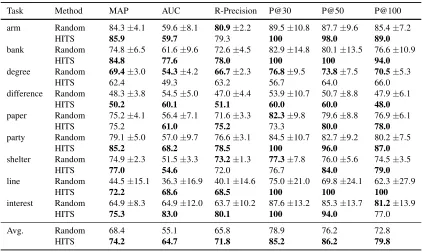
Table 1: Comparison of seed selection for Espresso (τ=5,nseed=7). For Random, results are reported as (mean±
standard deviation). All figures are expressed in percentage terms. The row labeled “Avg.” lists the values macro-averaged over the nine tasks.
1994) datasets1for our experiments. We lowercased words in the sentence and pre-processed them with the Porter stemmer (Porter, 1980) to get the stems of words.
Following (Komachi et al., 2008), we used two types of features extracted from neighboring con-texts: collocational features and bag-of-words fea-tures. For collocational features, we set a window of three words to the right and left of the target word.
4.2 Evaluation methodology
We run Espresso on the above datasets using differ-ent seed selection methods (for majority sense of tar-get words), and with or without stop lists created by our method (for minority senses of target words).
We evaluate the performance of the systems ac-cording to the following evaluation metrics: mean average precision (MAP), area under the ROC curve (AUC), R-precision, and precision@n(P@n) (Man-ning et al., 2008). The output of Espresso may con-tain seed instances input to the system, but seeds are excluded from the evaluation.
1http://www.d.umn.edu/∼tpederse/data.html
5 Results and Discussion
5.1 Effect of Seed Selection
We first evaluate the performance of our seed se-lection method for the majority sense of the nine polysemous nouns. Table 1 shows the performance of Espresso with the seeds chosen by the proposed HITS-based seed selection method (HITS), and with the seed sets randomly chosen from the gold stan-dard sets (Random; baseline). The results for Ran-dom were averaged over 1000 runs. We set the num-ber of seedsnseed=7 and number of iterationsτ=5
in this experiment.
As shown in the table, HITS outperforms the baseline systems except degree. Especially, the MAP reported in Table 1 shows that our approach achieved improvements of 10 percentage points on
Task Method MAP AUC R-Precision P@10 P@20 P@30
arm NoStop 12.7±4.3 51.8±10.8 13.9±9.8 21.4±19.1 15.1±12.0 14.1±10.4 HITS 13.4±4.1 53.7±10.5 15.0±9.5 23.8±17.7 17.5±12.0 15.5±10.2 bank NoStop 32.5±5.1 73.0±8.5 45.1±10.3 80.4±21.8 70.3±21.2 62.6±18.1 HITS 33.7±3.7 75.4±5.7 47.6±8.1 82.6±18.1 72.7±18.5 65.3±15.5 degree NoStop 34.7±4.2 69.7±5.6 43.0±7.1 70.0±18.7 62.8±15.7 55.8±14.3 HITS 35.7±4.3 71.7±5.6 44.3±7.6 72.4±16.4 64.4±15.9 58.3±16.2 difference NoStop 20.2±3.9 57.1±6.7 22.3±8.3 35.8±18.7 27.7±14.0 25.5±11.9 HITS 21.2±3.8 59.1±6.3 24.2±8.4 38.2±20.5 30.2±14.0 28.0±11.9 paper NoStop 25.9±6.6 53.1±10.0 27.7±9.8 55.2±34.7 42.4±25.4 36.0±17.8 HITS 27.2±6.3 56.3±9.1 29.4±9.5 57.4±35.3 45.6±25.3 38.7±17.5 party NoStop 23.0±5.3 59.4±10.8 30.5±9.1 59.6±25.8 46.8±17.4 38.7±12.7 HITS 24.1±5.0 62.5±9.8 32.1±9.4 61.6±26.4 47.9±16.6 40.8±12.7 shelter NoStop 24.3±2.4 50.6±3.2 25.1±4.6 25.4±11.7 26.9±10.3 25.9±8.7
HITS 25.6±2.3 53.4±3.0 26.5±4.8 28.8±12.9 29.0±10.4 28.1±8.2 line NoStop 6.5±1.8 38.3±5.3 2.1±4.1 0.8±4.4 1.8±8.9 2.3±11.0 HITS 6.7±1.9 38.8±5.8 2.4±4.4 1.0±4.6 2.0±8.9 2.5±11.1 interest NoStop 29.4±7.6 61.0±12.1 33.7±13.2 69.6±40.3 67.0±39.1 65.7±37.8
HITS 31.2±5.6 63.6±9.1 36.1±10.5 81.0±29.4 78.1±27.0 77.4±24.3
Avg. NoStop 23.2 57.1 27.0 46.5 40.1 36.3
[image:5.612.101.513.72.321.2]HITS 24.3 59.4 28.6 49.6 43.0 39.4
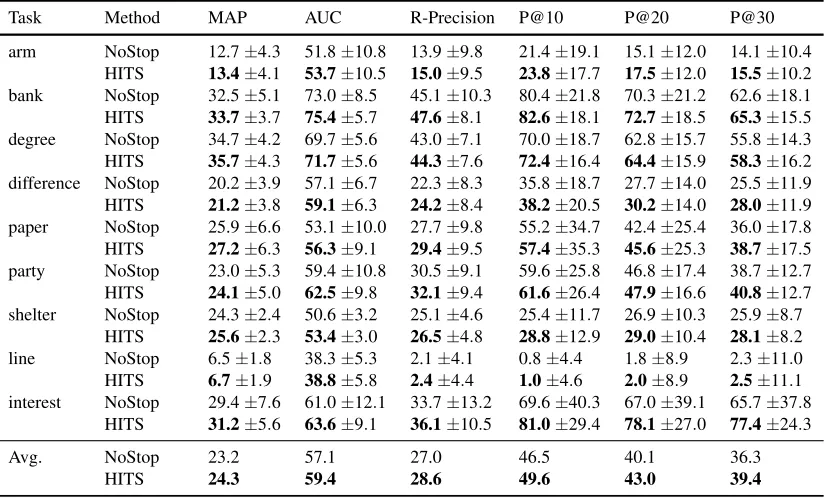
Table 2: Effect of stop lists for Espresso (nstop=10,nseed=10,τ=20). Results are reported as (mean±standard deviation). All figures are expressed in percentage. The row labeled “Avg.” shows the values macro-averaged over all nine tasks.
the baseline onbankand 25–37 points online.
5.2 Effect of Stop List
Table 2 shows the performance of Espresso using the stop list built with our proposed method (HITS), compared with the vanilla Espresso not using any stop list (NoStop).
In this case, the size of the stop list is set tonstop=
10, and the number of seedsnseed=10 and iterations τ =20. For both HITS and NoStop, the seeds are
selected at random from the gold standard data, and the reported results were averaged over 50 runs of each system. Due to lack of space, only the results for the second most frequent sense for each word are reported; i.e., the results for more minor senses are not in the table. However, they also showed a similar trend.
As shown in the table, our method (HITS) outper-forms the baseline not using a stop list (NoStop), in all evaluation metrics. In particular, the P@nlisted in Table 2 shows that our method provides about 11 percentage points absolute improvement over the baseline oninterest, for alln=10, 20, and 30.
6 Conclusions
We have proposed a HITS-based method for allevi-ating semantic drift in the bootstrapping algorithm Espresso. Our idea is built around the concept of
hubsin the sense of Kleinberg’s HITS algorithm, as well as the algorithmic similarity between Espresso and HITS. Hub instances are influential and hence make good seeds if they are of the target seman-tic class, but otherwise, they may trigger semanseman-tic drift. We have demonstrated that our method works effectively on lexical sample tasks. We are currently evaluating our method on other bootstrapping tasks, including named entity extraction.
Acknowledgements
References
Shuya Abe, Kentaro Inui, and Yuji Matsumoto. 2008. Acquiring event relation knowledge by learning cooc-currence patterns and fertilizing cooccooc-currence samples with verbal nouns. InProceedings of the 3rd Interna-tional Joint Conference on Natural Language Process-ing (IJCNLP ’08), pages 497–504.
Steven Abney. 2004. Understanding the Yarowsky
algo-rithm. Computational Linguistics, 30:365–395.
Krishna Bharat and Monika R. Henzinger. 1998. Im-proved algorithms for topic distillation environment in
a hyperlinked. InProceedings of the 21st Annual
In-ternational ACM SIGIR Conference on Research and Development in Information Retrieval (SIGIR ’98), pages 104–111.
Rebecca Bruce and Janyce Wiebe. 1994. Word-sense
disambiguation using decomposable models. In
Pro-ceedings of the 32nd Annual Meeting of the Associa-tion for ComputaAssocia-tional Linguistics (ACL ’94), pages 139–146.
Stephen Clark, James R. Curran, and Miles Osborne.
2003. Bootstrapping POS taggers using unlabelled
data. InProceedings of the 7th Conference on Natural Language Learning (CoNLL ’03), pages 49–55. Michael Collins and Yoram Singer. 1999. Unsupervised
models for named entity classification. InProceedings of the Joint SIGDAT Conference on Empirical Meth-ods in Natural Language Processing and Very Large Corpora (EMNLP-VLC ’99), pages 189–196.
James R. Curran, Tara Murphy, and Bernhard Scholz. 2007. Minimising semantic drift with mutual
exclu-sion bootstrapping. InProceedings of the 10th
Con-ference of the Pacific Association for Computational Linguistics (PACLING ’07), pages 172–180.
Marti A. Hearst. 1992. Automatic acquisition of hy-ponyms from large text corpora. InProceedings of the 14th Conference on Computational Linguistics (COL-ING ’92), pages 539–545.
Ashwin Ittoo and Gosse Bouma. 2010. On learning
subtypes of the part-whole relation: do not mix your
seeds. InProceedings of the 48th Annual Meeting of
the Association for Computational Linguistics (ACL ’10), pages 1328–1336.
Daniel Jurafsky and James H. Martin. 2008. Speech and
Language Processing. Prentice Hall, 2nd edition.
Jon M. Kleinberg. 1999. Authoritative sources in
a hyperlinked environment. Journal of the ACM,
46(5):604–632.
Mamoru Komachi and Hisami Suzuki. 2008. Minimally supervised learning of semantic knowledge from query
logs. In Proceedings of the 3rd International Joint
Conference on Natural Language Processing (IJCNLP ’08), pages 358–365.
Mamoru Komachi, Taku Kudo, Masashi Shimbo, and Yuji Matsumoto. 2008. Graph-based analysis of se-mantic drift in Espresso-like bootstrapping algorithms. InProceedings of the Conference on Empirical Meth-ods in Natural Language Processing (EMNLP ’08), pages 1011–1020.
Claudia Leacock, Geoffrey Towell, and Ellen Voorhees. 1993. Corpus-based statistical sense resolution. In Proceedings of the ARPA Workshop on Human Lan-guage Technology (HLT ’93), pages 260–265.
Christopher D. Manning and Hinrich Sch¨utze. 1999.
Foundations of Statistical Natural Language Process-ing. MIT Press.
Christopher D. Manning, Prabhakar Raghavan, and
Hin-rich Sch¨utze. 2008. Introduction to Information
Re-trieval. Cambridge University Press.
David McClosky, Eugene Charniak, and Mark Johnson. 2006. Effective self-training for parsing. In Proceed-ings of the Human Language Technology Conference of the North American Chapter of the Association of Computational Linguistics (HLT-NAACL ’06), pages 152–159.
Tara McIntosh and James R. Curran. 2009. Reducing semantic drift with bagging and distributional similar-ity. InProceedings of the Joint Conference of the 47th Annual Meeting of the ACL and the 4th International Joint Conference on Natural Language Processing of the AFNLP (ACL-IJCNLP ’09), volume 1, pages 396– 404.
Tara McIntosh. 2010. Unsupervised discovery of nega-tive categories in lexicon bootstrapping. In Proceed-ings of the 2010 Conference on Empirical Methods in Natural Language Processing (EMNLP ’10), pages 356–365.
Patrick Pantel and Marco Pennacchiotti. 2006. Espresso: Leveraging generic patterns for automatically harvest-ing semantic relations. InProceedings of the 21st In-ternational Conference on Computational Linguistics and the 44th Annual Meeting of the Association for Computational Linguistics (COLING-ACL ’06), pages 113–120.
M. F. Porter. 1980. An algorithm for suffix stripping. Program, 14(3):130–137.
Ellen Riloff and Rosie Jones. 1999. Learning dictio-naries for information extraction by multi-level boot-strapping. InProceedings of the 16th National Confer-ence on Artificial IntelligConfer-ence and the 11th Innovative Applications of Artificial Intelligence (AAAI/IAAI ’99), pages 474–479.
selection for bootstrapping statistical parsers. In Pro-ceedings of the 2003 Conference of the North Amer-ican Chapter of the Association for Computational Linguistics on Human Language Technology (HLT-NAACL ’03), volume 1, pages 157–164.
Michael Thelen and Ellen Riloff. 2002. A bootstrapping method for learning semantic lexicons using extraction
pattern contexts. InProceedings of the ACL-02
Con-ference on Empirical Methods in Natural Language Processing (EMNLP ’02), pages 214–221.
Vishnu Vyas, Patrick Pantel, and Eric Crestan. 2009. Helping editors choose better seed sets for entity set
expansion. InProceeding of the 18th ACM Conference
on Information and Knowledge Management (CIKM ’09), pages 225–234.
Roman Yangarber, Winston Lin, and Ralph Grishman. 2002. Unsupervised learning of generalized names. In Proceedings of the 19th International Conference on Computational Linguistics (COLING ’02). David Yarowsky. 1995. Unsupervised word sense
dis-ambiguation rivaling supervised methods. In
Proceed-ings of the 33rd Annual Meeting on Association for Computational Linguistics (ACL ’95), pages 189–196. Minoru Yoshida, Masaki Ikeda, Shingo Ono, Issei Sato,
and Hiroshi Nakagawa. 2010. Person name
dis-ambiguation by bootstrapping. InProceeding of the