Proceedings of the 49th Annual Meeting of the Association for Computational Linguistics, pages 1607–1615,
Ranking Class Labels Using Query Sessions
Marius Pas¸ca
Google Inc.
1600 Amphitheatre Parkway Mountain View, California 94043
Abstract
The role of search queries, as available within query sessions or in isolation from one an-other, in examined in the context of ranking the class labels (e.g., brazilian cities,
busi-ness centers, hilly sites) extracted from Web
documents for various instances (e.g., rio de
janeiro). The co-occurrence of a class la-bel and an instance, in the same query or within the same query session, is used to re-inforce the estimated relevance of the class la-bel for the instance. Experiments over eval-uation sets of instances associated with Web search queries illustrate the higher quality of the query-based, re-ranked class labels, rel-ative to ranking baselines using document-based counts.
1 Introduction
Motivation: The offline acquisition of instances (rio
de janeiro, porsche cayman) and their
correspond-ing class labels (brazilian cities, locations, vehicles,
sports cars) from text has been an active area of
re-search. In order to extract fine-grained classes of instances, existing methods often apply manually-created (Banko et al., 2007; Talukdar et al., 2008) or automatically-learned (Snow et al., 2006) extraction patterns to text within large document collections.
In Web search, the relative ranking of documents returned in response to a query directly affects the
outcome of the search. Similarly, the quality of
the relative ranking among class labels extracted for a given instance influences any applications (e.g., query refinements or structured extraction) using the
extracted data. But due to noise in Web data and limitations of extraction techniques, class labels ac-quired for a given instance (e.g., oil shale) may fail to properly capture the semantic classes to which the instance may belong (Kozareva et al., 2008). In-evitably, some of the extracted class labels will be less useful (e.g., sources, mutual concerns) or incor-rect (e.g., plants for the instance oil shale). In pre-vious work, the relative ranking of class labels for an instance is determined mostly based on features derived from the source Web documents from which the data has been extracted, such as variations of the frequency of co-occurrence or diversity of extraction patterns producing a given pair (Etzioni et al., 2005).
Contributions: This paper explores the role of
Web search queries, rather than Web documents, in inducing superior ranking among class labels ex-tracted automatically from documents for various in-stances. It compares two sources of indirect ranking evidence available within anonymized query logs: a) co-occurrence of an instance and its class label in the same query; and b) co-occurrence of an in-stance and its class label, as separate queries within the same query session. The former source is a noisy attempt to capture queries that narrow the search re-sults to a particular class of the instance (e.g., jaguar
car maker). In comparison, the latter source
nois-ily identifies searches that specialize from a class (e.g., car maker) to an instance (e.g., jaguar) or, conversely, generalize from an instance to a class. To our knowledge, this is the first study comparing inherently-noisy queries and query sessions for the purpose of ranking of open-domain, labeled class in-stances.
The remainder of the paper is organized as
fol-lows. Section 2 introduces intuitions behind an
approach using queries for ranking class labels of various instances, and describes associated ranking
functions. Sections 3 and 4 describe the
experi-mental setting and evaluation results over evaluation sets of instances associated with Web search queries. The results illustrate the higher quality of the query-based, re-ranked lists of class labels, relative to alter-native ranking methods using only document-based counts.
2 Instance Class Ranking via Query Logs
Ranking Hypotheses: We take advantage of anonymized query logs, to induce superior ranking among the class labels associated with various class instances within an IsA repository acquired from
Web documents. Given a class instanceI, the
func-tions used for the ranking of its class labels are cho-sen following several observations.
• Hypothesis H1: IfC is a prominent class of an
instanceI, thenCandIare likely to occur in text in
contexts that are indicative of an IsA relation.
• Hypothesis H2: IfC is a prominent class of an
instanceI, and I is ambiguous, then a fraction of
the queries aboutImay also refer to and containC.
• Hypothesis H3: IfC is a prominent class of an
instance I, then a fraction of the queries about I
may be followed by queries aboutC, and vice-versa.
Ranking Functions: The ranking functions follow
directly from the above hypotheses.
• Ranking based on H1 (using documents): The
first hypothesis H1 is a reformulation of findings
from previous work (Etzioni et al., 2005). In prac-tice, a class label is deemed more relevant for an in-stance if the pair is extracted more frequently and by multiple patterns, with the scoring formula:
ScoreH1(C,I) =F req(C,I)×Size({P attern(C)}) 2
(1)
whereF req(C,I)is the frequency of extraction of
Cfor the instanceI, andSize({P attern(C)})is the
number of unique patterns extracting the class label
Cfor the instanceI. The patterns are hand-written,
following (Hearst, 1992):
h[..]C[such as|including]I[and|,|.]i,
whereI is a potential instance (e.g., diderot) andC
is a potential class label (e.g., writers). The bound-aries are approximated from the part-of-speech tags
of the sentence words, for potential class labels C;
and identified by checking thatIoccurs as an entire
query in query logs, for instancesI(Van Durme and
Pas¸ca, 2008).
The application of the scoring formula (1) to can-didates extracted from the Web produces a ranked
list of class labels LH1(I).
• Ranking based on H2 (using queries):
Intu-itively, Web users searching for information about
I sometimes add some or all terms ofCto a search
query already containing I, either to further
spec-ify their query, or in response to being presented with sets of search results spanning several mean-ings of an ambiguous instance. Examples of such queries are happiness emotion and diderot
philoso-pher. Moreover, queries like happiness positive psy-chology and diderot enlightenment may be
consid-ered to weakly and partially reinforce the relevance of the class labels positive emotions and
enlighten-ment writers of the instances happiness and diderot
respectively. In practice, a class label is deemed more relevant if its individual terms occur in pop-ular queries containing the instance. More precisely,
for each term within any class label from LH1(I),
we compute a scoreT ermQueryScore. The score is
the frequency sum of the term within anonymized
queries containing the instance I as a prefix, and
the term anywhere else in the queries. Terms are stemmed before the computation.
Each class labelCis assigned the geometric mean
of the scores of its N terms Ti, after ignoring stop
words:
ScoreH2(C,I) = (
N
Y
i=1
T ermQueryScore(Ti))1/N (2)
The geometric mean is preferred to the arithmetic mean, because the latter is more strongly affected by outlier values. The class labels are ranked according
to the means, resulting in a ranked list LH2(I). In
case of ties, LH2(I) keeps the relative ranking from
LH1(I).
• Ranking based on H3 (using query sessions):
Given the third hypothesis H3, Web users searching
for information aboutImay subsequently search for
more general information about one of its classesC.
Conversely, users may specialize their search from
a class C to one of its instances I. Examples of
such queries are happiness followed later by
emo-tions followed later by happiness, or philosophers
followed by diderot. In practice, a class label is deemed more relevant if its individual terms occur as part of queries that are in the same query session as a query containing only the instance. More precisely,
for each term within any class label from LH1(I),
we compute a scoreT ermSessionScore, equal to the
frequency sum of the anonymized queries from the query sessions that contain the term and are: a) ei-ther the initial query of the session, with the instance
Ibeing one of the subsequent queries from the same
session; or b) one of the subsequent queries of the
session, with the instanceI being the initial query
of the same session. Before computing the frequen-cies, the class label terms are stemmed.
Each class labelCis assigned the geometric mean
of the scores of its terms, after ignoring stop words:
ScoreH3(C,I) = (
N
Y
i=1
T ermSessionScore(Ti))1/N (3)
The class labels are ranked according to the
geo-metric means, resulting in a ranked list LH3(I). In
case of ties, LH3(I) preserves the relative ranking
from LH1(I).
Unsupervised Ranking: Given an instance I, the ranking hypotheses and corresponding functions
LH1(I), LH2(I) and LH3(I) (or any combination
of them) can be used together to generate a merged,
ranked list of class labels per instanceI. The score
of a class label in the merged list is determined by
the inverse of the average rank in the lists LH1(I)
and LH2(I) and LH3(I), computed with the
follow-ing formula:
ScoreH1+H2+H3(C,I) =
N
PN
i Rank(C, LHi) (4)
whereN is the number of input lists of class labels
(in this case, 3), and Rank(C, LHi) is the rank of C
in the input list of class labels LHi (LH1, LH2 or
LH3). The rank is set to 1000, ifC is not present in
the list LHi. By using only the relative ranks and not
the absolute scores of the class labels within the in-put lists, the outcome of the merging is less sensitive to how class labels of a given instance are numeri-cally scored within the input lists. In case of ties,
the scores of the class labels from LH1(I) serve as a
secondary ranking criterion. Thus, every instanceI
from the IsA repository is associated with a ranked list of class labels computed according to this
rank-ing formula. Conversely, each class label C from
the IsA repository is associated with a ranked list of class instances computed with the earlier scoring
formula (1) used to generate lists LH1(I).
Note that the ranking formula can also consider only a subset of the available input lists. For
in-stance, ScoreH1+H2 would use only LH1(I) and
LH2(I) as input lists;ScoreH1+H3 would use only
LH1(I) and LH3(I) as input lists; etc.
3 Experimental Setting
Textual Data Sources: The acquisition of the IsA repository relies on unstructured text available
within Web documents and search queries. The
queries are fully-anonymized queries in English sub-mitted to Google by Web users in 2009, and are available in two collections. The first collection is a random sample of 50 million unique queries that are independent from one another. The second col-lection is a random sample of 5 million query ses-sions. Each session has an initial query and a se-ries of subsequent quese-ries. A subsequent query is a query that has been submitted by the same Web user within no longer than a few minutes after the initial query. Each subsequent query is accompanied by its frequency of occurrence in the session, with the corresponding initial query. The document collec-tion consists of a sample of 100 million documents in English.
Experimental Runs: The experimental runs
corre-spond to different methods for extracting and rank-ing pairs of an instance and a class:
• from the repository extracted here, with class
labels of an instance ranked based on the frequency
and the number of extraction patterns (ScoreH1
from Equation (1) in Section 2), in run Rd;
• from the repository extracted here, with class
labels of an instance ranked via the rank-based
merging of: ScoreH1+H2 from Section 2, in run
Rp, which corresponds to re-ranking using
co-occurrence of an instance and its class label in
the same query; ScoreH1+H3 from Section 2, in
run Rs, which corresponds to re-ranking using
co-occurrence of an instance and its class label, as sep-arate queries within the same query session; and
ScoreH1+H2+H3 from Section 2, in run Ru, which
Evaluation Procedure: The manual evaluation of
open-domain information extraction output is time consuming (Banko et al., 2007). A more practi-cal alternative is an automatic evaluation procedure for ranked lists of class labels, based on existing re-sources and systems.
Assume that there is a gold standard, containing gold class labels that are each associated with a gold set of their instances. The creation of such gold stan-dards is discussed later. Based on the gold standard, the ranked lists of class labels available within an IsA repository can be automatically evaluated as fol-lows. First, for each gold label, the ranked lists of class labels of individual gold instances are retrieved from the IsA repository. Second, the individual re-trieved lists are merged into a ranked list of class labels, associated with the gold label. The merged list can be computed, e.g., using an extension of the
ScoreH1+H2+H3 formula (Equation (4)) described
earlier in Section 2. Third, the merged list is com-pared against the gold label, to estimate the accu-racy of the merged list. Intuitively, a ranked list of class labels is a better approximation of a gold label, if class labels situated at better ranks in the list are closer in meaning to the gold label.
Evaluation Metric: Given a gold label and a list of
class labels, if any, derived from the IsA repository, the rank of the highest class label that matches the gold label determines the score assigned to the gold label, in the form of the reciprocal rank of the match. Thus, if the gold label matches a class label at rank 1, 2 or 3 in the computed list, the gold label receives a score of 1, 0.5 or 0.33 respectively. The score is 0 if the gold label does not match any of the top 20 class labels. The overall score over the entire set of gold labels is the mean reciprocal rank (MRR) score over all gold labels from the set. Two types of MRR scores are automatically computed:
•MRRf considers a gold label and a class label
to match, if they are identical;
• MRRp considers a gold label and a class label
to match, if one or more of their tokens that are not stop words are identical.
During matching, all string comparisons are case-insensitive, and all tokens are first converted to their singular form (e.g., european countries to european
country) using WordNet (Fellbaum, 1998). Thus, in-surance carriers and inin-surance companies are
con-Query Set: Sample of Queries
Qe (807 queries): 2009 movies, amino acids, asian
countries, bank, board games, buildings, capitals, chemical functional groups, clothes, computer lan-guage, dairy farms near modesto ca, disease, egyp-tian pharaohs, eu countries, fetishes, french presidents, german islands, hawaiian islands, illegal drugs, irc clients, lakes, macintosh models, mobile operator in-dia, nba players, nobel prize winners, orchids, photo editors, programming languages, renaissance artists, roller costers, science fiction tv series, slr cameras, soul singers, states of india, taliban members, thomas edison inventions, u.s. presidents, us president, water slides
Qm (40 queries): actors, actresses, airlines,
ameri-can presidents, antibiotics, birds, cars, celebrities, col-ors, computer languages, digital camera, dog breeds, dogs, drugs, elements, endangered animals, european countries, flowers, fruits, greek gods, horror movies, idioms, ipods, movies, names, netbooks, operating systems, park slope restaurants, planets, presidents, ps3 games, religions, renaissance artists, rock bands, romantic movies, states, universities, university, us cities, vitamins
Table 1: Size and composition of evaluation sets of queries associated with non-filtered (Qe) or
manually-filtered (Qm) instances
sidered to not match in MRRf scores, but match in
MRRpscores. On the other hand, MRRpscores may
give credit to less relevant class labels, such as
insur-ance policies for the gold label insurinsur-ance carriers.
Therefore, MRRp is an optimistic, and MRRf is a
pessimistic estimate of the actual usefulness of the computed ranked lists of class labels as approxima-tions of the gold labels.
4 Evaluation
IsA Repository: The IsA repository, extracted from
the document collection, covers a total of 4.04 mil-lion instances associated with 7.65 milmil-lion class la-bels. The number of class labels available per in-stance and vice-versa follows a long-tail distribu-tion, indicating that 2.12 million of the instances each have two or more class labels (with an average of 19.72 class labels per instance).
Evaluation Sets of Queries: Table 1 shows
sam-ples of two query sets, introduced in (Pas¸ca, 2010)
Query Set Min Max Avg Median Number of Gold Instances:
Qe 10 100 70.4 81
Qm 8 33 16.9 17
Number of Query Tokens:
Qe 1 8 2.0 2
[image:5.612.92.279.61.152.2]Qm 1 3 1.4 1
Table 2: Number of gold instances (upper part) and num-ber of query tokens (lower part) available per query, over the evaluation sets of queries associated with non-filtered gold instances (Qe) or manually-filtered gold instances
(Qm)
is obtained from a random sample of anonymized, class-seeking queries submitted by Web users to Google Squared. The set contains 807 queries, each associated with a ranked list of between 10 and 100 gold instances automatically extracted by Google Squared.
Since the gold instances available as input for
each query as part of Qeare automatically extracted,
they may or may not be true instances of the respec-tive queries. As described in (Pas¸ca, 2010), the
sec-ond evaluation set Qmis a subset of 40 queries from
Qe, such that the gold instances available for each
query in Qm are found to be correct after manual
inspection. The 40 queries from Qm are associated
with between 8 and 33 human-validated instances. As shown in the upper part of Table 2, the queries
from Qeare up to 8 tokens in length, with an average
of 2 tokens per query. Queries from Qm are
com-paratively shorter, both in maximum (3 tokens) and average (1.4 tokens) length. The lower part of Ta-ble 2 shows the number of gold instances availaTa-ble as input, which average around 70 and 17 per query,
for queries from Qeand Qmrespectively. To provide
another view on the distribution of the queries from evaluation sets, Table 3 lists tokens that are not stop
words, which occur in most queries from Qe.
Com-paratively, few query tokens occur in more than one
query in Qm.
Evaluation Procedure: Following the general
eval-uation procedure, each query from the sets Qe and
Qm acts as a gold class label associated with the
corresponding set of instances. Given a query and
its instances I from the evaluation sets Qe or Qm,
a merged, ranked lists of class labels is computed out of the ranked lists of class labels available in the
Query Cnt. Examples of Queries Containing the Token
Token
countries 22 african countries, eu countries, poor countries
cities 21 australian cities, cities in califor-nia, greek cities
presidents 18 american presidents, korean presidents, presidents of the south korea
restaurants 15 atlanta restaurants, nova scotia restaurants, restaurants 10024 companies 14 agriculture companies, gas
util-ity companies, retail companies states 14 american states, states of india,
united states national parks prime 11 australian prime ministers,
in-dian prime ministers, prime min-isters
cameras 10 cameras, digital cameras olym-pus, nikon cameras
movies 10 2009 movies, movies, romantic movies
american 9 american authors, american president, american revolution battles
ministers 9 australian prime ministers, in-dian prime ministers, prime min-isters
Table 3: Query tokens occurring most frequently in queries from the Qeevaluation set, along with the number
(Cnt) and examples of queries containing the tokens
underlying IsA repository for each instanceI. The
evaluation compares the merged lists of class labels,
with the corresponding queries from Qeor Qm.
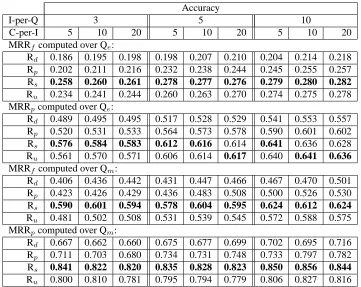
Accuracy of Lists of Class Labels: Table 4
summa-rizes results from comparative experiments, quanti-fying a) horizontally, the impact of alternative pa-rameter settings on the computed lists of class la-bels; and b) vertically, the comparative accuracy of the experimental runs over the query sets. The ex-perimental parameters are the number of input in-stances from the evaluation sets that are used for re-trieving class labels, I-per-Q, set to 3, 5, 10; and the number of class labels retrieved per input instance, C-per-I, set to 5, 10, 20.
Four conclusions can be derived from the results.
First, the scores over Qmare higher than those over
[image:5.612.313.541.67.420.2]Accuracy
I-per-Q 3 5 10
C-per-I 5 10 20 5 10 20 5 10 20
MRRfcomputed over Qe:
Rd 0.186 0.195 0.198 0.198 0.207 0.210 0.204 0.214 0.218
Rp 0.202 0.211 0.216 0.232 0.238 0.244 0.245 0.255 0.257
Rs 0.258 0.260 0.261 0.278 0.277 0.276 0.279 0.280 0.282
Ru 0.234 0.241 0.244 0.260 0.263 0.270 0.274 0.275 0.278
MRRpcomputed over Qe:
Rd 0.489 0.495 0.495 0.517 0.528 0.529 0.541 0.553 0.557
Rp 0.520 0.531 0.533 0.564 0.573 0.578 0.590 0.601 0.602
Rs 0.576 0.584 0.583 0.612 0.616 0.614 0.641 0.636 0.628
Ru 0.561 0.570 0.571 0.606 0.614 0.617 0.640 0.641 0.636
MRRfcomputed over Qm:
Rd 0.406 0.436 0.442 0.431 0.447 0.466 0.467 0.470 0.501
Rp 0.423 0.426 0.429 0.436 0.483 0.508 0.500 0.526 0.530
Rs 0.590 0.601 0.594 0.578 0.604 0.595 0.624 0.612 0.624
Ru 0.481 0.502 0.508 0.531 0.539 0.545 0.572 0.588 0.575
MRRpcomputed over Qm:
Rd 0.667 0.662 0.660 0.675 0.677 0.699 0.702 0.695 0.716
Rp 0.711 0.703 0.680 0.734 0.731 0.748 0.733 0.797 0.782
Rs 0.841 0.822 0.820 0.835 0.828 0.823 0.850 0.856 0.844
[image:6.612.126.487.61.348.2]Ru 0.800 0.810 0.781 0.795 0.794 0.779 0.806 0.827 0.816
Table 4: Accuracy of instance set labeling, as full-match (MRRf) or partial-match (MRRp) scores over the evaluation
sets of queries associated with non-filtered instances (Qe) or manually-filtered instances (Qm), for various
experi-mental runs (I-per-Q=number of gold instances available in the input evaluation sets that are used for retrieving class labels; C-per-I=number of class labels retrieved from IsA repository per input instance)
input set of instances available in Qm relative to
Qe should lead to higher-quality class labels for
the corresponding queries. Second, when I-per-Q is fixed, increasing C-per-I leads to small, if any, score improvements. Third, when C-per-I is fixed, even small values of I-per-Q, such as 3 (that is, very small sets of instances provided as input) produce scores that are competitive with those obtained with a higher value like 10. This suggests that useful class labels can be generated even in extreme scenarios, where the number of instances available as input is as small as 3 or 5. Fourth and most importantly, for most combinations of parameter settings and on both query sets, the runs that take advantage of query logs
(Rp, Rs, Ru) produce the highest scores. In
particu-lar, when I-per-Q is set to 10 and C-per-I to 20, run
Ru identifies the original query as an exact match
among the top three to four class labels returned (score 0.278); and as a partial match among the top one to two class labels returned (score 0.636), as an
average over the Qe set. The corresponding MRRf
score of 0.278 over the Qeset obtained with run Ru
is 27% higher than with run Rd.
In all experiments, the higher scores of Rp, Rsand
Ru can be attributed to higher-quality lists of class
labels, relative to Rd. Among combinations of
pa-rameter settings described in Table 4, values around 10 for I-per-Q and 20 for C-per-I give the highest
scores over both Qeand Qm.
Among the query-based runs Rp, Rsand Ru, the
highest scores in Table 4 are obtained mostly for run
Rs. Thus, between the presence of a class label and
an instance either in the same query, or as separate queries within the same query session, it is the lat-ter that provides a more useful signal during the re-ranking of class labels of each instance.
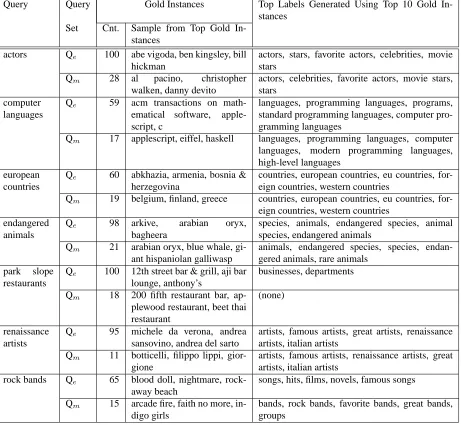
Table 5 illustrates the top class labels from the
ranked lists generated in run Rs for various queries
from both Qe and Qm. The table suggests that the
la-Query Query Gold Instances Top Labels Generated Using Top 10 Gold In-stances
Set Cnt. Sample from Top Gold In-stances
actors Qe 100 abe vigoda, ben kingsley, bill
hickman
actors, stars, favorite actors, celebrities, movie stars
Qm 28 al pacino, christopher
walken, danny devito
actors, celebrities, favorite actors, movie stars, stars
computer languages
Qe 59 acm transactions on
math-ematical software, apple-script, c
languages, programming languages, programs, standard programming languages, computer pro-gramming languages
Qm 17 applescript, eiffel, haskell languages, programming languages, computer
languages, modern programming languages, high-level languages
european countries
Qe 60 abkhazia, armenia, bosnia &
herzegovina
countries, european countries, eu countries, for-eign countries, western countries
Qm 19 belgium, finland, greece countries, european countries, eu countries,
for-eign countries, western countries endangered
animals
Qe 98 arkive, arabian oryx,
bagheera
species, animals, endangered species, animal species, endangered animals
Qm 21 arabian oryx, blue whale,
gi-ant hispaniolan galliwasp
animals, endangered species, species, endan-gered animals, rare animals
park slope restaurants
Qe 100 12th street bar & grill, aji bar
lounge, anthony’s
businesses, departments
Qm 18 200 fifth restaurant bar,
ap-plewood restaurant, beet thai restaurant
(none)
renaissance artists
Qe 95 michele da verona, andrea
sansovino, andrea del sarto
artists, famous artists, great artists, renaissance artists, italian artists
Qm 11 botticelli, filippo lippi,
gior-gione
artists, famous artists, renaissance artists, great artists, italian artists
rock bands Qe 65 blood doll, nightmare,
rock-away beach
songs, hits, films, novels, famous songs
Qm 15 arcade fire, faith no more,
in-digo girls
[image:7.612.78.539.65.490.2]bands, rock bands, favorite bands, great bands, groups
Table 5: Examples of gold instances available in the input, and actual ranked lists of class labels produced by run Rsfor
various queries from the evaluation sets of queries associated with non-filtered gold instances (Qe) or manually-filtered
gold instances (Qm)
bels generated for computer languages are relevant
and also quite similar for Qe vs. Qm, although the
list of gold instances in Qe may contain incorrect
items (e.g., acm transactions on mathematical
soft-ware). Similarly, the class labels computed for eu-ropean countries are almost the same for Qevs. Qm,
although the overlap of the respective lists of 10 gold instances used as input is not large. The table shows at least one query (park slope restaurants) for which the output is less than optimal, either because the class labels (e.g., businesses) are quite distant
se-mantically from the query (for Qe), or because no
output is produced at all, due to no class labels being found in the IsA repository for any of the 10 input
gold instances (for Qm). For many queries,
how-ever, the computed class labels arguably capture the meaning of the original query, although not neces-sarily in the exact same lexical form, and sometimes only partially. For example, for the query
endan-gered animals, only the fourth class label from Qm
0.062 0.125 0.250 0.500 1.000 2.000 4.000 8.000 16.000 32.000 64.000
1 2 3 4 5 6 7 8 9
10 11 12 13 14 15 16 17 18 19 20 (not in top 20)
Percentage of queries
Rank Query evaluation set: Qe
Full-match Partial-match
0.062 0.125 0.250 0.500 1.000 2.000 4.000 8.000 16.000 32.000 64.000
1 2 3 4 5 6 7 8 9
10 11 12 13 14 15 16 17 18 19 20 (not in top 20)
Percentage of queries
Rank Query evaluation set: Qm
[image:8.612.64.301.79.348.2]Full-match Partial-match
Figure 1: Percentage of queries from the evaluation sets, for which the earliest class labels from the computed ranked lists of class labels, which match the queries, oc-cur at various ranks in the ranked lists returned by run Rs
Figure 1 provides a detailed view on the
distribu-tion of queries from the Qeand Qm evaluation sets,
for which the class label that matches the query oc-curs at a particular rank in the computed list of class
labels. In the first graph of Figure 1, for Qe, the
query matches the automatically-generated class la-bel at ranks 1, 2, 3, 4 and 5 for 18.9%, 10.3%, 5.7%, 3.7% and 1.2% of the queries respectively, with full
string matching, i.e., corresponding to MRRf; and
for 52.6%, 12.4%, 5.3%, 3.7% and 1.7% respec-tively, with partial string matching, corresponding to
MRRp. The second graph confirms that higher MRR
scores are obtained for Qm than for Qe. In
particu-lar, the query matches the class label at rank 1 and 2 for 50.0% and 17.5% (or a combined 67.5%) of the
queries from Qm, with full string matching; and for
52.6% and 12.4% (or a combined 67%), with partial string matching.
Discussion: The quality of lists of items extracted
from documents can benefit from query-driven rank-ing, particularly for the task of ranking class labels
of instances within IsA repositories. The use of
queries for ranking is generally applicable: it can be seen as a post-processing stage that enhances the ranking of the class labels extracted for various in-stances by any method into any IsA repository.
Open-domain class labels extracted from text and re-ranked as described in this paper are useful in a variety of applications. Search tools such as Google Squared return a set of instances, in response to class-seeking queries (e.g., insurance companies). The labeling of the returned set of instances, using the re-ranked class labels available per instances, al-lows for the generation of query refinements (e.g.,
insurers). In search over semi-structured data
(Ca-farella et al., 2008), the labeling of column cells is useful to infer the semantics of a table column, when the subject row of the table in which the column ap-pears is either absent or difficult to detect.
5 Related Work
The role of anonymized query logs in Web-based information extraction has been explored in tasks such as class attribute extraction (Pas¸ca and Van Durme, 2007), instance set expansion (Pennacchiotti and Pantel, 2009) and extraction of sets of similar entities (Jain and Pennacchiotti, 2010). Our work compares the usefulness of queries and query ses-sions for ranking class labels in extracted IsA repos-itories. It shows that query sessions produce better-ranked class labels than isolated queries do. A task complementary to class label ranking is entity ing (Billerbeck et al., 2010), also referred to as rank-ing for typed search (Demartini et al., 2009).
The choice of search queries and query substitu-tions is often influenced by, and indicative of, vari-ous semantic relations holding among full queries or query terms (Jones et al., 2006). Semantic relations may be loosely defined, e.g., by exploring the ac-quisition of untyped, similarity-based relations from query logs (Baeza-Yates and Tiberi, 2007). In com-parison, queries are used here to re-rank class labels capturing a well-defined type of open-domain rela-tions, namely IsA relations.
6 Conclusion
in search queries, this study shows that inherently-noisy queries are useful in re-ranking class labels ex-tracted from Web documents for various instances, with query sessions leading to higher quality than isolated queries. Current work investigates the im-pact of ambiguous input instances (Vyas and Pantel, 2009) on the quality of the generated class labels.
References
R. Baeza-Yates and A. Tiberi. 2007. Extracting semantic relations from query logs. In Proceedings of the 13th
ACM Conference on Knowledge Discovery and Data Mining (KDD-07), pages 76–85, San Jose, California.
M. Banko, Michael J Cafarella, S. Soderland, M. Broad-head, and O. Etzioni. 2007. Open information ex-traction from the Web. In Proceedings of the 20th
In-ternational Joint Conference on Artificial Intelligence (IJCAI-07), pages 2670–2676, Hyderabad, India.
B. Billerbeck, G. Demartini, C. Firan, T. Iofciu, and R. Krestel. 2010. Ranking entities using Web search query logs. In Proceedings of the 14th European
Conference on Research and Advanced Technology for Digital Libraries (ECDL-10), pages 273–281,
Glas-gow, Scotland.
M. Cafarella, A. Halevy, D. Wang, E. Wu, and Y. Zhang. 2008. WebTables: Exploring the power of tables on the Web. In Proceedings of the 34th Conference on
Very Large Data Bases (VLDB-08), pages 538–549,
Auckland, New Zealand.
G. Demartini, T. Iofciu, and A. de Vries. 2009. Overview of the INEX 2009 Entity Ranking track. In INitiative
for the Evaluation of XML Retrieval Workshop, pages
254–264, Brisbane, Australia.
O. Etzioni, M. Cafarella, D. Downey, A. Popescu, T. Shaked, S. Soderland, D. Weld, and A. Yates. 2005. Unsupervised named-entity extraction from the Web: an experimental study. Artificial Intelligence, 165(1):91–134.
C. Fellbaum, editor. 1998. WordNet: An Electronic
Lexi-cal Database and Some of its Applications. MIT Press.
M. Hearst. 1992. Automatic acquisition of hyponyms from large text corpora. In Proceedings of the 14th
In-ternational Conference on Computational Linguistics (COLING-92), pages 539–545, Nantes, France.
A. Jain and M. Pennacchiotti. 2010. Open entity ex-traction from Web search query logs. In
Proceed-ings of the 23rd International Conference on Com-putational Linguistics (COLING-10), pages 510–518,
Beijing, China.
R. Jones, B. Rey, O. Madani, and W. Greiner. 2006. Gen-erating query substitutions. In Proceedings of the 15h
World Wide Web Conference (WWW-06), pages 387–
396, Edinburgh, Scotland.
Z. Kozareva, E. Riloff, and E. Hovy. 2008. Semantic class learning from the Web with hyponym pattern linkage graphs. In Proceedings of the 46th Annual
Meeting of the Association for Computational Linguis-tics (ACL-08), pages 1048–1056, Columbus, Ohio.
M. Pas¸ca and B. Van Durme. 2007. What you seek is what you get: Extraction of class attributes from query logs. In Proceedings of the 20th International
Joint Conference on Artificial Intelligence (IJCAI-07),
pages 2832–2837, Hyderabad, India.
M. Pas¸ca. 2010. The role of queries in ranking la-beled instances extracted from text. In Proceedings
of the 23rd International Conference on Computa-tional Linguistics (COLING-10), pages 955–962,
Bei-jing, China.
M. Pennacchiotti and P. Pantel. 2009. Entity extrac-tion via ensemble semantics. In Proceedings of the
2009 Conference on Empirical Methods in Natural Language Processing (EMNLP-09), pages 238–247,
Singapore.
R. Snow, D. Jurafsky, and A. Ng. 2006. Semantic tax-onomy induction from heterogenous evidence. In
Pro-ceedings of the 21st International Conference on Com-putational Linguistics and 44th Annual Meeting of the Association for Computational Linguistics (COLING-ACL-06), pages 801–808, Sydney, Australia.
P. Talukdar, J. Reisinger, M. Pas¸ca, D. Ravichandran, R. Bhagat, and F. Pereira. 2008. Weakly-supervised acquisition of labeled class instances using graph ran-dom walks. In Proceedings of the 2008 Conference on
Empirical Methods in Natural Language Processing (EMNLP-08), pages 582–590, Honolulu, Hawaii.
B. Van Durme and M. Pas¸ca. 2008. Finding cars, god-desses and enzymes: Parametrizable acquisition of la-beled instances for open-domain information extrac-tion. In Proceedings of the 23rd National
Confer-ence on Artificial IntelligConfer-ence (AAAI-08), pages 1243–
1248, Chicago, Illinois.
V. Vyas and P. Pantel. 2009. Semi-automatic entity set refinement. In Proceedings of the 2009 Conference
of the North American Association for Computational Linguistics (NAACL-HLT-09), pages 290–298,