Joint Training of Dependency Parsing Filters through
Latent Support Vector Machines
Colin Cherry
Institute for Information Technology National Research Council Canada
Shane Bergsma
Center for Language and Speech Processing Johns Hopkins University
Abstract
Graph-based dependency parsing can be sped up significantly if implausible arcs are elim-inated from the search-space before parsing begins. State-of-the-art methods for arc fil-tering use separate classifiers to make point-wise decisions about the tree; they label tokens with roles such asroot, leaf, or attaches-to-the-left, and then filter arcs accordingly. Be-cause these classifiers overlap substantially in their filtering consequences, we propose to train them jointly, so that each classifier can focus on the gaps of the others. We inte-grate the various pointwise decisions as latent variables in a single arc-level SVM classifier. This novel framework allows us to combine nine pointwise filters, and adjust their sensi-tivity using a shared threshold based on arc length. Our system filters 32% more arcs than the independently-trained classifiers, without reducing filtering speed. This leads to faster parsing with no reduction in accuracy.
1 Introduction
A dependency tree represents syntactic relationships between words using directed arcs (Me´lˇcuk, 1987). Each token in the sentence is a node in the tree, and each arc connects aheadto itsmodifier. There are two dominant approaches to dependency pars-ing: based and transition-based, where graph-based parsing is understood to be slower, but often more accurate (McDonald and Nivre, 2007).
In the graph-based setting, a complete search finds the highest-scoring tree under a model that de-composes over one or two arcs at a time. Much of the time for parsing is spent scoring each poten-tial arc in the complete dependency graph
(John-son, 2007), one for each ordered word-pair in the sentence. Potential arcs are scored using rich linear models that are discriminatively trained to maximize parsing accuracy (McDonald et al., 2005). The vast majority of these arcs are bad; in an n-word sen-tence, onlynof then2 potential arcs are correct. If
many arcs can be filtered before parsing begins, then the entire process can be sped up substantially.
Previously, we proposed a cascade of filters to prune potential arcs (Bergsma and Cherry, 2010). One stage of this cascade operates one token at a time, labeling each tokentaccording to various roles in the tree:
• Not-a-head(NaH):tis not the head of any arc
• Head-to-left (HtL{1/5/*}): t’s head is to its left within 1, 5 or any number of words
• Head-to-right(HtR{1/5/*}): as head-to-left
• Root(Root): tis the root node, which elimi-nates arcs according to projectivity
Similar to Roark and Hollingshead (2008), each role has a corresponding binary classifier. These token-role classifierswere shown to be more effective than vine parsing (Eisner and Smith, 2005; Dreyer et al., 2006), a competing filtering scheme that filters arcs based on their length (leveraging the observa-tion that most dependencies are short).
In this work, we propose a novel filtering frame-work that integrates all the information used in token-role classification and vine parsing, but of-fers a number of advantages. In our previous work, classifier decisions would often overlap: different token-role classifiers would agree to filter the same arc. Based on this observation, we propose a joint training framework where only the most confident
HtR16 NaH3 HtR*6 HtR56
Bob1 ate2 the3 pizza4 with5 his6 fork8 NN VBD DT NN IN POS NN
HtL16 salad7
NN
[image:2.612.85.284.60.170.2](T) (T) (T) (F) (F)
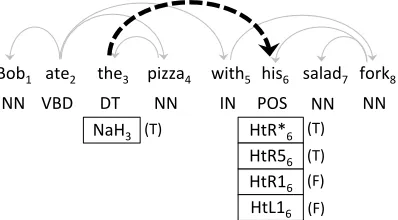
Figure 1:The dotted arc can be filtered by labeling any of the boxed roles as True; i.e., predicting that the headthe3is not the head of any arc, or that the modifierhis6attaches elsewhere. Role truth values, derived from the gold-standard tree (in grey), are listed adjacent to the boxes, in parentheses.
classifier is given credit for eliminating an arc. The identity of the responsible classifier is modeled as a latent variable, which is filled in during training using a latent SVM (LSVM) formulation. Our use of an LSVM to assign credit during joint training differs substantially from previous LSVM applica-tions, which have induced latent linguistic structures (Cherry and Quirk, 2008; Chang et al., 2010) or sen-tence labels (Yessenalina et al., 2010).
In our framework, each classifier learns to fo-cus on the cases where the other classifiers are less confident. Furthermore, the integrated approach di-rectly optimizes for arc-filtering accuracy (rather than token-labeling fidelity). We trade-off filtering precision/recall using two hyperparameters, while the previous approach trained classifiers for eight different tasks resulting in sixteen hyperparameters. Ultimately, the biggest gains in filter quality are achieved when we jointly train the token-role classi-fiers together with a dynamic threshold that is based on arc length and shared across all classifiers.
2 Joint Training of Token Roles
In our previous system, filtering is conducted by training a separate SVM classifier for each of the eight token-roles described in Section 1. Each clas-sifier uses a training set with one example per tree-bank token, where each token is assigned a binary label derived from the gold-standard tree. Figure 1 depicts five of the eight token roles, along with their truth values. The role labelers can be tuned for high precision with label-specific cost parameters; these are tuned separately for each classifier. At test time, each of the eight classifiers assigns a binary label
to each of the n tokens in the sentence. Potential arcs are then filtered from the complete dependency graph according to these token labels. In Figure 1, a positive assignment to any of the indicated token-roles is sufficient to filter the dotted arc.
In the current work, we maintain almost the same test-time framework, but we alter training substan-tially, so that the various token-role classifiers are trained jointly. To do so, we propose a classifica-tion scheme focused onarcs.1 During training, each arc is assigned a filteringeventas a latent variable. Events generalize the token-roles from our previous system (e.g.NaH3,HtR∗6). Events are assigned
bi-nary labels during filtering; positive events are said to be detected. In general, events can correspond to any phenomenon, so long as the following holds: For each arca, we must be able to deterministically construct the set Za of all events that would filter
a if detected.2 Figure 1 shows that Zthe3→his6 =
{NaH3,HtR∗6,HtR56,HtR16,HtL16}.
To detect events, we maintain the eight token-role classifiers from the previous system, but they be-come subclassifiers of our joint system. For no-tational convenience, we pack them into a single weight vectorw¯. Thus, the eventz=NaH3 is
de-tected only ifw¯·Φ(¯ NaH3)>0, whereΦ(¯ z)isz’s
feature vector. Given this notation, we can cast the filtering decision for an arca as a maximum. We filteraonly if:
f(Za)>0 where f(Za) = max z∈Za
¯
w·Φ(¯ z) (1)
We have reformulated our problem, which previ-ously involved a number of independent token clas-sifiers, as a single arc classifierf()with an innermax over latent events. Note the asymmetry inherent in (1). To filter an arc,w¯·Φ(¯ z)>0must hold for at least onez∈Za; but to keep an arc,
¯
w·Φ(¯ z)≤0 must hold for all z ∈ Za. Also note that tokens have completely disappeared from our formalism: the classifier is framed only in terms of events and arcs; token-roles are encapsulated inside events.
To provide a large-margin training objective for our joint classifier, we adapt the latent SVM
(Felzen-1
A joint filtering formalism for CFG parsing or SCFG trans-lation would likewise focus on hyper-edges or spans.
2
szwalb et al., 2010; Yu and Joachims, 2009) to our problem. Given a training set A of (a, y) pairs, whereais an arc in context andyis the correct filter label fora(1 to filter, 0 otherwise), LSVM training selectsw¯to minimize:
1 2||w¯||
2+ X
(a,y)∈A
Cymax
0,1 + f(Za|¬y)−f(Za|y)
(2) whereCy is a label-specific regularization parame-ter, and the event set Z is now conditioned on the labely: Za|1 = Za, andZa|0 = {Nonea}. Nonea is a rejection event, which indicates that a isnot filtered. The rejection event slightly alters our de-cision rule; rather than thresholding at 0, we now filteraonly iff(Za) >w¯·Φ(¯ Nonea). One can set
¯
Φ(Nonea)← ∅for allato fix the threshold at 0. Though not convex, (2) can be solved to a lo-cal minimum with an EM-like alternating minimiza-tion procedure (Felzenszwalb et al., 2010; Yu and Joachims, 2009). The learner alternates between picking the highest-scoring latent event zˆa ∈ Za|y for each example (a, y), and training a multiclass SVM to solve an approximation to (2) whereZa|yis replaced with{zˆa}. Intuitively, the first step assigns the eventzˆatoa, makingzˆaresponsible fora’s ob-served label. The second step optimizes the model to ensure that eachzˆais detected, leading to the desired arc-filtering decisions. As the process iterates, event assignment becomes increasingly refined, leading to a more accurate joint filter.
The resulting joint filter has only two hyper-parameters: the label-specific cost parameters C1
andCo. These allow us to tune our system for high precision by increasing the cost of misclassifying an arc that should not be filtered (C1Co).
Joint training also implicitly affects the relative costs of subclassifier decisions. By minimizing an arc-level hinge loss with latent events (which in turn correspond to roles), we assign costs to token-roles based on arc accuracy. Consequently, 1) A token-level decision that affects multiple arcs im-pacts multiple instances of hinge loss, and 2) No extra credit (penalty) is given for multiple decisions that (in)correctly filter the same arc. Therefore, an
NaH decision that filters thirty arcs is given more weight than an HtL5 decision that filters only one (Item 1), unless those thirty arcs are already filtered
NaH3 = 0.5
The1 big2 dog3 chased4 the5 cat6 DT ADJ NN VBD DT NN
[image:3.612.354.500.59.138.2]1.0 1.1 0.6 0.3 0.2
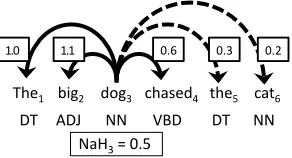
Figure 2: A hypothetical example of dynamic threshold-ing, where a weak assertion that dog3 should not be a head
`
¯
w·Φ(¯ NaH3) = 0.5´
is sufficient to rule out two arcs. Each arc’s threshold`
¯
w·Φ(¯ Nonea)´is shown next to its arrow.
by higher-scoring subclassifiers (Item 2).
3 Accounting for Arc Length
We can extend our system by expanding our event setZ. By adding an arc-level event Vinea to each Za, we can introduce avine filterto prune long arcs. Similarly, we have already introduced another arc-level event, the rejection event Nonea. By assign-ing features toNonea, we learn adynamic
thresh-oldon all filters, which considers properties of the arc before acting on any other event. We parameter-ize bothVineaandNoneawith the same two fea-tures, inspired by tag-specific vine parsing (Eisner and Smith, 2005):
Bias : 1
HeadTag ModTag Dir(a) : Len(a)
whereHeadTag ModTag Dir(a) concatenates the part-of-speech tags ofa’s head and modifier tokens to its direction (left or right), andLen(a) gives the unsigned distance betweena’s head and modifier.
In the context of Vinea, these two features al-low the system to learn tag-pair-specific limits on arc length. In the context ofNonea, these features protect short arcs and arcs that connect frequently-linked tag-pairs, allowing our token-role filters to be more aggressive on arcs that do not have these char-acteristics. The dynamic threshold also alters our interpretation of filtering events: where before they were either active or inactive, events are now as-signed scores, which are compared with the thresh-old to make final filtering decisions (Figure 2).3
3
4 Experiments
We extract dependency structures from the Penn Treebank using the head rules of Yamada and Mat-sumoto (2003).4 We divide the Treebank into train (sections 2–21), development (22) and test (23). We part-of-speech tag our data using a perceptron tagger similar to the one described by Collins (2002). The training set is tagged with jack-knifing: the data is split into 10 folds and each fold is tagged by a sys-tem trained on the other 9 folds. Development and test sets are tagged using the entire training set.
We train our joint filter using an in-house latent SVM framework, which repeatedly calls a multi-class exponentiated gradient SVM (Collins et al., 2008). LSVM training was stopped after 4 itera-tions, as determined during development.5 For the token-role classifiers, we re-implement the Bergsma and Cherry (2010) feature set, initializing w¯ with high-precision subclassifiers trained independently for each token-role. Vine andNone subclassifiers are initialized with a zero vector. At test time, we extract subclassifiers from the joint weight vector, and use them as parameters in the filtering tools of Bergsma and Cherry (2010).6
Parsing experiments are carried out using the MST parser (McDonald et al., 2005),7 which we have modified to filter arcs before carrying out fea-ture extraction. It is trained using 5-best MIRA (Crammer and Singer, 2003).
Following Bergsma and Cherry (2010), we mea-sure intrinsic filter quality withreduction, the pro-portion of total arcs removed, andcoverage, the pro-portion of true arcs retained. For parsing results, we present dependencyaccuracy, the percentage of to-kens that are assigned the correct head.
4.1 Impact of Joint Training
Our technical contribution consists of our proposed joint training scheme for token-role filters, along
4
As implemented at http://w3.msi.vxu.se/∼nivre/
research/Penn2Malt.html
5
The LSVM is well on its way to convergence: fewer than 3% of arcs have event assignments that are still in flux.
6http://code.google.com/p/arcfilter/. Since our
contribution is mainly in better filter training, we were able to use the arcfilter (testing) code with only small changes. We have added our new joint filter, along with the Joint P1 model to the arcfilter package, labeled asultra filters.
7http://sourceforge.net/projects/mstparser/
Indep. Joint
System Cov. Red. Cov. Red. Token 99.73 60.5 99.71 59.0 + Vine 99.62 68.6 99.69 63.3
[image:4.612.330.526.55.127.2]+ None N/A 99.76 71.6
Table 1:Ablation analysis of intrinsic filter quality.
with two extensions: the addition of vine filters (Vine) and a dynamic threshold (None). Using pa-rameters determined to perform well during devel-opment,8we examine test-set performance as we in-corporate each of these components. For the token-role and vine subclassifiers, we compare against an independently-trained ensemble of the same classi-fiers.9 Note that None cannot be trained indepen-dently, as its shared dynamic threshold considers arc and token views of the data simultaneously. Results are shown in Table 1.
Our complete system outperforms all variants in terms of both coverage and reduction. However, one can see that neither joint system is able to outper-form its independently-trained counter-part without the dynamic threshold provided by None. This is because the desirable credit-assignment properties of our joint training procedure are achieved through duplication (Zadrozny et al., 2003). That is, the LSVM knows that a specific event is important be-cause it appears in event setsZafor many arcs from the same sentence. WithoutNone, the filtering deci-sions implied by each copy of an event are identical. Because these replicated events are associated with arcs that are presented to the LSVM as independent examples, they appear to be not only important, but also low-variance, and therefore easy. This leads to overfitting. We had hoped that the benefits of joint training would outweigh this drawback, but our re-sults show that they do not. However, in addition to its other desirable properties (protecting short arcs), the dynamic threshold imposed byNonerestores in-dependence between arcs that share a common event (Figure 2). This alleviates overfitting and enables strong performance.
8C
0=1e-2,C1=1e-5
9Each subclassifier is a level SVM trained with
Filter Intrinsic MST-1 MST-2 Filter Cov. Red. Time Acc. Sent/sec* Acc. Sent/sec*
None 100.00 00.0 0s 91.28 16 92.05 10
B&C R+L 99.70 54.1 7s 91.24 29 92.00 17
Joint P1 99.76 71.6 7s 91.28 38 92.06 22
B&C R+L+Q 99.43 78.3 19s 91.23 35 91.98 22
[image:5.612.125.490.56.156.2]Joint P2 99.56 77.9 7s 91.29 44 92.05 25
Table 2: Parsing with jointly-trained filters outperforms independently-trained filters (R+L), as well as a more complex cascade (R+L+Q). *Accounts for total time spent parsing and applying filters, averaged over five runs.
4.2 Comparison to the state of the art
We directly compare our filters to those of Bergsma and Cherry (2010) in terms of both intrinsic fil-ter quality and impact on the MST parser. The B&C system consists of three stages: rules (R), lin-ear token-role filters (L) and quadratic arc filters (Q). The Q stage uses rich arc-level features simi-lar to those of the MST parser. We compare against independently-trained token-role filters (R+L), as well as the complete cascade (R+L+Q), using the models provided online.10 Our comparison points, Joint P1 and P2 were built by tuning our complete joint system to roughly match the coverage values of R+L and R+L+Q on development data.11 Results are shown in Table 2.
Comparing Joint P1 to R+L, we can see that for a fixed set of pointwise filters, joint training with a dynamic threshold outperforms independent train-ing substantially. We achieve a 32% improvement in reduction with no impact on coverage and no in-crease in filtering overhead (time).
Comparing Joint P2 to R+L+Q, we see that Joint P2 achieves similar levels of reduction with far less filtering overhead; our filters take only 7 seconds to apply instead of 19. This increases the speed of the (already fast) filtered MST-1 parser from 35 sen-tences per second to 44, resulting in a total speed-up of 2.75 with respect to the unfiltered parser. The improvement is less impressive for MST-2, where the overhead for filter application is a less substan-tial fraction of parsing time; however, our training framework also has other benefits with respect to R+L+Q, including a single unified training
algo-10
Results are not identical to those reported in our previous paper, due to our use of a different part-of-speech tagger. Note that parsing accuracies for the B&C systems have improved.
11
P1:C0=1e-2,C1=1e-5, P2:C0=1e-2,C1=2e-5
rithm, fewer hyper-parameters and a smaller test-time memory footprint. Finally, the jointly trained filters have no impact on parsing accuracy, where both B&C filters have a small negative effect.
The performance of Joint-P2+MST-2 is compa-rable to the system of Huang and Sagae (2010), who report a parsing speed of 25 sentences per second and an accuracy of 92.1 on the same test set, using atransition-based parser enhanced with dynamic-programming state combination.12 Graph-based and transition-Graph-based systems tend to make dif-ferent types of errors (McDonald and Nivre, 2007). Therefore, having fast, accurate parsers for both ap-proaches presents an opportunity for large-scale, ro-bust parser combination.
5 Conclusion
We have presented a novel use of latent SVM technology to train a number of filters jointly, with a shared dynamic threshold. By training a family of dependency filters in this manner, each subclassifier focuses on the examples where it is most needed, with our dynamic threshold adjust-ing filter sensitivity based on arc length. This al-lows us to outperform a 3-stage filter cascade in terms of speed-up, while also reducing the im-pact of filtering on parsing accuracy. Our filter-ing code and trained models are available online at
http://code.google.com/p/arcfilter. In
the future, we plan to apply our joint training tech-nique to other rich filtering regimes (Zhang et al., 2010), and to other NLP problems that combine the predictions of overlapping classifiers.
12The usual caveats for cross-machine, cross-implementation
References
Shane Bergsma and Colin Cherry. 2010. Fast and accu-rate arc filtering for dependency parsing. InCOLING. Ming-Wei Chang, Dan Goldwasser, Dan Roth, and Vivek Srikumar. 2010. Discriminative learning over con-strained latent representations. InHLT-NAACL. Colin Cherry and Chris Quirk. 2008. Discriminative,
syntactic language modeling through latent SVMs. In AMTA.
Michael Collins, Amir Globerson, Terry Koo, Xavier Carreras, and Peter L. Bartlett. 2008. Exponentiated gradient algorithms for conditional random fields and max-margin markov networks. JMLR, 9:1775–1822. Michael Collins. 2002. Discriminative training methods
for hidden markov models: Theory and experiments with perceptron algorithms. InEMNLP.
Koby Crammer and Yoram Singer. 2003. Ultraconserva-tive online algorithms for multiclass problems. JMLR, 3:951–991.
Markus Dreyer, David A. Smith, and Noah A. Smith. 2006. Vine parsing and minimum risk reranking for speed and precision. InCoNLL.
Jason Eisner and Noah A. Smith. 2005. Parsing with soft and hard constraints on dependency length. InIWPT. Pedro F. Felzenszwalb, Ross B. Girshick, David
McAllester, and Deva Ramanan. 2010. Object detec-tion with discriminatively trained part based models. IEEE Transactions on Pattern Analysis and Machine Intelligence, 32(9).
Liang Huang and Kenji Sagae. 2010. Dynamic program-ming for linear-time incremental parsing. InACL. Mark Johnson. 2007. Transforming projective bilexical
dependency grammars into efficiently-parsable CFGs with unfold-fold. InACL.
Ryan McDonald and Joakim Nivre. 2007. Characteriz-ing the errors of data-driven dependency parsCharacteriz-ing mod-els. InEMNLP-CoNLL.
Ryan McDonald, Koby Crammer, and Fernando Pereira. 2005. Online large-margin training of dependency parsers. InACL.
Igor A. Me´lˇcuk. 1987. Dependency syntax: theory and practice. State University of New York Press. Brian Roark and Kristy Hollingshead. 2008. Classifying
chart cells for quadratic complexity context-free infer-ence. InCOLING.
Hiroyasu Yamada and Yuji Matsumoto. 2003. Statistical dependency analysis with support vector machines. In IWPT.
Ainur Yessenalina, Yisong Yue, and Claire Cardie. 2010. Multi-level structured models for document-level sen-timent classification. InEMNLP.
Chun-Nam John Yu and Thorsten Joachims. 2009. Learning structural SVMs with latent variables. In ICML.
Bianca Zadrozny, John Langford, and Naoki Abe. 2003. Cost-sensitive learning by cost-proportionate example weighting. InThird IEEE International Conference on Data Mining.