Categorizing U n k n o w n Words: Using Decision Trees to Identify
N a m e s and Misspellings
J a n i n e T o o l e
N a t u r a l L a n g u a g e L a b o r a t o r y D e p a r t m e n t o f C o m p u t i n g S c i e n c e
S i m o n F r a s e r U n i v e r s i t y B u r n a b y , B C , C a n a d a V S A I S 6
A b s t r a c t
This paper introduces a system for categorizing un- known words. The system is based on a multi- component architecture where each component is re- sponsible for identifying one class of unknown words. The focus of this paper is the components that iden- tify names and spelling errors. Each component uses a decision tree architecture to combine multiple types of evidence about the unknown word. The sys- tem is evaluated using data from live closed captions
- a genre replete with a wide variety of unknown
words.
1 I n t r o d u c t i o n
In any real world use, a Natural Language Process- ing (NLP) system will encounter words that are not in its lexicon, what we term 'unknown words'. Un- known words are problematic because a NLP system will perform well only if it recognizes the words that it is meant to analyze or translate: the more words a system does not recognize the more the system's per- formance will degrade. Even when unknown words are infrequent, they can have a disproportionate ef- fect on system quality. For example, Min (1996) found that while only 0.6% of words in 300 e-mails were misspelled, this meant that 12% of the sen- tences contained an error (discussed in (Min and Wilson, 1998)).
Words may be unknown for many reasons: the word may be a proper name, a misspelling, an ab- breviation, a number, a morphological variant of a known word (e.g.
recleared),
or missing from the dictionary. The first step in dealing with unknown words is to identify the class of the unknown word; whether it is a misspelling, a proper name, an ab- breviation etc. Once this is known, the proper ac- tion can be taken, misspellings can be corrected, ab- breviations can be expanded and so on, as deemed necessary by the particular text processing applica- tion. In this paper we introduce a system for cat- egorizing unknown words. The system is based on a multi- component architecture where each compo- nent is responsible for identifying one category of unknown words. The main focus of this paper is thecomponents that identify names and spelling errors. Both components use a decision tree architecture to combine multiple types of evidence about the un- known word. Results from the two components are combined using a weighted voting procedure. The system is evaluated using data from live closed cap- tions - a genre replete with a wide variety of un- known words.
This paper is organized as follows. In section 2 we outline the overall architecture of the unknown word categorizer. The name identifier and the mis- spelling identifier are introduced in section 3. Perfor- mance and evaluation issues are discussed in section 4. Section 5 considers portability issues. Section 6 compares the current system with relevant preced- ing research. Concluding comments can be found in section 6.
2 S y s t e m A r c h i t e c t u r e
The goal of our research is to develop a system that automatically categorizes unknown words. Accord- ing to our definition, an unknown word is a word that is not contained in the lexicon of an NLP sys- tem. As defined, 'unknown-ness' is a relative con- cept: a word that is known to one system may be unknown to another system.
Our research is motivated by the problems that we have experienced in translating live closed cap- tions: live captions are produced under tight time constraints and contain many unknown words. Typ- ically, the caption transcriber has a five second win- dow to transcribe the broadcast dialogue. Because of the live nature of the broadcast, there is no op- portunity to post-edit the transcript in any way. Al- though motivated by our specific requirements, the unknown word categorizer would benefit any NLP system that encounters unknown words of differ- ing categories. Some immediately obvious domains where unknown words are frequent include e-mail messages, internet chat rooms, data typed in by call centre operators, etc.
unknown word. For example, the misspelling iden- tifier will specialize in identifying misspellings, the abbreviation component will specialize in identify- ing abbreviations, etc. Each component will return a confidence measure of the reliability of its predic- tion, c.f. (Elworthy, 1998). The results from each component are evaluated to determine the final cat- egory of the word.
There are several advantages to this approach. Firstly, the system can take advantage of existing research. For example, the name recognition mod- ule can make use of the considerable research that exists on name recognition, e.g. (McDonald, 1996), (Mani et al., 1996). Secondly, individual compo- nents can be replaced when improved models are available, without affecting other parts of the sys- tem. Thirdly, this approach is compatible with in- corporating multiple components of the same type to improve performance (cf. (van Halteren et al., 1998) who found that combining the results of several part of speech taggers increased performance).
3 T h e C u r r e n t S y s t e m
In this paper we introduce a simplified version of the unknown word categorizer: one that con- tains just two components: misspelling identifica- tion and name identification. In this section we in- troduce these components and the 'decision: compo- nent which combines the results from the individual modules.
3.1 T h e N a m e I d e n t i f i e r
The goal of the name identifier is to differentiate be- tween those unknown words which are proper names, and those which are not. We define a name as word identifying a person, place, or concept that would typically require capitalization in English.
One of the motivations for the modular architec- ture introduced above, was to be able to leverage existing research. For example, ideally, we should be able to plug in an existing proper name recog- nizer and avoid the problem of creating our own. However, the domain in which we are currently op- erating - live closed captions - makes this approach difficult. Closed captions do not contain any case information, all captions are in upper case. Exist- ing proper name recognizers rely heavily on case to identify names, hence they perform poorly on our data.
A second disadvantage of currently available name recognizers is that they do not generally return a confidence measure with their prediction. Some indication of confidence is required in the multi- component architecture we have implemented. How- ever, while currently existing name recognizers are inappropriate for the needs of our domain, future name recognizers may well meet these requirements
and be able to be incorporated into the architecture we propose.
For these reasons we develop our own name iden- tifier. We utilize a decision tree to model the charac- teristics of proper names. The advantage of decision trees is that they are highly explainable: one can readily understand the features that are affecting the analysis (Weiss and Indurkhya, 1998). Further- more, decision trees are well-suited for combining a wide variety of information.
For this project, we made use of the decision tree that is part of IBM's Intelligent Miner suite for data mining. Since the point of this paper is to describe an application of decision trees rather than to ar- gue for a particular decision tree algorithm, we omit further details of the decision tree software. Sim- ilar results should be obtained by using other de- cision tree software. Indeed, the results we obtain could perhaps be improved by using more sophisti- cated decision-tree approaches such as the adaptive- resampling described in (Weiss et al, 1999).
The features that we use to train the decision tree are intended to capture the characteristics of names. We specify a total of ten features for each unknown word. These identify two features of the unknown word itself as well as two features for each of the two preceding and two following words.
The first feature represents the part of speech of the word. Vv'e use an in-house statistical tagger (based on (Church, 1988)) to tag the text in which the unknown word occurs. The tag set used is a simplified version of the tags used in the machine- readable version of the Oxford Advanced Learners Dictionary (OALD). The tag set contains just one tag to identify nouns.
The second feature provides more informative tag- ging for specific parts of speech (these are referred to as 'detailed tags' (DETAG)). This tagset consists of the nine tags listed in Table 1. All parts of speech apart from noun and punctuation tags are assigned the tag 'OTHER;. All punctuation tags are assigned the tag 'BOUNDARY'. Words identified as nouns are assigned one of the remaining tags depending on the information provided in the OALD (although the unknown word, by definition, will not appear in the OALD, the preceding and following words may well appear in the dictionary). If the word is identified in the OALD as a common noun it is assigned the tag 'COM'. If it is identified in the OALD as a proper name it is assigned the tag 'NAME'. If the word is specified as both a name and a common noun (e.g. 'bilF), then it is assigned the tag 'NCOM'. Pronouns are assigned the tag ' P R O N ' . If the word is in a list of titles that we have compiled, then the tag ' T I T L E ' is assigned. Similarly, if the word is a member of the class of words that can follow a name (e.g. 'jr'), then the tag ' P O S T ~ is assigned. A simple rule-based sys-
COM common noun
NAME name
NCOM name and common noun
PRONOUN pronoun
T I T L E title
POST post-name word
BOUNDARY boundary marker O T H E R not noun or boundary UNKNOWN unknown noun
Table 1: List of Detailed Tags (DETAG)
Corpus frequency Word length Edit distance Ispell information
Character sequence frequency Non-English characters
Table 2: Features used in misspelling decision tree
tern is used to assign these tags.
If we were dealing with data that contains case information, we would also include fields represent- ing the existence/non-existence of initial upper case for the five words. However, since our current data does not include case information we do not include these features.
3.2 T h e M i s s p e l l i n g I d e n t i f i e r
The goal of the misspelling identifier is to differenti- ate between those unknown words which are spelling errors and those which are not. We define a mis- spelling as an unintended, orthographically incorrect representation (with respect to the NLP system) of a word. A misspelling differs from the intended known word through one or more additions, deletions, sub- stitutions, or reversals of letters, or the exclusion of punctuation such as hyphenation or spacing. Like the definition of 'unknown word', the definition of a misspelling is also relative to a particular NLP sys- tem.
Like the name identifier, we make use of a decision tree to capture the characteristics of misspellings. The features we use are derived from previous re- search, including our own previous research on mis- spelling identification. An abridged list of the fea- tures that are used in the training data is listed in Table 2 and discussed below.
Corpus frequency:
(Vosse, 1992) differentiates between misspellings and neologisms (new words) in terms of their frequency. His algorithm classi- fies unknown words that appear infrequently as mis- spellings, and those that appear more frequently as neologisms. Our corpus frequency variable specifies the frequency of each unknown word in a 2.6 millionword corpus of business news closed captions.
I~'ord Length:
(Agirre et al., 1998) note that their predictions for the correct spelling of mis- spelled words are more accurate for words longer than four characters, and much less accurate for shorter words. This observation can also be found in (Kukich, 1992). Our word length variables measures the number of characters in each word.Edit distance:
Edit-distance is a metric for iden- tifying the orthographic similarity of two words. Typically, one edit-distance corresponds to one sub- stitution, deletion, reversal or addition of a charac- ter. (Damerau, 1964) observed that 80% of spelling errors in his data were just one edit-distance from the intended word. Similarly, (Mitton, 1987) found that 70% of his data was within one edit-distance from the intended word. Our edit distance feature represents the edit distance from the unknown word to the closest suggestion produced by the unix spell checker, ispell. If ispell does not produce any sugges- tions, an edit distance of thirty is assigned. In pre- vious work we have experimented with more sophis- ticated distance measures. However, simple edit dis- tance proved to be the most effective (Toole, 1999).Character sequence frequency:
A characteris- tic of some misspellings is that they contain charac- ter sequences which are not typical of the language,e.g.tlted, wful. Exploiting this information is a stan-
dard way of identifying spelling errors when using a dictionary is not desired or appropriate, e.g. (Hull and Srihari, 1982), (Zamora et al., 1981).To calculate our character sequence feature, we firstly determine the frequencies of the two least fre- quent character tri-gram sequences in the word in each of a selection of corpora. In previous work we included each of these values as individual features. However, the resulting trees were quite unstable as one feature would be relevant to one tree, whereas a different character sequence feature would be rel- evant to another tree. To avoid this problem, we developed a composite feature that is the sum of all individual character sequence frequencies.
Non-English characters:
This binary feature specifies whether a word contains a character that is not typical of English words, such as accented char- acters, etc. Such characters are indicative of foreign names or transmission noise (in the case of captions) rather than misspellings.3.3 D e c i s i o n M a k i n g C o m p o n e n t
[image:3.612.105.289.88.295.2] [image:3.612.105.288.93.192.2]is neither a misspelling nor a name, but some other category of unknown word.
However, it is also possible t h a t both the spelling identifier and the name identifier will make positive predictions. In these cases we need a mechanism to decide which assignment is upheld. For the pur- poses of this paper, we make use of a simple heuris- tic where in the case of two positive predictions the one with the highest confidence measure is accepted. The decision trees return a confidence measure for each leaf of the tree. T h e confidence measure for a particular leaf is calculated from the training d a t a and corresponds to the proportion of correct predic- tions over the total n u m b e r of predictions at this leaf.
4 E v a l u a t i o n
In this section we evaluate the unknown word cat- egorizer introduced above. We begin by describing the training and test data. Following this, we eval- uate the individual components and finally, we eval- uate the decision making component.
T h e training and test d a t a for the decision tree consists of 7000 cases of unknown words extracted from a 2.6 million word corpus of live business news captions. Of the 7000 cases, 70.4% were manually identified as names and 21.3% were identified as mis- spellings.The remaining cases were other types of unknown words such as abbreviations, morphologi- cal variants, etc. Seventy percent of the d a t a was r a n d o m l y selected to serve as the training corpus. The remaining thirty percent, or 2100 records, was reserved as the test corpus. T h e test d a t a consists of ten samples of 2100 records selected r a n d o m l y with replacement from the test corpus.
We now consider the results of training a decision tree to identify misspellings using those features we introduced in the section on the misspelling identi- fier. T h e tree was trained on the training d a t a de- scribed above. T h e tree was evaluated using each of the ten test d a t a sets. T h e average precision and recall d a t a for the ten test sets are given in Ta- ble 3, together with the base-line case of assuming t h a t we categorize all unknown words as names (the most c o m m o n category). W i t h the baseline case we achieve 70.4% precision but with 0% recall. In con- trast, the decision tree approach obtains 77.1% pre- cision and 73.8% recall.
We also trained a decision tree using not only the features identified in our discussion on misspellings but also those features t h a t we introduced in our discussion of name identification. The results for this tree can be found in the second line of Table 3. T h e inclusion of the additional features has in- creased precision by approximately 5%. However, it has also decreased recall by about the same amount. T h e overall F-score is quite similar. It appears t h a t
the name features are not predictive for identifying misspellings in this domain. This is not surprising considering t h a t eight of the ten features specified for name identification are concerned with features of the two preceding and two following words. Such word-external information is of little use in identify- ing a misspelling.
An analysis of the cases where the misspelling de- cision tree failed to identify a misspelling revealed two m a j o r classes of omissions. T h e first class con- tains a collection of words which have typical char- acteristics of English words, but differ from the in- tended word by the addition or deletion of a syllable. Words in this class include
creditability
forcredi-
bility, coordmatored
forcoordinated,
andrepresen-
tires
forrepresentatives.
T h e second class contains misspellings t h a t differ from known words by the deletion of a blank. Examples in this class includewebpage, crewmembers,
andrainshower.
The second class of misspellings can be addressed by adding a feature t h a t specifies whether the unknown word can be split up into two c o m p o n e n t known words. Such a feature should provide strong predictability for the second class of words. T h e first class of words are more of a challenge. These words have a close ho- mophonic relationship with the intended word rather t h a n a close h o m o g r a p h i c relationship (as captured by edit distance). Perhaps this class of words would benefit from a feature representing phonetic distance rather t h a n edit distance.A m o n g those words which were incorrectly iden- tified as misspellings, it is also possible to identify c o m m o n causes for the misidentification. A m o n g these words are m a n y foreign words which have character sequences which are not c o m m o n in En- glish. Examples include
khanehanalak, phytopla~2k-
ton, brycee1~.
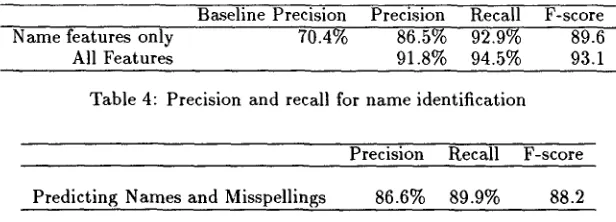
T h e results for our n a m e identifier are given in Table 4. Again, the decision tree approach is a sig- nificant improvement over the baseline case. If we take the baseline approach and assume t h a t all un- known words are names, then we would achieve a precision of 70.4%. However, using the decision tree approach, we obtain 86.5% precision and 92.9% re- call.
We also trained a tree using both the n a m e and misspelling features. T h e results can be found in the second line of Table 4. Unlike the case when we trained the misspelling identifier on all the features, the extended tree for the name identifier provides increased recall as well as increased precision. Un- like the case with the misspelling decision-tree, the misspelling-identification features do provide predic- tive information for n a m e identification. If we review the features, this result seems quite reasonable: fea- tures such as corpus frequency and non-English char- acters can provide evidence for/against name iden-
Baseline Precision/Recall Misspelling features only 70.4%/0%
All features
Precision Recall F-score 73.8% 7 7 . 1 % 75.4 82.8% 68.9% 75.2 Table 3: Precision and recall for misspelling identification
tification as well as for/against misspelling identifi- cation. For example, an unknown word that occurs quite frequently (such as
clinton)
is likely to be a name, whereas an unknown word that occurs infre- quently (such aswful)
is likely to be a misspelling.A review of the errors made by the n a m e iden- tifier again provides insight for future development. A m o n g those unknown words that are names but which were not identified as such are predominantly names that can (and did) appear with determiners. Examples of this class include
steelers
inthe steelers,
andpathfinder
inthe pathfinder.
Hence, the name identifier seems adept at finding the names of indi- vidual people and places, which typically cannot be combined with determiners. But, the n a m e identi- fier has more problems with names t h a t have similar distributions to c o m m o n nouns.The cases where the name identifier incorrectly identifies unknown words as names also have identifi- able characteristics. These examples mostly include words with unusual character sequences such as the misspellings
sxetion
andfwlamg.
No doubt these have similar characteristics to foreign names. As the misidentified words are also correctly identified as misspellings by the misspelling identifier, these are less problematic. It is the task of the decision- m a k i n g component to resolve issues such as these.T h e final results we include are for the unknown word categorizer itself using the voting procedure outlined in previous discussion. As introduced pre- viously, confidence measure is used as a tie-breaker in cases where the two components make positive decision. We evaluate the categorizer using preci- sion and recall metrics. The precision metric identi- fies the number of correct misspelling or name cat- egorizations over the total number of times a word was identified as a misspelling or a name. T h e re- call metric identifies the number of times the system correctly identifies a misspelling or n a m e over the number of misspellings and names existing in the data. As illustrated in Table 5, the unknown word categorizer achieves 86% precision and 89.9% recall on the task of identifying names and misspellings.
An examination of the confusion m a t r i x of the tie- breaker decisions is also revealing. We include the confusion matrix for one test d a t a set in Table 6. Firstly, in only about 5% of the cases was it nec- essary to revert to confidence measure to determine the category of the unknown word. In all other cases the predictions were compatible. Secondly, in the
majority of cases the decision-maker rules in favour of the name prediction. In hindsight this is not sur- prising since the name decision tree has higher re- suits and hence is likely to have higher confidence measures.
A review of the largest error category in this con- fusion matrix is also insightful. These are cases where the decision-maker classifies the unknown word as a name when it should be a misspelling (37 cases). The words in this category are typically ex- amples where the misspelled word has a phonetic relationship with the intended word. For example,
temt
fortempt, floyda
forflorida,
anddimow
part of the intended worddemocrat.
Not surprisingly, it was these types of words which were identified as prob- lematic for the current misspelling identifier. Aug- menting the misspelling identifier with features to identify these types of misspellings should also lead to improvement in the decision-maker.We find these results encouraging: they indicate that the approach we are taking is productive. Our future work will focus on three fronts. Firstly, we will improve our existing components by developing further features which are sensitive to the distinction between names and misspellings. T h e discussion in this section has indicated several promising direc- tions. Secondly, we will develop components to iden- tify the remaining types of unknown words, such as abbreviations, morphological variants, etc. Thirdly, we will experiment with alternative decision-making processes.
5
Examining Portability
In this paper we have introduced a means for iden- tifying names and misspellings from a m o n g other types of unknown words and have illustrated the pro- cess using the domain of closed captions. Although not explicitly specified, one of the goals of the re- search has been to develop an approach that will be portable to new domains and languages.
[image:5.612.128.496.100.138.2]Baseline Precision Precision Recall F-score Name features only 70.4% 86.5% 92.9% 89.6 All Features 91.8% 94.5% 93.1
Table 4: Precision and recall for name identification
Precision Recall F-score
Predicting Names and Misspellings 86.6% 89.9% 88.2
Table 5: Precision and recall for decision-making component
more information sources are available, then these can be readily included in the information provided to the decision tree training algorithm.
For m a n y languages, the features used in the unknown word categorizer may well be sufficient. However, the features used do make some assump- tions about the nature of the writing system used. For example, the edit distance feature in the mis- spelling identifier assumes that words consist of al- phabetic characters which have undergone substitu- tion/addition/deletion. However, this feature will be less useful in a language such as Japanese or Chinese which use ideographic characters. However, while the exact features used in this paper m a y be inap- propriate for a given language, we believe the generM approach is transferable. In the case of a language such as Japanese, one would consider the means by which misspellings differ from their intended word and identify features to capture these differences.
6
R e l a t e d R e s e a r c h
There is little research that has focused on differen- tiating the different types of unknown words. For example, research on spelling error detection and correction for the most part assumes that all un- known words are misspellings and makes no a t t e m p t to identify other types of unknown words, e.g. (Elmi and Evens, 1998). Naturally, these are not appropri- ate comparisons for the work reported here. How- ever, as is evident from the discussion above, previ- ous spelling research does provide an important role in suggesting productive features to include in the decision tree.
Research that is more similar in goal to that out- lined in this paper is Vosse (Vosse, 1992). Vosse uses a simple algorithm to identify three classes of un- known words: misspellings, neologisms, and names. Capitalization is his sole means of identifying names. However, capitalization information is not available in closed captions. Hence, his system would be inef- fective on the closed caption domain with which we are working. (Granger, 1983) uses expectations gen- erated by scripts to anMyze unknown words. The drawback of his system is that it lacks portability
since it incorporates scripts that make use of world knowledge of the situation being described; in this case, naval ship-to-shore messages.
Research that is similar in technique to that re- ported here is (Baluja et al., 1999). Baluja and his colleagues use a decision tree classifier to identify proper names in text. They incorporate three types of features: word level (essentially utilizes case in- formation), dictionary-level (comparable to our is- pell feature), and POS information (comparable to our POS tagging). Their highest F-score for name identification is 95.2, slightly higher than our name identifier. However, it is difficult to compare the two sets of results since our tasks are slightly dif- ferent. The goal of Baluja's research, and all other proper name identification research, is to identify all those words and phrases in the text which are proper names. Our research, on the other hand, is not con- cerned with all text, but only those words which are unknown. Also preventing comparison is the type of data that we deal with. Baluja's data contains case information whereas ours does not- the lack of case information makes name identification significantly more difficult. Indeed, Baluja's results when they exclude their word-level (case) features are signifi- cantly lower: a m a x i m u m F-score of 79.7.
7
C o n c l u s i o n
In this paper we have introduced an unknown word eategorizer that can identify misspellings and names. The unknown word categorizer consists of individ- ual components, each of which specialize in iden- tifying a particular class of unknown word. The two existing components are implemented as deci- sion trees. The system provides encouraging results when evaluated against a particularly challenging domain: transcripts from live closed captions.
R e f e r e n c e s
E. Agirre, K. Gojenola, K. Sarasola, , and A. Vouti- lainen. 1998. Towards a single proposal in spelling correction. In Proceedings of the 36th Ammal Meeting of the ACL and the 17th International
[image:6.612.174.482.102.213.2]Predicted Spelling Predicted Name Neither name nor misspelling 0 6
Misspelling 10 37
Name 4 43
Table 6: Confusion matrix for decision maker: includes only those examples where both components made a positive prediction.
Conference o1~ Computational Linguistics,
pages 22-28.S. Baluja, V. Mittal, and R.. Sukthankar. 1999. Applying machine learning for high performance named-entity extraction. In
Proceedings of the
Colzference of the Pacific Association for Com-
putational Linguistics ,
pages 365-378.K. Church 1988. A stochastic parts program and noun phrase parser for unrestricted text. In
Pro-
ceedings of the Second Conference on Applied Nat-
ural Language Processing,
pages 136-143. F. Damerau. 1964. A technique for computer detec-tion and correction of spelling errors.
Communi-
cations of the ACM,
7:171-176.M. Elmi and M. Evens. 1998. Spelling correction using context. In
Proceedings of the 36th Annual
Meeting of the A CL and the 17th hlternational
Collference on Computational Linguistics,
pages 360-364.D. Elworthy. 1998. Language identification with confidence limits. In
Proceedings of the 6th Work-
shop on Very large Corpora.
R. Granger. 1983. The nomad system: expectation- based detection and correction of errors during un- derstanding of syntactically and semantically ill- formed text.
American Journal of Computational
Linguistics,
9:188-198.J. Hull and S. Srihari. 1982. Experiments in text recognition with binary n-gram and viterbi algo- rithms.
IEEE Trans. Patt. Anal. Machine b~tell.
PAMI-4,
5:520-530.K.. Kukich. 1992. Techniques for automatically cor- recting words in text.
ACM Computing Surveys,
24:377-439.
I. Mani, R. McMillan, S. Luperfoy, E. Lusher, and S. Laskowski, 1996.
Corpus Processing for Lexical
Acquisition,
chapter Identifying unknown proper names in newswire text. MIT Press, Cambridge. D. McDonald, 1996.Corpus Processing for Lexi-
cal Acquisition,
chapter Internal and external ev- idence in the identification and semantic catego- rization of proper names. MIT Press, Cambridge. K. Min and W. Wilson. 1998. Integrated control of chart items for error repair. InProceedings of the
36th Annual Meeting of the Association for Com-
putational Linguistics and the 17th hlternational
Conferet~ce on Computational Linguistics.
K. Min. 1996.
Hierarchical Error Re.covery Based
on Bidirectional Chart Parsing Techniques.
Ph.D. thesis, University of NSW, Sydney, Australia. R. Mitton. 1987. Spelling checkers, spelling coffee-tots, and the misspellings of poor spellers.
Inf.
Process. Manage,
23:495-505.J. Toole 1999 Categorizing Unknown Words: A de- cision tree-based misspelling identifier In Foo, N (ed.)
Advanced Topics in Artificial h2telligence,
pages 122-133.
H. van Halteren, J. Zavrel, and W. Daelemans. 1998. Improving data driven word class tagging by sys- tem combination. In
Proceedings of the 36th An-
nual Meeting of the ACL and the 17th Interna-
tional Conference on Computational Linguistics,
pages 491-497.
T. Vosse. 1992. Detecting and correcting morpho- syntactic errors in real texts. In
Proceedin9s of
the 3rd Conference o11 Applied Natural Language
Processing,
pages 111-118.S. Weiss and N. Indurkhya. 1998.
Predictive Data
Mining.
Morgan Kauffman Publishers.S. Weiss, and C. Apte, and F. Damerau, and D. Johnson, and F. Oles and T. Goetz, and T. Hampp. 1999 Maximizing text-mining per- formance.
IEEE Intelligent Systems and their
Applications,
14(4):63-69 [image:7.612.171.470.109.163.2]