Abstract— Collaborative Virtual Environment (CVE) provides opportunity for users in a distant location to share and access Information and Communication Technology resources. In this paper, we propose the design of architectural framework of CVE based on cloud computing based paradigm in order to improve the effectiveness of the conventional CVE. The propose cloud based CVE was able to improve the effectiveness of the conventional CVE by allowing more access to ICT resources in a cost effective way than the Conventional CVE. Our proposal with minor modification can be applied to educational purposes, and distribution of government responsibilities to agencies.
Index Terms— Cloud Computing, Collaborative Virtual Environment, Infrastructure as a Service, Platform as a Service, Software as a Service.
I. INTRODUCTION
ollaborative Virtual Environment (CVE) allows participant from distant geographic location to share a common virtual environment, including virtual entities and resources maintained by a group of computers. In such a way that it can support effective communication among the users to achieve synergistic coordination of tasks [1-3]. Applications of CVEs include Education, massively multiplayer online games (e.g., World of Warcraft), virtual worlds (e.g., Second Life), military training, industrial remote training, and collaborative engineering [4-7]. As the number of concurrent participants is becoming larger, the CVE systems may no longer provide the level of consistency and scalability required, typically in terms of response time [1, 7, 8]. [1] proposes a dynamic clustering algorithm for partitioning the virtual environment with variable number of region servers. The algorithm calculates the most reasonable number of regions by tracking the number of users in the system. At the initial state of the system, one region server manages all cells in the different world. When the main server that monitors the load of the system periodically find the server approaching its capacity limit, the dynamic clustering algorithm is executed to partition the virtual environment, whereas another program is busy configuring a new server to handle excess load. Each time this algorithm is partitioning the virtual
A.Y. G. and A.S.I. ([email protected]) are PhD research scholar and professor, respectively with the University of Technology Malaysia, Department of Computer Science, Johor Baru, Malaysia. Corresponding author (e-mail: asgital @ yahoo.com).
M. C. is a professor with the Oxford e-Resource Center, University of Oxford, England, UK. (e-mail: [email protected]).
H. C. is a PhD research scholar with the University of Malaya, Kuala Lumpur, Malaysia (e-mail: [email protected]).
environment, other program must be configuring new server to handle the new partition, executing another process for merging different regions to or executing steps for the region server to exit from the system and merge it cells to another region. This process may take much time to execute and consume a lot of computing and communication resources. With current issues of increasing simultaneous number of users in CVE, this is not really suitable for time dependent applications such as CVE. The new region server consumes much time as well as communication resources. This is because the amount of data required to be transferred from a particular region server to a new region server are voluminous.
According to Forrester [9] end user organizations will continue to show strong interest in email and IM/presence services. This segment accounts for close to 14% of the total collaboration services market in 2011. Forrester estimates that the segment will grow by 10.6% through 2018, as organizations continue to migrate email systems from on-premises, self-managed models to host and cloud-based models. Therefore, we propose the design of a cloud based CVE to improve its effeteness.
The rest of the paper is organized as follows: section II describes an overview of CC. Section III presents the description of the major benefits of CC. Section IV covers a brief explanation on CC architecture. Section V presents the propose a framework and potential benefits in Section VI before concluding remarks in Section VII.
II.BASIC THEORY OF CLOUD COMPUTING
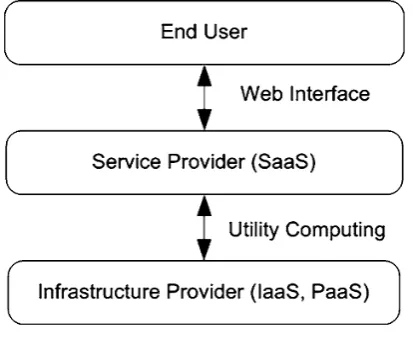
The CC is a new paradigm to organize and manage Information Technology (IT) resources. There are various definitions of CC, one of which is the definition according to The National Institute of Standards and Technology (NIST) which defines CC as “model for enabling convenient, on-demand network access to a shared pool of configurable computing resources (e.g., networks, servers, storage, applications, and services) that can be rapidly provisioned and released with minimal management effort or service provider interaction” [10]. Generally speaking, the CC service model consists of three layers: Infrastructure as a service (IaaS), Platform as a service (PaaS), Software as a Service (SaaS) [11]. The cloud computing service model is depicted in Fig 1.
A.Infrastructure as a Service
Infrastructure layer corresponds to IaaS infrastructure services, is the lowest layer of the network. Users can household provide standard services, including computing power and storage resources. It turns the memory, storage and computing power into a virtual resource pool for the
A Framework for the Design of Cloud Based
Collaborative Virtual Environment Architecture
Abdulsalam Ya’u Gital,
Abdul Samad Ismail,
Min Chen, and Haruna Chiroma, Member, IAENGstorage resources[10, 12-14].
B.Platform as a Service
The platform layer corresponds to the PaaS that create a higher level of abstraction on the IaaS layer to provide a development environment, test environment, server platforms, and other services. Users can develop applications based on the Internet, and other server service provider's infrastructure and subsequently, sharing it to other users[10, 12, 14].
C.Software as a Service
[image:2.595.60.267.388.557.2]SaaS is a software distribution model designed for web delivery, user can deploy and access through the Internet. SaaS providers need to build information for all network infrastructure, software, hardware, operating platform, and is responsible for the implementation of all post-maintenance and other services. Compared with the traditional method of service, SaaS (refer to Figure 1) not only reduces the cost of traditional software licensing, and vendors deploy application software on a unified server, eliminating the end-user's server hardware, network security devices and software upgrade and maintenance expenses, the customer does not need other IT investment in addition to personal computers and Internet connections to obtain the required software and services [10, 12, 14].
Fig 1. Service model of cloud computing
Clouds offer a new level of flexibility in application and data delivery. Provisioning applications and services from a cloud can give you the operational benefits without the capital expenses of maintaining on premises environments as pointed out in the CISCO official website. Cloud technology can provide significant benefits such as cost effectiveness, scalability, flexibility, agility, other benefits can be found in [13]. Outline the benefits that can be generated using CC technology. In the previous section, the CVE requirement was listed and described. To clearly show how the cloud features benefit in satisfying the requirement of CVE, it is necessary to match these requirements.
IV. CLOUD COMPUTING ARCHITECTURE
A. Cloud Computing Architecture
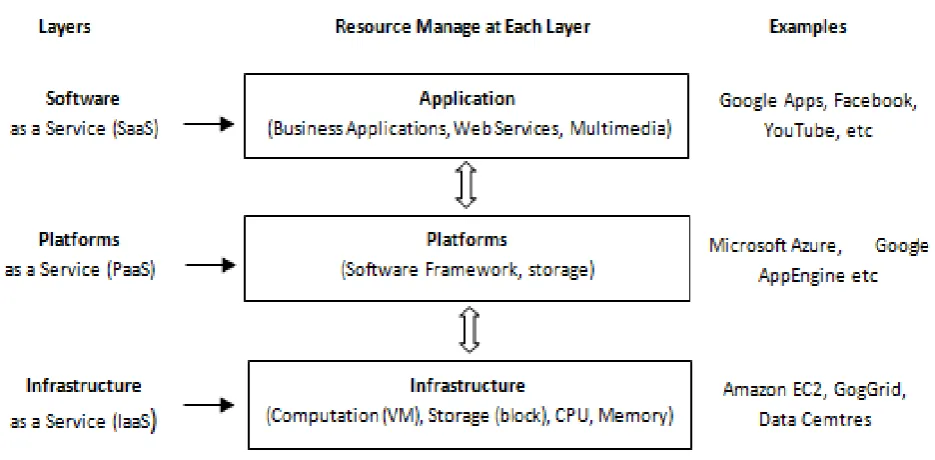
Generally speaking, the architecture of a CC environment can be divided into 4 layers: the hardware/datacenter layer, the infrastructure layer, the platform layer and the application layer, as shown in Fig 2.[10].
B. The Hardware Layer
This layer is responsible for managing the physical resources of the cloud, including physical servers, routers, switches, power and cooling systems. In practice, the hardware layer is typically implemented in data centers. A data center usually contains thousands of servers that are organized in racks and interconnected through switches, routers or other fabrics. Typical issues at hardware layer include hardware configuration, fault tolerance, traffic management, power and cooling resources management.
C. The Infrastructure Layer
Fig 2. Cloud computing architecture
D. The Platform Layer
Built on top of the infrastructure layer, the platform layer consists of operating systems and application frameworks. The purpose of the platform layer is to minimize the burden of deploying applications directly into VM containers. For example, Google App Engine operates at the platform layer to provide API support for implementing storage, database and business logic of typical web applications.
E. The Application Layer
At the highest level of the hierarchy, the application layer consists of the actual cloud applications. Different from traditional applications, cloud applications can leverage the automatic-scaling feature to achieve better performance, availability and lower operating cost. Compared to traditional service hosting environments such as dedicated server farms, the architecture of CC is more modular. Each layer is loosely coupled with the layers above and below, allowing each layer to evolve separately. This is similar to the design of the OSI model for network protocols. The architectural modularity allows CC to support a wide range of application requirements while reducing management and maintenance overhead.
V.PROPOSE FRAMEWORK OF THE CLOUD BASED COLLABORATIVE VIRTUAL ENVIRONMENT
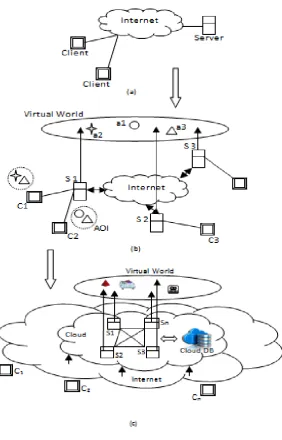
The architecture of the cloud based CVE is proposed by the modification of previous CVE. The CVE moves into the cloud instead of the conventional environment presently in used. Fig 3 present the propose design of the cloud based CVE which comprised of the following components: virtual world, The first component which is the cloud infrastructure. This layer represents the hardware layer that is used as the Virtual Collaboration and software visualization technology, which maintain the reliability and
stability of the infrastructures. It enables the provision of networking components, servers, storage, routers, and switches. The CC infrastructure heavily influences application performance and throughput in a distributed computing environment[10]. It is responsible for hosting and given supportive coordination to infrastructures including the platform of cloud, repositories, computers, servers, network communication devices, storage units among other physical structures like building. The resources of the information and communication technology are distributed by the cloud infrastructure. The cloud platform provides both services and inters connections among the systems on the platforms as well as to provide an easy way for the system's hardware to operate just like the internet. Furthermore, the cloud infrastructure allowed the hardware to securely access data in a sharable platform.
Fig 3. The Conventional CVE Architecture towards a Cloud based CVE Architecture
VI. POTENTIAL BENEFITS OF THE PROPOSE CLOUD BASED CVE ARCHITECTURE
The potential benefits to be derived from the propose framework are as follows: sharing and access to ICT resources will be easier than in the conventional CVE since high computation power can be increased. Users can now determine their storage capacity depending on their respective needs. Having access to the ICT resources can be at any time and anywhere. The cost of implementing cloud based CVE is more effective than the conventional CVE.
VII.CONCLUSIONS
REFERENCES
[1] X. Hu, L. Liu, and T. Yu, "A hierarchical architecture for improving scalability and consistency in CVE systems,"
International Journal of Parallel, Emergent and Distributed Systems, vol. 26, pp. 179-205, 2011.
[2] X. M. Hu, H. X. Cai, and T. Yu, "A Self-Adaptive Filtering Algorithm Based on Consistency QoS in CVE Systems,"
Advanced Materials Research, vol. 225, pp. 301-306, 2011. [3] W. Shao-Qing, C. Ling, and C. Gen-Cai, "A framework for
Java 3D based collaborative virtual environment," in
Computer Supported Cooperative Work in Design, 2004. Proceedings. The 8th International Conference on, 2004, pp. 34-39.
[4] S. Benford, C. Greenhalgh, T. Rodden, and J. Pycock, "Collaborative virtual environments," Communications of the ACM, vol. 44, pp. 79-85, 2001.
[5] C. Greenhalgh and S. Benford, "MASSIVE: a collaborative virtual environment for teleconferencing," ACM Transactions on Computer-Human Interaction (TOCHI),
vol. 2, pp. 239-261, 1995.
[6] A. S. Haji-Ismail, M. Chen, and P. W. Grant, "JACIE–an authoring language for WWW-based collaborative applications," Annals of Software Engineering, vol. 12, pp. 47-75, 1999.
[7] A. Y. Gital, A. S. bn Ismail, and S. Subramaniam, "On consistency and security issues in collaborative virtual environment systems," International Journal of Physical Sciences, vol. 8, pp. 1646-1654, 2013.
[8] Y. Deng and R. W. Lau, "On Delay Adjustment for Dynamic Load Balancing in Distributed Virtual Environments," Visualization and Computer Graphics, IEEE Transactions on, vol. 18, pp. 529-537, 2012.
[9] F. Consulting, "Collaboration Services: Deployment Options For The Enterprise," CISCO Systems2013.
[10] Q. Zhang, L. Cheng, and R. Boutaba, "Cloud computing: state-of-the-art and research challenges," Journal of Internet Services and Applications, vol. 1, pp. 7-18, 2010.
[11] A. Y. Gital and F. U. Zambuk, "Cloud Computing: Solution to ICT in Higher Education in Nigeria," Advances in Applied Science Research. 2011, vol. 2 (6). pp. 364-369..
[12] D. Madan, A. Pant, S. Kumar, and A. Arora, "E-learning based on Cloud Computing," International Journal of Advanced Research in Computer Science and Software Engineering, vol. 2, 2012.
[13] M. Carroll, A. Van der Merwe, and P. Kotze, "Secure cloud computing: Benefits, risks and controls," in Information Security South Africa (ISSA), 2011, 2011, pp. 1-9.