Abstract—The aim of this paper is to show how to minimize the project costs by using fuzzy quantities and schedule buffers. Very often, companies make rigid schedules that do not allow changes to be made. In this article we propose utilization of buffers to create soft schedules that can allow the easy application of changes during the project.
Index Terms: buffer management, project planning, time-cost trade-off, fuzzy numbers, scheduling, fuzzy linear programming
I. INTRODUCTION
chedule optimization of projects is extensive area that involves many different aspects of the projects. The most important element is the duration of the project, which, along with costs, is a fundamental criterion for the decision maker. At this point, it is reasonable to consider the different methods for optimizing both time and costs so that the project can be completed without exceeding the decision maker’s budget and the scheduled time. At this point, it is necessary to establish the applicability of the time-cost analysis, which was initiated by Fulkerson and Kelley. The first publication concerning the discussed scope appeared in the 1950s.
In this article, Goldratt's critical chain method, i.e., Critical Chain Project Management CCPM) was introduced, and it an analysis of the possibilities of its use were presented.
Existing methods that allow for multi-criteria analysis usually lead us first to the critical path method (CPM) and program evaluation and review technique (PERT). However, there is a fundamental difference between the critical path method and critical chain method. The difference lies primarily in the fact that the main variable in CCPM is the form of the human element, which was not included in CPM or PERT.
Of course, as is the case for every method, CCMP is not completely free from defects. However, with the ability to take into account the human element in the schedule, which often has a significant impact on the planned and timely Manuscript received March 14, 2014; revised April 10, 2014. This work was funded by the Polish National Science Centre on the basis of the decision number DEC-2011/03/D/HS4/01649.
P. Blaszczyk is with the University of Silesia, Institute of Mathematics, Bankowa 14, 40-007 Katowice, Poland (phone: +48-32-258-29-76; fax: +48-32-258-29-76;; e-mail: [email protected]).
T. Blaszczyk is with Department of Operation Research, University of Economics, 1 Maja 50, 40-287 Katowice, Poland (phone, fax: +48-32-257-74-71; e-mail: [email protected]).
K.Tyła is with Department of Operation Research, University of Economics, 1 Maja 50, 40-287 Katowice, Poland; e-mail: [email protected]
execution of the project plan, the results are more realistic, in that they allow the project manager the possibility of responding as unanticipated situations arise. Showing the impact on resources in relation to other measurable elements of the schedule makes it possible to introduce appropriate measures that impact the work of individuals or teams. There are behavioral techniques through which the manager can be aware of the appropriate relationships, risks, and costs that may affect the project after making assignments and motivating the project team, thus optimizing both time and cost of the entire project by preventing delays and incurring unforeseen costs.
II. METHODOLOGY A. Critical Chain
First, we start by explaining what the Critical Chain method is. Critical Chain Project Management (CCPM) is a methodology for planning, executing, and managing projects in single-project and multi-project environments. CCPM was developed by Dr. Eli Goldratt, who, in 1997, published the first novel undertaking using the Critical Chain approach [7]. This methodology was derived from the Theory of Constraints, which Goldratt also developed. This was a new approach that extended the concept of project planning to include project management. Another important element of this methodology is that it helps supervise the work associated with projects, and it has been used extensively by many companies in the U.S. and Europe.
By using the critical chain, we can manage the project effectively, thereby shortening its duration, reducing costs, and increasing the probability of completing the project on time. CCMP was developed because many projects were completed after their deadlines, resulting in increased cost. Goldratt was aware of the problems associated with traditional management. and he developed and used CCPM in an effort to minimize these problems and their effects.
This approach allows the elimination of the ‘student syndrome,’ i.e., starting work at the last minute. Goldratt also took Murphy's law into account by creating buffers. Another problem in traditional project management, i.e., Parkinson’s Law, also was eliminated by Goldratt’s new methodology. It was also significant that the methodology converted pessimistic outlooks to optimistic perspectives, avoiding overestimation of duration of each task and providing better coordination of every aspect of the project.
In traditional project management, extra time is added for each task when estimating the duration of the project to make sure that the project is completed on time, but most of them still weren’t completed on time. In the CCPM
Project Schedule Optimization by Critical Chain
Approach in a Fuzzy Environment
Paweł Błaszczyk, Tomasz Błaszczyk, Katarzyna Tyła
methodology, no extra time is assigned for each task; rather, extra time is invested in buffers that are located in strategic places in the project. In addition, CCPM eliminates conflicts in the allocation of resources, saving time that is regularly used.
B. Fuzzy Approach
The traditional way of describing tasks in projects is difficult because of the need to designate dates. The problems associated with untimely execution of tasks in projects, which obviously is the main problem in project management, were included in the discussion of the critical chain. Then, the question that must be dealt with is how to prevent such situations. How can we determine with some degree of accuracy the beginning and end of each task? At this point, the use of fuzzy numbers is justified. First, let us introduce some basic facts, which we use in our fuzzy model extension. Let A be a subset in some space X. A fuzzy set A in X is a set of ordered pairs
( ;xA( )) :x xX
, (1)where
:
A X R
(2)
is membership function of set A. For each xA, A( )x
called the grade of membership of x in A. The set A is
called normal if:
( ) =sup A( ) = 1.
x X
h A x
(3)
The set
( ) = { : A( ) > 0}
supp A xX x (4)
is called the support of A. Let [0,1]. The set
γ A
A ={x X: μ (x)γ} for each γ[0,1] (5) is called the gamma cut. Let X =R. A fuzzy number is
such that the fuzzy set AF R( )satisfies following conditions: A is a normal set, A is closed for each
[0,1]
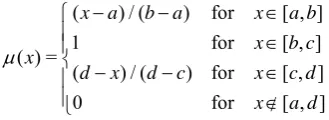
, and supp A( ) is bounded. The trapezoidal fuzzy numbers TrFN a b c d( , , , ) (Fig. 1) are a fuzzy numbers for which the membership function is given by the following formula:
( ) / ( ) for [ , ]
1 for [ , ]
( ) =
( ) / ( ) for [ , ]
0 for [ , ]
x a b a x a b
x b c x
d x d c x c d
x a d
(6)
The membership function depends on the expert's judgment about the availability of factors, workers, materials, and other essential components. Let xRand
[0,1]
be sufficiently small. The trapezoid fuzzy number x is called the fuzzy number close to the real number x which is given by:
= ( , , , )
x x x x x (7)
In this article, we denote the fuzzy number close to real number x by x.
We write the trapezoid fuzzy number ( , , , )A a b c d , where is some real number for which a. Moreover,
>
A if >a , A for d and ( , , , )A a b c d for d. If a are two fuzzy subsets of a space X, then
AB means that A( )x B( )x for all xX , or A is a
subset of B, A<B holds when A( ) <x B( )x for all
xX . There is a potential problem with the symbol < . In this article, A<B for fuzzy numbers A B, means that A is less than or equal to B.
For two fuzzy numbers, the basic four arithmetic operations are given by the following formulas:
=1 2 1 1 2 2
, , =
1 2 1 2
( ) = sup min{ ( ), ( )}
B A A A A
x x X y x x
y x x
(8)
=1 2 1 1 2 2
, , =
1 2 1 2
(( ) = sup min{ ( ), ( )}
B A A A A
x x X y x x
y x x
(9)
=1 2 1 1 2 2
, , =
1 2 1 2
(( ) = sup min{ ( ), ( )}
B A A A A
x x X y x x
y x x
(10)
=1 2 1 1 2 2
, , = /
1 2 1 2
(( ) = sup min{ ( ), ( )}
B A A A A
x x X y x x
y x x
(11)
In all of the above cases, the result is also a fuzzy number, but not necessarily a trapezoid fuzzy number. In the case in which the objective functions and the restrictions are given by fuzzy numbers, the Fuzzy Linear Programming (FLP) model is given by the following formula:
min
c x (12)
A x b (13)
0
x , (14)
[image:2.595.305.470.152.212.2]where , ,c A b are the fuzzy coefficient vector of the object function, the matrix of the fuzzy coefficient of restriction, Fig. 1. Trapezoid fuzzy number TrFN a b c d( , , , )
and the vector of the fuzzy numbers, respectively. Let c a j, ij
be fuzzy quantities. Then, the fuzzy sets c x1 1 c xn n
and a x1 1 a xn ndefined by the extension principle are
again fuzzy quantities. Detailed information about solving fuzzy linear programming can be found in the work of Buckey [5], Jamison [10], and Ramik [13].
C. Formal model
We consider a project that consists of x1, , xn tasks
characterized by cost and time criteria. We assume that only
q factors have any influence on the cost and the time of the
project. Let us consider the following matrixX:
11 1
1
q
n nq
x x
X
x x
(15)
Elements of the matrix X belong to interval
0,1 . If xijequals 1, it means that factor j has influence on the completion of task xi. In the other case, there is only partial
influence of factor j on task xi. We will call matrix X the
factor’s matrix. Let
1, , ; 1, ,
ij i n j q
K k
(16)
be the matrix of the cost ratios of all q factors for all tasks and let
1 , ,
m m m
n
W w w (17)
be the vector of minimal amounts of work for the tasks
1, , n
x x . On the basis of matrix X and vector Wm for task
i
x we can calculate the total amount of work wi by:
1, , ,
i
m i w i iq i
w f x x w , (18)
where
i
w
f is a work assigning function. Moreover, we assume that there is vector,
1, , q
R r r (19)
that describes the restrictions of the accessibility of the factors for the whole project. Let
1, , ; 1, ,
ij
i n j q
T t
(20)
be the matrix of amounts of work for each factor in each task. In a typical case, the values tij are positive real
numbers. Let us consider the situation in which the time when the task is to start is uncertain. This situation may occur for several reasons. For example, we must deal with this type of situation when the contractor accelerates the implementation of a previous activity, and it was completed
earlier. In such a situation, it can be important to us to start the next activity earlier, especially if the next activity is on the critical path. However, we often encounter situations in which the task completion date is postponed due to the delay in implementing the task. We can deal with this problem by using the fuzzy numbers to describe the duration of activities. In this article, we assume that the duration of each task is described by the trapezoid fuzzy number. On the basis of the matrices ,X Tand K, we calculate the cost and the duration of each task by:
1, , , , , , , ,1 1
ki iq
i i i iq i iq
k f x x t t k k (21)
and
1, , , , ,1
ti i iq i iq
i
t f x x t t
, (22)
where
k
i
f ,
t
i
f are the cost and the time functions, respectively. Thus, the total cost and the total duration of the project are given by
1
n
c i
i
K k
and
1, ,
max
c i i
i q
T ES t
, (23)
where ESi is the earliest start of task xi.
Under the following assumptions, we minimize the total cost of the project. It allows us to determine the optimal work assignments for every factor in each task. From the set of alternate optimal solutions, we choose the one for which the total duration of the project is the shortest time. In this way, we obtain the optimal solution in the safe case. According to the contractors’ safe estimations, the amount of work could be overestimated. It means that for task xi
the amount of work could be written as
1, , ,
i
m i w i iq i
w f x x w (24)
The overestimation of the amount of work leads to overestimations of the expected values of the tasks’ costs and durations and, subsequently, the total cost and the total duration of the entire project. Because the amount of work changed, the duration and cost of the project also changed. Therefore, we can write the total cost and total duration of project by:
e B c
K K K (25)
and
e B c
T T T , (26)
To set the buffers KB,TB, we must estimate the most probable amounts of work. We do that by changing the appropriate elements in matrix X and using the function
i
w for each activity xi. In this way, we get the new factor's
matrix X and the new vector of amounts of work W.
Then, we execute the same procedure for the most probable amount of work but under the additional condition tij tij
for i1, , ; n j1, , q, where
1, , ; 1, ,
ij
i n j q
T t
is the
matrix of amounts of work for each factor in each activity calculated for the new data. Under the following assumptions, we minimize the total cost of the project. If the functions
k
i
f , t
i
f are linear, then this optimization
problem can be solved by Fuzzy Linear Programming (FLP). From the set of alternate optimal solutions, we choose the one for which the total duration of the project is the shortest time. Since it is unlikely that all factors will occur, we can reduce the buffers for the project by:
B B
r
K K (27)
B B
r
T T , (28)
where ,
0,1 are the ratios that are used to revise the amount of the buffers.P e B
r
K K K (29)
P e B r
T T T (30)
Part of the money that is saved can be used to create bonus pool B to be divided between the factors. Let us introduce
the weight of importance of the tasks
i i 1, ,nS s
, (31)
where si
0,1 . To share the bonus pool, we define a function that depends on the amount of work saved, the importance of task xiand whether the task is critical or not,and on the reduced buffers of cost and time. In the general case, factor i can receive the amount of money bi
, , , ,
b
W K T
i i i i B B
b f s D c D D , (32)
where si is the importance of task xi, W i
D is the amount of
work saved for task xi, c = 1 if the task is on critical path or
c = 0 if it is not on the critical path, K B
D is the amount of cost saved, T
B
D is the amount of time saved, and b
i
f is
some function. In our example, we used the following function:
1
1 1
2
2 2
for critical
for non-critical
W j j
i
i W
j j
i
s D
B x
s D b
s D
B x
s D
, (33)
where B is the bonus pool, 2 1, 1 2 1, s1 is the
sum of the importances of the tasks that are on the critical path, s2 is the sum of importances of the tasks that are not
on the critical path, W j
D is the sum of amounts of work
saved for taskxi,
1
D is the amounts of work saved for tasks
that are critical, and 2
D is the sum of the amounts of work
saved for tasks that are not on the critical path. To motivate the executors of task xi to begin their work on the task
earlier, we propose to offer them an extra incentive, i.e.,:
, t , t ,ci newi
i IF i
IF f k (34)
The size of this incentive will be depend on the original start time, the new start time of the task (based on the number of days earlier that they could start the task), the value of planned work ki, and whether the task in on the critical
( c 1 ) path or outside of the critical path ( c 0 ). Such a mechanism could be used on demand by the project owner, depending on the current situation in the project.
III. CONCLUSIONS
Planning, scheduling, and execution of projects are closely related activities. As stated above, they are fully dependent on each other, so it should be decided in the planning stage how these three vital components of the project will be implemented. In the literature, there are many methods dedicated to effective project management. In this paper, we have shown the complexity of the situation in which the project depends on the originators and the subcontractors. The purpose of this article was to illustrate the applicability of the critical chain in a fuzzy environment to optimize decisions related to the selection of subcontractors. The model showed that both rewarding the contractors’ successes and penalizing their shortcomings may motivate employees to work and complete tasks on time.
ACKNOWLEDGMENT
The project was funded by the Polish National Science Centre on the basis of the decision number DEC-2011/03/D/HS4/01649.
REFERENCES
[1] Blaszczyk T., and Nowak B. (2008). “Project costs estimation on the basis of critical chain approach,” (in Polish), T. Trzaskalik (ed.): Modelowanie Preferencji a Ryzyko ’08, Akademia Ekonomiczna w Katowicach, Katowice.
[2] Błaszczyk P., Błaszczyk T., Kania M.B., The bi-criterial approach to project cost and schedule buffers sizing, Lecture Notes in Economics and Mathematical Systems. New state of MCDM in the 21st century.
Springer 2011, pp. 105-114
Engineering Technologies, Lecture Notes in Electrical Engineering Volume 170, 2013, pp. 375-388
[4] Brucker P, Drexl A, Möhring R, Neumann K, Pesch E et al. (1999) Resource-constrained project scheduling: Notation, classification, models, and methods.
[5] Buckey J.J., Eslami E., Feuring F. Fuzzy Mathematics in Economy and Engineering, Springer 2002.
[6] Fulkerson D R et al. (1961) A network flow computation for project cost curves. Management Science 7:pp. 167-178
[7] Goldratt E (1997) Critical Chain. North River Press
[8] Gonzalez,V., Alarcon, L.F., Molenaar K. (2009). Multi-objective design of Work-In-Process buffer for scheduling repetitive projects. Automation in Construction 18, pp. 95-108
[9] Herroelen, W., Leus, R. et al. (2001) On the merits and pitfalls of critical chain scheduling. Journal of Operations Management 19: pp. 559-577
[10] Jamison, K.D, Lodwick, W.A. Fuzzy linear programming using a penalty method, Fuzzy Sets and Systems vol. 119 pp. 97–110, 2001 [11] Kelley, J. E. et al. (1961) Critical-path planning and scheduling:
Mathematical basis. Operations Research 9: pp. 296-320
[12] Leach, L. (2003). Schedule and cost buffer sizing: how account for the bias between project performance and your model. Project Management Journal 34 (2), pp. 34-47
[13] Ramik J. Duality in fuzzy linear programming with possibility and necessity relations, Fuzzy Sets and Systems 157, pp. 1283-1302, 2006.
[14] Rogalska M., Bożejko, W., Hejducki, Z. et al. (2008), Time/cost optimization using hybrid evolutionary algorithm in construction project scheduling. Automation in Construction 18: pp. 24-31 [15] Tukel, O. I., Rom, W. O., Eksioglu, S. D. et al. (2006) An
investigation of buffer sizing techniques in critical chain scheduling. European Journal of Operational Research 172: pp. 401-416