New Late Ripening Apricot Genotypes from a Multipurpose
Apricot Breeding Programme in Turkey
Joanna Marie CROSS
1, Firat Ege KARAAT
1, Feyza İNCEOĞLU
2,
Zehra Tuğba MURATHAN
3and Bayram Murat ASMA
1*
1Horticulture Department, Faculty of Agriculture, and 2Biostatistics Department,
Faculty of Medicine, İnönü University, Malatya, Turkey; 3Food Engineering Department,
Faculty of Engineering, Ardahan University, Ardahan, Turkey
*Corresponding author: [email protected]
Abstract
Cross J.M., Karaat F.E., İnceoğlu F., Murathan Z.T., Asma B.M. (2018): New late ripening apricot genotypes from a multipurpose apricot breeding programme in Turkey. Czech J. Genet. Plant Breed., 54: 34−38.
The harvest season of apricots is short and fruit cannot be protected in cold stores for a long time. For those rea-sons, apricot production and consumption are lower than in other fruit species. This study was conducted for the purpose of breeding new late ripening apricot varieties. To this aim, a total of 3718 hybrid genotypes of apricots were obtained from 42 crosses. Phenological, pomological and yield analyses were performed and variations of fruit development period, fruit size, polarimetric dry matter (Brix), total acidity, yield and other traits were deter-mined. Two years of results for important traits are given for 12 promising genotypes. Fruit development period varied between 148 and 167 days, fruit weight 25.2 and 41.2 g, Brix 16.3 and 22.6% and total acidity 0.56 and 1.25%.
Keywords: crossing; promising hybrids; Prunus armeniaca L.; selection
Apricot (Prunus armeniaca L.) is a highly nutritious stone fruit from thefamily Rosaceae. Although it is not the genetic origin of apricot, Turkey is the leading apricot producer country, and particularly the Malatya region, located in the south-east of Turkey, produces more than half of the national production. In 2012, Turkey produced about 20% (~796 000 tons) of the total world production of apricot (~3 956 000 tons) (Asma 2007; Anonymous 2015).
Different commercial cultivars such as Hacıhaliloğlu, Kabaaşı, Hasanbey, Soğancı, and Çataloğlu are currently grown in Malatya. Apricot blooming usually starts around mid-March and lasts approximately 10 days. The fruits are harvested from early June to late July de-pending on varieties. However, a few non-commercial varieties mature in August to early September, but the fruits are not of high quality and do not fulfil some market requirements (Asma & Ozturk 2005).
The fact that the harvest period is short and the fruit cannot be stored for more than 4–6 weeks even
under the best storage conditions, affects fresh apri-cot production and consumption negatively. When compared to other Prunus species such as plum and peach, the availability of fresh apricot to the consumer at the market is very short. However, it is of particular interest to develop late ripening varieties to extend the fresh apricot season, from which apricot farmers would profit by increasing their revenues. Toward such goals, we undertook a traditional breeding program in attempt to produce late ripening cultivars with large fruit of good quality. For this purpose, 7 mid-ripening varieties were selected for their size and quality and crossed as female parent with 3 late ripening vari-eties whose yields are reasonable. Important fruit characteristics such as yield, fruit size, acidity and sugar content were then examined in the selected late ripening hybrid genotypes.
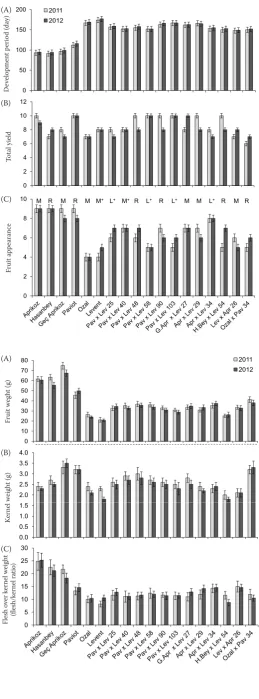
Figure 1. Evaluation of apricot parental lines and hybrids: fruit development period in days (A), total yield (B) and fruit appearance (C) during the years 2011 and 2012; yield (kg/tree) and fruit appearance (attractiveness of the fruit appearance) are described with a user defined scale ranging from 1 (poor) to 10 (excellent); average aroma for the two years is indicated in (C): L – low; M – medium; R – rich; L+ – low to medium; M+ – medium to rich
Figure 2. Evaluation of apricot parental lines and hybrids: fruit weight (A), kernel weight (B) and flesh over kernel weight (C) during the years 2011 and 2012; error bars represent standard deviation of 10 fruits; the dashed line in A marks the minimum requirement of 30 g for fruits to be accepted for processing
2.0 2.5 3.0 3.5 4.0
0.0 0.5 1.0 1.5
5 10 15 20 25 30
0 5
(A)
(B)
(C)
Fr
uit we
gh
t (
g)
Fle
sh over k
er
ne
l weig
ht
(fle
sh/k
er
ne
l ra
tio)
Ker
ne
l weig
ht (
g)
0 10 20 30 40 50 60 70 80
100 150 200
2011 2012
0 50 0
2 4 6 8 10 12 0 50 100 150 200
0 2 4 6 8
10 M R M R M M+ L+ M+ R L+ R L+ M M L+ R M R
(A)
(B)
(C)
D
eve
lopmen
t p
er
io
d (
da
y)
Tot
al y
ie
ld
Fr
uit a
pp
earanc
e
100 150 200
2011 2012
The hybrids, obtained from cross combinations of Paviot and Levent, Paviot × Levent 58 and Paviot × Levent 103 displayed outstanding yields of 9 or 10 on the rating scale. However, no hybrid showed any particularly good fruit quality or aroma (Figure 1C). Although taste attributes were improved in the hy-brids compared to late ripening parents, they still fall short relative to mid-ripening varieties.
Mid-ripening varieties generate fruits ranging from 50 g to over 70 g per fruit (Figure 2A). In contrast, fruits of late ripening varieties weighed less than the thresh-old required for industrial processing (30 g). Though small, most fruits of hybrids reached the processing threshold of 30 g (Figure 2A). Fruits from the hybrid Ozal × Paviot 34 are marginally larger than those of the other hybrids. Kernel weight follows the same pattern as fruits (Figure 2B). The varieties Aprikoz, Hasanbey, Geç Aprikoz produce high flesh to kernel ratios, while Paviot shows intermediate values and both late ripening varieties display poor ratios (Figure 2C). It is of commercial interest to produce varieties having the highest flesh-to-kernel ratio. All hybrids showed improved flesh–to-kernel ratios relative to late ripen-ing parents but some of them display values that are comparable with those of Paviot (Aprikoz × Levent 34,
Levent × Aprikoz 26). However, no hybrid reached the (flesh/kernel) ratios of the mid-ripening parental lines.
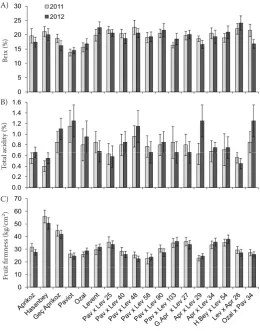
[image:3.595.66.327.426.758.2]The Brix scale (0−32%) (Cemeroglu 1992) provides an assessment of the total soluble solids particularly sugars, allowing to estimate the ripeness and quality of fruits. While Paviot displayed somewhat lower Brix values, all hybrids showed broad ranges of Brix values sometimes exceeding those of the parental cultivars (Figure 3A). The hybrid Levent × Aprikoz 26 presented the highest Brix value. Conversely, both Aprikoz and Hasanbey displayed the lowest levels of acidity, while Geç Aprikoz and Paviot showed higher values (Figure 3B). Acidity levels varied more than the other parameters both within genotypes and between years. Fruits from the two hybrids Aprikoz × Levent 29 and Ozal × Paviot 34 were particularly variable. Nonetheless, many hybrids produced fruits with the intermediate acidity level similar to late ripening parental lines. Moreover, both hybrids Paviot × Lev-ent 25 and LevLev-ent × Aprikoz 26 yielded fruits with consistently low acidity on a par with Aprikoz. Finally, fruit firmness is an important attribute for ease of transportation of the fruits. Fruits from Hasanbey and Geç Aprikoz show the highest firmness among the other varieties. The hybrids produced fruits as firm
Figure 3.Evaluation of apricot parental lines and hybrids: Brix (A), total acidity (B) and fruit firmness (C) during the years 2011 and 2012; Brix is sugar content in a fruit aqueous solution
15 20 25 30
0 5 10
0.8 1.0 1.2 1.4 1.6
0.0 0.2 0.4 0.6
20 30 40 50 60 70
0 10
(A)
(B)
(C)
100 150 200
2011 2012
0 50
Br
ix (%)
Tot
al ac
idity (%)
Fr
uit fir
mne
ss (kg/c
m
as their parental lines. However, the hybrids Paviot × Levent 25, Geç Aprikoz × Levent 27, Aprikoz × Lev-ent 34, and Hasanbey × Levent 54 produced marginally firmer fruits (Table 1).
[image:4.595.64.534.111.326.2]On the other hand, most selected hybrids produced yellow fruits (Figure 4). The orange colour of Paviot’s fruits was not observed in any selected progeny. In fact, three lines showed the lighter flesh colour than either parent. Surprisingly, the hybrid Aprikoz × Levent 34 resulted in creamy fruits while both parents produced yellow apricots, suggesting that the fruit colour is a complex trait. Parental lines produced round, ovate, or oblong fruits. All shapes were present in the progeny (Figure 4).
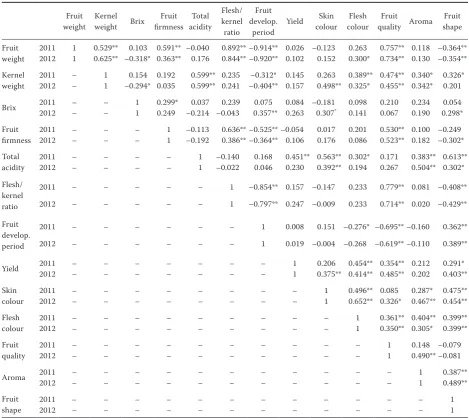
In terms of correlations positive and negative cor-relations at a low, moderate, high and very high level
were determined between the variables. Results of correlations between variables are presented in Table 2.
[image:4.595.164.489.579.712.2]Fruit development is a precisely timed and energy expensive process for plants. Since blooming and fruit formation occur before leaves are fully expanded, fruit development is dependent on nutritive reserves. There-fore, fruit characteristics vary significantly between cultivars (Albuquerque et al. 2004; Ruiz & Egea 2008). For example, late ripening varieties appear to generate less fruits per tree than their mid-ripening counterparts. In summary, mid-ripening varieties produce larger fruits because they produce less fruits but with enhanced cell division length and rate. Individually, each apricot costs more energy for the plant during the early stages of fruit development. The ideal late ripening variety should display the initial growth process of large fruits,
Table 1. ANOVA and Kruskal-Wallis test P-value results according to variables (2011–2012) in apricot hybrids
Variables 2011 2012
ANOVA Kruskal-Wallis ANOVA Kruskal-Wallis
Fruit weight – 0.001* – 0.001*
Kernel weight 0.001* – 0.001* –
Brix 0.001* – 0.001* –
Fruit firmness – 0.001* – 0.007*
Total acidity 0.057 – – 0.003*
Flesh/kernel ratio – 0.001* – 0.001*
Fruit development period – 0.001* – 0.001*
Yield – 0.001* – 0.009*
Skin colour – 0.001* – 0.034*
Flesh colour – 0.003* – 0.030*
Fruit quality – 0.001* 0.003* –
Aroma – 0.002* – 0.002*
Fruit shape 0.001* – 0.001* –
*P < 0.05 indicates a statistically significant difference between the characteristics
Figure 4. Evaluation of apricot parental lines and hybrids; flesh (bottom box) and skin (top box) colours along with fruit shape
Ob – oblong; Ro – round; Ov – ovate; results are for the year 2011 as the data were identical for the two seasons
Flesh
Sk
in
Ob Ob Ob Ro Ov Ov Ov Ro Ov Ov Ro Ov Ov Ob Ob Ov Ov Ov
adapted reserve accumulation in the previous season, and regulatory maturation factors of late ripening varieties. Hence, the hybrids are being backcrossed into mid-ripening lines.
Acknowledgements. This study was supported by the
Sci-entific and Technical Research Council of Turkey (TÜBİTAK) grants TOGTAG-3099 and TOVAG 106O665 coded Projects.
References
Alburquerque N., Burgos L., Egea J. (2004): Influence of flower bud density, flower bud drop and fruit set on apri-cot productivity. Scientia Horticulturae, 102: 397–406. Anonymous (2015): FAOSTAT. Available at http://faostat.
fao.org/ (accessed Oct 28, 2015).
Asma B.M., Ozturk K. (2005): Analysis of morphological, pomological and yield characteristics of some apricot germplasm in Turkey. Genetic Resources and Crop Evo-lution, 52: 305–313.
Asma B.M. (2007): Malatya: World’s capital of apricot cul-ture. Chronica Horticulturae, 47: 20–24.
Cemeroglu B. (1992): The Basic Analysis Methods in Fruit and Vegetable Processing Industry. Ankara, IndustryArsu Press. (in Turkish)
Ruiz D., Egea J. (2008): Analysis of the variability and cor-relations of floral biology factors affecting fruit set in apricot in a Mediterranean climate. Scientia Horticultu-rae, 115: 154–163.
[image:5.595.62.532.110.528.2]Received for publication October 3, 2016 Accepetd after corrections August 23, 2017 Published online October 25, 2017
Table 2.Correlations between studied traits of selected apricot hybrids (2011−2012)
Fruit weight
Kernel weight Brix
Fruit firmness
Total acidity
Flesh/ kernel
ratio
Fruit develop.
period
Yield Skin colour
Flesh colour
Fruit quality Aroma
Fruit shape
Fruit weight
2011 1 0.529** 0.103 0.591** –0.040 0.892** –0.914** 0.026 –0.123 0.263 0.757** 0.118 –0.364** 2012 1 0.625** –0.318* 0.363** 0.176 0.844** –0.920** 0.102 0.152 0.300* 0.734** 0.130 –0.354** Kernel
weight 20112012 –– 11 –0.294* 0.0350.154 0.192 0.599** 0.235 –0.312* 0.1450.599** 0.241 –0.404** 0.157 0.2630.498** 0.325* 0.455** 0.342* 0.2010.389** 0.474** 0.340* 0.326*
Brix 20122011 –– –– 11 0.299*0.249 –0.214 –0.0430.037 0.239 0.357** 0.2630.075 0.084 –0.1810.307* 0.1410.098 0.0670.210 0.1900.234 0.298*0.054
Fruit
firmness 20112012 –– –– –– 11 –0.113–0.192 0.636** –0.525** –0.0540.386** –0.364** 0.106 0.1760.017 0.0860.201 0.530** 0.100 –0.2490.523** 0.182 –0.302* Total
acidity
2011 – – – – 1 –0.140 0.168 0.451** 0.563** 0.302* 0.171 0.383** 0.613**
2012 – – – – 1 –0.022 0.046 0.230 0.392** 0.194 0.267 0.504** 0.302*
Flesh/ kernel ratio
2011 – – – – – 1 –0.854** 0.157 –0.147 0.233 0.779** 0.081 –0.408**
2012 – – – – – 1 –0.797** 0.247 –0.009 0.233 0.714** 0.020 –0.429**
Fruit develop. period
2011 – – – – – – 1 0.008 0.151 –0.276* –0.695** –0.160 0.362**
2012 – – – – – – 1 0.019 –0.004 –0.268 –0.619** –0.110 0.389**
Yield 20112012 –– –– –– –– –– –– –– 11 0.375** 0.414** 0.485** 0.2020.206 0.454** 0.354** 0.212 0.291*0.403**
Skin
colour 20112012 –– –– –– –– –– –– –– –– 11 0.652** 0.326* 0.467** 0.454**0.496** 0.085 0.287* 0.475** Flesh
colour 20112012 –– –– –– –– –– –– –– –– –– 11 0.361** 0.404** 0.399**0.350** 0.305* 0.399** Fruit
quality 20112012 –– –– –– –– –– –– –– –– –– –– 11 0.148 –0.0790.490** –0.081
Aroma 20122011 –– –– –– –– –– –– –– –– –– –– –– 11 0.387**0.489**
Fruit
shape 20122011 –– –– –– –– –– –– –– –– –– –– –– –– 11