Original Article
Research in etiology of MONW based on epigenetics
and constitution Identification of traditional Chinese
and medicine theory: design and protocol
Jinjin Wang1, Jianfeng Zhang2, Xueqin Xu1, Lanying Pei1, Chunyang Sun1, Xiaohui Liu1, Ying Liu1, Guoli Yan1
1Discipline of Public Health and Preventive Medicine, Center of Preventive Medicine Research and Assessment,
Henan University of Traditional Chinese Medicine, Zhengzhou 450008, People’s Republic of China; 2Henan Armed
Police Corps Hospital, Zhengzhou 450000, People’s Republic of China
Received September 4, 2016; Accepted September 29, 2016; Epub January 1, 2017; Published January 15, 2017
Abstract: Background: We aimed in this study to evaluate the constitution status of Traditional Chinese Medicine (TCM) in metabolic obesity normal weight (MONW) and the genetic effectors of this phenotype from single nucleo-tide polymorphisms (SNP) and DNA methylation modification. Methods: One to one matched case-control study was conducted in our research. We conducted the standardized Constitution in Chinese Medicine Questionnaires (CCMQ) questionnaire, testing anthropometric measurements, genotyping the six gene polymorphism loci (including
FTO rs1421085, rs9939609, rs1121980, PPP1R3B rs2126259, rs9987269 and GCKR rs780094) by the TaqMan probe, and using pyrosequencing to detect DNA methylation level of FTO, PPP1R3B and GCKR gene. Discussion: The results of this research will provide convinced evidence for etiology of MONW from the constitution status of TCM, genetic effects, and interactions among them and behavior risk factors laying the foundations of individualized prevention and the Precision Medicine.
Keywords: Constitution status of TCM, MONW, Chinese, genetic effect
Introduction
In recent years, as aging and westernized life-style is gradually increasing in Chinese popula-tion, metabolic abnormalities have been more and more frequent. The independent abnormal metabolic index is rare, so for a variety of differ-ent combinations of mutually abnormal meta-bolic markers by people have been gradually more widespread concerned. The metabolic obesity normal weight (MONW) is the one. MONW is a specific phenotype combining obe-sity with metabolic which first proposed in 1981, which BIM within the normal range, whereas there are several metabolic risk fac-tors clustering [1]. The central link of this sub-type is insulin resistance, which prone to sub-type 2 diabetes, hypertension, hypertriglyceridemia [2, 3], and could be corrected through control-ling of diet and exercise [2, 4]. The meta-analy-sis showed that the overall prevalence of MONW was 19.98%, and European population had the highest MONW prevalence [5]. It is
noteworthy that with the recent trend of rising prevalence of childhood obesity, MONW also have been spreading to children and adoles-cents [6, 7].
The danger of MONW is more serious than the opposite metabolic phenotype-metabolically healthy obese (MHO). A research conducted by Korea showed that the risk of cardiovascular disease and all-cause risk ratio of MONW group is higher than MHO group [8], and the impacts on atherosclerosis were stronger than MHO group [9]. Thus, metabolic factors may play more important role than the degree of obesity for chronic non-communicable disease, such as cancer, cardiovascular disease [10, 11]. Because of the characteristics of normal weight, MONW is often more likely to be over-looked. To carry out the research about the eti-ology has an important significance for early identification and intervention on MONW.
and acquired based on the formation of the structure, physiological and psychological as- pects of a comprehensive state of relatively stable natural qualities and the development process human personality in adaption for the natural and social environment. The constitu-tion status differences resulted in disorder variability. The relationship between the dis-ease and different physical phenotypes reveals the inner nature of the development of the dis-ease. For the particular metabolic phenotype-MONW, the physical identification could reveal the etiology and pathogenesis from the inher-ent nature of the disease, and provide app- roaches to protect the health population. MONW is the result of environmental factors and genetic factors working together. It is important to confirm susceptibility loci of MONW combined with environmental factors for reducing the incidence of MONW. Currently, the research on MONW mainly focused on its impact on a variety of chronic non-communica-ble disease, whereas, the manuscript about genetic background is rare. Based on the research reported in 2014 which did cluster analysis of fasting insulin-associated genetic variants [12], combined with Chinese data-base, we selected FTO, GCKR, and PPP1R3B
genes to evaluate their relationships with MONW in Chinese. But only finding the cause from the DNA sequence was one-sided. In many cases, although there was no change in DNA sequence, it could change the phenotype of the organism occurs, which means the same genotype, different phenotypes as epigenetic phenomenon.
To sum up, we aimed in this study: (1) to identify the constitution status of Traditional Chinese Medicine in MONW providing the evidences on physical nursing and physical intervention from the perspective of physical science to; (2) to evaluate the genetic effectors of this pheno-type from single nucleotide polymorphisms and DNA methylation modification; (3) to analyze the interactions among susceptibility genes, physical identification and behavioral risk fac-tors providing the basis of individualized pre-vention and the Precision Medicine.
Methods and design
Design
One to one matched case-control study was conducted in our research. We conducted
questionnaire, testing anthropometric mea-surements, genotyping the six gene polymor-phism loci (including FTO rs1421085, rs99- 39609, rs1121980, PPP1R3B rs2126259, rs9987269 and GCKR rs780094) by the TaqMan probe, and using pyrosequencing to detect DNA methylation level of FTO, PPP1R3B
and GCKR gene. Data on demographic and anthropometric characteristics were collected by interviewer-administered questionnaire. An- thropometric measurements included body weight, body height, body mass index (BMI), waist circumference (WC), and blood pressure. An electronic sphygmomanometer was used to measure blood pressure. We obtained informed consent from all participants, and the study was approved by the Ethics Committees of the First Affiliated Hospital of Henan University of TCM.
Estimating of sample size
For association of genetic susceptibility, sam-ple size calculation involved use of power for genetic association analyses (PGA) package (http://dceg.cancer.gov/bb/tools/pga), which α = 0.05 and power = 90%, the main outcome of these gene based on our meta-analysis of association between these SNPs and other metabolic disorders, the lowest MAF of six SNPs (0.078 from NCBI), and the prevalence of MONW in China 11.25%. Each group needs at least 300 objects.
For physical identification of Constitution, based on the Chinese general population data-base, the Inherited Special Constitution was the lowest rates of nine kings of physical identi-fication exposure about 0.034 in Henan prov-ince, the Inherited Special Constitution expo-sure of MONW (5.87%) and control (3.83%), the sample size in this study can be estimated ini-tially according to the one to one matched case-control study’s formula:
[ /2 (1 )] /( 1/2)
m= z +z p -p 2 p- 2
a b
/(1 )
p OR= +OR
Each group needs at least 696 objects.
Patients
The cases in this study were from Henan Province in China, and recruited from four hos-pitals in Henan province (including the first, second and third affiliated hospital of Henan University of TCM and Henan Province People’s Armed Police Corps Hospital).
Inclusion criteria
The diagnostic criteria of MONW currently did not reached general consensus, for which mainly determined by obesity and metabolic syndrome diagnostic criteria. The common cri-teria include Wildman standard, Karelis stdan-dard, ATPIII and the HOMA index. Because our study conducted in Chinese Han population, combining with the Han population characteris-tic, we finally adapted the Wildman standard [13] for BMI between 18.5-23 kg/m2 [14] and satisfying the following two:
a. Systolic/diastolic blood pressure ≥ 130/85 mmHg or use of any antihypertensive drugs; b. TG ≥ mmol/L or use of any lipid-lowering drugs; c. Fasting plasma glucose ≥ 5.6 mmol/L or use of any hypoglycemic agents; d. HOMA-IR > 5.13; e. hs-CRP > 0.1 mg/l; f. HDL-C ≥ 1.0/1.3 mmol/l (male/female).
Exclusion criteria
Patients with any of the following conditions will be excluded: pregnant, handicapped, or mentally disturbed; had obesity caused by dis-ease or were taking certain drugs; and had can-cer or were unable or unwilling to participate.
Controls
The controls were from the same district match-ing cases accordmatch-ing to the same sex, the age difference < 5 years.
Constitution in Chinese Medicine Question- naires (CCMQ) reported in 2009, which adopt-ed by ministerial-level appraisal, approvadopt-ed by the Chinese Medical Association, recognized as the industry standard. In our study, accord-ing to the Chinese Medical Association Stan- dards, the investigations were undergoing by the investigator owing the Chinese Medicine bachelor degree and with a uniform training.
SNP selection, genotyping and DNA
methyla-tion modificamethyla-tion
Based on the article published in 2014 about the genetic evidence for MONW linking insulin resistance, hypertension, coronary artery dis-ease and type 2 diabetes [12], we selected
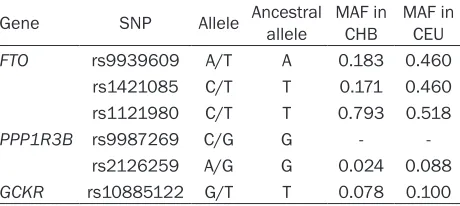
FTO, PPP1R3B and GCKR genes to evaluate. Genotyping plans to use of TaqMan Probe and use of pyrosequencing to detect DNA methyla-tion level of genes. Table 1 listed SNPs select-ed in our study.
Statistical analysis
[image:3.612.93.323.86.189.2]The data will be analyzed by SPSS 21.0 statisti-cal software package. The physistatisti-cal identifica-tions of TCM on MONW were evaluated by logis-tic regression analyses and cluster analysis. The relationships between genes and MONW were calculated by logistic regression analyses. The associations between genes and quantita-tive traits FPG and lipid metabolism indicators such as level of triglycerides (TG), total choles-terol (TC), high-density lipoprotein-cholescholes-terol (HDL-C), and low-density lipoprotein-cholesterol (LDL-C) were evaluated by linear regression. The interactions among genes and behavior risk factors were analyzed by multifactor dimen-sionality reduction (MDR) and multiplicative logistic regression after adjusting for sex, age, and BMI. All tests were two-sided and were con-sidered statistically significant with at P ≤ 0.05. Table 1. SNPs in our study
Gene SNP Allele Ancestral allele MAF in CHB MAF in CEU
FTO rs9939609 A/T A 0.183 0.460
rs1421085 C/T T 0.171 0.460
rs1121980 C/T T 0.793 0.518
PPP1R3B rs9987269 C/G G -
-rs2126259 A/G G 0.024 0.088
GCKR rs10885122 G/T T 0.078 0.100
Constitution identification of traditional
Chinese medicine
Discussions
The population could be divided into four sub-types when considering metabolic phenosub-types with obesity: metabolically healthy with normal weight (MHNW), metabolically obese but nor-mal weight (MONW), metabolically healthy obese (MHO), and metabolically abnormal obese (MAO). As compared with MHO, MONW subtype may have higher visceral fat, lipid metabolisms, and it could be ignored because of lower lean body mass. In contrast to MHO and MHNW, MONW owed high risk of chronic non-communicable diseases, such as type 2 diabetes and cardiovascular diseases. Despite many studies, the mechanisms of MONW remain uncertain.
According to the theory of Traditional Chinese Medicine (TCM), the constitution status of people can be divided into nine types, includ- ing Balanced Constitution, Qi-deficient Consti- tution, Yang-deficient Constitution, Yin-deficient Constitution, Phlegm-dampness Constitution, Damp-heat Constitution, Stagnant Blood Con- stitution, Stagnant Qi Constitution, and Inhe- rited Special Constitution. The identification of constitution status of MONW is helpful to figure out which constitution is significant for it, and for these people who own this significant con-stitution, early effective lifestyle intervention will be taken to prevent the occurrence of MONW. The Constitution in Chinese Medicine Questionnaire has been translated into English, and for all global people, it is feasible to identify the constitution status.
Epigenetics is defined as: there are some genetic regulators besides the nuclear genome sequence including DNA methylation, non-cod-ing RNA regulation, histone modification and so on. Any part of the exception will affect chroma-tin structure and gene expressing leading to more complex syndrome of the diseases. Different from the classical genetics, epi-genetics mainly focus on the maintain mecha-nisms of these epigenetic code, and how to determine cell phenotype and ontogeny. In genetics, DNA methylation is an important epi-genetic modifications form, which has an important role in maintaining the normal func-tion of cell and embryo development. Therefore, DNA methylation levels of FTO, PPP1R3B, and
GCKR genes were estimated in our study.
We did evidence-based research on the major databases (including EMBASE, Pubmed, Coch- rane for English, and CNKI, VIP and Wanfang database for Chinese) to collect the informa-tion about the associainforma-tions between FTO,
PPP1R3B, GCKR genes and MONW through meta-analysis providing the evidences for the estimation of the sample size and the statisti-cal power of the research.
Henan province is a populous in China. The sample size can be fully guaranteed based on the actively cooperation of the three affiliated hospitals of our institution and the People’s Armed Police Corps Hospital of Henan Province. The members of the group have a reasonable structure incorporated into the Chinese medi-cal diagnosis, the basic theory of Traditional Chinese Medicine, as well as a number of researchers specializing in prevention and laboratory.
In conclusion, the purpose of this research is to provide convinced evidence for etiology of MONW from the constitution status of TCM, genetic effects, and interactions among them and behavior risk factors laying the foundations of individualized prevention and the Precision Medicine.
Acknowledgements
This study was supported by the Doctoral Research Fund of Henan Chinese Medicine (NO. BSJJ2014-18). We sincerely thank for all of the authors for their work in this study. We obtained informed consent from all partici-pants, and the study was approved by the Ethics Committees of the First Affiliated Hospital of Henan University of TCM.
Disclosure of conflict of interest
None.
Authors’ contribution
Abbreviations
SNP, single nucleotide polymorphism; TCM, Traditional Chinese Medicine; MHNW, metabol-ically healthy with normal weight; MONW, bolically obese but normal weight; MHO, meta-bolically healthy obese; MAO, metameta-bolically abnormal obese; BMI, body mass index; WC, waist circumference; MAF, Minor allele frequen-cy; CHO, Han Chinese in Beijing, China; CEU, Utah residents with Northern and Western European ancestry from the CEPH collection.
Address correspondence to: Guoli Yan, Discipline of Public Health and Preventive Medicine, Center of Preventive Medicine Research and Assessment, Henan University of Traditional Chinese Medicine, No. 1 Jinshui Road, Zhengdong New District, Zhengzhou 450056, Henan, People’s Republic of China. Tel: (0)371-67002510; Fax: 0086-(0)371-67002510; E-mail: 13937187109@163. com
References
[1] Ruderman NB, Schneider SH, Berchtold P. The “metabolically-obese”, normal-weight indi-vidual. Am J Clin Nutr 1981; 34: 1617-1621. [2] Aung K, Lorenzo C, Hinojosa MA, Haffner SM.
Risk of developing diabetes and cardiovascu-lar disease in metabolically unhealthy normal-weight and metabolically healthy obese indi-viduals. J Clin Endocrinol Metab 2014; 99: 462-468.
[3] Kwon BJ, Kim DW, Her SH, Kim DB, Jang SW, Cho EJ, Ihm SH, Kim HY, Youn HJ, Seung KB, Kim JH, Rho TH. Metabolically obese status with normal weight is associated with both the prevalence and severity of angiographic coro-nary artery disease. Metabolism 2013; 62: 952-960.
[4] Ruderman N, Chisholm D, Pi-Sunyer X, Schneider S. The metabolically obese, normal-weight individual revisited. Diabetes 1998; 47: 699-713.
[5] Wang B, Zhuang R, Luo X, Yin L, Pang C, Feng T, You H, Zhai Y, Ren Y, Zhang L, Li L, Zhao J, Hu D. Prevalence of Metabolically Healthy Obese and Metabolically Obese but Normal Weight in Adults Worldwide: A Meta-Analysis. Horm Metab Res 2015; 47: 839-845.
[6] Ding WQ, Yan YK, Zhang MX, Cheng H, Zhao XY, Hou DQ, Mi J. Hypertension outcomes in bolically unhealthy normal-weight and meta-bolically healthy obese children and adoles-cents. J Hum Hypertens 2015; 29: 548-554.
[7] Guerrero-Romero F, Rodriguez-Moran M. Meta- bolically obese normal-weight children. World J Clin Pediatr 2012; 1: 37-39.
[8] Choi KM, Cho HJ, Choi HY, Yang SJ, Yoo HJ, Seo JA, Kim SG, Baik SH, Choi DS, Kim NH. Higher mortality in metabolically obese normal-weight people than in metabolically healthy obese subjects in elderly Koreans. Clin Endocrinol (Oxf) 2013; 79: 364-370.
[9] Yoo HJ, Hwang SY, Hong HC, Choi HY, Seo JA, Kim SG, Kim NH, Choi DS, Baik SH, Choi KM. Association of metabolically abnormal but normal weight (MANW) and metabolically healthy but obese (MHO) individuals with arte-rial stiffness and carotid atherosclerosis. Atherosclerosis 2014; 234: 218-223.
[10] Gao B, Zhang L, Zhao M; China National Survey of Chronic Kidney Disease Working Group Investigator. Underweight but metabolically abnormal phenotype: Metabolic features and its association with cardiovascular disease. Eur J Intern Med 2016; 29: 46-51.
[11] Oh CM, Jun JK, Suh M. Risk of cancer mortality according to the metabolic health status and degree of obesity. Asian Pac J Cancer Prev 2014; 15: 10027-10031.
[12] Yaghootkar H, Scott RA, White CC, Zhang W, Speliotes E, Munroe PB, Ehret GB, Bis JC, Fox CS, Walker M, Borecki IB, Knowles JW, Yerges-Armstrong L, Ohlsson C, Perry JR, Chambers JC, Kooner JS, Franceschini N, Langenberg C, Hivert MF, Dastani Z, Richards JB, Semple RK, Frayling TM. Genetic evidence for a normal-weight “metabolically obese” phenotype link-ing insulin resistance, hypertension, coronary artery disease, and type 2 diabetes. Diabetes 2014; 63: 4369-4377.
[13] Wildman RP, Muntner P, Reynolds K, McGinn AP, Rajpathak S, Wylie-Rosett J, Sowers MR. The obese without cardiometabolic risk factor clustering and the normal weight with cardio-metabolic risk factor clustering: prevalence and correlates of 2 phenotypes among the US population (NHANES 1999-2004). Arch Intern Med 2008; 168: 1617-1624.