University of Southampton Research Repository
ePrints Soton
Copyright © and Moral Rights for this thesis are retained by the author and/or other
copyright owners. A copy can be downloaded for personal non-commercial
research or study, without prior permission or charge. This thesis cannot be
reproduced or quoted extensively from without first obtaining permission in writing
from the copyright holder/s. The content must not be changed in any way or sold
commercially in any format or medium without the formal permission of the
copyright holders.
When referring to this work, full bibliographic details including the author, title,
awarding institution and date of the thesis must be given e.g.
AUTHOR (year of submission) "Full thesis title", University of Southampton, name
of the University School or Department, PhD Thesis, pagination
UNIVERSITY OF SOUTHAMPTON Faculty of Engineering and Applied Science Department of Electronics and Computer Science
A mini-thesis submitted for transfer from MPhil to PhD
Supervisor: Leslie Carr Examiner: Nigel Shadbolt
An Annotative Approach to Better Hyperauthoring and Associative Linking
by Timothy J. Miles-Board
UNIVERSITY OF SOUTHAMPTON
ABSTRACT
FACULTY OF ENGINEERING AND APPLIED SCIENCE DEPARTMENT OF ELECTRONICS AND COMPUTER SCIENCE
A mini-thesis submitted for transfer from MPhil to PhD
by Timothy J. Miles-Board
Early hypertext visionaries proposed entire online archives of the world’s literature, with everything associatively linked to everything else. Today, the most widespread hypertext system is the World-Wide Web (WWW), a publicly accessible and globally distributed medium. However, the WWW is not living up to the promise of hypertext associativity - the majority of hypertext linking on the WWW is estimated to be intended for navigational purposes only.
WWW authors typically have new ideas to contribute, and assert particular relation-ships between these and existing ideas already published in order to demonstrate both the reliability of the conceptual foundation being built on, and the innovation and sig-nificance of the new ideas. However, these associations are rarely rendered as associative links which seamlessly link the new material into the global context. This research inves-tigates the possibility of capturing these implicit inter-document associations through annotation, and then using these annotations to assist the hyperauthoring process. The hypothesis of this work is therefore that by capturing inter-document associations through annotation, a better hyperauthoring process will result, both in terms of the quality and coverage of the new writing, and in terms of the seamless (associative) inte-gration with the global context, helping the WWW evolve to achieve all of its potential hypertextual richness.
TheAnnotationLInkingENvironment (ALIEN) has been implemented to demonstrate techniques for capturing inter-document associations made by an author whilst reading, using free form annotations.
Contents
1 Introduction 1
1.1 Roadmap . . . 2
2 Background 3 2.1 The promise of hypertext . . . 3
2.2 Hypertext on the World-Wide Web . . . 3
2.2.1 The navigation problem . . . 4
2.2.2 The comprehension problem. . . 5
2.2.3 The linking effort problem . . . 6
2.3 Linking with annotations . . . 6
2.3.1 Annotations and reading. . . 6
2.3.2 A simple model of writing . . . 8
2.3.3 Making associations with annotations . . . 8
2.3.4 Summary and definition of approach . . . 9
3 Hyperauthoring Systems Review 11 3.1 SEPIA . . . 11
3.2 Writing Environment . . . 13
3.3 StorySpace . . . 14
3.4 Aquanet and the Visual Knowledge Builder . . . 15
3.5 Describing associations . . . 17
3.6 Discussion . . . 18
4 Annotation Systems Review 21 4.1 Annotea . . . 22
4.2 InterNote . . . 23
4.3 Multivalent Annotations . . . 24
4.4 XLibris . . . 25
4.5 CritSuite . . . 27
4.6 ScholOnto . . . 27
4.7 Discussion . . . 28
5 Implementation Work 33 5.1 Annotation Linking ENvironment (ALIEN) . . . 33
5.1.1 Annotator . . . 33
5.1.1.1 Referential integrity of annotations . . . 36
5.1.2 Annotation Linker . . . 39
vi CONTENTS
5.1.4 Annotation Server . . . 45
5.2 Other Work . . . 46
5.2.1 The Client DLS system and its applications . . . 46
5.2.1.1 Brief tour of link services . . . 46
5.2.1.2 Moving a WWW link service to the client side . . . 47
5.2.2 OntoPortal - an ontological hypermedia portal . . . 48
5.2.2.1 Related Work . . . 51
6 Further Work 53 6.1 Extensions to the Annotation Linking Environment. . . 53
6.2 Considerations arising from writing diary observations . . . 54
6.3 Applying captured associations to hyperwriting . . . 56
6.4 Collaborative writing . . . 57
6.5 Enriching the WWW. . . 57
6.6 Annotation-based recommender system . . . 57
6.7 Work schedule . . . 58
7 Conclusion 59
List of Figures
2.1 Marshall’s dimensions of annotation Marshall (1998) . . . 7
3.1 Cognitive Model for the Writing Environment (after Smith et al. (1987)) . 14
3.2 Abstract Toulmin micro-argument structure Toulmin (1959) . . . 15
4.1 Annotea RDF schema definition for basic annotation properties (after [Koivunen]) . . . 23
4.2 The structure of a scholarly claim in the ScholOnto ontology Buckingham-Shum et al. (2000) . . . 28
5.1 Creating an annotation with the Annotator tool . . . 34
5.2 ALIEN internal XML representation of a span annotation . . . 35
5.3 Components of the Multivalent Annotation location descriptor (after Phelps and Wilensky (1997)) . . . 37
5.4 Creating an association with the Annotation Linker tool . . . 40
5.5 The result of creating an association with the Annotation Linker tool . . 41
5.6 An association structure takes shape on the Annotation Desk . . . 42
5.7 XML representation of association structure shown in Figure5.6 . . . 43
5.8 Creating associations using freeform marks on the Annotation Desk . . . 44
5.9 The interface offered by the Annotation Server to ALIEN components . . 45
5.10 The Client DLS in action, augmenting the PeP website with links. . . 48
5.11 OntoPortal overlays a meaningful meta-layer of information onto a sparsely linked research community. . . 49
5.12 The OntoPortal Ontology . . . 49
5.13 The application of the OntoPortal server to the metadata research com-munity . . . 50
Chapter 1
Introduction
Early hypertext visionaries (such as Bush Bush (1945) and NelsonNelson (1980)) pro-posed entire online archives of the world’s literature, with everything associatively linked to everything else. Hyperauthors would have no need to reiterate material that had al-ready been written - readers follow associative links from concepts used in newer writings to explanations that have been written before, to a depth that satisfies their own personal requirement for understanding.
Today, the most widespread hypertext system is the World-Wide Web (WWW), a pub-licly accessible and globally distributed medium. However, the WWW is not living up to the promise of hypertext associativity - the majority (as much as 99%) of hyper-text linking on the WWW has been estimated to be intended for navigational purposes only Carr et al. (2000). Factors contributing to this lack of associative linking activity on the WWW have been identified as the fact that authoring associative links incurs a significant development effort Mendes and Hall (2000), and recommendations that associative linking be minimised to avoid well documented problems such as readers becoming “lost in hyperspace” and suffering cognitive overload as a result (for example
Lynch and Horton(1997)).
WWW authors typically have new ideas to contribute, and assert particular relation-ships between these and existing ideas already published in order to demonstrate both the reliability of the conceptual foundation being built on, and the innovation and sig-nificance of the new ideas. However, these associations are rarely rendered as associative links which seamlessly link the new material into the global context. This research inves-tigates the possibility of capturing these implicit inter-document associations through annotation, and then using these annotations to assist the hyperauthoring process. The hypothesis of this work is therefore that by capturing inter-document associations through annotation, a better hyperauthoring process will result, both in terms of the quality and coverage of the new writing, and in terms of the seamless (associative) inte-gration with the global context, helping the WWW evolve to achieve all of its potential
2 Chapter 1 Introduction
hypertextual richness. Annotation is an integral and fluent part of reading, so it is posited that the effort required to author inter-document associations in this manner will be reduced. Furthermore, by providing annotation tools that allow the reader to capture associations in a meaningful way, problems arising from the net-like charac-teristics of the resulting hypertext by can potentially be alleviated by disciplining the hypertext network with semantic information.
1.1
Roadmap
Chapter 2provides a more detailed discussion of the theoretical background of this hy-pothesis, followed by reviews of previous approaches in hyperauthoring systems research (Chapter3) and annotation systems research (Chapter4) which are particularly relevant to this work.
Chapter 5 introduces the implementation work carried out, primarily focusing on the
Annotation LInking ENvironment (ALIEN) system, which demonstrates techniques for capturing inter-document associations made by an author whilst reading, using free form annotations.
Chapter 6 outlines a number of proposals for future research directions, including the implementation of a mechanism for re-purposing captured associations and using them to assist the authoring and linking processes through dynamic visualisation of the asso-ciation structures “as-you-type”, the transclusion of annotated material, and automatic associative linking.
Chapter 2
Background
2.1
The promise of hypertext
Hypertext in its purest form is an associative network of nodes (semantically discrete concepts or ideas) which are connected by links, mimicking the brain’s ability to access information quickly and intuitively by referenceFiderio (1988). Indeed, Engelbart saw hypertext as a means to augment human intellectEngelbart (1963).
ConklinConklin(1987) proposed that true hypertext systems should provide computer supported navigation through hypertextual space, and Bush’s conceptual Memex system
Bush (1945) - a huge database of the world’s literature that everyone can access - first envisioned this. Through associative links, Memex offers parenthetical information, footnotes, digressions, or parallel themes that enrich the main content, providing a computer-based medium for thinking and communicating.
Nelson, the originator of the word “hypertext” itself also envisioned an online network of the world’s literature using his Xanadu systemNelson (1980).
The promise of hypertext is that it allows everything to be associatively linked to everything else, with no need for authors to reiterate material that has already been written -readers can follow associative links from concepts used in newer writings to explanations that have been written before, to a depth that satisfies their own personal requirement for understanding, and become fully immersed in the hypertext network.
2.2
Hypertext on the World-Wide Web
The World-Wide Web (WWW) Berners-Lee (1989) is a publicly accessible, globally distributed, hypertext platform. The promise of hypertext means that every document published on the WWW can potentially be associatively linked to every other related
4 Chapter 2 Background
document, effecting the introduction of a new non-sequential (hyper) writing paradigm. However, the WWW is not living up to this promise.
In an investigation of linking practices on the WWW, Carr et al Carr et al. (2000) concluded that, largely by inspection, the majority (as much as 99%) of hypertext linking on the WWW is for navigational purposes (either in structured site navigation menus, or ad-hoc, non-hierarchical “related information” links), after finding few examples of associative linking from within the actual content of hypertext documents.
The WWW therefore exemplifies Moulthrop’s concept of local coherence Moulthrop
(1992), where nodes exist as stable units which stand in isolation connected purely by transitional links, rather than global coherence, whereby nodes serve to associatively augment the global context.
Current research suggests three contributing factors to the current state of the WWW:
• Widespread concerns that hypertext users face problems of disorientation and cognitive overload have led to recommendations that linking on the WWW be restricted to serve navigational purposes onlyLynch and Horton(1997).
• Similarly, concerns that the net-like character of true associative hypertext makes it hard for users to grasp the overall structure of a document and understand the meaning of its links have led to calls for such associative linking to be avoided unless structured or otherwise meaningful links can be constructedDe Young(1990).
• The hypertext community has always maintained that the authoring of associative links ishard; hypertext development metrics have been used to demonstrate that the number of links desired in a hypertext application does increase the develop-ment effort significantlyMendes and Hall (2000).
These factors are discussed in more detail in the following sections.
2.2.1 The navigation problem
Chapter 2 Background 5
and VOIR Golovchinsky and Chignell (1997) systems), sophisticated overview maps (Gloor(1991);Kreutz et al.(1999);Nanard and Nanard(1991);Bieber and Wan(1994);
Robert and Lecolinet (1998)), link reduction algorithms (Walden’s Paths Furuta et al.
(1997)), and recommender systems (MEMOIR Pikrakis et al.(1998)).
Lynch and HortonLynch and Horton (1997), the authors of the influentialYale C/AIM Web Style Guide, express strong concern about associative linking on the WWW, claim-ing that overuse or poor placement of associative links can cause disorientation. Associa-tive linking is claimed to disrupt the narraAssocia-tive flow by inviting readers to go elsewhere, and instead of enhancing the reader’s understanding of a subject, an associative link may “send them to a foreign land without a guide” in the attempt to discern the link’s significance.
Bernstein validates widespread concerns of confusing the reader through associative link-ing, but disagrees with the strategy of restricting the role of links in WWW documents
Bernstein (1991). Bernstein’s view is that disorientation arises not from the fact that information is associatively linked, but the fact that it is linked badly. Bernstein further claims that no convincing evidence exists that associatively linked information necessar-ily prevents readers from getting “lost”, a claim supported by Davies et alDavies et al.
(1998).
2.2.2 The comprehension problem
Research which focuses on the navigation problem often overlooks the second difficulty arising from associative hypertexts: comprehension. Readers often fail to grasp the overall structure of a hyperdocument or to understand the semantics of its linksStreitz et al. (1992), leading to calls for “structured” or otherwise disciplined hypertext. Glushko, in a commentary on the issues involved in creating multi-document hypertexts
Glushko (1989), rejects the Xanadu hypertext model in which multiple documents are integrated to the extent that their separate structures disappearNelson(1980), favouring instead a solution which limits associative linking in order to preserve structural and contextual clues.
The use of link taxonomies to disipline the hypertext network has been described by researchers such as DeRose DeRose (1989), TriggTrigg (1983) and Baron Baron et al.
(1996).
6 Chapter 2 Background
2.2.3 The linking effort problem
Mendes et al Mendes and Hall(1999, 2000) have investigated the use of software engi-neering metrics in measuring quality characteristics of hypertext applications and devel-opment processes, in an attempt to provide metrics for estimating the effort required to develop new hypertext applications. They report that hypertext applications which have a higher number of links will contribute significantly to a larger developmental effort. Mendes et al suggest that by adding type and context information to links at creation time, this information may be used in order to facilitate link reuse in later developments. Some research has proposed automatic link suggestion mechanisms for link authors (for exampleBernstein (1990)), in an attempt to reduce the authoring effort. However, ob-servers such as GlushkoGlushko (1989) posit that associative links are better identified by the hypertext author rather than extracted automatically (for example, with natural language processing mechanisms), since the author will create links based on their un-derstanding and context of the document, in terms of their writing goals - considerations that are difficult, if not impossible, to reproduce mechanically.
2.3
Linking with annotations
2.3.1 Annotations and reading
In a diary study describing how people read in the course of their daily working lives, Adler et al Adler et al. (1998) report that cross-referencing was the most frequently observed reading mode. This provides an indication of the scale on which associative linking between documents could take place - cross-referencing between multiple docu-ments is a common activity. The study also highlighted the fact that reading frequently co-occurred with some form of writing, with a significant amount of time spent anno-tating documents whilst reading them.
MarshallMarshall (1998) takes up the question of annotation as a fundamental activity for hypertext readers, arguing that past research has been geared more towards the initial design of a hypertext, rather than the annotation of existing materials, and therefore emphasises the role of the reader-as-navigator rather than the role of the reader-as-annotator.
Chapter 2 Background 7
• Form
– Formal (structured metadata)←→ Informal (readers marginalia)
– Explicit (intended for others to read)←→ Tacit (personal)
• Function
– Writing (polyvocal, participatory medium) ←→Reading
– Hyperextensive←→ Extensive←→ Intensive (see Levy(1997))
– Permanant (always available)←→Transient (last only for duration of reading)
• Role
– Published (visible to all) ←→Private (visible only to annotator)
[image:16.612.106.552.25.256.2]– Global ←→Institutional←→ Workgroup←→Personal
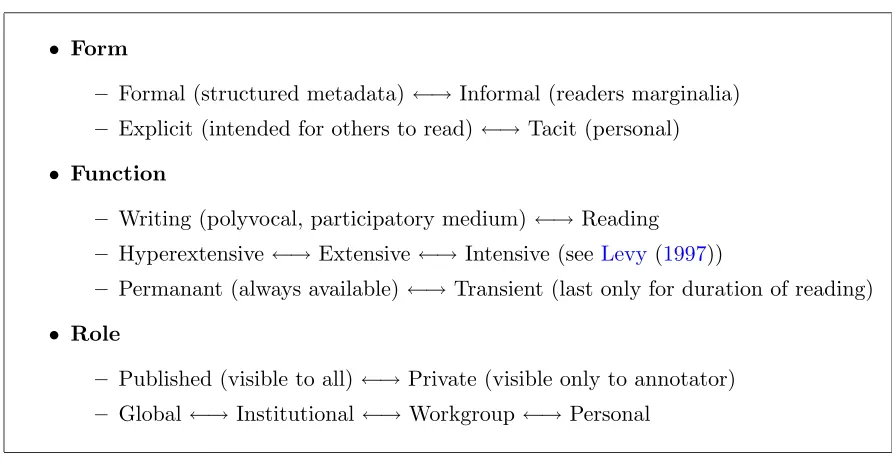
Figure 2.1: Marshall’s dimensions of annotationMarshall(1998)
work in the hypertext field. The Memex machine envisioned by Bush Bush (1945) fo-cuses on annotation through trail blazing, Nelson’s Xanadu Nelson (1980) introduced a transclusive approach whereby new hypertext seamlessly assimilates portions of older writings, and Engelbart’s Augment system Engelbart (1963) emphasised a capacity for journal system commentary.
Marshall provides a useful overview of the dimensions of annotation Marshall (1998) (Figure 2.1). Annotation has variously been interpreted as link making, path building, commentary, marking in and around existing text, decentering of authority, as a record of reading and interpretation, or as community memory.
After carrying out an investigation of the annotations made in paper-based textbooks, Marshall posited that annotations on paper are in fact hypertextual in nature, existing in non-linear relationships to the printed linear text, interrupting and orthogonal to linear reading, connecting disparate passages, and generally functioning as hypertext is intended to.
Readers create hypertext links on paper by associating annotations with the printed document elements. Marshall observed four kinds of associations that readers make:
Composite associations Annotations that refer to many subparts of a single docu-ment, for example a note that refers to an entire chapter.
Node-to-annotation associations Produced when annotations are localised to a par-ticular document part, but don’t visibly refer to any parpar-ticular document element, for example a note written orthogonally to the printing on a page.
8 Chapter 2 Background
associated directly with an annotation using a connecting arrow, bracket, brace, or other spanning mark, or by simply using proximity to imply a relation.
Word-to-word associations Particularly likely to be constructed in foreign language texts where a word is directly associated with its translation.
Readers may also use annotations to create new nodes from document segments, often because the author’s structure does not suit the readers purposes. Marshall observed techniques such as the hierarchical numeration of passages, and the switching of colours between segments in order to achieve this.
2.3.2 A simple model of writing
CarrCarr(1995) describes a simple model of writing in which an author first adopts the role ofreader, searching for relevant ideas and information in the literature, then adopts the role ofcensor, choosing the information appropriate to the task. Finally they adopt the role of organiser to arrange the selected information within an informal structure. In the role of organiser, the author may partition and sort the gathered information into themes. Since each theme may be divided into subthemes requiring further partitioning and sorting, this process is inherently iterative. Using this structure as a guide, the author then adopts the role of writer and actually produces new material, revisiting earlier roles as new ideas initiate further searches, censorship, and organisation.
2.3.3 Making associations with annotations
We have seen that annotating frequently occurs with reading, and that reading is both a precursor and ongoing part of the writing process. The hypertext author in the role of reader is actually producing annotative constructs which represent an early form of the final hypertext.
Chapter 2 Background 9
reliability of the conceptual foundation being built on, and the innovation and signif-icance of the new ideas, linking the new material into the global context. It is these implicit relationships that are closest to the vision of hypertext: associative links that are not explicit between related documents but that can be extracted by careful and cre-ative analysis of the texts and the relationships between them. However, these implicit associations exist only in the authors short-term memory, and are in danger of being forgotten, unless they can be made explicit through annotation of the documents. Nelson visualised two documents positioned side by side on a computer screen, with interconnecting lines drawn between related ideas Nelson (1980). In a paper medium, it would be difficult to capture associative links between documents by drawing lines between ideas.
Alternatively, readers may use symbols to link physically separate document sections, for example an asterisk in the margin next to several paragraphs selected from a number of documents indicates that the ideas presented in these paragraphs are related. However, it then becomes difficult for the reader to remember which symbols have been used to mark up which type of relation, especially as the number of unique symbols used increases. It also becomes difficult to gather together all related ideas once writing begins, since, in the worst case, the reader must search through all the documents to find them.
Price et al Price et al. (1998a) describe how the XLibris personal annotation system could be extended to provide support for linking using symbols in the computer medium. Digital ink marks which are circled become “ink anchors”: passages are linked together by annotating each passage with a similar ink anchor. Activating an ink anchor would create a composite view of all the linked passages in which all the passages marked with the same ink anchor are displayed end to end in a linear fashion. A list of all the ink anchors created by the reader can also be viewed as a reminder of the anchors that have been used before.
2.3.4 Summary and definition of approach
We have seen the promise of hypertext, but have been disappointed to discover that, although a publicly available and global medium, the WWW largely fails to live up to this promise. We have posited that the reason for the lack of associative linking on the WWW derives from at least three contributing factors - the net-like properties of hypertext which cause navigation problems; the lack of structural cues in a hypertext which lead to incomprehension problems; and the significant effort required to author associative links which restricts their abundant creation.
10 Chapter 2 Background
annotations are a ubiquitous part of reading (particularly when the reading activity is part of a larger authoring effort), we posit that using the reader’s annotations to capture these potentially volatile associations between ideas and concepts presented in different documents will not accrue a significant extra effort. By capturing information about the context and type of these relationships, it is hypothesised that navigation and incomprehension issues may be kept to a minimum. This information can then be used to support the author during the writing process, by providing a mechanism for automatically constructing associative links from the new writing to the global context, and also describing and making available the associations between documents in the global context, in the context of the new writing. As BushBush (1945) reminds us :
One cannot hope thus to equal the speed and flexibility with which the mind follows an associative trail, but it should be possible to beat the mind decisively in regard to the permanence and clarity of the items resurrected from storage.
Chapter 3
Hyperauthoring Systems Review
The emphasis of this review is on mechanisms for describing and authoring associations between information nodes, since these mechanisms are most applicable to the approach of this work. Other hyperauthoring facilities and concerns such as collaboration (Haake and Wilson(1992)), author ability (Joyce(1991)), and thinking tools (Thimbleby(1994)) are also important considerations for hyperauthoring research but will not be discussed here.
3.1
SEPIA
The SEPIA (Structured Elicitation and Processing of Ideas for Authoring) environment
Streitz et al.(1989,1992);Haake and Wilson(1992) provides hyperwriting tools for both the individual and collaborative writer, based on the principle of cognitive compatibility. There is no difference between single and cooperative authoring in SEPIA in terms of the way users manipulate and navigate hyperdocuments.
Authors create hyperdocuments by interacting with four activity space browsers dedi-cated to the tasks of content generation and structuring, planning, arguing and writing the final hyperdocuments under a rhetorical perspective (content space, planning space, argumentation space, and rhetorical space respectively). SEPIA’s basic hypertext ob-jects are atomic nodes, composite nodes, and labelled links. The contents of each com-posite node created in an activity space is displayed in a new activity space browser when the composite node is opened.
The planning space serves as a meta space for coordinating the activities in the other three spaces and for controlling the progress of the hypertext design process. The plan-ning space contains the overall goal structure and plans for writing, and acts as a switch-board between the other activity spaces - for example, nodes created in the planning
12 Chapter 3 Hyperauthoring Systems Review
space can be migrated as topics forming the basis of argumentation networks in the argumentation space.
The content space utilises the structuring facility of hypertext to support idea dumping, the grouping of related ideas into topic related clusters by composite nodes, and the connection of ideas via part-whole relationships.
The argumentation space supports the development of argumentative structure, through the ability to relate information nodes with links typed according to an argumentation schema. Writers are able to use this argumentation space to elaborate arguments by generating support or objections on different levels, and by formulating contradictions and argumentative chains.
The node types and links, and the operations which can be carried out on them in the argumentation space are summarised below :
• Nodes
– statement (position, claim, datum)
• Links
– so (may exist with warrant and/orbacking)
– contradicts
– contributes to
• Operations – support
– object to
– justify
– negate
– generalise
– specialise
Chapter 3 Hyperauthoring Systems Review 13
To attack a claim, the author applies the object to operation to an existing claim. This operation creates two new nodes (a claim which opposes the existing argument and a datum that supports the new claim) linked together with a supportingso relation, and links the new claim to the claim under attack via acontradicts relation. This structure is necessarily complex in order to make the implications of the attack explicit to the author.
The justify operation can be used to create supporting relations (through the so link) with warrant and backing to cover the relation between datum and claim. The warrant and backing are essentially properties of the supporting relation.
Authors often start with a global argument, and then gradually refine it by creating other arguments which are more specific instances of the global argument. Alterna-tively, authors may start with several arguments and draw a more general position by summarising their claims. Hence, in order to be able to model arguments at multi-ple levels of abstraction, generalisation and specialisation operations are provided. The
generalise operation allows a more general statement to be related to one or more state-ments at a lower level of abstraction via the contributes to relation. Conversely, the
specialise operation enables more specific statements to be linked to the appropriate general statements.
The rhetorical space is where the author creates the reader-oriented, final document (which can be either a linear text or hyperdocument) by imposing a document structure on the ideas and arguments explicated and elaborated in the content and argumentation space. The rhetorical space provides three working modes : outline mode (global outline of the document), argumentation strategy mode (rhetorical reorganisation of positions and arguments for each subissue), and text edit mode (sentence-level editing).
SEPIA emphasises smooth ad-hoc transition between activity spaces, in recognition that the production and transformation of knowledge during writing is not done in a linear sequence of stages from idea generation to text generation.
3.2
Writing Environment
14 Chapter 3 Hyperauthoring Systems Review
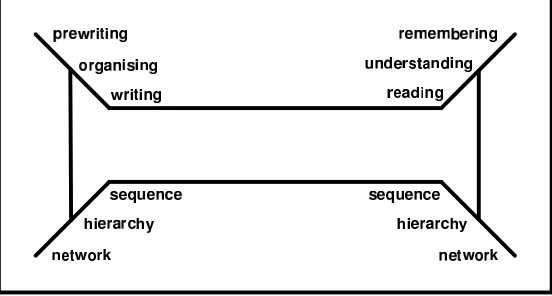
Figure 3.1:Cognitive Framework for Written Communication (after Smith et al.
(1987)).
hierarchical structure, and then writing a document in accord with that structure. The developers of WE posit that hypertext is therefore a supporting utility over which more constrained applications will be developed, rather than the primary application system itself.
The cognitive model on which the WE is based models reading as the process of taking the linear stream of text, comprehending it by structuring the concepts hierarchically, and absorbing it into long-term memory as a network. Writing is seen as the reverse of this process - the organisation of a loosely structured network of internal ideas and external sources into a hierarchy or outline which is then used as the foundation of a linear stream of words and sentences (Figure 3.1).
The WE contains two major view windows, a graphical window and a hierarchical win-dow. A writer begins by creating nodes in the graph view, but imposes little or no struc-ture on the conceptual material. Nodes may be placed in “piles” if they seem related, and simple subordinate/superordinate relations imposed. As the conceptual structure emerges, nodes can be copied into the hierarchy window and arranged according to this structure.
In a follow-up study Lansman et al. (1993), WE was used to investigate how writers developed the structure of technical documents. The ability to view the organisational structures of the document as the text was being written proved popular among partic-ipants.
3.3
StorySpace
Chapter 3 Hyperauthoring Systems Review 15
a place in the evolving structure of elements. The visual representation of a writing space therefore contains two components: a textual component (in the form of a title bar which leads to viewing and editing of the text inside the writing space), and a structural component which can hold additional writing spaces (in fact, the writer may locate an indefinite number of nested writing spaces inside one superordinate space). Writers manipulate structure directly by arranging, opening, and closing spaces. The inherent hierarchical nature of writing spaces can also be used to provide a tree-like view of the graphical layout. Bernstein et al argue that these writing spaces are easier to manipulate than chunks of continuous writing because the writer identifies with each space as a discrete symbolic entityBernstein et al.(1991).
Storyspace allows labelled links to be used to graphically model associations between related spans of text, regions of graphics, or entire writing spaces. If the source and destination of a link are not on the same level of the hierarchy, only an abbreviated incoming or outgoing arrow is displayed. Storyspace allows the construction of both
univalent links (links with a single beginning and a single end) and multivalent links (links with multiple sources and/or destinations), which can be labelled arbitrarily by the writer.
3.4
Aquanet and the Visual Knowledge Builder
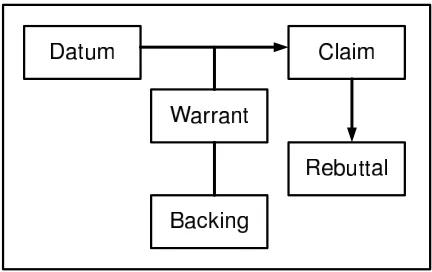
[image:24.612.208.424.478.614.2]AquanetMarshall et al.(1991) is a tool designed to support knowledge structuring tasks. Users are able to create and browse knowledge structures (interconnected networks of information bearing nodes). Node types and links can be created, according to a user definable schema, for example the Toulmin argumentation structure Toulmin (1959) (Figure 3.2).
Figure 3.2: Abstract Toulmin micro-argument structureToulmin (1959)
16 Chapter 3 Hyperauthoring Systems Review
main display space as a drawing board, expressing developing relationships between the object icons spatially, for example placing similar objects in a pile. Marshall and Rogers describe various manipulations of representational structures as crucial to the author’s interpretive process, and this work has led to the development of tools which support these manipulations in all their richness.
The Visual Knowledge Builder (VKB)Shipman et al. (1999) (based on the earlier VIKI system Marshall and Shipman, III (1997)) is based on a spatial notion of hypertext, providing users with spatial and visual affordances for organising information. Marshall and Shipman describe this prewriting/analytic process of sorting through materials and organising them to meet the needs of the task at hand as “information triage”Marshall and Shipman, III (1997).
The VKB system provides a rich feature set in terms of the visual manipulation of infor-mation nodes, or objects, represented as symbols in the spatial area. The position, size, border width, font style, transparency, background color, font, and border colours of visual symbols and collections are able to be modified by direct manipulation. Informa-tion objects can be also represented by more than one visual symbol, allowing multiple interpretations of a single piece of content.
Information objects can be assigned a set of attributes and values - when a common set of attributes are shared by a number of objects, an object type can be defined. Types combine semantic information about the objects (a set of expected attributes and their default values), and visual information about the symbols (as default visual characteristics, including color, shape, and details of which attribute values are shown in the visual presentation).
The VKB system is also able to integrate with the user’s working enviroment - objects can use an attribute value to point to external information, for example Microsoft Word documents, Adobe Acrobat documents, documents on the WWW, or any other data type with a registered viewer in the user’s working environment.
In order to express relationships or categories in VKB, symbols are simply placed near one another, or placed in a collection. Hierarchies of collections can be navigated by double clicking on the borders of each collection object; navigating into a collection causes that collection to fill the entire workspace window. Relationships are constructed using spatial structures, such as piles, lists, and repeating patterns of visual symbols.
Chapter 3 Hyperauthoring Systems Review 17
the visual categorisation of symbols). The spatial parser allows the VKB workspace to be exported to formats such as XML and HTML.
VKB also includes an embedded history mechanism. As information spaces are rarely completely consistent, it is important for users to be able to rewind, replay, or step through the interpretative process leading to the current workspace when they are unable to remember initial interpretations.
3.5
Describing associations
Mechanisms for describing associations have also been suggested by other research not directly related to hyperauthoring systems.
Rittel introduced the idea of Issue Based Information Systems (IBIS) Kunz and Rittel
(1970) (see also Conklin and Begeman (1988)). IBIS systems provide teleconferencing components for collaborative understanding of the major issues and implications sur-rounding what Rittel describes as “wicked problems” (problems that lack a definitive formulation), and hypertext components for creating structured arguments surrounding the issues. IBIS allow three types of node to be created - issues, positions, and argu-ments - and used eight different types of relationship to link these node (responds to, questions, supports, objects to, specialises, generalises, refers to and replaces).
The SYNVIEW systemLowe(1986) takes the IBIS approach in a different direction by allowing the nodes to be collaboratively rated in terms of validity and relevance - new readers are therefore able to focus on those argument trails having the highest voted validity.
TriggTrigg(1983) describes a taxonomy of over 70 link types, classified into two major categories. Normal links serve to “connect nodes making up a scientific work”, whilst
commentary links “connect statements about a node to the node in question”.
In an attempt to structure hypertext for Classics and Religious studies, DeRoseDeRose
(1989) presents a taxonomy of links categorised at the highest level as eitherextensional
or intensional. Extensional links are futher split intorelational andinclusive categories. Relational links consist of associative links (connecting arbitrary pieces of text) and
annotational links (referential links connecting portions of the text to information about the text). Inclusive links consist ofsequential and taxonomic links, which associate lists of properties with particular document elements. The second highest-level category, intensional links, describes other link types that follow strictly from the structure and content of the document (for example, the linking of references of the form “see Section
n” to the appropriate section).
18 Chapter 3 Hyperauthoring Systems Review
hyperlinks with meaningful labels enabled more effective searching across a hypertext document. The three classes of link used were: semantic links (similar, contrast, part of), rhetorical links (definition, explanation, continuation, illustration, summary), and
pragmatic links (warning, prerequisite, usage, example).
3.6
Discussion
This chapter has examined the mechanisms which have been applied in previous hyperauthoring-related research for describing and authoring associations between information nodes.
Other link taxonomies that describe associations between documents have also been examined.
Although the authoring systems share many common features in terms of the manner in which information nodes can be visual manipulated on-screen, the mechanisms each system offers to the hyperauthor for making associations are quite different.
Both the SEPIA and WE systems base their interaction modes on established cognitive models, supporting the author through various processes of refinement from forming a unstructured network of ideas to the final structured hypertext. The WE allows the user to express simple ordinate/subordinate relationships between ideas with the intention of capturing the intended hierarchical structure of the document. The WE is therefore oriented toward authoring a linear document. In contrast, the SEPIA system (and also the Storyspace system) allow the user to create true hypertext links between ideas and produce a rich hypertext. The VKB system allows authors to spatially organise and classify information nodes into “piles”, but does not allow authors to explicitly express meaningful associations between interrelated nodes. Aquanet and SEPIA in contrast allow authors to apply argumentation-based structures to ensure that associations can be meaningfully expressed.
The link types with which each system allows authors to express associations between information nodes varies diversely (Trigg suggests more than 70 link types, the SEPIA system provides only 3). Aquanet allows the author to define a strict taxonomy of link types it offers, and Storyspace goes a step further to allow the author to unrestrictedly describe an association in any manner that the author feels is appropriate. It is clear that care needs to be taken to achieve the right balance - too few link types may limit the expressiveness of the author and the degree to which associations between ideas are able to be captured; too many links may overwhelm the author and be left largely unused; unrestricted typing of links may lead to inconsistencies.
inter-Chapter 3 Hyperauthoring Systems Review 19
weave them with their own, the system does not record where these ideas originated (the author must “cut and paste” ideas into the system, rather than seamlessly “tran-sclude” them). Therefore the author makes associations between the information nodes in the system, but not between the literature itself - the system has no sense of the underlying literature foundation from which the ideas are derived. The system lacks the global perspective which this work requires, unless this is explicitly (and inefficiently) orchestrated by the user (e.g. in VKB by assigning properties to each information node which are placeholders for metadata about the document from which an information node transcludes).
Chapter 4
Annotation Systems Review
WhittingtonWhittington(1996), and Cousins et al Cousins et al.(2000) identify com-mon characteristics of annotation systems. Whittington identifies 12 characteristics which define and differentiate annotation systems. Cousins et al describe a framework for annotation systems, based on the dimensions of:
1. The platform used to create the annotations 2. The platform used to read the annotations 3. The annotations themselves
4. The target object being annotated
In this review, investigation of the following five characteristics, derived from both Whit-tington’s and Cousins et al’s models, have been identified as being most relevant to this work :
• Architecture - what are the main architectural features of the annotation plat-form?
• Authoring- how are annotations created?
• Granularity- at what granularity can annotations be associated with documents? For example, the coarsest granularity annotations are those at the document level.
• Storage- how are the annotations represented and stored?
• Typing - what facilities exist for attaching semantics to the annotations?
An additional consideration in exploring annotation systems, not included in Whitting-ton’s or Cousins et al’s taxonomies, is the facilities that existing annotation systems offer forassociative linking- the expression of relationships between different annotations.
22 Chapter 4 Annotation Systems Review
4.1
Annotea
Koivunen et al Koivunen et al. (2000); Kahan et al. (2001) describe the Annotea an-notation system, developed by the World Wide Web Consortium (W3C), in order to support annotative collaboration through an open metadata infrastructure.
Architecturally, Annotea consists of two main components: an annotation server that stores and serves the annotations in RDF form, and a WWW browser/editor that pro-vides users with an interface for creating and reading the annotations. The primary WWW browser/editor for the system is Amaya, an Open Source system also developed by the W3C. When annotations are in use, the Amaya browser consults the annotation server every time the user loads a new document and the annotations related to that document are retrieved and presented. Annotation Servers can be hosted by any indi-vidual, and users wishing to view annotations stored on a particular server can configure the Amaya browser to request annotations from one or more different servers.
Annotations in the Annotea system are different statements about a document, such as comments, typographical corrections, hypothesis or ratings. Annotations are posted to an annotation server in RDF format, and stored in an RDF database as general metadata triples. A single triple is a (subject, property, value) statement and states that for a WWW object whose Web address is subject, the given property has the specifiedvalue. This provides a flexible framework for describing objects on the WWW, permitting separate communities to develop independent metadata vocabularies and then freely mix statements using these vocabularies in a single database of triples. By the nature of the RDF standard, the property names themselves have Web addresses, so other statements about the meaning and use of each property and its relationships to other properties can be inferred. The RDF schema definitions for the basic annotation properties are shown in Figure4.1.
Currently Amaya supports two kinds of annotation: annotations that apply to the whole document, and annotations which apply to a specific point or span in the document. Doc-ument level annotations are created by selecting the “Annotate DocDoc-ument” command from Amaya’s menu. Similarly, finer grained annotations can be created by moving to a point or selecting a span and choosing the “Annotate Selection” command. When an annotation has been created, a small icon appears either at the top of the document, at the specified point in the document, or at the beginning of the selected span. Clicking on the icon opens a new window which displays the content of the annotation.
Chapter 4 Annotation Systems Review 23
for example a property that describes the rating of an annotation according to a scale created by the collaborative group.
rdf:type The type of the annotation, which should indicate the author’s intention when making an annotation. The value should be of rdf:type Annotation, or any of its subclasses.
annotates The resource to which the annotation applies.
body The content of the annotation.
context The context defines where exactly inside the doc-ument the annotation is attached to. The XPointer standard is used to define this location.
dc:creator The creator of the annotation (from Dublin Core element set).
created The date and time on which the annotation was created.
dc:date The date and time on which the annotation was last modified (from Dublin Core element set).
related Related resources that augment the body of the an-notation, for example, backing evidence for an argu-ment, related issues, or discussion threads.
Figure 4.1:Annotea RDF schema definition for basic annotation properties (after [Koivunen])
4.2
InterNote
The InterNote annotation systemCatlin et al.(1989) is an extension to the InterMedia system Meyrowitz (1986), implemented in an attempt to better support collaborative document review and revision.
24 Chapter 4 Annotation Systems Review
The Commentary Frame is used to provide a textual justification or commentary of the suggested changes entered into the Incorporation Frame.
A link anchor then appears at the beginning of the selection in the annotated document. Selecting the annotation marker causes the Note to appear in a separate window to the main document, which contains a link back to the document. The InterNote system introduces the concept of warm linking, linking that involves not only navigation, but also allows data transfer across the link. The author of the document can therefore view the annotations made by reviewers and decide whether to incorporate them into the next revision. Suggestions made in the Incorporation Frame of annotations can be incorporated by executing thePull command on the link anchor in the main document, replacing the content which the Note annotates with the content in the Incorporation Frame. Alternatively, the Push command can be executed on the link anchor in the Note window to achieve the same effect.
4.3
Multivalent Annotations
Phelps and Wilensky have developed Multivalent Annotations Phelps and Wilensky
(1997), based on the Multivalent Document systemPhelps and Wilensky(2000b). In the Multivalent Document system, a hub document is an XML description of the layers and behaviours that comprise a single conceptual document. For example, a hub document may consist of a scanned document image, and its corresponding OCR-inferred text. Other layers and behaviours may provide arbitrary functionality, including various forms of annotation.
Three broad types of multivalent annotation have been developed: annotations that make use of point-to-point spans of media elements, annotations that make use of geo-metric regions, and annotations that make use of structures within the document tree. Span annotations include highlighting of text (created by selecting a region of text, and then choosing the “highlight” behaviour), hyperlinks (created by selecting a region of text, choosing the “hyperlink” behaviour, and then entering the URL), and copy editor markup (created by selecting a region of text and then associating copy editor markup with the span by drawing freehand marks on the page, typing in text, or choosing from a palette of common copy editor markup symbols). Another example of a span annotation is that used to visualise version differences, with deleted text overstruck, inserted text in italics and changed text in bold.
Chapter 4 Annotation Systems Review 25
as language translators - an experimental “language translation lens” displays French or German translations of underlying English sentences.
Structural annotations hook into the hierarchical document tree. For example, by an-notating an entry in a bibliography with structural information (e.g. author, title), the bibliographic entry could automatically be transformed into BiBTeX or Refer format when the entry was pasted into another application.
Multivalent annotations may also be combined - Phelps and Wilensky introduce NoteMarks, a combination of structural and span annotations that allow the overall structure of a document to be sensed by collapsing sections so that only headings are visible, except for section content that contains higher priority annotations. For example, in reading a manual page, the page could be annotated such that only the section headings are visible except for content within the section which contained search hits for a particular topic that the user is interested in (presented as span annotations).
As the concept of “hub documents” in the Multivalent Document model implies, annota-tion behaviours can be stored apart from the other layers and behaviours that make up the document. A hub document can be also constructed that incorporates annotations created by one or more persons.
4.4
XLibris
Price et alGolovchinsky et al.(1999);Schilit et al.(1998);Price et al.(1998a,b) describe the XLibris system, an annotation system geared towards the support of the active reading process - the combination of reading with critical thinking and learning which involves not just reading, but also underlining, highlighting, scribbling, and commenting. XLibris uses the paper document metaphor by providing a display that emulates the appearance of a sheet of paper, an interface for viewing pages in the linear order of the document, the ability to mark in any place on the page, and cues about the size of a document and the reader’s location within it. The physical experience of reading a paper document is also emulated - readers hold a lightweight pen tablet that displays one page of a document at a time, and can mark anywhere on the page with coloured pens, highlighters, and an eraser, taking the granularity of annotations to the pixel level. Different types of annotation can be effected by using different ink colours.
26 Chapter 4 Annotation Systems Review
the margin of the page next to the annotation, allowing the user to peruse the related information at their leisure. This process of initiating searches related information in the context of the users reading is known as linking by inking.
The XLibris system also provides a Reader’s Notebook, and a “workspace view”. The Reader’s Notebook is a notebook of clippings derived from user’s annotations, providing review and retrieval facilities. Clippings are derived from the bounding boxes of the user’s annotations, and are presented end-to-end on a page, labelled with the document title and page number, and acting as a link to the underlying page. Clippings from one or more documents may be viewed simultaneously, and may be sorted by creation time or page number, or filtered according to the ink color used. The “workspace view” displays a thumbnail of each document, with the size of the documents shadow used to indicate the size of the document.
Price et alPrice et al.(1998a) describe the possibility of linking documents together using digital ink, proposing a design whereby circling any annotation converts that annotation into an anchor. The system would then maintain multi-way links between similar ink anchors - tapping on a particular instance of an ink anchor should produce a list of clippings that contain matching target ink anchors (similar to the Reader’s Notebook). Readers can use the flexibility of free form ink to make the ink anchors meaningful; this could potentially include assigning types to the links.
Since the XLibris system is primarily a personal reading device, annotations are ex-pected to be stored locally and not be accessible to anyone other than the reader herself. However, Marshall et alMarshall et al.(1999) have demonstrated how the XLibris sys-tem can be used in a collaborative reading environment. Suggestions arising from this study include:
• The overlaying of several sets of annotations from different readers, in order that the group can see multiple annotations at once.
• Allowing readers to access the annotations and underlying text apart from the document to create a compact representation of the passages that other readers have annotated.
• The processing of different readers’ annotations in order to produce a document which has passages emphasised where one or more readers annotated them, but preserves anonymity by not showing the original annotations. By looking atwhere
Chapter 4 Annotation Systems Review 27
4.5
CritSuite
The CritSuiteYee(1998) system provides a referential annotation system for the WWW, supporting the practice of critical discussion.
The CritSuite system uses a proxy architecture (CritSuite’s creator, Yee, calls this proxy service a Mediator), which augments requested web documents with the “CritLink” interface, and any annotations that have been made on the document. The mediator also modifies the links in the documents it processes so that the client software will continue to invoke the mediator on each request.
CritSuite supports two types of annotation granularity, annotations that apply to the entire document, and annotations that apply to a specific phrase (arbitrary span of text) in the document. In order to create an annotation of either type, the user selects the “comment” icon from the CritLink interface bar inserted at the top of each page requested through the mediator, which in turn opens a new window displaying the “CritWriter” interface - an HTML form containing fields for the annotation content and author. In order to apply the annotation to the document as a whole, the “link to entire document” option is selected. Linking to a specific phrase is more cumbersome and requires the annotator to copy and paste the phrase and its surrounding context into appropriate fields of the CritWriter interface. The annotation can then be stored on the server, or alternatively, downloaded and made available on the WWW by the annotator. CritSuite supports four types of annotation; support (agree), issue(disagree), query, and comment.
When documents are subsequently viewed through the mediator, annotations specific to spans are presented as small arrows at the start and end of the span, which can be clicked on to open a new window displaying the annotation. The mediator also inserts a summary of links to all annotations of the document at the bottom of the document, including span specific annotations (with the annotated phrase reproduced verbatim), orphan annotations, and annotations that apply to the document as a whole.
4.6
ScholOnto
Buckingham Shum et al Shum et al. (1999); Buckingham-Shum et al. (2000) describe a formal ontological approach to annotating WWW resources, in an attempt to model the claims that scholars make about their research.
28 Chapter 4 Annotation Systems Review
Figure 4.2: The structure of a scholarly claim in the ScholOnto ontology
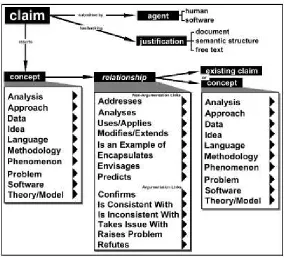
Buckingham-Shum et al. (2000). All claims are owned by an agent, and have some form of justification. Claims assert new relationships with other claims, or between
concepts.
descriptions have the advantage that authors promoting their work take ownership of, and have control over, the way in which their work is presented.
The ScholOnto system can then be used by researchers to answer queries such as Are there any arguments against the framework on which this paper builds?, andHas anyone extended language L?.
Authors can use a direct annotation interface to describe their contributions to a research community. This interface provides the opportunity to annotate specific points of the document using the available ontological relationships (Figure 4.2) - for example the author can specify exactly which part of the document refutes a theory proposed in another document. Using a 1-to-N link, a number of points in the document can be associated with an ontological concept. The annotations are stored on the ScholOnto server, separate from the documents being annotated.
4.7
Discussion
Chapter 4 Annotation Systems Review 29
In terms of architecture, the Annotea framework adopts the client-side model, in which a WWW browser is augmented with the capability to request and display annotations from a dedicated annotation server as the WWW is browsed. This architecture allows users to view annotations from multiple sources by configuring the browser to request annotation from multiple servers. In contrast, the CritSuite system is based on a proxy architecture, in which requests to view WWW documents are routed through the Crit-Suite “mediator”, which decorates each document with annotations before returning it to the browser. The InterNote, Multivalent Annotations, XLibris, and ScholOnto systems are dedicated annotation enviroments in which the user must work in order to take advantage of annotative capabilities. The impetus of this work is to allow the WWW to evolve into all its hypertext richness - the working environment of the author is the WWW, and thus tools to support the capture of implicit relationships between documents need to be integrated into the WWW browsing environment in much the same way as the Annotea framework extends the Amaya browser to include annotation facilities.
The Annotea framework uses an RDF syntax to describe annotations of WWW re-sources. These descriptions are then stored in a (freely distributable) database held on a dedicated server which can be queried extensively by any application able to use the same communication protocol. Annotations created in the other systems are not acces-sible outside that systems storage environment. In the context of this work, it would be sensible to allows “open” access to stored annotations, particularly in a situation where collaborating authors share each others annotations.
The ScholOnto and Multivalent Annotation systems differ from the other systems de-scribed in terms of the concept of what exactly constitutes an “annotation”. The Mul-tivalent Annotation system regards mechanisms which alter the presentation of the text as a form of annotation. ScholOnto regards annotations as formal statements that are made about a resource in order to allow computers to perform intelligent reasoning and inferencing over a set of resources, as opposed to personal responses to a text that are intended to be human readable. The annotations authors make when reading literature clearly fall into this category.
In terms of granularity, the Annotea, CritSuite, ScholOnto, Multivalent Annotations and Internote systems allow annotations to be made at the character level by selecting text in the document to which an annotation will be anchored. These systems also allow annotations to be attached to a document as a whole. InterNote also allows true multi-media annotations, for example images can be annotated with image-editing tools.
30 Chapter 4 Annotation Systems Review
text is being annotated and perform actions according to these annotations (e.g. link suggestions in XLibris when passages are underlined).
In terms of this work, character level granularity seems best for highlighting impor-tant parts of documents, and pixel-level granularity seems best for expressing associa-tions.between these highlighted parts.
Chapter3concluded that link taxonomies suggested by the literature vary diversely, and should be chosen carefully. The same is true of annotation taxonomies advocated by the annotation systems reviewed in this chapter, and the same cautionary note should be heeded. The Annotea system allows the available annotation types to be extended. The Multivalent Annotations and XLibris systems offer unconstrained annotation types - freeform marks or notes can be used to describe the purpose of the annotation.
Further to the link taxomony discussion in Chapter3, the ScholOnto system provides a number of link types which are particularly appropriate to this work.
The link types with which each system allows authors to express associations between information nodes varies diversely (Trigg suggests more than 70 link types, the SEPIA system provides only 3). Aquanet allows the author to define a strict taxonomy of link types it offers, and Storyspace goes a step further to allow the author to unrestrictedly describe an association in any manner that the author feels is appropriate. It is clear that care needs to be taken to achieve the right balance - too few link types may limit the expressiveness of the author and the degree to which associations between ideas are able to be captured; too many links may overwhelm the author and be left largely unused; unrestricted typing of links may lead to inconsistencies.
Of all the systems described in this chapter, only the XLibris and Annotea systems provide mechanisms for associating interrelated annotations. XLibris proposes a “ink anchor” technique for associating related annotations. All passages marked with the same freeform symbol are automatically associated and can be viewed together, sepa-rately from their source documents. Meaningful associations can be made using freeform marks near the ink anchors (for example, noting the type or reason for the association) - these marks are also presented when all the associated passages are viewed together. This mechanism does not provide for the creation of more complex association structures however, and it is not clear how the associations created can be integrated directly into the writing space.
Chapter 4 Annotation Systems Review 31
information about inter-annotation relationships by subclassing and extending the RDF Annotation class.
Chapter 5
Implementation Work
5.1
Annotation Linking ENvironment (ALIEN)
TheAnnotationLInkingENvironment (ALIEN) was implemented to demonstrate the principles of “linking by annotating”; how annotations could be used to capture associ-ations between documents as they are read.
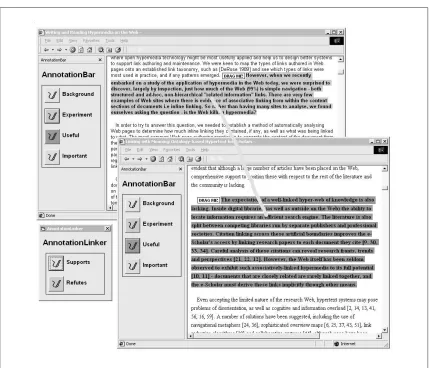
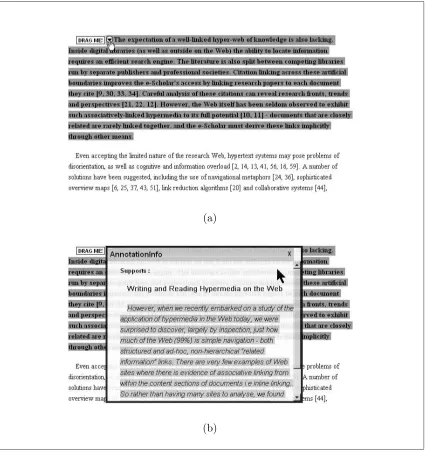
ALIEN consists of 4 major components, the Annotator, Annotation Linker, Annotation Desk, and Annotation Server. WWW Documents can be annotated using the Annota-tor, which is integrated into the Internet Explorer WWW browsing environment. The Annotation Linker is then used to express the relationships between annotated parts of WWW documents using typed links. More complex annotations can be constructed by dragging document annotations created with the Annotator onto the Annotation Desk and using the advanced annotation facilities. The Annotation Desk also provides mecha-nisms for associating meaningful labels and statements with the various annotations and relationships. The Annotator, Annotation Linker, and Annotation Desk communicate with the Annotation Server, which maintains a central annotation repository.
5.1.1 Annotator
Architecturally, the Annotator component has many similarities to the Annotea anno-tation system Koivunen et al.(2000);Kahan et al. (2001). The Annotator is a tool for annotating web documents that is integrated into the Internet Explorer WWW browsing environment as a user interface “plug-in”. Annotations are stored separately from the annotated document - on the addition of a new annotation, the Annotation Server is informed that a new annotation has been added to this particular WWW document. Subsequently, when the browser returns to the WWW document, the Annotator queries the Annotation Server for annotations of the document, and displays the return anno-tations.
34 Chapter 5 Implementation Work
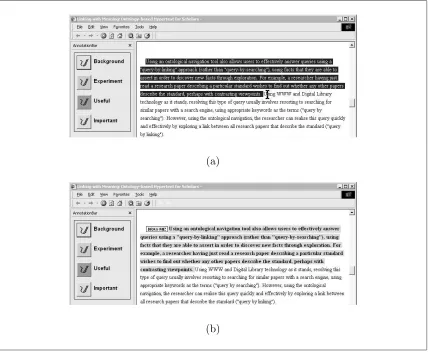
Currently, the Annotator facilitates annotations of the type that may be achieved in a paper environment with a highlighter pen, that is, span annotations. Web documents are annotated by selecting a text span from the currently displayed document, and then choosing an annotation type. The selected area is then highlighted according to the colour associated with that annotation type. The granularity of the annotations is therefore at the character level. Figure5.1 demonstrates how the Annotator facilitates the in-place annotation of a WWW document.
(a)
[image:43.612.73.502.158.514.2](b)
Figure 5.1: Creating an annotation with the Annotator tool. After selecting the span of text to be annotated (a), the author chooses an annotation type from the palette,
and the selected text becomes highlighted in the corresponding colour (b).
The Annotator can be configured to present a number of different annotation types to the user, each with a corresponding (user defined) colour. For example, the Annotator could be configured to provide annotation types based on argumentation models (for example Toulmin Toulmin (1959), SEPIA Streitz et al. (1992), IBIS Kunz and Rittel
Chapter 5 Implementation Work 35
and “important” for highlighting an important experimental result or conclusion.
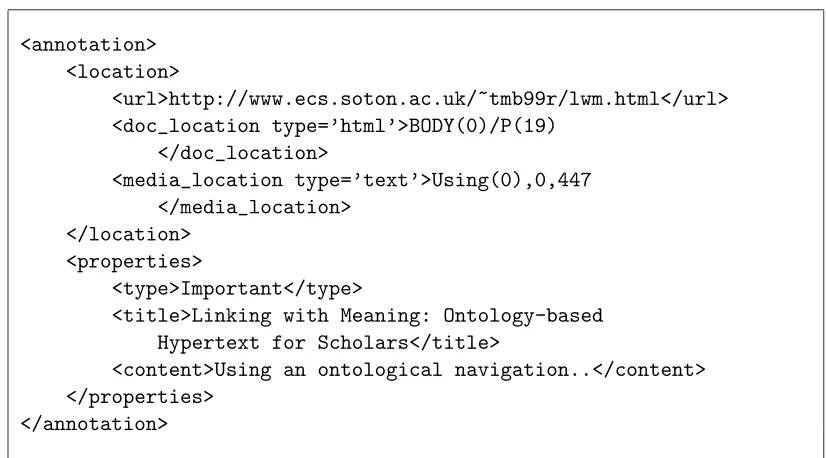
In order to record the position and extent of the span annotations created through the Annotator, an XPointer-like construct is used. This approach is comparable to that of Phelps and WilenskyPhelps and Wilensky(2000b) and AnnoteaKoivunen et al.(2000);
Kahan et al.(2001), who use a similar syntax to describe the positions of annotations. Annotations created by the Annotator are described (and subsequently stored by the Annotation Server) as XML fragments (Figure 5.2). This XML format is regarded as a stepping stone to RDF representation, and compliance with the W3C standard. An RDF representation would also mean that the Annotea RDF annotation server could be deployed in place of the current Annotation Server component.
<annotation> <location>
<url>http://www.ecs.soton.ac.uk/~tmb99r/lwm.html</url> <doc_location type=’html’>BODY(0)/P(19)
</doc_location>
<media_location type=’text’>Using(0),0,447 </media_location>
</location> <properties>
<type>Important</type>
<title>Linking with Meaning: Ontology-based Hypertext for Scholars</title>
<content>Using an ontological navigation..</content> </properties>
[image:44.612.108.521.226.455.2]</annotation>
Figure 5.2:ALIEN internal XML representation of a span annotation
The location construct of the XML representation shown Figure 5.2 describes the location of the annotation within the document in two separate parts - the document
location and themedialocation. Together, these two parts form the “location descriptor” for the annotation, which acts as an indice into the document content.
36 Chapter 5 Implementation Work
Although the XPointer standard is intended to be used to reference nodes of XML documents, and is often unsuitable for HTML documents that are not well formed, it was found that provided the same technique was used for creating and resolving the structure level locator for HTML documents (more specifically, provided that HTML nodes that are not well formed are treated consistently), these locators can be used. The media level component (media_location) describes the location of the annotation in terms of the lexia found at the structural element referenced by the structure level component. In Figure 5.2, the structural locator contains text, and the media level locator identifies the span annotation as beginning at the first occurence of the word “Using”, and extending for 447 characters from the beginning of this word (position 0). Again, the modular implementation of the ALIEN system allows different media handlers to be initiated depending on the media type in order to display the annotation appropriately.
Currently document handlers have been implemented for HTML documents, and media handlers for text-based media. These handlers are delegated responsibility for creating and resolving structure and media level location descriptors, and the media handler must also display the annotation (for example, using thetypeand colourinformation of the propertiesconstruct in Figure 5.2).
In order to integrate the system fully with the document types and embedded media available on the WWW, document handlers for PDF, PS, plain text, and Microsoft Word documents need to be implemented. Since these types of documents do not have the structural markup of an HTML document, a different structural model, requiring a different syntax, will be required. Media handlers supporting, for example, image and video types, would allow diagrams and presentations to be annotated.
5.1.1.1 Referential integrity of annotations
A significant problem with this implementation of the ALIEN system is that although the refere