Non-stationary processing centre for small and
medium-sized blueberry farms. A Review
Kaarel Soots*, Jüri Olt
1
Institute of Technology, Estonian University of Life Sciences, Tartu, Estonia
*Corresponding author: [email protected]Abstract
Soots K., Olt J. (2017): Non-stationary processing centre for small and medium-sized blueberry farms. A Review. Res. Agr. Eng., 63: 136–144.
Growing blueberries on exhausted milled peat fields could be a possible solution to decrease carbon dioxide emission from these areas. To operate such crop-giving plantation manually, a lot of manpower is needed. To decrease the man-power, suitable and helpful technical solutions should be introduced. The aim of this article is to investigate different technological aspects of post-harvest processing of blueberries and to study already existing technical solutions. As a result, non-stationary processing centre for small or medium-sized blueberry farms is proposed. The proposed solution allows reducing manpower, lowering production costs and increasing the area used for growing blueberries. Also, it may encourage other farms to start growing blueberries.
Keywords: agricultural engineering; berry sorter; bilberry; post-harvest treatment
Exhausted and abandoned milled peat fields are the largest plains of denudation in Estonia that are caused by human activity (Purre 2013). In 2009, the area of such fields was about 9,400 ha from which about 2,000 ha are suitable to restart peat mining (Ramst, Orru 2009). It has been found that up to 20,000 ha of exhausted milled peat fields will be added to it in the next 10–15 years (Ilom-ets 2011). 1 ha of exhausted milled peat field emits approximately 4–5 t of carbon dioxide every year (Ilomets et al. 2010). Thus, in 10–15 years there will be about 29,400 ha of exhausted milled peat fields that will yearly emit up to 147,000 t of car-bon dioxide. In addition, these areas are extremely inflammable during hot summer periods. There-fore, it is important to recover or recultivate these areas (Purre 2013). Mostly, this does not happen by itself and human assistance is required (Purre 2013). Also, abandoned milled peat fields are not only a problem for Estonia, it is a wider problem for all the countries with the peat deposits (Paal et al. 2007; Vahejõe et al. 2010). There are several
options but Vahejõe et al. (2010) claim that low-bush blueberry growing on milled peat fields will put these areas to economically profitable use. It has been found that benefit-to-cost ratio for low-bush blueberries is 227% when they are cultivated on milled peat fields (Vahejõe et al. 2010).
In the Marjasoo farm and also in other Estonian blueberry farms, blueberries are harvested manu-ally at the moment (Vahejõe et al. 2010). This har-vesting method is time consuming, requires lot of manpower and thus, is not economically profitable compared to mechanical harvesting (Vahejõe et al. 2010; Olt et al. 2013). One worker can pick about 40–50 kg of large blueberries in a day (Starast et al. 2005). It is essential to harvest blueberries at right time when their quality is optimal for handling and consumption because their quality cannot be improved after harvest (Forney 2009). Blueberries are ready for harvesting one week after they have reached correct and uniform colour (Starast et al. 2005). It means that increasing blueberry grow-ing area in farms may lead to a situation where it is essential to use productive harvesting method. For example, the productivity of machine harvester is 60 times higher than handpicking (Brown et al. 1996; Käis, Olt 2010). Making such change in harvesting methods requires also productive post-harvest processing technology.
In addition to domestic market, blueberries are also sold to China. According to the Estonian Min-istry of Agriculture (2015), the biggest export prod-uct from Estonia to China in 2014 in period from January to October were frozen blueberries. Per-centage of frozen blueberries from all exported ag-ricultural products and food products to China was 61%, but only 2% of it was grown in Estonia. This shows that the quantity of exported frozen blueber-ries that are grown in Estonia could be much larger. The aim of this research was to study blueberries different post-harvest processing factors and exist-ing technological solutions to propose a suitable technological solution for small or medium-sized blueberry farms located in Estonia. An indirect goal was to encourage usage of exhausted milled peat fields for growing blueberries. In the analysis, different blueberry post-harvest factors were con-sidered and different technical solutions were in-vestigated to estimate the most suitable method for mechanical post-harvest processing of blueberries.
Blueberry post-harvest factors
Blueberries are highly perishable and the final quality of berries depends on their cultivars (Faria et al. 2005; Sinelli et al. 2008; Eum et al. 2013). A blueberry cultivar is suitable for growing in Estonia
when it is able to tolerate northern climatic condi-tions, for example it must be winter hardy (Albert et al. 2010). In 2014, night frosts ruined the blue-berry crops; major climatic danger for blueberries in Estonia is thus night frost during the blooming season. Blueberry varieties differ from each other by taste, colour and physico-mechanical features like geometric dimensions, which is the main char-acteristic for sorting (Bosoi et al. 1977). The diam-eter of highbush blueberry Vaccinium corymbosum berry is 4–12 mm, lowbush blueberry Vaccinium angustifolium berry diameter is 3–12 mm, blue’ berry diameter is up to 20 mm and ‘North-country’ berry diameter is up to 10 mm (Starast et al. 2005; Noormets 2006; Hansaplant 2013).
Blueberries can be harvested by handpicking or mechanically. The first method is blueberry-friendly and is preferred for fresh market berries. Mechanically harvested blueberries are usually processed frozen (Forney 2009). Handpicking can also be done using berry rake but it may harm blue-berries (Starast et al. 2005). All harvesting meth-ods may knead blueberries or remove wax coating (Starast et al. 2005). The most unfriendly method for berries is mechanical harvesting, but for bigger fields it is the most suitable. In Estonia, it can be done with motor-block harvester and harvesting productivity is then 300 kg/h (Käis, Olt 2010).
when blueberries are unclean and mistreated (Jack-son et al. 1999). Correct temperature management must start immediately after harvesting with remov-ing saved field heat out of the blueberries to maintain their quality (Forney 2009). Due to the transporta-tion limitatransporta-tions immediate cooling is impossible thus, it is considered optimal to cool blueberries down in the timeframe of 2 to 12 hours (Starast et al. 2005). It would be good to develop technological solution where heat removal starts already in the field. It is difficult to accomplish storage temperature of 0°C in the field because usually there is no electricity for refrigeration units. The simplest and cheapest way is to cover harvested blueberries with reflective cover to protect them from solar radiation (Forney 2009) or with light moistened fabric (Starast et al. 2005). Blueberries collecting place thus equipped should be placed near the side of the field. From the tent the blueberries can be transported to the repository pe-riodically (Starast et al. 2005).
According to Yu et al. (2014) in harvesting, pro-cessing and handling, the drop height of berries is important to preserve their quality. When compar-ing short and long impacts then short impacts are more dangerous to the fruit because they create forces with high impulse (Mohsenin 1986; Yu et al. 2014). When blueberry drop height to hard surface is greater than 150 mm, extensive bruising will occur (Brown et al. 1996). Also, Yu et al. (2014) claimed that this aspect is the reason why conveyor belts should be made of plastic to lower the impact mag-nitude. In addition, Brown et al. (1996) claim that using cushioning materials will help prevent bruis-ing of blueberries with drop height up to 1.2 m.
When developing machines that process food, it is important that all used materials and technological liquids are approved to be in contact with food (Food standards agency 2009). Common material that is used in food processing machines is stainless steel because it is corrosion resistant, it is easy to clean and it does not need surface finish. Stainless steel type that is recommended by Fischer et al. (2010) and by the British Stainless Steel Association (2015) to be used in food production is X2CrNiN19-11.
Technologies for post-harvest processing of blueberries
In the field, handpicked blueberries may be col-lected into the berries collection boxes, where they
are sold (Starast et al. 2005). With this harvesting version, picker selectively picks blueberries with suitable size and colour from plant and removes additional material from berries when needed. This harvesting method is labour-intensive but it does not require blueberries cleaning and sorting. A faster harvesting method is harvesting with berry rake and blueberries may be collected into bigger collection boxes or pails. This harvesting version is less labour-intensive but requires post-harvesting cleaning and sorting. When quantities are small, cleaning and sorting might be done by hand, but with larger quantities it is reasonable to use ma-chines. The third harvesting version, mechanical harvesting, is the least labour-intensive and has the lowest harvesting costs (Brown et al. 1996) but the harvested berry mixture contains semi-ripe ries, bruised and crushed berries, good quality ber-ries of different size, and other additional materials (Soots et al. 2014).
In the berry mixture that is harvested with berry rake or mechanically the most valuable berries are large, good quality berries (Starast et al. 2005; Forney 2009). Second valuable fractions are mid-dle and small size blueberries. It is essential that the post-harvest processing technology will maintain the quality of all harvested blueberries. According to Soots et al. (2014) blueberries that are harvested by machine need post-harvest processing technology that includes many different operations to achieve the desired result. All these operations may harm blueberries quality. The less blueberries are pro-cessed and the shorter the chain to the consumer is, the better it is for blueberries quality (Forney 2009).
Methods for removing additional material
(2015) has developed a solution where tubular shape mesh sieve is constantly cleaned with a rota-ry head. Factors that must be considered in blower cleaner development are as follows: even airflow to ensure equal cleaning in conveyor scope, side pan-els should be removable for cleaning, configurable conveyor speed to ensure line speed, configurable airflow speed to ensure cleaning performance, right construction materials to ensure product quality, self-cleaning air filter to avoid clogging and turning off the blower cleaner (A&B Packing Equipment 2015; Lakewood Process Machinery 2015).
Methods for fractioning
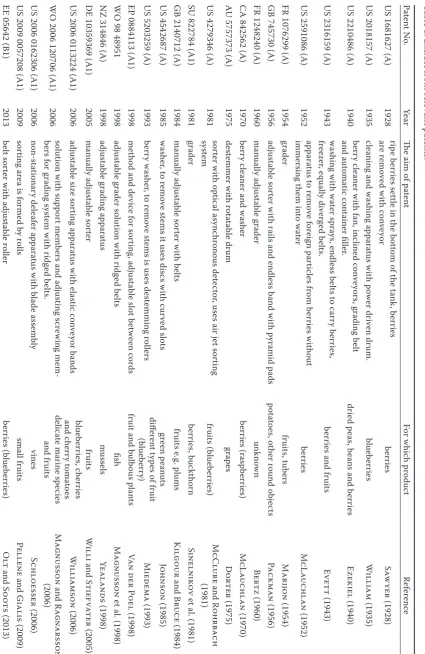
Fractioning of the harvested berries can be achieved with various methods like video grading sorting, roll sorting, net sorting, line sorting, drum sorting and belt sorting (Recce et al. 1998; Grote, Feldhusen 2007; Kondo 2009; Cubero 2014; Soots et al. 2014). Different methods are studied to find suitable solutions for blueberries. Extracts from patents from the European Patent Office (2015) that are studied and considered in this re-search, are given in Table 1. Patents given in Table 1 are ordered by the year of publication.
In a method that is not described in any litera-ture source but is used by some berry pickers an inclined sorting area is used. Inclined sorting area is formed by a moistened fabric. Harvested berries are poured into the higher part of the sorting area and berries roll along the fabric into the fruit col-lection box that is located at the lower part. Ad-ditional material like leaves or branches will stay on the fabric and they are removed periodically by hand. How this method affects berries quality is unknown at the moment.
According to Karolin and Pärli (1998), factors that influence sorting quality of potatoes are speed of the sorting unit, sorting area inclination angle and potatoes feed quantity. These factors must be also considered when developing sorting machine for blueberries.
Suitable technological solution for post-harvest processing
Companies like the Lakewood Process Machin-ery (2015) and the A&B Packing (2015) offer
ma-chines for post-harvest processing of blueberries. To use these machines, it is required to install them in a factory building. Unfortunately, this may be a problem for small or medium size farmers as it re-quires large investment while this factory building would be in use only about 1–2 months per year.
Machines that are important for post-harvest processing of blueberries cannot be installed on blueberries harvester because they will increase harvester weight and turf soil in bogs cannot bear heavy machinery (Olt, Arak 2012; Olt et al. 2013). One option is to develop non-stationary processing centre (NSPC) where all the necessary components are installed on a trailer. This trailer is transported onto the field by an all-terrain vehicle (ATV). While the NSPC is operating at the field, the ATV can be used for transporting harvested and processed blueberries into a repository where they are transported into the grocery stores and food industries. NSPC can be mounted to the trailer or it can be detachable. In this study, the NSPC was mounted on a trailer. The trailer should be similar to the Estonian trailer manufacturer Respo Haa-gised AS trailer version 750M301L150 KIOSK. The main technical parameters of this trailer are: height 1.6 m, length 3 m, width 1.5 m and load capacity 300 kg. The trailer is covered from all sides and from the top to protect devices and berries from rain and solar radiation. Still, this 4.5 m2 size area is not sufficient and an extra area should be used next to the NSPC to store harvested and processed blueberries. This area should also be covered with solar radiation reflective tent.
Inputs for NSPC are blueberries harvested with berry rake or machine harvester. The minimum productivity of the NSPC must be equal to the pro-ductivity of blueberry machine harvester because it is greater than the productivity with berry rake. According to Käis, Olt (2010) productivity of the motor-block harvester is about 300 kg/h. If there is no electricity to run the NSPC on field, electricity can be obtained from a generator with combustion engine. NSPC should include machines to carry out post-harvest processing of blueberries according to the principle scheme given in Soots et al. (2014).
Ta
ble 1. E
xtrac t f rom r ele van t p aten ts. Pa ten t No. Ye ar
The aim of p
aten t For whic h pr oduc t Ref er enc e
US 1681627 (A)
1928 rip e b er rie s s ett
le in t
he b
ot
tom of t
he t ank , b er rie s ar e r emove d w ith c on ve yor ber rie s Sa w yer (1928)
US 2018157 (A)
1935
cle
aning and w
ashing a pp ara tu s w ith p ower dr iven dr um. blue ber rie s W illia m (1935)
US 2210486 (A)
1940 ber ry c le aner w ith f an, inc line d c on ve yors , g rading b elt and a ut oma tic c on tainer filler . dr ie d p ea s, b
eans and b
er rie s Ez ek iel (1940)
US 2316159 (A)
1943 w ashing w ith w ater spra ys, endle ss b elt s t o c ar ry b er rie s, fre ezer , e qu ally diver ge d b elt s. ber rie
s and f
ruit
s
Evet
t (1943)
US 2591086 (A)
1952 app ara tu s t o r emove f or eig n p ar tic le s f rom b er rie s w ithout immersing t hem in to w ater ber rie s M cL auc hl an (1952)
FR 1076299 (A)
1954 grader fruit s, t ub ers M ari jon (1954)
GB 745730 (A)
1956 adju st able s or ter w ith rail
s and endle
ss b and w ith py ramid p ad s pot ato es, ot her r ound obj ec ts Pac km an (1956)
FR 1248240 (A)
1960 man ually adju st able g rader unk now n Ber tz (1960) C
A 842562 (A)
1970
ber
ry c
le
aner and w
asher ber rie s (ra spb er rie s) M cL auc hl an (1970) A
U 5757373 (A)
1975 de st emmer w ith r ot ata ble dr um grap es D or ter (1975)
US 4279346 (A)
1981 sor ter w ith optic al a sy nc hr onou s de tec tor , u se
s air j
et s or ting sy st em fruit s ( blue ber rie s) M cC lu re and Rohrbac h (1981)
SU 822784 (A1)
1981 grader ber rie s, buc kt hor n Sinelniko v e
t al. (1981)
GB 2140712 (A)
1984 man ually adju st able s or ter w ith b elt s fruit s e.g . plums Kil gou r and Br uc e (1984)
US 4542687 (A)
1985 w asher , t o r emove st
ems it u
se s di sc s w ith c ur ve d s lot s gre en p ean ut s Johnson (1985)
US 5203259 (A)
1993 ber ry w asher , t o r emove st ems i s u se s de st emming r ollers diff er en t ty pe
s of f
ruit (blue ber ry) Miede m a (1993)
EP 0884113 (A1)
1998
me
tho
d and de
vic e f or s or ting , adju st able s lot b etwe en c or ds
fruit and bulb
ou
s pl
an
ts
Van der Poel
(1998)
WO 98 48951
1998 adju st able g rader s olution w ith r idge d b elt s fish M ag nu sson e
t al. (1998)
NZ 314846 (A)
1998 adju st able g rading a pp ara tu s m us sels Ye al ands (1998)
DE 10359369 (A1)
2005 man ually adju st able s or ter fruit s W illi and St ief va ter (2005)
US 2006 0113224 (A1)
2006 adju st able si ze s or ting a pp ara tu s w ith e lastic c on ve yor b and s blue ber rie s, c her rie s and c her ry t oma to es W illia mson (2006)
WO 2006 120706 (A1)
2006
solution w
ith supp
or
t memb
ers and adju
sting s cre w ing mem -bers f or g rading s yst em w ith r idge d b elt s. de lic ate mar ine sp ec ie s and f ruit s M ag nu sson and Rag nar sson (2006)
US 2006 0162306 (A1)
2006 non-st ationar y de le af er a pp ara tu s w ith bl ade a ss embly vine s Sc hl oe ss er (2006)
US 2009 0057208 (A1)
2009 sor ting ar ea i s f or me
d by r
oll s small f ruit s Pellene and Gialis (2009)
EE 05642 (B1)
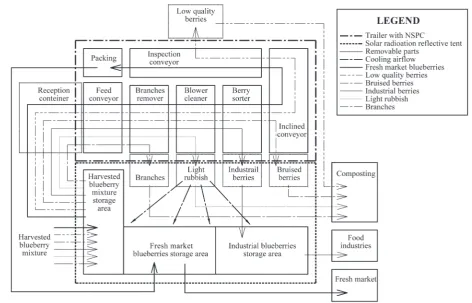
to receive harvested berry mixture from reception container and to supply following NSPC part with an even flow of berry mixture. Berry mixture layer height on feed conveyor can be controlled by slot height between reception conveyor and container. Feed speed of the berry mixture to the next NSPC step is controlled by the conveyor speed. Volume of the container should be at least double the volume of the collection box to ensure continuous berry mixture flow onto the reception conveyor.
The next NSPC part should be remover of branch-es. Branches may cause jams in different NSPC parts and so it is essential to remove them in the begin-ning of processing line. For example the Lakewood Process Machinery (2015) produces branches re-movers where rollers with grooves are used to form roller conveyor. Berries fall through slots between rollers grooves and branches and bigger leaves are transported over rollers to the rubbish container. A similar solution can be used in the NSPC.
In the next phase of the NSPC light rubbish is re-moved from the harvested berry mixture. For that, a blower cleaner is installed on the NSPC. In order to prevent damaging the blueberries, berry mixture
should be transported through the blower cleaner with wire belt conveyor to avoid blueberries falling through. It is not reasonable to let the produced air-flow from blower cleaner into the surrounding en-vironment. Out-going airflow of the blower cleaner can also be used to remove the saved field heat from blueberries. Thus, air output from blower cleaner should be directed into the side area under solar radiation reflective tent, where the harvested and processed blueberries are stored. To keep already processed blueberries clean in the storage area, the airflow from blower cleaner must be filtered, for ex-ample with mesh sieve. Cleaning of the filters should be solved in such a way that there is no need to turn off the blower cleaner, similar to the solution de-signed by the A&B Packing Equipment (2015).
[image:6.595.59.532.97.400.2]blueberry growers would lose interest to buy it. In this study, the belt sorter was used. The idea of sorting is to separate bigger blueberries from the smaller ones. Blueberries could be sorted into two or three fractions by their size. Smaller blueberries are marketed in a frozen form in food industries and bigger blueberries are marketed fresh.
To decrease labour of inspection conveyor worker, the inclined conveyor should be used in the NSPC to remove bruised berries and non-round rubbish from fresh market berries. The working principle of the inclined conveyor is that round shaped ob-jects are rolling off from conveyor to the picking table and non-round objects are transported with conveyor to the rubbish box. Conveyor and screens around the conveyor should be covered with soft material to avoid bruising of the berries.
Inspection conveyor is a part of the NSPC where remaining trash and low quality blueberries are hand-picked from the fresh market berries. After inspec-tion conveyor fresh market berries are collected in boxes and they are moved to the storing area. As the work in this part of the NSPC is performed manu-ally by a worker, the inspection conveyor must be er-gonomically built. For example, its width must be in accordance with the worker forward reach distance. If the picking table height of 100 cm above the floor is considered, the conveyor should not be wider than 37 cm (Putz-Anderson 1988; Konz, Johnson 2000). Inspection conveyor should also be provided with lighting to operate in darker conditions.
All the separate parts of the NSPC should be adjustable to ensure flexibility, to use slower line speeds at the beginning of processing in order to make fine adjustments and to ensure the NSPC max. processing quality. More specifically adjusta-ble should be the horizontality of NSPC, berry mix-ture layer height on feed conveyor; feed conveyor speed, blower cleaner wire belt conveyor speed, air flow from blower cleaner, belt conveyor speed that forms belt sorter, belt sorter gap size between belts, inclined conveyor speed, inclined conveyor slope and inspection conveyor speed. The principle schema for the NSPC is given in Fig. 1.
Three workers are needed to run the NSPC and, in cases where blueberries that are marketed fresh are packed on the field, one extra worker is needed. It must also be kept in mind that the NSPC works in outdoor environment, so all electrical and mechan-ical systems should have protection against poten-tial damage from moisture and water. To evaluate
the water loss of harvested blueberries, the weight of processed blueberries in their collection boxes should be measured. It would be advantageous to determine a fixed weight for all boxes to simplify the monitoring of weight loss.
The main reason for developing NSPC was the lack of a suitable technological solution that could process blueberries from small or medium-size blueberry farms. Also, it helps to increase the use of machine harvesters and, which increases the productivity at farms where blueberries are normally handpicked. The expected benefits of the utilisation of the pro-posed NSPC in the blueberry farms are in economical savings and processing speed. If blueberries are pro-cessed on the field, the transportation chain is shorter and costs for that are lower too. Berries that are mar-keted fresh can be transported directly from field to the grocery store or market. Rubbish that is removed from berries can be left on the field as a fertilizer, which also helps to save money on rubbish transpor-tation and utilisation. As the work with the NSPC is seasonal in Estonia, it is reasonable that the NSPC owner would rent it out to other blueberry growers to shorten the NSPC payback period.
CONCLUSION
In this research, the principle structure of the non-stationary processing centre (NSPC) for post-harvest processing of blueberries at small or medi-um-sized blueberry farms is proposed. In the de-velopment of the NSPC, various different blueberry post-harvest factors that influence berry quality have been considered, in order to find suitable technical solutions for processing blueberries. All processing operations may cause unintended harm to blueber-ries, so the proposed NSPC includes only essential processing operations in order to ensure quality of the blueberries. For further research, real tests with the NSPC are required to find out how much it af-fects blueberry quality and how large its economic gains for blueberry growers really were.
References
A&B Pakcing Equipment (2015): Available at http://abpack-ing.com
Bertz G. (1960): Dispositif de réglage de grandeurs de classe-ment applicable à des machines de classeclasse-ment. Patent No. FR 1248240 (A).
British Stainless Steel Association (2015): Available at http:// www.bssa.org.uk
Brown G.K., Schulte N.L., Timm E.J., Beaudry R.M., Peterson D.L., Hancock J.F., Takeda F. (1996): Estimates of mechani-zation effects on fresh blueberry quality. American Society of Agricultural Engineers, 12: 21–26.
Bosoi E., Verniajev O., Smirnov I., Sultan-Shah E. (1978): Теория, конструкция и расчет. Moscow, Mechanical Engineering.
Cubero S., Aleixos N., Albert F., Torregrosa A., Ortiz C., Garcıa-Navarrete O., Blasco J. (2014): Optimised computer vision system for automatic pre-grading of citrus fruit in the field using a mobile platvorm. Precision Agriculture, 15: 80–94.
Dorter H. (1975): Grape destemmer. Patent No. AU 5757373 (A). Estonia Ministry of Agriculture, Trade and Agri-Food De-partment (2015): Agricultural products (KN 1-14) trade between Estonia and China, period of January to October year 2014, review. Tallinn.
Eum H.L, Hong S.C., Chun C., Shin I.S., Lee B.Y., Kim H.K., Hong, S.J. (2013): Influence of temperature on shelf-life quality of highbush blueberries (Vaccinium corymbosum L. cvs. Bluetta, Duke). Horticulture, Environment and Biotechnology, 54: 128–133.
European Patent Office. (2015): Available at http://www.epo. org/searching/free/espacenet.html
Evett R.J. (1943): Fruit and berry washing and grading equip-ment. Patent No. US 2316159 (A).
Ezekiel J. (1940): Berry cleaner and separator. Patent No. US 2210486 (A).
Faria A., Oliveira J., Neves P., Gameiro P., Santos-Buelga,C., De Freitas V., Mateus N. (2005): Antioxidant properties of prepared blueberry (Vaccinium myrtillus) extracts. Journal of Agricultural and Food Chemistry, 53: 6896–6902. Food standards agency (2009): Materials and articles in
con-tact with food. Available at www.food.gov.uk
Forney CF. (2009): Postharvest Issues in blueberry and cran-berry and methods to improve market-life. Acta Horticul-turae (ISHS), 810: 785–798.
Grote K.-H., Feldhusen J. (2007): Dubbel Taschenbuch für den Maschinenbau. Springer.
Hansaplant (2015): Available at http://www.hansaplant.ee Ilomets M. (2011): Kogemusi Eestist. In: Paal J. (ed.):
Jääk-sood, nende kasutamine ja korrastamine. Tartu, Estonian Peat Association, 141–149.
Ilomets M., Pajula R., Sepp K., Truus L. (2010): Keskkonna-korraldus, Maapõue alamprogramm programme, Projekt No. 14 „Turba jääkväljade rekultiveerimine
turbasammal-dega“ lõpparuanne. Available at http://www.tlu.ee/files/ arts/1011/Turbabe45a5a36afe49d68d387e9d21058a6f.pdf Jackson E.D., Sanford K.A., Lawrence R.A., McRae K.B., Stark
R. (1999): Lowbush blueberry quality changes in response to prepacking delays and holding temperatures. Posthar-vest Biology and Technology, 15: 117–126.
Johnson R. (1985): Green peanut destemmer and washer. Patent No. US 4542687 (A).
Karolin M., Pärli M. (1998): Kartulipuhasti-sorteeri KSR-5M katsetamisest. In: Heinloo M. Lember S. Seesmaa S. (eds). Agricultural Machinery, Building and Energy Engineering. Tartu, Estonian Agricultural University: 46–54.
Kays S.J. (1997): Postharvest Physiology of Perishable Plant Products. New York, Van Nostrand Reinhold Press. Kilgour J., Bruce A.R. (1984): Grader. Patent No. GB 2140712 (A). Kondo N. (2009): Robotization in fruit grading system. Sensing and Instrumentation for FoodQuality and Safety,3: 81–87. Konz S.A., Johnson S. (2000): Work design: industrial
ergo-nomics. Arizona, Holcomb Hathaway.
Käis L., Ol J. (2010): Low-bush blueberry machine cultiva-tion technology in plantacultiva-tions established on milled peat fields. In: Kosutic S. (ed.): Actual Tasks on Agricultural Engineering, 38: 271–279.
Lakewood Process Machinery (2015): Available at http:// lakewoodpm.com
Magnusson R., Ragnarsson E.T. (2006): Gap width adjust-ment mechanism for the belts for grading system. Patent No. WO 2006 120706 (A1).
Magnusson R.M., Steinson S., Ragnarsson E.T. (1998): Ap-paratus for grading objects such as fish. Patent No. WO 98 48951 (A1).
Marijon G.-R. (1954): Grader. Patent No. FR 1076299 (A). McClure W.F., Rohrbach P.R. (1981): Asynchronous blueberry
sorter. Patent No. US 4279346 (A).
McLauchlan A.B. (1952): Berry cleaner. Patent No. US 2591086 (A).
McLauchlan R.D. (1970): Berry cleaner and washer. Patent No. CA 842562 (A).
Miedema A.D. (1993): Blueberry destemmer. Patent No. US 5203259 (A).
Mohsenin N.N. (1986): Physical properties of plant and animal materials, Vol 1: Structure, physical characteristics and me-chanical properties. 2nd Ed. New York, Gordon and Breach.
NeSmith D.S., Prussia S., Tetteh M., Krewer G. (2002): Firmness losses of rabbiteye blueberries (Vaccinium ashei Reade) durning harvesting and handling. Acta Horticul-turae (ISHS),574: 13–19.
Noormets M. (2006): Ahtalehise mustika (Vaccinium angus-tifolium Ait.) ja Kanada mustika (V. Myrttilloides Michx) õie bioloogia mõningaid aspekte; ahtalehise mustika ja hariliku jõhvika (Oxycoccus palustris Pers.) kultiveerimine ammendatud freesturbaväljadel [PhD. Thesis] Tartu, Esto-nian University of Life Sciences.
Nunez-Barrios A., NeSmith D.S., Chinnan M., Prussia S.E. (2005): Dynamics of rabbiteye blueberry fruit quality in response to harvest method and postharvest handling temperature. Small Fruits Review,4: 73–81.
Olt J., Arak M. (2012): Motoplokk-tüüpi mustikakombaini korjehaspli konstruktsioon ja arendus. Journal of Agricul-tural Science, 23: 21–26.
Olt J., Soots K. (2013): Berry sorter. Patent No. EE 05642 (B1). Olt J., Arak M., Jasinskas A. (2013): Development of mechani-cal technology for low-bush blueberry cultivating in the plantation established on milled peat fields. Agricultural Engineering, Research Papers,45: 120–131.
Paal J., Lode E., Pikka J., Raudsep R., Paal T., Ilomets M., Orru M., Leiner E., Niitlaan E. (2007): Jääksoode korrastamise käsiraamat. Tartu: Environmental Investment Centre. Packman P.J. (1956): Improvements in or relating to sorting
or grading apparatus. Patent No. GB 745730 (A).
Paniagua A.C., East A.R., Hindmarsh J.P., Heyes J.A. (2013): Moisture loss is the major cause of firmness change during postharvest storage of blueberries. Postharvest Biology and Technology,79: 13–19.
Pellene R., Gialis J. M. (2009): Sorting table with sorter rolls for elimination of foreign matter remaining mixed in a harvest of small fruit. Patent No. US 2009 0057208 (A1). Purre A-H. (2013): Freesturbaväljadest ja sammaldest.
Avail-able at www.v2rskeaju.eu/2013/03/
Putz-Anderson V. (1988):Cumulative Trauma Disorders. London, Taylor and Francis.
Ramst R., Orru M. (2009): Eesti mahajäetud turbatootmis-alade taastaimestumine. Estonian Combustible Natural Resources and Wastes, 1–2: 6–7.
Recce M., Plebe A., Taylor J. (1998): Video grading of oranges in realtime. Artificial Intelligence Review,12: 117–136. Sawyer J.W. (1928): Process and apparatus for cleaning
ber-ries. Patent No. US 1681627 (A).
Schloesser C.M. (2006): Deleafer apparatus and method. Patent No. US 2006 0162306 (A1).
Sinelli N., Spinardi A., Di Egidio V., Mignani I., Casiraghi E. (2008): Evaluation of quality and nutraceutical content of blueberries (Vaccinium corymbosum L.) by near and mid-infrared spectroscopy. Postharvest Biology and Technol-ogy, 50: 31–36.
Sinelnikov A.P., Dashtoyan A.A., Varlamov G.P., Plotnikov S., Majkovskij I.A., Filipovskikh G.A., Kobyakov A. A. (1981): Berry cleaner. Patent No. SU 822784 (A1).
Soots K., Maksarov V., Olt J. (2014): Continuously adjustable berry sorter. Agronomy Research, 12: 161–170.
Staras M., Karp K., Paal T., Värnik R., Vool E. (2005): Kul-tuurmustikas ja selle kasvatamine Eestis Tartu, Estonian Agricultural University.
Tetteh M.K., Prussia S.E., NeSmith D.S., Verma B.P., Ag-garwal D. (2004): Modeling blueberry firmness and mass loss during cooling delays and storage. American Society of Agricultural Engineers, 47: 1121–1127.
Vahejõe K., Albert T., Noormets M., Karp K., Paal T., Starast M., Värnik R. (2010): Berry Cultivation in cutover peatlands in Estonia: Agricultural and economical aspects. Baltic Forestry,16: 264–272.
Van der Poel J.G.G. (1998): Method and device for sort-ing objects, in particular fruit and bulbous plants, with regard to their cross-sectional dimension. Patent No. EP 0884113 (A1).
Willi M., Stiefvater W. (2005): Vorrichtung zum Sortieren von Obst nach der Größe. Patent No. DE 10359369 (A1). William E.U. (1935): Blueberry cleaner. Patent No. US
2018157 (A).
Williamson R.L. (2006): Adjustable size sorting apparatus for small produce. Patent No. US 2006 0113224 (A1). Willis R., McGlasson B., Graham D., Joyce D. (1998):
Post-harvest. An introduction to the physiology and handling of fruit, vegetables and ornamentals(4th Ed.). Adelaide,
Hyde Park Press.
Yealands S.W. (1998): Apparatus for grading mussels accord-ing to size, includes a support frame and spacaccord-ing adjust-ment means. Patent No. NZ 314846 (A).
Yu P., Li C., Takeda F., Krewer G., Rains G., Hamrita T. (2014): Measurement of mechanical impacts by rotary, slapper, and sway blueberry mechanical harvesters. Computers and Electronics in Agriculture, 101: 84–92.