Original Article
Genetic polymorphisms of
ADIPOQ
and osteonecrosis
of the femoral head risk in Chinese population
Zi-Jin Liu, Hua-Wu Zhang
Department of Orthopedics, Shandong Provincial Western Hospital, Jinan, Shandong, China
Received January 4, 2016; Accepted March 18, 2016; Epub August 1, 2016; Published August 15, 2016
Abstract: Aims: The objective of this study was to investigate the effect of adiponectin gene (ADIPOQ) polymor-phisms on osteonecrosis of the femeral head (ONFH) susceptibility. Methods: Polymerase chain reaction (PCR) was used to detect the genotypes of ADIPOQ polymorphisms in 104 patients with ONFH and 131 controls matched by
age and gender with the former. χ2 test were conducted to compare the frequency difference of genotypes and al-leles in ADIPOQ polymorphisms between the above two groups and detect the Hardy-Weinberg equilibrium (HWE).
Odds ratio (OR) with 95% confidence interval (95% CI) was calculated to represent the association intensity of gene
polymorphisms with disease. The linkage disequilibrium (LD) and haplotype of these two polymorphisms were ana-lyzed by Haploview. Results: In ADIPOQ polymorphisms, neither genotype nor allele of rs3774261 was found the
significant frequency difference between the case and control groups (P>0.05). However, TT genotype of rs1063537 was correlated to the increased risk of ONFH development (OR=2.66, 95% CI=1.04-6.78), T allele had also a 1.57 times risk to suffer from ONFH, compared with C allele (OR=1.57, 95% CI=1.04-2.36). There was strong LD between these two polymorphisms. Conclusion: ADIPOQ rs1063537 polymorphism is associated with the onset of ONFH, but not rs3774261 in Han population based on our study. A-T haplotype might be a risk factor in ONFH.
Keywords: ADIPOQ,osteonecrosis of the femeral head risk, polymorphism, haplotype
Introduction
Osteonecrosis of the femoral head (ONFH) is a devastating bone disease in femoral head that always induces arthropathy of the hip joint [1]. This disease is characterized by the interrup-tion of local blood supply and the death of osteocytes and bone marrow cells, usually occurring in the age of 20-50 years old [2, 3]. In clinical, ONFH is divided into traumatic- and non-traumatic ONFH and the latter has been studied widely in pathogenesis, prevention and treatment [4-6]. Non-traumatic ONFH is a com-plex multifactorial disease and the known risk factors involve corticosteroid misuse, alcohol abuse, thrombotic interference and idiopathic origins [7, 8]. Among of these causes, genetic factors play a vital role in ONFH development, especially the single nucleotide polymorphism (SNP) of gene [9-11].
Adiponectin is firstly found by Scherer et al. in
1995 [12] and then is proved to be secreted by adipose tissues. As a kind of hormone, it is
some 3q27 [13]. It can regulate a number of metabolic processes, such as glucose regula-tion and fatty acid breakdown. In previous stud-ies, ADIPOQ has been reported to participate in the generation of various diseases, type 2 dia-betes mellitus (T2DM), cardiovascular disease (CVD), insulin resistance and obesity are the common diseases in clinical [14-16]. Recently, adiponectin is also found to be associated with the function of endothelial cells and monocyte-macrophages and may be play an important role in restraining the occurrence of atheroscle-rosis [17]. In bone metabolism, the formation of osteoblastc and osteoclasts is considered to be accelerated by adiponectin which can promote bone matrix mineralization, too. In addition, adi-ponectin is also involved in lipid metabolism and dyslipidemia is a leading cause of ONFH development. What’s more, the studies show that the genetic variant of ADIPOQ influences
between ADIPOQ polymorphisms and ONFH was explored and two SNPs were selected in ADIPOQ gene, that is, rs3774261, rs1063537. In addition, the linkage disequilibrium was also paid attention between these two SNPs.
Materials and methods
Subjects
104 patients with ONFH and 131 healthy peo-ple were as the case and control groups respec-tively to conduct this case-control study. The cases were all non-traumatic ONFH diagnosed by pathobiology in orthopedics department of Shandong Provincial Western Hospital from 3, 2012 to 7, 2013, consisted of 63 males and 41 females with the mean age of 46.76±10.49. All patients didn’t accept the surgery before col-lecting the blood sample. The controls were also from the hospital similar to the cases at the same time, including 72 males and 59
females. They were confirmed to be healthy by
the physical examination center of the hospital and the age range was from 34 to 72 years old. All subjects were Chinese Han population from Shandong province and had no relationship by
chain reaction (PCR) and sequencing. The poly-morphisms of rs3774261, rs1063537 were selected in ADIPOQ and the corresponding PCR primers were designed using Primer Premier 5.0 software. The primer sequences and their detailed information were listed in Table 1.
20.0 μl PCR system was used, including 1.0 μl DNA template, each 0.5 μl of forward and reverse primers, 10.0 μl PCR Mix and 8.0 μl
sterile ddH2O. The PCR program was as follows: initial denaturation at 95°C for 2 min, 32 cycles with denaturation at 95°C for 30 s, annealing at 58°C for 45 s and extension at 72°C for 45
s, final extension at 72°C for 7 min. And then,
PCR products were detected the quality and concentration.
The eligible PCR products were sequenced to determine the genotype of every individual in Shanghai Sangon Biotech Co., Ltd.
Statistical analysis
[image:2.612.90.369.84.150.2]The relative data were processed in PASW Statistics 18.0 software. Hardy-Weinberg dis-equilibrium (HWE) in controls was evaluated based on ADIPOQ polymorphisms. Age distribu-tion between the cases and controls were
Table 1. The primer sequences of ADIPOQ polymorphisms
SNP Primer sequences Location Length
rs3774261 Fro. 5’-GCTCAGTCCTGCCTTTGG-3’ Intron 2 239 bp Rev. 5’-CCTCCTCTATTCTGCCTAC-3’
rs1063537 Fro. 5’-GTTGAGGTAGTTGATGGTGGTA-3’ 3’UTR 270 bp Rev. 5’-CCTGGCAACAGAGGGAAA-3’
Note: SNP: Single nucleotide polymorphism; 3’UTR: 3’untranslated region.
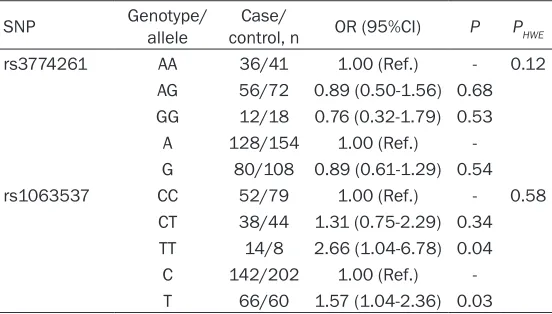
Table 2. The relationship between ADIPOQ gene polymorphisms and ONFH susceptibility
SNP Genotype/allele control, nCase/ OR (95%CI) P PHWE
rs3774261 AA 36/41 1.00 (Ref.) - 0.12
AG 56/72 0.89 (0.50-1.56) 0.68 GG 12/18 0.76 (0.32-1.79) 0.53 A 128/154 1.00 (Ref.) -G 80/108 0.89 (0.61-1.29) 0.54
rs1063537 CC 52/79 1.00 (Ref.) - 0.58
CT 38/44 1.31 (0.75-2.29) 0.34 TT 14/8 2.66 (1.04-6.78) 0.04 C 142/202 1.00 (Ref.) -T 66/60 1.57 (1.04-2.36) 0.03
Note: HWE: Hardy-Weinberg equilibrium.
blood each other. The study was accepted by the Research Ethics Committee of Shandong Provincial Western Hospital and participants were informed the study process and the detailed study content. Written consents must be obtained from all sub-jects before starting the whole study.
DNA extraction
2 ml peripheral venous blood from every subject was collect-ed and put into corresponding tubes for blood specimen col-lection, and stored at -80°C. Genomic DNA was extracted from peripheral blood using an AxyPrep Blood Genomic DNA Miniprep Kit (Axygen Bioscien- ces, Union, CA, USA).
Genotyping
[image:2.612.91.367.208.365.2]assessed by t-test and the χ2 test was used to
measure the differences of genotype, allele, haplotype and the other indexes between the above two groups. The odds ratio (OR) and 95%
confidence interval (CI) were calculated to eval -uate the association strength between gene polymorphisms and disease. The statistical
sig-nificant difference was set at P<0.05. The link-age disequilibrium (LD) and haplotype were analyzed referring to Haploview software.
Results
Characteristics of patients and controls
A total of 235 subjects were enrolled and con-tained 104 ONFH patients and 131 healthy persons. The average age in the control group
was 46.76±10.49, which showed no significant
difference with the average age of 47.52±11.27 in the case group (P=0.64). In the case group, nearly 61% subjects were males and the per-centage of males in the control group was about 55%. So there was no obvious difference between two groups in gender (P=0.39). HWE test and the association analysis of ADIPOQ polymorphisms with ONFH
The genotype distributions of ADIPOQ polymor-phisms in the control group were detected to conform to HWE (P>0.05) in Table 2, the results showed that our study population was consis-tent with the standard of the selection and pos-sessed the representativeness of group. In views of the association analysis between ADIPOQ polymorphisms with ONFH susceptibil-ity, the results were listed in Table 2. The
geno-type distribution of rs3774261 had no signifi -cant difference between two groups and this polymorphism might be not directly associated with ONFH risk (P=0.68, 0.53 respectively). The effect of rs3774261 allele on ONFH was not
significant (P=0.54). Referring to rs1063537, differing from rs3774261, TT genotype
fre-Association between haplotypes and ONFH susceptibility
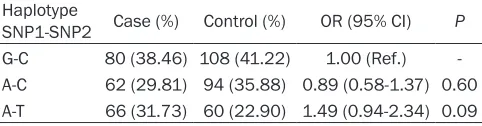
We found that there was the strong LD bet- ween rs3774261 and rs1063537 polymor-phisms from Haploview software (D’=1.0, r2=0.256). Three haplotypes were detected in
our population, namely G-C, A-C, A-T and their frequencies in the case and control groups were 38.46%, 29.81%, 31.73% and 41.22%, 35.88%, 22.90%, respectively. The detailed information of haplotypes was showed in Table 3. In these haplotypes, their frequency differ-ences between two study groups didn’t reached
the significant level of P<0.05, but A-T haplo-type might be a risk factor for ONFH (OR=1.49, 95% CI=0.94-2.34).
Discussion
Recently, OPG-RANKL-RANK system is found to play a fatal role in bone destruction [19, 20].
Receptor activator of NF-κB ligand (RANKL)
mainly promotes the differentiation, matura-tion, activation of osteoclasts and meanwhile inhibits their apoptosis through combining with
receptor activator of NF-κB (RANK) in the sur -face of preosteoclasts [21]. Osteoprotegerin (OPG) is a member of tumor necrosis factor superfamily and it can effectively prevent bone loss mediated by RANKL in the case of integrat-ing RANKL. Bone resorption is also modulated by the balance of OPG and RANKL. Studies show that a number of hormones, cytokines affect bone metabolism directly or indirectly through regulating the OPG-RANKL-RANK path-way, which leads to bone metabolism diseases, such as ONFH.
[image:3.612.92.333.99.162.2]Adiponectin is a kind of hormone secreted by adipocytes, consisted of 244 amino acids. In the primary sequence of adiponectin, four func-tional domains are revealed, namely a signal peptide containing 18 amino acids, a non-heli-cal domain of N-terminal, a collagen repetitive
Table 3. The detected results of linkage disequilibrium and haplotype between two polymorphisms of ADIPOQ Haplotype
SNP1-SNP2 Case (%) Control (%) OR (95% CI) P G-C 80 (38.46) 108 (41.22) 1.00 (Ref.) -A-C 62 (29.81) 94 (35.88) 0.89 (0.58-1.37) 0.60 A-T 66 (31.73) 60 (22.90) 1.49 (0.94-2.34) 0.09
Note: SNP1: rs3774261; SNP2: rs1063537.
sequence containing 22 amino acids and a globular domain in C-terminal. It is persisted in tripolymer, hexamer and multimer status within plasma [22]. Adiponectin regulates bone metabolism by the way of affecting the expres-sion of OPG, RANKL, RANK mainly. On the one hand, it can promote the proliferation, differen-tiation of osteoblasts by the adiponectin recep-tor 1 (AdipoR1)/JNK, AdipoR1/p38 (mitogen-activated protein kinase, MAPK) pathways [23]. On the other hand, recombinant adiponectin accelerates the expression of RANKL and inhib-it OPG expression through AdipoR1/p38 MAPK pathway in osteoblasts [24]. Therefore, adipo-nectin plays an important role in the formation of osteoclasts and osteoblasts and it realizes the regulation for osteoclasts on the basis of osteoblasts. In addition, adiponectin regu-lates the blood glucose, blood fat and insulin-resistance by the way of PPAR (peroxisome pro-liferator activated receptor) and AMPK (AMP-activated protein kinase) signal transduction pathway, so it also plays a role in lipid metabolism.
ONFH occurrence is closely associated with lipid metabolism disorders. In the study of Cui et al., the genetic polymorphisms of apolipopro-tein A5 (ApoA5) which may result in lipid metab-olism disorders are associated with the occur-rence of ONFH in Chinese population [25]. In order to determine the association of hypercho-lesterolemia with idiopathic ONFH risk, Moskal et al. detect cholesterol levels in serum of patients with ONFH, which suggests that
hyper-cholesterolemia may have a systemic influence
on the pathophysiology of ONFH [26]. In the meanwhile, the role of OPG-RANKL-RANK path-way in ONFH development has been proved in
previous study. Jiang et al. have verified this
conclusion in rats, they found that Achyranthes bidentata extract (ABE) can inhibit steroid-induced ONFH and remiss the bone deteriora-tion induced by steroid through down-regulat-ing OPG and up-regulatdown-regulat-ing RANK and RANKL in OPG-RANKL-RANK system [27]. So adiponectin which can regulate lipid metabolism and OPG-RANKL-RANK pathway may be closely correlat-ed to the generation and development of ONFH. In present study, the genetic polymorphisms of ADIPOQ were analyzed the association with ONFH susceptibility. Two common SNPs were selected, namely rs3774261, rs1063537 and
the former is located in intron 2, the latter is in 3’-UTR. In the genotypes and alleles analyses of rs3774261, no obvious difference was found between the case and control groups, which indicated that this polymorphism was not directly associated with the onset of ONFH in our study population. Differently, the genotype
distribution of rs1063537 had a significant dif -ference between the two groups, that is, TT genotype carriers has a larger risk to suffer from ONFH than people carrying CC genotype. T allele of rs1063537 was also a risk factor in this study population. The strong LD was found between these two polymorphisms of ADPIOQ and three haplotypes were analyzed the effect on ONFH, but all haplotype distribution differ-ences between the case and control groups
didn’t reached a statistical significance and
maybe A-T haplotype is a risk factor in the development of ONFH based on a larger study population.
All in all, ADIPOQ polymorphisms affect the level of adiponectin in humans and them result in a series of biological processes disorders, which causes various diseases. In our study, ADIPOQ rs1063537 is associated with the onset of ONFH, but not rs3774261 in Chinese Han population based on our study. But the
results need to be verified due to the small
sample size, ignoring the environmental factors and region difference in gene polymorphism. In the future, studies with well design, large samples are conducted to deeply reveal the effect of ADIPOQ polymorphisms on ONFH pathobiology.
Disclosure of conflict of interest
None.
Address correspondence to: Dr. Zi-Jin Liu, Depart- ment of Orthopedics, Shandong Provincial Western Hospital, Duan Xing West Road, Huai Yin District, Jinan 250000, Shandong, China. E-mail: [email protected]
References
[1] Mont MA, Jones LC and Hungerford DS. Nontraumatic osteonecrosis of the femoral head: ten years later. J Bone Joint Surg Am 2006; 88: 1117-1132.
[3] Koo KH, Lee JS, Lee YJ, Kim KJ, Yoo JJ and Kim HJ. Endothelial nitric oxide synthase gene poly-morphisms in patients with nontraumatic fem-oral head osteonecrosis. J Orthop Res 2006; 24: 1722-1728.
[4] Yamamoto T and Iwamoto Y. [Corticosteroids treatments and osteonecrosis of the femoral head]. Fukuoka Igaku Zasshi 2015; 106: 47-53.
[5] Hong YC, Luo RB, Lin T, Zhong HM and Shi JB.
Efficacy of alendronate for preventing collapse
of femoral head in adult patients with nontrau-matic osteonecrosis. Biomed Res Int 2014; 2014: 716538.
[6] Zheng L, Wang W, Ni J, Li Z and Xiao T. The as-sociation of eNOS gene polymorphism with avascular necrosis of femoral head. PLoS One 2014; 9: e87583.
[7] Felten R, Messer L, Moreau P, Goussot R and Mahe A. Osteonecrosis of the femoral head linked to topical steroids for skin bleaching: a case report. Ann Intern Med 2014; 161: 763-764.
[8] Wang C, Peng J and Lu S. Summary of the vari-ous treatments for osteonecrosis of the femo-ral head by mechanism: A review. Exp Ther Med 2014; 8: 700-706.
[9] Liu Y, Zhang Z, Liu S, Su X and Zhou S. Association between VEGF -634G/C polymor-phism and osteonecrosis of the femoral head susceptibility: a meta analysis. Int J Clin Exp Med 2015; 8: 10979-10985.
[10] Zhou Z, Hua Y, Liu J, Zuo D, Wang H, Chen Q, Zheng L and Cai Z. Association of ABCB1/ MDR1 polymorphisms in patients with gluco-corticoid-induced osteonecrosis of the femoral head: Evidence for a meta-analysis. Gene 2015; 569: 34-40.
[11] Wang Z, Zhang Y, Kong X, Li S, Hu Y, Wang R, Li Y, Lu C, Lin N and Chen W. Association of a polymorphism in PON-1 gene with steroid-in-duced osteonecrosis of femoral head in Chinese Han population. Diagn Pathol 2013; 8: 186.
[12] Scherer PE, Williams S, Fogliano M, Baldini G and Lodish HF. A novel serum protein similar to C1q, produced exclusively in adipocytes. J Biol Chem 1995; 270: 26746-26749.
[13] Li ZP, Zhang M, Gao J, Zhou GY, Li SQ and An ZM. Relation between ADIPOQ Gene Polymorphisms and Type 2 Diabetes. Genes (Basel) 2015; 6: 512-519.
[14] Wu ZJ, Cheng YJ, Gu WJ and Aung LH. Adiponectin is associated with increased mor-tality in patients with already established car-diovascular disease: a systematic review and meta-analysis. Metabolism 2014; 63: 1157-1166.
[15] Narayana Swamy A, Valasala H and Kamma S. In silico Evaluation of Nonsynonymous Single Nucleotide Polymorphisms in the ADIPOQ Gene Associated with Diabetes, Obesity, and
Inflammation. Avicenna J Med Biotechnol
2015; 7: 121-127.
[16] Hu X, Feng F, Li X, Yuan P, Luan R, Yan J, Liu W and Yang Y. Gene polymorphisms related to in-sulin resistance and gene-environment inter-action in colorectal cancer risk. Ann Hum Biol 2015; 1-9.
[17] Schernthaner GH and Stangl H. Reduced adi-ponectin receptor signalling accelerates ath-erosclerosis and may worsen the outcome in type 2 diabetes mellitus - another one of those missing links? Atherosclerosis 2013; 229: 30-31.
[18] Tureck LV, Leite N, Souza RL, da Silva Timossi L, Osiecki AC, Osiecki R and Alle LF. ADIPOQ single nucleotide polymorphism: Association with adiponectin and lipoproteins levels re-stricted to men. Meta Gene 2015; 5: 98-104. [19] Geusens P. The role of RANK
ligand/osteopro-tegerin in rheumatoid arthritis. Ther Adv Mus- culoskelet Dis 2012; 4: 225-233.
[20] Ho TY, Santora K, Chen JC, Frankshun AL and Bagnell CA. Effects of relaxin and estrogens on bone remodeling markers, receptor activator of NF-kB ligand (RANKL) and osteoprotegerin (OPG), in rat adjuvant-induced arthritis. Bone 2011; 48: 1346-1353.
[21] Yasuda H. RANKL, a necessary chance for clin-ical application to osteoporosis and cancer-re-lated bone diseases. World J Orthop 2013; 4: 207-217.
[22] Pajvani UB, Hawkins M, Combs TP, Rajala MW, Doebber T, Berger JP, Wagner JA, Wu M, Knopps A, Xiang AH, Utzschneider KM, Kahn SE, Olefsky JM, Buchanan TA and Scherer PE. Complex distribution, not absolute amount of adiponectin, correlates with thiazolidinedione-mediated improvement in insulin sensitivity. J Biol Chem 2004; 279: 12152-12162.
[23] Luo XH, Guo LJ, Yuan LQ, Xie H, Zhou HD, Wu XP and Liao EY. Adiponectin stimulates human osteoblasts proliferation and differentiation via the MAPK signaling pathway. Exp Cell Res 2005; 309: 99-109.
[24] Luo XH, Guo LJ, Xie H, Yuan LQ, Wu XP, Zhou HD and Liao EY. Adiponectin stimulates RANKL and inhibits OPG expression in human osteo-blasts through the MAPK signaling pathway. J Bone Miner Res 2006; 21: 1648-1656. [25] Cui Y, Kaisaierjiang A, Cao P, Wu ZY and Lv Q.
[26] Moskal JT, Topping RE and Franklin LL. Hyper- cholesterolemia: an association with osteone-crosis of the femoral head. Am J Orthop (Belle Mead NJ) 1997; 26: 609-612.
[27] Jiang Y, Zhang Y, Chen W, Liu C, Li X, Sun D, Liu Z, Xu Y, Mao X, Guo Q and Lin N. Achyranthes