Original Article
Association of SELP genetic polymorphisms
and additional gene-smoking interaction on
cardiovascular disease in Chinese Han population
Lu Kou, Ning Yang, Gang Chen, Yang Li, Jingyu Yang, Bo Dong, Qin Qin
Department of Cardiology, Tianjin Chest Hospital, Tianjin, China
Received May 11, 2016; Accepted July 22, 2016; Epub September 1, 2016; Published September 15, 2016 Abstract: Aims: To investigate the impact of P-selectin (SELP) genetic polymorphisms and its interaction with smok-ing on cardiovascular disease (CVD) risk based on Chinese population. Methods: A total of 1082 subjects (519 males, 563 females), with a mean age of 53.9±13.1 years old, were selected, including 540 CVD patients and 542 normal control participants. Logistic regression model was used to examine the association between four SNP and CVD risk. Odds ratio (OR) and 95% confident interval (95% CI) were calculated. Generalized multifactor dimensional -ity reduction (GMDR) was employed to analyze the gene-smoking interaction. Results: Logistic regression analysis showed that CVD risk was significantly lower in carriers of A allele of the rs1800805 polymorphism than those with GG genotype (GA+AA versus GG), adjusted OR (95% CI)=1.69 (1.31-2.16). In addition, we also found CVD risk was also higher in carriers of AC genotype of the rs6136 polymorphism than those with AA genotype (AC+AA versus CC), adjusted OR (95% CI)=1.78 (1.28-2.26). GMDR analysis suggested a significant gene-environment interaction be -tween rs1800805 and smoking. Overall, the two-locus models had a cross-validation consistency of 10 of 10, and had the testing accuracy of 62.17%, and smokers with GA or AA of rs1800805 genotype have the highest CVD risk, compared to never smokers with GG genotype, OR (95% CI) was 2.42 (1.83-3.16). Conclusions: Our results support an important association between rs1800805 and rs6136 minor allele of SELP and increased risk of CVD, and ad-ditional interaction between rs1800805 and smoking.
Keywords: Cardiovascular disease, SELP, polymorphism, interaction, smoking
Introduction
P-selectin (SELP) gene is a member of the selectin family of cell adhesion molecules which are involved in the transient attachment of leukocytes to endothelial cells, platelets and each other [1, 2]. The human SELP gene locat-ed on chromosome 1q22eq25 and was orga-nized in 17 exons that span about 40 kb [3]. To date, polymorphic variants of SELP have been intensively reported to be involved in the patho-genesis of atherosclerotic and inflammatory diseases, including cardiovascular disease and MI [4-6]. Moreover, some studies have demon-strated that P-selectin may play a novel role in progression of both early and advanced stages of the atherosclerotic lesion development, and up-regulated expression of P-selectin on endo-thelial cells may promote the formation of ath-erosclerotic plaques, and increase the risk of
focused on the gene-environment interaction between SELP gene and smoking on CVD were conducted. Given the interesting on SELP gene-CVD association and SELP gene-smoking inter-action, we conducted this case-control study to investigate the impact of SELP genetic polymor-phisms and its interaction with smoking on CVD risk based on Chinese population.
Materials and methods
Subjects
Participants were consecutively recruited be- tween July 2012 and December 2014 from Tianjin Chest Hospital. All cases were confirmed by clinical diagnosis. CVD cases were diag-nosed according to following events: interven-tional therapy of coronary artery (cardiac cath-eterization, percutaneous coronary interven-tion, or coronary artery bypass grafting), stable angina pectoris, unstable angina pectoris, the first occurrence of acute myocardial infarction, congestive heart failure caused by myocardial ischemia after baseline investigation, ischemic stroke, hemorrhagic stroke, and peripheral vas-cular disease, or cardiovasvas-cular death. A total of 1082 subjects (519 males, 563 females), with a mean age of 53.9±13.1 years old, were selected, including 540 CVD patients and 542 normal control participants. Healthy controls were randomly selected from a population screening program for risk factors of CVD in the same regions and matched to cases on the basis of age (±4 years). Participants with diabe-tes, hypertension, hyperlipidemia, missing data and participants with BMI<18.5 kg/m2 were not included in the controls. Informed consent was obtained from all participants.
Body measurements
Body weight, height and waist circumference (WC) were measured, and body mass index
(BMI) was calculated as weight in kilograms divided by the square of the height in meters. WC was measured two times at 1 cm above the umbilicus at minimal respiration by trained observers; the mean of the two WC measure-ments was utilized in the analysis. Information on demographic, lifestyle risk factors for all par-ticipants was obtained using a standard ques-tionnaire administered by trained staffs, includ-ing smokinclud-ing and drinkinclud-ing status. Cigarette smokers were those who self-reported smoking cigarettes at least once a day for 1 year or more. Alcohol consumption was expressed as the sum of milliliters of alcohol per week from wine, beer, and spirits. Blood samples were col-lected in the morning after at least 8 hours of fasting. The concentrations of TC, FPG, HDL cholesterol and triglycerides were assessed enzymatically using an automatic biochemistry analyzer (Hitachi Inc., Tokyo, Japan) and com-mercial reagents.
Genomic DNA extraction and genotyping
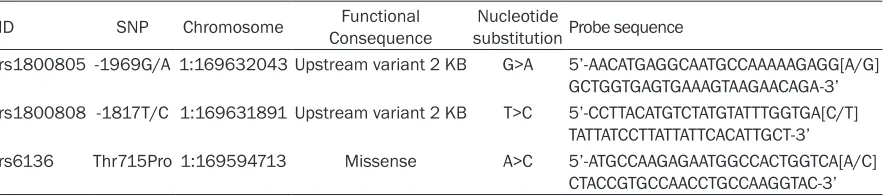
[image:2.612.87.531.84.182.2]Blood samples were collected from each par-ticipant. We selected SNPs within the SELP gene according to the following methods, including: 1) which have been reported associ-ations with risk factors of CVD; 2) minor allele frequency (MAF) greater than 5%. At last, three SNPs of SELP gene were selected for genotyp-ing in the study: rs1800805, rs1800808 and rs6136. Genomic DNA from participants was extracted from EDTA-treated whole blood, us- ing the DNA Blood Mini Kit (Qiagen, Hilden, Germany) according to the manufacturer’s instructions. All SNPs were detected by Taqman fluorescence probe. ABI Prism7000 software and allelic discrimination procedure was used for genotyping of fore-mentioned three SNPs. Probe sequences used for detection on all SNPs were shown in Table 1. A 25 μl reaction mixture including 1.50 ul SNP Genotyping Assays (20×), 12.25 μl Genotyping Master Mix Table 1. Description and Probe sequence for 3 SNPs used for Taqman fluorescence probe analysis
ID SNP Chromosome ConsequenceFunctional substitution Probe sequenceNucleotide
rs1800805 -1969G/A 1:169632043 Upstream variant 2 KB G>A 5’-AACATGAGGCAATGCCAAAAAGAGG[A/G] GCTGGTGAGTGAAAGTAAGAACAGA-3’ rs1800808 -1817T/C 1:169631891 Upstream variant 2 KB T>C 5’-CCTTACATGTCTATGTATTTGGTGA[C/T]
TATTATCCTTATTATTCACATTGCT-3’ rs6136 Thr715Pro 1:169594713 Missense A>C 5’-ATGCCAAGAGAATGGCCACTGGTCA[A/C]
(2×), 20 ng DNA, and the conditions were as fol-lows: initial denaturation for 12 min and 92°C, denaturation for 20 s and 95°C, annealing and extension for 110 s and 60°C, 70 cycles. Statistical analysis
The mean and SD were calculated for normally distributed continuous variables, and were compared using Student’s t test. And percent-ages were calculated for categorical variable, and were compared using χ2 test. Hardy-Weinberg equilibrium (HWE) was performed by using SNPStats (available online at http://bio-info.iconcologia.net/SNPstats). Logistic regres-sion was performed to investigate association between three SNP within SELP gene and CVD using gender, age, smoking and alcohol status, FPG, TC, TG and HDL as covariates in the model. Logistic regression was also performed to investigate gene-environment interaction be- tween rs1800805 and smoking, and OR (95% CI) were calculated. Generalized multifactor dimensionality reduction (GMDR) [13] was used to analyze the impact of SELP gene-smoking interaction on CVD risk, cross-validation con-sistency, the testing balanced accuracy, and the sign test, to assess each selected interac-tion were calculated. The cross-validainterac-tion con-sistency score is a measure of the degree of consistency with which the selected interaction is identified as the best model among all pos-sibilities considered. The testing balanced ac- curacy is a measure of the degree to which the interaction accurately predicts case-control
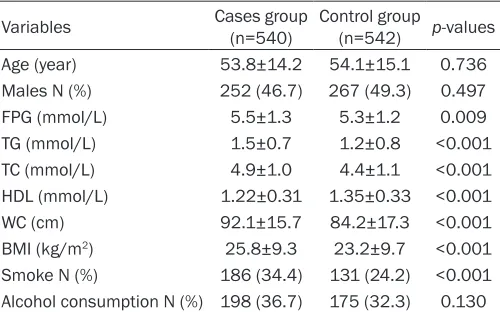
ing rate was higher in cases than that in con-trols. The mean of WC, BMI, FPG, TG and TC were also significantly higher in CVD cases than that in normal controls. The concentration of HDL was lower in cases than that in controls. All genotypes were distributed according to Hardy-Weinberg equilibrium in controls (all P values were more than 0.05). The frequencies of rs1800805- A allele was significantly higher in CVD cases than that in controls (29.6% vs 22.1%), and AC genotype of rs6136 was also significantly higher in CVD cases than that in controls (40.2% vs 31.2%). Logistic regression analysis showed that genotypes of variants in rs1800805 and rs6136 were associated with increased CVD risk, after adjustment for gen-der, age, smoking and alcohol status, FPG, TC, TG and HDL. CVD risk was significantly higher in carriers of rs1800805- A allele than those with GG genotype (GA+AA versus GG, adjusted OR (95% CI)=1.69 (1.31-2.16). In addition, we also found CVD risk was also higher in carriers of ACor CC genotype of the rs6136 polymorphism than those with AA genotype (AC+AA versus CC), adjusted OR (95% CI)=1.78 (1.28-2.26) (Table 3).
[image:3.612.92.342.96.252.2]GMDR analysis was used to investigate SELP gene-smoking interaction in this study. Table 4 shows the results obtained from GMDR mod-els. There was a significant two-locus mod- el (P=0.0010) involving rs1800805 and smok-ing, indicating a potential gene-environment interaction between rs1800805 and smoking. Table 2. General characteristics of 1082 study
partici-pants in case and control group
Variables Cases group(n=540) Control group(n=542) p-values Age (year) 53.8±14.2 54.1±15.1 0.736 Males N (%) 252 (46.7) 267 (49.3) 0.497
FPG (mmol/L) 5.5±1.3 5.3±1.2 0.009
TG (mmol/L) 1.5±0.7 1.2±0.8 <0.001 TC (mmol/L) 4.9±1.0 4.4±1.1 <0.001 HDL (mmol/L) 1.22±0.31 1.35±0.33 <0.001 WC (cm) 92.1±15.7 84.2±17.3 <0.001 BMI (kg/m2) 25.8±9.3 23.2±9.7 <0.001 Smoke N (%) 186 (34.4) 131 (24.2) <0.001 Alcohol consumption N (%) 198 (36.7) 175 (32.3) 0.130
Note: Means ± standard deviation for age, WC, BMI, FPG, TC, TG, HDL-C; TC, total cholesterol; HDL, high density lipoprotein; FPG, fast plasma glucose; TG, triglyceride.
status with scores between 0.50 (indi-cating that the model predicts no bet-ter than chance) and 1.00 (indicating perfect prediction). Finally, a sign test or a permutation test (providing empir-ical p-values) for prediction accuracy can be used to measure the signifi-cance of an identified model.
Results
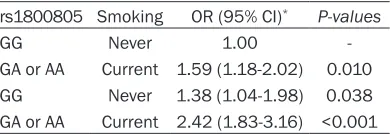
smok-Overall, the two-locus models had a cross-vali-dation consistency of 10 of 10, and had the testing accuracy of 62.17%, and smokers with GA or AA of rs1800805 genotype have the
highest CVD risk, compared to never smokers with GG genotype, OR (95% CI) was 2.42 (1.83-3.16), after adjustment for gender, age, smok-ing and alcohol status, FPG, TC, TG and HDL (Table 5).
Discussion
[image:4.612.91.525.85.385.2]In the present study, we found that there was a significant association between rs1800805 and rs6136 in SELP with increased CVD risk. The CVD risks were higher in the A allele of rs1800805 and C allele of rs6136 carriers, suggesting that variants in two SNP could increase CVD risk. The human SELP gene locat-ed on chromosome 1q22eq25 and is organizlocat-ed in 17 exons that span about 40 kb [3]. SELP, Table 3. Logistic analysis on the association between 3 SNP and CVD risk
SNPs Genotypes and Alleles Control group (n=542)Frequencies N (%) Cases group (n=540) H-W test for controlsOR (95% CI)* rs1800805
GG 333 (61.4) 274 (50.7) 1.00 0.269
GA 178 (32.8) 212 (39.3) 1.62 (1.29-2.04)
AA 31 (5.7) 54 (10.0) 1.88 (1.34-2.31)
GA+AA 209 (38.6) 266 (49.3) 1.69 (1.31-2.16)
G 844 (77.9) 760 (70.4)
A 240 (22.1) 320 (29.6)
rs1800808
TT 320 (59.0) 290 (53.7) 1.00 0.102
TC 187 (34.5) 205 (38.0) 1.26 (0.95-1.73)
CC 35 (6.5) 45 (8.3) 1.38 (0.84-2.05)
CC+TC 222 (41.0) 250 (46.3) 1.29 (0.93-1.86)
T 827 (76.3) 785 (72.7)
C 257 (23.7) 295 (27.3)
rs6136
AA 342 (63.1) 276 (51.1) 1.00 0.102
AC 169 (31.2) 217 (40.2) 1.85 (1.32-2.41)
CC 31 (5.7) 47 (8.7) 1.18 (0.91-1.66)
CC+AC 200 (36.9) 264 (48.9) 1.78 (1.28-2.26)
A 853 (78.7) 769 (71.2)
C 231 (21.3) 311 (28.8)
[image:4.612.94.523.434.488.2]*Adjusted for gender, age, smoking and alcohol status, FPG, TC, TG and HDL.
Table 4. Best gene-smoking interaction models, as identified by GMDR
Locus no. Best combination Cross-validation consistency Testing accuracy p-values*
2 rs1800805 Smoking 10/10 0.6217 0.0010
3 rs1800805 rs6136 Smoking 9/10 0.5399 0.0547
4 rs1800805 rs6136 rs1800808 Smoking 8/10 0.4958 0.1719
*Adjusted for gender, age, smoking and alcohol status, FPG, TC, TG and HDL.
Table 5. Gene environment interaction analysis for rs1800805 and smoking by using logistic
rs1800805 Smoking OR (95% CI)* P-values
GG Never 1.00
-GA or AA Current 1.59 (1.18-2.02) 0.010 GG Never 1.38 (1.04-1.98) 0.038 GA or AA Current 2.42 (1.83-3.16) <0.001
[image:4.612.93.288.559.626.2]also called granule membrane protein 140 (GMP-140), antigen CD62, or platelet activation dependent granule-external membrane protein (PADGEM), is a 140-kD adhesion molecule that mediates the interaction of stimulated endo-thelial cells or platelets to leukocytes in the vascular surface [1, 2, 14]. SELP splicing vari-ant forms and a number of SNPs distributed in the promoter and coding sequence have been described [3, 15, 16]. The distribution of these allelic variants in the population have been investigated in association studies with myo-cardial infarction and stroke [9, 17, 18], how-ever the association of SELP polymorphisms and cardiovascular diseases remains contro-versial. Barbaux et al [19] indicated a strong association between P-selectin gene polymor-phisms and serum P-selectin levels and a com-plex age-dependent relation between soluble P-selectin levels and coronary artery disease, which suggests that this molecule might have different roles in the atherothrombotic process. A recent study conducted by Bielinski et al [20] indicated that there was a positive linear asso-ciation between P-selectin levels and rate of incident CHD after adjustment for traditional risk factors in non-Hispanic white Americans. Ghazouani et al [4, 8] suggested that -2123C/G in SELP gene was associated with increased CHD risk in Tunisians. Reiner et al [21] also sug-gested that common SELP polymorphisms were associated with soluble P-selectin and carotid IMT in young adults, but the patterns of association differed between EAs and AAs. These results support the role of P-selectin in the preclinical stages of atherosclerosis. However, some studies suggested inconsistent results. Volcik et al [22] conducted a study and indicated that the SELP Thr715Pro polymor-phism is not associated with incident CHD or ischemic stroke in either whites or African-Americans, although genotypes carrying the SELP Pro715 variant allele are associated with decreased P-selectin levels compared to the homozygous wild-type genotype in whites. Zhou et al [23] also suggested a significant relation-ship between SELP genetic polymorphisms and the pathogenesis of CHD among Asians and Caucasians. However, they observed no sig- nificant associations between SELP genetic polymorphisms and the risk of CHD and MI among Africans.
The pathogenesis of CVD is diverse, including both genetic and environmental factors,
sever-al risk factors we reported in previous studies, including age, obesity, high blood pressure, hyperlipidemia, diabetes mellitus, tobacco smoking, excessive alcohol consumption, lack of physical activity and so on. In these risk fac-tors, smoking was an important risk factor for CVD and has been reported in several studies [11, 12]. However, till now, no studies focused on the gene-environment interaction between SELP gene and smoking on CVD were conduct-ed. For this reason, an analysis on impact of gene-environment interaction between SELP gene and smoking on CVD risk was necessary. GMDR analysis was used to investigate SELP gene-smoking interaction in this study, we fo- und a potential gene-environment interaction between rs1800805 and smoking, smokers with GA or AA of rs1800805 genotype have the highest CVD risk, compared to never smokers with GG genotype. To our knowledge, this is the first study focused on the impact of gene-envi-ronment interaction between SELP gene and smoking on CVD risk. The underlying mecha-nism of this interaction remains unclear. The influence of gene-smoking interaction on sP-selectin levels maybe the possible explanation for this interaction on CVD risk. Two previous studies have confirmed the impact of SELP gene-smoking interaction on sP-selectin levels. Barbaux et al [19] have confirmed the finding of a significant interaction of Thr715Pro and smoking in determining sP-selectin levels. Carter et al [9] concluded the similar results that the Pro715 allele was associated with decreased sP-selectin in non-smokers whereas in current smokers and there was no difference in the levels of sP-selectin by genotype.
Several limitations of this study should be con-sidered. Firstly, more environmental factors should be included in the SELP-environment interaction studies, including lifestyle, diet and activity factors. Secondly, More SNPs in SELP gene should be included in the future study, not only in SELP gene, but also in others metabolic related gene, and additional gene-gene interac-tion should be investigated in the further studies.
gene-environment interaction between rs18- 00805 and smoking, smokers with GA or AA of rs1800805 genotype have the highest CVD risk, compared to never smokers with GG genotype.
Acknowledgements
The writing of this paper was supported by Tianjin Chest Hospital. We thank all the part-ners and staffs who help us in the process of this study.
Disclosure of conflict of interest
None.
Address correspondence to: Qin Qin, Tianjin Chest Hospital, 261 Taierzhuang South Road, Jinnan District, Tianjin, China. Tel: +86-22-88185065; Fax: +86-22-88185065; E-mail: [email protected]
References
[1] Zelensky AN and Grady JE. The C-type lectin-like domain superfamily. FEBS J 2005; 272: 6179-217.
[2] Chen M and Geng JG. P-selectin mediates ad-hesion of leukocytes, platelets, and cancer cells in inflammation, thrombosis, and cancer growth and metastasis. Arch Immunol Ther Exp 2006; 54: 75-84.
[3] Johnston GI, Bliss GA, Newman PJ and McEver RP. Structure of the human gene encoding granule membrane protein-140, a member of the selectin family of adhesion receptors for leukocytes. J Biol Chem 1990; 265: 21381-5. [4] Ghazouani L, Abboud N, Khlifa SB, Perret C,
Nicaud V, Cambien F, Almawi WY and Mahjoub T. P-selectin gene polymorphisms and risk of coronary heart disease among tunisians. J Thromb Thrombolysis 2009; 28: 314-319. [5] Pasquali A, Trabetti E, Romanelli MG, Galavotti
R, Martinelli N, Girelli D, Gambaro G, Olivieri O and Pignatti PF. Detection of a large deletion in the P-selectin (selp) gene. Mol Cell Probes 2010; 24: 161-5.
[6] Elmas E, Bugert P, Popp T, Lang S, Weiss C, Behnes M, Borggrefe M and Kalsch T. The P-selectin gene polymorphism val168met: a novel risk marker for the occurrence of primary ventricular fibrillation during acute myocardial infarction. J Cardiovasc Electrophysiol 2010; 21: 1260-1265.
[7] Sivapalaratnam S, Motazacker MM, Maiwald S, Hovingh GK, Kastelein JJ, Levi M, Trip MD and Dallinga-Thie GM. Genome-wide associa-tion studies in atherosclerosis. Curr Atheroscler Rep 2011; 13: 225-232.
[8] Ghazouani L, Abboud N, Khalifa SB, Perret C, Nicaud V, Almawi WY, Cambien F and Mahjoub T. Contribution of SELP and PSGL-1 genotypes and haplotypes to the presence of coronary heart disease in Tunisians. Mol Biol Rep 2011; 38: 495-501.
[9] Carter AM, Anagnostopoulou K, Mansfield MW and Grant PJ. Soluble P-selectin levels, P-selectin polymorphisms and cardiovascular disease. J Thromb Haemost 2003; 1: 1718-1723.
[10] Kee F, Morrison C, Evans AE, McCrum E, McMaster D, Dallongeville J, Nicaud V, Poirier O and Cambien F. Polymorphisms of the P-selectin gene and risk of myocardial infarc-tion in men and women in the ectim extension study. Etude castemoin de l’infarctus myocar-de. Heart 2000; 84: 548-552.
[11] U.S. Department of Health and Human Ser- vices. The Health Consequences of Smoking: A Report of the Surgeon General. Atlanta, GA: U.S. Department of Health and Human Services, Centers for Disease Control and Prevention, National Center for Chronic Di- sease Prevention and Health Promotion, Office on Smoking and Health, 2004.
[12] Wannamethee SG, Shaper AG, Whincup PH and Walker M. Smoking cessation and the risk of stroke in middle-aged men. JAMA 1995; 274: 155-160.
[13] Lou XY, Chen GB, Yan L, Ma JZ, Zhu J, Elston RC and Li MD. A generalized combinatorial ap -proach for detecting by gene and gene-by-environment interactions with application to nicotine dependence. Am J Hum Genet 2007; 80: 1125-1137.
[14] Vestweber D and Blanks JE. Mechanisms that regulate the function of the selectins and their ligands. Physiol Rev 1999; 79: 181-213. [15] Ay C, Jungbauer LV, Sailer T, Tengler T, Koder S,
Kaider A, Panzer S, Quehenberger P, Pabinger I and Mannhalter C. High concentrations of soluble P-selectin are associated with risk of venous thromboembolism and the P-selectin Thr715 variant. Clin Chem 2007; 53: 1235-43. [16] Herrmann SM, Ricard S, Nicaud V, Mallet C,
Evans A, Ruidavets JB, Arveiler D, Luc G and Cambien F. The P-selectin gene is highly poly-morphic: reduced frequency of the Pro715 al-lele carriers in patients with myocardial infarc-tion. Hum Mol Genet 1998; 7: 1277-84. [17] Tregouet DA, Barbaux S, Escolano S, Tahri N,
Golmard JL, Tiret L and Cambien F. Specific haplotypes of the P-selectin gene are associ-ated with myocardial infarction. Hum Mol Genet 2002; 11: 2015-23.
[19] Barbaux SC, Blankenberg S, Rupprecht HJ, Francomme C, Bickel C, Hafner G, Nicaud V, Meyer J, Cambien F and Tiret L. Association Between P-Selectin Gene Polymorphisms and Soluble P-Selectin Levels and Their Relation to Coronary Artery Disease. Arterioscler Thromb Vasc Biol 2001; 21: 1668-73.
[20] Bielinski SJ, Berardi C, Decker PA, Kirsch PS, Larson NB, Pankow JS, Sale M, de Andrade M, Sicotte H, Tang W, Hanson NQ, Wassel CL, Polak JF and Tsai MY. P-selectin and subclini-cal and clinisubclini-cal atherosclerosis: The Multi-Ethnic Study of Atherosclerosis (MESA). Athe- rosclerosis 2015; 240: 3-9.
[21] Reiner AP, Carlson CS, Thyagarajan B, Rieder MJ, Polak JF, Siscovick DS, Nickerson DA, Jacobs DR Jr and Gross MD. Soluble P-Selectin, SELP Polymorphisms, and Atherosclerotic Ri- sk in European-American and African-African Young Adults: The Coronary Artery Risk Deve- lopment in Young Adults (CARDIA) Study. Arterioscler Thromb Vasc Biol 2008; 28: 1549-55.
[22] Volcik KA, Ballantyne CM, Coresh J, Folsom AR, Wu KK and Boerwinkle E. P-selectin Thr715Pro polymorphism predicts P-selectin levels but not risk of incident coronary heart disease or ischemic stroke in a cohort of 14 595 partici-pants: The Atherosclerosis Risk In Communities Study. Atherosclerosis 2006; 186: 74-9. [23] Zhou DH, Wang Y, Hu WN, Wang LJ, Wang Q,