Original Article
Distribution and expression profiles of dendritic
cell subpopulations in human bladder cancer
Peng Wang, Bo Yang, Bo Zhou, Jun Zhang, Shujing Li, Jun Jiang, Zhongyi Sun, Fengshuo Jin
Department of Urology, Daping Hospital, Institute of Surgery Research, The Third Military Medical University, Chongqing, China
Received February 15, 2016; Accepted May 20, 2016; Epub July 1, 2016; Published July 15, 2016
Abstract: Bladder cancer is one of the most common cancers worldwide, with transitional cell carcinoma (TCC) being the predominant form. Dendritic cells (DCs) are a heterogeneous population of antigen-presenting cells that play a crucial role in the regulation of the immune response and immunological tolerance. The aim of this study was to investigate the expression and characteristic of different DC subsets in non-muscle-invasive TCC (NMI-TCC), muscle-invasive TCC (MI-TCC) and controls. Our study demonstrated that normal human bladder contained only im-mature CD1a+, CD11c+, and CD209+ DCs whereas CD123+ pDCs and CD83+ mature DCs were virtually absent. The
number of both CD11c+ IL-23+ mDCs and CD123+ pDCs were significantly elevated in NMI- and MI-TCC, and the mDC
populations of CD1a+, CD209+ immature DCs and CD83+ mature DCs also increased in NMI- and MI-TCC. Except
for a relatively low number of CD83+ mature DCs, the numbers of CD11c+, CD123+, CD1a+, CD209+ DCs were also
significantly increased in MI-TCC compared with NMI-TCC. Taken together these results suggest that an imbalance in the distribution of tumor infiltrating DCs in the tumor area seems to be involved in the development or progression
of bladder cancer.
Keywords: Dendritic cells, bladder cancer, progression, immune response
Introduction
Bladder cancer is one of the most common cancers worldwide, with transitional cell carci-noma (TCC) being the predominant form [1]. Bladder cancer represents a heterogeneous disease, with two distinct subtypes of TCCs:
~75% of the affected individuals have superfi -cial non-muscle-invasive TCCs (NMI-TCCs), which tend to recur but not life-threatening, and ~25% of patients have muscle-invasive TCC
(MI-TCCs), which are associated with a high risk
of death from distant metastases [2]. Previous studies demonstrate that the presence of
tumor-infiltrating lymphocytes was associated
with increased disease-free survival in MI-TCCs [3, 4]; whereas an earlier study found that the
density of tumor infiltrating lymphocytes was
positively correlated to a short recurrence-free survival in NMI-TCCs [5]. Recent studies report-ed that a high level of CD83+ mature DC infiltra
-tion of NMI-TCC patients do not respond as well to bacillus Calmette-Guerin (BCG) immunother-apy [6]; subsequently, their studies showed
that the presence of CD83+ mature DC was
found associated with a significant risk of pro -gression to MI-TCCs [7]. However, DCs are a heterogeneous population of antigen-present-ing cells, and the distribution and characteriza-tion of DC subpopulacharacteriza-tions remain to be eluci-dated in human bladder cancer.
DCs are thought to be crucial regulators of immune response and immunologic tolerance in numerous organs, which comprise two major classes: plasmacytoid DCs (pDCs) and myeloid DCs (mDCs) [8]. pDCs express CD123, CLA and
BDCA-2, lack expression of CD11c in human,
and sense the environment for nucleic acids with the help of pattern-recognition receptors in the context of viral and microbial infections as well as autoimmune diseases [9]. mDCs also called conventional DCs have a strong capabil-ity to capture antigens which enables them to stimulate T cells. These major antigen present-ing and activatpresent-ing cells also comprise a very heterogeneous subset of cells expressing high
DCs in bladder cancer
II molecules and integrin CD11c on their cell surface. Immature DCs express CD1a, adhe-sion molecules (such as CD209), and low level
of HLA class II. After antigen uptake and pro -cessing, mDCs undergo maturation with coordi-nate up-regulation of HLA class II molecules, co-stimulatory molecules (CD80, CD86), CD83 and migrate to lymphoid tissue where they elicit adaptive Th1/Th17 type immunity [10, 11]. Thus, unraveling the characterization and pro-
gnostic value of tumor-infiltrating DC subsets
are helpful for analyzing the immunopahologi-cal mechanisms of bladder cancer and under-standing the mechanisms of immune escape and prognosis of bladder cancer. The purpose of the present study was to identify the distri- bution of DC subpopulations in NMI- and MI- TCCs to elucidate the contribution of TIDCs to the immune escape and clinical prognosis of human bladder cancer.
Materials and methods Sample collection
Samples were obtained from 20 patients with urothelial tumors of the urinary bladder (2 women, 18 men). The mean age was 61 years (range 44-77 years) in patients with a non-mus-cle invasive tumor (n=10) and 63 years (range 45-79 years) in patients with a muscle invasive tumor (n=10). The patients were treated at the Department of Urology, Da Ping hospital, from 2012 to 2014. Tumors were diagnosed and
classified according to the International Union Against Cancer TNM Classification criteria. The
grading of these tumors was assessed
accord-ing to the WHO Classification of Tumors. The
exclusion criteria were the following: 1) non-urothelial bladder cancer, 2) any intravesical instillations (BCG or chemotherapy) or systemic chemotherapy prior to study inclusion, and 3)
insufficient tissue material available for histo -logical re-review and immunohistochemistry. All samples were collected after getting the
The IHC technique was performed in a stan-dard manner as previously described [12].
Briefly, IHC was performed on 4 µm sections of
the archival epididymal tissue biopsies, which
had been fixed in formalin’s fixative and embed
-ded in paraffin. The sections were deparaf
-finized, hydrated, washed in phosphate-buff -ered saline (PBS, pH 7.2). Antigen retrieval was
done with Dako Target Retrieval Solution (pH 6.0, Dako, Glostrup, Denmark), and then the
sections were applied with 3% H2O2 solution
to block endogenous peroxides at room tem -perature (RT) for 10 min, treated with 10% normal goat serum containing 5% bovine se-
rum albumin (BSA) at RT for 30 min (Jackson
Immunoresearch, West Grove, USA), and then incubated with the primary antibodies at the appropriate optimal dilutions overnight at 4°C
in a humidified chamber (Table 1). Maixin MaxVisionTM HRP-Polymer anti-Mouse/Rabbit
IHC Kit (Maixin, Fuzhou, China, Code K5010) was applied for detection of the primary
anti-body binding. 3,3’-Diaminobenzidine (DAB) was
carried out with Substrate-Batch and the
sec-tions were counterstained with Mayer’s hema -toxylin. In addition, the negative controls were obtained by substitution of the primary antibod-ies with isotype control IgG1 or IgG2a respective-ly in the staining procedure. All slides were
mounted in Microscopy Kaiser’s glycerol gela
-tine (Merck, Darmstadt, Germany, HX807791),
and images were acquired with Leica Appli-
cation Suite (Version 4.2.0, Oberkochen,
Ger-many) under a Leica DM 4000B microscope.
Immunofluorescence (double staining)
Paraffin-embedded slides were deparaffinized
by immersion in xylene, followed by dehydration in ethanol. Antigen retrieval was done with
Dako Target Retrieval Solution (pH 6.0, Dako, Denmark). Following a 5-minute wash with
Tris-buffered saline-Tween 20 (TBS-T), sections were incubated for 30 min at RT with 10%
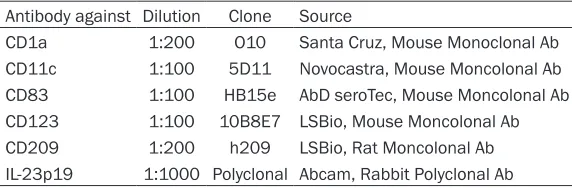
nor-Table 1. Summary of primary antibodies used in this study
Antibody against Dilution Clone Source
CD1a 1:200 O10 Santa Cruz, Mouse Monoclonal Ab CD11c 1:100 5D11 Novocastra, Mouse Moncolonal Ab CD83 1:100 HB15e AbD seroTec, Mouse Moncolonal Ab CD123 1:100 10B8E7 LSBio, Mouse Moncolonal Ab CD209 1:200 h209 LSBio, Rat Moncolonal Ab IL-23p19 1:1000 Polyclonal Abcam, Rabbit Polyclonal Ab
informed consents from pa- tients. The study was con-ducted with the approval of the local ethics committee and clinical investigation was performed according to the principles expressed in the
Declaration of Helsinki.
[image:2.612.90.376.84.178.2]mal goat serum. Tissue sections were incubat-ed overnight at 4°C with the mixture of two pri-mary antibodies (CD11c+ IL-23p19 and CD4+
IL-17A). Following a 5-minute wash with TBS-T, slides were incubated for 30 min at RT with the mixture of two secondary antibodies
(Cy2-conjugated affinipure goat anti-mouse IgG and Cy3-conjugated affinipure goat anti-rabbit IgG; Jackson Immunoresearch, USA), and counter
-staining was performed with 4’,6-diamidino-2-phenylindole dihydrochloride (DAPI) (Merck, Germany). Again, sections of psoriatic skin
served as positive control, while negative con-trols were obtained by substitution of the pri-mary antibodies with mouse IgG1 or rabbit se- rum in the staining procedure. All slides were mounted with Fluoromount-G (Southern Bio-
tech, Birmingharm, USA) to preserve fluores
-cence. The filters were used for fluorescence microscopy described as follows: Cy2, filter I3; Cy3, filter Y3; DAPI, filter A. Images were ac-quired with a Leica DM4000B fluorescence
microscope with a JVC digital device camera and collected by Leica Application Suite (Ver- sion 4.2.0).
Stereological techniques and statistical analy-sis
The immunohistochemical image data were
analyzed and quantified by two blinded
ob-servers using stereological image processing software Image-Pro Plus (Version 6.0; Media
Cybernetics, Inc, Rockville, USA). Five random microscope fields were selected from each
slide (×200), and the expression intensity of immunopositive cells was represented by mean optical density value, which equals Integrate Optical Density (IOD) summary/Area summary.
The Number of immunopositive cell/field was counted by means of the five fields. Data are
expressed as mean ± SEM. For the statistical
evaluation of significances, the value of data
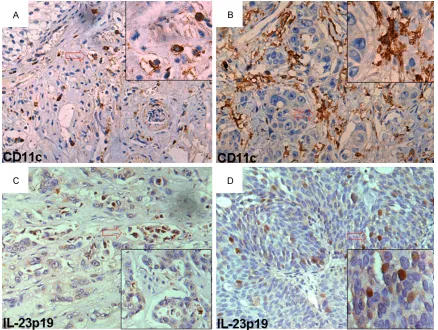
[image:3.612.88.526.71.401.2]obeyed normal distribution and Pearson test was performed using SPSS software (Version Figure 1. Distribution of CD11c+ mDCs and IL-23p19 in NMI- and MI-TCCs. CD11c+ mDCs were observed in the
stroma and within tumors (A, B). For comparison, a stronger CD11c+ mDC infiltration was observed in MI-TCC (B) in
contrast to NMI-TCC (A). Immunostaining for IL-23p19 could be observed in NMI- (C) and MI-TCC (D) (original
DCs in bladder cancer
17.0, SPSS GmbH Software, an IBM Company, Shanghai, China). P-value < 0.05 was
consid-ered to indicate a statistically significant
di-fference.
Results
Increased numbers of CD11c+ IL-23p19+
mDCs in NMI- and MI-TCC
As little is known about the expression of
CD11c+ mDCs in human bladder cancer, the
results showed that CD11c+ mDCs were
observed in the stroma and within tumors (Figure 1A, 1B). The number of CD11c+ mDCs
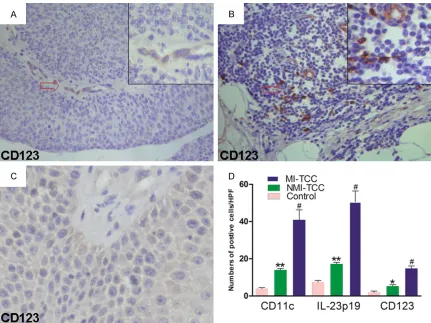
was low in control (Figure 2D), and a significant
increase of CD11c+ mDC number can be
detect-ed in NMI- and MI-TCC compardetect-ed with that in control (Figure 2D). Moreover, a stronger CD11c+ mDC infiltration was observed in
MI-TCC in contrast to NMI-TCC (Figure 1A, 1B).
There was a base line expression of IL-23p19+
cells in control (data not shown), and an increased number of IL-23p19 expression could be observed in NMI- and MI-TCC (Figure 1C,
1D). In addition, the double staining of
immuno-fluorescence revealed that the abundant num -bers of CD11c+ IL-23p19+ mDCs were found in
NMI- and MI-TCC. The results demonstrated that CD11c+ IL-23p19+ mDCs were the
predomi-nant component in bladder cancer and
abun-dantly infiltrated into the stroma and tumors
especially in MI-TCC.
The abundance of CD123+ pDC recruitments
in NMI- and MI-TCC
pDCs represent the natural IFN-α-producing
[image:4.612.90.521.69.392.2]cells; of note, within 6 h of activation by a virus, human pDCs secrete 200-1000 times more IFNs than any other blood cell type [9]. However, the possible involvement of CD123+ pDCs in
Figure 2. Distribution of CD123+ pDCs in NMI-, MI-TCCs and controls. CD123+ pDCs were detected in the vast
major-ity of NMI- (A) and MI-TCC (B), whereas they were virtually absent from the control (C). This population of DCs was
observed around the small vessels or as single cells in NMI-TCC (A) and principally localized within the leukocyte infiltration, arranged as clusters in MI-TCC (B). The results showed that the number of CD123+ pDCs significantly
bladder cancer has not been reported. The results showed that CD123+ pDCs were
detect-ed in the vast majority of NMI- and MI-TCC (Figure 2A, 2B), whereas they were virtually absent from the control (Figure 2C). This popu-lation of DCs was observed around the small vessels or as single cells in NMI-TCC (Figure 2A) and principally localized within the leuko
-cyte infiltration, arranged as clusters in MI-TCC
(Figure 2B). The results showed that the num-ber of CD123+ pDCs significantly elevated in
NMI- and MI-TCC compared with the control (Figure 2D).
Increased numbers of CD1a+, CD209+
imma-ture DCs and CD83+ mature DCs in NMI- and
MI-TCC
CD1a+ DCs are known to represent an imma
-ture subset of DCs and the low number of
CD1a+ DCs was found mostly in the epithelium
of the control (data not shown). Compared with normal counterparts, the numbers of CD1a+
DCs were significantly increased in the stroma
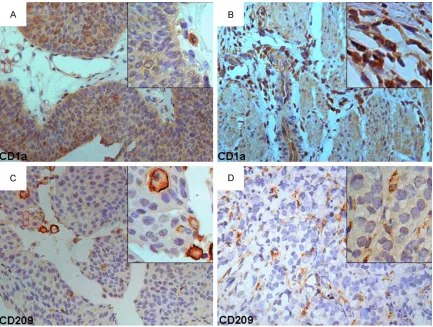
of NMI- and MI-TCC (Figures 3A, 3B, 4D). Moreover, the abundance of CD1a+ DCs was
observed mostly in the stroma but rarely within tumors in MI-TCC (Figure 3B).
CD209+ immature DCs were sparsely
distribut-ed in the interstitial of control (data not shown), but there were virtually no CD83+ mature DCs
in control (Figure 4C). The numbers of CD209+
DCs in NMI- and MI-TCC were also significantly
increased in comparison to control and were frequently located in the stroma and occasion-ally as small aggregates in approximately half of MI-TCC (Figure 3D). Staining for CD83
showed a significant number of CD83+ cells in
[image:5.612.90.523.70.397.2]NMI- and MI-TCC and they were identified as
Figure 3. Distribution of CD1a+ and CD209+ immature DCs in NMI- and MI-TCCs. CD1a+ DCs were found mostly in
the epithelium of the control (data not shown). Compared with normal counterparts, the numbers of CD1a+ DCs
were significantly increased in the stroma of NMI- (A) and MI-TCC (B). Moreover, the abundance of CD1a+ DCs was
observed mostly in the stroma but rarely within tumors in MI-TCC (B). The numbers of CD209+ DCs in NMI- (C) and
DCs in bladder cancer
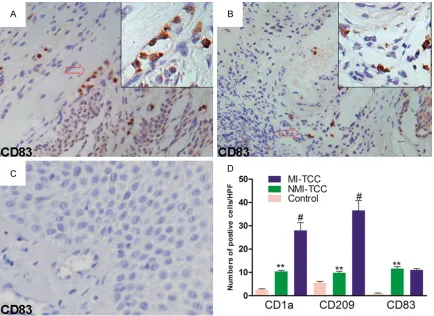
mature DCs (Figure 4A, 4B). CD83+ mature DCs
were distributed in the underlying stroma, rare-ly within tumors and frequentrare-ly in rare-lymphoid aggregates (Figure 4A, 4B). Interestingly, a rel-atively low number of CD83+ DCs was observed
in MI-TCC compared with NMI-TCC (Figure 4D).
Discussion
DCs are specialized APCs that are key
play-er in antigen presentation and T cells activa- tion exerting pathogenic role in tumor immunol-ogy, but the characteristics, distribution and function of DC subsets in bladder cancer have
not been well defined in the past. In this study, we demonstrated for the first time that (I)
normal human bladder contained only imma-ture CD1a+, CD11c+, and CD209+ DCs whereas
CD123+ pDCs and CD83+ mature DCs were
virtually absent; (II) the number of both CD11c+
IL-23+ mDCs and CD123+ pDCs were signifi
-cantly elevated in NMI- and MI-TCC; (III) the
mDC populations of CD1a+, CD209+ immature
DCs and CD83+ mature DCs also increased in
NMI- and MI-TCC; (IV) except for a relatively low number of CD83+ mature DCs, the numbers of
CD11c+, CD123+, CD1a+, CD209+ DCs were
also significantly increased in MI-TCC compared
with NMI-TCC.
The infiltration of DCs in various cancers has
been reported as an important prognostic parameter, either favorable or unfavorable and that often depends on both cell localization and degree of cell maturation [6, 13]. Previous stud-ies revealed that CD1a+ and CD209+ DCs
played key roles in the capture of antigens and
subsequent processing for presentation to T cells [14, 15]. Moreover, immature DCs capture apoptotic cells and cross-present antigens derived from internalized dying cells on MHC I class molecules for recognition by CD8+ T cells
[16]. Therefore, the strategic localization of immature CD1a+ DCs and CD209+ DCs
sug-Figure 4. Distribution of CD83+ matures DCs in NMI-, MI-TCCs and controls. CD83+ mature DCs were distributed in
the underlying stroma, rarely within tumors and frequently in lymphoid aggregates (A, B), but there were virtually no CD83+ mature DCs in control (C). Interestingly, a relatively low number of CD83+ DCs was observed in MI-TCC
[image:6.612.90.524.70.386.2]gests that they might have an important role in the afferent arm of the adaptive immune
response in bladder tissue, by taking up anti -gens from apoptotic cells and patho-gens. On the other hand, cancer cells actively suppress
steady state DCs (also called tumor-infiltrating DCs, TIDCs) and keep them in the favorable
immature state [17]. This results in the promo-tion of tumor development because immature DCs are less capable of initiating T lymphocyte activation resulting in T cell anergy.
Our study showed that the large numbers of CD11c+ cDCs were observed in NMI- and
MI-TCC compared with that in control. Similarly, the number of IL-23p19+ cells also increased in
bladder cancer. In accordance with this finding,
previous studies demonstrated that the abun-dance of CD11c+ DCs were probably derived
from the monocytes that were first to recruited to the inflammatory site and marked the critical step in the formation of inflammatory lesion
and tumor development [18, 19]. IL-23p19 pro-duced by APCs is thought to play a pivotal role in terminal differentiation and survival of Th17 cells associated with the development of
auto-immunity and inflammatory response [15]. The termed “inflammatory DCs” are recently identi
-fied as CD11c+ IL-23+ mDCs and probably
dif-ferentiated from monocytes that are first to recruit to the site of inflammation and induce
Th17 differentiation [20]. Our observations indi-cate that CD11c+ DCs probably represent the
main source of IL-23, thereby initiating the
inflammatory cascade and promoting Th17
development.
Interestingly, this study demonstrates that pDCs are found in the vast majority of blad- der cancer, whereas they were virtually absent from the controls. pDCs represent the main
IFN-α producers among leucocytes and this cytokine might induce cytotoxicity, activating
NK/T cytotoxic cells or FasL-mediated apopto-sis [21]. Cytotoxic T cells as the main lympho-cyte subpopulations have been reported in muscle invasive urothelial carcinoma, which were strongly associated with longer overall survival [3]. Fas/FasL system played crucial
roles in cytotoxic T lymphocyte and natural kill -er cell mediated cytotoxicity against canc-er cancers; meanwhile, circulating soluble Fas antagonizes cell-surface Fas function and may interfere with immune surveillance against autologous tumors [22]. Therefore, the recruit-ment of pDCs in bladder cancer might facilitate
and amplify the cytotoxic T cell functions acting as a barrier to prevent invading pathogens and eliminate malignant cells. Although pDCs have been implicated in the initiation and mainte-nance of various cancers, it remains unclear whether pDCs are dispensable during the onset and development of bladder cancer.
Previous studies suggest that a high level of CD83+ mature DC infiltrations decrease the risk
of recurrence in patients with bladder cancer
and were associated with a significant risk of
progression to muscle-invasive cancer [6, 7]. Interestingly, our study demonstrates that a relatively low number of CD83+ mature DCs are
observed in MI-TCC compared with NMI-TCC but there are virtually no CD83+ DCs in control.
Only mature DCs are able to stimulate T cells, hereby increasing their proliferation and
secre-tion of IFN-γ, which are often considered to be
surrogate indicators of a productive immune stimulation [23]. On the other hand, abundance of CD1a+, CD209+ immature DCs are found in
NMI- and MI-TCC, which suggest this may be the result of tumor cells inhibiting the release of DC stimulation and maturation factors. Therefore, an imbalance in the distribution of TIDCs in the tumor area seems to be involved in the development or progression of bladder
can-cer. Taken together, an understanding of the
heterogeneity and function of different TIDC subsets in bladder cancer is critical to design of better strategies for the treatment of bladder cancer immunotherapy.
Acknowledgements
This study was supported by the Youth Inno- vation Foundation of Daping Hospital (No. 50116-2295).
Disclosure of conflict of interest
None.
Address correspondence to: Drs. Zhongyi Sun and Fengshuo Jin, Department of Urology, Daping Hos- pital, Institute of Surgery Research, The Third Mili- tary Medical University, Chongqing 400042, China. E-mail: [email protected] (ZYS); jinfs- [email protected] (FSJ)
References
DCs in bladder cancer
[2] Wu XR. Urothelial tumorigenesis: a tale of di -vergent pathways. Nat Rev Cancer 2005; 5: 713-725.
[3] Sharma P, Shen Y, Wen S, Yamada S, Jungbluth AA, Gnjatic S, Bajorin DF, Reuter VE, Herr H,
Old LJ and Sato E. CD8 tumor-infiltrating lym -phocytes are predictive of survival in muscle-invasive urothelial carcinoma. Proc Natl Acad Sci U S A 2007; 104: 3967-3972.
[4] Liakou CI, Narayanan S, Ng Tang D, Logothetis
CJ and Sharma P. Focus on TILs: Prognostic
significance of tumor infiltrating lymphocytes
in human bladder cancer. Cancer Immun 2007; 7: 10.
[5] Lipponen PK, Eskelinen MJ, Jauhiainen K, Harju E and Terho R. Tumour infiltrating lym -phocytes as an independent prognostic factor in transitional cell bladder cancer. Eur J Cancer 1992; 29A: 69-75.
[6] Ayari C, LaRue H, Hovington H, Decobert M, Harel F, Bergeron A, Têtu B, Lacombe L, Fradet
Y. Bladder tumor infiltrating mature dendritic
cells and macrophages as predictors of re-sponse to bacillus Calmette-Guerin immuno-therapy. Eur Urol 2009; 55: 1386-1395. [7] Ayari C, LaRue H, Hovington H, Caron A,
Bergeron A, Têtu B, Fradet V, Fradet Y. High
level of mature tumor-infiltrating dendritic cells
predicts progression to muscle invasion in bladder cancer. Hum Pathol 2013; 44: 1630-1637.
[8] Steinman RM. Decisions about dendritic cells: past, present, and future. Annu Rev Immunol 2012; 30: 1-22.
[9] Reizis B, Bunin A, Ghosh HS, Lewis KL and
Sisirak V. Plasmacytoid dendritic cells: recent
progress and open questions. Annu Rev Immunol 2011; 29: 163-183.
[10] Coquerelle C and Moser M. DC subsets in pos-itive and negative regulation of immunity. Immunol Rev 2010; 234: 317-334.
[11] Ganguly D, Haak S, Sisirak V and Reizis B. The
role of dendritic cells in autoimmunity. Nat Rev Immunol 2013; 13: 566-577.
[12] Duan YG, Yu CF, Novak N, Bieber T, Zhu CH,
Schuppe HC, Haidl G, Allam JP. Immuno- deviation towards a Th17 immune response associated with testicular damage in azo-ospermic men. Int J Androl 2011; 34: e536-545.
[13] Sandel MH, Dadabayev AR, Menon AG, Morreau H, Melief CJ, Offringa R, van der Burg
SH, Janssen-van Rhijn CM, Ensink NG,
Tollenaar RA, van de Velde CJ, Kuppen PJ.
Prognostic value of tumor-infiltrating dendritic
cells in colorectal cancer: role of maturation status and intratumoral localization. Clin Cancer Res 2005; 11: 2576-2582.
[14] Novak N, Koch S, Allam JP and Bieber T.
Dendritic cells: bridging innate and adaptive immunity in atopic dermatitis. J Allergy Clin Immunol 2010; 125: 50-59.
[15] Allam JP, Duan Y, Heinemann F, Winter J, Götz W, Deschner J, Wenghoefer M, Bieber T, Jepsen
S, Novak N. IL-23-producing CD68(+) macro
-phage-like cells predominate within an IL-17-polarized infiltrate in chronic periodontitis le -sions. J Clin Periodontol 2011; 38: 879-886. [16] Burgdorf S, Scholz C, Kautz A, Tampe R and
Kurts C. Spatial and mechanistic separation of cross-presentation and endogenous antigen presentation. Nat Immunol 2008; 9: 558-566. [17] Chiba S, Baghdadi M, Akiba H, Yoshiyama H,
Kinoshita I, Dosaka-Akita H, Fujioka Y, Ohba
Y, Gorman JV, Colgan JD, Hirashima M, Uede
T, Takaoka A,Yagita H, Jinushi M. Tumor-infiltrating DCs suppress nucleic acid-mediat -ed innate immune responses through interac-tions between the receptor TIM-3 and the alar-min HMGB1. Nat Immunol 2012; 13: 832-842.
[18] Hespel C and Moser M. Role of inflammatory
dendritic cells in innate and adaptive immuni-ty. Eur J Immunol 2012; 42: 2535-2543. [19] Duan YG, Wang P, Zheng W, Zhang Q, Huang W,
Jin F, Cai Z. Characterisation of dendritic cell
subsets in chronically inflamed human epididy -mis. Andrologia 2016; 48: 431-40.
[20] Segura E, Touzot M, Bohineust A, Cappuccio A, Chiocchia G, Hosmalin A, Dalod M, Soumelis V,
Amigorena S. Human inflammatory dendritic
cells induce Th17 cell differentiation. Immunity 2013; 38: 336-348.
[21] Feng D and Barnes BJ. Bioinformatics analysis of the factors controlling type I IFN gene ex-pression in autoimmune disease and virus-in-duced immunity. Front Immunol 2013; 4: 291. [22] Mizutani Y, Yoshida O and Bonavida B. Pro-
gnostic significance of soluble Fas in the
serum of patients with bladder cancer. J Urol 1998; 160: 571-576.
[23] Dudek AM, Martin S, Garg AD and Agostinis P.